

Many business owners make a common mistake: they think having a huge list of affiliates means they are successful.
But if those partners aren’t making sales, they aren’t helping your business—they are actually costing you money. When partners stop trying, you lose sales and waste valuable time searching for new people to replace them.
This guide explains why keeping your current partners happy is far more profitable than finding new ones. We will show you exactly why affiliates go quiet and give you simple steps to get them active, engaged, and earning money for you right away.
Why Losing Affiliates Costs You More Than You Think
Most merchants measure affiliate program success by total affiliate count. This is the wrong metric.
A program with 2,000 affiliates and 12% active rate is underperforming a program with 300 affiliates and 70% active rate — by every meaningful revenue measure.

The real cost of affiliate churn isn’t just the lost sale from an inactive partner. It’s the compounding cost of:
- Constant re-recruitment to replace churned affiliates (elevated CAC)
- Lost brand reach as disengaged partners pivot to competitors
- Degraded program reputation among high-performing affiliates in your niche
The strategic opportunity: If you reduce your affiliate churn rate by just 20%, your GMV can increase disproportionately.
Why?
Because retained affiliates are usually your top-performing partners — they already understand your product and audience, and have invested time optimizing their promotions.
Why Do Affiliates Stop Selling?
Before building an engagement strategy, you need to diagnose the problem accurately. Affiliate inactivity typically traces to one of four root causes:

| Root Cause | Merchant Signal | Fix |
| Unclear expectations | Low first-sale rate within 30 days | Onboarding optimization |
| Low perceived value | High early churn, poor earnings | Commission structure review |
| Lack of support | Affiliates stop responding to emails | Communication cadence |
| Better alternatives | Mass exit to competitor programs | Competitive differentiation |
The majority of affiliate churn occurs within the first 60 days — before the affiliate ever makes a meaningful sale. This is an onboarding failure, not a motivation failure.
How to Help New Affiliates Get Their First Sale Quickly
The goal of affiliate onboarding is a first conversion within 14 days. Affiliates who make their first sale quickly are statistically more likely to remain active at 90, 180, and 365 days. Every day between approval and first sale increases churn probability.
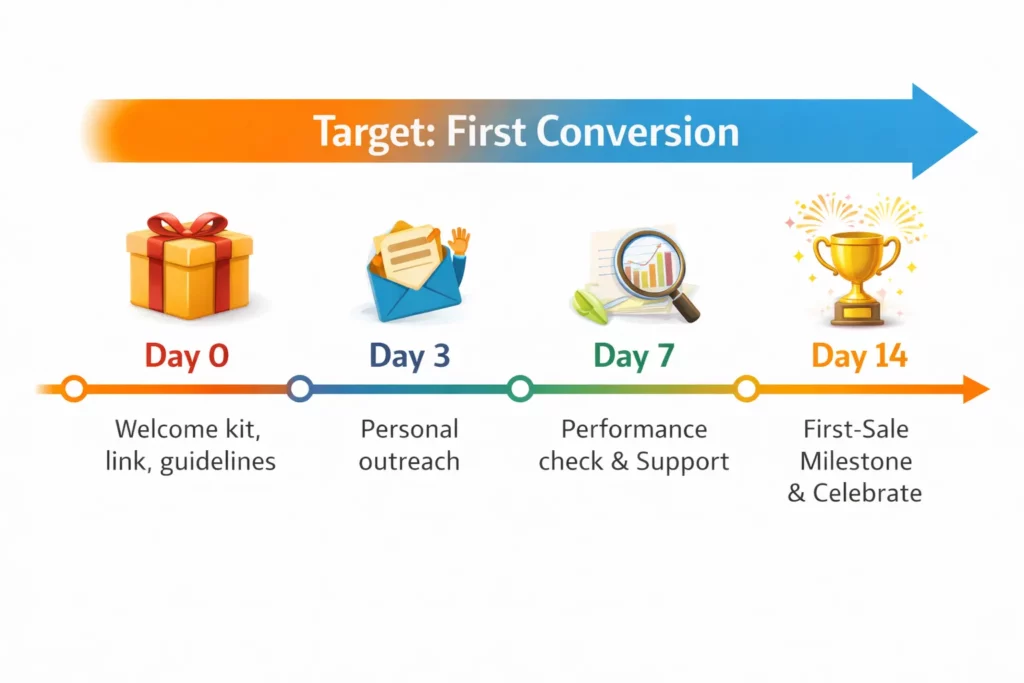
Day 0–1: Immediate Value Delivery
- Deliver a welcome kit within hours of approval — not days
- Include: custom affiliate link, brand guidelines, top-converting creatives, and a one-page product overview written for affiliate audiences
- Set explicit earning expectations: “Affiliates who follow this guide typically earn their first commission within 10–14 days”
Day 3: Personal Outreach
- Send a personal email (not automated) from your affiliate manager
- Ask one question: “Do you have everything you need to get started?”
- Offer a 15-minute onboarding call for high-potential partners
Day 7: Performance Check
- Review which affiliates have generated clicks but no conversions
- Send targeted support: new creatives, a seasonal angle, or a promotional hook they can use immediately
Day 14: First-Sale Milestone
- Celebrate and acknowledge affiliates who’ve made their first sale
- For affiliates still at zero — trigger a re-engagement sequence with a limited bonus incentive
Platforms like UpPromote allow merchants to automate milestone-based communication flows, so this 14-day sequence runs without manual tracking across hundreds of affiliates simultaneously.
How to Set Up Commissions That Keep Top Affiliates Around
Flat-rate commissions are a retention liability. They give your highest-performing affiliates no reason to scale their efforts — they earn the same percentage at $1,000/month as at $10,000/month. This is structurally misaligned with partner ambition.
Tiered Commission Architecture
A tiered structure creates a retention mechanism built into your economics:

| Tier | Monthly Sales Volume | Commission Rate | Strategic Effect |
| Standard | $0–$2,000 | 8% | Entry baseline |
| Silver | $2,001–$8,000 | 11% | Motivates early scaling |
| Gold | $8,001–$20,000 | 14% | Locks in mid-tier performers |
| Elite | $20,000+ | 18% + bonuses | Creates ambassador-level loyalty |
High commissions create natural loyalty. If an affiliate is earning 18% with you, they won’t want to leave for a competitor offering only 10–12%. By building a strong commission architecture, you’ve made it “too expensive” for them to switch.
Don’t make the common mistake of resetting performance tiers every month; it kills motivation. Instead, use quarterly resets or rolling 90-day windows. This gives affiliates more time to build momentum and keeps them pushing for higher rewards.
How to Build Strong Relationships With All Your Affiliates
Relationship-building at scale sounds like a contradiction. It isn’t — if you segment intelligently.
How to Treat Affiliates Based on Their Performance
Tier 1: Elite Partners (Top 5% by GMV)
Treat these as strategic partners, not affiliates. This means:
- Quarterly business reviews (30-min calls reviewing their performance, your roadmap, and co-marketing opportunities)
- Early access to new products before public launch
- Custom landing pages and exclusive discount codes to differentiate their promotions
- Named affiliate manager contact — not a support inbox
The investment here is high, but so is the return. Losing a single Elite partner can cost more GMV than losing 50 standard affiliates.
Tier 2: Active Mid-Tier (Next 20%)
These are your growth engine — affiliates with trajectory. Engagement here focuses on:
- Monthly newsletters with top-performing creative assets and seasonal campaign hooks
- Automated performance reports showing their earnings vs. previous period
- Tier upgrade incentives: “You’re $800 away from Gold status”
Tier 3: Standard and New Affiliates
Automated touchpoints, educational content, and community access. Individual attention doesn’t scale here — systems do.
What Content Helps Affiliates Sell More?
Affiliates who run out of fresh content go silent. This is one of the most preventable causes of churn, and one of the most overlooked.
A Simple Schedule for Sharing New Content
Commit to a predictable content release schedule your affiliates can plan around:
- Monthly: New creatives (static images, video clips, email swipe copy)
- Seasonal: Campaign packages tied to major retail moments (Q4, summer sales, category-specific events)
- Product-launch: Dedicated launch kits whenever you release a new product or collection
High-performing creative assets should be tagged with conversion data — “This banner drives a 4.2% CTR vs. program average of 1.8%” — so affiliates can make informed choices rather than guessing which assets to use.
Advanced play: Share audience-specific performance data with your top affiliates. If you know that a specific creative converts 40% better with audiences over 35, tell your lifestyle content affiliates. This positions you as a strategic partner, not just a commission payer.
How to Reduce Affiliate Churn Through Community
While high commissions are great, they aren’t enough to keep affiliates loyal. To reduce churn, you need to embed your affiliates into a community. When partners feel connected to your mission and each other, they are far less likely to leave than those who only interact with a dashboard.
Here is how you can build that infrastructure:
1. Create a Private Hub
Set up a dedicated space (like Slack, Discord, or a Facebook Group) where affiliates can connect. Encourage engagement by organizing the space into specific channels:
- Performance Tips: Share strategies that work.
- Creative Feedback: Peer reviews for better content.
- Product Questions: Get direct answers.
- Wins & Milestones: Celebrate successes together.
2. Host Monthly Live Sessions
Hold a 45-minute monthly call (and record it for those who can’t make it live). Use this time for:
- Program Updates: Performance highlights and affiliate spotlights.
- Upcoming Opportunities: Previews of new campaigns or seasonal launches.
- Direct Access: Q&A sessions with your product or marketing teams.
- Why this works: It gives your affiliates an “insider edge,” helping them create better content and drive more conversions.
3. Celebrate Milestones
Publicly recognize your affiliates when they hit goals—such as their first sale, their first $1,000, or being named “Top Earner of the Month.” This creates a positive feedback loop and builds a sense of belonging that makes it much harder for them to walk away.
Example: How One Brand Fixed Its Affiliate Program
The situation: A DTC apparel merchant with 800 affiliates and a 9% active rate — 72 active partners generating all revenue, 728 generating nothing.
The diagnosis: No structured onboarding, flat 10% commission across all tiers, zero creative refresh in six months, no affiliate manager dedicated to the program.
The intervention over 90 days:
- Implemented the 14-day activation framework for all new recruits
- Launched a three-tier commission structure (10% / 13% / 17%)
- Rebuilt the creative library with 24 new assets segmented by content type
- Launched a private Slack community with bi-weekly live sessions
- Assigned a dedicated affiliate manager to the top 40 partners by potential
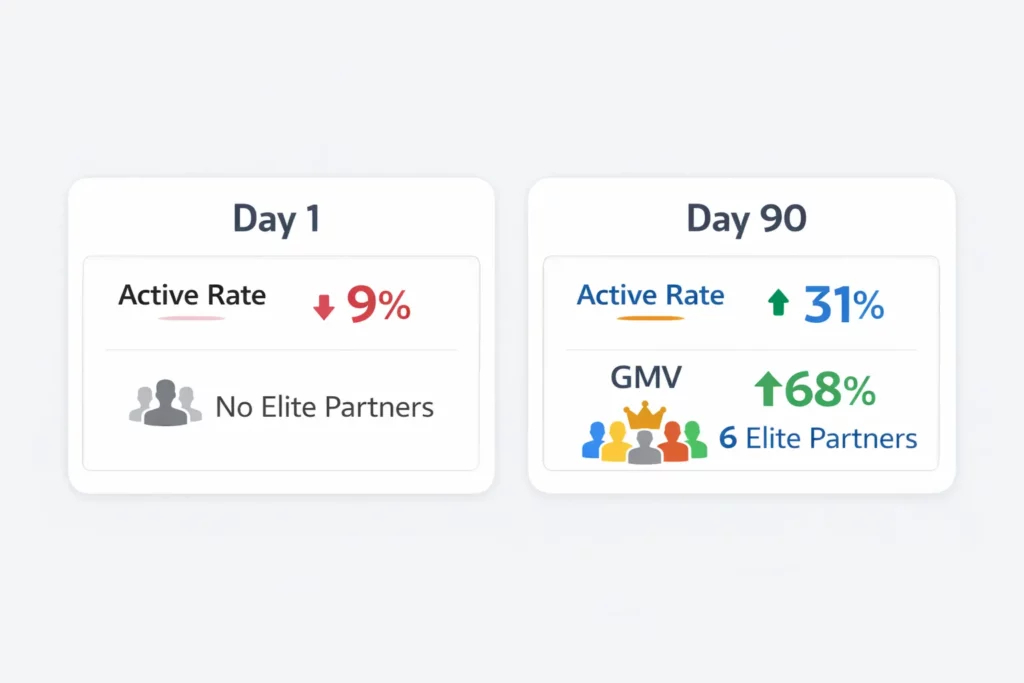
The outcome at 90 days:
- Active rate: 9% → 31%
- GMV from affiliate channel: +68%
- New Elite partner tier created from 6 affiliates who scaled rapidly
- Affiliate churn rate in the first 60 days dropped by 44%
The total additional operational cost: one part-time affiliate manager and a creative refresh budget of $2,400. The incremental GMV was 14× that investment.
How Much Time Should You Spend on Each Affiliate?
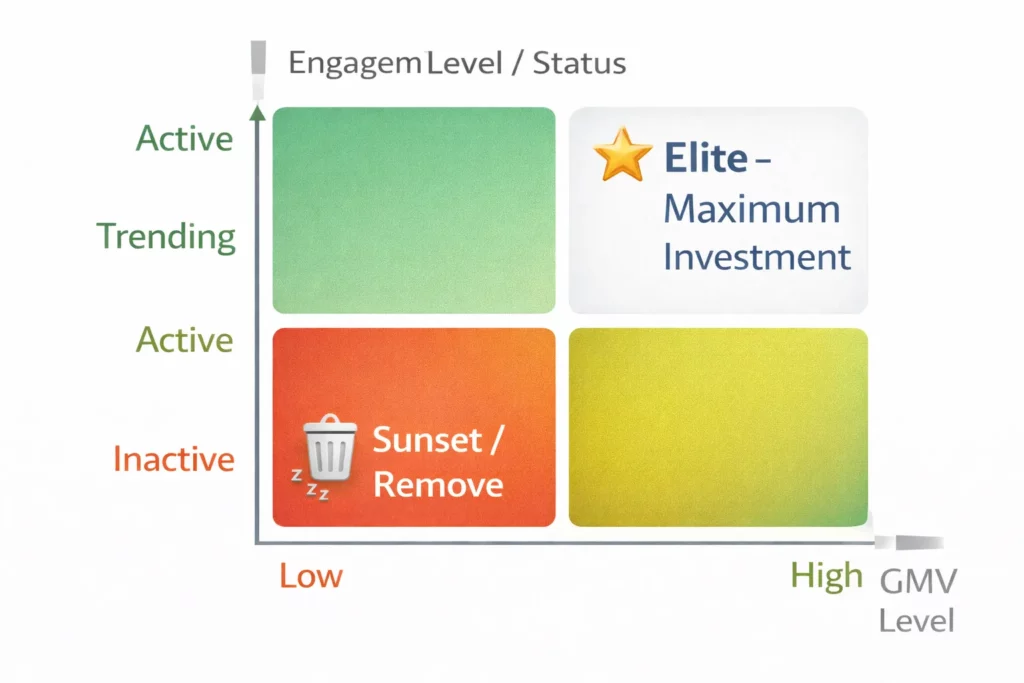
Not every affiliate deserves the same engagement investment. Use this framework to allocate resources efficiently:
| Partner Signal | Recommended Engagement Level | Priority Actions |
| High GMV, increasing trend | Elite — maximum investment | Dedicated manager, co-marketing, custom assets |
| High GMV, plateauing | Strategic intervention | Tier upgrade path, exclusive incentive |
| Mid GMV, consistent | Automated + periodic personal | Monthly newsletter, tier tracker |
| Low GMV, still active | Light automation | Quarterly creative refresh, community |
| Zero activity, 30+ days | Re-engagement sequence | Incentive-led reactivation, then suppress |
| Zero activity, 90+ days | Sunset or reclassify | Remove from active roster, reduce noise |
The key operational decision: When do you sunset an affiliate vs. continue re-engagement? The answer is economics — if re-engagement cost exceeds expected 90-day LTV from that partner, suppress and reallocate resources.
Common Mistakes That Accelerate Affiliate Churn
1. Approving Every Applicant
The Mistake: Approving every applicant. Accepting everyone floods your program with low-quality partners, wasting your time and resources.
The Fix: Set clear minimum standards for audience size, niche relevance, and content quality before hitting “approve.”
2. Sending the Same Message to Everyone
The Mistake: Treating your affiliates like a giant, anonymous email list. Sending the same monthly newsletter to 2,000 people leads to “inbox fatigue.”
The Fix: Segment your partners by performance tier or niche. Personalized updates see much higher open rates and better results.
3. Ignoring the First 30 Days
The Mistake: Investing in recruitment but ignoring onboarding. Most affiliates quit within their first month because they don’t know how to get started.
The Fix: Focus on the first-month experience. A solid onboarding process actually yields a higher ROI than finding new partners.
4. Changing Pay Rates Without Warning
The Mistake: Changing pay rates without warning. Nothing kills trust faster than moving the goalposts on someone’s paycheck.
The Fix: Be transparent. Give at least 30 days’ notice for any changes and clearly explain the “why” behind them.
Conclusion
The merchants who consistently outperform in affiliate-driven revenue share one characteristic: they treat affiliate engagement as a core commercial function, not an afterthought managed by an overloaded marketing coordinator.
To reduce affiliate churn rate meaningfully, you need three things operating simultaneously:
- A structured onboarding system that creates first-sale momentum within 14 days
- A commission architecture that rewards and retains top performers economically
- A relationship infrastructure that creates switching cost through community, support, and genuine partnership
Affiliates who feel like brand partners — not just commission earners — promote with more conviction, stay longer, and grow their contribution over time. That’s the compound effect of engagement done right.
The technical infrastructure to manage this at scale exists. Platforms like UpPromote give merchants the tooling to automate tier tracking, communication sequences, and performance reporting — so your team’s attention goes to the relationships that generate the most value, not to manual spreadsheet management.

Start here: Audit your current active affiliate rate. If it’s below 25%, you have a retention problem that no amount of new recruitment will solve. Fix the leak before adding more water.

Jodie is an SEO content writer and part of the UpPromote team. For her, writing is not just a hobby but also a way to express her creativity and imagination. She enjoys the process of turning her thoughts into words and is always eager to learn more about SEO and content marketing to make her writing even more effective. Besides creating content, she loves cats and traveling.