

Most merchants look at the relationship between affiliate marketing and SEO through the wrong end of the telescope. They worry that a few “bad” links will suddenly trigger a Google penalty, but the real threat is much quieter—and it’s usually hiding inside your own program terms.
When an affiliate program scales without strict guardrails, it doesn’t just drive sales; it creates a messy backlink profile, encourages “thin” content, and can even trick you into paying commissions for traffic you already owned.
It’s time to stop treating your affiliates as just a performance channel and start managing them as a high-authority distribution network. Here is how to stop the “SEO tax” and turn your partners into an organic growth engine.
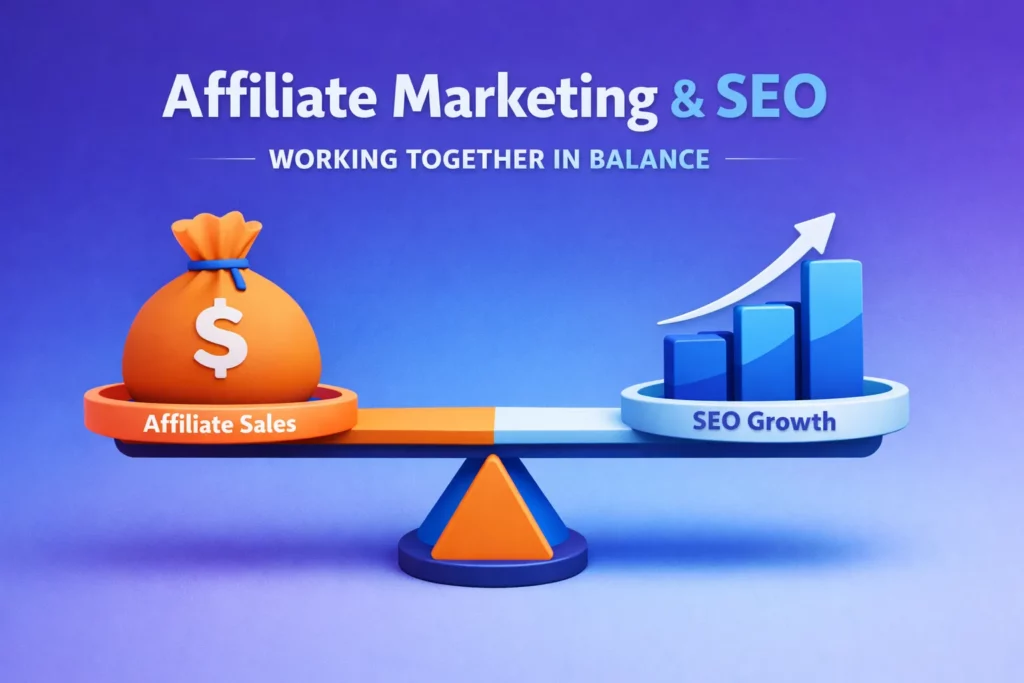
The Real SEO Risks for Merchants
Most merchants approach this question backwards.
They worry about affiliate links they receive damaging their site. The actual risk is subtler — and it sits inside your own program design, partner quality standards, and link compliance policies.
Here’s what’s actually happening when your affiliate program scales without SEO guardrails:
Your partners publish content across hundreds of domains. Some of those pages are thin, keyword-stuffed review posts with your brand name in the title and your affiliate link at the bottom. Google crawls those pages. It reads the link as a dofollow vote of confidence for your domain — which violates Google’s link spam policies.
Over time, if your program drives a high volume of low-quality, non-attributed affiliate links, your backlink profile accumulates signals that resemble a manipulation pattern.
This is the real risk. Not affiliate links themselves.
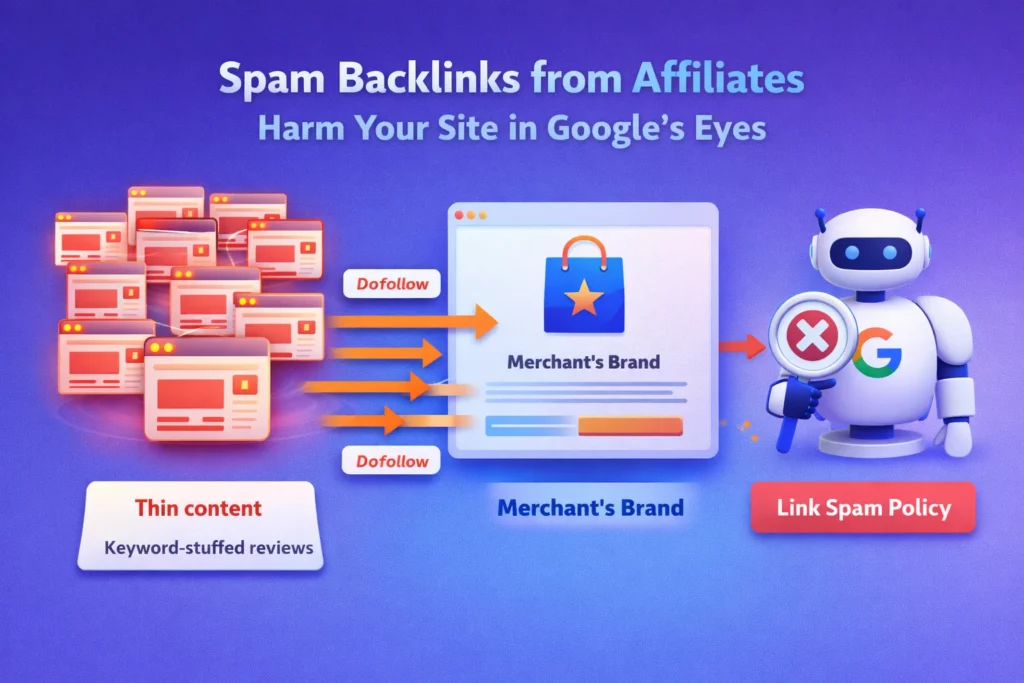
How Google Handles Affiliate Links
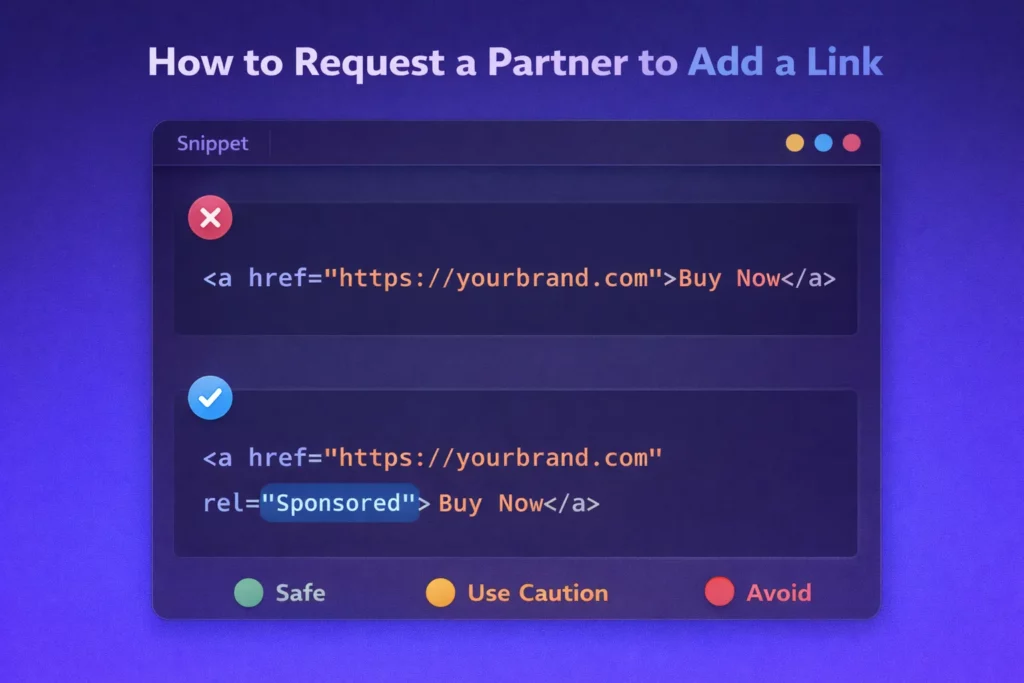
Google is very clear about affiliate links: because they are paid (or incentivized), they must be tagged as rel=”sponsored” or rel=”nofollow”. If you don’t do this, Google considers it a “link scheme” violation.
You usually won’t get a manual penalty for this anymore. Instead, Google simply ignores those links. This means they won’t help your SEO ranking, but they still clutter up your backlink profile.
Three specific risks to watch for:
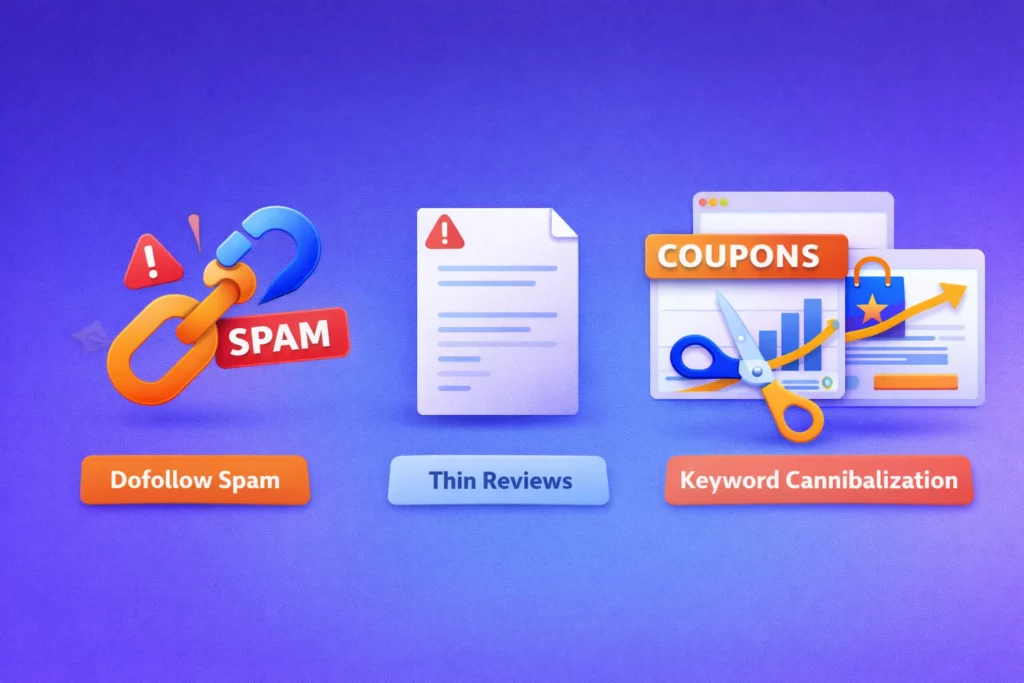
- Unmanaged “Dofollow” Links: If you don’t force your partners to use the correct tags, they probably won’t. This creates a messy backlink profile that looks like paid spam to Google.
- Low-Quality “Thin” Reviews: Lazy affiliates often write short, useless reviews just to get clicks for your brand name. These pages offer no value but compete against your own website in search results.
- Coupon Site Cannibalization: Coupon sites often swoop in at the last second to claim credit for a sale. This messes up your analytics—it makes your affiliate program look more profitable than it is, while making your SEO efforts look like they aren’t working.
Do Affiliate Links Hurt Merchant Sites?
This is a common question from potential partners. The answer is: It depends on their content quality.
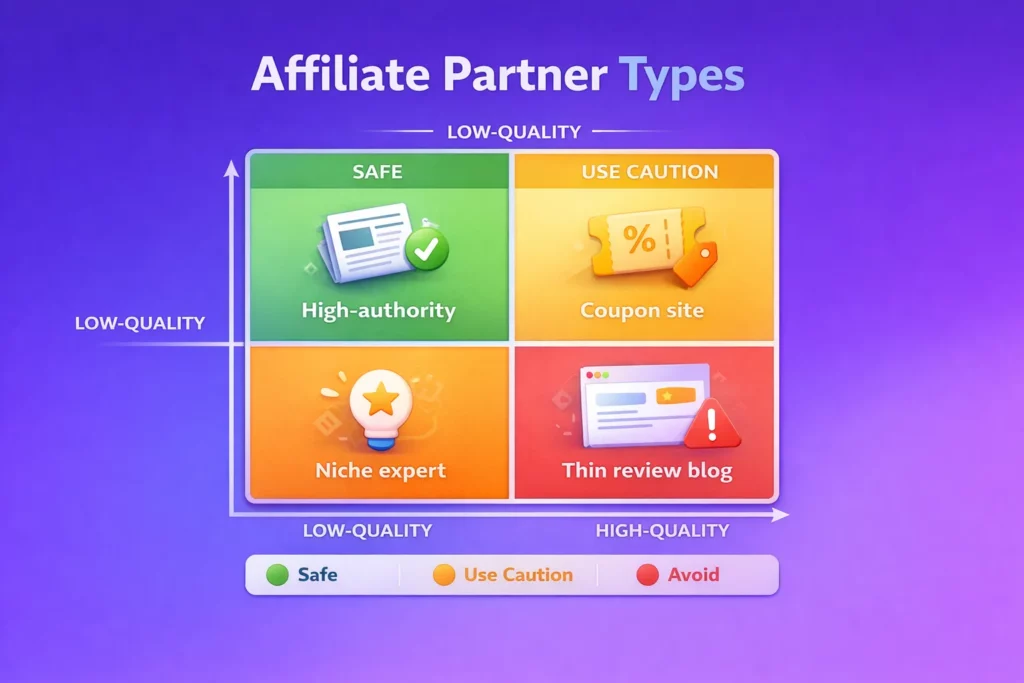
- The Risk: If a site exists only to post affiliate links without offering real value or original writing, Google classifies it as “thin content.” Over time, this destroys that site’s ranking.
- The Reality: High-quality publishers—like news sites, niche experts, and detailed review blogs—are safe. Because they provide genuine value to readers, Google does not penalize them for using affiliate links.
5 Steps to an SEO-Safe Affiliate Program
Step 1: Require Proper Link Tags
Your affiliate agreement must explicitly require partners to use rel=”sponsored” on all affiliate links. This is non-negotiable from a Google policy standpoint.
Implementation note: Some merchant programs also require rel=”nofollow” as an additional failsafe. Either attribute satisfies Google’s guidelines. The sponsored tag is preferred because it’s the most accurate signal.
Platforms like UpPromote allow merchants to include custom terms and conditions at onboarding, so you can make link compliance a condition of program participation before partners ever publish their first link.
Step 2: Set Quality Standards for Partners
Define a minimum DA threshold for partner sites that carry “dofollow” or sponsored-tagged links to your domain. For editorial partners (bloggers, reviewers, publishers), 30+ DA is a reasonable floor. For high-value placements targeting competitive commercial queries, raise the threshold to 50+.
Beyond metrics, require that any content featuring your product includes:
- Original product analysis or hands-on experience
- Comparison context (not just your product in isolation)
- A clearly disclosed affiliate relationship in the post itself
Step 3: Check Your Backlinks Quarterly
Run your affiliate-linked domains through a backlink auditing process every quarter. Flag:
- Sudden spikes in low-DA referring domains (potential link farm activity)
- Dofollow links from partners who agreed to use sponsored attributes
- High-volume anchor text repetition using exact-match commercial terms
Disavow low-quality links as needed. Don’t wait for a manual action — proactive maintenance prevents the pattern from becoming a signal.
Step 4: Stop Affiliates From Stealing Your Brand Searches
Affiliates targeting your branded terms are consuming search equity you should own outright. Monitor the SERPs for:
- “[Brand Name] review”
- “[Brand Name] discount”
- “[Brand Name] vs [Competitor]”
If thin affiliate content is ranking above your own pages or product pages for these queries, address it through content investment — build better, more authoritative versions of those pages yourself.
But organic search is only half the battle. If partners are also running paid ads against your keywords to intercept high-intent customers, you need to establish strict rules against brand bidding in affiliate marketing.
Step 5: Track Sales Accurately
Most merchants default to 30-day last-click attribution. This is a risk to SEO channel performance visibility. If your attribution model over-credits affiliates for sales that organic content assisted, you’ll misread your SEO ROI and underfund content investment.
Consider first-touch or linear attribution models alongside last-click to understand where affiliate links appear in the actual conversion journey — and where organic search contributes earlier in the funnel.
Case Study: A Skincare Brand
This case study follows a $4M DTC skincare brand that learned a hard lesson: a bigger affiliate program isn’t always a better one.
The Background
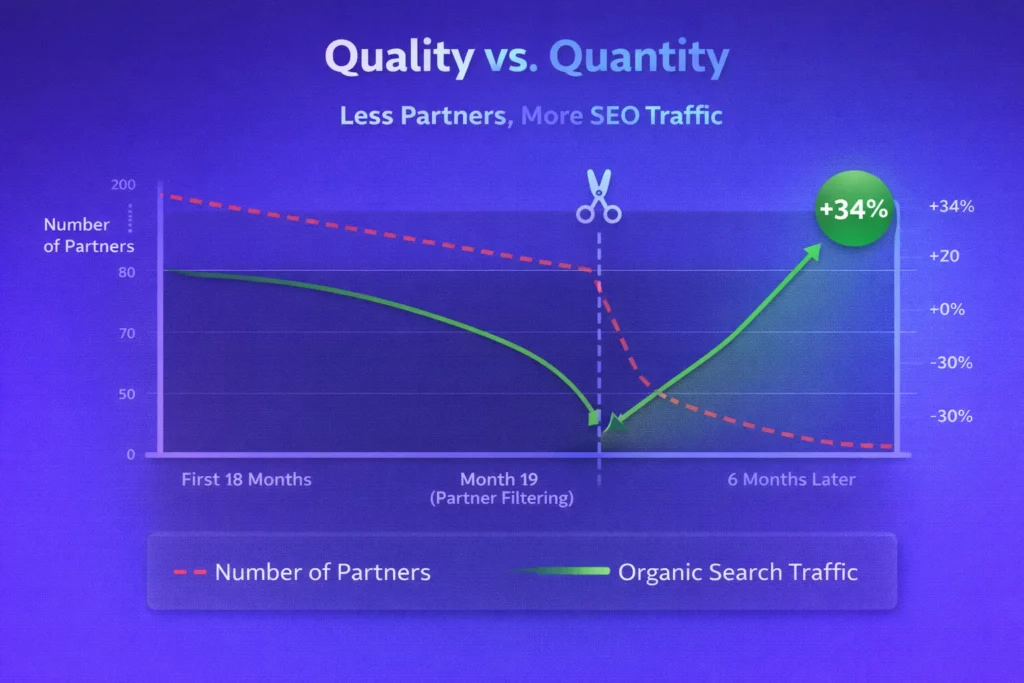
The brand managed a 200-partner affiliate program with a 12% commission but no formal rules on how links were used. Over 18 months, they racked up 3,400 referring domains—mostly low-quality review sites.
The Problem: Dropping Search Rankings
Despite the high volume of links, the brand’s search rankings for key terms (like “retinol serum”) started to tank. An audit revealed why:
- Invisible Links: Google flagged 2,800+ of the links as “thin content.” The brand was getting zero SEO authority from them.
- Self-Cannibalization: Affiliate pages were outranking the brand’s own testimonial pages for “[Brand Name] reviews.” They were essentially paying commissions for traffic they should have owned for free.
The Solution and Results
The brand stopped chasing volume and focused on quality and compliance. They pruned their list from 200 partners down to just 80 high-quality creators and issued a strict content guide.
The outcome over the next six months:
- Revenue: Remained stable (the 80 partners were more effective).
- SEO Recovery: Non-branded search impressions rose by 34%.
- Efficiency: Higher commissions for top partners led to better long-term relationships.
The Takeaway
Affiliate volume does not equal SEO health. In the eyes of Google, a few high-authority endorsements are worth more than thousands of low-quality links.
Checklist: Is Your Program at Risk?
Use this diagnostic to assess your program’s current exposure:
| Diagnostic Question | Risk Indicator |
| Do your program terms require rel=”sponsored” or rel=”nofollow”? | No → High risk |
| Have you audited your backlink profile in the last 6 months? | No → Medium risk |
| Do more than 30% of your referring domains have DA < 20? | Yes → Medium–High risk |
| Are affiliate pages ranking in positions 1–10 for your branded queries? | Yes → Cannibalization risk |
| Does your attribution model separate affiliate-last-touch from organic-assisted? | No → Attribution distortion risk |
| Do you have minimum content quality standards for affiliate partners? | No → Content signal risk |
If you answered “risk indicator” for three or more questions, your affiliate program likely has active SEO exposure that warrants immediate attention.
Conclusion
Affiliate links aren’t the enemy—poor program management is. When handled correctly, high-authority partners provide some of the best SEO value possible: genuine, third-party endorsements that money alone can’t buy.
The risk doesn’t come from the links themselves. It comes from “set it and forget it” program designs that ignore:
- Partner Quality: Who is actually linking to you?
- Link Compliance: Are they using the right attributes (like rel=”nofollow” or rel=”sponsored”)?
- SERP Protection: Are partners stealing your own branded search traffic?
Two Ways to Run a Program
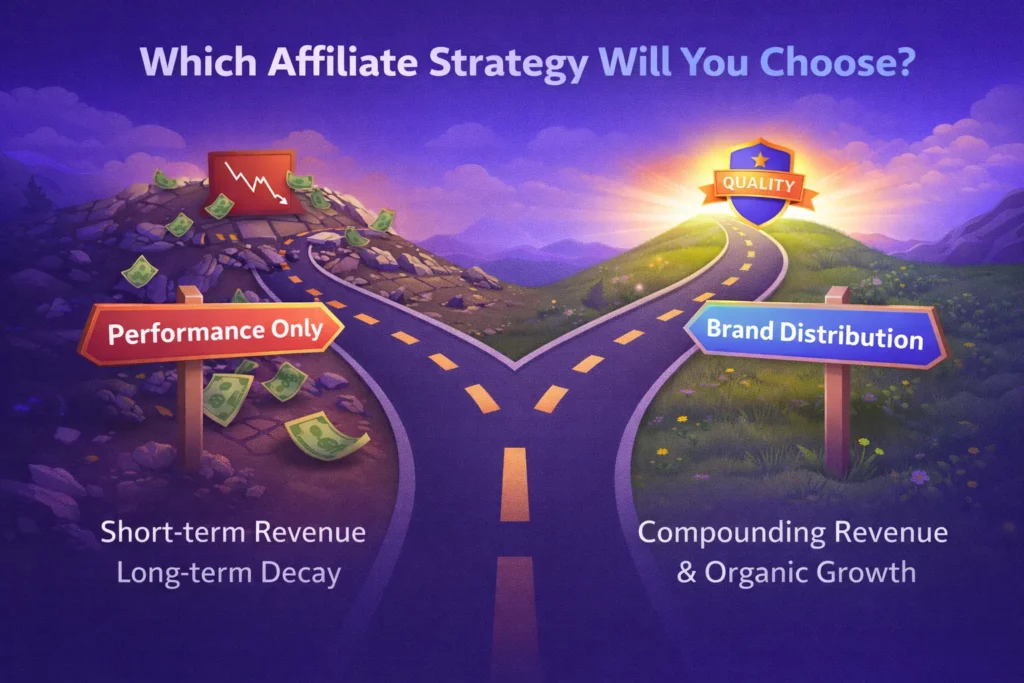
How you view your affiliates determines your long-term search health:
| The “Performance Only” Approach | The “Brand Distribution” Approach |
| Focuses strictly on immediate sales. | Focuses on quality content and authority. |
| Ignores how links impact SEO. | Enforces strict link and content standards. |
| Result: Short-term revenue, long-term SEO decay. | Result: Compounding revenue and organic growth. |
The Takeaway: If you treat your affiliate program as just a sales channel, you’ll eventually pay the “SEO tax.” Treat it as a distribution network governed by high standards, and you’ll win on both fronts.
Your first move: Audit your program terms today. If they don’t explicitly mention content quality and link attributes, it’s time for an update.

Jodie is an SEO content writer and part of the UpPromote team. For her, writing is not just a hobby but also a way to express her creativity and imagination. She enjoys the process of turning her thoughts into words and is always eager to learn more about SEO and content marketing to make her writing even more effective. Besides creating content, she loves cats and traveling.