


Many e-commerce merchants don’t realize their affiliate program is quietly eating away at their profits. The numbers might look great on the screen, but the reality is very different. The root cause is almost always the same: they track affiliate performance using the exact same metrics they use for paid ads.
But affiliate marketing isn’t the same as buying standard ad space. Treating them the same leads to costly mistakes, like paying for weak traffic or handing out commissions for sales you were already going to make.
If you want your affiliate program to bring in profitable new customers instead of just draining your budget, you need a different strategy.
Read on to learn why the standard approach fails, the exact metrics you need to track, and how to build a system that rewards genuine business growth.

Why Most Merchants Measure Their Affiliate Programs Wrong
Most merchants default to measuring affiliate performance the same way they measure paid advertising: impressions, clicks, and surface-level conversions. That framework misses everything that makes affiliate programs structurally different from media buys.
With paid ads, you control spend and optimize placements. With affiliate programs, your partners control promotional decisions and you pay on results which is why platforms like ReferralCandy emphasize performance-based tracking with built-in fraud detection.That distinction changes what you need to measure — and what happens when you measure it wrong.
The common failure modes:
- Rewarding affiliates for traffic that converts at 0.3% while your site average is 2.8%
- Paying full commissions on orders that would have converted anyway through direct or organic search
- Retaining high-click, low-conversion affiliates because your dashboard shows them as “top performers”
- Missing that your bottom 20% of affiliates generate 60% of your incremental GMV
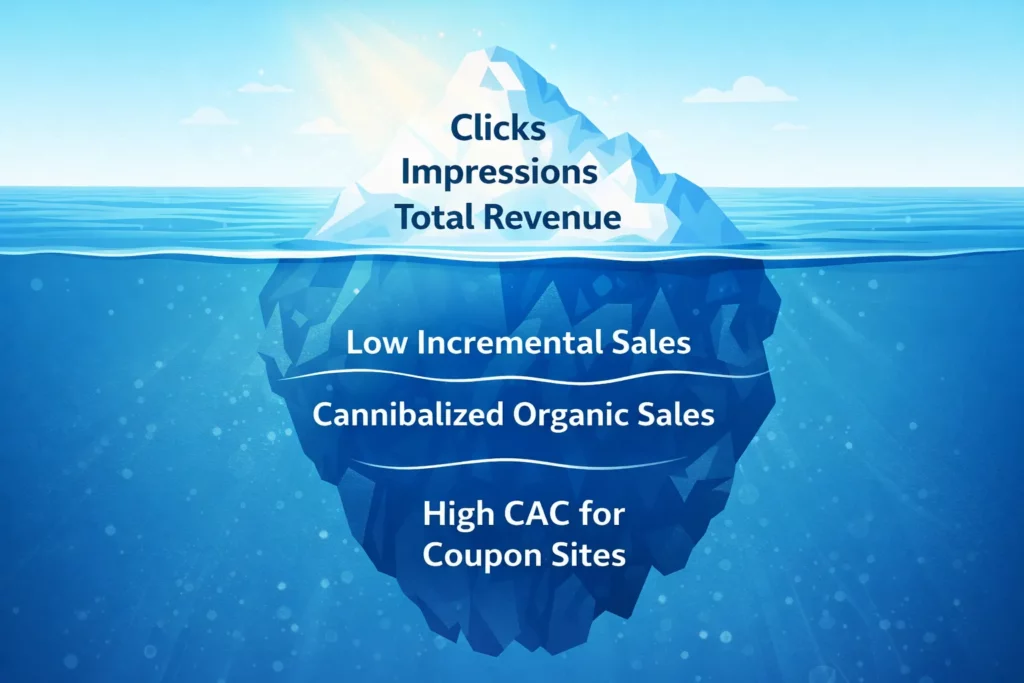
A proper measurement system surfaces these dynamics. Without it, your affiliate program operates as an expensive loyalty scheme for partners who don’t drive new revenue.
What It Actually Means to Track Your Affiliate Program
Measuring affiliate marketing means quantifying the business impact of your affiliate program across three levels: program performance, partner performance, and campaign performance. Each level answers different operational questions and informs different decisions.
| Measurement Level | Core Question | Key Decision Driven |
| Program Level | Is the channel profitable? | Budget allocation vs. paid ads |
| Partner Level | Who drives real value? | Recruitment, retention, tiering |
| Campaign Level | What content/offer converts? | Commission structure, creative briefs |
Most merchants only measure at the program level — total affiliate revenue, total commissions paid. That’s the equivalent of reviewing your P&L once a quarter and calling it financial management.
The 7 Metrics That Reveal Your True Performance

1. Affiliate-Attributed GMV
What it is: Total gross merchandise value generated through affiliate referrals within your attribution window.
This is your starting point, not your endpoint. GMV alone tells you scale; it doesn’t tell you quality or profitability.
How to use it: Track affiliate GMV as a percentage of total store GMV. A healthy affiliate channel typically contributes 10–30% of total revenue for mature e-commerce programs. Significantly below that suggests underinvestment or poor recruitment. Significantly above may indicate attribution overlap with other channels.
2. Commission Payout Ratio
What it is: Total commissions paid ÷ Total affiliate-attributed GMV, expressed as a percentage.
Formula:
Commission Payout Ratio = (Total Commissions Paid / Affiliate GMV) × 100
This is your affiliate channel’s effective cost of revenue. A fashion brand with 60% gross margins can sustain a 15% commission rate comfortably. A consumer electronics merchant at 12% gross margins cannot.
Benchmarks by vertical:
| Vertical | Sustainable Payout Ratio |
| Fashion & Apparel | 10–20% |
| Health & Beauty | 10–18% |
| Consumer Electronics | 3–8% |
| SaaS / Digital Products | 20–40% |
| Home & Living | 8–15% |
If your payout ratio creeps above your gross margin threshold, the program is subsidizing revenue, not generating profit.
3. Affiliate Customer Acquisition Cost (CAC)
What it is: How much money it costs you to get one brand-new customer through your affiliate program.
The Formula:
(Total Commissions + Platform Fees + Management Costs) ÷ New Customers from Affiliates
Why it matters: It lets you compare affiliates to other marketing channels. If it costs you $48 to get a customer on Facebook but only $31 through affiliates, it’s a no-brainer to spend more on your affiliate program.
⚠️ Watch out: Only count new customers. If an existing customer simply uses an affiliate’s coupon code on their 5th order, that isn’t a true acquisition cost—it’s just a discount.
4. Incremental Revenue Rate
What it is: The percentage of affiliate sales that are truly new—meaning the customer would not have bought anything without the affiliate’s link.
Why it matters: Many customers use Google to find a promo code at the very last second before checking out. If an affiliate claims credit for a customer who was going to buy anyway, your true Return on Investment (ROI) is lower than your dashboard says.
The Benchmark: Coupon and cashback sites usually claim a lot of sales that would have happened anyway (35–55%). Content creators and review blogs drive much more genuine, new revenue (only 15–25% would have bought anyway).
How to test it: Temporarily turn off affiliate links for a small test group and see how much your overall sales drop.
5. Partner Productivity
What it is: The average amount of money generated by each active affiliate.
The Formula:
Total Affiliate Revenue ÷ Number of Active Affiliates
Why it matters: In most programs, a tiny handful of affiliates brings in almost all the money. This metric shows you how efficient your overall roster of partners is.
⚠️ Watch out: If your average revenue per affiliate drops as you recruit more partners, it means you are either recruiting the wrong people or failing to train them well.
6. Affiliate Conversion Rate
What it is: The percentage of affiliate visitors who actually buy something, compared to your website’s normal average.
The Formula:
Affiliate Purchases ÷ Affiliate Website Visits
Why it matters: Not all website traffic is good traffic. An affiliate sending 5,000 visitors who never buy anything is useless and messes up your retargeting ads. But an affiliate sending 800 visitors who buy like crazy is sending you highly qualified leads—and you should reward them!
💡 Pro Tip: Look at this metric for each individual affiliate so you know exactly who is sending high-quality buyers.
7. Average Order Value (AOV) by Affiliate
What it is: The average amount of money a customer spends when they come from a specific affiliate.
Why it matters: Some affiliates might send you a lot of sales, but only for your cheapest items. Other affiliates (like detailed review blogs or specialized email newsletters) might send fewer buyers, but those buyers spend a lot more money.
💡 Pro Tip: Don’t just reward affiliates for getting a high volume of sales. Create commission tiers that reward them for getting customers to spend more money per order.
How to Set Up Your Attribution Model Correctly
Attribution model selection is one of the highest-leverage decisions in affiliate program management. The model you choose determines which partners get credited, how commissions are paid, and ultimately which affiliates stay in your program.
The Four Main Attribution Models for Merchants
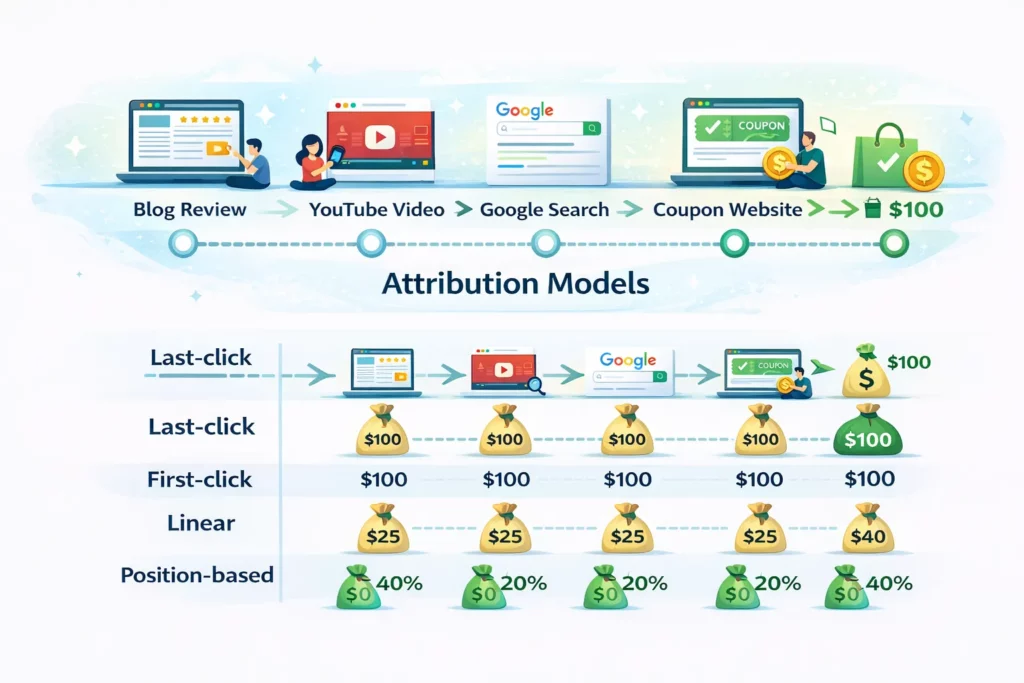
| Model | How It Works | Best For | Risk |
| Last-click | Full credit to the last affiliate touchpoint | Simple programs, early stage | Rewards coupon/cashback affiliates unfairly |
| First-click | Full credit to the affiliate that initiated the journey | Brand awareness programs | Ignores conversion-driving partners |
| Linear | Equal credit across all affiliate touchpoints | Multi-partner journeys | Dilutes high-performer rewards |
| Position-based | 40% first touch, 40% last touch, 20% middle | Balanced programs | Requires multi-touch tracking infrastructure |
For most e-commerce merchants, the practical recommendation is:
- Start with last-click with a 30-day attribution window to establish baseline data.
- Introduce first-click analysis alongside it to identify top-of-funnel contributors you may be undervaluing.
- Graduate to position-based attribution once your program exceeds 50 active partners generating consistent volume.
Attribution Window Strategy
Your attribution window (the period after a click during which a conversion is credited to the affiliate) directly affects your commission liability.
- 7-day window: Appropriate for impulse-purchase categories (fashion accessories, consumables under $50)
- 30-day window: Standard for most e-commerce categories
- 60–90 day window: Warranted for considered purchases (furniture, electronics, B2B tools)
Extending your attribution window increases partner satisfaction and recruitment appeal. Shortening it reduces commission costs but risks losing high-quality content partners who drive considered purchase journeys.
How to Set Up Your Tracking Dashboard
Level 1: Program Health Dashboard (Weekly Review)
Track these weekly to catch issues before they compound:
- Total affiliate GMV (week-over-week)
- Commission payout ratio
- Number of active affiliates (generated ≥1 conversion)
- Top 10 affiliates by GMV
- New affiliate activations
Level 2: Partner Performance Report (Monthly Review)
- Revenue per active affiliate (partner productivity)
- Conversion rate by partner vs. site average
- AOV by partner
- Commission earned vs. revenue generated ratio per partner
- New customer rate per affiliate (% of conversions from first-time buyers)
Level 3: Program Profitability Analysis (Quarterly Review)
- Affiliate CAC vs. paid channel CAC comparison
- Incremental revenue estimation
- Commission payout ratio trend
- LTV of affiliate-acquired customers vs. other channels
- Program ROI: (Affiliate GMV – Total Commission & Overhead) / Total Commission & Overhead
Real Example: How One Merchant Cut Wasted Commissions by 34%
A home goods merchant running a 120-partner affiliate program was reporting $380K/month in affiliate GMV at a 14% commission rate — approximately $53K/month in commissions.
When they implemented partner-level CVR and AOV tracking, the data revealed:
- 22 coupon and cashback affiliates accounted for 61% of commission spend but only 18% of new customer acquisitions
- 14 editorial content partners accounted for 11% of commission spend and 47% of new customer acquisitions
- Average AOV from editorial partners was $127 vs. $64 from coupon partners
Actions taken:
- Restructured commissions: 8% flat for coupon/cashback affiliates, 18% for content/editorial partners
- Added a new customer acquisition bonus of $12 per first-time buyer (any affiliate)
- Removed 17 affiliates generating sub-0.5% CVR with no new customer attribution
Results after 90 days:
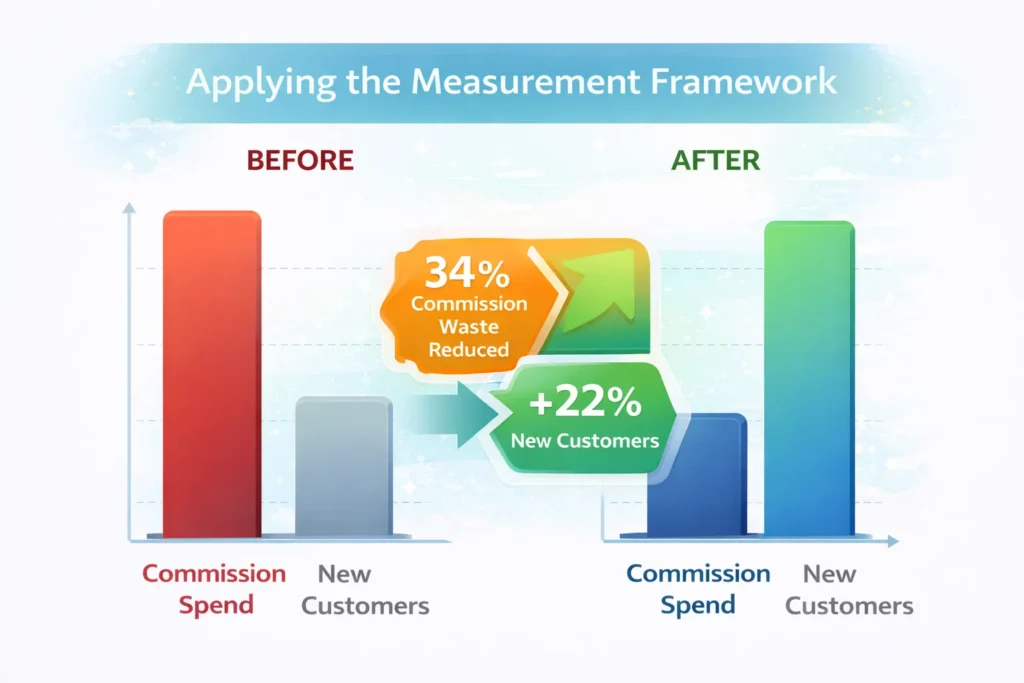
- Total commissions: $35K/month (34% reduction)
- Affiliate GMV: $341K/month (10% decrease — primarily non-incremental revenue removed)
- New customer acquisitions via affiliate: up 22%
- Affiliate CAC: reduced from $61 to $38
The apparent GMV reduction was a program improvement. The non-incremental revenue was costing more than it contributed.
Costly Tracking Mistakes You Must Avoid
Mistake 1: Counting all affiliate revenue as incremental
Non-incremental revenue (purchases that would have happened anyway) inflates your program’s apparent ROI. Build incrementality checks into your quarterly analysis.
Mistake 2: Ignoring the new customer metric
An affiliate program that primarily drives repeat purchases from existing customers is a loyalty discount program with extra steps. Track new customer rate by affiliate religiously.
Mistake 3: Optimizing for volume without quality gates
High traffic volume from low-intent sources damages your site metrics, consumes retargeting budget, and inflates session counts without contributing meaningful revenue.
Mistake 4: Using a single attribution model without challenge
Run parallel attribution analysis. If your last-click model tells you Partner A is your top performer but first-click analysis shows Partner A never introduces new customers, you’re rewarding the wrong behavior.
Mistake 5: Measuring program performance in isolation
Your affiliate channel doesn’t exist in a vacuum. Compare affiliate CAC, LTV, and conversion quality to your paid, organic, and email channels. The comparison drives better budget decisions.
Tools That Make This Measurement Operationally Feasible
Tracking affiliates on a spreadsheet might work at first, but it quickly falls apart once you have more than 20 or 30 partners. It just gets too complicated.
That’s where dedicated affiliate platforms come in. Tools like UpPromote, for example, are designed specifically for Shopify merchants. They automatically calculate all your key metrics for you—like individual partner conversion rates, payouts, and whether a sale came from a new customer.
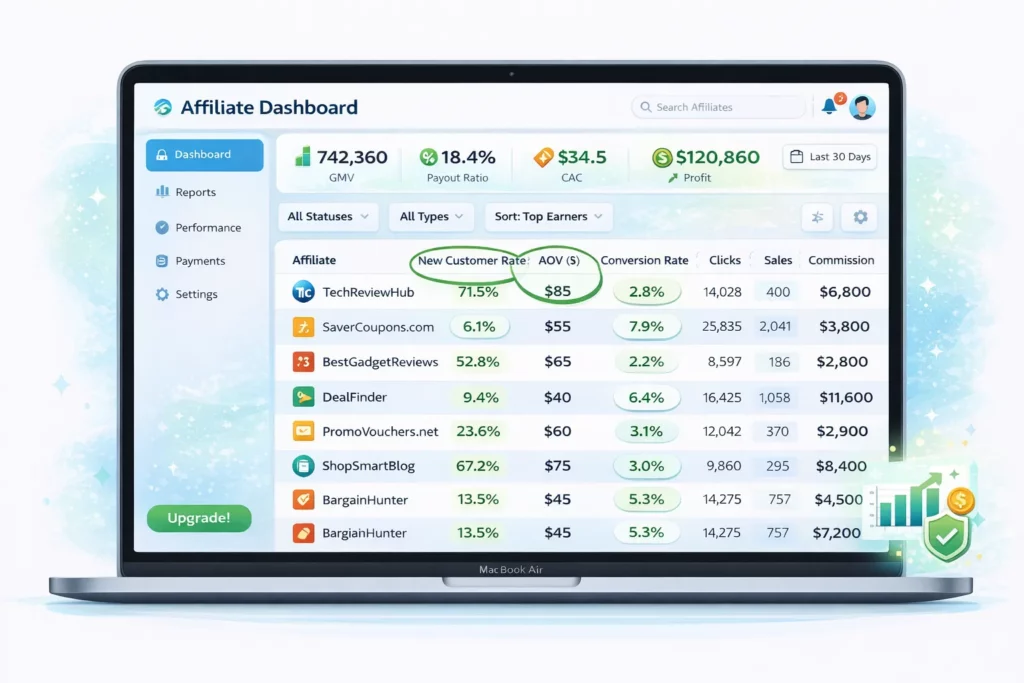
The image is for illustration purposes only and is not a representation of the actual product.
Ultimately, the tracking strategy we’ve outlined will work on any platform. What matters most is tracking your data consistently, and having the right software makes that consistency possible at scale.
Action Plan: What to Do With Your Data
Once you have clean data, the decisions are straightforward:
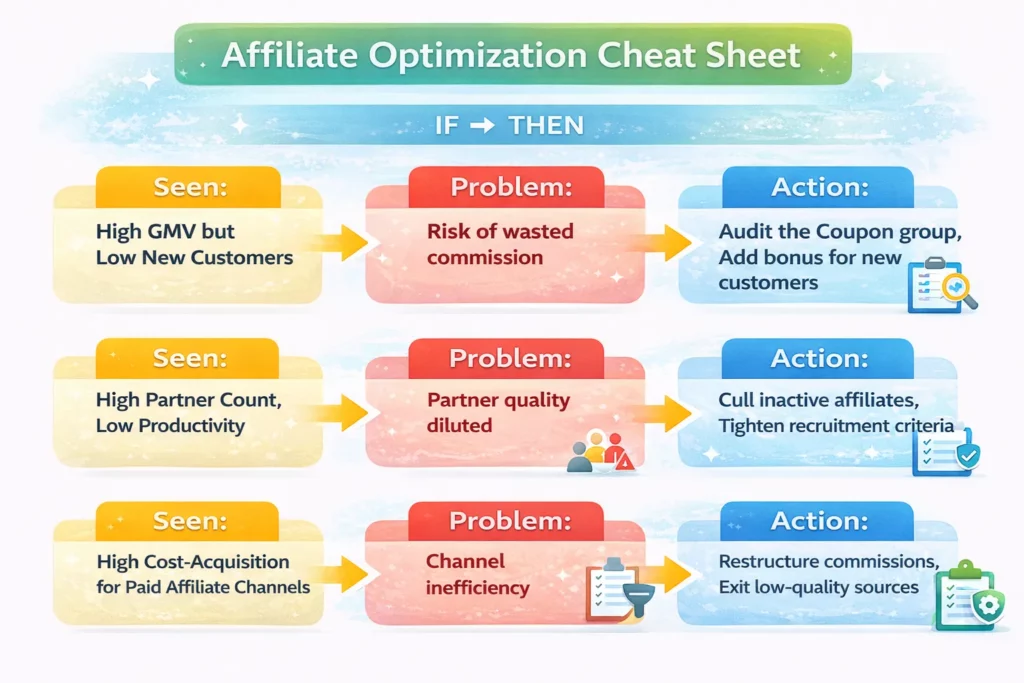
| What You’re Seeing | What It Means | Action |
| High GMV, low new customer rate | Non-incremental revenue risk | Audit coupon/cashback traffic, add new customer bonus |
| High partner count, low productivity | Partner quality dilution | Cull inactive affiliates, tighten recruitment criteria |
| Low affiliate CVR vs. site average | Low-intent traffic | Add traffic quality minimums, restructure commission triggers |
| High commission ratio, low AOV | Margin compression | Introduce AOV-based commission tiers |
| High affiliate CAC vs. paid channels | Channel inefficiency | Restructure commissions, exit low-quality partners |
| Low affiliate CAC vs. paid channels | Underinvestment signal | Increase recruitment budget, raise commissions for top tier |
Conclusion: Measurement Is the Program
An affiliate program without structured measurement is a cost center disguised as a revenue channel. The merchants who scale affiliate to 20–30% of GMV while maintaining healthy margins aren’t guessing — they’re operating from a measurement system that tells them exactly which partners to invest in, which structures to run, and which traffic to exit.
The framework in this article gives you the operational scaffolding. The next step is implementation: audit your current attribution model, add partner-level CVR and AOV tracking, and build your first incremental revenue estimate.
Your affiliate program’s profitability isn’t determined at launch. It’s determined by what you measure, and what you do with what you learn.

Jodie is an SEO content writer and part of the UpPromote team. For her, writing is not just a hobby but also a way to express her creativity and imagination. She enjoys the process of turning her thoughts into words and is always eager to learn more about SEO and content marketing to make her writing even more effective. Besides creating content, she loves cats and traveling.