

TL; DR:
A complete recruitment playbook to go from zero affiliates to 50–100 active partners in 90 days:
- 12 channels ranked by conversion rate — customers (15–25%) and social taggers (12–18%) convert the highest
- 6 outreach templates ready to copy-paste
- Vetting checklist with 5 rejection red flags
- 90-day week-by-week plan from first invite to working network
You’ve built your affiliate program. Commissions are set, tracking is live, the signup page looks great.
Now you need the one thing no program can run without: the right partners.
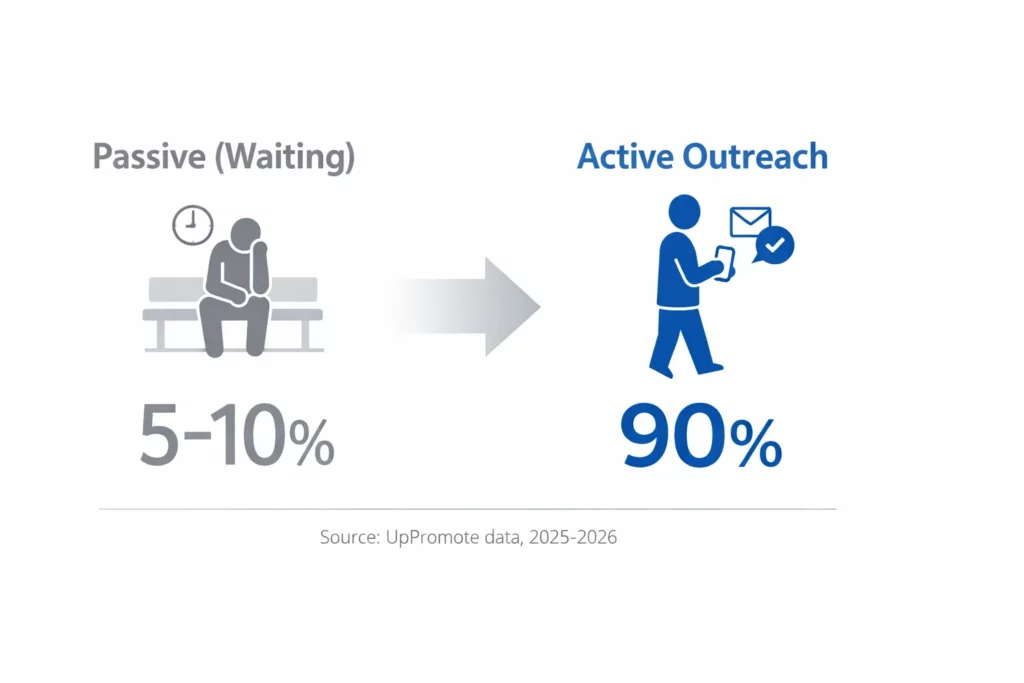
Here’s the uncomfortable truth — most Shopify stores launch an affiliate program and then wait. But only 5 – 10% of affiliates come from organic signups on your website. The other 90% come from active, deliberate recruitment (UpPromote data, 2025–2026).
The channel you start with matters, too. Merchants who recruit from their existing customer base see activation rates 2x higher than those who rely on cold outreach alone.
This guide will break it down:
- 12 recruitment channels ranked by conversion rate
- 6 ready-to-use email templates
- A vetting checklist to filter out bad-fit affiliates
- A 90-day week-by-week plan to go from zero partners to a working affiliate network
Why Most Shopify Stores Fail at Affiliate Recruitment (And What Works Instead)
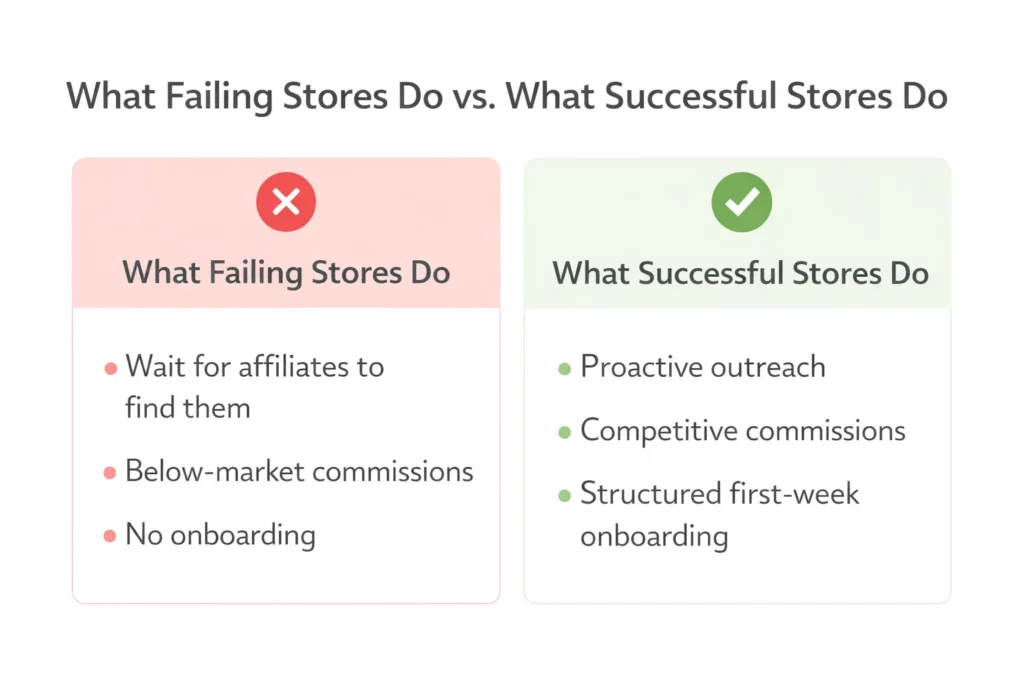
Most Shopify stores fail at affiliate recruitment for three reasons: they wait for affiliates to find them instead of doing outreach, they set commission rates below what competitors offer, and they skip onboarding.
The result: affiliates sign up and never promote.
Stores that succeed do the opposite: proactive outreach, competitive commissions, and a structured first-week onboarding.
“If you build it, they will come” is a myth
Setting up a registration page and waiting is the most common recruitment mistake — and the most expensive in lost time.
Data from UpPromote’s merchant base (2023-2025) shows that only 5–10% of affiliate signups come from passive discovery. The remaining 90% result from merchants reaching out to potential partners.
If your entire strategy is a “Become an Affiliate” link in your footer, you’re fishing with no bait.
Commission that doesn’t compete won’t attract
According to CJ Affiliate’s 2025 publisher survey, 85% of affiliates say a higher commission rate is the deciding factor when choosing between programs.
The math is simple. If your beauty brand offers 10% while a competitor in the same niche offers 20%, most affiliates will pick the competitor — even if your product is better.
The fix is just as simple: research what competitors pay before you set your rates.
Search “[competitor] affiliate program” and note their commission percentage, cookie duration, and sign-up bonuses. Then match or beat the offer on at least one dimension.
The framework that works: Outreach → Qualify → Onboard → Build trust
Effective recruitment isn’t a single action. It’s a four-step loop that repeats throughout the life of your program.
| Step | Goal | Timeline |
| 1. Outreach | Reach potential affiliates through the right channels | Weeks 1–2 |
| 2. Qualify | Vet applications — check audience fit, content quality, red flags | Within 48h of each application |
| 3. Onboard | Send a welcome kit, materials, and a first-sale incentive | First 7 days after approval |
| 4. Build trust | Guide affiliates to their first sale and keep them engaged | Months 1–3 |
Each remaining section maps to this framework. The 12 recruitment channels and messaging templates cover Outreach. The vetting checklist covers Qualify, the onboarding framework covers Build trust, and the 90-day plan ties it all together.
Key Takeaway:
Recruitment is not “post and pray.” Successful merchants spend 3–5 hours per week on active outreach during the first 90 days. After that, momentum compounds — top affiliates refer other affiliates, marketplace listings generate inbound applications, and post-purchase enrollment runs on autopilot.
The 12 Best Channels to Recruit Affiliates (Ranked by Conversion Rate)
Not all recruitment channels perform the same. Some convert at 25%. Others struggle to break 3%.
The ranking below is based on aggregate data from UpPromote’s merchant base (Q4 2025 – Q1 2026). Conversion rate here means the percentage of people contacted who sign up as affiliates.
| Rank | Channel | Conversion Rate* | Cost | Volume | Best For |
| 1 | Existing customers | 15–25% | Free | Medium | All niches |
| 2 | Social media taggers | 12–18% | Free | Low–Med | Fashion, Beauty, Food |
| 3 | Post-purchase auto-enrollment | 10–15% | Free | High | DTC brands, subscriptions |
| 4 | Brand fans & UGC creators | 8–12% | Free–Low | Low | Lifestyle brands |
| 5 | Affiliate marketplaces | 3–8% | Free | High | All niches |
| 6 | Niche bloggers (cold email) | 5–8% | Free | Medium | Niche products, SEO-driven |
| 7 | YouTube creators | 4–7% | Product gifting | Medium | High-ticket, demo products |
| 8 | Competitor’s affiliates | 4–6% | Free | Low | Competitive niches |
| 9 | TikTok creators | 3–6% | Product gifting | High | Trend-driven, young demo |
| 10 | Podcast hosts | 3–5% | Free–$$ | Low | Niche, high-trust audiences |
| 11 | Facebook/Reddit communities | 2–4% | Free | Medium | Niche communities |
| 12 | Industry events & conferences | 5–10% | $$–$$$ | Low | B2B, high-ticket |
*Conversion rate = % of people reached who sign up as affiliates. Source: UpPromote aggregate data, Q4 2025 – Q1 2026.
Channel #1: Existing Customers (Conversion: 15–25%)
Your customers already know, trust, and use your product. You don’t need to convince them it works; you just need to invite them.
Your purchase history is the best starting point. Export your top 100 customers — those who’ve bought at least twice or have the highest order value. Then send a personalized email invitation (templates in the recruitment messaging section below).
One small move makes a big difference: offer a commission rate above your standard, say 20% instead of 15%, as a loyalty incentive.
This channel converts the most because the trust barrier has already been cleared. Customer-affiliates have an activation rate (at least one referred sale) 2× higher than cold-recruited affiliates (UpPromote data, 2025–2026).
Case study: Snogo Straws turned loyal customers into affiliates using personalized referral cards and tiered commission programs. Result: affiliate marketing now drives 25% of total sales.
Most affiliate apps like UpPromote let you set up a dedicated customer referral program that auto-enrolls buyers after purchase, building an ongoing recruitment channel.
Channel #2: Social Media Taggers (Conversion: 12–18%)
Someone already tagging your product on Instagram or TikTok is promoting you for free. Your job is to formalize that relationship.
To find these organic advocates, you can check Instagram for tagged posts, story mentions, and your branded hashtag. TikTok is worth scanning too — look for videos that mention or review your product.
If you use a social listening tool, your brand mentions dashboard is the fastest starting point of all.
When you reach out, referencing their specific post is what makes the difference.
A DM like “Hey [name], loved your story about [product] — want to earn commission every time your followers buy through your link?” outperforms generic copy-paste messages by 3×.
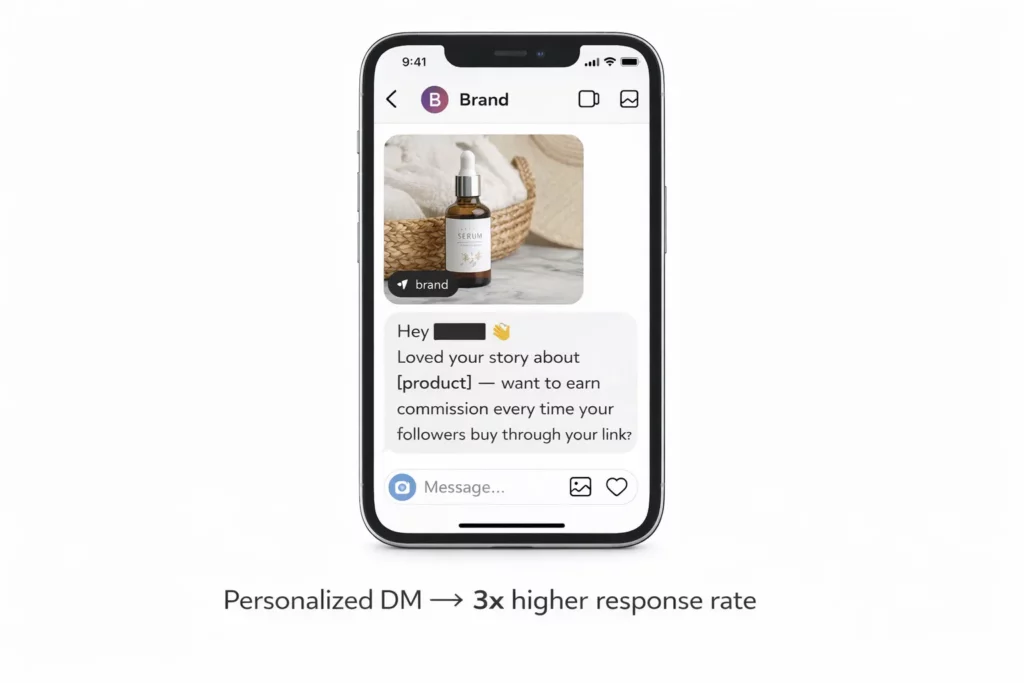
Brands are leaning into this channel hard. Data shows brands collaborating with 33% more micro-influencers year over year — and most of those partnerships start with someone who was already posting organically.
Channel #3: Post-Purchase Auto-Enrollment (Conversion: 10–15%)
The moment right after purchase is when customer excitement peaks. That’s your window, and there are two straightforward ways to capture it:
- Thank-you page banner: “Love [product]? Earn 15% commission by sharing it. Join our referral program in 30 seconds.”
- Post-purchase email (24h after delivery): “How’s your [product]? If you love it, earn money sharing it.”
The timing alone explains the numbers. Post-purchase enrollment emails have a 60–70% open rate – the highest of any email type (Omnisend data).
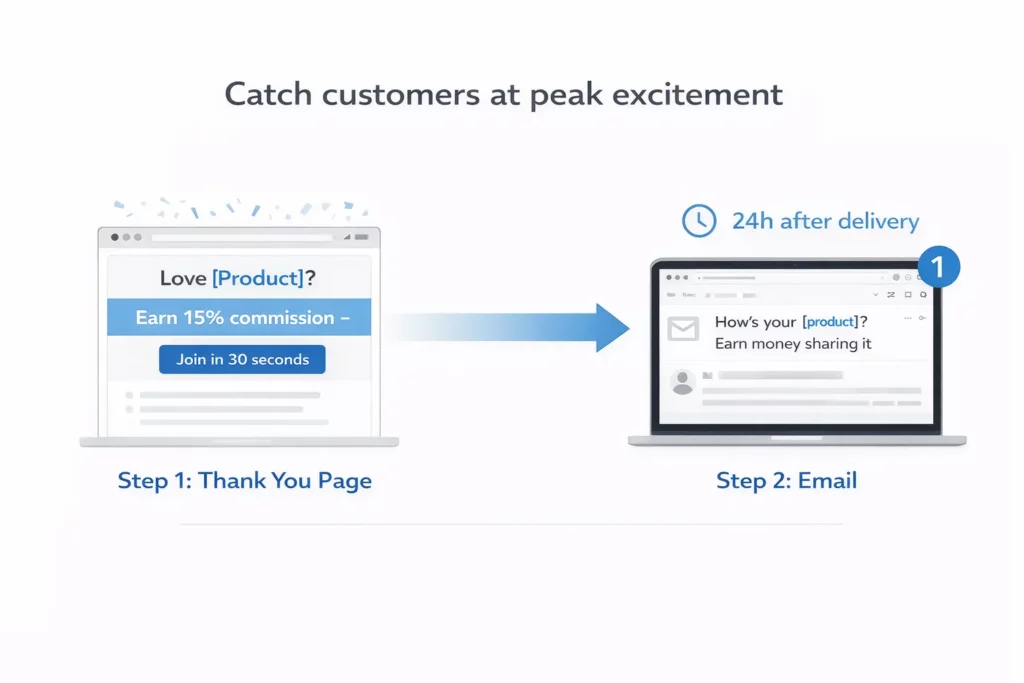
Apps like UpPromote offer a refer-a-friend feature that converts customers into affiliates after purchase. That cuts the gap between a happy buyer and an active promoter to a single step.
📝 One important note: auto-enrollment should always require a clear opt-in. Don’t turn customers into affiliates without their consent.
Channel #4: Brand Fans & UGC Creators (Conversion: 8–12%)
This is different from Channel #2. Social taggers already mention your brand. UGC creators haven’t mentioned you yet — but they’re creating content in your niche and reviewing products similar to yours.
The best candidates are creators already reviewing competitor products or related items in your category. A free product sample paired with an affiliate invitation is the most effective outreach format.
Instagram Reels, TikTok, and YouTube Shorts are where UGC thrives. 73% of shoppers use short-form video to research products before buying.
A genuine UGC review is more persuasive than any ad you can run. That makes the brand fans and UGC creators channel low-volume but high-impact.
Channel #5: Affiliate Marketplaces (Conversion: 3–8%)
Marketplaces flip the script. Instead of you finding affiliates, affiliates find you.
UpPromote Marketplace lets affiliates browse and apply to programs in their niche. List your program with a clear commission rate, niche description, and product images to attract qualified partners.
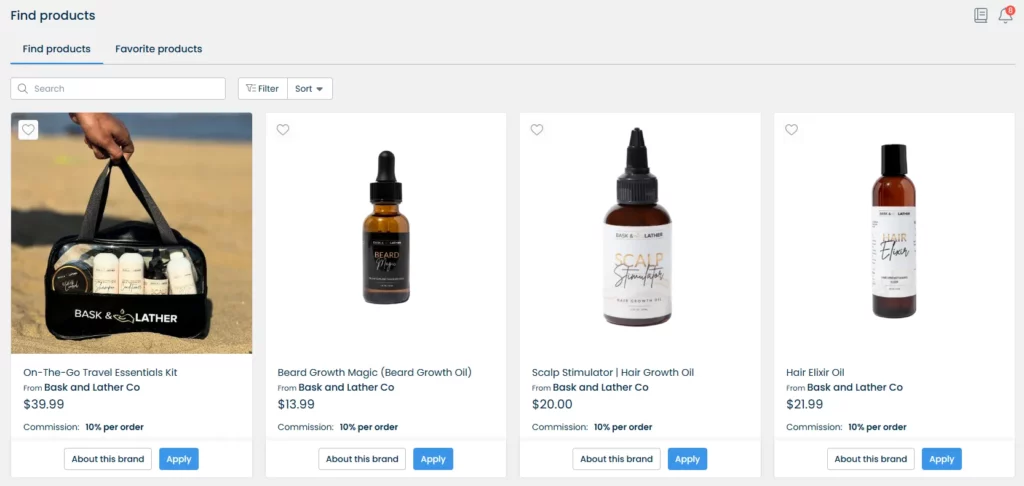
For access to professional affiliates with established audiences, enterprise networks such as ShareASale, CJ Affiliate, and Awin are worth considering for higher budgets.
Shopify Collabs is free but limited in features (3.9★ on the Shopify App Store) — better as a supplement than a primary channel.
A well-written listing does most of the work for you. Here are some tips to make yours stand out:
- Lead with your commission rate in the headline
- State your niche clearly – “organic skincare” beats “health & wellness”
- Include average earnings per affiliate as social proof
- Use high-quality product images
Conversion rates vary between 3% and 8% depending on listing quality. A vague listing with no commission details sits untouched. A specific, well-structured one attracts applications around the clock.
Channel #6: Niche Bloggers via Cold Email (Response: 5–8%)
Bloggers need to monetize their content. Affiliate commissions are a natural fit if you pitch it right.
The best targets are bloggers already writing reviews or comparison posts about products in your category. A Google or AI search for “[niche] + best [product type] + 2026” will quickly surface them.
You should aim for blogs with a Domain Authority of 20 or higher. They have enough traffic to generate real sales but aren’t so large that your email gets buried.
The volume math is straightforward: 100 cold emails → 6 responses → 4 sign up → 1-2 become active within 3 months. Scale to 200 emails per month, and you’re adding 2-4 active blogger-affiliates monthly.
Personalization is the differentiator here. Emails that reference a specific article the blogger wrote get 5–8% response rates. Generic “Dear blogger” emails get 1–2%.
Channel #7: YouTube Creators (Response: 4–7%)
Unlike social media posts that vanish from feeds within days, a single YouTube review video can rank on Google for years. That shelf life makes each YouTube affiliate a source of passive, compounding traffic.
The sweet spot is channels with 5K–100K subscribers: large enough to drive real sales, small enough to respond to your outreach.
You can find relevant creators by searching “[niche] + review,” “[niche] + haul,” or “[niche] + unboxing.” The most effective offer combines product gifting, commission, and an exclusive discount code for their viewers.
Case study: Freewell Gear handpicked creators based on technical expertise rather than follower count, sending free product samples without requiring specific scripts. Result: $350K in affiliate revenue within two months from roughly 700 creators worldwide.
The upfront effort is real (product gifting, relationship building). But one quality review video generates traffic for 2–3 years.
Daniel Grindrod: Cine Tips – One of the affiliates of Freewell Gear
Channel #8: Competitor’s Affiliates (Response: 4–6%)
These affiliates have already proven they can sell in your niche. They have the audience, they understand the affiliate model, and they’re looking for products to promote.
Finding them is straightforward: a Google search for “[competitor name] affiliate program” or “[competitor] discount code” will reveal the bloggers and influencers promoting those brands.
One rule when reaching out: never bash the competitor.
Position your program as an additional income stream – “alongside,” not “instead of.”
Most affiliates already promote multiple brands. That works in your favor. Check the competitor’s commission rate first, then match or beat it on at least one dimension.
Channels #9–12: Four Lower-Volume Channels Worth Testing
The remaining four channels convert at lower rates but serve specific niches well.
TikTok creators (3–6% response) are best reached through niche hashtags like #skincare or #homegym. Target creators with 5K–200K followers and engagement rates above 3%.
With 51.9% of businesses now using TikTok Shop (Influencer Marketing Hub), creators on the platform already understand the affiliate model — making your pitch easier.
Podcast hosts (3–5% response) offer unusually high audience trust. Target niche podcasts with 1K–50K downloads per episode.
One practical detail: podcast affiliates need a discount code rather than a link — listeners are hearing, not clicking.
Facebook groups and Reddit communities (2–4% response) require patience.
You should become a helpful member first, then mention your program naturally. Reddit is especially valuable: AI search tools like Perplexity cite Reddit threads heavily.
Industry events and conferences (5–10% in-person) have the second-highest conversion rate after existing customers. A 15-second pitch and a QR code linking to your signup page is all you need.
How to Write Recruitment Messages That Get Responses (6 Templates)
There are 6 templates for recruitment messages:
- Customer Invite (15–25% signup rate)
- Blogger Cold Outreach (5–8% response)
- Influencer DM (8–12% response)
- Competitor’s Affiliate Pitch (4–6% response)
- Post-Purchase Follow-Up (10–15% signup)
- Inactive Re-Activation (5–10% re-engagement)
Every template is under 150 words. Shorter messages outperform longer ones.
One principle runs through all six: specificity. Emails that reference a specific purchase, article, or post convert 3× higher than generic outreach. Placeholders below are marked with [brackets] — fill them in before sending.
Template #1: Customer Invite Email
This is your highest-converting message because it goes to people who already love your product. The subject line leans into that existing relationship.
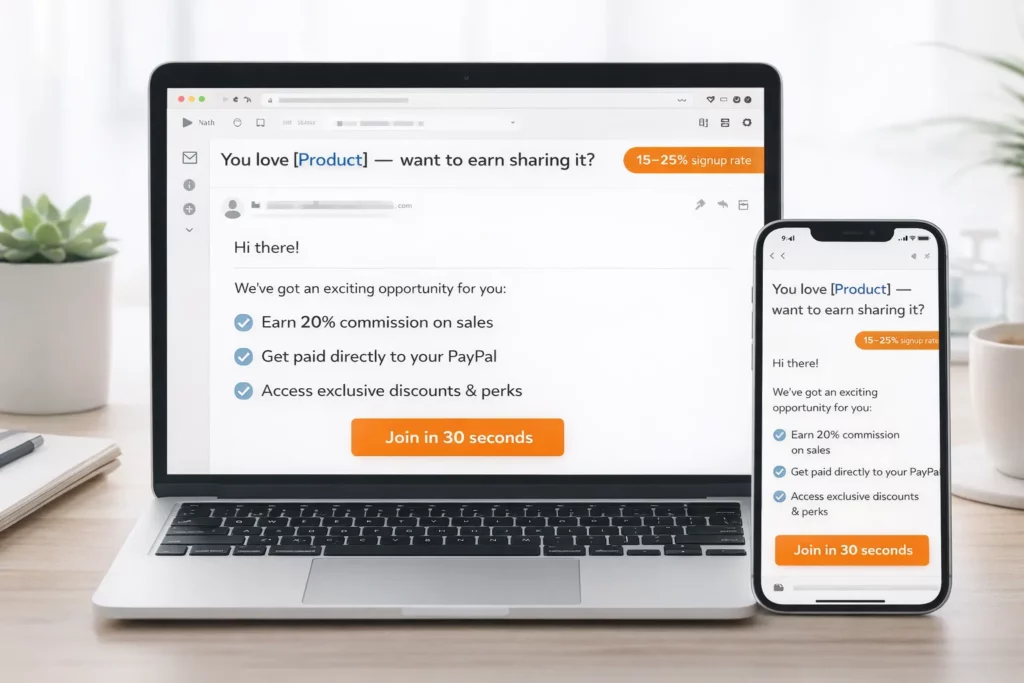
Subject: You love [product] — want to earn sharing it?
Hi [First Name],
I noticed you’ve ordered [product] [X] times — thank you for being such a loyal customer!
We just launched an affiliate program, and I think you’d be a great fit. Here’s how it works:
- You get a unique link and discount code
- Share with friends, social media, or blog
- Earn [X]% commission on every sale (paid monthly via PayPal)
As a valued customer, you’ll get [X+5]% — higher than our standard rate.
Interested? Sign up here in 30 seconds: [Link] [Your name] [Brand name]
This template averages a 15–25% signup rate with a 45–55% open rate. The higher-than-standard commission offer drives conversion – it signals that you value the customer relationship.
Template #2: Blogger Cold Outreach
Cold emails to bloggers live or die on personalization. The first sentence must prove you read their work — generic openers like “I love your blog” get deleted on sight.
Subject: Collaboration invitation: [Commission]% affiliate partnership for [Blog Name]
Hi [Name],
I found your post “[Specific Article Title]” and loved
your take on [specific point]. Your readers clearly
trust your recommendations.
I run [Brand Name], a Shopify store selling [products]. I think your audience would love our [specific product], and I’d love to set you up as an affiliate partner.
Here’s what we offer:
- [X]% commission on every sale (avg. $[X] per sale)
- [X]-day cookie window
- Free [product] for you to test
- Custom discount code for your readers
Are you interested? Happy to send a free sample so you can try it first.
[Your name]Response rates fall between 5–8% when the first sentence references a specific article. Without that personalization, you can expect 1–2%.
Template #3: Influencer DM (Instagram/TikTok)
DMs play by different rules than email. They need to feel casual, be scannable in a few seconds, and stay under 50 words. Anything longer gets ignored, influencers receive dozens of pitches daily.
Hey [Name]! 👋
Huge fan of your [specific content type]. Especially
loved [specific post/video].
We make [product], and I think your audience would really vibe with it. Want to try it free + earn [X]% commission as an affiliate?
DM me or email [email] and I’ll ship one to you! 🎁
This format pulls an 8–12% response rate. The key is referencing a specific post — it separates your DM from the mass-blast pitches cluttering their inbox.
Template #4: Competitor’s Affiliate Pitch
Reaching out to someone who promotes a competitor requires a specific tone: respectful of their existing partnerships and focused on “additional,” not “replacement.”
Subject: Wanna earn an additional income stream? [Your Brand] affiliate program
Hi [Name],
I saw your review of [Competitor Product] on [Platform], super great content!
I run [Brand Name]. We offer a similar product in the [niche] space, and many affiliates promote both our brand and [Competitor] to give their audience options.
Our affiliate program offers:
- [X]% commission (compared to [Competitor]’s [Y]%)
- [X]-day cookie window
- Free product to review
- Dedicated affiliate support
Would you be open to adding us alongside your current
partnerships? Happy to send a free sample.
[Your name]Expect a 4–6% response rate. The comparison line works best when your rate matches or beats the competitor’s. If it doesn’t, lead with cookie duration or product quality instead.
Template #5: Post-Purchase Follow-Up (24h After Delivery)
This template catches customers at their most enthusiastic — right after they’ve received and tried your product. The 60–70% open rate (Omnisend data) makes it the most-opened message in this set.
Subject: Love [product]? Earn money by sharing it 💰
Hi [First Name],
Hope you’re enjoying your [product]! Quick question:
Have you told any friends about it yet?
If so, we’d love to pay you for it. Our affiliate program gives you [X]% commission every time someone buys through your link.
Takes 30 seconds to join: [Link]
Already joined? You’ll earn even more with our auto-tier system — commissions increase as you refer more customers.
[Brand name]Signup rates land at 10–15%. The auto-tier mention at the end serves double duty, giving existing affiliates a reason to re-engage and showing new signups that there’s room to grow.
If you use UpPromote, the auto-tier commission feature automatically handles progression based on performance milestones you define.
Template #6: Inactive Affiliate Re-Activation
This template targets affiliates who joined but never shared their link — typically 60–70% of your roster.
Subject: We miss you + a special bonus inside
Hi [Name],
We noticed you joined our affiliate program [X] months ago but haven’t shared your link yet. No worries — we want to make it easier for you.
Here’s what we’ve added since you joined:
- New product: [Product Name] (our bestseller)
- Updated media kit with ready-to-post graphics
- Bonus: Earn double commission ([2X]%) for the next 30 days
Your unique link: [Link]
Your discount code: [Code]
Need help getting started? Reply to this email and I’ll personally walk you through it.
[Your name]Re-engagement rates average 5–10%. The double commission offer, available for a limited window, is the most effective trigger.
Key Takeaway:
Every template stays under 150 words. Everyone offers something tangible — a free product, a higher commission, an exclusive code. Personalization (a specific purchase, a specific article, a specific post) converts 3× higher than generic outreach. And one follow-up email 5–7 days later increases response rates by 40%.
How to Vet and Approve Affiliates (Checklist + Red Flags)
Not every affiliate is a good fit for your brand. Approving the wrong ones leads to wasted commissions, brand damage, and fraud.
The fix is a structured vetting process built on eight criteria: audience relevance, content quality, engagement rate, posting frequency, brand alignment, follower authenticity, previous affiliate experience, and FTC compliance.
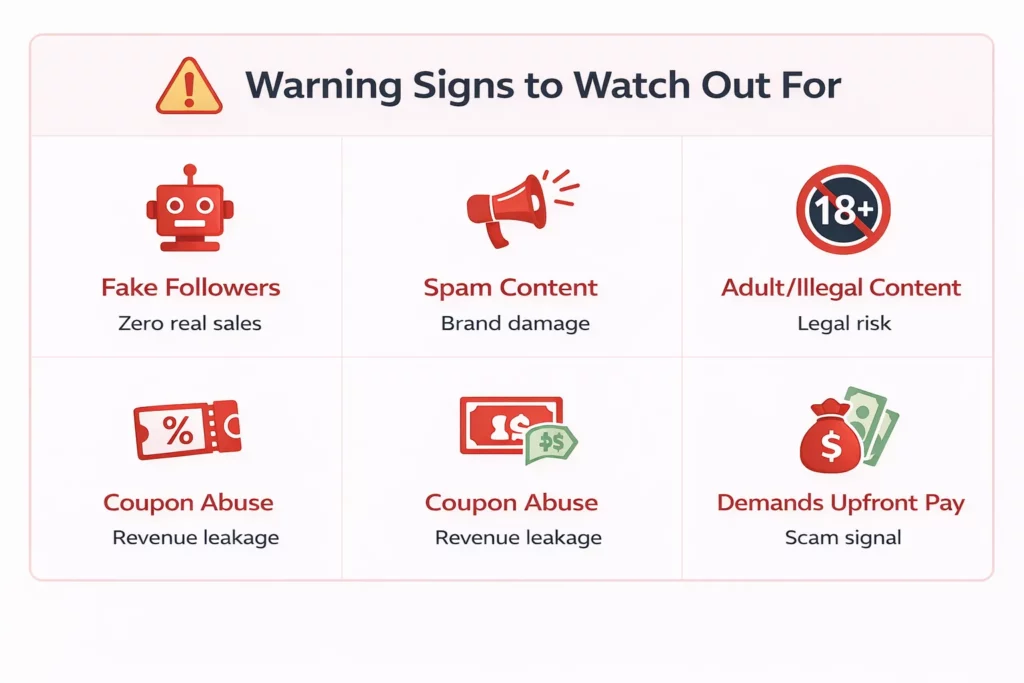
Five red flags should trigger an immediate rejection: fake followers, spam content, adult/gambling sites, coupon abuse history, and demands for upfront payment.
The good news: five to ten minutes per application is enough if you know what to look for.
The 8-Point Vetting Checklist
The checklist works for any affiliate type — bloggers, influencers, customers, or marketplace applicants.
Not every criterion needs a perfect score, but the first three (audience relevance, content quality, engagement rate) are non-negotiable.
| # | Criterion | Pass | How to Check |
| 1 | Audience relevance — their followers match your niche | ☐ | Review their last 10 posts. Is the content related to your product category? |
| 2 | Content quality — professional, original, not spammy | ☐ | Scroll their feed. Does the content show effort, or is it all reposts and stock images? |
| 3 | Engagement rate — ≥2% on Instagram, ≥1% on YouTube | ☐ | (Likes + comments) ÷ followers. Tools: HypeAuditor, Social Blade |
| 4 | Posting frequency — at least 2 posts per week | ☐ | An active account means active promotion. Dormant accounts won’t drive sales. |
| 5 | Brand alignment — tone and values match yours | ☐ | Look for anything that conflicts with your brand: controversial takes, offensive content, political extremes. |
| 6 | Follower authenticity — real people, not bots | ☐ | Sudden follower spikes, generic emoji-only comments, and abnormal follower-to-following ratios are warning signs. |
| 7 | Previous affiliate experience — helpful but not required | ☐ | Ask in your application form: “Have you promoted other brands before? If so, which ones?” |
| 8 | FTC compliance awareness — knows how to disclose | ☐ | Check their past sponsored posts. Do they use #ad or #sponsored? If not, you’ll need to educate them during onboarding. |
Most affiliate apps, including UpPromote, let you review each application individually before approving.
The affiliate profile shows social links, website, and audience details in one view — much faster than checking each platform manually.
5 Red Flags That Mean Immediate Rejection
Some applications aren’t worth a second look. These five patterns indicate either fraud or brand risk – reject them on the spot.
| Red Flag | Why It’s Dangerous | Action |
| Fake followers (purchased bots) | Fake traffic, zero sales, wasted commission budget | Reject |
| Spam content (20+ posts/day, all promotions) | Damages your brand by association | Reject |
| Adult, gambling, or illegal content | Legal liability for your brand | Reject |
| Coupon abuse history (posting codes on coupon aggregator sites) | Revenue leakage — those “sales” didn’t come from real affiliate effort | Reject |
| Demands upfront payment to join | Affiliate marketing is pay-for-performance. Anyone asking for money to “join” is a red flag. | Reject |
You don’t need to catch every red flag manually.
UpPromote’s fraud detection feature flags suspicious signups before they reach your review queue – same-IP registrations, disposable emails, self-referrals, and abnormal order patterns.
When to Approve Even If the Application Isn’t Perfect
A strict checklist is useful, but being too strict can filter out high-potential partners. Three situations where it’s worth approving despite an imperfect profile:
Micro-influencer with 1K–5K followers but 5%+ engagement rate. A small, engaged audience converts better than a large, fake one. These affiliates often outperform bigger names within 3–6 months.
Customer with no social media presence but an email list of 500+. Email consistently outperforms social media for affiliate-driven conversions. Don’t overlook it as a channel.
Beginner with no affiliate experience but a genuine passion for your niche. Pair them with extra onboarding support (see the 7-day onboarding framework below). First-time affiliates who feel invested in your brand often become your most loyal long-term partners.
How to Onboard New Affiliates for Maximum Activation (7-Day Framework)
Affiliates who receive an onboarding email within the first 48 hours have an activation rate 3x higher than those left to figure things out on their own (UpPromote data, 2024-2025).
The difference isn’t the email itself, it’s what comes after.
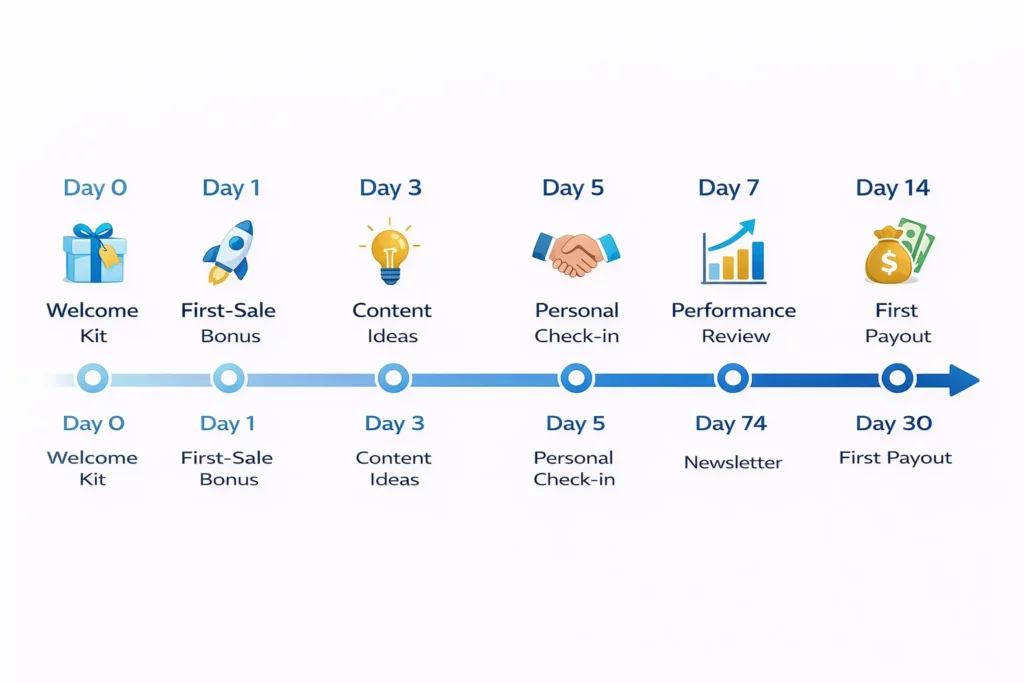
A structured 7-day framework turns signups into sellers:
- Welcome kit on Day 0
- First-sale incentive on Day 1
- Content ideas on Day 3
- Personal check-in on Day 5
- Performance review on Day 7.
Most merchants invest hours recruiting affiliates and then go silent after approval. That silence is where activation dies.
The 7-Day Onboarding Framework
Each touchpoint in this framework has a specific job – from removing friction on Day 0 to building momentum by Day 7.
The full sequence extends to Day 30, when a timely first payout cements the relationship.
| Day | Action | Purpose | What to Send |
| 0 | Welcome email + full access to materials | Affiliate has everything they need immediately | Welcome kit: link, code, images, brand guide, payout info |
| 1 | First-sale incentive | Create urgency and early momentum | “Earn double commission on your first 5 sales this week” |
| 3 | Content ideas + best practices | Help affiliates who don’t know where to start | “5 easiest ways to share: Instagram story, blog review, email list, TikTok, DM to friends” |
| 5 | Personal check-in: “Need any help?” | Solve blockers before they cause drop-off | Personal email or DM — ask something specific, not generic |
| 7 | Performance review + next steps | Celebrate early wins, encourage slow starters | “You’ve generated [X] clicks! Here’s how to convert them to sales…” |
| 14 | Monthly newsletter or community invite | Build long-term engagement | Affiliate newsletter: top earners, new products, seasonal tips |
| 30 | First payout + feedback request | Cement the relationship and gather insights | Pay on time. Ask: “What would make our program better?” |
The single biggest mistake in this sequence is skipping Day 5.
That personal check-in is where you catch affiliates who signed up with good intentions but hit a wall. They couldn’t find their link, didn’t know what to post, or weren’t sure how commissions work.
A short, specific message (“Have you had a chance to share your link yet? Happy to help with content ideas“) recovers more inactive affiliates than any re-activation email sent months later.
What to Include in Your Welcome Kit
The Day 0 welcome kit is the most important deliverable in this entire framework.
It needs to answer every question an affiliate might have before they ask, so nothing slows them down between approval and their first promotion.
A complete kit includes seven elements:
- Affiliate dashboard login link — immediate access, no waiting
- Unique referral link + unique coupon code — ready to share from minute one
- Product images — 10 – 15 lifestyle and product shots, high-res, optimized for social media dimensions
- Brand guidelines — tone of voice, approved claims, and FTC disclosure requirements
- FAQ — commission rates, cookie duration, payout schedule, available payment methods
- Support contact — who to reach out to when they need help (email, chat, or Slack channel if available)
- First-sale bonus details — “Earn [2X]% commission on your first 5 sales within 7 days”
Having marketing materials ready upfront makes a measurable difference.
Affiliates with access to a pre-built media gallery generate 60% more sales than affiliates who create their own content from scratch (UpPromote data, 2025–2026).
If you use UpPromote, the media gallery feature lets you upload banners, product shots, and videos that affiliates can download from their dashboard, no back-and-forth email threads needed.
→ Deep dive: How to Create an Affiliate Welcome Kit
The 90-Day Affiliate Recruitment Plan (Week-by-Week)
A 90-day plan to recruit 50–100 active affiliates breaks into three phases.
Month 1 focuses on foundation and your first 20 affiliates from customers and social followers — the highest-converting channels.
Month 2 scales outreach to bloggers, YouTube creators, and marketplaces for 30 more.
Month 3 shifts to optimization: reactivating inactive signups, incentivizing top performers, and building a repeatable process that runs without you.
The logic behind this sequence is simple: start with the channels that convert the highest and cost nothing, then expand to channels that require more effort but deliver higher volume.
| Week | Actions | Cumulative Signups | Priority Channels |
| 1 | Set up program, prepare marketing materials, list on marketplace | 0 (prep) | — |
| 2 | Email top 50 customers + DM 20 social media taggers | 10–15 | Customers, Social taggers |
| 3 | Launch post-purchase enrollment + email next 50 customers | 15–25 | Post-purchase, Customers |
| 4 | Send 50 blogger cold emails + list on 2 additional marketplaces | 25–35 | Bloggers, Marketplaces |
| 5–6 | 50 more blogger emails + outreach to 20 YouTube creators | 35–50 | Bloggers, YouTube |
| 7–8 | Research competitor affiliates + send 30 outreach emails | 50–65 | Competitor affiliates |
| 9–10 | TikTok creator outreach (20) + podcast hosts (10) | 65–80 | TikTok, Podcasts |
| 11–12 | Re-activate inactive affiliates + optimize top performer incentives | 80–100 | Re-activation |
| 13 | Review 90-day results + document repeatable process | 50–100 active | All channels |
📝Notice the pattern: weeks 1–3 are free and relationship-based. Paid or high-effort channels (events, podcasts) don’t appear until the program already has momentum and early revenue to reinvest.
What to Expect After 90 Days
Results depend on how hard you execute.
The table below shows three realistic scenarios based on an average order value of $50–75, a 15% commission rate, and a 20–30% active rate (signups who generate at least one sale per month).
| Metric | Conservative | Average | Aggressive |
| Total signups | 60 | 100 | 200 |
| Active affiliates (≥1 sale/mo) | 15 (25%) | 25 (25%) | 50 (25%) |
| Monthly affiliate revenue | $1,500–3,000 | $3,000–8,000 | $8,000–20,000 |
| % of total store revenue | 5–8% | 8–15% | 15–25% |
The 25% active rate is the most important number in this table. It means roughly 1 in 4 signups will generate sales.
That’s why the recruitment volume in the timeline above targets 60–200 total signups rather than 15–50. You’re building a pipeline, not a finished team.
How Many Affiliates Do You Actually Need?
The number of affiliates you need depends on your revenue target.
A useful rule of thumb: each active affiliate generates an average of $200–500 per month in referred revenue. Working backward from your goal tells you how many to recruit.
Revenue-to-Affiliate Calculator
| Revenue Target | Active Affiliates Needed | Total Recruits (25% active rate) | Timeline |
| $1,000/mo | 5–10 | 20–40 | 1–2 months |
| $5,000/mo | 10–25 | 40–100 | 2–4 months |
| $10,000/mo | 20–50 | 80–200 | 3–6 months |
| $20,000/mo | 40–100 | 160–400 | 6–12 months |
| $50,000+/mo | 100–250 | 400–1,000 | 12–24 months |
Assumes: average AOV $60, 15% commission, 3–8 sales per affiliate per month.
The “Total Recruits” column is the one most merchants underestimate.
With a 25% active rate, reaching $5,000 per month in affiliate revenue means recruiting 40–100 affiliates total, not 10–25. That gap is why the 90-day plan in Section 6 targets high recruitment volume from the start.
Why 50 Quality Affiliates Beat 500 Inactive Ones
The Pareto principle holds in affiliate marketing: 20% of affiliates generate 80% of revenue.
Rather than chasing a large headcount, the highest-ROI move is investing in your top performers.
That means exclusive commission tiers, monthly communication with new product previews, and personal relationships where you know their audience.
Case study: Kess Berlin drove 44,000+ referrals from just 44 active influencers — roughly 1,000 referrals per creator. They screened for brand-fit influencers and offered both commissions and flat fees per post, proving that a small, quality roster outperforms a large, passive one.
The same pattern shows up at scale. Saledress generated over $1.8M in affiliate revenue from 30K referral orders using auto-tier commissions to reward top performers with higher rates.
What Changed in Affiliate Recruitment in 2026?
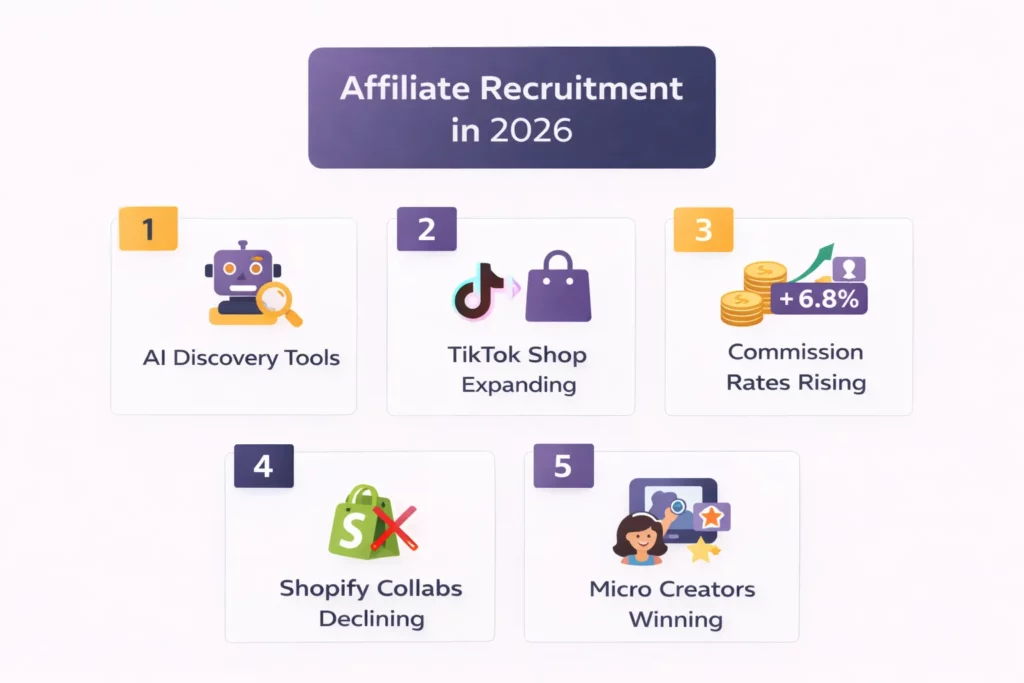
Five shifts are reshaping how merchants find and recruit affiliates in 2026: AI-powered discovery tools, TikTok Shop’s expanding creator marketplace, rising commission rates, the decline of Shopify Collabs, and a broad shift from macro-influencers toward micro and nano creators.
1. AI-powered affiliate discovery
Finding the right affiliates used to mean hours of manual research — scrolling through social profiles, checking engagement rates, evaluating audience overlap. That’s changing fast.
As of 2026, 79.3% of affiliate marketers have adopted AI tools to automate this process (Authority Hacker). These tools analyze creator profiles, content quality, and audience demographics to surface best-fit candidates in minutes rather than days.
2. TikTok Shop’s creator marketplace is expanding
With 51.9% of businesses now using TikTok Shop (Influencer Marketing Hub), the platform’s creator marketplace has become a significant recruitment channel.
Creators on TikTok Shop are already familiar with the affiliate model — they understand commission structures, tracking links, and performance-based payouts. That familiarity makes your initial pitch much easier.
3. Commission rates are climbing
Affiliate commission rates aren’t static. Variable rates increased 6.8% year over year (Partnerize), and 85% of publishers now say a higher commission rate is their top criterion when choosing programs (CJ Affiliate, 2025).
Merchants who set their rates based on 2023 benchmarks are losing quality affiliates to competitors who’ve adjusted upward.
4. Shopify Collabs is losing ground
Shopify’s built-in affiliate tool has dropped to a 2.4★ rating on the App Store. Many merchants and affiliates who relied on Collabs are migrating to third-party apps like UpPromote that offer deeper feature sets, better support, and more reliable tracking.
That migration creates an opportunity: affiliates leaving Collabs are looking for new programs to join.
5. Micro and nano creators are outperforming macro-influencers
Brands are collaborating with 33% more micro-influencers year over year (Shopify, 2025). The reason is performance: creators with 1K–10K followers deliver engagement rates 3–5× higher than macro-influencers, at a fraction of the cost.
For affiliate recruitment, micro-creators are easier to reach, more responsive to outreach, and more likely to maintain a genuine, long-term partnership with your brand.
Frequently Asked Questions
How long does it take to recruit 50 active affiliates?
Most Shopify stores starting from zero reach 50 active affiliates within 2–4 months. The typical trajectory: 10–15 from customers and social followers in month one, then 20–30 more from bloggers, YouTube creators, and marketplaces in months two and three.
The key expectation to set early is the active rate — on average, 20–30% of signups will generate at least one sale. That means you need roughly 170–250 total signups to end up with 50 who produce revenue.
Should I recruit affiliates before or after my store has consistent orders?
After. Your store needs at least 50 orders per month and a conversion rate above 1% before affiliate recruitment makes sense.
Here’s why: affiliates drive traffic — they don’t fix a conversion problem. If visitors land on a store that doesn’t convert, affiliates won’t earn commissions, and they’ll abandon your program within weeks. Product-market fit first, affiliate program second.
Should I pay affiliates an upfront fee to join?
No. Affiliate marketing is a pay-for-performance model. Anyone requesting money upfront to “join” your program is a red flag — legitimate affiliates earn through commissions, not sign-up fees.
One important distinction: product gifting is not an upfront fee. Sending a free product for an influencer to review before promoting is a standard and worthwhile investment. Paying someone to sign up is not.
How can I tell if an affiliate has fake followers?
Five signs to watch for:
- Sudden follower spikes of 1,000+ per day with no corresponding viral content
- Engagement rates below 1% despite a large follower count
- Comments that are all generic emojis or phrases like “nice!” and “great pic!”
- An abnormal follower-to-following ratio (10K followers but following 0 accounts)
- Story or reel views that are far too low compared to follower count
Tools like HypeAuditor, Social Blade, and Modash can automate this analysis and flag suspicious accounts before you approve an application.
How many affiliates should I recruit per month?
In the first three months, aim for 20–30 signups per month — which translates to roughly 5–8 new active affiliates monthly at a 25% active rate.
After that initial push, it’s more effective to reduce recruitment to 10–15 signups per month and shift your energy toward retaining existing affiliates and optimizing your top performers.
The math shows the same thing: 25 active affiliates producing consistent sales generate more revenue than 250 signups who never post.
Should I use an affiliate marketplace or recruit manually?
Both — but in different proportions. Marketplaces handle passive recruitment: affiliates discover your program and apply on their own. Manual outreach handles targeted recruitment: you choose who you want and pitch them.
The recommended effort split is 30% marketplace, 70% manual outreach. This balance matters most in the first six months. Without social proof — top earner stats, recognizable affiliates — marketplace listings won’t be compelling on their own.

Ellie Tran, a seasoned SEO content writer with three years of experience in the eCommerce world. Being a part of the UpPromote team, Ellie wants to assist Shopify merchants in achieving success through useful content & actionable insights. Ellie's commitment to learning never stops; she's always eager to gain more knowledge about SEO and content marketing to create valuable content for users. When she's not working on content, Ellie enjoys baking and exploring new places.