

Every e-commerce merchant knows the sinking feeling of checking an ad dashboard: high spend, plenty of clicks, but zero sales. In traditional advertising models like CPC (Cost Per Click) or CPM (Cost Per Mille), you assume all the financial risk. You pay for the opportunity to sell, not the sale itself.
But what if you could flip that equation? What if you never paid a cent for marketing until the cash was already in your register?
This is the promise of CPA (Cost Per Acquisition) Affiliate Marketing. Unlike vague brand awareness campaigns, CPA is a ruthless performance engine. It shifts the risk from your budget to your partners, ensuring that every marketing dollar you spend is tied directly to a tangible result.
However, running a CPA program isn’t as simple as flipping a switch. It requires precise math, smart fraud protection, and the right infrastructure. This guide will walk you through exactly how to build a CPA strategy that protects your margins while scaling your growth.
What Is CPA Affiliate Marketing, Exactly?
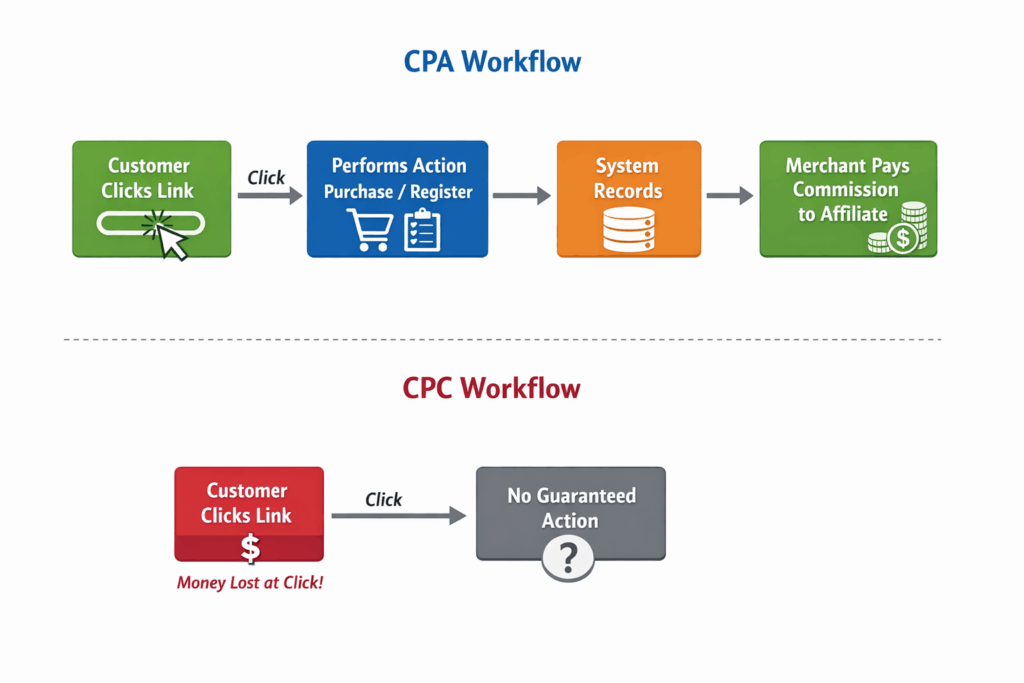
CPA affiliate marketing is a performance-based partnership model in which merchants pay a commission only when an affiliate drives a pre-defined conversion — typically a completed purchase, a form submission, or a new customer account.
The “acquisition” in CPA refers to whatever action holds business value for you as a merchant. In e-commerce, that’s almost always a sale. In SaaS, it might be a free trial sign-up. In financial services, it’s often a completed application.
Here’s what makes this model structurally different from other advertising:
- You set the price of an acquisition upfront. If you decide a new customer is worth $15 in commission, you pay exactly that — regardless of how many clicks, impressions, or sessions the affiliate generated to get there.
- Affiliates absorb the distribution cost. They create content, run paid traffic, send emails, or leverage their audience — and only get paid when it works.
- Your CAC becomes predictable. No performance variance from impression-based campaigns. No CPC charges for unqualified traffic. Just a fixed cost per outcome.
This is why CPA programs are structurally superior for merchants who want to scale partner channels without scaling risk.
How Does CPA Affiliate Marketing Work? (The Merchant’s Operational View)
CPA affiliate marketing operates through a straightforward but precision-dependent system. Understanding each component helps merchants avoid the setup mistakes that lead to poor partner quality or margin erosion.
Step 1: Define Your CPA Event and Target Cost
Before recruiting a single affiliate, establish:
- What counts as an “acquisition”? (First purchase only? Any order? Subscription sign-up?)
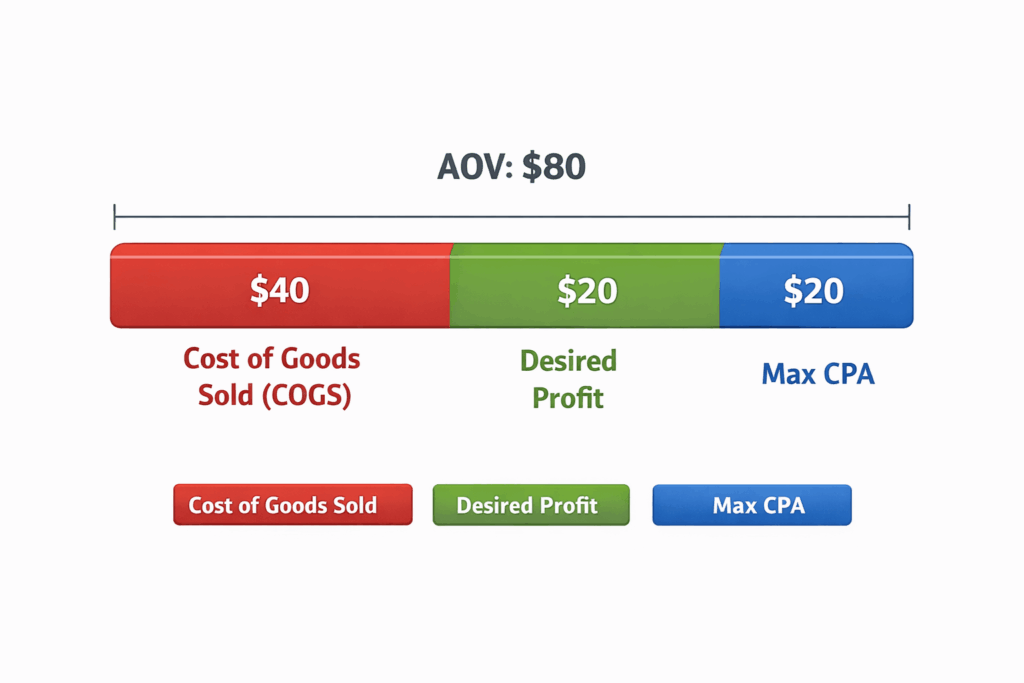
- What is your maximum allowable CPA? This is calculated from your margins, AOV, and customer LTV:
Max CPA = (AOV × Gross Margin %) − Desired Net Margin per Order
Example: If your AOV is $80, gross margin is 55%, and you want to retain at least 35% margin after commission, your max CPA is approximately $16.
Getting this number wrong is the most expensive mistake in CPA program management.
Step 2: Choose a Tracking Infrastructure
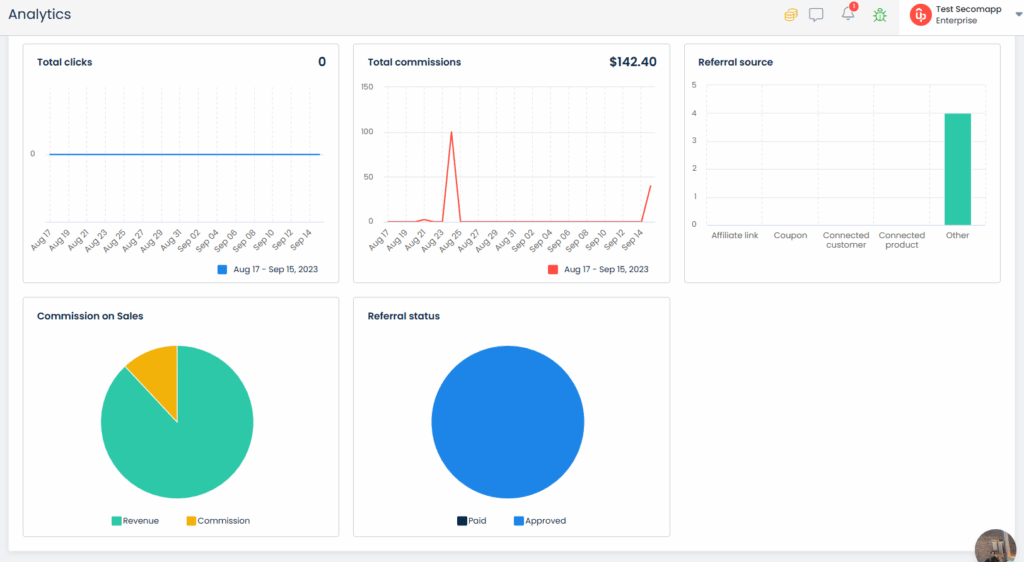
CPA programs need accurate tracking that prevents fraud. You generally have two options:
- Management Platforms: Apps like UpPromote (for Shopify) integrate directly with your store. They automatically handle click tracking and commission calculations for you.
- Affiliate Networks: Large networks like ShareASale, CJ, or Impact connect you with an existing audience of affiliates. However, they usually charge an extra fee on every sale.
Tip: Most merchants start with a management platform to keep costs low, then join networks later to scale up.
Step 3: Recruit and Qualify Affiliates
Not all traffic sources convert equally. A CPA model exposes this immediately — partners who can’t convert don’t earn. This creates natural selection, but also means you need to attract quality partners proactively:
- Identify affiliates with demonstrated conversion track records in your niche
- Prioritize content creators and review sites over pure coupon/cashback aggregators
- Offer competitive-but-sustainable commission rates to earn top partners’ attention
Step 4: Set Attribution Rules
Attribution is where CPA programs get complex. Define clearly:
- Cookie window: How long after a click does a conversion credit the affiliate? (30, 60, or 90 days?)
- Last-click vs. multi-touch: Most programs use last-click. If an affiliate’s link is the final touchpoint before purchase, they earn the commission.
- New customer vs. all customers: Many merchants only pay CPA on net-new customer acquisitions to avoid commissioning repeat purchases that would have happened organically.
Step 5: Monitor, Audit, and Optimize
A CPA program without active management becomes a liability. Regular tasks include:
- Reviewing conversion rate by partner to identify underperformers and fraudulent traffic
- Auditing coupon code usage to ensure commissions align with genuine acquisition
- Adjusting commission tiers based on partner volume and quality
CPA vs. Other Affiliate Commission Structures: When to Use Each
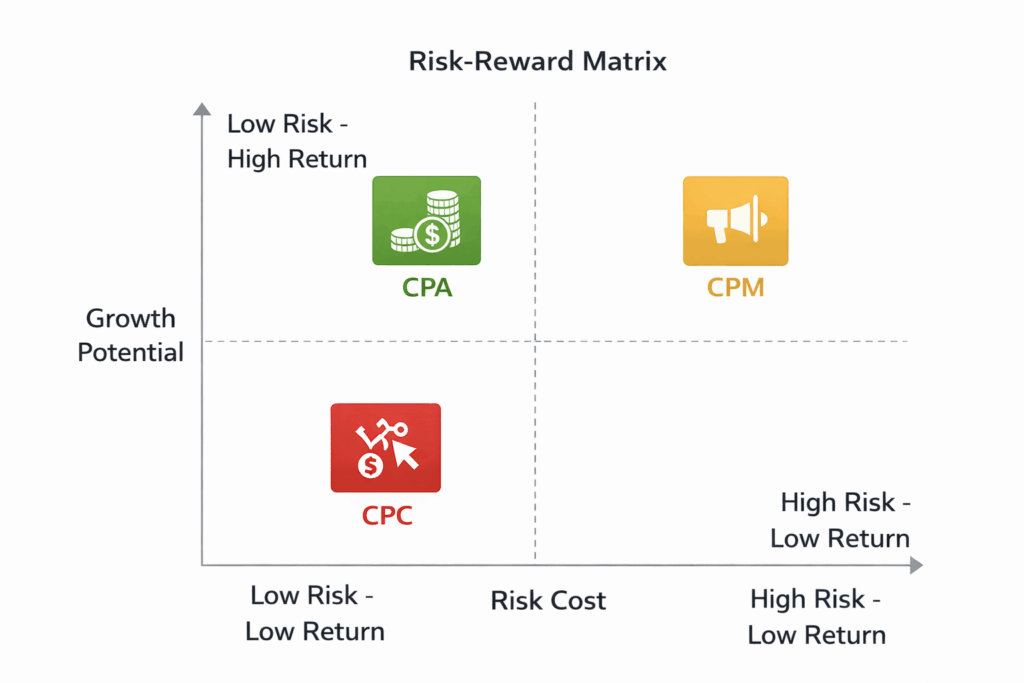
| Model | Merchant Pays For | Risk Level | Best For |
| CPA (Cost Per Acquisition) | Completed purchase or lead | Low | Merchants prioritizing CAC control and guaranteed ROI |
| CPC (Cost Per Click) | Each click to your site | High | Traffic campaigns where conversion optimization is internal |
| CPL (Cost Per Lead) | Form submissions, sign-ups | Medium | SaaS, services, lead-gen businesses |
| Revenue Share (%) | % of each sale generated | Low-Medium | High-AOV merchants, subscription businesses with strong LTV |
| Hybrid (CPA + RevShare) | Fixed acquisition + ongoing % | Low | Subscription merchants wanting to incentivize retention |
The right model depends on your margin structure and what behavior you want to reward. Pure e-commerce stores with single-purchase customers typically do best with flat CPA or revenue share. Subscription merchants benefit from hybrid structures that incentivize affiliates to send customers who actually retain.
David from a leading Google Ads agency notes that, “Choosing the right commission structure isn’t just about payouts. It’s about creating incentives that attract the right affiliates and the right customers.”
What Commission Rate Should You Set for CPA?
You need a rate that attracts top partners but still leaves you with a profit. Since every business has different margins, there is no “one size fits all” number.
Use this framework to find your rate:
- Find your Break-Even Point: Calculate how much you can pay before you stop making money (Sales Price minus Cost of Goods and Shipping).
- Set Your Limit: Decide the maximum you are willing to pay while still hitting your profit goals.
- Check Competitors: Look at what others in your niche are paying. If your rate is much lower than theirs, top affiliates will likely ignore you.
- Use Tiered Rates: Start new partners on a base rate, but offer higher rates to those who bring in high volume (e.g., 20+ sales a month).
Tip: Platforms like UpPromote can automate these tiers for you. As partners hit specific sales targets, the system automatically moves them to a higher commission level, saving you time.
The Risk Architecture of CPA Programs: What Can Go Wrong
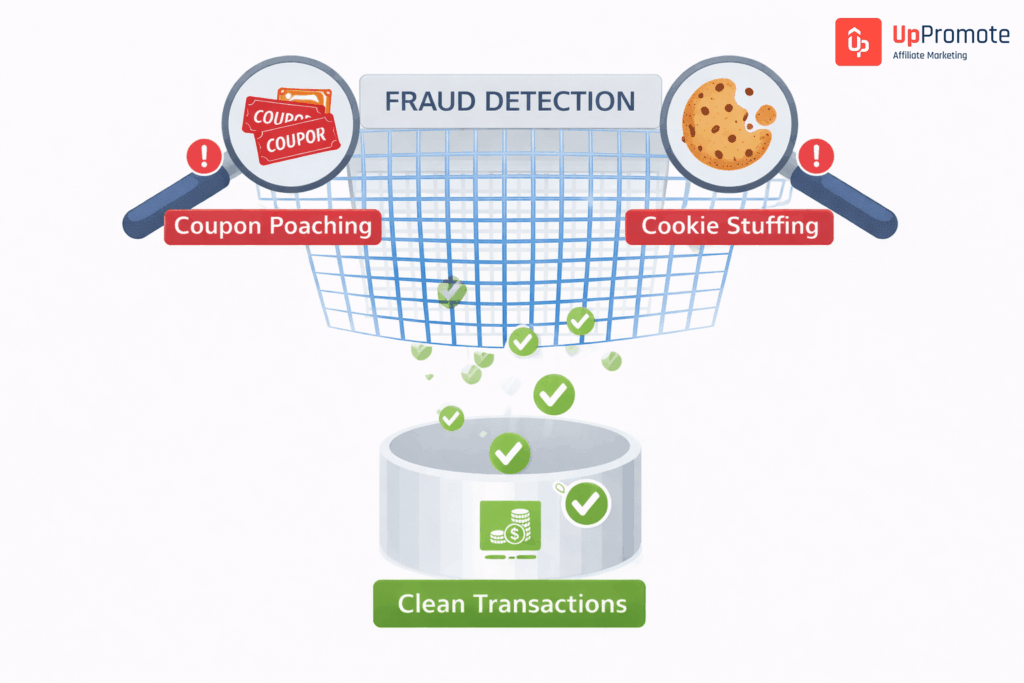
CPA programs are profitable, but they aren’t risk-free. Here are the four most common ways merchants lose money and how to stop them.
1. Coupon “Poaching” Coupon sites often claim credit for customers who were already at your checkout and just went searching for a discount code. You end up paying a commission for a customer you already had.
- The Fix: Check the data. If a partner’s conversion rate is suspiciously high (3–5x your average), restrict their access to coupon codes or block them.
2. Cookie Stuffing (Fraud) Dishonest affiliates use scripts to force a tracking cookie onto a visitor’s browser without them clicking a link. This lets them claim commissions on your organic sales.
- The Fix: Use a platform with built-in fraud detection. Watch out for affiliates with high sales but very low time-on-site metrics.
3. Losing Margins on Small Orders If you pay a flat fee (e.g., $10 per sale) and a customer places a small order (e.g., $15), you lose money.
- The Fix: Switch to a percentage-based commission (Revenue Share) or require a minimum order value to trigger a payout.
4. Windows That Are Too Long If a customer usually buys within 2 weeks, but your tracking window is 90 days, you might pay an affiliate for a sale they didn’t really influence.
- The Fix: Match your “cookie window” to your sales cycle. For most products, 14–30 days is accurate.
Scenario: How a DTC Merchant Structures a Profitable CPA Program
Situation: A DTC skincare brand on Shopify has an AOV of $65 and a gross margin of 60%. Their current CAC through paid social is $28.
Goal: Build an affiliate program that drives new customers at a CAC below $20, freeing budget from paid channels.
Program structure:
- CPA rate: $14 per new customer (flat fee, first purchase only)
- Attribution: 30-day last-click
- Eligibility: Net-new email addresses only, tracked via post-purchase customer match
- Coupon policy: No public coupons. Affiliates offer exclusive 10% discount codes tied to their unique tracking link.
- Platform: UpPromote, integrated with Shopify for automated commission payouts and fraud monitoring
Outcome after 90 days:
- 22 active affiliates recruited (content creators, skincare review sites, YouTube influencers)
- Average CPA: $16.40 — 41% below paid social CAC
- 3 coupon affiliates identified and terms renegotiated after audit showed zero incremental lift
- Top 3 affiliates driving 68% of affiliate-attributed revenue — focus shifted to growing these partnerships
This isn’t a hypothetical edge case. It’s the operating reality for brands that treat CPA programs as engineered revenue systems, not passive referral links.
Decision Framework: Is CPA the Right Affiliate Model for Your Business?
Use this framework to determine your best starting structure:
Choose CPA if:
- You have a single-purchase product or clear conversion event
- Your margins can absorb a fixed per-acquisition fee at scale
- You want maximum CAC predictability
- You’re concerned about paying for unqualified traffic
Choose Revenue Share if:
- You have high AOV with variable order sizes
- You sell subscriptions or have strong repeat purchase behavior
- You want affiliates financially motivated by LTV, not just first orders
Choose Hybrid CPA + RevShare if:
- You sell subscriptions and want to reward both acquisition and retention
- Your average LTV justifies a larger total commission spread over time
Start with CPA if you’re launching your first affiliate program. It’s the most transparent model for both parties, easiest to explain to new partners, and gives you the clearest performance data in the first 90 days.
Conclusion: CPA Affiliate Marketing Is a Revenue Engineering Problem
Many businesses see CPA affiliate marketing as just another way to advertise. However, successful merchants treat it as a “revenue engineering” challenge. This means focusing on accurate profit calculations, solid tracking, attracting the right partners, and constantly preventing fraud.
The concept of CPA is simple: you only pay for results. But your execution will decide if your program becomes a reliable source of new customers or just a costly liability.
The strategic next step: Calculate your maximum allowable CPA today. Then assess whether your current affiliate setup — or the one you’re building — is designed to operate within that number at scale. If you’re not sure, that’s the gap to close first.


![How to Recruit Affiliates for Your Shopify Store: The Complete Recruitment Playbook [2026]](https://static.uppromote.com/wp-content/uploads/2026/04/how-to-recruit-affiliates-for-your-shopify-store-300x169.webp)