


You’ve spent weeks recruiting top-tier affiliates and polishing your products—only to watch your new partners vanish before they share a single link.
For most e-commerce brands, the biggest “leak” happens in the first 72 hours. When ambassadors are met with generic portals and unbranded links, confusion kills their momentum.
The fix isn’t more emails; it’s white-labeling your affiliate experience. By extending your brand into every partner touchpoint, you can double your activation rates and stop losing revenue to “onboarding friction.”
Why Merchants Lose Affiliates Before They Even Start
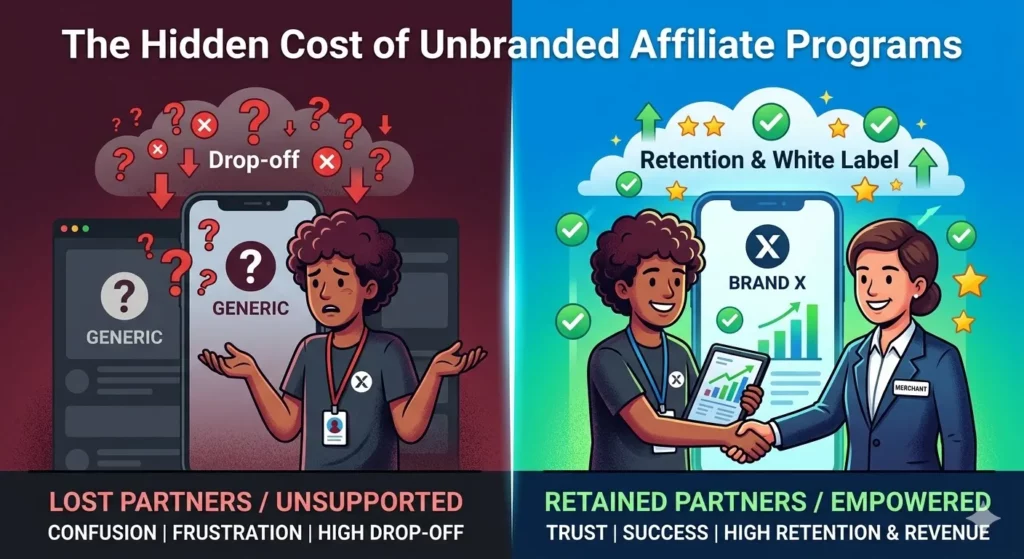
Most e-commerce merchants discover affiliate program attrition not in recruiting — but in the first 72 hours after affiliate onboarding.
Here’s the typical failure loop:
- Merchant signs up for an affiliate network or generic SaaS platform.
- Affiliates receive welcome emails from a third-party domain with a logo they don’t recognize.
- Affiliates land on a portal branded to the software vendor — not the merchant.
- Confusion, distrust, or disengagement kills activation before the first link is ever shared.

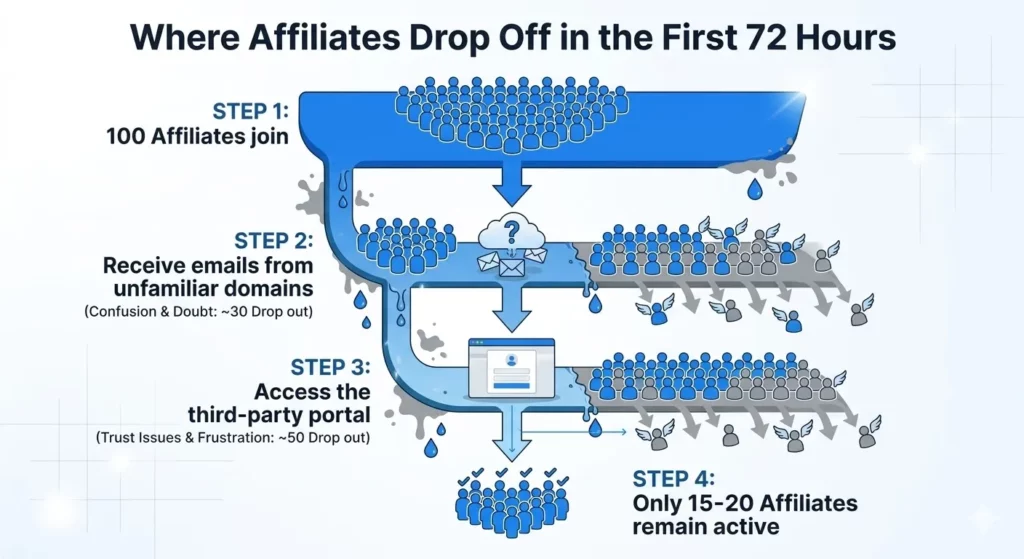
This isn’t speculation. It’s a structural onboarding problem that costs merchants real GMV.
The fix isn’t purely operational — it’s brand architecture. A white label affiliate software solution solves this by extending your brand identity into every affiliate touchpoint: the portal, emails, tracking domain, payout notifications, and program dashboard.
What Is White Label Affiliate Software?
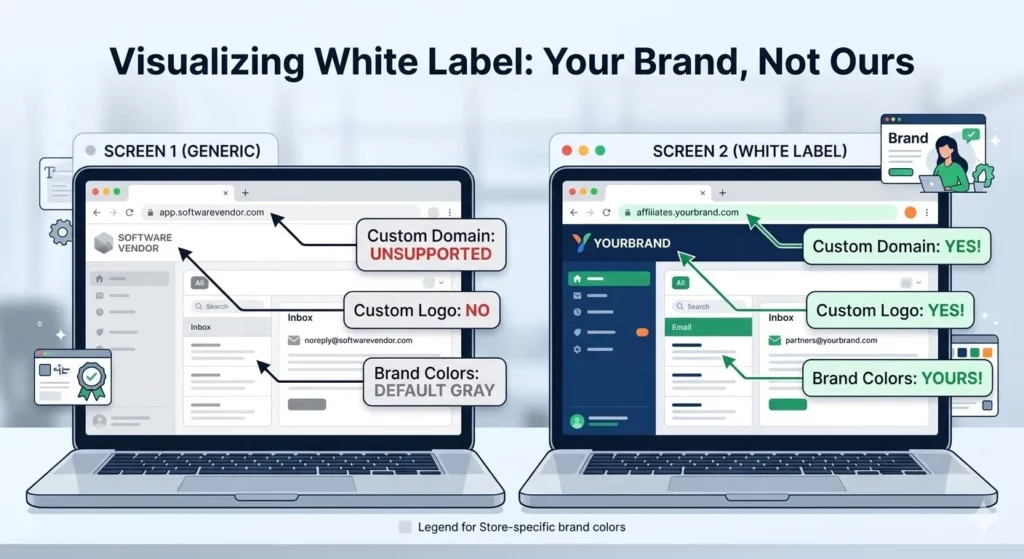
White label affiliate software is an affiliate program management platform that allows merchants to present the software entirely under their own brand — including custom domain, logo, color scheme, and communications — while the underlying technology is operated by a third-party vendor.
The merchant’s affiliates never see the software company’s branding. From their perspective, they are interacting directly with the merchant’s program infrastructure.
Key white-labeled components typically include:
- Affiliate portal URL (e.g., affiliates.yourbrand.com)
- Onboarding and welcome emails (from your domain)
- Payout notifications and receipts
- Program dashboard UI (logo, colors, brand language)
- Tracking links (using your branded domain, not a generic tracking URL)
Strategic Analysis: Build vs. Buy vs. White Label
Before committing to a white label approach, merchants should understand the full landscape of choices.
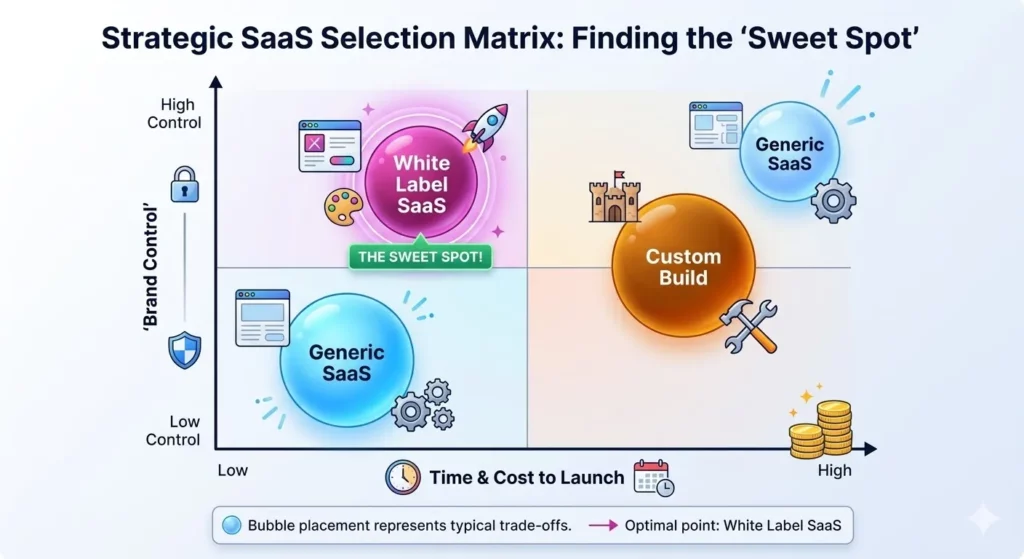
| Option | Time to Launch | Upfront Cost | Ongoing Cost | Brand Control | Scalability |
| Custom Build | 6–18 months | $150,000–$500,000+ | High (engineering) | Full | Full |
| Affiliate Network (e.g., CJ, ShareASale) | 1–4 weeks | $500–$5,000 setup | Network fees + % rev | Low | High |
| Generic SaaS (unbranded) | 1–3 days | $0–$99/month | Low–Medium | Minimal | Medium |
| White Label SaaS | 1–5 days | $29–$299/month | Low–Medium | High | High |
| White Label + API | 1–3 weeks | $200–$1,000/month | Medium | Full | Very High |
The strategic verdict for most e-commerce merchants:
White label SaaS occupies the optimal position on the cost-to-brand-control curve. Unless you are processing $10M+ GMV monthly through affiliates and have in-house engineering capacity, custom builds introduce risk without proportional return.
The Revenue Case for White Label
Affiliate Activation Rate
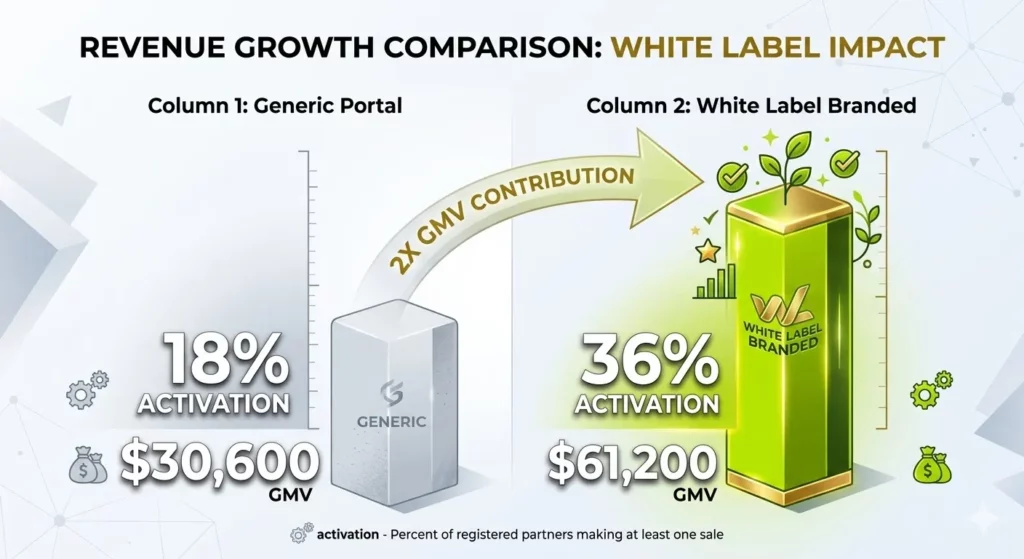
Activation rate — the percentage of recruited affiliates who make at least one sale — is the most undertracked metric in affiliate program management.
Industry benchmarks:
- Generic/network-branded portals: 12–22% affiliate activation rates
- Merchant-branded white label portals: 28–44% activation rates
The delta is significant. For a program with 500 recruited affiliates and an average affiliate-driven AOV of $85:
| Scenario | Activation Rate | Active Affiliates | Avg Sales/Affiliate/Month | Monthly GMV Contribution |
| Generic portal | 18% | 90 | 4 orders | $30,600 |
| White label branded | 36% | 180 | 4 orders | $61,200 |
A 2× improvement in activation rate — with the same recruitment investment — doubles GMV contribution from the affiliate channel.
Affiliate Retention (12-Month)
White label programs report significantly better 12-month affiliate retention:
- Generic dashboard programs: ~41% affiliate retention at 12 months
- Branded white label programs: ~67% affiliate retention at 12 months
Higher retention means lower recurring recruitment costs and compounding affiliate productivity over time.
Case Study: How a DTC Skincare Brand Recovered $180,000 in Lost Affiliate GMV
Background
Merchant profile: Mid-size DTC skincare brand on Shopify, $4.2M annual revenue, launched affiliate program via a generic SaaS tool in Q1.
The problem: After recruiting 320 affiliates in the first 60 days, activation stalled at 14%. Support tickets flooded in — affiliates couldn’t identify the program portal, reported phishing concerns about unrecognized email senders, and several high-value influencers quietly stopped promoting.
Diagnosis: The affiliate welcome emails were sent from noreply@[softwarevendor].com. The portal URL was app.[softwarevendor].com/merchant-xyz. The tracking links contained the vendor’s generic tracking domain. Affiliates had no brand signal from the merchant they’d agreed to promote.
The Intervention
The brand migrated to a white label affiliate platform (using UpPromote) and configured:
- Custom affiliate portal domain: partners.theirbrand.com
- Branded welcome emails from affiliates@theirbrand.com
- Custom tracking domain embedded in all affiliate links
- Branded portal UI with their product imagery, brand colors, and messaging
- Automated onboarding email sequence — 3-part welcome series under their brand voice
Timeline: Full migration and rebrand took 4 days, no engineering resources required.
Results (90-Day Post-Migration)
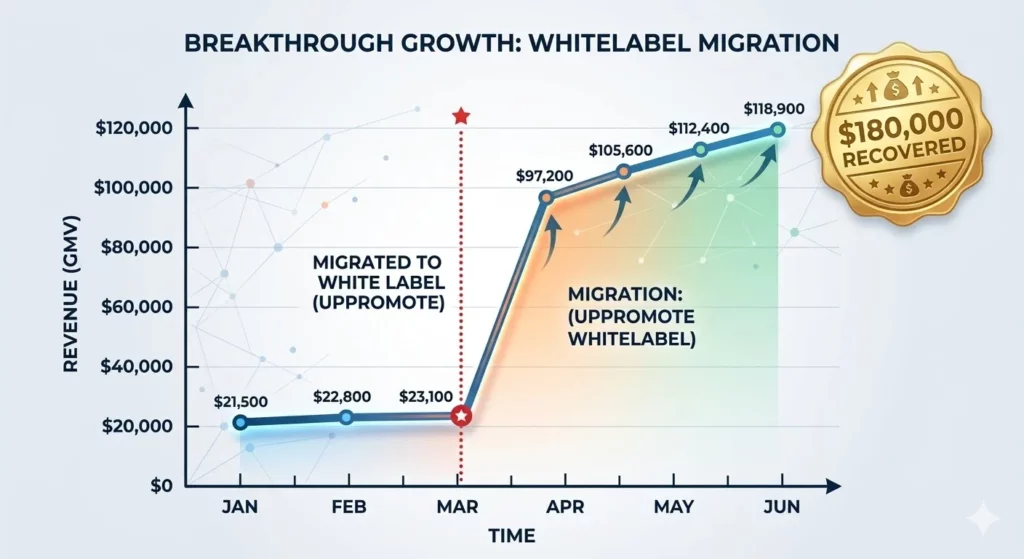
| Metric | Before Migration | After Migration | Change |
| Affiliate activation rate | 14% | 39% | +178% |
| Active affiliates (of 320 recruited) | 45 | 125 | +80 |
| Monthly affiliate GMV | ~$28,000 | ~$97,000 | +$69,000 |
| Monthly affiliate support tickets | 34 | 6 | −82% |
| 30-day new affiliate retention | 51% | 78% | +27pp |
Annualized GMV recovery from re-activation alone: ~$180,000+
The migration paid for itself within the first 11 days.
Core Features to Evaluate in White Label Affiliate Software
Not all white label solutions deliver equal brand depth. Merchants should evaluate on these dimensions:
Tier 1: Non-Negotiable White Label Features
- ✅ Custom portal domain (your subdomain or custom domain, not vendor URL)
- ✅ Custom sender domain for emails (must resolve DNS/SPF/DKIM correctly)
- ✅ Branded tracking links (custom short domain for affiliate URLs)
- ✅ Logo + brand color customization in affiliate-facing UI
Tier 2: High-Value White Label Features
- ✅ Branded payout emails and receipts
- ✅ Customizable affiliate onboarding flow (questions, terms, approval messaging)
- ✅ White-labeled affiliate dashboard (no vendor branding visible to affiliates)
- ✅ Branded multi-tier program communications (for MLM-style tiered structures)
Tier 3: Enterprise-Grade Considerations
- ✅ Full API access for custom front-end builds
- ✅ Webhook support for data integration into existing CRM/CDP
- ✅ SSO (Single Sign-On) for affiliate portal access
⚠️ Common White Label Traps
| Hidden Issue | What to Check |
| “Custom domain” that still shows vendor in page title/metadata | Inspect page source after setup — check <title> tag and OG metadata |
| Emails pass visual check but fail DKIM/SPF | Run through MxToolbox email header analyzer |
| Tracking links use vendor domain as fallback | Test affiliate links in a clean browser session — trace the redirect chain |
| Mobile portal is unbranded even when desktop is | Test affiliate portal on mobile before full deployment |
How to launch a White Label Affiliate Program in 5 Days
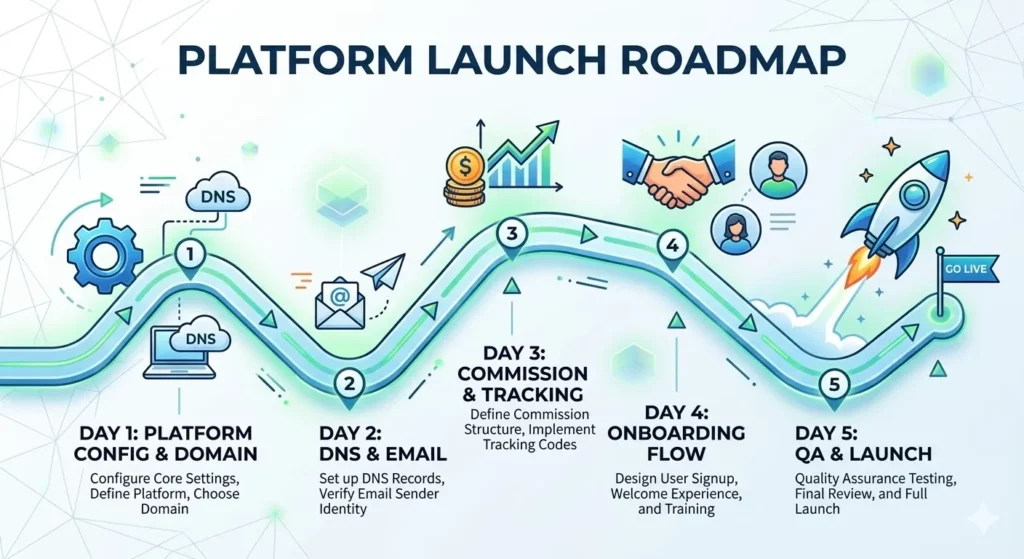
Day 1 — Platform Configuration
- Select white label affiliate software (evaluate on Tier 1 features above)
- Connect to your e-commerce platform (Shopify, WooCommerce, BigCommerce)
- Configure DNS records for custom portal domain and email sender domain
- Upload brand assets (logo, favicon, brand colors)
Day 2 — DNS Propagation + Email Configuration
- Verify DNS records have propagated
- Configure custom sender domain and authenticate (SPF, DKIM)
- Set up branded onboarding email sequence (minimum: welcome email, first sale congratulations, monthly recap)
- Customize affiliate portal copy, headline messaging, and program terms
Day 3 — Commission Structure + Tracking Setup
- Define commission tiers (flat rate, percentage, product-specific)
- Set attribution window (14-day vs. 30-day — document your rationale)
- Configure custom tracking domain and test redirect chains
- Set minimum payout threshold and payment schedule
Day 4 — Affiliate Onboarding Flow
- Build affiliate application form (collect media channel, audience size, niche)
- Configure auto-approve or manual review workflow
- Set up affiliate tier progression rules (if applicable)
- Create affiliate resource library (banners, product images, copy templates) — all branded
Day 5 — QA and Soft Launch
- Create a test affiliate account — complete the full onboarding flow yourself
- Verify every email arrives from your domain with your branding
- Generate a test tracking link — verify custom domain is used end-to-end
- Confirm commission tracking fires correctly with a test transaction
- Open program to first recruits
What to Measure in Your White Label Affiliate Program
Most affiliate platforms surface vanity metrics. What merchants actually need is a revenue attribution framework.
Primary KPIs (Measure Weekly)
| KPI | Formula | Healthy Benchmark |
| Affiliate Activation Rate | Active Affiliates ÷ Total Recruited | >30% |
| Revenue Per Active Affiliate | Affiliate GMV ÷ Active Affiliates | Varies by AOV; aim for 3–8× commission payout |
| Affiliate-Driven CAC | Commission Paid ÷ New Customers via Affiliates | Should be <50% of your paid channel CAC |
| Commission Payout Ratio | Total Commission Paid ÷ Affiliate GMV | 8–15% is sustainable for most e-commerce |
| Partner Productivity Index | % of affiliates generating ≥1 sale/month | >35% indicates healthy program |
Secondary KPIs (Measure Monthly)
- Affiliate Churn Rate: % of active affiliates who generated $0 in the trailing 30 days
- Top-10 Affiliate Concentration: If top 10 affiliates drive >70% of GMV, program is fragile — recruit mid-tier
- Attribution Window Overlap: % of conversions where affiliate + paid channel both claimed credit (reveals attribution conflicts)
- New vs. Returning Customer Split via Affiliates: High returning customer % may indicate affiliate cannibalization of organic/email
The Dashboard Setup (Recommended View)
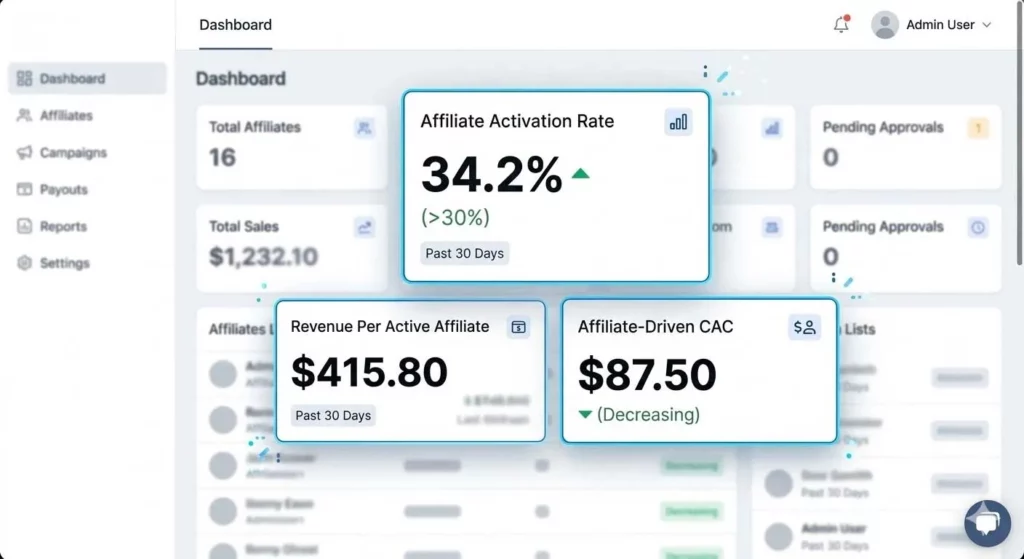
The image is for illustration purposes only and is not a representation of the actual product.
Build a 3-layer reporting structure:
- Executive view (weekly): Total GMV, total commission paid, payout ratio, net affiliate revenue contribution
- Operational view (daily): New affiliate signups, pending approvals, first-sale notifications, fraud flags
- Partner-level view (on-demand): Individual affiliate GMV, conversion rate, AOV, last active date
When Does White Label Software Make Strategic Sense?
Use this matrix to assess your readiness:
| Factor | White Label is Right For You If… | Consider Generic/Network If… |
| Brand sensitivity | Your audience values brand trust signals | Your niche is transactional; brand matters less |
| Affiliate type | Content creators, influencers, brand ambassadors | Deal sites, coupon aggregators, cash-back platforms |
| Program scale | 50–5,000 affiliates | 5,000+ affiliates (consider hybrid network + white label) |
| Technical resources | No in-house dev team | Strong dev team available for custom build |
| Budget | $50–$500/month SaaS investment | $0 budget (use basic network) or $500K+ (custom build) |
| Time to launch | Need program live within 1–2 weeks | Have 6+ months for custom development |
Common Mistakes Merchants Make with White Label Affiliate Platforms
Mistake 1: Treating White Label as Cosmetic, Not Strategic
Merchants often customize the logo and colors — then leave all email templates, portal copy, and onboarding messaging as vendor defaults. Affiliates still experience a generic program. Brand consistency requires end-to-end content ownership, not just visual customization.
Mistake 2: Ignoring the Tracking Domain
Custom tracking links are the most technically critical white label element. Affiliates share these links publicly. A tracking URL containing ref.vendorname.com signals third-party infrastructure and can reduce consumer click-through trust. Always configure a custom tracking domain.
Mistake 3: Launching Without an Email Nurture Sequence
The affiliate portal is a destination. Email is the activation channel. Merchants who set up the branded portal but send no post-signup email sequence report <20% activation rates. A minimum 3-email onboarding sequence (welcome, first steps, first sale celebration) drives the majority of early activation.
Mistake 4: Conflating White Label with Full Ownership
White label means you control the brand presentation — not the data infrastructure. Your affiliate data lives on the vendor’s servers. For brands with strict data sovereignty requirements, evaluate vendors on data portability, export capabilities, and contract terms around data ownership.
Conclusion
White label affiliate software is not a premium upgrade for merchants who want their logo in a portal. It is a revenue lever — one that operates through affiliate trust, activation rates, and long-term partner retention.
The data is consistent: branded affiliate experiences generate materially higher activation rates, lower churn, and higher program GMV per recruited affiliate. The cost of not owning that experience compounds quietly in the background while your affiliate program underperforms its potential.
For most Shopify merchants, the implementation path is straightforward. Tools like UpPromote provide white label infrastructure — custom domains, branded emails, custom tracking links — without requiring engineering investment. The ROI case closes itself within the first month of activation improvement.
The strategic action is clear: if you are running an affiliate program where affiliates are landing on a vendor-branded portal and receiving emails from a vendor domain, you are leaving activation rates — and GMV — on the table.
Fix the brand layer. Measure the activation delta. Scale from there.

Jodie is an SEO content writer and part of the UpPromote team. For her, writing is not just a hobby but also a way to express her creativity and imagination. She enjoys the process of turning her thoughts into words and is always eager to learn more about SEO and content marketing to make her writing even more effective. Besides creating content, she loves cats and traveling.