

The basketball market’s revenue is projected to reach US$11.24bn in 2024. With such high demand, promoting basketball products can be a great way to earn commissions.
From top brands to trusted sports retailers, these basketball affiliate programs offer a wide variety of options for you to explore. Let’s find the perfect fit for you to start earning money.
Quick Comparison
| Program Name | Commission (%) | Cookie Duration (Days) | Niche Suitable |
|---|---|---|---|
| NBA Store | 8% | 7 days | Basketball, NBA fans, sports apparel |
| HoopsKing | 10% | 30 days | Basketball training, coaching, skill development |
| Wilson | 8% | 30 days | Sporting goods (basketball, tennis, golf, etc.) |
| Nike | Up to 15% | 7 days | Sportswear, athletic gear, global fitness niche |
| Puma | 5–7% | 14 days | Running, soccer, basketball, athletic wear |
| Fanatics | 1–8% | 7 days | Fan merchandise, NFL/NBA/MLB gear |
| Li Ning – Way of Wade | 3% | 15 days | Basketball footwear, sneaker fans |
| New Balance | 2% | 30 days | Running shoes, lifestyle footwear |
| Leather Head Sports | 10% | 60 days | Handmade vintage sports gear |
| Paragon Sports | 8% | 7 days | Multi-sport equipment and apparel |
Affiliate Earnings Calculator
Estimate your affiliate income based on Traffic, CTR, AOV, and Commission rate. Drag the sliders below to explore different scenarios.
Estimated Results
These figures are for illustrative purposes – feel free to adjust them to fit your specific niche.
- Conversion Rate here is defined as the percentage of traffic that buys.
- Does not account for refunds, cancellations, or varying commission rates by product.
Top 18 Basketball Affiliate Programs to Boost Your Earnings
1. NBA Store
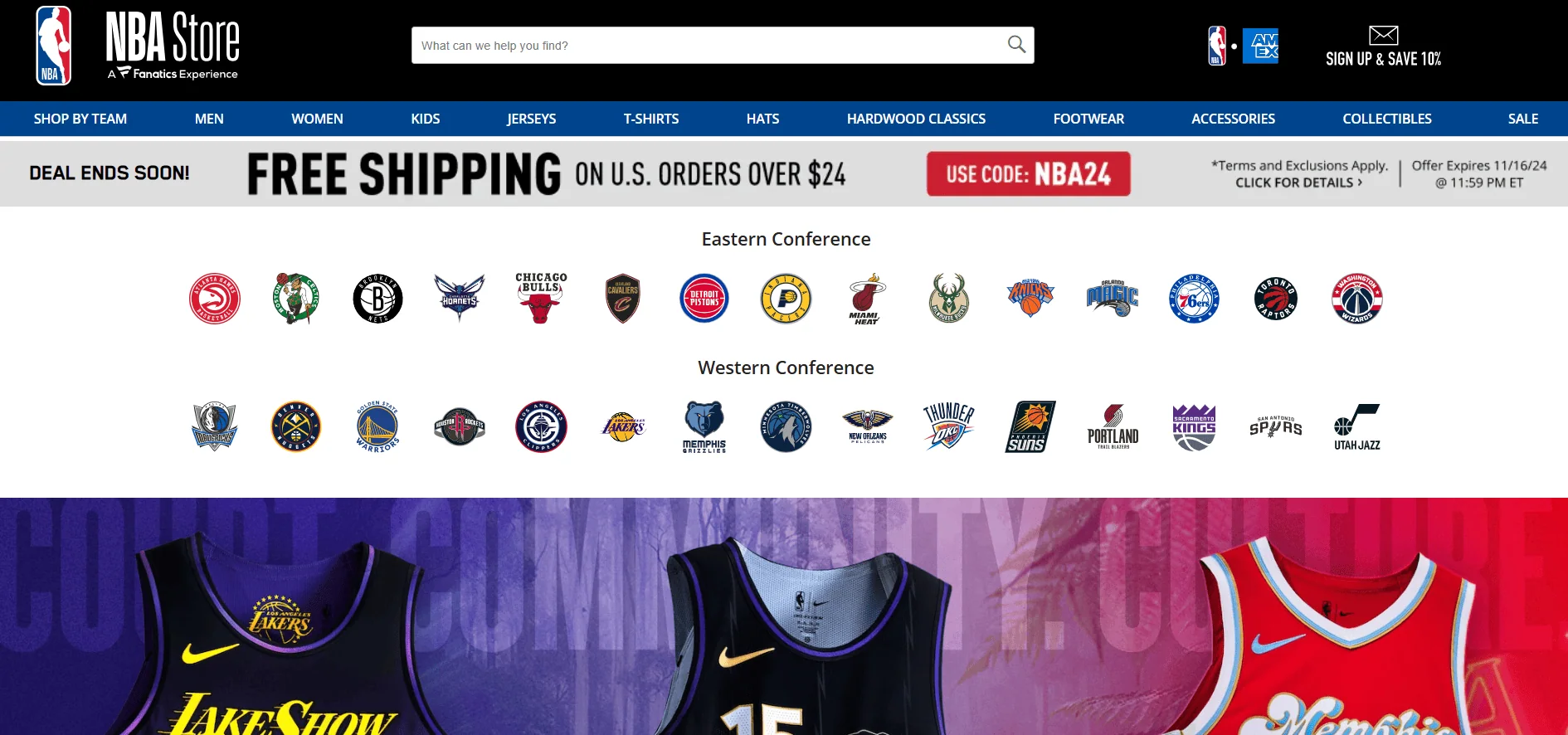
The NBA store is taking the lead in selling branded basketballs and other sports merchandise, primarily focused on the National Basketball Association (NBA). They provide a range of team jerseys, apparel, footwear, memorabilia, and accessories.
By joining the NBA affiliate program, you can get a competitive commission rate of 8% for each order. The cookie duration lasts 7 days, so you can earn a commission on sales within 1 week of visitors clicking on your link.
The NBA Store affiliate program offers an auto-updating dashboard to track your promotional results. Their dedicated affiliate managers are always ready to provide support and help optimize your performance.
|
2. HoopsKing
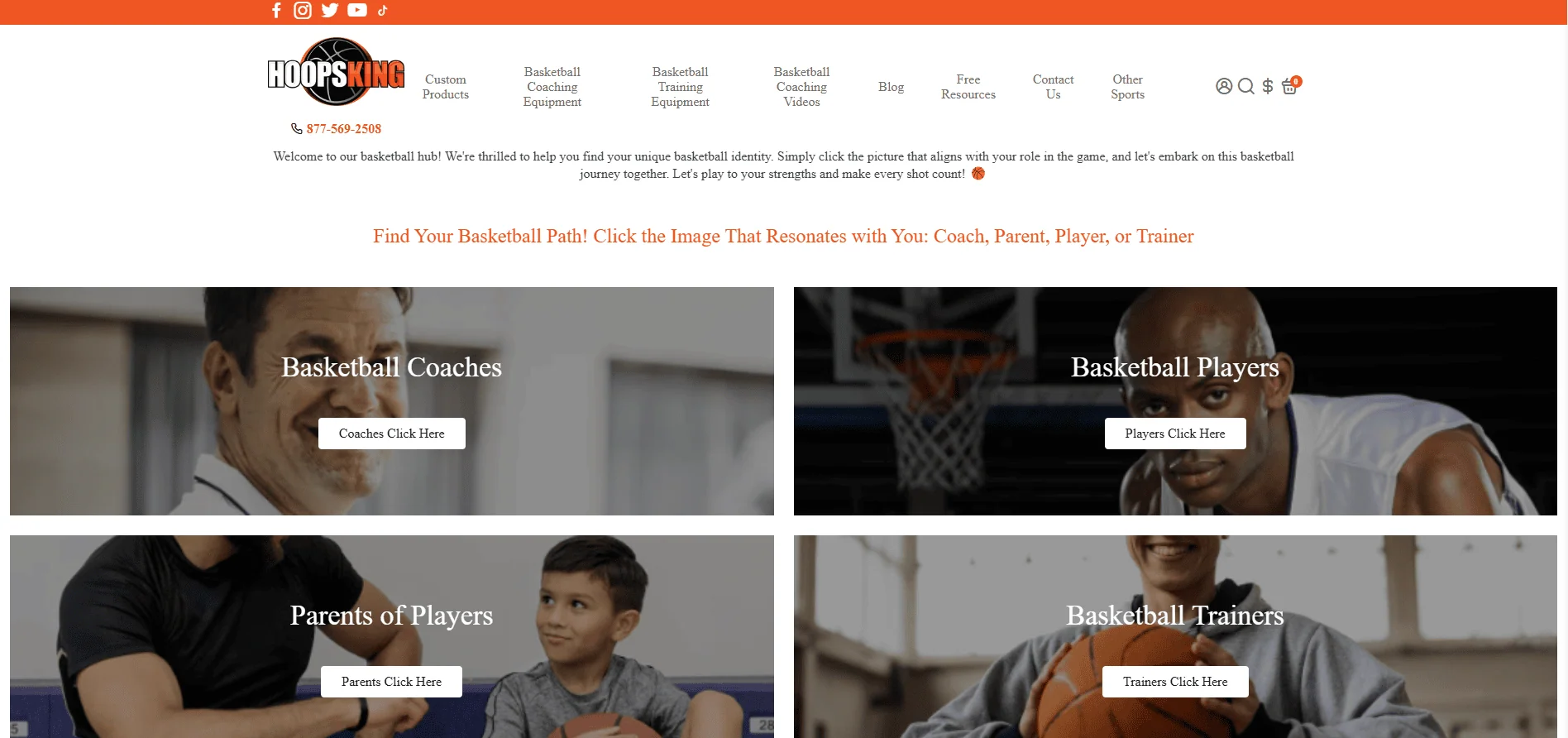
HoopsKing focuses on helping athletes improve their basketball skills through innovative products and expert-designed resources. The brand has a variety of training aids, instructional videos, and custom sports products for players of all levels.
By joining the HoopsKing affiliate program, you can earn a high competitive commission rate of up to 10%. You’ll receive credit for purchases made within 30 days of customers clicking your affiliate link.
The program provides a broad range of text links, banners, and product information for you to promote their products. You can also check your referrals and commissions via a real-time tracking dashboard.
|
3. Wilson
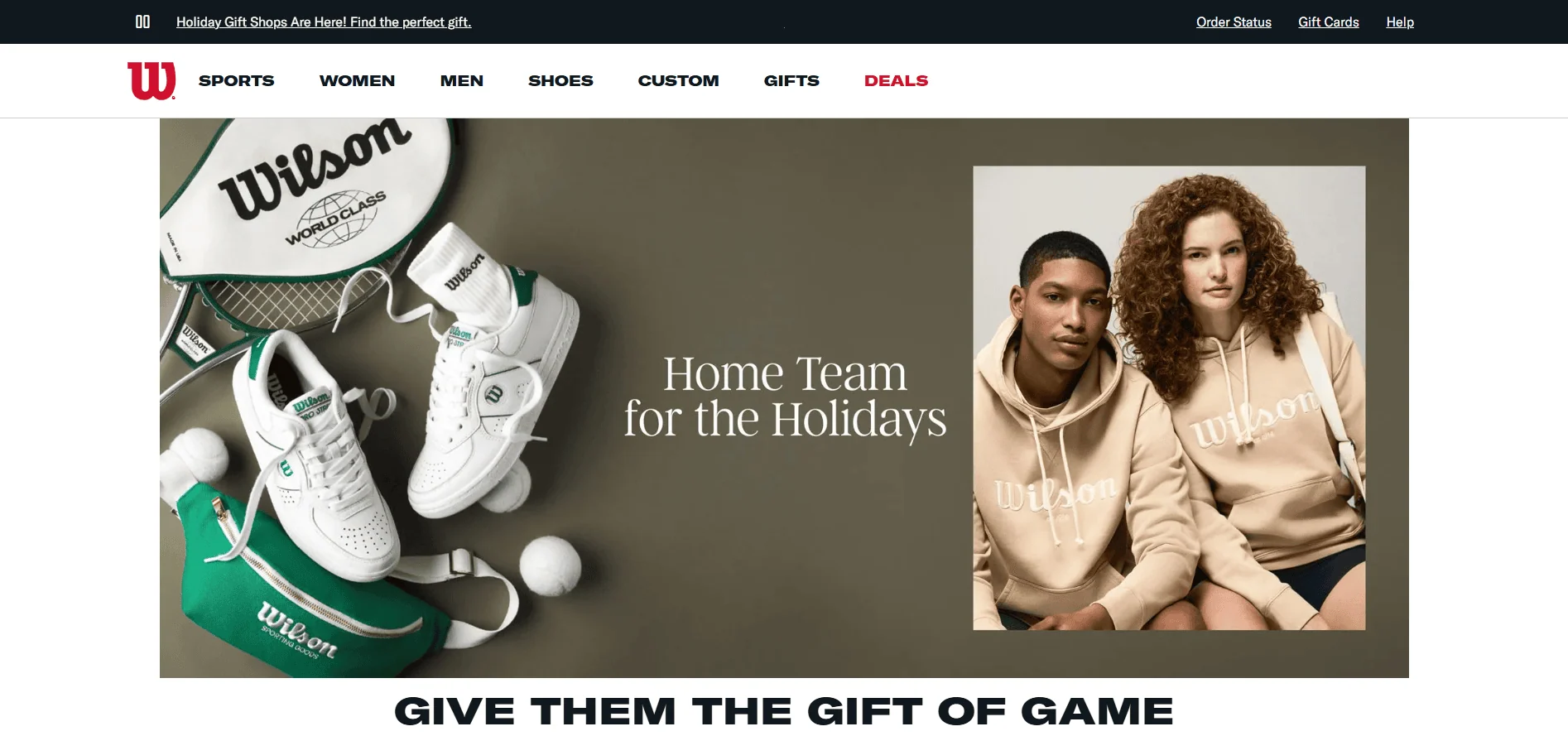
Wilson is a trusted name in high-quality sporting equipment and apparel. Their diverse product offerings cover basketball, tennis, baseball, pickleball, golf, and more.
Wilson affiliates can get up to 8% commission on each successful sale. The cookie duration is 30 days long from consumers’ first click.
As a Wilson affiliate, you’ll get personalized links and banners to begin your promotions. If you have any questions about the program, the program manager is ready to assist.
The brand supports you with various customized links and banners to create appealing promotional content. You can also ask their affiliate manager for more promotion tips to boost your earnings
|
4. Nike
Nike is one of the largest and best-recognized global sports and athleticwear brands. Their product line features sports apparel, footwear, and gear for basketball, golf, soccer, baseball, and more.
The Nike affiliates can earn up to a 15% commission rate on each order. You can earn commissions on any successful order made within 7 days of the customer’s first click.
Their automated product feed and affiliate newsletters will update you with the latest offers and product launches. Their affiliate manager also offers personalized advice and recommendations to optimize your promotion.
|
5. Puma
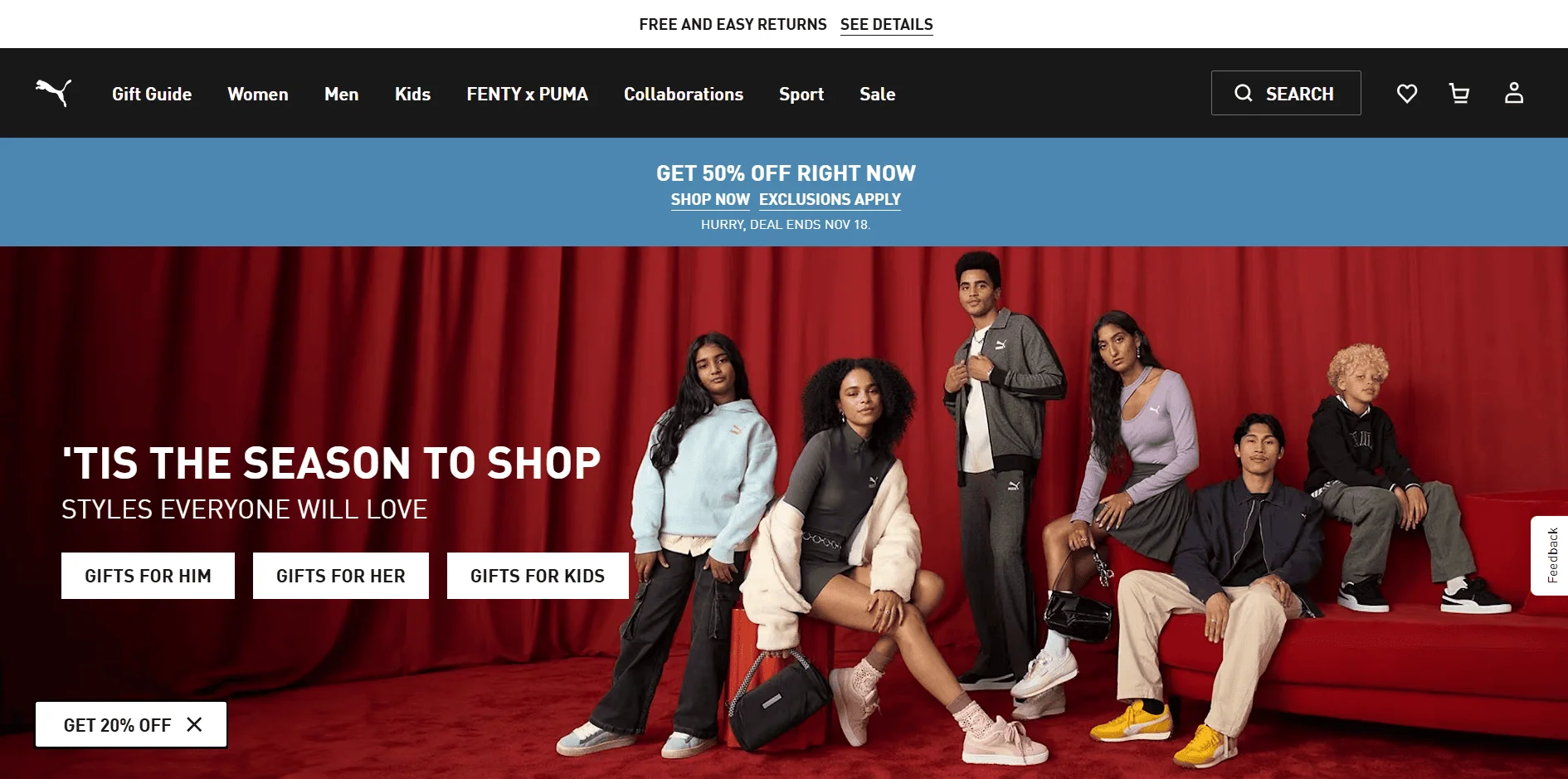
Puma is the third-largest sportswear manufacturer globally and sells their products in over 120 countries. They are available products cater to a variety of sports, including running, soccer, basketball, golf, and motorsport.
The Puma affiliate program allows you to earn a commission rate of 5-7%. The cookie window lasts 14 days from the consumer’s first click.
Managed through CJ Affiliate, the program offers tracking tools for you to monitor your promotional performance. You can also keep your promotional product up-to-date with their daily product feed.
|
6. Fanatics
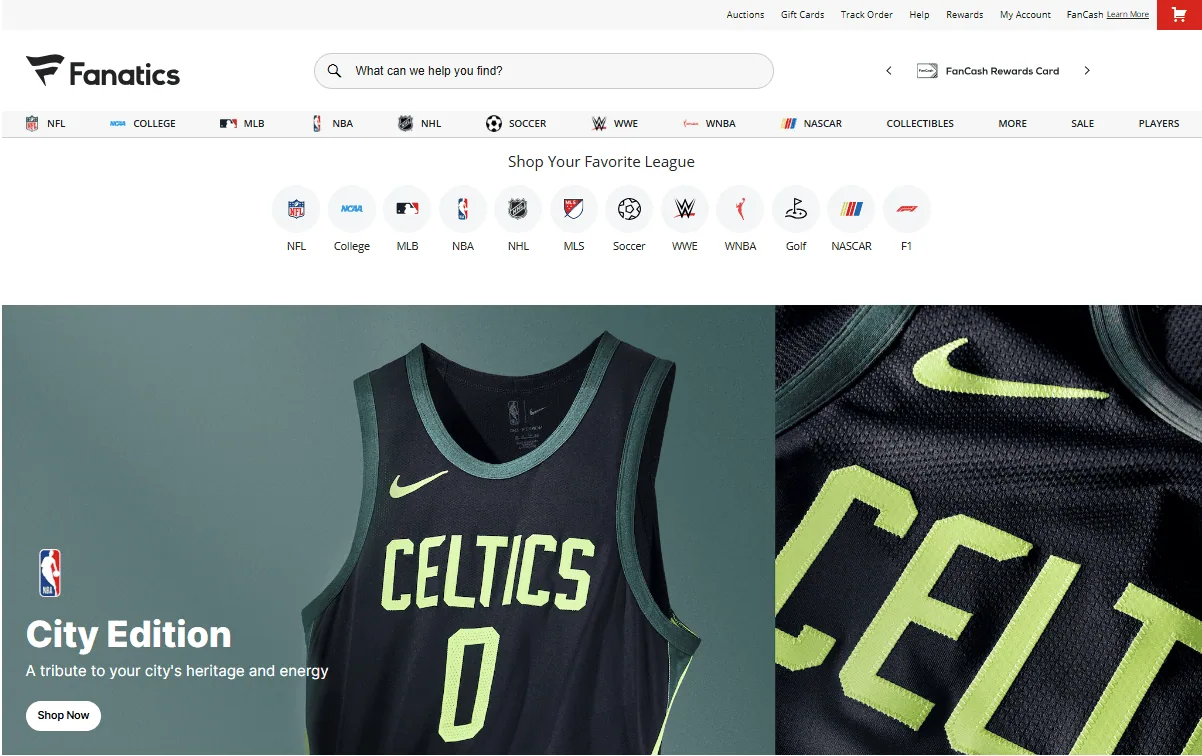
Fanatics is a go-to destination for authentic fan gear with an extensive selection and partnerships with top teams like the NFL, NBA, and MLB. They provide a wide range of licensed sports merchandise such as apparel, footwear, and collectibles.
Affiliates can enjoy a 1-8% commission rate for each sale generated through your link. The 7-day cookie window ensures you get credit for any purchases made within a week of someone clicking your link.
Their automated tracking dashboard lets you stay informed about your real-time performance. You can also get support with essential guidance and personalized advice to have better promotional strategies.
|
7. Li Ning Way of Wade
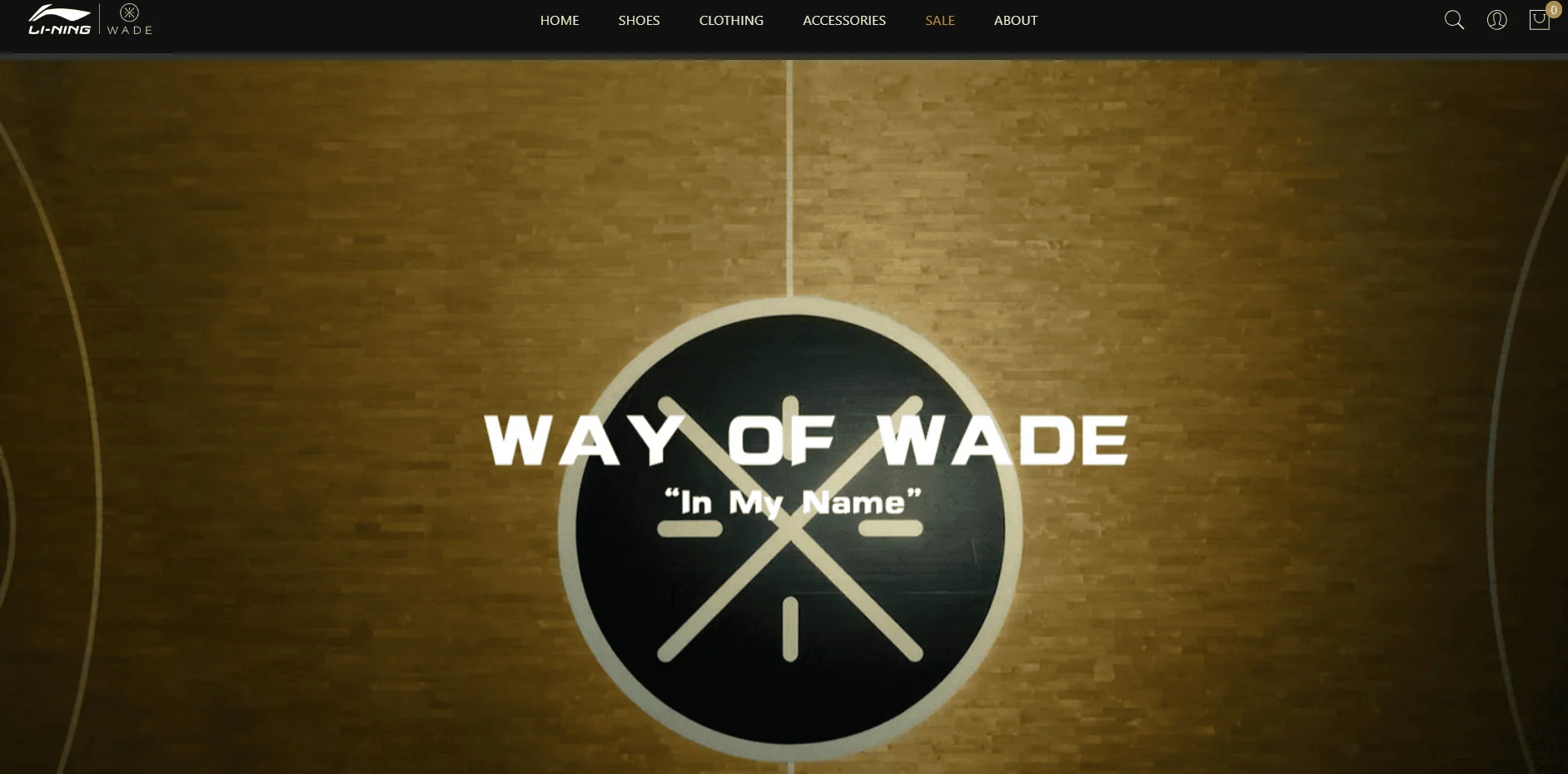
The Way of Wade is a line of basketball shoes, clothing, and accessories created by Dwyane Wade in collaboration with Li-Ning. The brand has been popular in the sports footwear industry with design and technology inspired by Wade’s signature style.
The Li Ning Way of Wade provides a 3% commission rate for each successful sale. You earn commissions when purchases are made within 15 days of a customer clicking your affiliate link.
With their monthly updates, you can stay up-to-date on the newest products and offer your audience fresh and relevant items. They also offer free products of your choice to encourage stronger partnerships.
|
8. New Balance
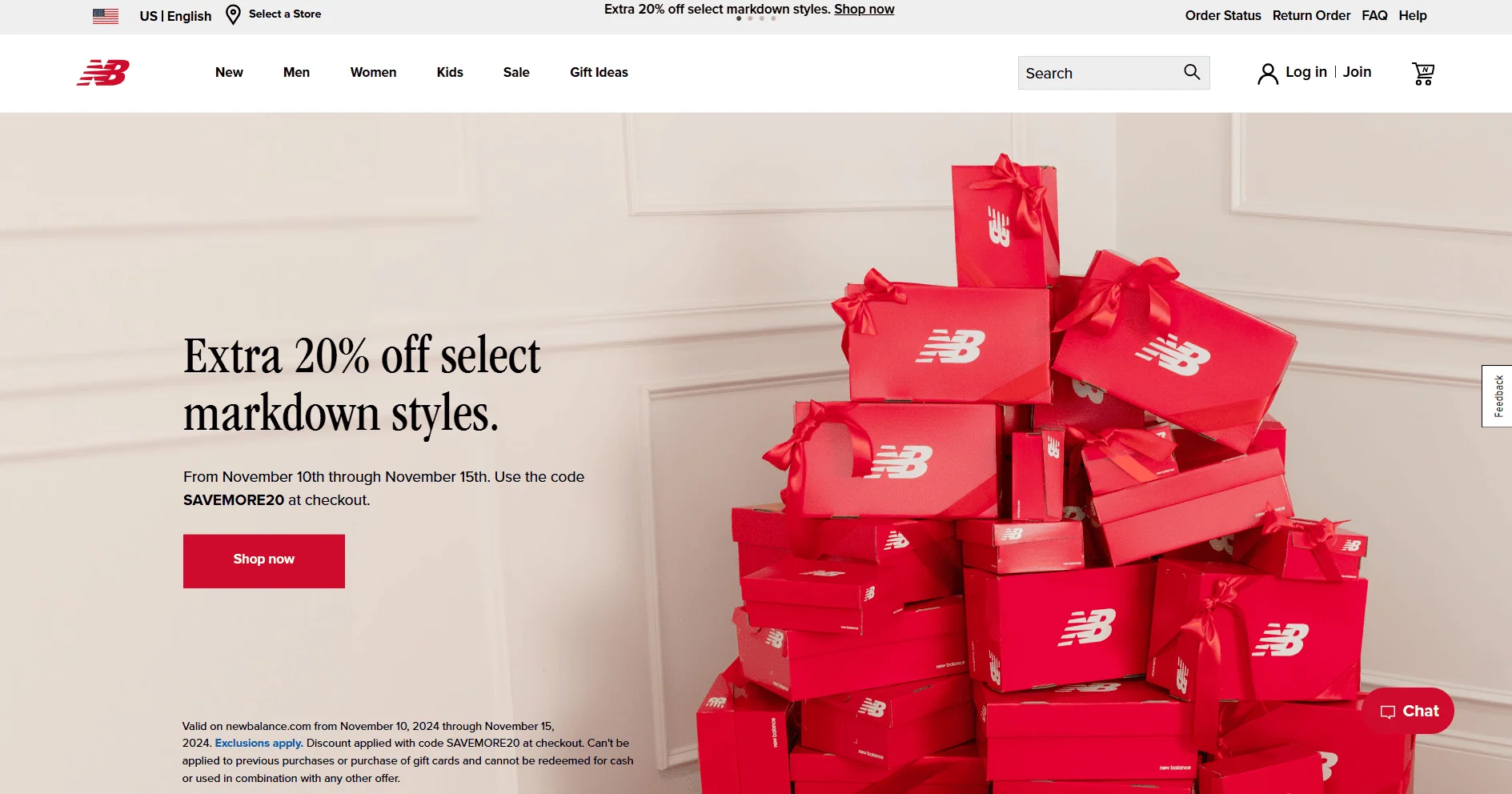
New Balance stands out in the sportswear industry with a combination of heritage and modern design. Their products are ideal for both athletes and casual consumers with superior fit, performance innovation, and sustainability.
Managed through Impact, the New Balance affiliate program offers partners a 2% commission rate. You may earn about $2,5 for each successful order with an average order size of $125.
The 30-day cookie allows you to get commissions from orders placed within a month of the initial click.
Their monthly newsletters keep you informed about the latest promotions, content, and sales opportunities. Plus, you can keep your content fresh and drive more attention with newly updated product details from the data feed.
|
9. Leather Head Sports
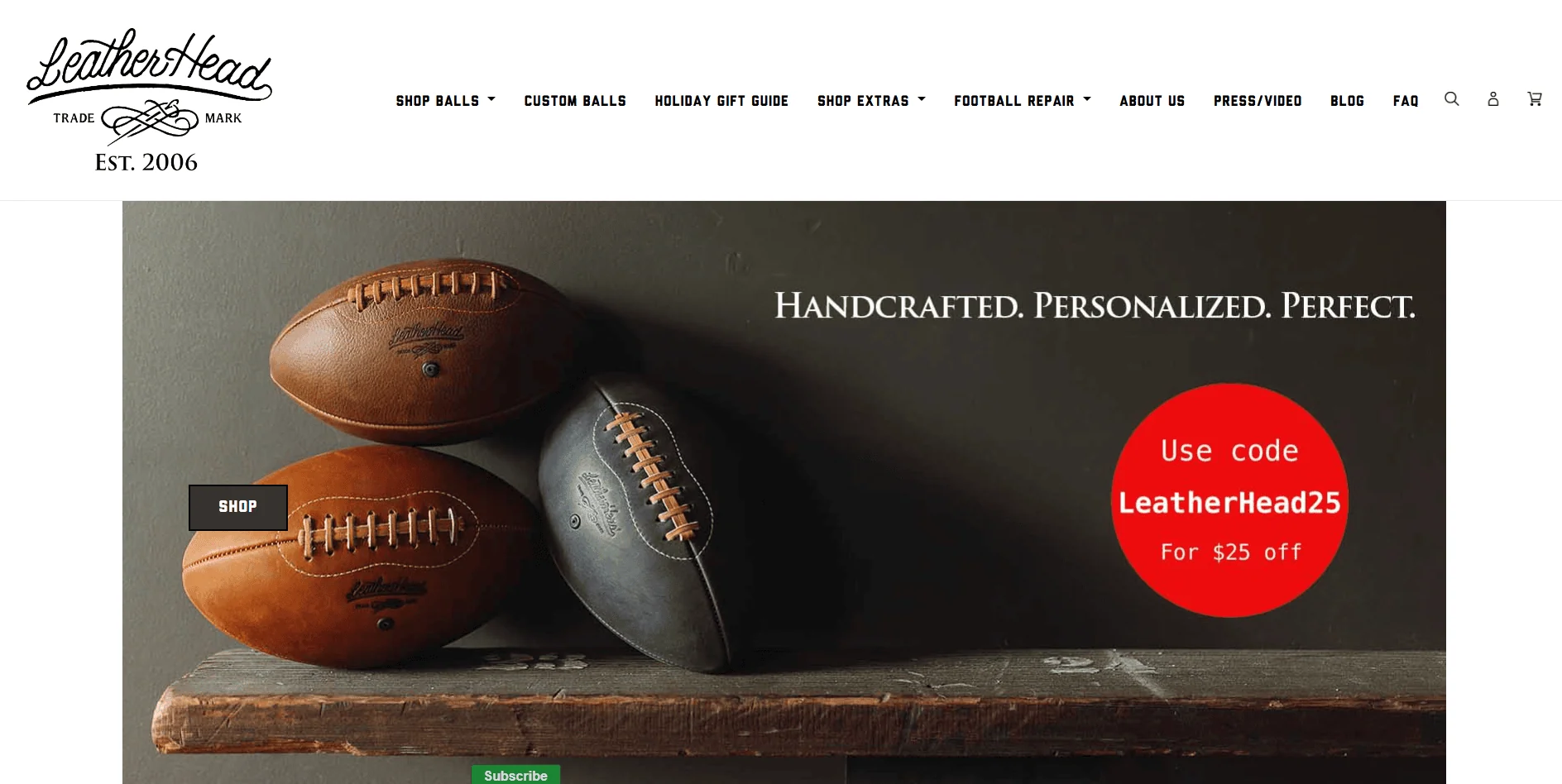
Leather Head Sports is a premium brand known for their handcrafted, vintage-inspired sports equipment. They specialize in using genuine leather and expert stitching to create durable, stylish products.
The Leather Head Sports affiliate program allows you to earn a 10% commission rate within 60 days of cookie duration. Their average order size is over $150, so you will receive up to $15 for each successful order.
The brand will customize professional banners for your website. Plus, their affiliate director is always available to help optimize your promotion.
|
10. Paragon Sports
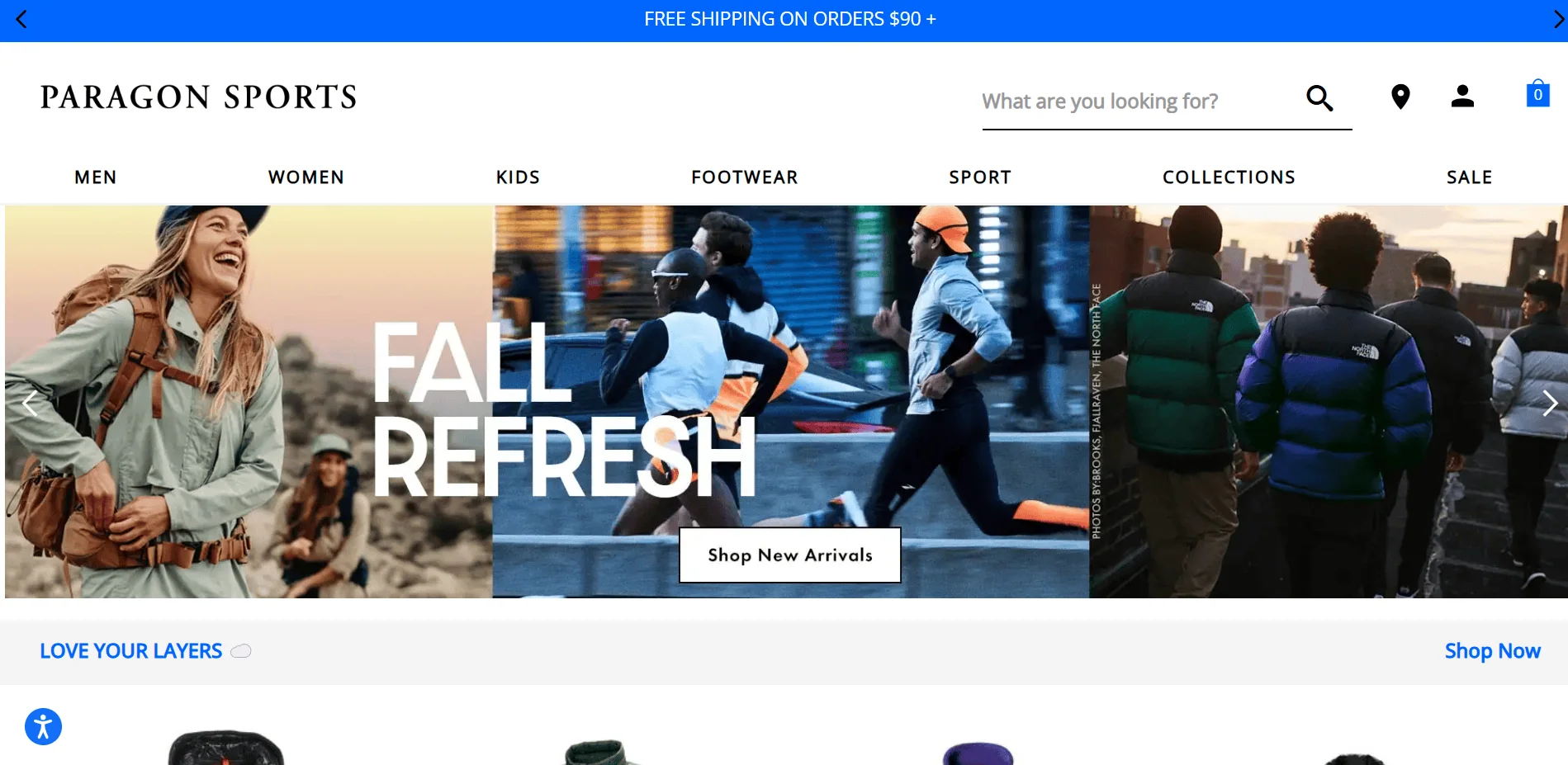
Family-owned since 1908, Paragon Sport is New York City’s best sports specialty store. They provide the most innovative and technologically advanced sports products, catering to both beginners and experienced athletes.
The Paragon Sports affiliates can earn a high commission rate of up to 8% with a 7-day referral window. The average order value is $170, which means you may get $13,6 for each order via your link.
You can boost credibility and drive more conversions by promoting a wide range of products from The North Face and Nike. They also support your promotion with attractive banners and text links.
|
11. Will-One
- Commission rate: 10%
- Cookie duration: Not mentioned
Will-One offers training programs for basketball players to develop their skills and reach their full potential. They focus on the players’ mental and physical health to help them create good habits and control their environment.
12. Swish International
- Commission rate: 40-50%
- Cookie duration: Not mentioned
Swish International aims to help players improve their basketball shooting skills with detailed instructional videos. Their program is designed for basketball players of all levels and coaches to boost their shooting percentage and overall performance.
13. Vert Shock
- Commission rate: Not mentioned
- Cookie duration: Not mentioned
Vert Shock can help basketball and other jumping sports players develop explosive power within 8 weeks. Their program is perfect for both at-home and gym workouts with simple, practical exercises that require little equipment.
14. Cost 2 Coast Sports
- Commission rate: 5%
- Cookie duration: Not mentioned
Cost 2 Coast Sports specializes in custom uniforms for sports like basketball, netball, football, and rugby. With over 300 designs available, they provide full team wear, accessories, and 24/7 access to merchandise.
15. Online Sports
- Commission rate: 10-14%
- Cookie duration: 60 days
Online Sports provides a flexible shopping experience with options to browse by category, supplier, sport, or item. Consumers can also use the search tool to find any sports item they need.
16. Pro:Direct Sport
- Commission rate: 3%
- Cookie duration: 1 day
Pro:Direct Sport provides a diverse selection of sportswear, footwear, and equipment for various sports, including football, running, and basketball. They serve athletes of all levels with expert advice, quality gear, and fast shipping.
17. Decathlon
- Commission rate: 1-3%
- Cookie duration: 30 days
Decathlon is the world’s largest sporting goods retailer with over 1,700 stores worldwide. They cover equipment, apparel, and accessories for various sports, including basketball, hiking, camping, and cycling.
18. Dick’s Sporting Goods
- Commission rate: 2%
- Cookie duration: 3 days
Dick’s Sporting Goods is a major sporting goods retailer in the US with diverse sports products, from basketballs and tennis rackets to hiking boots and camping gear. They also offer uniforms and equipment for schools and leagues.
Why Should You Promote Basketball Affiliate Programs?
Before you choose a niche, you need to know if the math works.
Many affiliates make the mistake of choosing a sport based only on passion. Then they realize the audience doesn’t buy, or the commissions are too small to build a business.
Basketball is different. It sits in a “sweet spot” of affiliate marketing. It combines the expensive gear prices of golf with the massive popularity of soccer.
In this section, we’ll break down exactly why basketball beats other sports niches and the kind of steady income you can expect.
Year-Round Demand Creates Consistent Affiliate Revenue
If you’ve ever promoted NFL or college football products, you know the pain of the “February Cliff.”
Traffic skyrockets during the Super Bowl, and then… silence. Your income drops to zero for six months.
Basketball offers a completely different reality: stability.
Instead of a cycle where you “feast or starve,” basketball provides a steady stream of sales. 🏀 The calendar never truly stops, which keeps your commissions flowing.
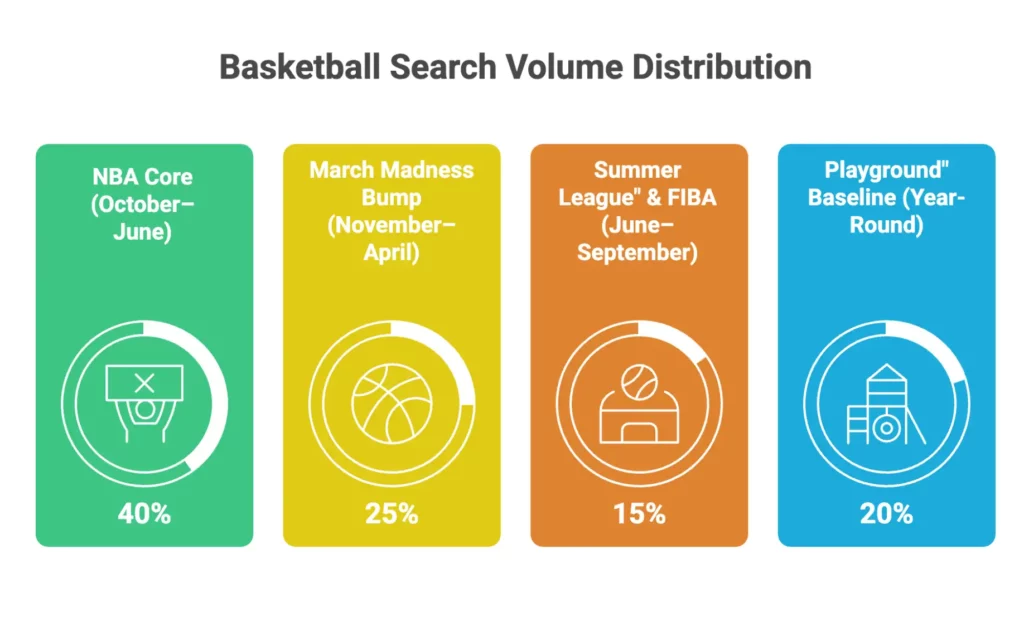
According to Google Trends data, basketball traffic stacks up differently than other major sports:
The NBA Core (October–June)
This period drives roughly 40% of annual search volume. The long regular season flows directly into the playoffs, keeping interest high for nine months.
The March Madness Bump (November–April)
College basketball overlaps with the NBA season. However, traffic spikes specifically in March, adding another 25% to the total.
The “Summer League” & FIBA (June–September)
Just as the NBA Finals end, international play and summer leagues (like The Drew League) begin. This contributes another 15%.
The “Playground” Baseline (Year-Round)
Unlike football (needs a team) or baseball (needs good weather), basketball is played indoors and outdoors constantly. Gear replacement and training searches provide a consistent 20% baseline that never dips.
High Average Order Values Maximize Commission per Sale
Traffic is vanity; revenue is sanity. The second major advantage of this niche is the sheer cost of the gear.
In many niches, you rely on volume—selling hundreds of $20 items to make a decent commission. In basketball, the Average Order Value (AOV) is much higher because equipment is expensive and players often buy it.
Let’s look at the price tags for a typical serious player (your ideal customer):
| Item Category | Price Range | Details |
| Performance Shoes | $120 – $180 | Signature models (LeBron, Curry, Durant) can reach $200 – $250. |
| Official Game Balls | $60 – $150 | Quality indoor Wilson or Spalding leather balls. |
| Essential Accessories | $30 – $80 | Includes ankle braces, sleeves, and specialized socks. |
Here is where the magic happens. A parent or player rarely buys just a pair of socks. They buy a “season readiness” package. For instance:
- 1 Pair of Nike Zoom Freak 4s: $130
- 1 Wilson Evolution Basketball: $80
- 1 Pair of McDavid Ankle Braces: $50
- Total Cart Value: $260
At a standard sports retail commission rate of 8%, that single customer generates $20.80 in commission.
Compare this to a niche like soccer, where a standard ball is $20 and shin guards are $15. You would need to convert 7 to 8 customers in the soccer niche to make the same money you make from one customer in basketball.
Passionate Audiences Drive Higher Engagement and Conversion Rates
High prices are great, but they only matter if people actually buy. In most hobbies, people just browse and leave.
Basketball is different. Fans are obsessed with the sport, and that obsession makes it way easier to earn money.
When they’re looking for a product review, they don’t just skim. They read every word because they really care about getting the right gear. This means three big wins for you:
📺 Longer watch times: Basketball fans watch videos for 8 to 12 minutes – twice as long as most lifestyle content.
🖱️ More clicks: They’re searching for specific solutions, like shoes that protect their ankles. So they click your links way more often.
💰 More sales: In regular niches, maybe 2 out of 100 visitors buy something. In basketball, that number can jump to 10 out of 100.
Now, you might be wondering why basketball fans buy so much more than other hobby enthusiasts. It all comes down to the culture.
Most basketball players believe that looking like a pro helps them play like a pro. Style and performance go hand in hand on the court, and that mindset creates the perfect environment for recommendations.
Here’s what makes this even better: fans aren’t trying to avoid ads or sales pitches.
Go to any basketball forum on Reddit, and you’ll see people actively asking for advice. They want to know which shoes work best on dusty outdoor courts or which recovery gear actually helps.
When you answer these questions, you’re helping them solve a real problem. That’s why they trust your recommendations and actually buy what you suggest.
Multiple Revenue Categories Protect Against Seasonal Fluctuations
We have established that the audience is consistent, spends heavily, and converts well. But the final piece of the puzzle is risk management.
If you only promote one type of product (like shoes), you leave yourself vulnerable. The basketball niche offers a massive “safety net” because you can make money from five different categories that peak at different times.
By mixing your affiliate partners, you can create a revenue map that looks like this:
| Category | Products | Peak Season |
| Hard Goods (Equipment) | Shoes, basketballs, portable hoops, training aids. | September–November (Pre-season) & January–March (Mid-season). |
| Soft Goods (Apparel) | Jerseys, shorts, compression sleeves, socks. | April–June (NBA Playoffs & Championship season). |
| Digital & Recurring (Services) | Training apps (HomeCourt) and streaming (NBA League Pass). | Year-round / Season start. |
| The “Summer Circuit” (Travel & Camps) | Hotel booking affiliates (Expedia/Booking.com), camp registrations. | April–August. |
| 5. Collectibles (High Ticket) | Autographed memorabilia, trading cards, vintage sneakers. | Year-round (spikes during record-breaking moments). |
This variety protects your bottom line. When winter apparel sales naturally drop in July, your commissions from outdoor equipment and summer camp travel will likely rise to fill the gap.
How Do You Choose the Right Basketball Affiliate Program?
Now that you see the potential of this niche, you need the right partners. Many beginners fail by joining too many programs or chasing high commissions without checking the details.
Below, we’ll guide you through some steps to pick the most suitable basketball affiliate program for your content.
Match Affiliate Programs to Your Specific Basketball Content Type
The biggest mistake beginners make is a “mismatch of intent.” You cannot sell high-end training gear to a casual fan looking for a jersey. You can’t sell bulk team uniforms to a sneaker collector.
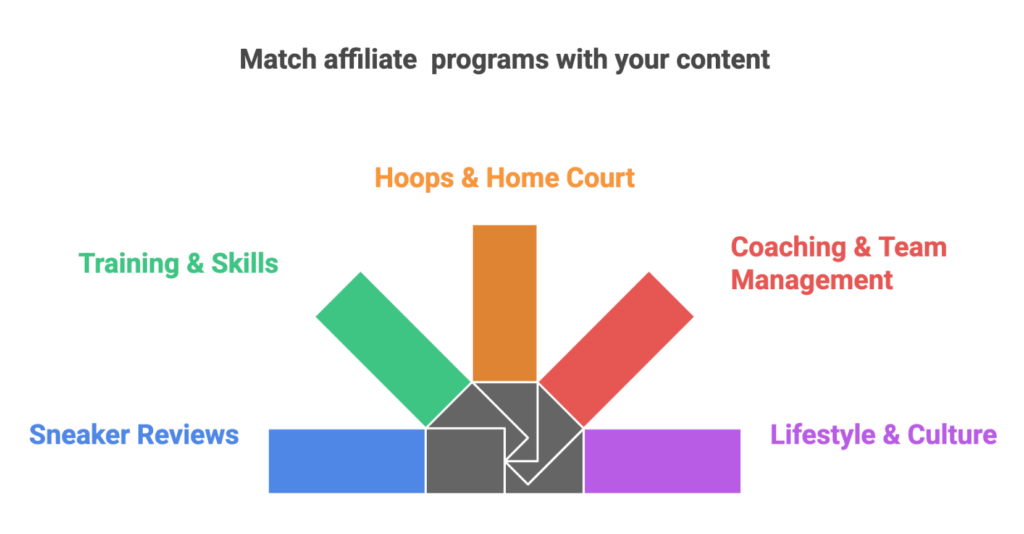
Your content strategy dictates your partner strategy. You need to map your specific audience to the program that serves them best.
You can look at your last 10-20 pieces of content. Which category do they fall into?
Sneaker Reviews & Hype: If you cover the latest drops, performance reviews, or “cop or drop” guides, your audience wants selection and speed.
➡️ Best Partners: Nike, Foot Locker, Eastbay. These brands have the inventory depth and the “launch day” trust that sneakerheads demand.
Training & Skills: If you teach shooting mechanics or dribbling drills, your audience needs tools, not fashion.
➡️ Best Partners: Spalding, Wilson. These programs focus on the hard goods—balls, heavy training balls, and skill aids—that help players improve.
Hoops & Home Court: If you review portable hoops or backyard setups, you are targeting high-ticket buyers.
➡️ Best Partners: Goaliath, Dick’s Sporting Goods, Spalding. You need partners that carry inventory ranging from $300 starter hoops to $2,000 in-ground systems.
Coaching & Team Management: If your content speaks to coaches organizing a season, they buy in bulk.
➡️ Best Partners: Eastbay Team Sales, Shoot-A-Way. These programs are built to handle large orders of uniforms and expensive hardware.
Lifestyle & Culture: If you cover streetball history or basketball fashion.
➡️ Best Partners: Ballislife, adidas. These brands appeal to the “culture” side of the game—streetwear, retro jerseys, and accessories.
The rule is to identify the dominant product category your audience naturally clicks on.
You should prioritize the program that is strong in that category, even if their commission rate is slightly lower than a generic competitor.
Balance Commission Percentage Against Cookie Duration Windows
One of the most common traps is looking at the commission rate in a vacuum. A 10% commission sounds better than a 5% commission. But it isn’t better if the cookie window closes before your customer actually buys.
You must balance the rate (how much you get paid) against the window (how long you get credit).
Different products have different buying cycles. You need to match the program’s terms to your content’s role in that cycle.
| Purchase Model | Typical Scenario | User Behavior | Best Fit | Core Benefit |
| Immediate Intent | Low-cost items (e.g., “Best Basketballs 2026”) | Reads, clicks, and purchases within minutes. | Amazon (24-hour cookie) | High conversion rates and extra commissions from “cart-stuffing.” |
| Consideration Heavy | High-ticket items (e.g., “$1,500 Hoops”) | Researches today; measures and buys in 1–2 weeks. | Direct Brands (30-day cookie) | Long tracking window protects your commission for slow decisions. |
Align Program Selection with Your Content’s Natural Order Value
Conversion rate tells you if they buy; Average Order Value (AOV) tells you how much they buy.
Your goal is traffic efficiency. You want to make the most money with the least amount of traffic.
To get this right, you need to realize that different topics attract different “wallet sizes.”
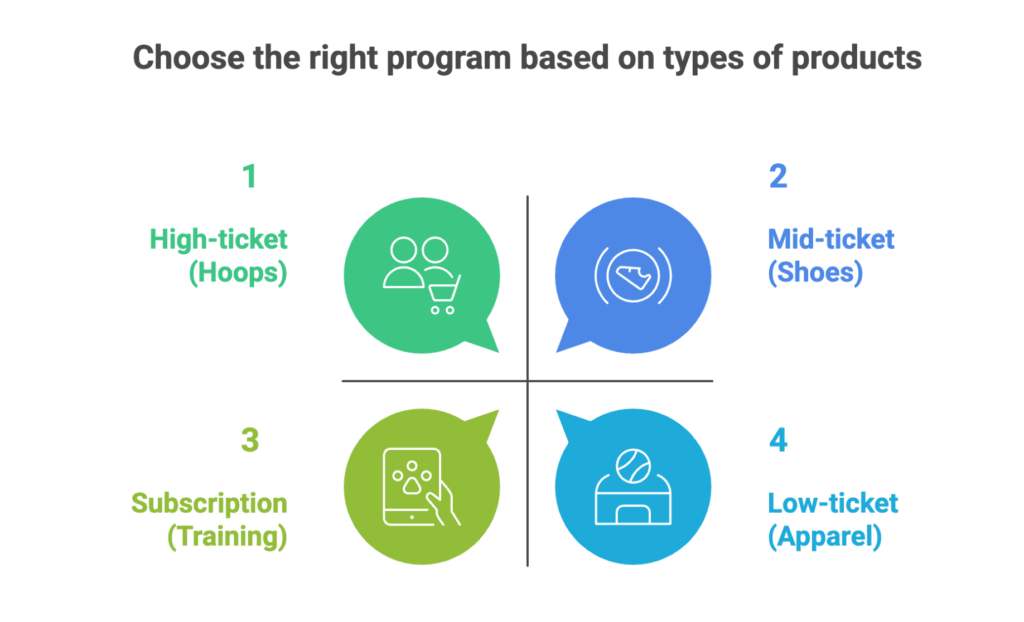
High-ticket (Hoops) 🏀
If you are reviewing expensive in-ground systems, partner with brands like Spalding or Goaliath. These orders usually range from $300 to $2,000. Selling just one “Mammoth” hoop can put over $100 in your pocket.
Mid-ticket (Shoes) 👟
When you write about the newest sneakers, look at Nike or Foot Locker. Most people spend between $120 and $200 here. This is a great “sweet spot” because you get a good mix of high sales volume and decent payouts.
Subscription (Training) 📱
If you review skill-building apps like HomeCourt AI, you’ll see values around $60 to $120 a year. You might make less upfront, but the income is steady if the customer keeps their subscription.
Low-ticket (Apparel) 🧦
For articles like “The Best Basketball Socks,” you’ll likely use Amazon or Under Armour. Since people only spend $30 to $80, you’ll need a ton of readers to make a good living here.
Once you understand these different levels, the math behind your strategy becomes much clearer.
Let’s say you want to earn $3,000 this month. If you only promote $60 basketballs, you’d need to move 833 of them to hit your goal.
But if you promote those $2,000 hoops, you only need to make 25 sales to reach that same $3,000. 💰
Evaluate Payment Terms and Minimum Thresholds for Cash Flow
The final filter in your decision framework is practical: When do you actually get paid?
This is often overlooked, but for a new affiliate, cash flow is oxygen. Waiting six months for your first check can kill your motivation and your budget for content creation.
Because every company handles payments differently, you need to know which “lane” your partners are in before you start promoting them:
The fast lane (Amazon): Pays roughly 60 days after month-end with a low $10 minimum. This is the fastest reliable access to cash for beginners.
The industry standard (ShareASale/CJ): Pays net-30 to net-60 with $50–$100 minimums. Most of your partners (Fanatics, Dick’s) will likely live here.
The “Whale” terms (Specialized B2B): Programs like Shoot-A-Way (shooting guns) might pay quarterly with a $500 minimum. This is fine if you sell one machine ($6,000+). But if you are a small affiliate, your money could be locked up for half a year.
What Basketball Products Can You Promote?
You’ve chosen your niche and selected your partners. Now, what exactly are you going to sell?
Most new affiliates think small. They picture selling a pair of Jordans or a jersey. But the basketball market is huge, ranging from a $30 rubber ball to an $8,000 robotic shooting machine.
In this section, we will map out the major product categories. We’ll break down who buys them, how much they cost, and the strategic role each plays in your income mix.
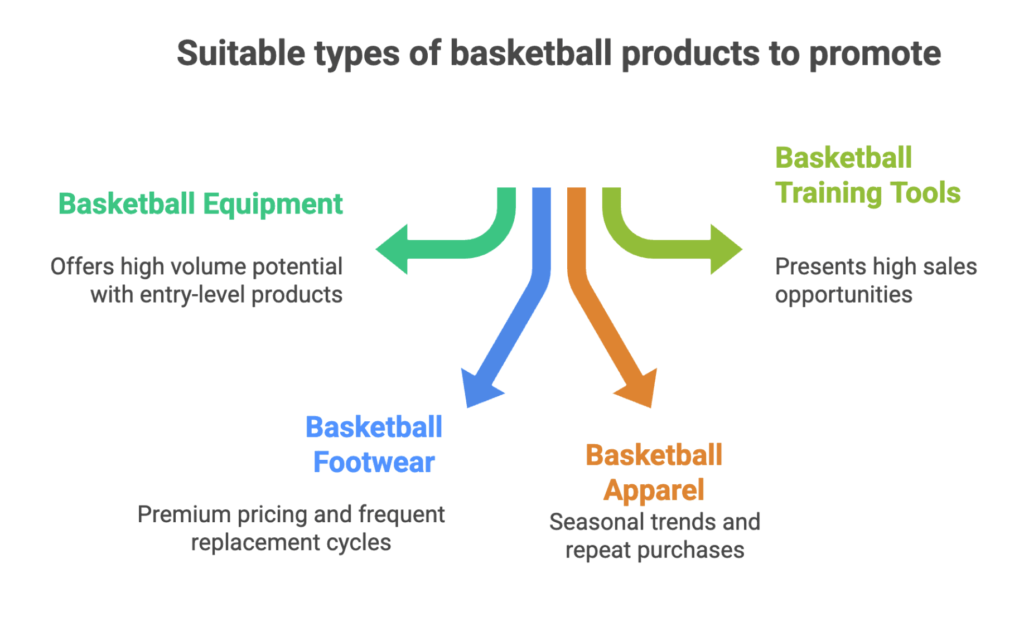
Basketball Equipment: Entry-Level Products with Volume Potential
Basketball gear is the real heart of this business. Every player needs a ball, and almost every driveway has a hoop.
You can think of this category as having two different sides: the items that bring people to your site and the items that actually pay the bills.
To understand how this works, let’s start with the products that bring in the most traffic.
- Indoor Composite Leather ($60–$120): Models like the Wilson Evolution offer premium feel and are consistent sellers.
- Outdoor Rubber ($30–$70): Built for concrete and asphalt. These are lower-priced but sell in higher volume, especially in spring and summer.
- Training & Specialty ($40–$80): This includes weighted balls for dribbling or oversized balls for shooting accuracy.
- Official Game Balls ($80–$150): Authentic NBA leather balls. These are often high-end gifts rather than everyday equipment.
While selling basketballs is a great way to get consistent sales, you will need to look at larger equipment if you want to see a major jump in your income.
This is where the big money is made. You might sell 50 basketballs in a single month, but selling just two high-end hoops can earn you the exact same amount of commission.
- Portable Systems ($250–$800): The most common choice for renters. They have a base filled with water or sand.
- In-Ground Residential ($600–$1,500): Permanent setups with tempered glass backboards. This is a major “home improvement” purchase for families.
- Institutional Systems ($1,200–$3,000): Heavy-duty adjustable hoops for schools or high-end training facilities.
Basketball Footwear: Premium Prices and Frequent Replacement Cycles
If equipment provides the baseline, footwear provides the explosive growth. Shoes are the engine of the basketball economy because they combine high prices with a short lifespan.
Unlike a hoop that lasts 10 years, performance shoes “die.” The traction wears out, and the foam compresses.
So what are people actually buying? There are three main categories you should know about.
Performance Shoes ($120–$200)
Built for the court. Features focus on grip, ankle support, and impact protection. Brands like Nike (GT Cut), Adidas (Harden), and Under Armour (Curry) dominate.
Retro & Lifestyle ($150–$250)
Jordans and classic re-releases. These appeal to collectors and fashion-conscious fans who might never step on a court.
Essential Add-Ons
Socks ($15–$35) and performance insoles ($20–$60) are classic “upsells” that increase the cart value.
Moreover, this category has a hidden superpower: specific intent.
When someone searches “basketball shoes,” they’re just browsing. But when they type “LeBron 21 purple colorway size 10,” they’re ready to buy right now. 💳
Signature models like LeBron, Curry, Giannis, and Luka convert at a high rate because fans are loyal to their favorite players.
You don’t have to convince a Curry fan to buy Under Armour. You just have to show them where the new Curry 11 is in stock.
Basketball Apparel: Seasonal Trends and Repeat Purchasing Behavior
While shoes have a performance lifespan, apparel is driven by something even more powerful: The season.
Think about it this way. A player might buy one basketball hoop in ten years. They might grab two pairs of shoes each year. But clothes? They’re buying those all the time.
The basketball calendar naturally creates shopping moments throughout the year. Players and fans are ready to buy 2-4 times every season, and each moment has its own shopping list.
October kicks off the pre-season
Players need to stock up on practice basics—reversible jerseys run $25-$60, shorts cost $30-$70, and compression sleeves go for $20-$50. Everyone’s getting ready to hit the court.
Then comes the winter grind from December to February
Gyms get cold, and travel ball season starts heating up. That’s when you’ll see sales jump for warm-up suits ($60-$150) and hoodies ($40-$100). Players need to stay warm between games.
April through June brings the playoff push
This is when fans take over. NBA Finals fever means everyone wants to rep their team. Authentic jerseys ($120-$200) fly off the shelves, and replica versions ($40-$80) aren’t far behind.
Basketball Training Tools: High-Ticket Institutional Sales Opportunity
If apparel is the “frequent flyer” category, training tools are the “heavy lifters.”
This is where you move from selling to individual players to selling to institutions—schools, universities, and training facilities.
So what are we talking about here? The institutional-grade stuff starts in the thousands.
Shooting machines like Dr. Dish or Shoot-A-Way run $4,000-$8,000.
These automated systems catch rebounds and pass the ball back to players. Land one sale with a 5% commission, and you just made $200-$400.
Additionally, rebounding and passing machines for post players sit in the $2,000-$4,000 range. Even the “cheaper” items, weighted vests, plyometric boxes, and vertical jump trainers, still cost $100-$800 per order.
All that means these basketball training tools can really earn you big.
FAQs
1. Which program is best for high-ticket basketball items?
HoopsKing is a standout for high-ticket items like shooting machines and weighted training systems. They offer a 10% commission with conversion rates often hitting 5% because their products solve specific problems for coaches and parents.
2. Can I promote the official NBA Store?
Yes. The NBA Store (often managed via Fanatics on the Impact network) typically offers around a 6% to 8% commission. While the percentage is lower than training software, the high brand trust often leads to higher volume sales during the playoffs and Christmas.
3. What are the requirements for coaching software affiliates?
Programs like FastModel Sports (FastDraw) look for “relevant partners.” You typically need a blog, YouTube channel, or social media following specifically geared toward high school, college, or youth coaches. Their payout is tiered:
- 1–10 sales: 15% commission
- 11–19 sales: 18% commission
- 20+ sales: 20% commission
4. How do I get paid, and what is the minimum threshold?
Most programs use networks like Impact, CJ Affiliate, or Affiliatly.
- Threshold: Most require you to earn at least $50 before a payout is triggered.
- Frequency: Payouts are usually monthly or quarterly (e.g., FastModel pays quarterly).
5. Are there legal restrictions for promoting basketball betting?
Yes, and they are strict. If you promote sportsbooks (DraftKings, FanDuel):
- Licensing: Some states (like AZ, CO, MI) require affiliates to have a specific marketing license.
- Disclosures: You must include FTC disclosures and responsible gambling messaging (1-800-GAMBLER) on every page.
Conclusion
Setting up a basketball affiliate program is a powerful way to grow your business and connect with a passionate community.
By choosing the right partners, offering great commissions, and using a tool like UpPromote to manage everything, you can build a program that gets great results.
We’ve shown the essential steps for building a successful affiliate program for your basketball store on Shopify from start to finish. Now it’s your turn to take the court and put these strategies into play.

Ellie Tran, a seasoned SEO content writer with three years of experience in the eCommerce world. Being a part of the UpPromote team, Ellie wants to assist Shopify merchants in achieving success through useful content & actionable insights. Ellie's commitment to learning never stops; she's always eager to gain more knowledge about SEO and content marketing to create valuable content for users. When she's not working on content, Ellie enjoys baking and exploring new places.