

Electricity generation in the global solar energy market is expected to reach 1.39 trillion kWh by 2026, according to Statista.
This number highlights the rapid growth and increasing demand for renewable energy. If you’re an influencer or eco-conscious individual, you can partner with top solar brands and earn commissions.
In this article, we’ve compiled the 16 best solar affiliate programs. Let’s look closer at their commission rates, cookie durations, and key benefits to find the right one for your audience.
Quick Comparison
| Program Name | Commission (%) | Cookie Duration (Days) | Niche Suitable |
|---|---|---|---|
| Santan Solar | 5% | 30 | Solar panels, renewable energy |
| Bluebird Solar | 5% | 60 | Solar installation, Indian market |
| Solar Power Store Canada | 10% | 60 | Canada solar solutions, eco blogs |
| Solar Direct | 5% (multi-tier: 5%/2%/1%) | 365 | Solar services, MLM affiliates |
| BioLite | 10–15% | 45 | Outdoor, camping, off-grid gear |
| Soliom | 8% | 90 | Solar security cameras, smart bird feeders |
| LuminAID | 10% | 30 | Emergency gear, camping |
| EcoFlow | 5% | 7 | Portable power stations, tech gear |
| Shop Solar Kits | 3% | 30 | RV, van-life, solar kits |
| SmartPower4All | Up to 75% | Not specified | DIY solar, digital solar products |
Affiliate Earnings Calculator
Estimate your affiliate income based on Traffic, CTR, AOV, and Commission rate. Drag the sliders below to explore different scenarios.
Estimated Results
These figures are for illustrative purposes – feel free to adjust them to fit your specific niche.
- Conversion Rate here is defined as the percentage of traffic that buys.
- Does not account for refunds, cancellations, or varying commission rates by product.
16 Best Solar Affiliate Programs to Promote Renewable Energy Solutions
1. Santan Solar
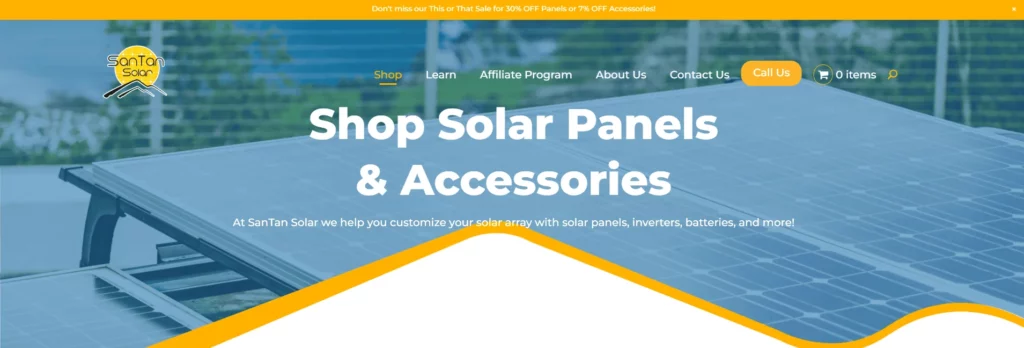
Santan Solar offers a diverse selection of solar panels, including new, used, repaired, refurbished, and overstocked options. All products come with a 1-year warranty, with an option to extend it up to 5 years.
As joining the Santan Solar affiliate program, you can earn a 5% commission on every purchase. The cookie duration lasts 30 days from the customer’s first click on your unique link.
Affiliates can receive payments through direct deposit after hitting a $50 threshold. With the brand’s well-designed banners, logos, images, and content, you can create appealing promotions and attract more audiences.
|
2. Bluebird Solar
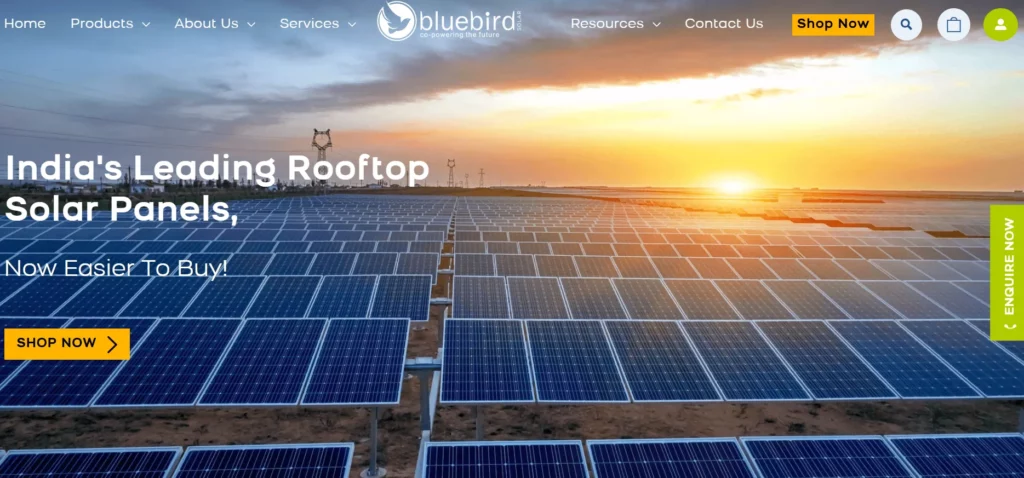
Bluebird Solar has taken the lead among Indian solar panel manufacturers with over 30 years of expertise. Plus, their Turnkey EPC services provide end-to-end solutions for solar power projects, covering the entire lifecycle of a solar power plant.
The Bluebird Solar affiliate program lets you earn a 5% commission every time someone clicks your unique link and places an order. The brand gives you a 60-day cookie window to earn commissions on qualified purchases.
The brand transfers your commission directly into your bank account on the 15th of the following month. Plus, you can access their affiliate dashboard to keep track of your sales and earnings in real time.
|
3. Solar Power Store Canada
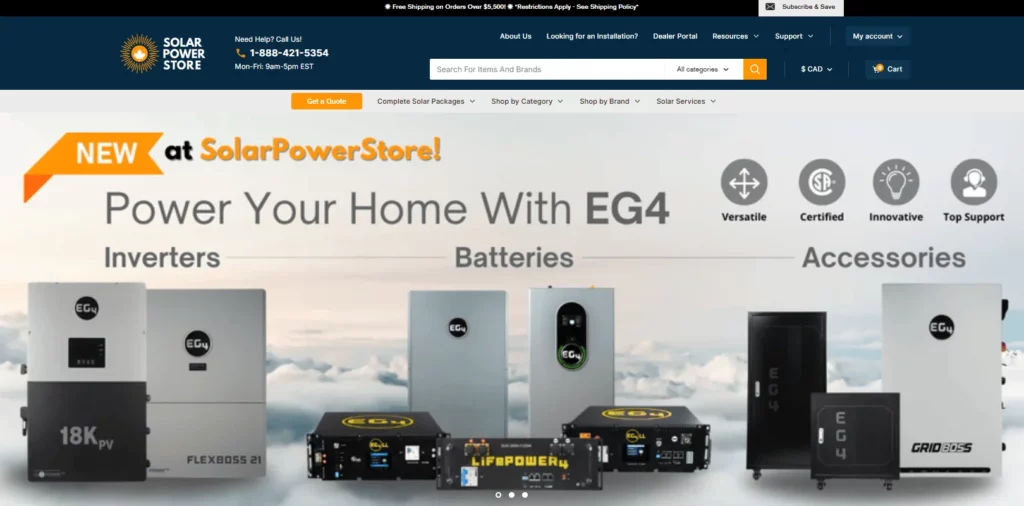
Solar Power Store Canada (SPSC) supplies Canadian families with solar power solutions, equipment, and technical support. Their products are designed to help reduce energy costs, promote sustainability, and contribute to the growing demand for clean energy.
You can earn a 10% commission whenever someone visits the SPSC site through your link and makes a purchase. The cookie will remain valid for 2 months from the visitor’s first click on your link.
Your commission payments are processed via PayPal, but you’ll only get paid once your total earnings exceed $50.
You’ll have a chance to receive free products to test and create detailed review content. Furthermore, the Solar Power Store partnership team is always ready to assist you with any affiliate-related issue.
|
4. Solar Direct
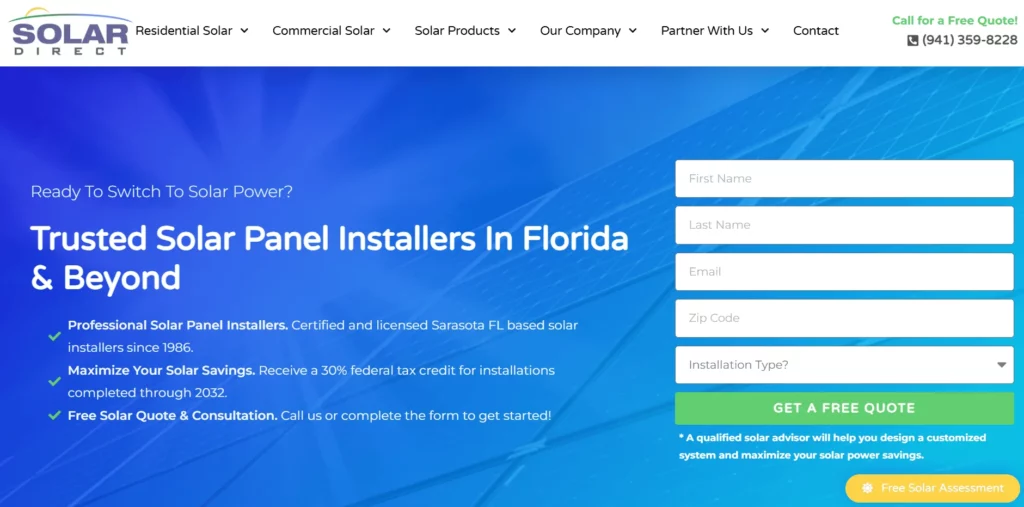
Solar Direct is a pioneering company in the renewable energy sector. The company provides comprehensive solar solutions, including consulting, engineering, sales, and installation services.
The Solar Direct affiliate program offers a multi-tiered commission structure, letting you earn commissions from both your own sales and the sales made by affiliates you refer.
- 5% commission on your direct sales
- 2% commission on sales generated by affiliates you recruit
- 1% commission on sales generated by people your affiliates sign up
They give you up to 1 year from the customer’s first click to earn on approved purchases. Affiliates can receive their commissions via PayPal, with a minimum payout threshold of $10.
The brand lets you use their vibrant banners and links to make your promotions stand out. Plus, you can sign up for newsletters to keep updated with the latest promotions and exclusive offers.
|
5. BioLite
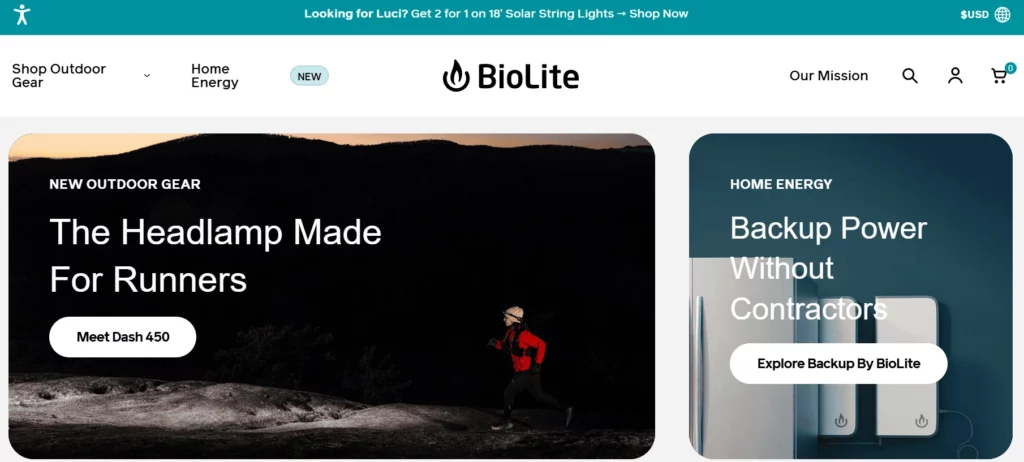
BioLite develops off-grid energy products for both outdoor recreational use and sustainable living. Their product line includes CampStove, HomeStove, FirePit, HeadLamps, SolarHome 620, and various solar panels and charging devices.
The brand pays you a commission of 10-15% on every sale you drive. They allow you to earn a commission for each order placed within 45 days from the first click on your link.
You can use various BioLite image and video assets, story ideas, and a comprehensive social media and blog library to enhance your promotional efforts. You will also receive their bi-monthly newsletters on soon-to-come sales and offers. Moreover, you can try samples of their latest products and best-sellers to create authentic recommendations.
|
6. Soliom
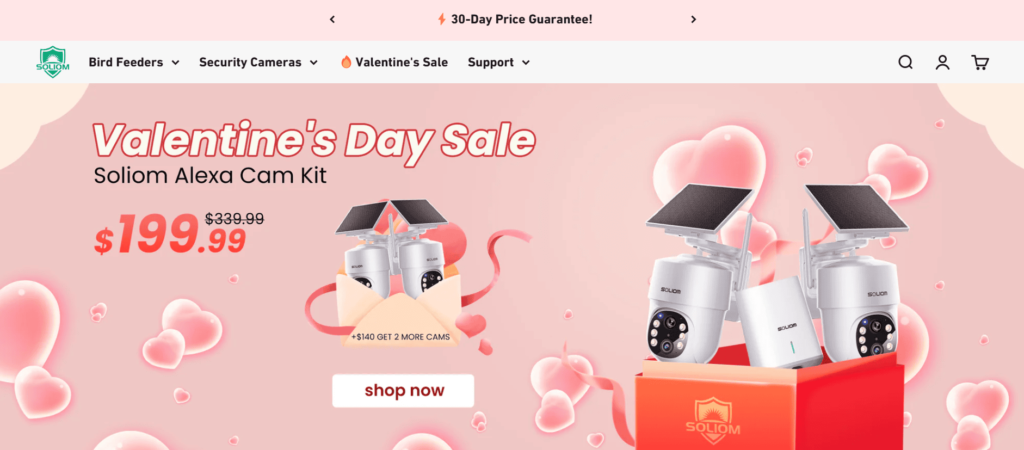
Soliom creates advanced, low-maintenance, cost-effective, and green-powered wireless security cameras and smart bird feeders. Their cameras come with innovative features like motion detection, night vision, and two-way audio.
The brand rewards you with an 8% commission on each sale you refer. The cookie remains active for 3 months from the visitor’s first click on your unique link.
Soliom supports you with visually appealing banners, images, and content to create captivating promotions. You’ll get access to regularly updated data feeds, including SEO descriptions and exclusive photos.
|
7. LuminAID

LuminAID creates solar-powered, inflatable lights and phone chargers. These lightweight, easy-to-use, and easily packable products are suitable for disaster relief and emergency preparedness.
Affiliates can enjoy a high commission of 10% on every purchase you refer. You have a full month from the customer’s first click to earn money on sales.
Managed via AvantLink, their solar affiliate program gives you access to your personal tracking dashboard to check your promotional results. The LuminAID newsletters update you on the newest promotions, products, and tools to help you drive more sales.
|
8. Ecoflow
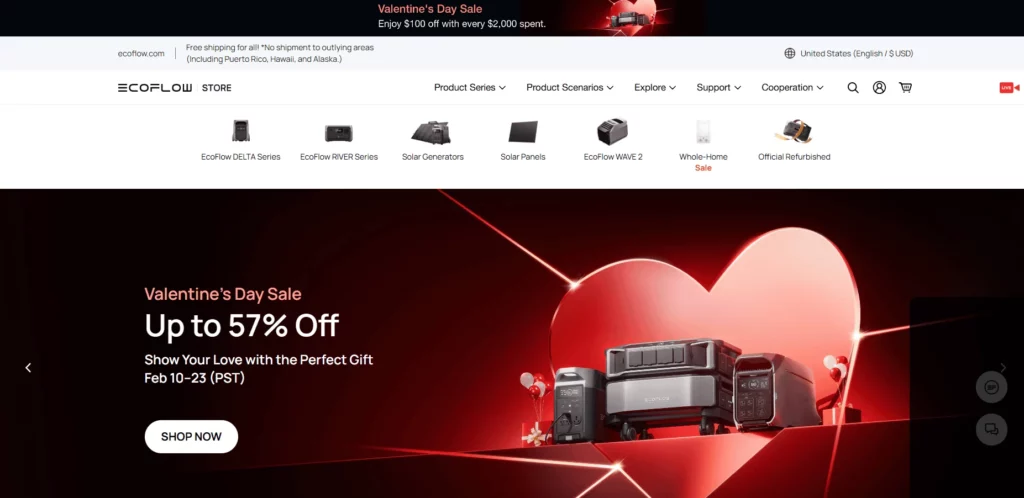
EcoFlow develops portable power stations, smart devices, and home energy systems. Their app helps customers monitor their products using Bluetooth locally or control them remotely via the cloud.
Managed via CJ Affiliate, the EcoFlow solar affiliate program offers a 5% commission rate on all sales. That means you can receive $50 with an average order value of $1000. The brand lets you earn commissions on orders placed within 7 days of the customer’s first click on your link.
You must create a CJ account before registering for the EcoFlow program. Then, you can access your account to get a unique tracking link and start your promotions.
|
9. Shop Solar Kits
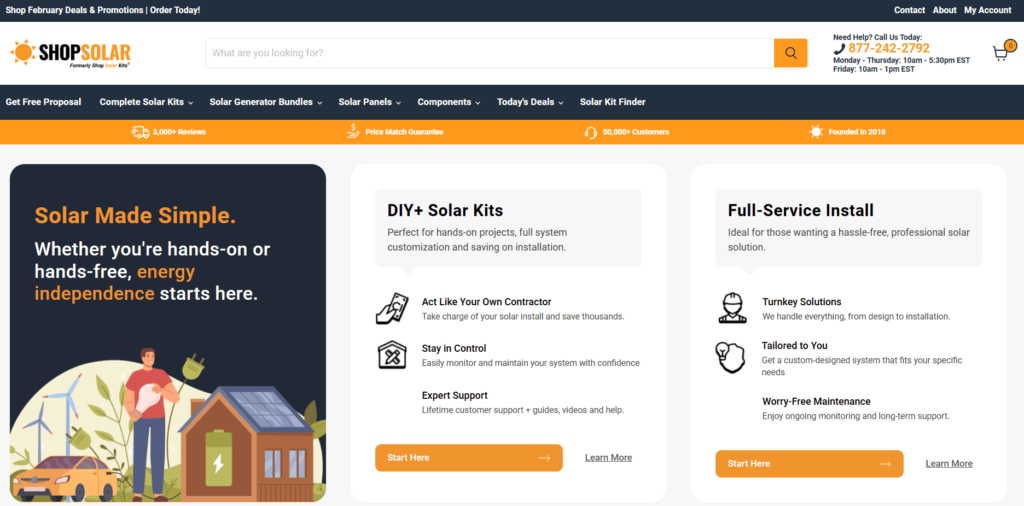
Shop Solar Kits is an e-commerce retailer specializing in pre-assembled solar kits and separate solar components. Their solar generator kits are ideal for RV enthusiasts, van lifers, campers, and emergency preparedness.
The Shop Solar Kits affiliate program offers a commission of 3% for every successful order placed through your link. With an average order value of $4,000, your earnings per sale are around $120. You can earn commissions on purchases made within a month from the customer’s initial click.
The brand will pay your commission on a monthly basis. One important note is that your order will only be marked as a qualified order for commission 45 days after it has been placed and successfully shipped.
|
10. SmartPower4All
SmartPower4All creates innovative solar energy solutions, particularly the Smart Solar Box. Their system helps users power electronics, appliances, and household lighting while saving up to 65% on energy bills.
When joining this solar affiliate program, you can earn up to 75% commissions for each customer’s initial sales and the three additional upsells.
The brand prepares a collection of banners and keywords for you to download and use in your promotions. You can also leverage their links and email templates to attract your audiences and drive more sales.
|
11. Sunstore Solar
- Commission rate: 5%
- Cookie duration: 30 days
Sunstore Solar is a family-run company offering expert solar power engineering and installation services. They offer 12V solar panels and kits for various applications, including caravans, motorhomes, boats, and more.
12. A1 Solar Store
- Commission rate: 6%
- Cookie duration: 180 days
A1 Solar Store supplies solar panels, inverters, batteries, and charge controllers. Their items come from trusted brands such as Canadian Solar, Q CELLS, and JA Solar.
13. Jackery
- Commission rate: 5%
- Cookie duration: 15 days
Jackery is a leading provider of portable power and green outdoor energy solutions. Their power stations feature AC, DC, and USB ports to charge smartphones, laptops, and small appliances.
14. Inergy Solar
- Commission rate: $100
- Cookie duration: Not mentioned
Inergy Solar specializes in portable and modular solar power solutions, including solar-powered generators, portable solar panels, and accessories. Their products are ideal for home backup power and outdoor enthusiasts seeking portable energy solutions.
15. Vivint Solar
- Commission rate: 30%
- Cookie duration: Not mentioned
Vivint Solar is a residential solar energy systems provider. With their Vivint app, users can track solar panel performance, system status, energy savings, and lifetime conversions while also managing various smart home functions.
16. America Solar
- Commission rate: $500
- Cookie duration: Not mentioned
America Solar provides homeowners with simple and affordable clean energy solutions. They take care of everything in the solar process, from analyzing utility bills and designing the system to securing permits and completing the installation.
How Do You Choose the Right Solar Affiliate Program for Your Audience?
Most new affiliates make a fatal mistake: they choose the program with the highest commission percentage or the most famous brand name.
That is a trap. A 15% commission on a product your audience can’t buy results in exactly $0.

Instead, you need a systematic evaluation process. You must match the program’s rules to your audience’s reality.
This framework looks at location, budget, and installation needs to help you find the top 2-3 programs for your specific business.
Start with Geographic Match – Your Highest-Impact Decision
Before checking commission rates, look at a map. Solar is a local industry defined by state regulations and incentives.
Start by analyzing your geographic traffic in Google Analytics to determine your strategy.
🏠 The “Local Hero” (Traffic concentrated in 1-3 states)
Prioritize Regional Programs. Local installers often offer significantly higher commissions (8–12%) than national giants.
The Math: On three sales of a $30,000 system, a national program (4% rate) pays $3,600. A regional partner (12% rate) pays $10,800.
The Strategy: If your audience is specific (e.g., the Northeast), align them with regional payers like Trinity Solar to potentially triple your earnings for the same traffic.
🗺️ The “National Spread” (Traffic distributed across 10+ states)
Choose Nationwide Programs (e.g., Sunrun, Tesla). While commissions are lower (4–6%), you need provider coverage in 40+ states.
Promoting a high-paying regional offer to a dispersed audience wastes the majority of your clicks on users outside the service area.
Bottom line: Let your traffic pattern, not just the payout rate, dictate your partner choice.
Match Program Pricing Tiers to Your Audience’s Financial Profile
Once you’ve solved the geography puzzle, you need to look at your audience’s wallet.
Promoting a $40,000 premium system to a budget-conscious audience will tank your conversion rates, regardless of how good the commission looks.
You can guess income levels based on your content topics. “Luxury eco-home renovations” implies high income; “How to save money on electric bills” implies a tighter budget.
Match your program selection to these three financial tiers:
| Audience | Income | Priorities | Best Programs | Strategy/Cost |
| High-Income | $150k+ | Aesthetics, brand reputation, and technology. | SunPower, Tesla, Trinity Solar | Premium tech;
25-40k range. |
| Middle-Income | 75k-150k | Balance of quality and ROI. | Sunrun, Palmetto, Momentum | Solid equipment;
16-28k range. |
| Budget-focused | 50k-150k | Low upfront costs; avoids cash payments. | Sunrun ($0 Down), Blue Raven | Leases, PPAs, and flexible financing. |
| DIY Outlier | Any Income | Avoids labor costs; prefers “sweat equity.” | GoGreenSolar, Renogy | Self-install kits; saves 40-50%. |
Align Programs with Your Content Strategy and Format
After matching location, you must match the affiliate program to your content style. A mismatch—like linking a DIY guide to a luxury installer—confuses readers and destroys trust.
Align your choice with your audience’s intent:
Educational Content (Research Mode)
Best Fit 💎: Full-service programs with tools (e.g., Palmetto, SunPower).
Why 🧐: Their savings calculators and roof assessments complement “Solar 101” guides, converting passive readers into leads without a hard sell.
Comparison & Review Sites (Shopping Mode)
Best Fit 💎: Marketplaces (e.g., Solar.com).
Why 🧐: Readers want options. Marketplaces provide multiple quotes, allowing you to remain neutral while earning commissions regardless of which installer they choose.
Smart Home & Tech
Best Fit 💎: Vivint Solar.
Why 🧐: For audiences focused on automation, this positions solar as a seamless upgrade to a connected home ecosystem rather than a construction project.
DIY & Technical Guides
Best Fit 💎: Kit suppliers (e.g., GoGreenSolar, Renogy).
Why 🧐: If you are teaching wiring or mounting, your audience wants to buy parts, not labor. Sending a DIYer to a full-service installer is a dead end.
Calculate Commission Economics Based on Your Traffic Volume
Once you’ve matched your geography and content style, the final tie-breaker is simple math: your traffic volume.
A site with 5,000 visitors shouldn’t play by the same rules as one with 50,000.
If you’re a low-traffic affiliate (under 20k visitors), you have a volume problem.
You can’t afford to waste a single lead on a low payout. Ignore the famous national brands and hunt for high-commission regional partners like Trinity or Blue Raven.
Selling just three systems at a 12% commission nets you $10,800.
Those same three sales at a standard 4% rate? Only $3,600. At this stage, commission rate is everything.
As you grow into medium traffic, start diversifying.
Mix a high-paying regional offer with a reliable national marketplace to hedge your bets and see what actually converts.
When you finally hit high traffic (50k+), the logic flips.
Now, you can afford the lower 4–6% rates from giants like Tesla or Solar.com. Why?
Because their brand recognition converts cold traffic significantly faster.
If a big brand converts three times better than an unknown high-payer, the revenue balances out—but you need the massive volume to make that trade-off worth it.
Decision Rule: If you are currently generating fewer than 5 conversions a month, do not overthink “brand trust.”
A 6-percentage-point increase in commission (from 6% to 12%) effectively doubles your income from the exact same traffic. Until you hit scale, prioritize the payout.
Evaluate Payment Timelines Against Your Cash Flow Requirements
You have calculated your potential earnings based on traffic volume, but there is a massive difference between “earning” a commission and “receiving” it.
In typical affiliate niches (like Amazon or software), you get paid 30 days after the sale. Solar is different.
Solar is a major construction project involving permitting, financing, and inspections. If you do not plan for this “solar lag,” you will run out of cash before your first check arrives.
Assess Marketing Support Needs vs. Commission Trade-offs
Finally, you must decide how much help you need to make the sale.
There is almost always an inverse relationship between the quality of marketing support and the commission rate. Programs that give you everything (landing pages, banners, calculators) usually pay less. Programs that give you nothing but a tracking link usually pay the most.
If you cannot code a savings calculator or design high-converting landing pages from scratch, do not chase the highest percentage.
It is better to earn 6% on a sale that actually happens because the provided landing page converted well, than 12% on a sale you lost because your homemade funnel looked amateur.
If you have an established content system and know how to build your own funnels, the support is useless to you.
You are “capturing the value” that the other programs spend on marketing support. The 2-4 percentage point difference justifies the effort of creating your own assets.
Also consider who you can call when things break.
Support is often routed through a generic ticketing system with 24-48 hour response times. You are a number.
You can often get an affiliate manager’s cell phone number. When a $30,000 sale isn’t tracking correctly, that direct access is worth its weight in gold.
Decision Framework: Ask yourself honestly: “Can I build a high-converting landing page by myself?”
If Yes: Prioritize Commission Rate over Support.
If No: The speed-to-market advantage of comprehensive support outweighs a 1-2% commission difference in your first year.
What Are the Most Effective Ways to Promote Solar Affiliate Programs?
Most solar affiliates fail because they focus on generic content like “The Benefits of Renewable Energy.” That might get traffic, but it rarely gets sales.
To earn commissions, you need to target users who are already doing the math.

This strategy focuses on six specific content formats that drive real conversions.
We are talking about interactive tools that capture leads at a 15-25% rate and local guides that rank for high-intent searches. This isn’t about brand awareness; it’s about getting the click.
Interactive Solar Cost Calculators – Your Highest-Converting Asset
If you only use one tactic from this list, make it this one. An interactive solar calculator is the single most effective tool for capturing serious leads.
Static blog posts are passive. A calculator is active. When a user enters their address, monthly bill ($150), and roof size, they are making a series of “micro-commitments.”
By the time they see the estimated savings, they have invested time and data.
Users who use calculators convert into qualified leads at a rate of 15-25%.
They naturally click “Get My Official Quote” because it feels like the logical next step to validate the numbers you just gave them.
Tools like WP Cost Calculator or Calculoid let you build logic-based forms with drag-and-drop ease.
Programs like EnergySage or Palmetto often provide branded calculator widgets that you can simply paste into your site. The affiliate tracking is built right in.
Calculator pages rank for some of the most valuable keywords in the industry:
“[State] solar cost calculator”
“How much is solar in [City]”
“Solar payback period [Region]”
For example: Create a “California Solar Savings Calculator” landing page.
Inputs: Configure the math for California pricing ($2.50-$3.50/watt) and PG&E rates.
Incentives: Include a toggle for the SGIP battery rebate.
Targeting: You are now targeting the 680,000+ annual searches for California solar costs with a tool that gives an instant answer.
City-Specific Solar Installer Comparison Guides
Solar is a local business. A homeowner in Phoenix doesn’t care about the best installer in Boston. They want to know who can handle the Arizona heat.
Building detailed, city-specific guides helps you rank for “bottom-of-funnel” keywords. These are users holding their credit card, looking for a vendor.
Do not just list companies. Create a “Best Solar Companies in [City]: 2026 Review” guide that profiles 5-8 regional installers. Each profile must include:
Average pricing ($/watt), Warranty terms (25-year production vs. workmanship), and Industry Certifications (look for NABCEP certified crews).
Be honest. If a company has great prices but slow service, say it. This builds trust.
Mention local factors. For a Phoenix guide, discuss how their panels handle extreme heat.
These pages rank for terms like “Best solar companies Phoenix” or “Solar installers San Diego reviews.”
These keywords have lower volume than “solar power,” but the buying intent is massive. A user searching for “installers in Dallas” is ready to book a consultation today.
Priority Targets: The Top 20 Markets Don’t guess where to start. Focus on the cities with the highest solar volume. These 20 cities represent over 40% of the residential solar market:
- Phoenix, AZ
- Los Angeles, CA
- San Diego, CA
- Houston, TX
- Dallas, TX
- Sacramento, CA
- Las Vegas, NV
- San Antonio, TX
- Denver, CO
- Orlando, FL
- San Jose, CA
- Austin, TX
- Riverside, CA
- Tampa, FL
- Miami, FL
- Tucson, AZ
- Fresno, CA
- Albuquerque, NM
- San Francisco, CA
- Portland, OR
Solar ROI and Payback Analysis with Real Household Examples
Calculators often lack context. To persuade skeptical homeowners, you must “show your work” through transparent ROI breakdowns.
Move the conversation from abstract green energy to concrete household profit with a specific case study, such as “How Much Does Solar Actually Save in [State]?”
Avoid vague averages. Walk readers through the math: a $20,000 system, minus tax credits and rebates, might net $12,000.
If this generates $1,500 in annual savings, you can demonstrate an 8-year break-even point and over $25,000 in lifetime tax-free profit.
Reinforce this data with visuals.
Use an “Accumulation Graph” to contrast rising utility costs against flat solar costs.
Build trust by including a sensitivity analysis—showing how payback timelines shift for $100 versus $250 monthly bills.
Finally, pivot naturally to your affiliate offer: “The math works. Request a personalized quote to see your specific savings.”
State-Specific Solar Incentive and Rebate Guides
ROI relies heavily on incentives, the primary trigger for most purchases.
Because the world of tax credits and rebates is confusing, a “2025 Complete Guide” positions you as the expert who clarifies the chaos.
📋 The Authority Checklist
Your guide must be exhaustive. Cover the full stack:
- Federal ITC: The 30% tax credit.
- State Programs: High-value rebates (e.g., for battery storage).
- Net Metering: How utilities pay for excess energy.
- Tax Exemptions: Property and sales tax waivers.
⚙️ The “Maintenance” Rule
Incentives expire. You must update content quarterly. Listing an expired rebate destroys credibility, while a “Last Updated” tag builds trust.
🎯 Priority Targets: The “Generous 15”
Focus on states combining high volume with complex incentives:
- West: CA, CO, OR, WA, HI, NM
- Northeast: NY, MA, NJ, CT, MD, RI, VT
- Midwest: IL, MN
The Conversion Hook
Readers are in the “cost-justification” phase. Leverage urgency to close them: “Incentive funds are often limited. Get your free quote today to lock in your eligibility for the 2026 rebate cycle.”
YouTube Reviews of Portable Solar Products
While ROI breakdowns suit expensive home systems, portable solar converts faster. These are “credit card” purchases, not loan applications.
Video reviews tap into the “Show Me It Works” factor.
A video of a generator running a fridge creates undeniable proof, driving conversion rates of 3-8%. Viewers searching “EcoFlow vs. Jackery” are ready to buy, not just browsing.
Video Structure for Sales
- Unboxing: Briefly show contents and specs.
- Stress Test: Crucial. Run real appliances (drills, coffee makers) and show the wattage meter.
- Comparison: Weigh performance against competitors like Bluetti.
- Verdict: Clearly state the ideal user (e.g., campers vs. home backup).
Low Barrier, High Reward
Unlike $30k roof systems, these units cost $200 – $2000. Focus on Portable Power Stations (600Wh+) and Foldable Panels, which offer healthy $50 – $150 in commission.
Strategy: Embed these videos into SEO-driven blog posts like “Emergency Preparedness.” The video builds trust, while the text captures the search traffic.
Solar vs. Alternatives Comparison Content for Mid-Funnel Buyers
Target “fence-sitters” who know they have a problem but doubt the solution. Comparison content resolves this “Mid-Funnel” indecision.
Use the “This vs. That” Framework (e.g., “Solar vs. Generators” or “Lease vs. Loan”). Structure these posts to force a decision:

Comparison Tables: Highlight cost, maintenance, and ROI instantly.
“Best For” Scenarios: Be honest. Admit solar is bad for short-term renters. This transparency builds the trust required to sell to homeowners.
Financial Graphs: Show how generators burn fuel forever, while solar creates free power after payoff.
Rank production by decision impact:
Solar vs. Grid: The fundamental value question.
Battery vs. Generator: Critical for blackout-prone areas.
Purchase vs. Lease: The financial hurdle stopping many buyers.
Pivot to the offer naturally: “If you fit the profile for long-term savings, request a custom quote to see how solar stacks up against your current bill.”
What Mistakes Kill Solar Affiliate Earnings (And How to Avoid Them)
Most affiliates approach solar the same way they approach selling t-shirts or software. They use generic strategies that work in e-commerce, only to watch them fail in the high-stakes world of solar.
Solar is a “high-consideration” purchase. It involves credit checks, roof inspections, and 20-year contracts. The rules here are different.
To save you from wasting months on strategies that don’t work, we are going to debunk the two biggest myths that kill earnings—and replace them with the proven approaches that actually convert.
Myth #1: “More Traffic Always Equals More Earnings”
The industry’s most dangerous lie is that traffic volume equals success.
In solar, audience quality always beats quantity. 50,000 visitors reading generic green news are worthless to installers if they are renters, whereas 5,000 homeowners actively researching “installation costs” represent high value.
🤫 The Reality Check
A “Traffic Chaser” with 50,000 broad visitors often earns less than an “Intent Hunter” with just 5,000 targeted visitors. The difference is intent: one audience is browsing; the other is buying.
🔁 The Strategic Correction
Stop writing for everyone. You must target the “Golden Triangle” of conversion traits:
Homeownership: They must own the roof.
Geography: They must reside in states with viable incentives and net metering.
Financial Capacity: They need credit scores of 650+ or cash reserves.
Before scaling, audit your analytics. Your ideal profile should consist of 70%+ homeowners, incomes above $60k, and traffic exclusively from
Myth #2: “Promoting 10+ Programs Maximizes Revenue”
“More options” often trigger Decision Paralysis.
For homeowners facing a $30,000 investment, a list of 10 companies feels like homework, not freedom. Overwhelmed users simply close the tab.
Data confirms the “Paradox of Choice”: Single recommendations convert at 8-12%, while lists of 8+ options drop conversions to 2-4%, effectively halving your revenue.

Instead of a laundry list, limit partners to three distinct roles:
- Premium CPA: For brand trust (e.g., SunPower).
- Aggregator CPL: For price shopping (e.g., EnergySage).
- Niche Option: For DIY or low-credit users.
Consistently recommending the same few companies builds authority.
It proves you have vetted the market.
Reinforce this with a “Why We Recommend” page—transparency builds far more trust than generic “Top 10” lists.
Myth #3: “Hard-Sell Tactics Work Better Than Education”
Just as promoting too many programs triggers paralysis, pushing too hard triggers skepticism.
Affiliates often try to sell solar like they are selling a diet pill: “Act Now! Limited Time Offer! Zero Down!”
This is a fundamental misunderstanding of the solar sales cycle. The average solar purchase takes 45-90 days from first Google search to signed contract.
Homeowners consult 3-5 sources and get 2-4 quotes.
If you scream at them to “Buy Now,” you sound like a scammer. They will simply leave to find a site that respects their intelligence.
🤝 The “Trust First” Conversion Data
Hard-Sell Strategy: Aggressive copy converts 2-3% of visitors immediately but generates 70% bounce rates.
Educational Strategy: Comprehensive guides with “soft” CTAs convert 6-9% of visitors over the 90-day window.
🔄 The Educational Alternative
Instead of hype, offer clarity. Acknowledge that solar is complex. Be the person who explains:
The Downsides: Admit that solar doesn’t make sense for shaded roofs or short-term owners.
The Financing Reality: Fairly compare Cash vs. Loan vs. PPA, rather than pushing the one with the highest commission.
The Evidence: Cite third-party data (like NREL or EnergySage) to back up your savings claims.
When you educate rather than sell, you earn backlinks and social shares. Hard-sell landing pages get zero organic love. Educational guides compound in value over time.
Myth #4: “National Content Outperforms Local Content”
Many affiliates write “The Ultimate Guide to Solar Panels” and think they are done. They are missing the point: Solar is hyper-local.
Writing a national guide is like writing a guide on “How much a house costs in America.” It’s meaningless.
A 30% federal tax credit, but everything else—utility rates, net metering, rebates, and installation costs—varies wildly by state.
If a reader in Pennsylvania sees a guide quoting California prices and mentioning Florida incentives, they immediately know your content is irrelevant. They lose trust and leave.
Local keywords have lower volume but vastly higher intent.
Generic Keyword: “Best Solar Panels” (8,100 searches/mo) → 2% Conversion.

Local Keyword: “Best Solar Panels in Florida” (1,900 searches/mo) → 12% Conversion.
Don’t try to cover the whole country.
- Pick Your Battles: Start with states that have favorable economics (high electricity rates + strong incentives).
- Build State Guides: Create a “Solar in [State]” hub page covering local costs and rebates.
- Scale to Cities: Once you rank for the state, drill down to “[City] Installer Reviews.”
Myth #5: “You Need Solar Industry Expertise to Succeed”
This is the myth that stops people from even starting. You look at terms like “kilowatts,” “inverters,” and “SRECs” and think, I’m not an engineer, I can’t write about this.
Here is the secret: Your audience isn’t engineers either. They are confused homeowners.
Experts often suffer from the “Curse of Knowledge.” They use jargon that confuses normal people.
As a beginner, you have a massive advantage: you ask the same questions your audience asks.
The Expert writes: “Photovoltaic array DC-to-AC inversion efficiency ratios.”
You write: “How much power do you actually lose when converting solar energy for your home?”
You don’t need to be the source of the data; you just need to be the curator.
Aggregate Data: Take spec sheets from manufacturers and turn them into easy-to-read comparison tables.
Interview Pros: Send 5 questions to a local installer and publish their answers as a Q&A. You get their expertise; they get exposure.
Cite Authorities: Link to NREL.gov or Energy.gov for technical claims. This borrows their credibility.
You do not need a degree. You need “Consumer-Level Mastery.”
If you spend 10-15 hours researching the basics of cost, savings, and incentives, you will know more than 99% of homeowners. That is enough to lead them.
FAQs
What is a solar affiliate program?
A partnership where you earn commissions by referring customers to solar products or installation services.
How do solar affiliates make money?
Through pay-per-lead, pay-per-sale, or fixed bounties when referrals convert.
How much can you earn per referral?
Typically $50–$300+ per lead; full system sales can pay $500–$5,000+.
Are solar affiliate programs beginner-friendly?
Yes, especially for content creators in home improvement, finance, or sustainability.
Do you need technical solar knowledge?
No, but basic understanding improves trust and conversions.
What traffic works best for solar affiliates?
SEO, local landing pages, YouTube explainers, and paid search perform well.
Is solar affiliate marketing location-dependent?
Yes. Most programs only accept leads from specific countries or states.
Are solar affiliate programs legitimate?
Yes—many are run by established solar installers and energy companies.
How long is the sales cycle?
Usually long (weeks to months), but payouts are higher to compensate.
Do solar programs have cookie tracking?
Some do, but many rely on lead forms instead of cookies.
Conclusion
Now that you know the essential steps to set up a solar affiliates program, it’s time to actually build one.
Your affiliate marketing journey can be easier if you have the right tool like UpPromote. We have everything you need to manage your program properly and effectively over time.
Let’s explore our pricing plans today to see which one suits your program!

Ellie Tran, a seasoned SEO content writer with three years of experience in the eCommerce world. Being a part of the UpPromote team, Ellie wants to assist Shopify merchants in achieving success through useful content & actionable insights. Ellie's commitment to learning never stops; she's always eager to gain more knowledge about SEO and content marketing to create valuable content for users. When she's not working on content, Ellie enjoys baking and exploring new places.