












TL; DR
Most Shopify stores should launch a referral program first, then add an affiliate program once monthly revenue exceeds $20K. Referrals deliver higher-trust conversions, and affiliates deliver broader reach.
- Higher LTV: Referred customers are worth 16% more than non-referred
- Lower friction: Referrals come pre-validated through personal trust
- Broader reach: Affiliates tap blogger and creator audiences customers can’t access
- Faster start: Referral setup takes days; affiliate recruitment takes weeks
- Best combo: Run both — referral program for retention, affiliate program for new acquisition
Most Shopify merchants treat affiliate programs and referral programs as the same thing. They are not — and launching the wrong one first can cost months of effort.
Affiliate marketing is now mainstream: 81% of advertisers and 84% of publishers leverage it.
Referral marketing runs on a different mechanic entirely — existing customers recommending your brand to people they trust.
Wharton research found that referred customers have a 16% higher lifetime value than non-referred customers.
Two models, two playbooks, one decision: which to launch first.
This guide breaks down the differences using data from Shopify merchants running both, plus a clear framework for choosing the right starting point for your store.
What Is the Difference Between an Affiliate Program and a Referral Program?
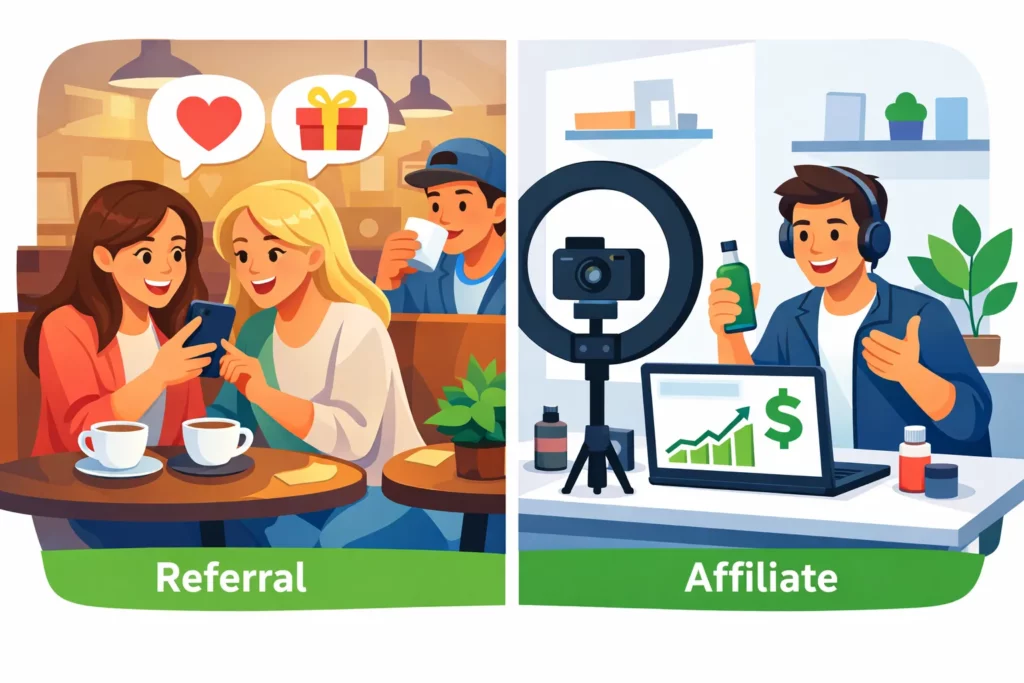
An affiliate program pays cash commissions to external partners (bloggers, influencers, coupon sites) to send customers your way.
Meanwhile, a referral program rewards your existing customers for bringing in friends or family. One targets reach, the other leverages trust.
Affiliate partners are marketers or creators who haven’t bought your product. They join for the commission, build content around your brand, and drive traffic.
Their incentive is income.
Referral participants come from the opposite direction. They’ve already bought your product and liked it enough to recommend it to someone they know personally.
Their incentive is trust, not income.
The implications of those two starting points show up across every operational dimension.
| Dimension | Affiliate Program | Referral Program |
| Who promotes | External partners (bloggers, influencers, creators) | Existing customers |
| Relationship to brand | Usually haven’t purchased | Have purchased and like the product |
| Motivation | Cash commission | Reward (store credit, discount, gift) |
| Reach | Broad — entirely new audiences | Narrow — personal network of customers |
| Trust level | Medium — promotional context | Very high — personal recommendation |
| Conversion rate | Lower — typical for cold traffic | Higher — driven by personal trust |
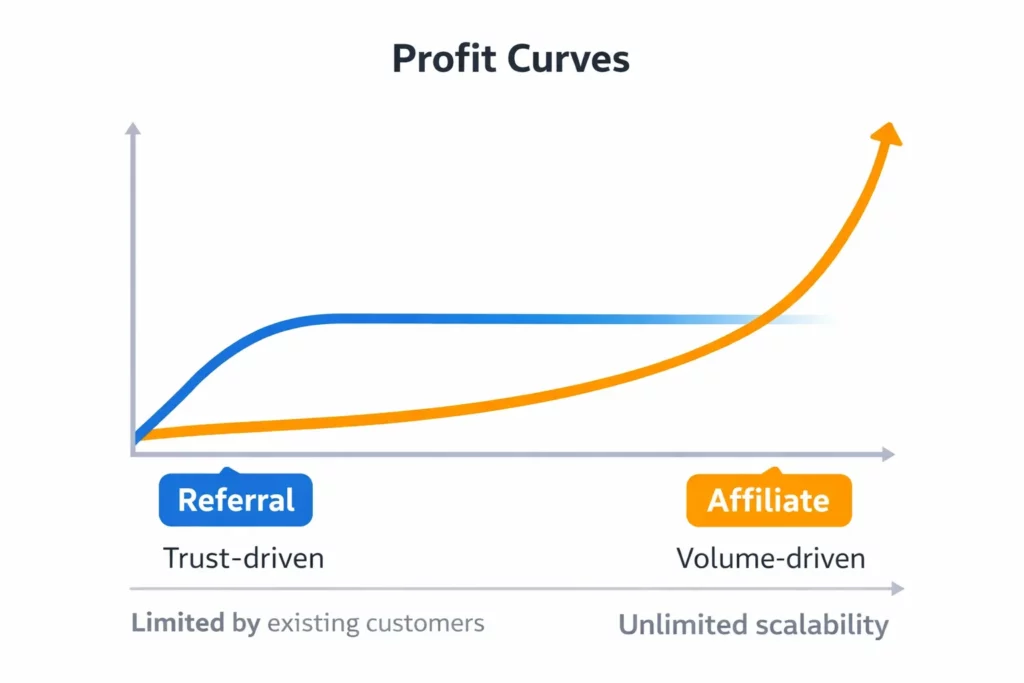
| Scale potential | High — no cap on partner count | Medium — limited by customer base |
| Payment method | Cash (PayPal, bank transfer) | Store credit, discount codes, free products |
| Management effort | High — recruit, vet, onboard, support | Low — automated post-setup |
| Best for | New acquisition, broad reach | Retention, LTV boost, word-of-mouth |
Affiliate programs can scale to thousands of partners, but that scale demands active management — sourcing creators, vetting applicants, processing payouts.
Referral programs flip the equation. They run on autopilot once you set up the post-purchase trigger, but their reach can’t exceed your existing customer base.
How Do Affiliate and Referral Programs Compare on ROI and Performance?
Affiliate and referral programs deliver different ROI profiles.
Referral programs generate fewer transactions but each customer is worth more over time. Affiliate programs generate broader volume faster, but with thinner margins per customer.
Wharton research shows that referred customers start with built-in trust; a recommendation from someone the buyer knows removes most of the cold-traffic friction.
The economics favor referrals on a per-customer basis.
Affiliate programs win on scale and speed. The Performance Marketing Association’s 2022 industry study found a 12:1 average return on ad spend across the channel — every dollar spent generated roughly $12 in revenue.
That math gets attractive at volume.
| Performance dimension | Affiliate Program | Referral Program |
| Customer LTV | Standard (no built-in lift) | +16% vs non-referred (Wharton) |
| ROAS benchmark | ~12:1 average across the channel (PMA) | High — rewards cost less than cash commissions |
| Cost structure | Cash commission as % of every sale | One-time reward per referral (store credit, discount) |
| Scale ceiling | Unlimited — partner pool keeps growing | As large as your existing customer base |
| Time to first revenue | Slower — recruitment + content cycle | Faster — single email or post-purchase trigger |
Two real merchants illustrate the tradeoff.
Saledress, an apparel store, generated $1.8M in affiliate revenue from 30,000 referral orders in 2022 by combining tiered commissions with multi-level marketing.
Putnam, a home goods brand, took the opposite path. They used UpPromote’s Customer Referral feature alongside the marketplace listing to convert their existing customer base into a steady promotion channel.
Neither approach is universally better. The right question is which dimension matters more for your store right now.
Which Should You Launch First? A Decision Framework
There’s no universal answer, but there is a clear framework.
Three factors decide which program to launch first: your current revenue stage, your existing customer base size, and your niche. Match those three against the table below to find your starting point.
Each factor pulls in a different direction. Stores with steady customer flow but low brand awareness benefit most from referrals.
Stores with niche bloggers or influencers already covering their space benefit most from affiliate marketing. Stores with both should run both, but rarely at the same time.
Sequencing matters more than picking the “right” one.
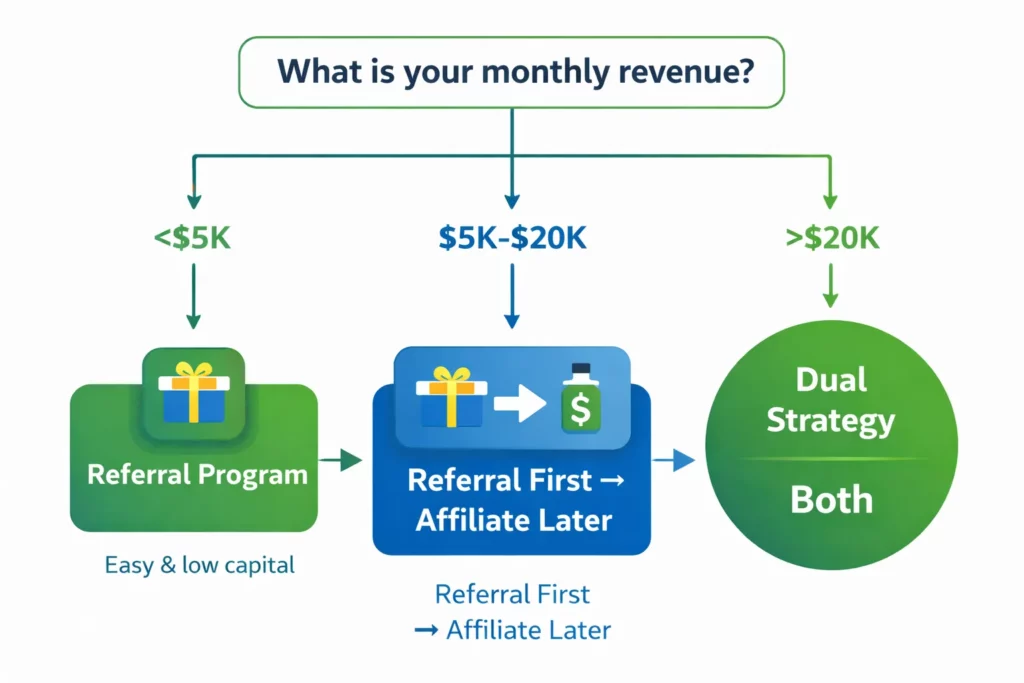
| Your situation | Launch first | Why |
| Revenue under $5K/month, satisfied customers | Referral | Low setup effort, leverages existing happiness, no need for outreach |
| Revenue under $5K/month, small customer base | Affiliate (lightweight) | Customer base too thin for referral momentum; need external reach |
| Revenue $5K–$20K/month | Referral first, affiliate 1–2 months later | Referral = fast wins. Affiliate = scale layer once cash flow steadies |
| Revenue $20K+/month | Both at once | Resources to manage both. The two channels complement each other |
| Niche dense with bloggers/influencers (beauty, fashion, fitness) | Affiliate priority | Large creator pool already covering your space |
| Subscription or consumable products (food, skincare) | Referral priority | Repeat customers = natural recurring referrers |
| High-ticket ($200+) products | Affiliate priority | Commission per sale is meaningful enough to attract serious creators |
| Community-driven brand | Referral priority | Customers share because they belong, not because they’re paid |
Most Shopify stores follow the same rough pattern when launching both programs:
Months 1–2: Launch referral first. Setup takes hours, not days. Trigger the program with a post-purchase email to existing customers and let it accumulate.
Months 3–4: Add affiliate. Once referral runs steady, recruit bloggers and influencers in your niche. This is where the heavier management work begins.
Months 5+: Optimize both. Top customer-referrers often graduate into the affiliate program for cash commission. External creators stay on the affiliate side. The two channels feed each other.
The logic behind the sequence is simple. Referral programs need almost no recruitment — you already have the participants.
Affiliate programs need recruitment, vetting, and onboarding before any commission gets paid. Starting with referral buys you 2 – 4 weeks of revenue while the affiliate program ramps.
Key Takeaway: Most Shopify stores should launch referral first. It’s faster to set up and runs on existing customers. Add affiliates in months 3-4 once the referral program stabilizes. Stores above $20K/month can run both from day one.
Can You Run Both at the Same Time? And How?
Yes — and for stores above $20K/month, running both is the optimal setup.
The two programs serve different jobs and don’t cannibalize each other. Most modern affiliate platforms support both program types from a single dashboard.
The structural separation matters more than the platform choice.
Customer referral and affiliate programs use different reward types, different recruitment paths, and different management cadences.
Trying to merge them into one program creates conflict; running them as parallel tracks creates leverage.
Each track captures a different audience.
| Element | Referral track | Affiliate track |
| Participants | Existing customers | Bloggers, influencers, content creators |
| Reward type | Store credit, discount, or free product | Cash commission (PayPal, bank transfer) |
| Reward size | Smaller — $10–20 credit or 10–15% discount | Larger — 15–25% cash on every sale |
| Enrollment | Automatic post-purchase | Manual application + approval |
| Materials needed | Referral link + share button | Full media kit + brand guide |
| Tracking method | Referral link or coupon code | Affiliate link + dedicated coupon |
| Management cadence | Mostly automated after setup | Active — weekly communication |
SilverCeuticals, a health and wellness brand, runs exactly this dual structure. Their combined customer referral and affiliate programs together generate close to 30% of total revenue.
The brand now supports 1,100+ active affiliates, with top performers earning $50,000–$100,000+ in monthly sales.
The customer referral side does most of its work automatically. UpPromote’s Customer Referral feature triggers a post-purchase invite to every shopper, handing them a unique link or coupon to share.
The affiliate side runs in parallel with its own setup — recruitment, vetting, cash payouts — and the two never collide.
This setup creates a natural pipeline. Customers start as casual sharers earning store credit, and the most active ones get invited into the affiliate program for cash commission.
Bloggers and creators recruited from outside stay on the affiliate track. Every audience segment lands in the right slot.
What Changed in 2026?
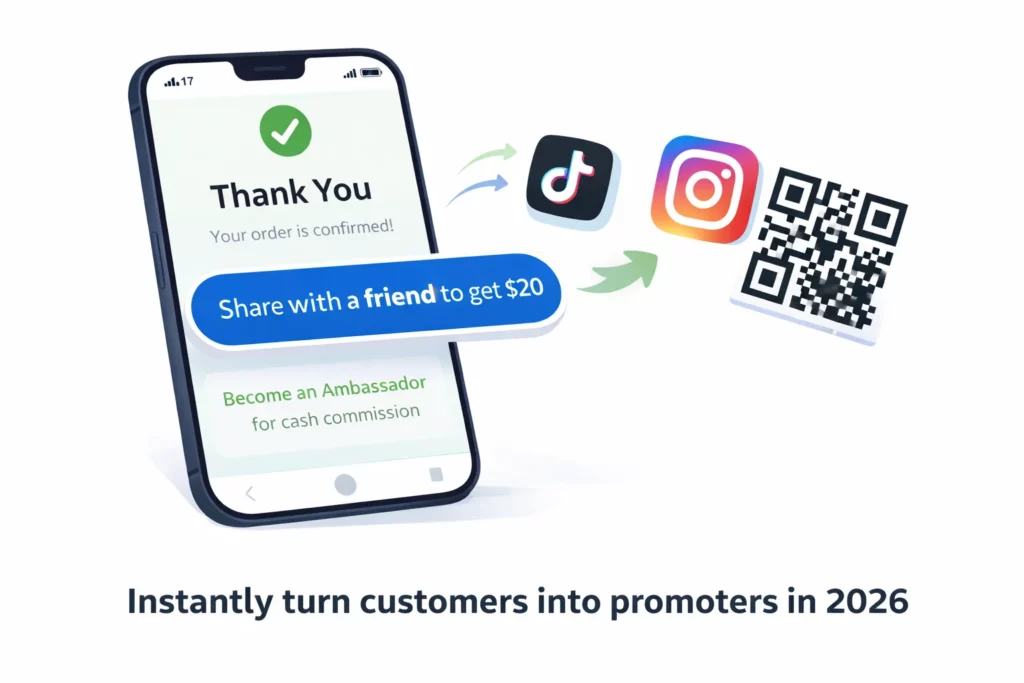
Three shifts in the past year have changed how Shopify merchants think about referral and affiliate programs. Each one tightens the case for running both rather than choosing.
Post-purchase enrollment has become standard. Tools like UpPromote now trigger a referral or affiliate invite at the thank-you page, blurring the line between “customer” and “affiliate” the moment a sale closes.
That timing shift matters.
TikTok Shop has created a hybrid creator economy. Creators on the platform act as both referrers (sharing because they like the product) and affiliates (earning commission on sales).
One person, both incentives.
Subscription and consumable products keep gaining share. These categories favor referral programs — repeat customers create repeat referral opportunities, and store-credit rewards recycle straight back into the next order.
Frequently Asked Questions
Does a referral program need a separate app?
Yes. Shopify doesn’t include a built-in referral program feature, so you need a third-party app from the Shopify App Store to track referrals, manage rewards, and prevent fraud. Most options offer free plans or trials to test before committing.
Can one app handle both affiliate and referral programs?
Yes. Many Shopify affiliate apps now support both program types from a single dashboard. Running both on one platform avoids tracking conflicts, gives a unified analytics view, and removes the cost of paying for two separate tools.
Can the same person be both a referrer and an affiliate?
Yes — many merchants design their programs around this overlap. Customers start in the referral program earning store credit, and the most active ones move into the affiliate program for cash commission.
This pipeline turns the best referrers into committed partners.
Which costs less to run — referral or affiliate?
Referral programs cost less per acquired customer in most cases. Rewards are store credit or discount codes — recyclable into future sales — rather than cash payouts.
Affiliate programs require both cash commissions and active management time on top of recruitment.
My store sells subscription products — which should I launch first?
Referral first. Subscription buyers come back on a recurring cycle, which means more chances to trigger referral invites at each renewal.
Layer in an affiliate program later with recurring commissions to attract creators who review subscription products.
Does a referral program help with SEO or AI search visibility?
Indirectly, yes. Referrals drive brand mentions, social shares, and word-of-mouth conversations — all signals that AI search engines weigh when surfacing brand recommendations.
Affiliate programs contribute more directly through blog posts, YouTube reviews, and creator content that ranks in both traditional and AI search results.

Ellie Tran, a seasoned SEO content writer with three years of experience in the eCommerce world. Being a part of the UpPromote team, Ellie wants to assist Shopify merchants in achieving success through useful content & actionable insights.Ellie's commitment to learning never stops; she's always eager to gain more knowledge about SEO and content marketing to create valuable content for users. When she's not working on content, Ellie enjoys baking and exploring new places.

![How to Use Shopify Functions with Your Affiliate Program [2026 Guide]](https://static.uppromote.com/wp-content/uploads/2026/06/how-to-use-shopify-functions-with-affiliate-program-300x169.webp)

![How to Prevent Affiliate Fraud on Shopify: Self-Referral, Coupon Abuse & More [2026]](https://static.uppromote.com/wp-content/uploads/2026/06/how-to-prevent-affiliate-fraud-on-shopify-300x169.webp)