











TL;DR
By default, most affiliate apps only track the first subscription order. Renewals go unattributed; your affiliates earn $6 on a $480 customer instead of $72.
- The fix: Enable subscription app integration — most are a one-click toggle
- Setup time: Under 5 min utes
- Apps supported: Recharge, Bold, Appstle, Seal, Recurpay
- Best starting model: Higher first-order commission + lower recurring rate, capped at 12 months
Subscription brands have a built-in advantage with affiliate marketing. One referral doesn’t just pay once — it can keep paying for months or years.
Here’s the math. A customer subscribes at $40 per month and stays for a year. That’s $480 in lifetime value from a single referral.
An affiliate earning 15% on the full run would collect $72, not the $6 they’d get from a one-time order. That gap is exactly what draws serious affiliates to subscription products.
But most programs never actually pay the $72.
By default, most affiliate tracking tools only attribute the first subscription order. Every renewal after that goes untracked, and the affiliate who brought you a $480 customer walks away with $6.
The fix itself takes about two minutes. The bigger decision is how to structure recurring commissions so your program attracts the right kind of partners.
Why Does Default Tracking Miss Recurring Orders?
Renewal orders come from your subscription app’s billing system, not from a customer clicking an affiliate link. That’s the core of the problem. Without that click, there’s no tracking data for your affiliate app to work with.
Here’s how standard tracking works. A customer clicks an affiliate link, the app stores a cookie, and at checkout the order matches back to the referrer.
Every step in that chain depends on the customer initiating the purchase. Subscription renewals skip it entirely.
The subscription app auto-charges the customer on a billing cycle and creates a new order in Shopify. No one visits your store, no one clicks a link, and your affiliate app sees an order with no referral data attached.
In practice, that means the affiliate who referred the customer earns nothing on months 2 through 12.
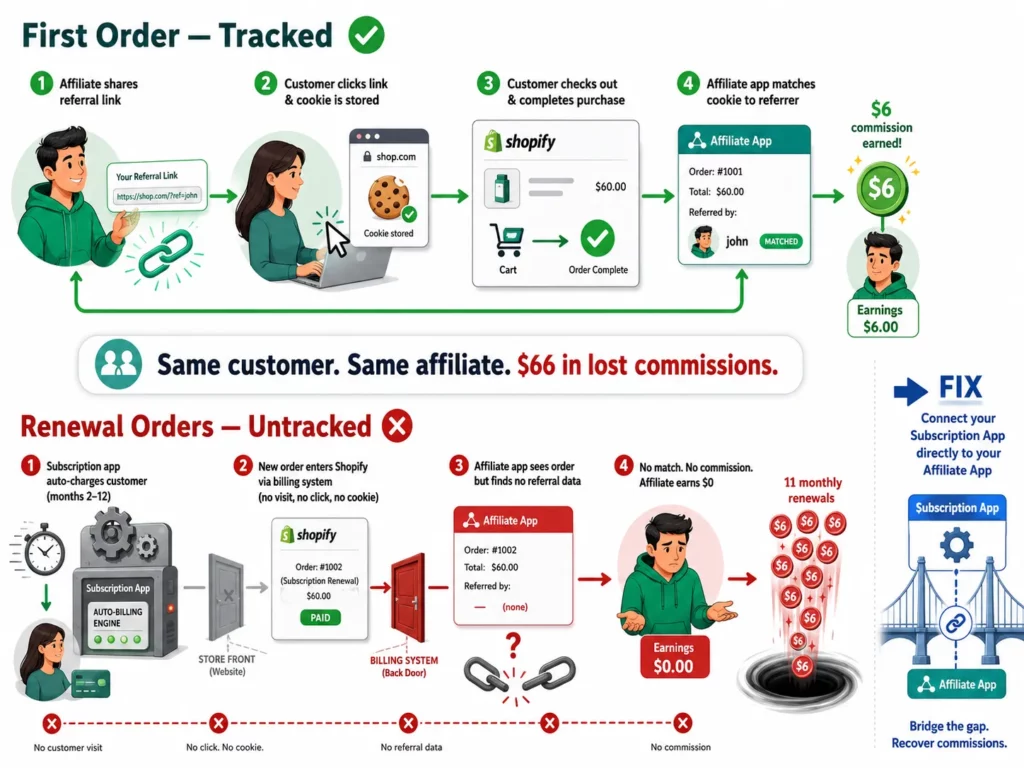
The fix is a direct integration between your subscription app and your affiliate tool. When a renewal fires, that integration links the order back to the initial referral. The affiliate earns commission on every charge after the first.
First-Order-Only vs Recurring Commission: Which Model Fits Your Margins?
You can pay affiliates on the first subscription order only, or on every renewal that follows.
The right choice will depend on your margins, your churn rate, and how hard you want to compete for quality partners.
How the two models compare
First-order-only will keep your costs low. You pay the affiliate once, and your total spend per referral is fixed no matter how long the customer subscribes.
However, that simplicity comes with a tradeoff. The payout is usually small enough that serious affiliates may not prioritize your program over a competitor offering recurring income.
Recurring commission, on the other hand, flips the incentive.
Affiliates earn on every renewal, which means they’re motivated to refer customers who stay, not just customers who convert.
| Factor | First-Order-Only | Recurring Commission |
| Affiliate earns | Commission on first order only | Commission on every renewal |
| Your cost per referral | Lower and fixed | Higher but proportional to LTV |
| Affiliate motivation | Lower (one-time payout) | Higher (ongoing income stream) |
| Quality of affiliates attracted | Standard | Premium — they treat it as real income |
| Affiliate retention | Lower (no ongoing incentive) | Higher (leaving means losing income) |
| Customer LTV alignment | Misaligned | Aligned — affiliate benefits when customers stay |
| Complexity | Simple | Medium (requires integration + tracking) |
| Best for | Tight margins or testing phase | Growth phase with healthy margins |
The single biggest difference is alignment. When you offer recurring commissions, your affiliate’s income grows as your customer sticks around. In effect, that can turn affiliates into retention partners rather than one-time growth channels.
What that looks like in real dollars
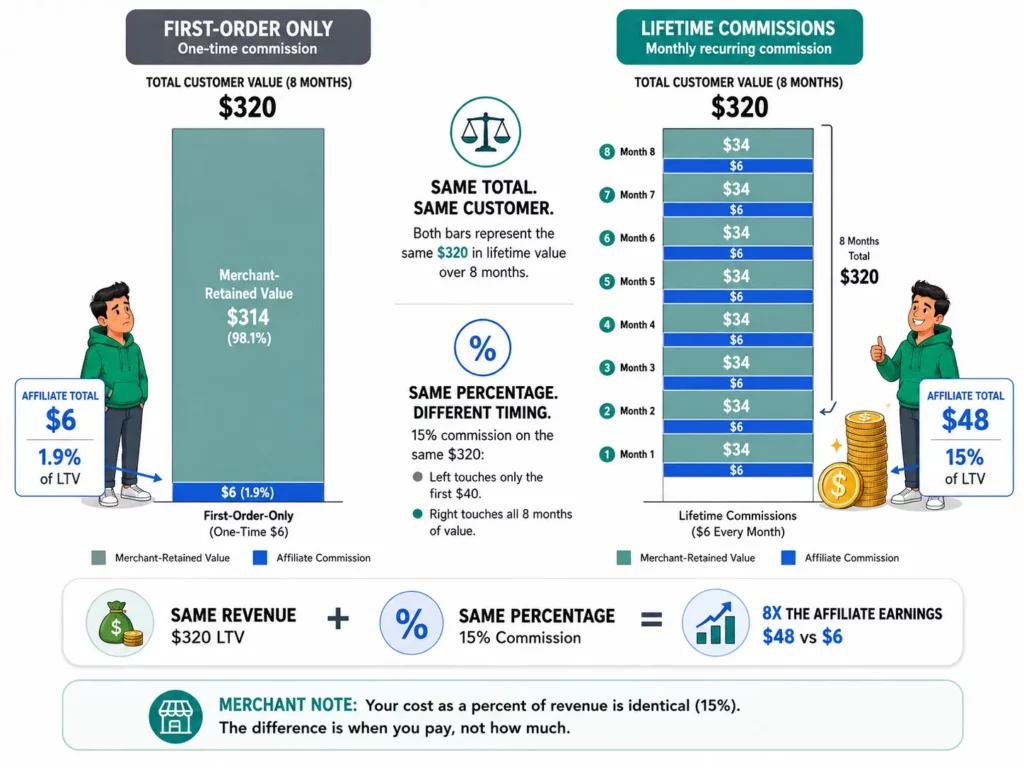
The dollar gap becomes clear when you run the numbers. Take a $40/month subscription where the average customer stays 8 months.
With first-order-only at 15%, the affiliate would earn $6 total. Your cost stays fixed at $6, and the customer generates $320 in revenue over their lifetime.
With recurring commission at the same rate, the affiliate would earn $6 per month for 8 months, or $48 total.
Your revenue is still $320, so commission as a percentage of lifetime value stays at 15%. The ratio doesn’t change. Only the total dollar amount does.
That ratio is the key insight. Recurring commission doesn’t cost you a higher percentage of revenue. Instead, it costs more in absolute dollars because you’re earning more from the customer.
Hybrid models worth testing
That said, few brands jump straight to full recurring commission from day one. Most will start with a hybrid that balances the upfront incentive against long-term cost.
| Model | How It Works | When It Fits |
| Full recurring (same rate) | 15% every month | High-margin products with strong retention |
| Declining rate | 15% months 1–3, 10% months 4–6, 5% after | Moderate margins where cost needs tapering |
| Capped recurring | 15% for up to 12 months, then stops | Protects against indefinite payouts |
| Higher first + lower recurring | 25% on first order, 5% on renewals | Rewards acquisition while limiting ongoing cost |
If you’re launching recurring commissions for the first time, the last model (higher first, lower recurring) may give you the most control.
It front-loads the incentive for acquisition while keeping your ongoing cost low. You can always raise the recurring rate later once you have enough churn data to justify it.
After all, starting conservative and scaling up is far easier than cutting rates after affiliates have come to expect them.
How to Enable Subscription Tracking in UpPromote
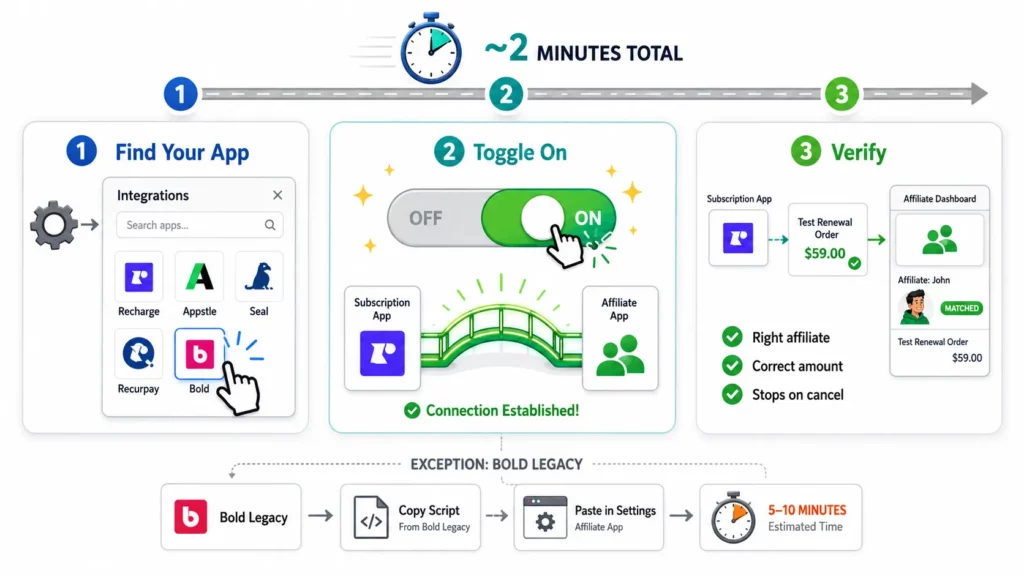
UpPromote integrates with popular subscription apps out of the box: Recharge, Bold, Appstle, Seal, Recurpay, and more. For most of them, setup is a single toggle that takes under two minutes.
| App | Setup | Time |
| Recharge | 1-click toggle | ~2 min |
| Appstle | 1-click toggle | ~2 min |
| Seal | 1-click toggle | ~2 min |
| Recurpay | 1-click toggle | ~2 min |
| Bold (new version) | 1-click toggle | ~2 min |
| Bold (legacy version) | Tracking script | 5–10 min |
For the 1-click apps, the process is simple: find your subscription app in the integration settings, toggle it on, and confirm.
Recurring orders will start tracking from that point forward.
You’ll want to verify the setup after one full renewal cycle. If the renewal order shows up under the referring affiliate and the commission calculates correctly, you’re good to go.
Bold’s legacy version — the one that doesn’t use Shopify Checkout — needs a few extra steps.
You’ll need to copy a tracking script from the documentation, paste it into Bold’s Advanced Tracking Scripts panel, and save. That takes closer to five or ten minutes, but it only applies to stores still running the older Bold app.
How to Calculate LTV-Based Commission for Subscription Products
Subscription commissions work different from one-time payouts.
The total cost depends on how long customers stay. You’ll need three inputs to run the math: your monthly subscription price, the average customer lifespan, and your commission rate.
For example, take a $40/month subscription with an average retention of 8 months. That customer’s lifetime value is $320.
At a 15% recurring commission, the affiliate would earn $48 over that period, compared to just $6 on the first order alone.
The important part is what happens to the ratio.
Whether a customer stays 3 months or 18, recurring commission at a flat percentage keeps your cost proportional to the revenue that customer generates.
| Avg. Customer Lifespan | LTV ($40/mo) | Total Commission (15%) | As % of LTV |
| 3 months | $120 | $18 | 15% |
| 6 months | $240 | $36 | 15% |
| 8 months | $320 | $48 | 15% |
| 12 months | $480 | $72 | 15% |
| 18 months | $720 | $108 | 15% |
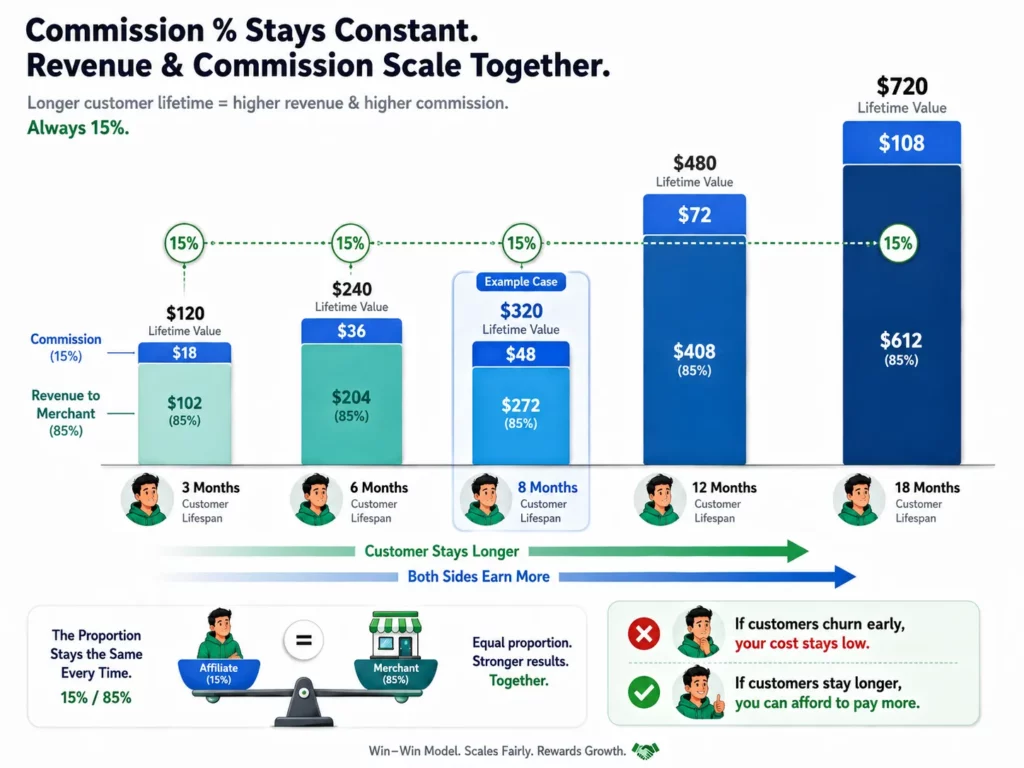
That steady ratio is what makes recurring commission workable at scale.
If customers churn early, your cost stays low because the affiliate earns less. If they stay longer, you can afford to pay more because you’re earning more.
Both sides benefit from retention, and both lose when customers leave. That built-in alignment is the strongest argument for the recurring model.
How to Fix 3 Common Subscription Tracking Issues
Most subscription tracking problems come down to one thing: the integration between your affiliate app and subscription app isn’t turned on.
Beyond that, double commissions and wrongly credited renewals are the two issues merchants run into most.
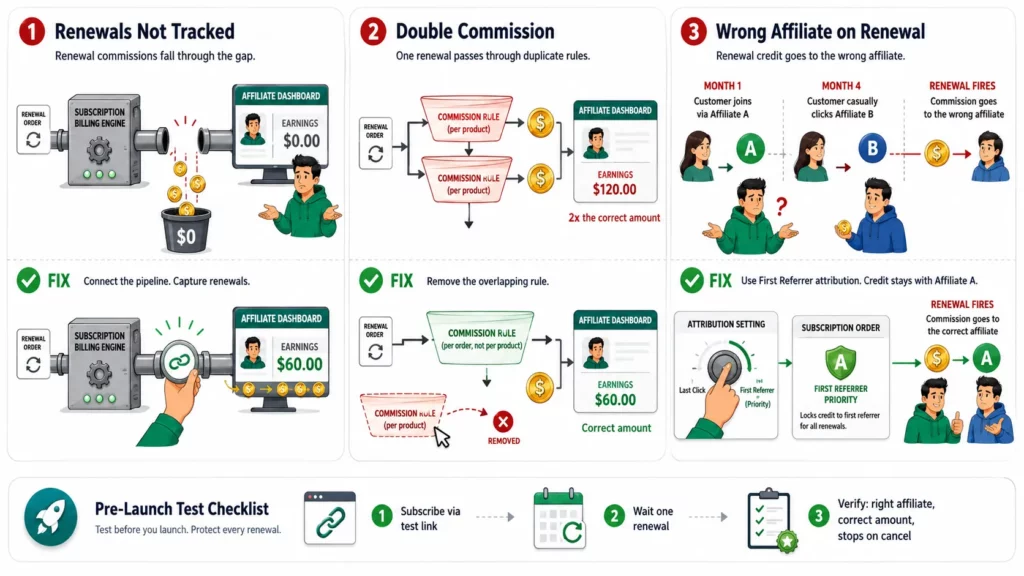
| Issue | What You See | Likely Cause | Fix |
| Renewals not tracked | First order earns commission; renewals show $0 | Integration not enabled | Toggle on the subscription integration in your settings |
| Double commission | Affiliate earns a duplicate payout on the same renewal | Commission rule conflict or stacking | Set commission per order, not per product; remove overlapping rules |
| Wrong affiliate on renewal | Renewal credited to a different affiliate than the first referrer | Customer clicked a second affiliate link after subscribing | Set attribution to prioritize the first referrer for subscription orders |
The first issue accounts for the bulk of support tickets. If renewals aren’t showing any commission at all, the fix is almost always the integration toggle from the setup section above.
Double commissions and wrongly credited renewals are less common but can be harder to pin down.
They usually stem from a conflict between commission rules or an attribution setting that favors last-click over first referrer.
Before you roll out recurring commissions to your affiliates, it’s worth running a quick end-to-end test: subscribe through a test affiliate link and wait for one renewal to come through.
Then verify three things: the renewal appears under the right affiliate, the commission amount is correct, and commissions stop when the subscription cancels.
If all three check out, your setup is solid. If anything fails, you’ll have specific test results to bring to your app’s support team.
What Changed in 2026?
Recurring commissions have shifted from an advanced feature to a baseline expectation.
Subscription brands that don’t offer them now face a real drawback when recruiting affiliates. Serious partners will choose programs that pay on every renewal over ones that pay once.
The affiliate app landscape has responded. Most major platforms have expanded their subscription integrations over the past year.
That makes it easier to connect affiliate tracking with whichever subscription tool a merchant already uses.
There’s also a technical advantage that’s easy to overlook. Subscription tracking is cookieless by design.
Renewal attribution lives server-side, tied to the first order, not to a browser cookie that can expire or get blocked. For subscription brands, that makes affiliate tracking on renewals more reliable than tracking on the initial click.
If you’re using Shopify’s free native subscription feature, check your affiliate app’s compatibility. Support varies by platform and is still expanding.
Frequently Asked Questions
Do most affiliate apps track subscription renewals by default?
No. Most only track the first subscription order. Renewal orders are created by the subscription app’s billing system, not by a customer clicking an affiliate link, so they carry no attribution data. You’ll need to enable a specific integration between your affiliate tool and subscription app to track recurring orders.
Should I pay recurring commission or first-order-only?
Recurring if your margins support it. Affiliates who earn on every renewal are more motivated to refer customers who stay, not just customers who convert. Start with a hybrid: higher first-order rate, lower recurring, capped at 12 months.
How long should I cap recurring commissions?
Twelve months is the most common cap. By that point, the customer is typically retained through the product itself rather than the affiliate. Some brands run uncapped programs, but starting with a 12-month limit gives you a clear cost ceiling while you gather retention data.
What happens if a subscriber cancels and re-subscribes?
It depends on your cookie window and attribution settings. If the customer re-subscribes within the tracking window, the referring affiliate typically gets credit. If the window has expired, the re-subscription may be treated as a new customer. Set a clear policy in your affiliate agreement to avoid disputes.
Is subscription renewal tracking more reliable than standard affiliate tracking?
For renewals, yes. Renewal attribution is stored server-side and tied to the first order, so it doesn’t depend on browser cookies that can expire or get blocked. The initial subscription purchase, however, still relies on standard click-based or coupon-based tracking.
How do I test if subscription tracking is working?
Subscribe through a test affiliate link and wait for one renewal cycle. Then check three things: the renewal appears under the correct affiliate, the commission calculates correctly, and commissions stop on cancellation. If any step fails, share the specific results with your app’s support team.

Ellie Tran, a seasoned SEO content writer with three years of experience in the eCommerce world. Being a part of the UpPromote team, Ellie wants to assist Shopify merchants in achieving success through useful content & actionable insights.Ellie's commitment to learning never stops; she's always eager to gain more knowledge about SEO and content marketing to create valuable content for users. When she's not working on content, Ellie enjoys baking and exploring new places.
![How to Use Shopify Functions with Your Affiliate Program [2026 Guide]](https://static.uppromote.com/wp-content/uploads/2026/06/how-to-use-shopify-functions-with-affiliate-program-300x169.webp)

![How to Prevent Affiliate Fraud on Shopify: Self-Referral, Coupon Abuse & More [2026]](https://static.uppromote.com/wp-content/uploads/2026/06/how-to-prevent-affiliate-fraud-on-shopify-300x169.webp)