











TL;DR
Most new affiliates disappear because they receive no structured guidance after approval. A 7-day onboarding sequence will help change that.
- Ghost rate: 40–60% of signups never make a single sale without onboarding
- Activation window: Days 0–7 after approval = peak motivation
- Framework: 5 automated emails + 3 manual check-ins over 30 days
- Time cost: ~15 minutes per affiliate across the full 30-day sequence
- Goal: First post within 7 days, first sale within 14 days
Someone applies. You approve them. They get a link. And then, nothing. No clicks, no posts, no sales. They’re gone.
This pattern is not unusual. Forty to sixty percent of new affiliate signups never make a single sale, according to affiliate management expert Matt McWilliams. The number drops when programs have a structured welcome sequence in place.
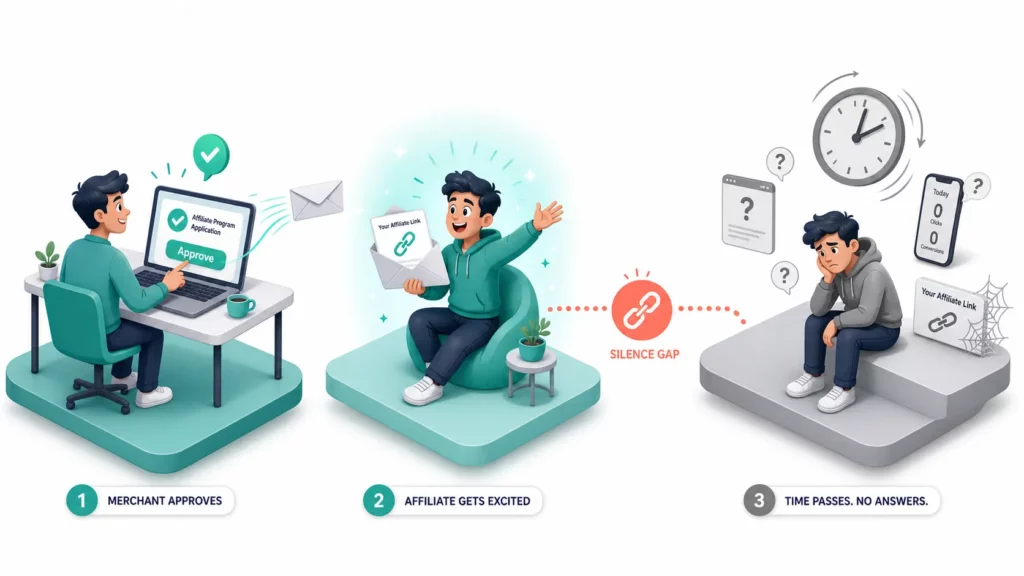
This is not a recruiting problem. You found the right people and lost them in the silence after approval.
The first 14 days after a new affiliate joins are when they’re most likely to either commit or quietly vanish (Matt McWilliams, 2026). Shopify’s own affiliate guide recommends a clear onboarding process that helps new partners make their first sale.
That’s why we want to introduce you to a day-by-day framework for the first 7 days and email templates for each touchpoint.
You’ll also find an automation setup that scales to 50+ affiliates per month, plus milestone check-ins at Day 14 and Day 30.
Why Do the First 7 Days Decide Whether an Affiliate Promotes or Ghosts?
New affiliates arrive at peak excitement, but that excitement fades fast.
Every day without clear guidance reduces the chance they’ll ever post, share, or sell. By day seven, most have either taken their first action or moved on.
Affiliate motivation follows a predictable curve through three stages in the first two weeks.
| Stage | Timeline | What happens |
| Excitement | Day 0–3 | “I just joined, ready to promote.” Motivation peaks. |
| Uncertainty | Day 3–7 | “What should I post? How does this work?” Motivation declines. |
| Decision | Day 7–14 | “Is this worth my time?” The affiliate promotes or ghosts. |
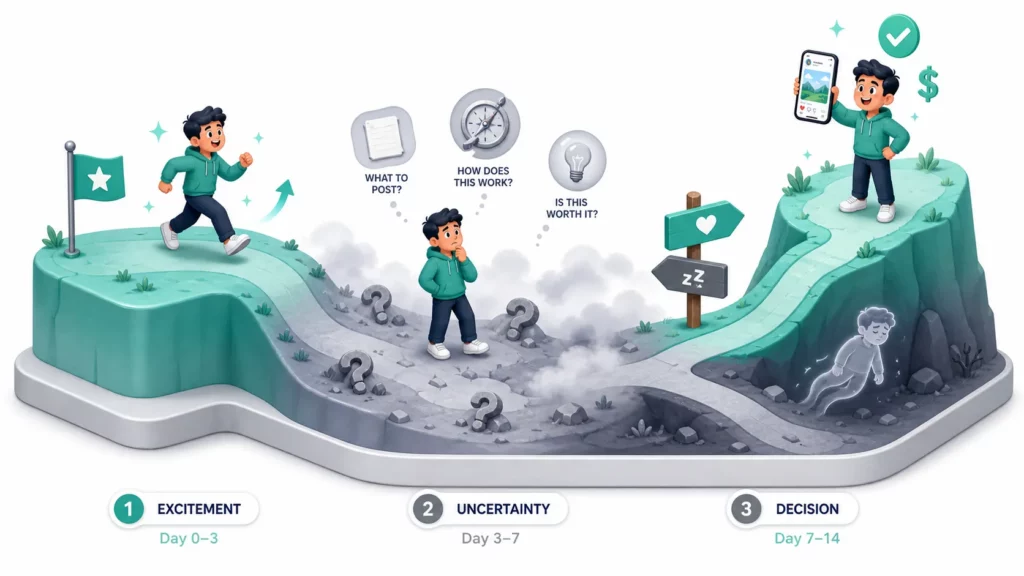
The pattern in the table explains why silence after approval is so costly. Without onboarding, excitement turns into confusion, confusion turns into inaction, and the affiliate disappears.
A structured sequence flips that trajectory. Each stage gets a specific touchpoint: excitement gets a welcome kit, uncertainty gets a quick-win guide, and the decision stage gets a personal check-in.
The data supports this. The average affiliate program sits at just a 5% active rate — only 1 in 20 signups ever promotes. A simple 5-email sequence after signup can double that active rate .
How to Onboard New Affiliates in 7 Days (Day-by-Day Email Sequence)
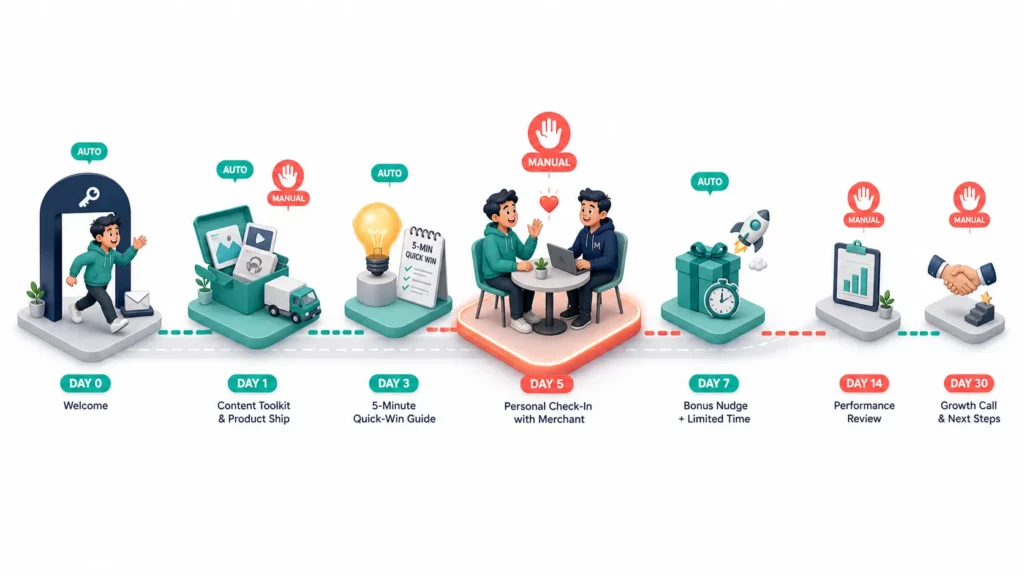
The full sequence runs five automated emails across the first week plus three manual check-ins through day 30.
Automation handles the repeatable parts. The manual touchpoints handle relationship-building, and they’re the ones most programs skip.
| Day | Touchpoint | Goal | Auto or Manual |
| 0 | Welcome + portal access | Capitalize on peak excitement | Auto |
| 1 | Content kit + product shipping | Remove “I don’t have assets” barrier | Auto + manual |
| 3 | Quick-win guide | Remove “What should I post?” barrier | Auto |
| 5 | Personal check-in | Build human connection + troubleshoot | Manual |
| 7 | First-sale nudge + bonus | Create urgency before motivation fades | Auto |
| 14 | Performance check | Assess progress + adjust support | Manual |
| 30 | Tier and relationship review | Decide long-term partnership path | Manual |
Day 0: Welcome + Portal Access (within 1 hour of approval)
Peak excitement is a perishable asset. The welcome email needs to arrive while the affiliate still remembers why they applied within one hour.
This single email should include four things: the affiliate’s unique link, their discount code, a login link to the affiliate dashboard , and one clear first step .
That first step matters more than anything else in the email. Make it specific and small: “ share your link in your Instagram bio today ” works better than “ start promoting .”
UpPromote, for example, can help send an automated welcome email the moment you approve an affiliate and auto-generate a unique coupon code for each affiliate. The link, code, and dashboard access all land in one message without manual setup.
Day 1: Content Kit + Product Shipping
The welcome email opened the door. Day 1 removes the next two barriers: “I don’t have images” and “I haven’t tried the product.”
Your content kit needs a central, always-updated home, not an email attachment that goes stale. Affiliate software like UpPromote provides you a shared media library where affiliates download product images, logos, and sample captions from their account.
If your budget allows product seeding, ship a sample alongside the content kit. Affiliates who’ve held the product create more authentic content than those working from spec sheets alone.
Day 3: Quick-Win Guide
This is the email that prevents the “uncertainty” stage from turning into silence. The biggest blocker for new affiliates isn’t motivation; it’s not knowing what to post first.
You can consider giving one specific, low-effort action. Check out the following template:
The 5-Minute First Post:
- Download one product image from your portal
- Write a short caption: “I recently discovered [Product] and I’m loving [one specific thing]. Link in bio for [X]% off.”
- Add your affiliate link to your bio
- Post. Done.
The goal is a first post because affiliates who post within the first week are far more likely to stay active long-term.
Day 5: Personal Check-in (Manual)
Every touchpoint until now has been automated. Day 5 is different.
It’s the single highest-impact email in the entire sequence.
A manual, personal message that references the affiliate by name and asks about their experience sends a clear signal: this brand cares about me as a partner.
The response rate on personal check-ins runs much higher than on automated emails, making the Day 5 send worth every minute.
Keep it short, warm, and genuine. If the affiliate has already posted content, you should ask them to reshare it on your brand channels.
Day 7: First-Sale Nudge + Bonus
One week in, your affiliate is approaching the decision stage from the motivation table. A well-timed nudge paired with a short-term bonus can tip the balance toward action.
The most effective structure includes a brief recap of their stats so far and a reminder of their link and code. Pair that with a time-limited bonus or extra commission on the first 5 sales, valid for 14 days.
The bonus doesn’t need to be large. Even an extra 5% for two weeks creates urgency without meaningful cost.
If the affiliate’s stats show zero activity, acknowledge it without pressure: “Most affiliates see their first results in week 2–3 after consistent sharing.”
Day 14: Performance Check (Manual)
By now, your dashboard shows enough data to segment new affiliates into four groups and respond accordingly.
- Posted + has sales: Celebrate, share stats, suggest a tier upgrade path.
- Posted + no sales yet: Encourage clicks take time to convert. Offer two specific content tips.
- Not posted yet: Ask what’s blocking them. Offer a quick call.
- Posted once, then went silent: Re-engage with a new angle — a product launch or seasonal hook.
Day 30: Tier and Relationship Review (Manual)
The first month reveals who your long-term partners will be. Active affiliates with sales earn a personal thank-you and a conversation about higher commission tiers or early product access.
Active but low-volume affiliates need a content strategy chat. Ask what would help them post more consistently.
For affiliates still inactive after 30 days, send one final soft message: “Your link stays active whenever you’re ready.” Then shift your focus to partners who are producing.
How to Automate Your Affiliate Onboarding Sequence
Three layers make the sequence scalable:
- Your affiliate app handles the instant welcome on approval
- An email platform runs the timed sequence
- A calendar reminder covers the manual sends.
The split keeps each tool doing what it does best.
Most affiliate apps like UpPromote can sync new affiliates to Klaviyo, Omnisend, or Mailchimp automatically on approval. That sync triggers a timed drip sequence: Day 1 content kit, Day 3 quick-win guide, Day 7 bonus nudge.
You write the emails once, and every new affiliate receives the same sequence without manual sends.
The manual touchpoints — Day 5, 14, and 30 — work best as weekly batches. Group new affiliates by approval week, then block 30 minutes each Friday for personal check-ins.
At 15 minutes per affiliate across the full 30 days, one person can onboard 50 new affiliates per month without it becoming a full-time job.
If you don’t use an email platform yet, a shared spreadsheet tracking each affiliate’s approval date and touchpoint status works at small scale. The goal is consistency, not polish.
How Do You Measure Affiliate Onboarding Success?
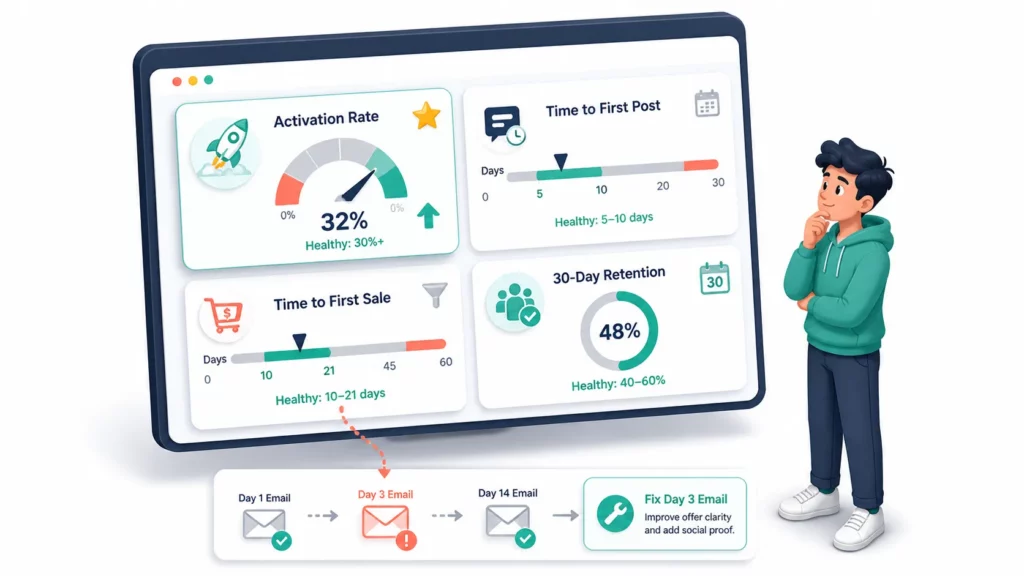
Four metrics below will tell you whether your onboarding sequence is working or where it’s breaking down.
Activation rate is the most important of the four. It measures what percentage of approved affiliates post content within their first 14 days.
Programs with strong onboarding often push this above 30% , while most programs sit below 10% (Matt McWilliams, 2026).
The table below shows all four metrics, what to aim for, and where to look if the numbers fall short.
| KPI | What it measures | Healthy benchmark | If below benchmark |
| Activation rate | % of approved affiliates who post within 14 days | 30%+ | Improve Day 3 quick-win email |
| Time to first post | Days from approval to first content | 5–10 days | Improve Day 1 content kit |
| Time to first sale | Days from approval to first referred sale | 10–21 days | Check store conversion rate |
| 30-day retention | % of approved affiliates still active at Day 30 | 40–60% | Improve Day 14/30 check-ins |
Activation rate below 10% signals that the onboarding sequence needs immediate work. A longer-than-expected time to first sale often points to store conversion issues rather than affiliate effort.
UpPromote’s built-in analytics show clicks, orders, and conversion rates per affiliate. Filter by approval date to calculate these KPIs without a separate tracking system.
Key Takeaway: Track activation rate, time to first post, time to first sale, and 30-day retention monthly. Activation rate below 10% means onboarding needs immediate attention. Above 30% means the sequence is working.
Four metrics below can tell you whether your onboarding sequence is working or where it’s breaking down.
Activation rate is the most important of the four. It measures what percentage of approved affiliates post content within their first 14 days.
Programs with strong onboarding often push activation above 30% — well above the industry average, where most programs sit below 10% (Matt McWilliams, 2026).
Time to first post tracks how many days pass between approval and an affiliate’s first piece of content. A healthy range is 5 to 10 days. If the average stretches beyond two weeks, the Day 3 quick-win email likely needs work.
Time to first sale measures days from approval to the affiliate’s first referred sale . Most programs see this land between 10 and 21 days. A longer gap often points to store conversion issues rather than affiliate effort.
Besides, thirty-day retention rate tells you what percentage of approved affiliates remain active one month in.
UpPromote’s built-in analytics show clicks, orders, and conversion rates per affiliate. Merchants can easily filter by approval date to calculate these KPIs without a separate system.
What’s Changed in Affiliate Onboarding in 2026?
The biggest shift in 2026 is a change in priorities: programs that once focused almost on recruiting alone are now investing equal effort into activation.
The logic is simple. Doubling your active rate from 5% to 10% delivers the same revenue lift as doubling your affiliate roster. Three trends are driving that shift.
Video Welcome Messages
A short Loom or screen recording from the program manager is replacing the text-only Day 0 email. Video feels warmer, lands faster, and gives new affiliates a face behind the brand.
Early adopters report faster activation, though industry-wide benchmarks are still forming.
AI-Personalized Sequences
Some programs are beginning to tailor onboarding emails based on affiliate type. Bloggers receive written content tips and SEO angles. TikTok creators receive video scripts and hook ideas.
The technology is still early, but the direction is clear: relevance over one-size-fits-all.
Gamified First-Sale Bonuses
Instead of a flat bonus, more programs now offer tiered rewards — escalating commission for the first 5, then 10, then 25 sales. The structure sustains momentum past the initial activation window and turns the first month into a progression path.
Frequently Asked Questions
Does this onboarding sequence work for all affiliate types?
The core sequence works for all affiliate types. Customize two elements per type: the Day 1 content kit and the Day 3 quick-win guide. Bloggers get written content ideas and a review-paragraph prompt. TikTokers get video script outlines and a short-video prompt. If you onboard fewer than 20 affiliates per month, one sequence is enough.
Is the Day 5 manual check-in really necessary?
Technically optional, but it delivers the highest engagement of any email in the sequence. A personal message signals that the brand cares and affiliates who feel supported are far more likely to stay active. If you can only send one manual email, make it the Day 5 check-in.
How long should I keep following up with an unresponsive affiliate?
The Day 14 check-in is the last serious attempt. Day 30 is a soft final re-engagement. After that, shift your focus to active partners but keep the inactive affiliate’s account open. Some affiliates return months later when a content idea or seasonal push gives them a reason to promote.
Should I use email or DMs for the onboarding sequence?
Email works best for the automated sequence. It’s professional, trackable, and easy to template. For the Day 5 personal check-in, a DM on Instagram or TikTok can feel more natural if the affiliate is active on those platforms. Match the channel to where the affiliate is most responsive.
Is a first-sale bonus worth the cost?
Not required, but effective. A small bonus, even 5% extra commission for two weeks, creates urgency and gamification during the activation window. The cost is minimal relative to the motivation it generates, especially for affiliates on the fence about their first post.
Can this sequence scale to 50+ new affiliates per month?
Yes, with automation. Day 0, 1, 3, and 7 run fully automated through your affiliate app and email platform. Day 5, 14, and 30 are batched manually by approval week. Total time at 50 affiliates per month: roughly 12 to 13 hours per month — manageable for one person.

Ellie Tran, a seasoned SEO content writer with three years of experience in the eCommerce world. Being a part of the UpPromote team, Ellie wants to assist Shopify merchants in achieving success through useful content & actionable insights.Ellie's commitment to learning never stops; she's always eager to gain more knowledge about SEO and content marketing to create valuable content for users. When she's not working on content, Ellie enjoys baking and exploring new places.
![How to Use Shopify Functions with Your Affiliate Program [2026 Guide]](https://static.uppromote.com/wp-content/uploads/2026/06/how-to-use-shopify-functions-with-affiliate-program-300x169.webp)
![How to Prevent Affiliate Fraud on Shopify: Self-Referral, Coupon Abuse & More [2026]](https://static.uppromote.com/wp-content/uploads/2026/06/how-to-prevent-affiliate-fraud-on-shopify-300x169.webp)