


Summary
CHALLENGE
- A one-year-old, ads-led brand that wanted a clean affiliate channel without the fraud that plagues open programs.
- Some sign-ups tried to game the program with coupon-code sites, Google Ads poaching, and fake profiles.
- Paid influencer deals often carry risk, since a big following does not guarantee sales.
SOLUTION
- Offers a flat 25% commission from the first sale, higher than the usual 10 to 20%, to attract quality affiliates.
- Vets every applicant and enforces strict rules: no coupon-code sites, no Google Ads, social-profile validation, and monthly check-ins.
- Uses UpPromote to detect and deny affiliates driving traffic through Google Ads.
- Runs a hybrid influencer model, paying a flat fee plus commission and licensing the content for reuse in ads.
RESULTS
- More than 800 affiliates, built in about a year, almost entirely through UpPromote.
- Around $38,000 in affiliate GMV across 362 affiliate orders in a recent 30-day period.
- Affiliate order value averages about $105, and the channel is a deliberately small share of the business by design.
LESSONS
- A bold, transparent commission can be a recruiting magnet on its own.
- In wellness, strict vetting protects margins and brand trust more than raw affiliate count.
- Influencer content is worth paying for even when direct sales are uncertain, if you license it for reuse.
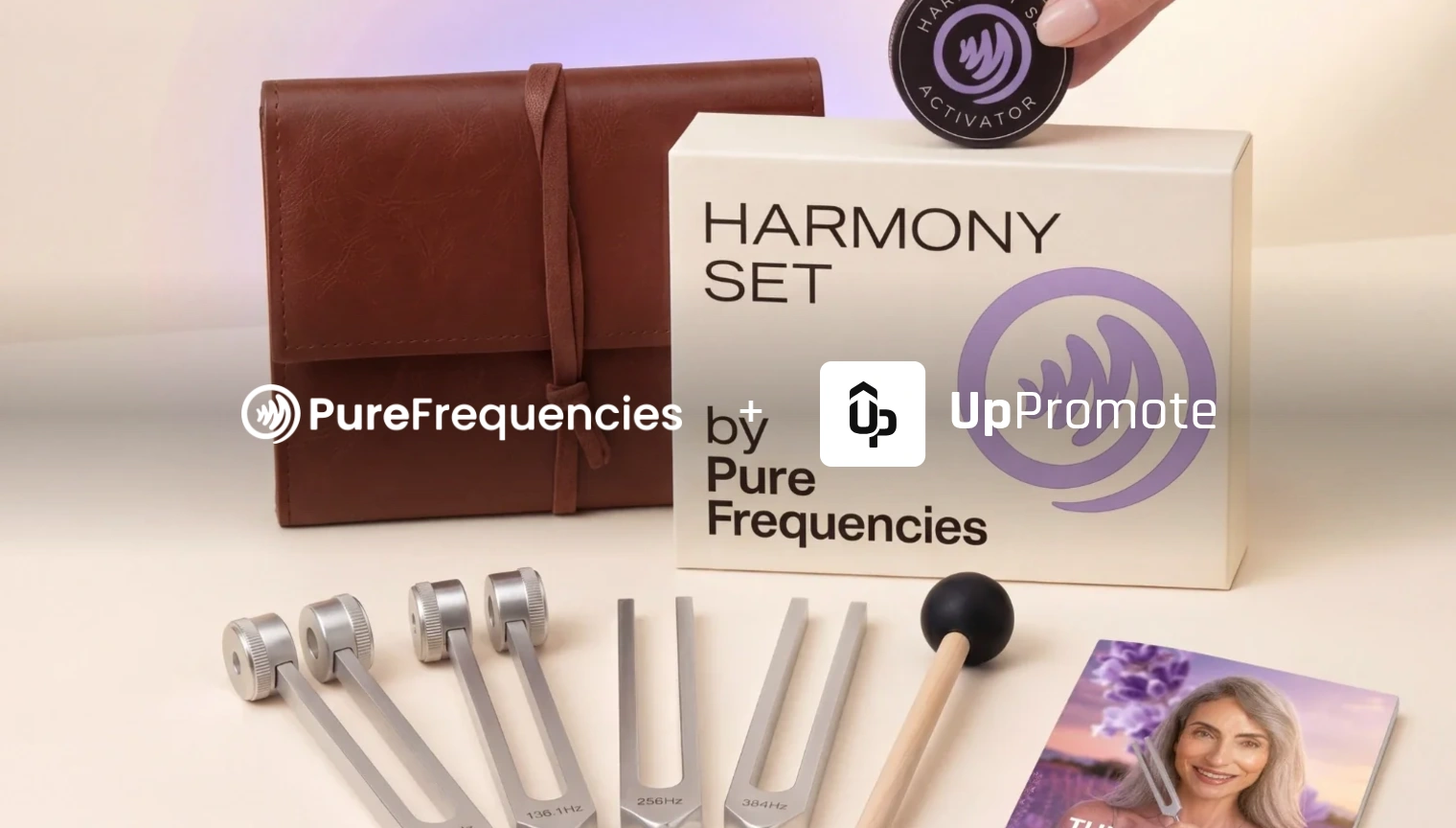
Pure Frequencies makes sound-healing tuning forks, precision instruments used to ease stress, tension, and sleep issues. It is a wellness brand with a devoted, health-focused audience, typically women aged 35 and older.
The company is young. It launched in 2025 and, a little over a year later, sells at Shopify Plus scale, led by founder Karlo, a Croatian marketer with more than a decade of brand-building behind him.
Ads on Meta and Google drive most of that growth. Affiliate marketing is a smaller, deliberate slice, and how Pure Frequencies runs it is a study in quality over volume.
Why is affiliate a deliberately small, clean channel for Pure Frequencies?
Most brands chase the biggest affiliate roster they can. Pure Frequencies took the opposite view. Ads do the heavy lifting, and affiliate stays a focused minority of the business. That is a choice, not a limitation.
Affiliate marketing is, you can say, 10% of what we are doing.
Muhammad Talha, Pure Frequencies
The team would rather run a clean tenth than a fraud-riddled third. Open programs attract coupon-code sites, Google Ads poachers, and fake profiles, and that is exactly what Pure Frequencies set out to prevent.
How does Pure Frequencies run a high-quality affiliate program?
The program rests on three deliberate choices: a generous commission, strict vetting, and a smart influencer model.
Where many brands scale commissions from 10 to 20%, Pure Frequencies leads with 25% from the first sale.
We don’t offer 10, 15, 20. It’s straight 25% from the start.
Muhammad Talha, Pure Frequencies
Because there is no ad spend or customer-acquisition cost on affiliate orders, the math still works. Even after the 25% commission and a roughly 10% customer discount, a healthy margin remains. The high rate becomes a recruiting magnet in itself.
A generous commission invites bad actors, so the team screens hard.
We don’t allow any coupon code sites… we don’t want anyone to use Google Ads or any spammy methods.
Muhammad Talha, Pure Frequencies
Every applicant must share a social profile for validation. The team then watches behavior and runs monthly check-ins, asking each affiliate how they are producing sales. Anyone playing games gets switched off.
UpPromote enforces one of the strictest rules for them: it flags referrals that actually came through Google Ads, so the team can deny those while the affiliate keeps working legitimately elsewhere.
How does a hybrid influencer deal double as content?
Beyond the self-serve program, Pure Frequencies partners with YouTubers and Instagrammers on flexible terms: commission-only, flat fee, or a hybrid of both. The hybrid is their favorite, because a single deal buys two things at once.
For the flat fee, we use that content in our other marketing campaigns… once we have paid them, we have the license of the video.
Muhammad Talha, Pure Frequencies
So one partnership yields both new referral sales and a licensed video the brand can run on Meta, Google, its website, and testimonials. Even when a creator’s own audience does not convert, the content keeps earning its keep.
What results has Pure Frequencies seen?
The disciplined approach has scaled fast for a brand barely a year old. Pure Frequencies now runs more than 800 affiliates, recruited almost entirely through UpPromote.
In a recent 30-day period, affiliates generated around $38,000 in GMV across 362 orders, at an average order value of about $105.
By the team’s own estimate, that is about a tenth of the overall business, exactly the focused, high-quality channel they set out to build.
Why does it work?
Two forces sit underneath the numbers: a founder who has built brands for over a decade and leads the ads, and a product people genuinely feel.
In the health category, if somebody is suffering from pain or stress and they get relief, they are definitely going to refer that solution to another person.
Muhammad Talha, Pure Frequencies
That word-of-mouth is reinforced by heavy customer education, free how-to resources, a one-year warranty, and a 60-day refund. To push the program further, the team is exploring UpPromote’s new-customer commission option, which would pay a lower rate on repeat buyers who no longer need convincing.