

According to Fortune Business Insights, the global bakery products market is expected to reach $731.69 billion by 2032.
This is great news for those interested in promoting baking affiliate programs. If you’re a cake lover or food blogger, you should not miss this chance.
In this article, we’ll introduce 16 excellent baking affiliate programs, offering everything from baking ingredients and equipment to recipes and learning courses. Let’s explore and find the right match for your audience.
Quick Comparison
| Program Name | Commission (%) | Cookie Duration (Days) | Niche Suitable | Affiliate’s Rating (1–5⭐) |
|---|---|---|---|---|
| King Arthur Baking | 5% | 30 days | Baking ingredients, flour, baking education | ⭐⭐⭐⭐ |
| Bosch Mixers | 8% | 30 days | Kitchen appliances, stand mixers, home baking | ⭐⭐⭐⭐⭐ |
| KitchenAid | 5% | 30 days | Kitchen appliances, mixers, cookware | ⭐⭐⭐⭐ |
| Gourmet Food World | 10% | 60 days | Gourmet food, cooking ingredients, foodies | ⭐⭐⭐⭐⭐ |
| CakeFlix | Up to 30% | 30 days | Baking courses, cake decorating, online learning | ⭐⭐⭐⭐⭐ |
| Cake Stackers | 10% | 120 days | Cake tools, cake stacking systems, baking supplies | ⭐⭐⭐⭐ |
| How To Cake It | 15% | 30 days | Baking tutorials, cake tools, online learning | ⭐⭐⭐⭐⭐ |
| Greyston Bakery | 7–10% | 30 days | Brownies, desserts, ethical food brands | ⭐⭐⭐⭐ |
| Le Creuset | Up to 10% | Not stated (network default: 30 days typical) | Premium cookware, cast iron pots | ⭐⭐⭐⭐ |
| Kitchen Universe | 6–10% | Not mentioned | Kitchen appliances & premium cookware | ⭐⭐⭐⭐ |
Top 16 Baking Affiliate Programs to Boost Your Earnings
1. King Arthur
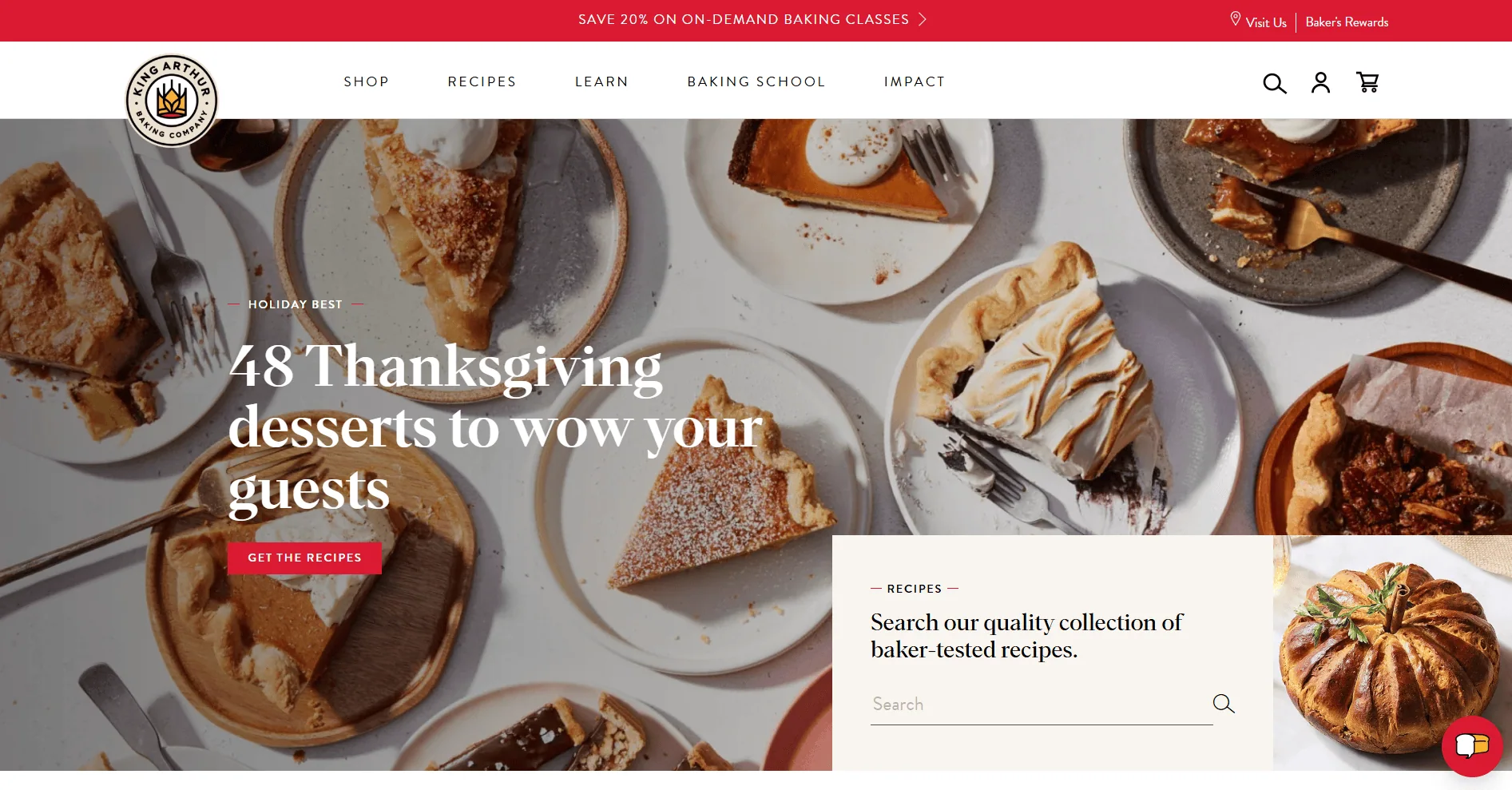
King Arthur Baking is the U.S.’s oldest flour company, well-known for their premium baking products and commitment to quality. They offer a wide range of ingredients, recipes, baking tips, and online baking courses to both beginners and experienced bakers.
The King Arthur affiliate program offers a 5% commission rate for each successful sale. The cookie duration lasts for 30 days from the customer’s first click on your link.
They offer a variety of beautiful banners and links to make your promotion more eye-catching. Their regular newsletters also provide you with the latest product information and exclusive offers to boost your earnings.
You will receive payouts around the 20th day of the month if you reach a minimum balance of $50.
|
2. Bosch Mixers
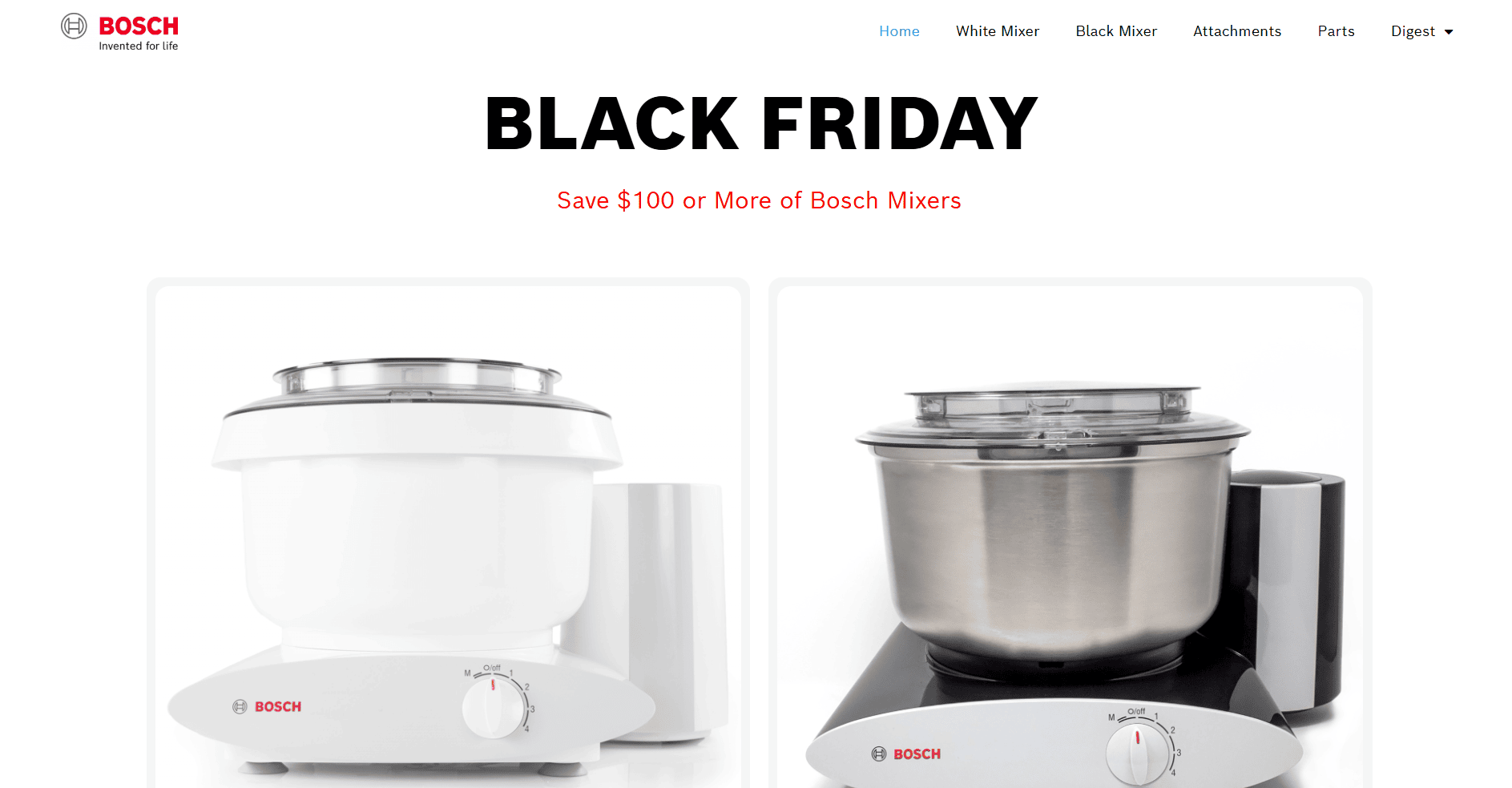
Bosch has been a trusted name in kitchen appliances and especially in the baking world. They provide a variety of mixers with different models, powerful engines, and elegant designs.
You’ll receive an 8% commission per sale, with the chance to increase earnings based on your performance. The referral window is 30 days starting from the customer’s first click.
They supply a Dropbox folder with all the creatives you’ll need to begin your promotion. You can take advantage of their exclusive offers and coupons to encourage the audience’s attention and drive more sales.
|
3. KitchenAid
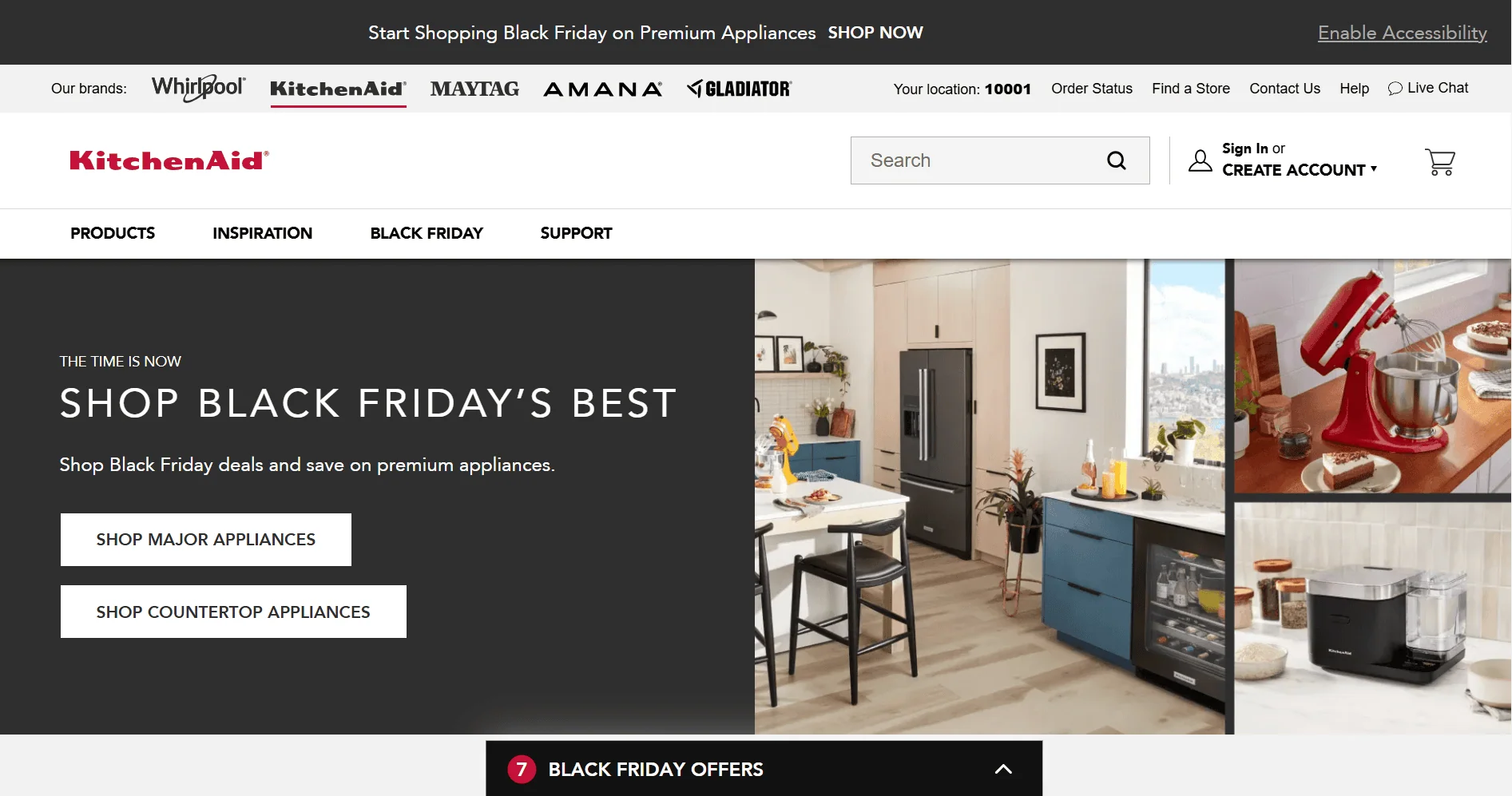
KitchenAid is a well-established American brand known for their high-quality kitchen appliances and tools. In addition to their iconic stand mixers, they also offer a range of blenders, food processors, toasters, and more.
The KitchenAid affiliate program pays a 5% commission for every order placed. The $103 average order value allows you to earn $5 for each purchase.
The cookie duration is 30 days from the consumer’s initial click, so you can earn commissions on purchases made within 1 month via your link.
|
4. Gourmet Food World
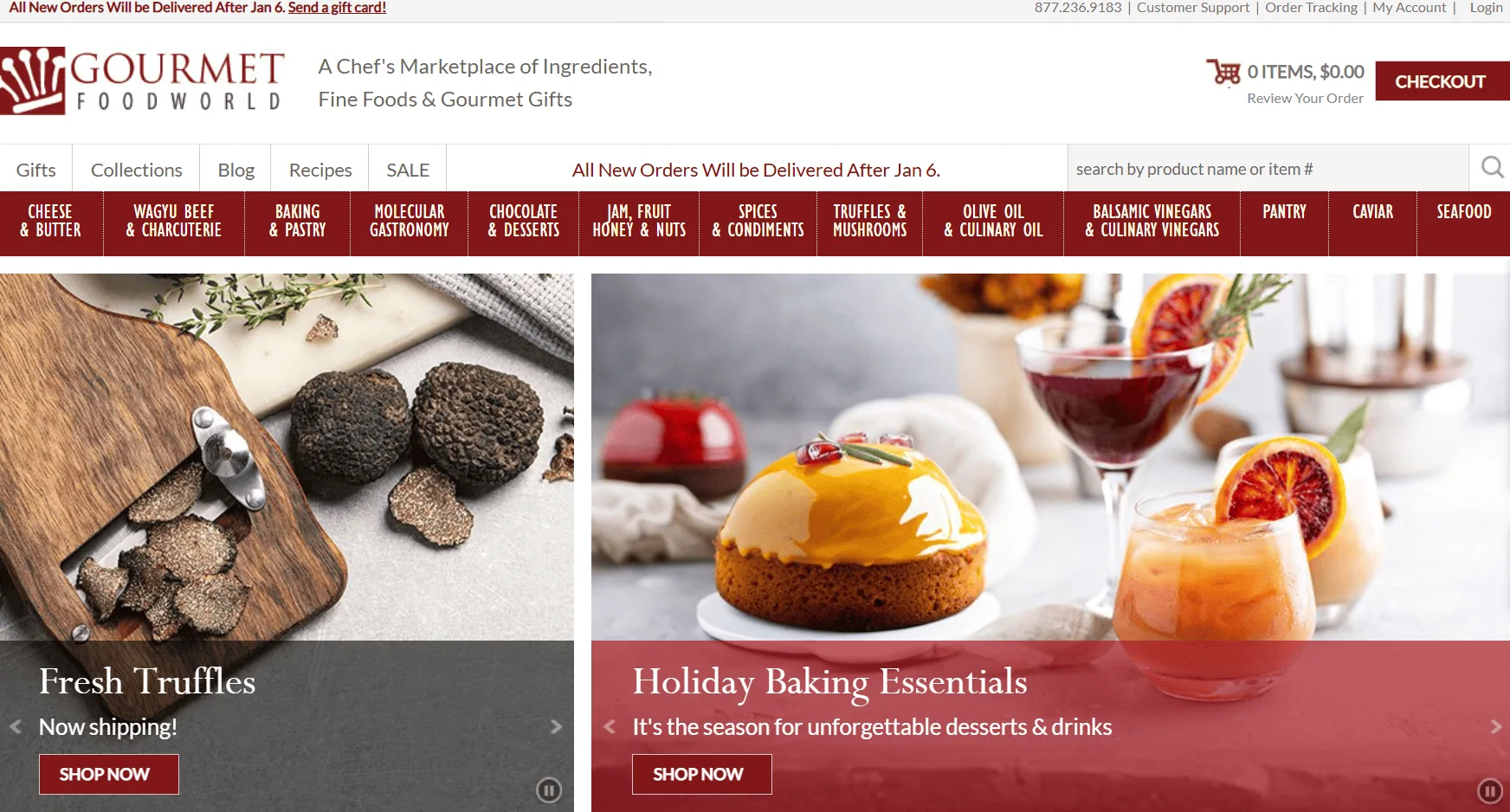
Gourmet Food World supplies an extensive array of high-quality gourmet foods and ingredients. Their product range includes specialty meats, cheeses, seafood, oils, spices, and caviar.
The Gourmet Food World affiliate program offers a competitive commission rate of 10%. You’ll earn commissions for purchases within 60 days from the customer’s first click.
The brand prepares a broad array of appealing images, banners, and links. You can choose ideal templates to improve your content and increase conversion rates.
|
5. CakeFlix
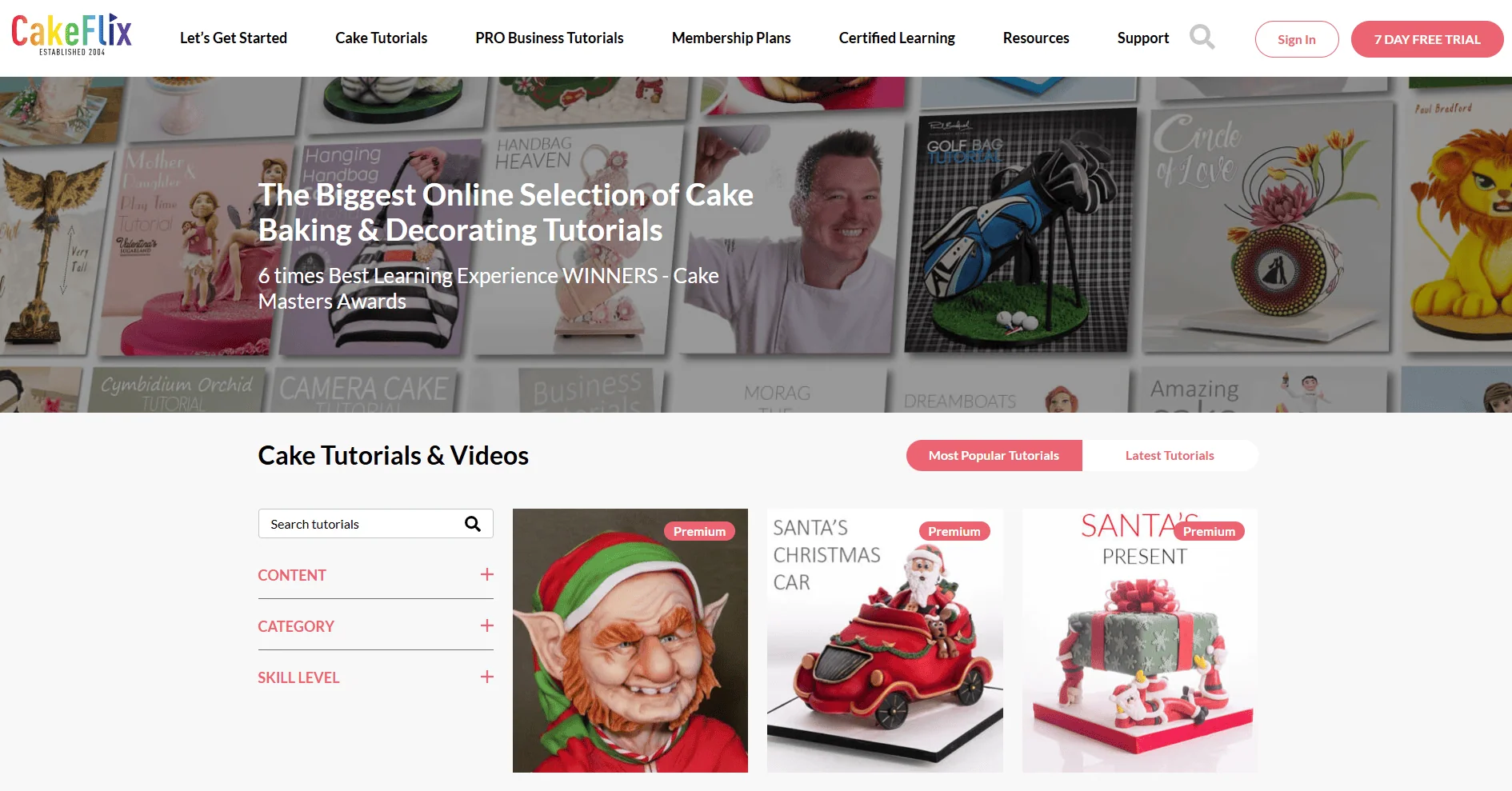
CakeFlix is dedicated to teaching cake decorating and baking skills through videos. They offer a comprehensive range of tutorials, courses, and resources for bakers of all skill levels.
You can earn up to 30% commission on successful sales when joining their baking affiliate program. The 30-day cookie duration allows you to earn commissions on purchases within 1 month from the consumer’s first click.
They also have plenty of regular update banners and text ads for you to create promotions and drive more sales.
|
6. Cake Stackers
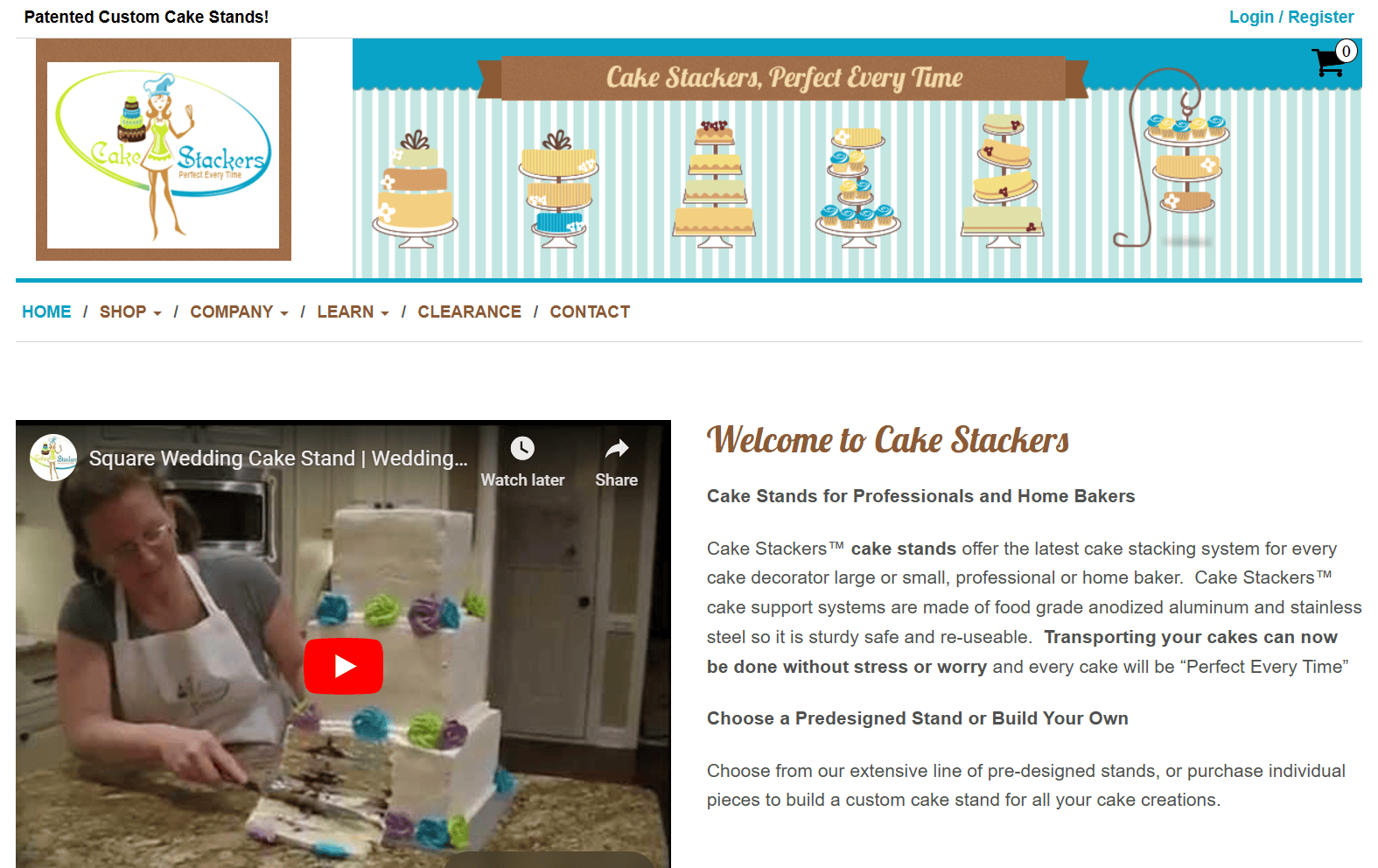
Cake Stackers offers innovative cake stacking and support systems for multi-tier cakes. Their product line features adjustable rods and stacking plates to help prevent layers of large or intricate cakes from shifting or collapsing.
Their cake affiliate program allows affiliates to get a 10% commission on their referrals. The brand lets you earn commissions for orders placed within 4 months of customers’ first click on your link.
You can receive your earnings through PayPal and Check, but one requirement is your payouts must reach at least $25 each month.
Cake Stacker assists your promotion with numerous banners and links to display on your website. You can also monitor your promotional results and earnings with their smart dashboard.
|
7. How To Cake It
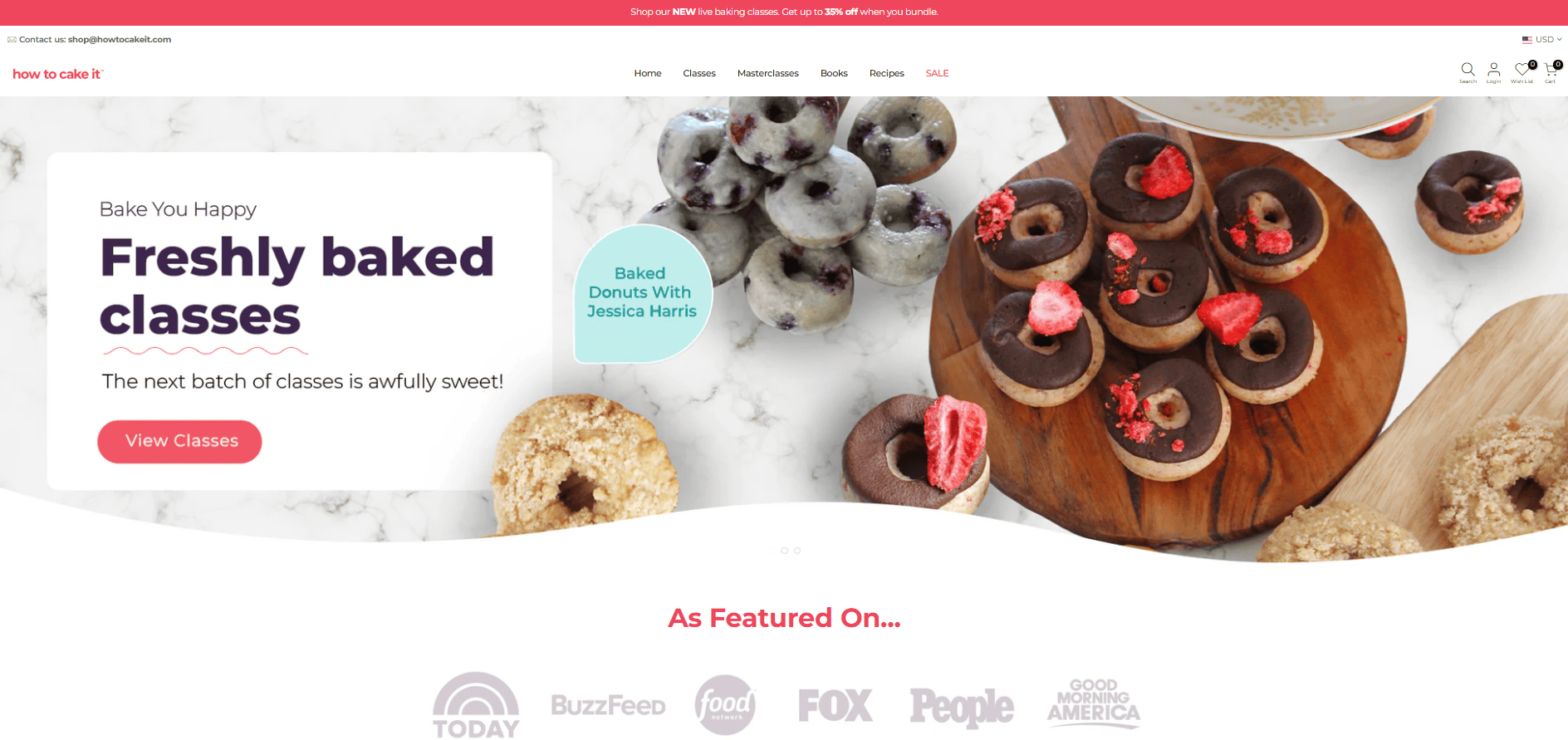
How To Cake It is taking the lead in online baking education with over 15 million customers worldwide. They teach how to create scrumptious cakes through free tutorials, premium courses, decorating books, and baking tools.
Once approved for their affiliate program, you may earn a 15% commission on each successful sale. They allow you to earn commissions for purchases within 30 days of the customer’s first click.
You must have a PayPal account to receive your payouts. The brand will process affiliate payments on the 15th of every month.
You can use a wide variety of product images, logos, and links to create engaging content and attract customers’ attention.
|
8. Greyston Bakery
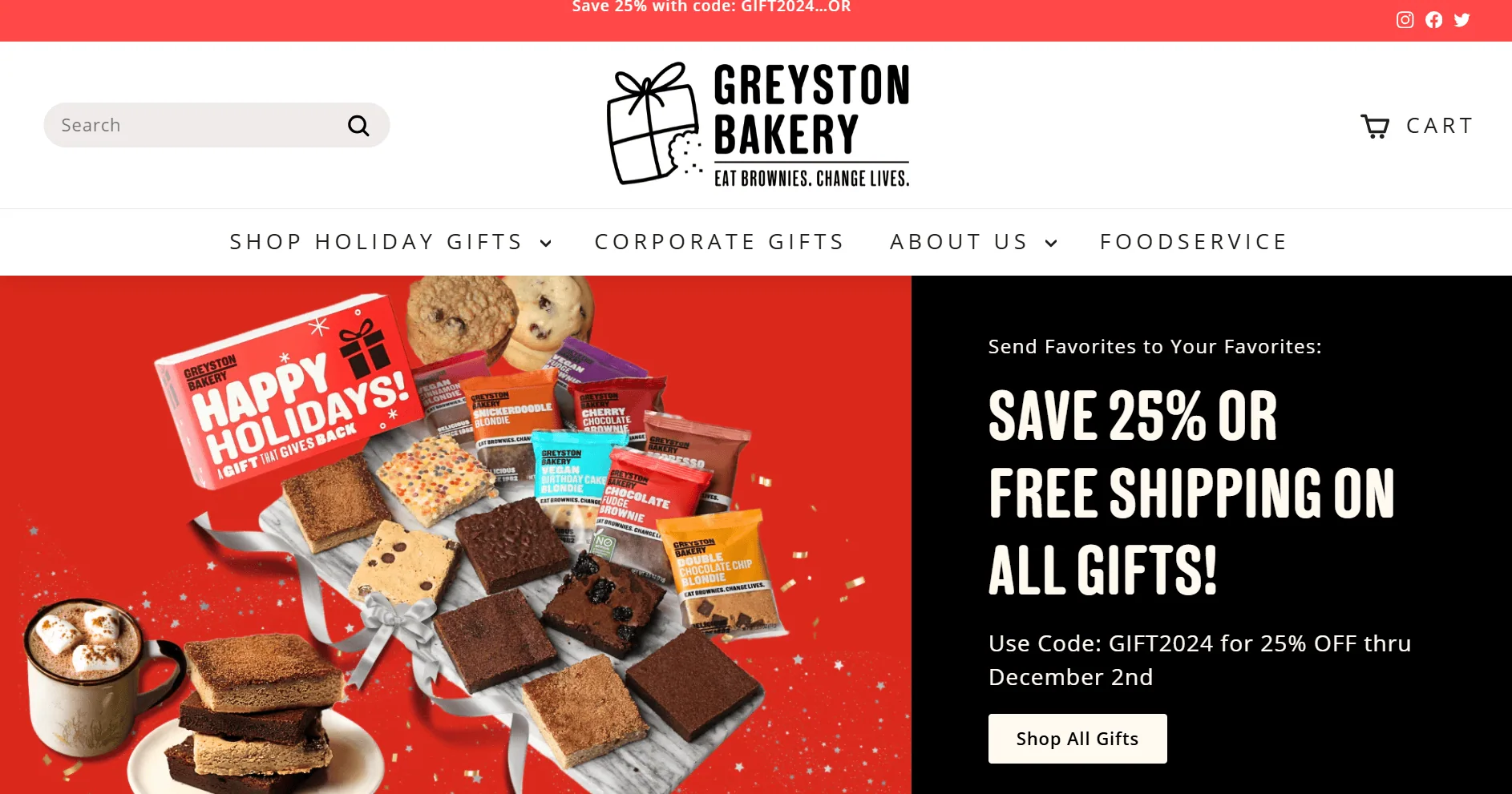
Greyston Bakery produces super delicious, rich & moist brownies for Ben & Jerry’s ice cream. The business is committed to a social purpose, helping people overcome employment barriers through meaningful job opportunities.
The Greyston Bakery affiliate program offers increasing commission rates based on the referred order’s value:
- Orders less than $100: 7%
- Orders more than $100: 10%
The cookie duration lasts 30 days, so you will earn commissions on purchases made within a whole month of the visitor’s initial click.
They also provide a wealth of banners and text links for you to promote their products. Moreover, their exclusive coupon codes can help your promotions stand out and increase conversions.
|
9. Le Creuset
Le Creuset is well-known for their high-quality cast iron cookware with excellent heat retention and distribution. They also produce many kitchen items, including bakeware, cookware, utensils, and stoneware.
Managed through the PepperJam network, the Le Creuset affiliate program offers up to 10% commission rates on each sale. You’ll need to sign up through PepperJam to join the program.
You can put their impressive logos, banners, and product links on your website to start promoting their products. You can check your promotional results in real-time with their daily updated reports.
|
10. Kitchen Universe
Kitchen Universe features a wide range of premium kitchen tools and supplies, always refreshed with the newest trends and innovations. Their products include countertop appliances, kitchen carts, blenders, mixers, and food processors.
Managed through Shareasale, their affiliate program allows publishers to earn a 6-10% commission. The average order value is $150, so you may earn at least $9 for each order.
You can create more attractive promotions with their eye-catching banners and text links. You can also stay up-to-date with your sales and commissions through your own personalized tracking dashboard.
|
11. Baking Steel
- Commission rate: 10%
- Cookie duration: 30 days
Baking Steel helps create restaurant-quality dishes at home with high-performance cooking steels. Their durable steel plates provide exceptional heat retention and even cooking for baking pizzas, bread, and more.
12. Chummys Bakery
- Commission rate: 25%
- Cookie duration: 30 days
Chummy’s Bakery is known for their wide range of freshly baked goods, including custom cakes, cookies, cupcakes, pastries, and bread. They also provide customized brownie delivery boxes to help customers have the best experience with a variety of mouthwatering flavors.
13. The Prepared Pantry
- Commission rate: 10%
- Cookie duration: Not mentioned
The Prepared Pantry sells a variety of high-quality baking ingredients, mixes, and kitchen tools. They also provide recipes and tips to help bakers create delicious treats for both everyday baking and special occasions.
14. Gluten Free Baking School
- Commission rate: 50%
- Cookie duration: Not mentioned
The Gluten Free Culinary School is dedicated to teaching gluten-free baking techniques and business skills. Their step-by-step instructions, expert tips, and guidance help bakers make over 50 professional recipes, including breads, pastries, and desserts.
15. LearnCakeDecoratingOnline
- Commission rate: 30-50%
- Cookie duration: Not mentioned
LearnCakeDecoratingOnline provides a variety of cake decorating courses for bakers of all levels. They strengthen every baking skill with step-by-step video tutorials, tips, techniques, and expert instructor guidance.
16. The Gluten Free Bakery
- Commission rate: 5%
- Cookie duration: Not mentioned
The Gluten Free Bakery ensures that customers on gluten-free diets can enjoy a wide variety of baked goods. All their products are crafted with high-quality, wheat-free ingredients to ensure both safety and great taste.
How to Choose the Right Baking Affiliate Program for Your Audience
Now that you know which programs are available, your next logical step is selection.
While it’s tempting to sign up for everything, spreading yourself too thin is a classic rookie mistake. Instead, let’s focus on quality over quantity.
This section will walk you through a simple 4-step process to filter your options and find the programs.
Step 1: Define Your Core Audience and Their Baking Profile
Many creators paste generic Amazon links without considering who is actually reading their content.
Rather than shooting in the dark, validate your strategy with the “Last 10 Posts” test.
Look at your top ten performing posts and analyze the specific patterns they reveal regarding skill, budget, and intent.
Start by looking at their technique to see if they’re beginners whipping up banana bread or experts tackling complex sourdough.
Once you know that, check their wallets – are they looking for a bargain, or are they the type to splurge on high-end Le Creuset gear?
Ultimately, you need to figure out if baking is just a hobby for them or if they’re serious professionals handling real orders.
If your top post is “Gluten-Free Cupcakes for Kids,” a program like Bob’s Red Mill or Wilton (decorating focus) will convert much better than a high-end equipment site.
On the other hand, if you write technical guides on artisan bread, your audience is likely ready to invest in a Challenger Bread Pan.
Identifying your audience is the foundation. But to make this profitable, you need to do the math on what you’re actually selling.
Step 2: Match Commission Structure to Your Average Order Value
A common trap for affiliates is chasing the highest commission percentage without looking at the price of the product. 8% of nothing is still nothing.
To make smart choices, you need to calculate your potential Earnings Per 100 Clicks. Let’s compare these two realistic scenarios:
Scenario A: You promote a $30 Danish Dough Whisk at 8% commission.
-> Math: $30 × 0.08 = $2.40 earnings per sale.
Scenario B: You promote a $15 set of mixing bowls at 3% commission (typical big-box rate).
-> Math: $15 × 0.03 = $0.45 earnings per sale.
Thinking about earning more money, you would need to sell five times as many mixing bowls as dough whisks.
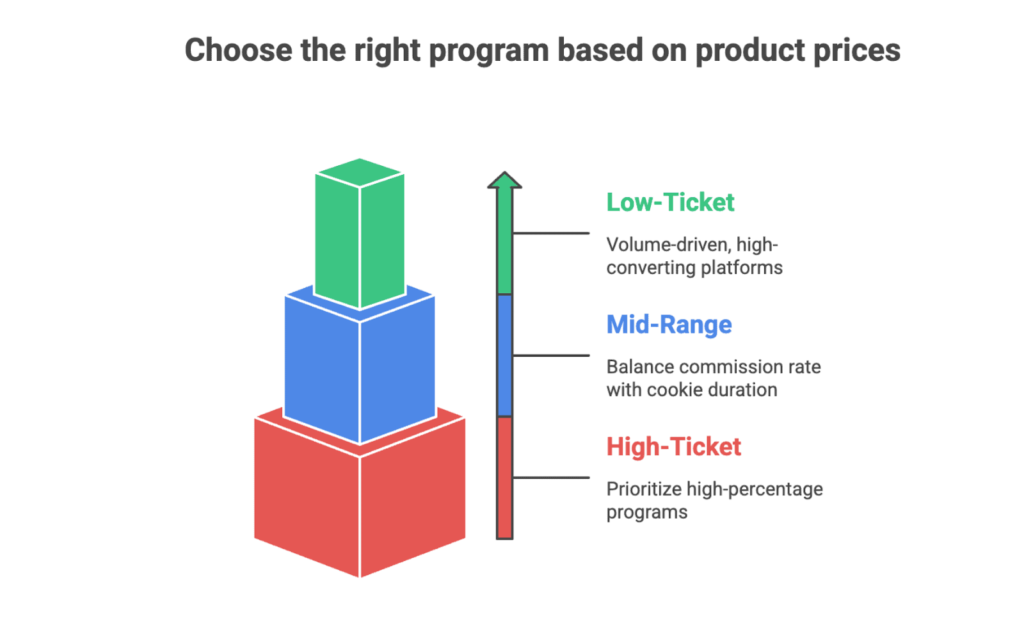
Here is a simple decision tree based on price points to guide your content strategy:
- High-Ticket Items (Over $100): Prioritize high-percentage programs. A Stand Mixer at 10% is a massive payout.
- Mid-Range ($30–$100): Balance the commission rate with the cookie duration (we’ll cover that next).
- Low-Ticket (Under $30): Volume is king. Stick to high-converting, trusted platforms like Amazon, where users might add other items to their cart (the “Basket-Building” strategy).
The math looks good on paper, but if your tracking window expires before the reader buys, you get zero. That’s where the “Cookie Gap” comes in.
Step 3: Evaluate Cookie Duration Against Your Content Lifespan
The “Cookie Duration” is how long you get credit for a sale after a click, which is the hidden killer of affiliate income.
You must match the cookie length to the “Consideration Phase” of the product you are pitching.
If you recommend a $600 KitchenAid mixer, nobody clicks and buys instantly. They click, read your review, check their bank account, talk to their spouse, and then buy two weeks later.
❌If you used a program with a 7-day cookie: That cookie expired a week ago. You earned $0.
✅If you used a program with a 30-day cookie: You just made $60.
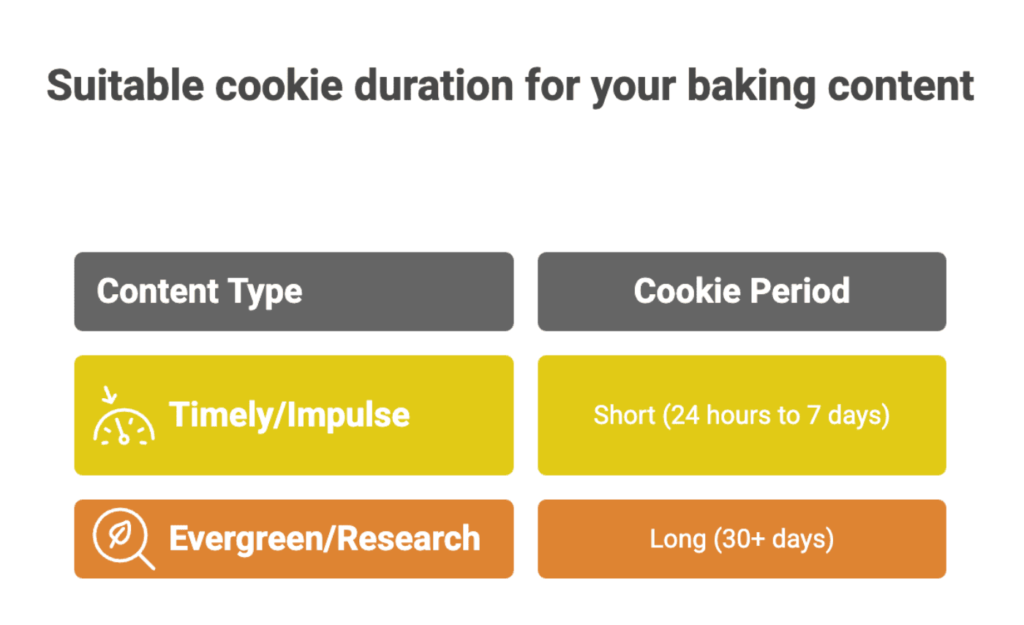
So, how do you know which cookie period is suitable and beneficial? Here’s the strategy to look for the right one:
For Timely/impulse content, such as seasonal recipes, short cookies (with a shelf life of 24 hours to 7 days) are suitable because the purchase decision occurs quickly.
For Evergreen/Research Content, like in-depth reviews or comparisons, you must prioritize programs with 30+ day cookies.
If a program offers a higher commission but a 24-hour cookie for a high-ticket item, avoid it.
Step 4: Test and Track Performance Before Scaling
You should never go “all in” on a single program without any data to support it. The smartest affiliates often run a 60-day bake-off between programs.
You can start by selecting 2–3 different programs (e.g., Amazon for convenience vs. King Arthur for brand loyalty).
Then, you can rotate these links in your top posts and track the metric that actually matters: EPC (Earnings Per Click).
How to calculate EPC:
Total Commissions Earned ÷ Total Number of Clicks = EPC
In the Baking Niche, the realistic EPC level means:
| EPC Level | Meaning / Action |
| EPC under $0.10 | Poor performance — move down or remove. |
| EPC $0.10 – $0.30 | Good performance — keep in rotation. |
| EPC over $0.30 | Top performers — place at the top and feature. |
By making decisions based on data rather than guessing, you stop hoping for commissions and start building them.
What Content Strategies Generate the Highest Baking Affiliate Conversions?
Most baking bloggers treat affiliate links as an afterthought, randomly placing them in recipe posts and hoping for the best.
That’s why most conversion rates stay around 1%. To hit the 5-8% rates seen by top earners, you need to shift from “mentioning products” to “creating buyer resources.”
Here are the 7 specific content formats proven to turn casual readers into buyers.
“Complete Setup” Guides (Starter Kits for Specific Baking Types)
Beginners are often paralyzed by choices.
If someone wants to start sourdough baking, having to research a jar, a scale, a lame, and a Dutch oven individually is overwhelming.
Your chance of success here is to create a “One-Stop Shop” guide. You can make a title like “The Complete Sourdough Starter Kit for Under $150.”
With this type of content, instead of selling a single $15 basket, you are selling a $150 bundle. Moreover, you can even save the reader hours of research.
So, what should your blog post have? Let’s follow this structure to create a smart one:
- The Essentials: 5-7 items they cannot bake without (e.g., Digital Scale, Dutch Oven).
- The Ingredients: Specific flour brands or yeast.
- The Upgrades: Nice-to-have tools for later.
- The Investment: A clear total cost estimate.
Data shows these guides generate 3-5x higher earnings because the reader is in the “starting phase” and ready to buy everything at once.
Side-by-Side Product Comparisons with Clear Winners
Readers hate ambiguity. If your review concludes with “it depends on what you like,” you haven’t helped them. They want an expert to make the hard choice for them.
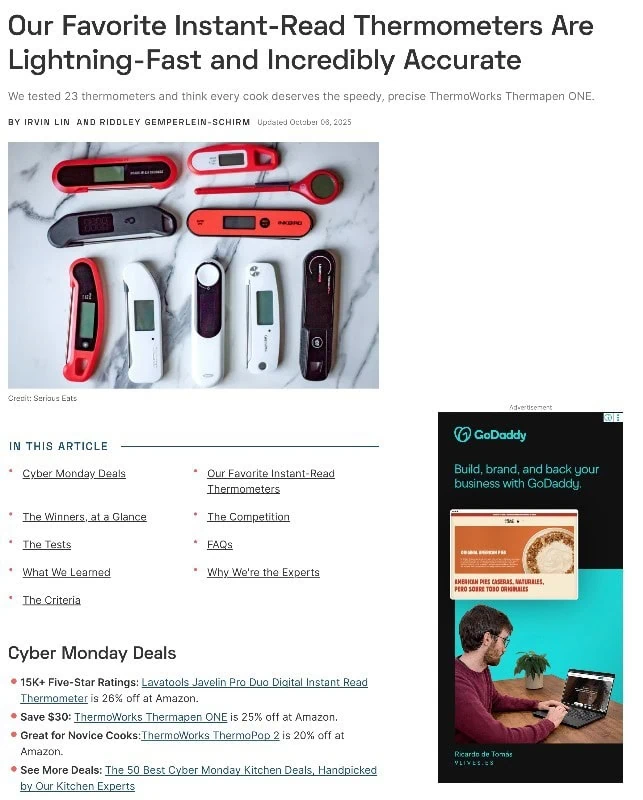
You need to test 3-5 similar products (e.g., “The Best Digital Thermometers of 2025”) and choose a clear winner.
Your strategic content should explain exactly how you tested (e.g., speed, accuracy, durability).
Next, you need to list 1st, 2nd, and 3rd place clearly and suggest which product is suitable for which type of audience.
Pro Tip: Link the winner in the very first paragraph. Many readers just want the answer without reading the whole post. Comparison posts convert 40-60% better than single-product reviews because they answer the reader’s main question: “Is there something better?”
Seasonal Gift Guides with Specific Recipient Personas
For many food bloggers, the holiday season (October–December) accounts for 60-70% of their annual affiliate revenue
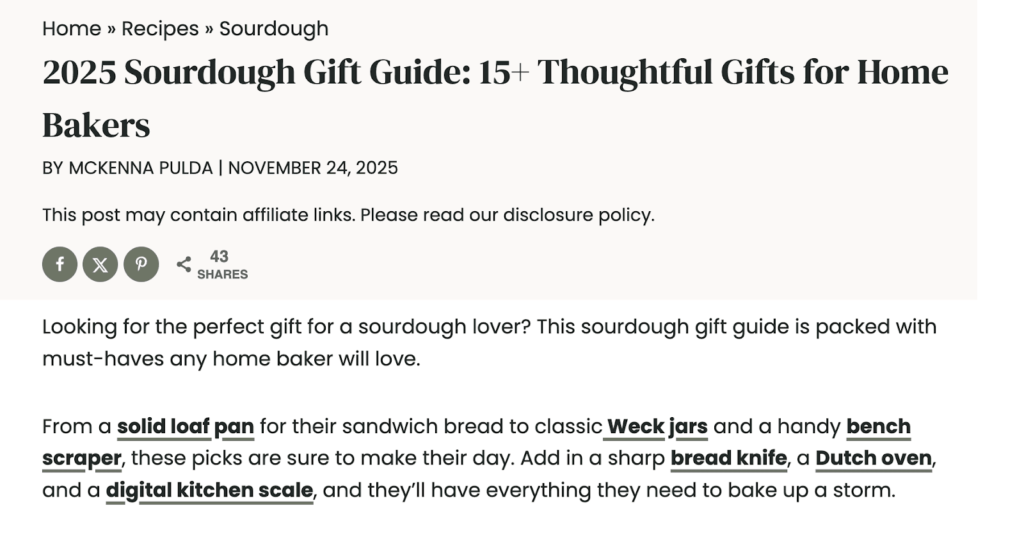
The secret behind their high sales is how they create urgency. Rather than just writing “Gifts for Bakers.”, write “11 Gifts for the Sourdough Obsessed” or “Under $30 Stocking Stuffers for Cookie Decorators.”
We suggest structuring the content for better conversion following the 2 smart points:
- Organize by Budget: Group items by price ($15-30, $30-60, $100+). Gift givers usually have a set spending limit.
- Create Urgency: Use phrases like “Ships Prime-eligible” or “Order by Dec 18th for Christmas delivery.”
Publish your content 4-6 weeks before the holiday to rank in search, then promote it heavily 10 days before the date to catch the panic buyers.
Recipe Posts with “As Used in This Recipe” Tool Links
A recipe post is the most natural way to monetize your existing traffic. While dedicated reviews convert higher, recipe guides have significantly more traffic.
While producing this content, how do you add affiliate links naturally to likely generate clicks?
Don’t just list equipment at the bottom. Mention the specific tool in context during the intro or instructions.
❌Bad: “Here is a link to a muffin tin.”
✅Good: “I’ve tested six different tins, and [Brand Name] is the only one that releases these muffins without sticking.”
You can also stick to these tips for more effective content:
- Target Specialty Items: Flour and sugar don’t convert well. Piping tips, specialty pans, and vanilla bean paste do.
- Limit Mentions: Stick to 2-3 key tools per recipe. Any more feels spammy.
“Problem-Solution” Troubleshooting Guides
A reader searching for “why are my cookies flat” is frustrated and looking for a quick fix. If you can solve their problem, they will buy your solution immediately.
In this case, you just need to provide solutions in your detailed guides:
- Diagnose the Pain: “Your cookies are spreading because your oven temperature is inaccurate.”
- Explain the Science: Briefly explain why heat matters.
- Offer the Tool: “I fixed this by using [This $8 Oven Thermometer] to find my oven’s true hot spots.”
A problem-solution guide works because it positions the product as a solution, not a sales pitch.
Equipment Upgrade Guides (“When to Replace X”)
This strategy targets your most valuable audience: experienced bakers who already own the basics but are ready to level up.
They have money to spend and are looking for permission to upgrade.
You need to focus on validation. You can write posts like “5 Signs It’s Time to Upgrade Your Stand Mixer” or “Why Your Cookie Sheets Are Ruining Your Bake.”
So, what should you include in your guide to make it attractive for bakers? Let’s look at some of the most important information:
- The Signs: “If your mixer struggles with double batches of dough…”
- The Difference: Explain the specific performance leap (e.g., metal gears vs. plastic gears).
- The ROI: Justify the cost by calculating the “cost per use” over 10 years.
These posts have high conversion rates because the reader is already sold on baking—they just need to be sold on the gear.
Resource Roundups from Expert Bakers
If you don’t have enough authority yet, borrow it from other experts.
We recommend interviewing 8-12 fellow bakers or bakery owners and asking them one question: “What is the one tool you can’t live without?”
Having these bakers talking in your content is a huge plus point because:
✅Social Proof: It’s not just you recommending it; it’s a consensus of pros.
✅Link Volume: A single post can legitimately contain 20+ affiliate links without looking spammy.
✅Networking: The experts you feature are likely to share the post with their own audiences, driving free traffic to your affiliate links.
Your job here is to compile their answers, add a short bio for each expert, and link directly to their favorite product.
7 Advanced Strategies to Maximize Your Baking Affiliate Revenue
Most content creators hit an income ceiling. They write more reviews and post more recipes, but their revenue stays flat.
You can avoid facing the same issue. All you need to do is stop acting like a writer and start acting like a marketer.
We can help you out with these 7 advanced strategies that focus on optimization – squeezing more revenue out of the traffic you already have.
1. Create Seasonal Content Calendars 8-10 Weeks in Advance
Timing is everything. If you publish your “Best Thanksgiving Pie Tools” post in November, you have already lost. The high-intent search traffic started peaking in October.
Your strategy here is to publish promotional content early to rank early, for example:
- Valentine’s Day: Publish in early December.
- Easter: Publish in mid-January.
- Christmas: Publish in mid-October.
It’s understandable since Google Indexing takes time for search engines to find and rank new content.
It’s also the right publishing time since Pins on Pinterest need weeks to circulate and gain repins. Moreover, your audience often spends the most money planning weeks ahead.
By publishing 8-10 weeks out, you capture the “Early Planners,” the “Mid-Planners,” and the “Last Minute Panic Buyers.” If you publish late, you only get the panic buyers.
2. Build Affiliate Product Tables That Update Automatically
Let’s face it: static text links are revenue killers. When prices change or items go out of stock, manual updates become a nightmare that costs you money.
The smarter play is to use dynamic product tables through tools like AAWP (for Amazon) or Lasso. These tools pull data directly via API, ensuring your links are always alive.
This doesn’t just save you time; it boosts conversions for three specific reasons:
✅Trust: Readers see the actual current price, not an outdated one.
✅Urgency: Showing “Only 3 left in stock” drives immediate action.
✅Deal Capture: If a mixer goes on sale for Prime Day, your table updates instantly, capturing deal-seekers without you lifting a finger.
Stop manually checking links. Let the software do the work so you can focus on creating.
3. Leverage Email Sequences for High-Intent Content Upgrades
Social algorithms are unpredictable, but your email list is the one asset you truly own. However, a generic weekly newsletter won’t pay the bills.
Now, you need the “Content Upgrade” Funnel – a system designed to sell for you automatically to maximize revenue.
You can start by capturing high-intent readers on your top posts by exchanging a valuable freebie (like a “Printable Sourdough Schedule”) for their email.
Once they are in, your automation takes them on a journey:
The Hook (Day 0): Deliver the freebie immediately. This proves you are reliable and builds instant trust.
The Nurture (Day 3): Send a helpful tutorial that naturally mentions organic products, solving a problem without being pushy.
The Pitch (Day 5): Now that they trust you, send a curated “My Favorite Tools” guide containing your high-ticket affiliate links.
4. Negotiate Higher Commission Rates After Proving Performance
Affiliate managers have a budget, and it is cheaper for them to keep a top performer than to find new ones. If you are generating consistent sales, you have leverage.
Once you generate $500–$1,000/month for a single program, ask for a raise. You can text the affiliate program manager and showcase your performance in the last quarter:
“Hi [Manager Name], over the last 90 days, I’ve generated $3,200 in sales at a 5% commission. I’m planning my Q4 content and want to feature your brand more prominently. Would you consider moving me to a 7% tier to reflect this volume?”
Success Rate: About 50% of mid-tier programs (like King Arthur or specialized kitchenware brands) will say yes. Amazon won’t negotiate, but almost everyone else will.
5. Create Shoppable Pinterest Pins with Direct Affiliate Links
It is important to recognize that Pinterest is not traditional social media; rather, it is a visual search engine designed for purchase planning.
A key advantage over platforms like Instagram is that Pinterest allows for direct affiliate links, shortening the path to purchase.
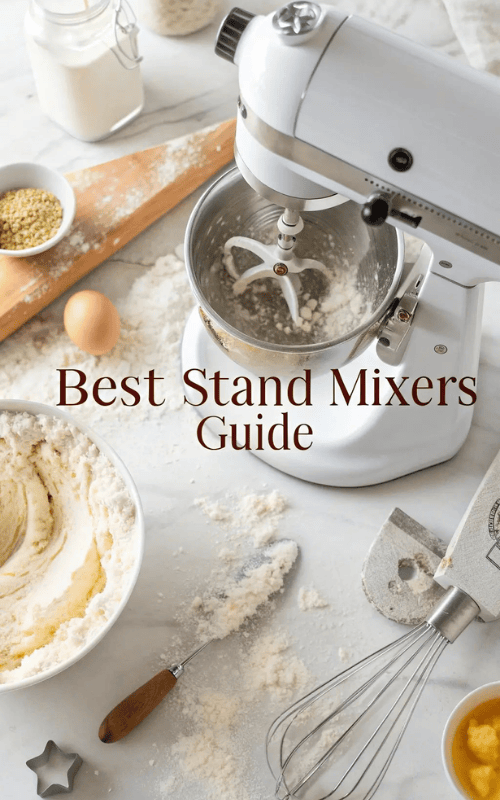
Your strategy should focus on creating vertical pins (1000x1500px) that showcase a product—such as “The Stand Mixer Pros Use”—and link directly to the retailer via your affiliate URL.
To maximize performance, keep these optimization tips in mind:
- Disclosure: Transparency is mandatory. You must clearly state “Affiliate Link” or “Ad” on the image or in the text.
- Rich Pins: distinct from standard pins, “Rich Pins” automatically sync price and stock information.
- Timing: Because Pinterest users are forward-looking, you should pin seasonal content 2–3 months early—much further ahead than you would for Google search traffic.
6. Build “Best Of” Roundup Posts That Consolidate Top Performers
Instead of hoping 15 different reviews rank individually, you should combine their power into one massive authority post.
For example, you can create a post titled “The 15 Baking Tools I Recommended Most in 2025” or “My Ultimate Kitchen Gear Guide.”
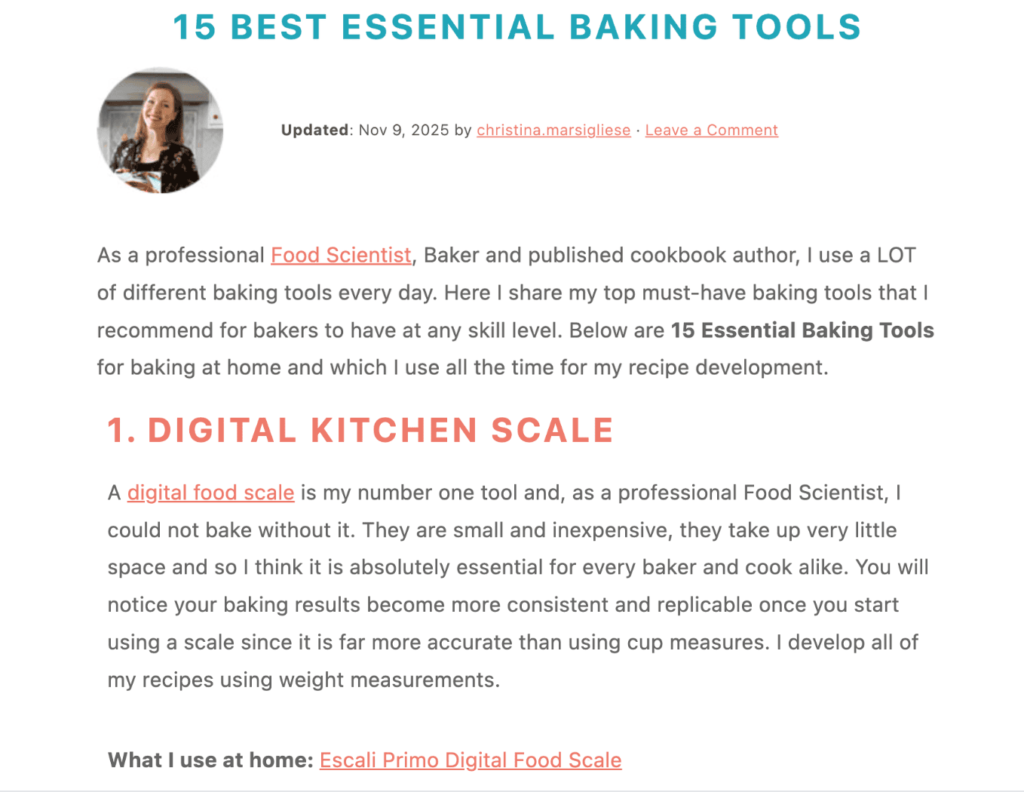
Writing roundup posts can effectively drive traffic to your blog thanks to:
- SEO Dominance: These comprehensive posts target competitive keywords like “best baking tools” that single reviews can’t touch.
- Link Equity: It is easier to build backlinks to one “Ultimate Guide” than to 20 small posts.
- Efficiency: You only have to update one post a year to keep your highest-converting content fresh.
7. Use Retargeting Pixels to Capture Research-Phase Visitors
98% of visitors leave without buying. They are researching. If you let them leave, you lose the commission.
You can install a tracking pixel (Facebook or Google) on your high-value comparison posts. Run ads targeting those specific visitors for 14-30 days.
Let’s do some simple math. You spend $5/day showing ads for your “Stand Mixer Review” to people who have already visited that page.
It keeps your recommendation top-of-mind while they decide. That means you have spent $150/month and sold 3 extra mixers; you have doubled your money.
Note: This is an advanced strategy. It requires a budget and strict adherence to affiliate terms (some programs don’t allow direct ad-linking, so drive them back to your content). But for established creators, it is the most scalable way to grow revenue.
Common Baking Affiliate Marketing Mistakes (And How to Avoid Them)
Affiliate marketing often feels like “passive income” until you realize you’ve spent six months writing reviews that earn nothing.
The difference between a hobby blog and a revenue engine isn’t luck; it’s avoiding the specific traps that kill conversions and damage trust.
Here are the 5 most common mistakes new baking affiliates make – and exactly how to fix them.
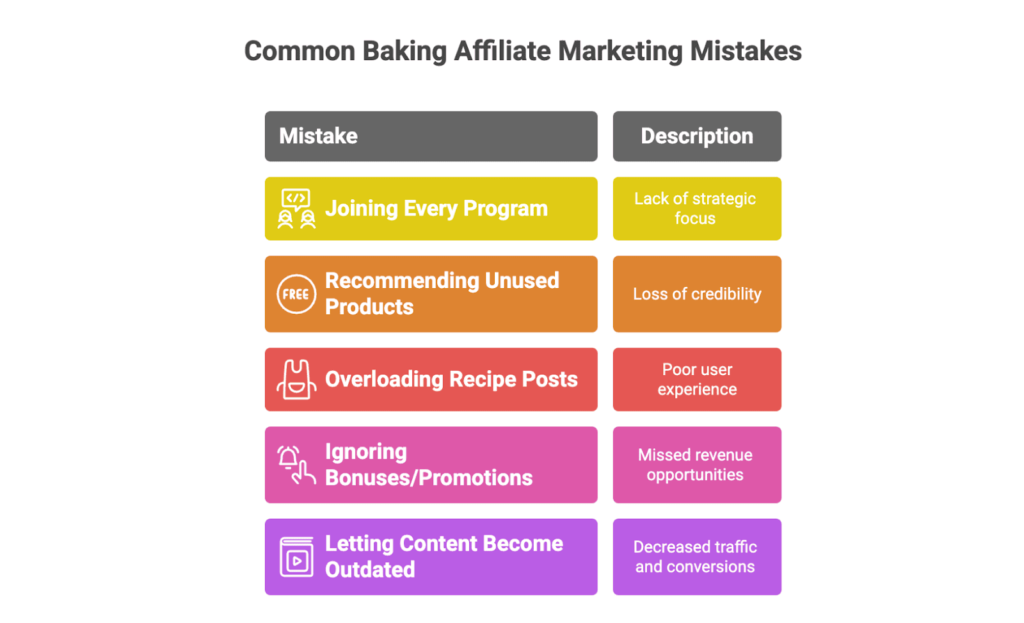
Mistake #1: Joining Every Program Instead of Strategically Focusing
The most common new mistake is the “shotgun approach”. For example, some might join 12 different programs in the hopes that more programs equal more money.
However, spreading your effort kills your payout. Most affiliate programs have minimum payout thresholds (usually $50–$100).
If you earn $40 across 10 different programs, you have technically earned $400, but you will actually be paid $0. That money sits in limbo, often for months.
You can consider starting with three affiliate programs to promote different baking products. Your top choices can be based on:
- Mass Market: (e.g., Amazon) for volume and small tools.
- Niche Specialist: (e.g., King Arthur) for loyalty and specific ingredients.
- High-Ticket: (e.g., Williams Sonoma) for big purchases like mixers.
Focus all your energy here until each one pays you at least $300/month consistently. Only then should you expand.
This ensures you actually get paid and helps you build a relationship with affiliate managers (which gives you leverage for Mistake #4).
Mistake #2: Recommending Products You Haven’t Actually Used
Readers have highly sensitive “BS detectors.” If you write a review based solely on specifications and other people’s opinions, your writing will feel generic and hollow.
The moment a reader realizes you are recommending a mixer you’ve never touched, you lose more than just a sale. These bakers will begin to doubt every recipe you publish.
That’s why you must commit to a higher standard: only recommend gear you have personally used for at least 2-4 weeks.
If you must mention something you haven’t tested (e.g., a newer model of a tool you own), disclose it explicitly:
“I haven’t tested this specific model personally, but based on the specs and 200+ verified reviews…”
Pro Tip: Reinvest 10-15% of your affiliate income into buying new gear to test. It is a tax-deductible business expense, and authentic photos of your messy kitchen with the product convert 35-50% better than stock photos.
Mistake #3: Overloading Recipe Posts with Excessive Affiliate Links
We’ve all seen recipe posts where every single ingredient, from salt to sugar to flour, is a blue hyperlink. It looks like a spam farm, not a helpful resource.
And the result? Readers stop trusting your formatting and start ignoring your links entirely, costing you clicks on the high-value items.
The rule here is to limit recipe posts to 1-3 highly relevant links. Ask yourself three questions before linking:
- Does this specific tool change the outcome?
- Do they probably not own it yet? (Link a Madeleine pan, not a mixing bowl).
- Is it hard to find? (Link almond flour or vanilla bean paste, not white sugar).
A recipe with two carefully chosen, high-value links often outperforms a recipe with 12 random ones because the recommendation feels genuine and helpful.
Mistake #4: Ignoring Seasonal Commission Bonuses and Promotions
Many creators treat affiliate rates as fixed numbers. They set it and forget it, missing out on the easiest money in the industry.
But the rates fluctuate. Most major programs offer 1.5–2x commission rates during peak seasons (Prime Day, Black Friday, Holiday).
If you aren’t paying attention, you are doing the same work for half the pay. You should have a “Promote Calendar”.
Don’t forget to subscribe to the affiliate newsletters for your top 3 programs. They will announce:
- Rate Bumps: “Earn 10% instead of 5% this weekend.”
- Bonus Tiers: “Sell $500 this month and get a $50 bonus.”
- Exclusive Codes: “Use code BAKE20 for 20% off.”
When these hit, update your existing high-traffic posts with a temporary banner: “Heads up: This mixer is 20% off at Williams Sonoma this week!” This simple tweak can add hundreds of dollars to your Q4 revenue.
Mistake #5: Letting High-Performing Content Become Outdated
Now, you write a killer review of the “Best Stand Mixers,” it ranks #1 on Google, and you start making money. So you move on to the next post and ignore it for two years.
But the fact is that the models get discontinued. Prices change. Links break. Google notices that your “Best of 2022” post hasn’t been touched in 18 months and drops your rankings.
To avoid this problem, you need a “Quarterly Audit.”
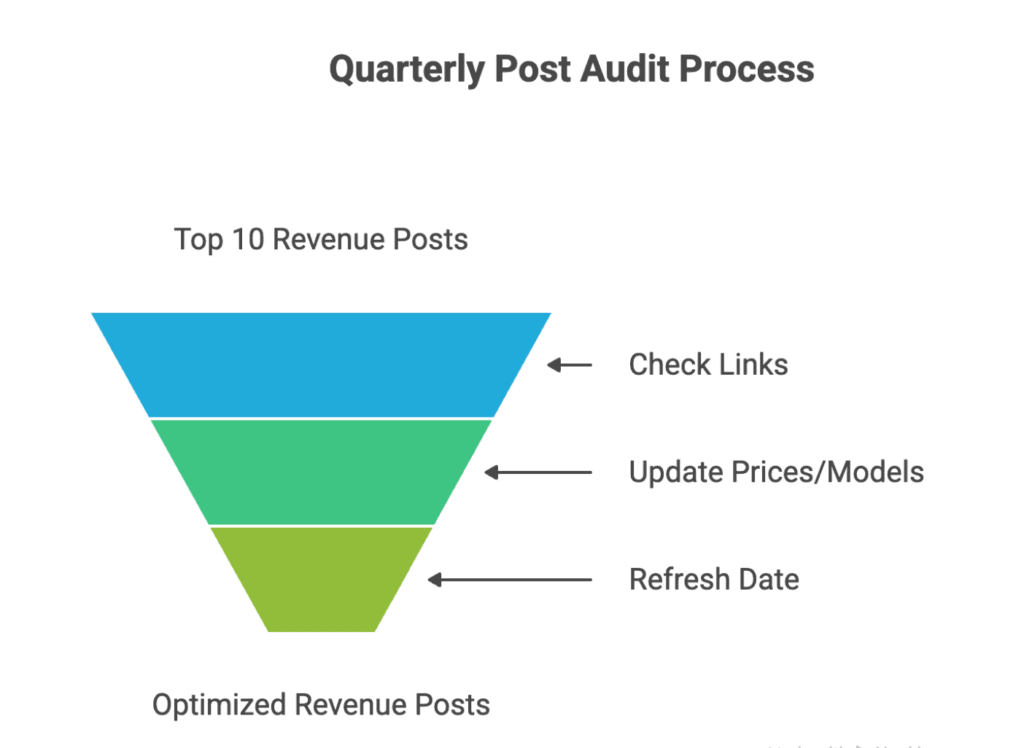
Every 3 months, pull a report of your top 10 revenue-generating posts and follow this guide:
- Check Links: Click every affiliate link to ensure the product is still in stock.
- Update Prices/Models: Did a newer version come out? Mention it.
- Refresh the Date: Update the “Last Updated” timestamp.
Maintaining your winners is infinitely more profitable than writing new posts that might flop. Spending 4 hours a quarter on maintenance can protect $5,000+ in annual passive income
Conclusion
Building a successful affiliate program doesn’t have to be overwhelming. The recipe is simple: use the right tool to avoid manual headaches, create an attractive offer, and focus on building strong relationships with your partners.
By automating the difficult parts, you can focus on what really matters – connecting with people who love baking as much as you do. It’s time to build your team of brand advocates and watch your baking business rise.

Ellie Tran, a seasoned SEO content writer with three years of experience in the eCommerce world. Being a part of the UpPromote team, Ellie wants to assist Shopify merchants in achieving success through useful content & actionable insights. Ellie's commitment to learning never stops; she's always eager to gain more knowledge about SEO and content marketing to create valuable content for users. When she's not working on content, Ellie enjoys baking and exploring new places.