

The global eBooks market is forecast to generate $14.92 billion in revenue by 2025, according to Statista. If you’re a bookworm or a content creator, now is the perfect time to start earning money by promoting highly-rated eBooks.
In this article, we’ll introduce 10 of the best eBooks with full details on commissions, cookie duration, and other benefits. Let’s explore and find the perfect fit for your audience’s interests today!
Quick Comparison
| Program Name | Commission (%) | Cookie Duration (Days) | Niche Suitable | Affiliate’s Rating |
|---|---|---|---|---|
| Abebooks | 5% (only first $500 per item) | 30 days | Books, collectibles, rare books | ⭐⭐⭐ |
| Apple Books | 7% | 30 days | eBooks, audiobooks, apps, Apple ecosystem | ⭐⭐⭐⭐ |
| Books-A-Million | 3% | 30 days | Books, gifts, toys, magazines | ⭐⭐ |
| Epic! | $0.50 per sign-up | 30 days | Kids’ books, children’s education content | ⭐⭐⭐ |
| Pinch of Yum | 50% | 180 days | Food blogging, cooking, photography | ⭐⭐⭐⭐⭐ |
| Kobo | 5–10% | 14 days | eBooks, audiobooks, devices | ⭐⭐⭐ |
| eBooks.com | 10–15% (tiered) | 45 days | eBooks, digital publications | ⭐⭐⭐⭐ |
| Barnes & Noble | 5% | 1 day | Books, textbooks, eBooks | ⭐⭐ |
| Flipkart | 12% | N/A (not stated) | General e-commerce, Indian market, eBooks | ⭐⭐⭐⭐ |
| BookBaby | 10% (orders over $100) | N/A | Self-publishing, authors, book marketing | ⭐⭐⭐ |
10 Best eBook Affiliate Programs to Monetize Your Content
1. Abebooks
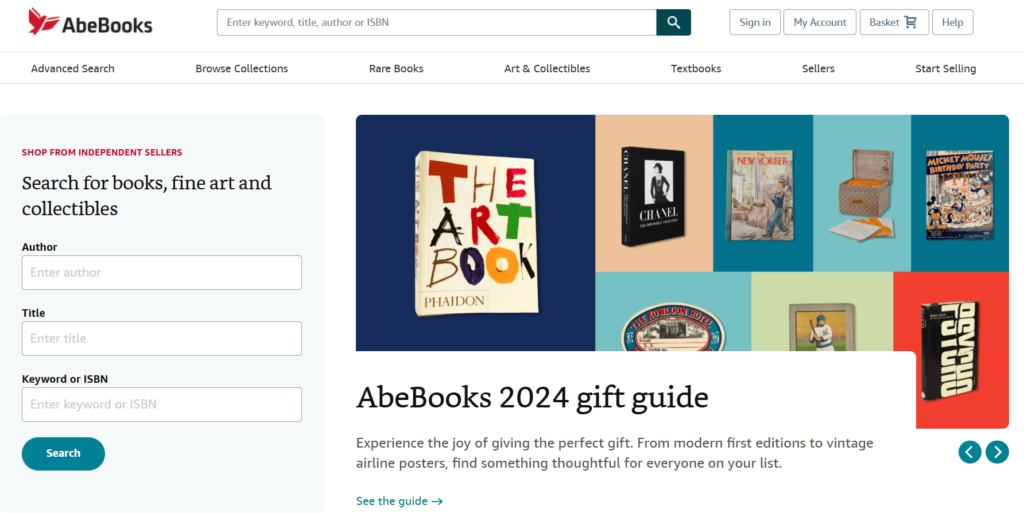
Abebooks is a great online marketplace for book lovers and collectors searching for hard-to-find, unique items. They have become a global platform connecting buyers with independent sellers in over 50 countries.
When joining the Abebooks affiliate programs, you’ll earn a 5% commission on every approved sale. However, the brand pays commissions only on the first $500 of an item’s sale, even if the price exceeds that amount. The cookie stays active for 30 days from the customer’s first click on your link.
Abebooks runs their eBook affiliate program through Impact Radius. You can access the network and utilize their ready-made banners on your site to enhance your promotional efforts.
|
2. Apple Books
Apple Books is an e-book and audiobook platform developed by Apple. They offer millions of titles, from bestsellers and free books to handpicked collections across various genres.
The Apple Books affiliate program pays you a 7% commission for all sales you refer. The cookie stays valid for 30 days from the customer’s first visit to your link.
The brand collaborates with the Partnerize network to manage their program. You can simply log in to the platform to access your unique tracking link for promotions. Apple Books pays out commissions once your balance reaches $30.
|
3. Books-A-Million
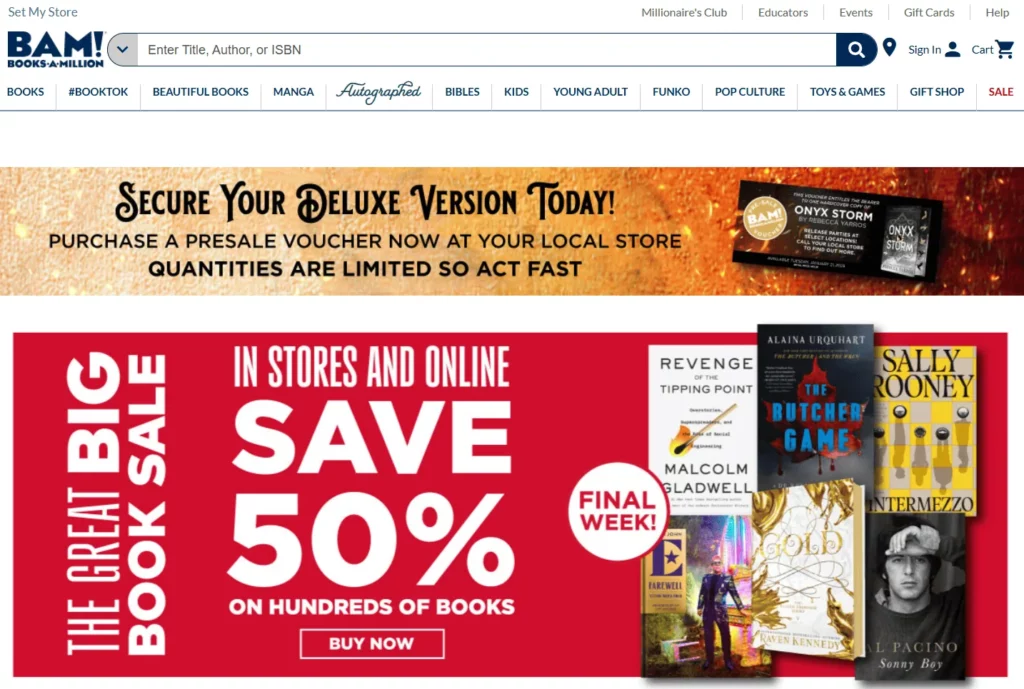
Books-A-Million is the second-largest book retailer in the U.S., with 260 stores across 32 states. They offer a diverse selection of books, e-books, magazines, collectibles, toys, tech gadgets, gift items, and more.
The Books-A-Million affiliate program lets you earn a 3% commission on every qualified sale you refer. The cookie lasts for 30 days, so you’ll earn commissions on purchases made within this period.
You can request direct deposit payouts once your balance reaches $50, while paper checks have a minimum threshold of $100. The brand will send you their ready-to-use banners, text links, and button images to help you promote their products better and increase conversions.
|
4. Epic!
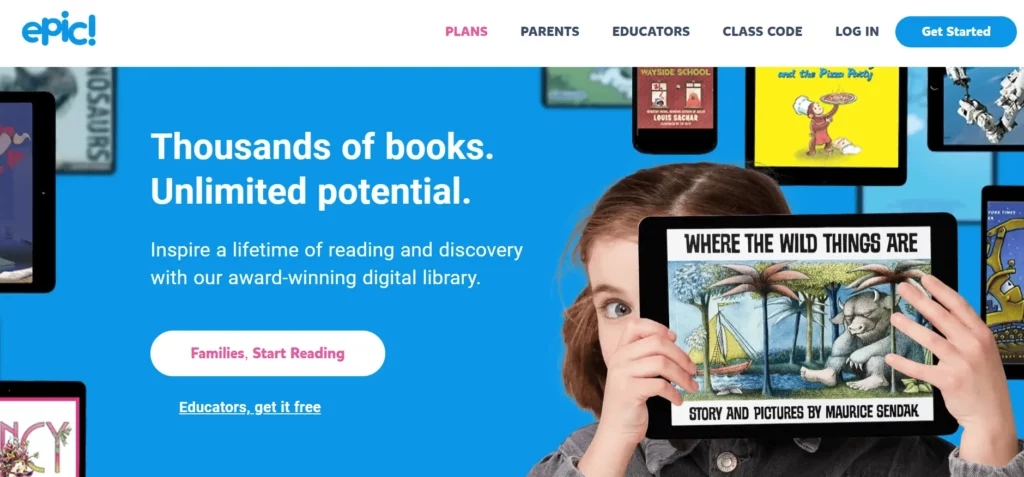
Epic! is a digital library for kids. They offer over 40,000 books, including picture books, chapter books, audiobooks, educational videos, and interactive content to make reading more engaging and fun.
This ebook affiliate program pays you a $0.50 commission for each account sign-up you drive. The cookie tracks referrals for 30 days from the initial click.
You can receive bonus commissions for each sale made in your first month with the program. Moreover, sharing their engaging content and exclusive discounts with your audience is a great way to enhance your promotions.
|
5. Pinch of Yum
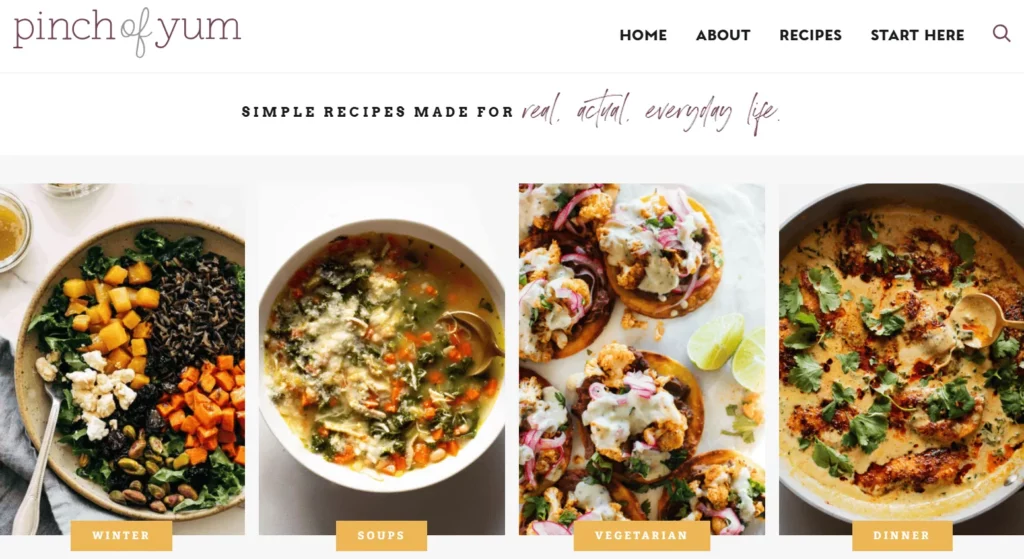
Pinch of Yum offers a variety of recipes, from vegetarian meals to quick dishes for busy days. They also provide an eBook, Tasty Food Photography, with practical tips for anyone looking to improve their food photography skills.
You can enjoy a generous 50% commission on each eBook purchase made through your affiliate link. The long 180-day cookie duration gives you plenty of time to earn commissions on qualifying purchases.
Their ebook affiliate program is managed via the Shareasale network, so you must have an account before signing up to be their publisher. Additionally, you can create many attractive promotions with their eye-catching banners and text links.
|
6. Kobo
Kobo is a digital reading service offering over 5 million ebook and audiobook titles. Book lovers can download the Kobo App for free to enjoy their favorite stories on the go.
By joining the Kobo ebook affiliate program, you can earn different commission rates based on the type of item you promote:
- eBooks, audiobooks and devices: 5%
- Device accessories: 10%
With a 14-day cookie, you can earn commissions on purchases completed within this timeframe.
The brand partners with the Rakuten Linkshare to manage their program. Ebook affiliates can monitor your clicks, conversions, and earnings via Rakuten’s tracking dashboard.
|
7. eBooks.com
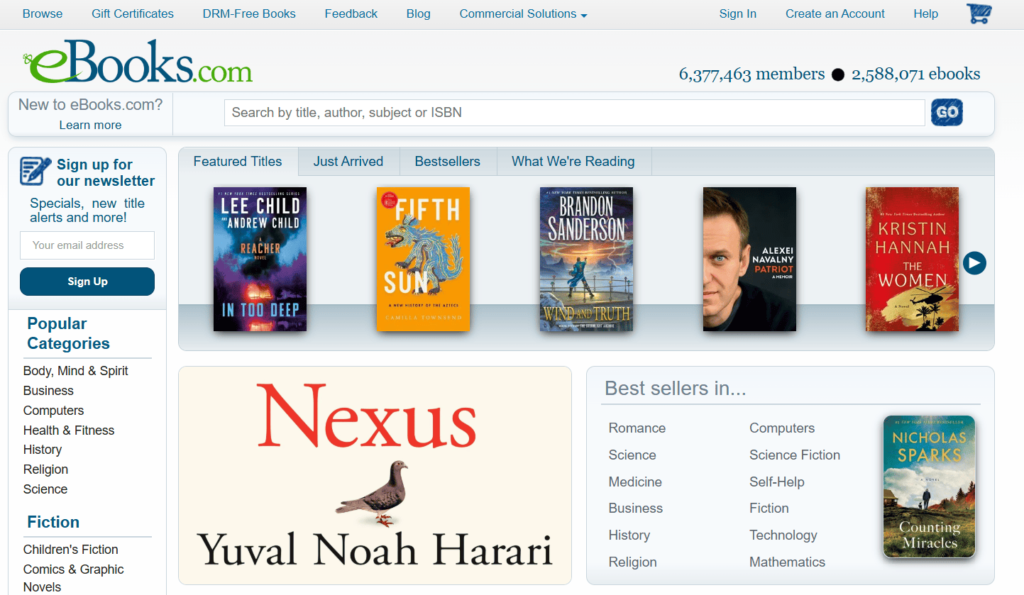
eBooks.com is a leading ebook retailer with over 2 million titles. They are also well-known for providing ebook-related services to publishers.
The eBooks.com affiliate program offers you a tiered commission structure based on your annual sales:
- Sales up to $100,000: 10%
- Sales over $100,000: 15%
The cookie window lasts 45 days, so you have a long time to earn money on purchases made after the first visit.
You can monitor your performance in real time through their user-friendly tracking and reporting tool. Besides that, their dedicated affiliate managers will provide valuable insights, strategies, and ongoing assistance to help improve your performance.
|
8. Barnes & Noble
Barnes & Noble is the leading bookseller with nearly 600 stores in the U.S. They offer a wide range of products, including textbooks, magazines, DVDs, gifts, and an extensive selection of eBooks and audiobooks.
When joining this ebook affiliate program, you can enjoy a 5% commission on each sale through your referral. However, the cookie duration is only 1 day, and you just get credit for purchases within this period.
The brand works with CJ Affiliate to manage their program. So, make sure your CJ account is active before signing up.
|
9. Flipkart
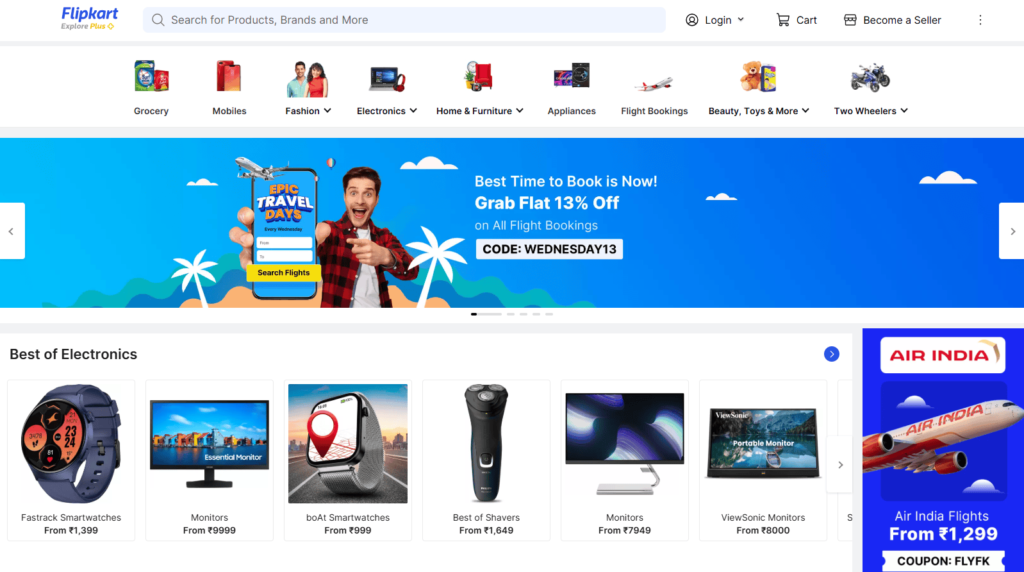
Flipkart is among the biggest and most well-known e-commerce platforms in India. Their product range includes electronics, clothing, shoes, toys, ebooks, and beauty products.
The Flipkart ebook affiliate program rewards you with a 12% commission on each successful sale. You can choose an eGift voucher payment with a minimum of Rs 2,500 or an EFT payment once your balance reaches Rs 5,000.
The company assists you with plenty of ready-to-use banners, links, and content to create interactive promotions. Their tracking dashboard will update you with your real-time orders and commissions.
|
10. BookBaby
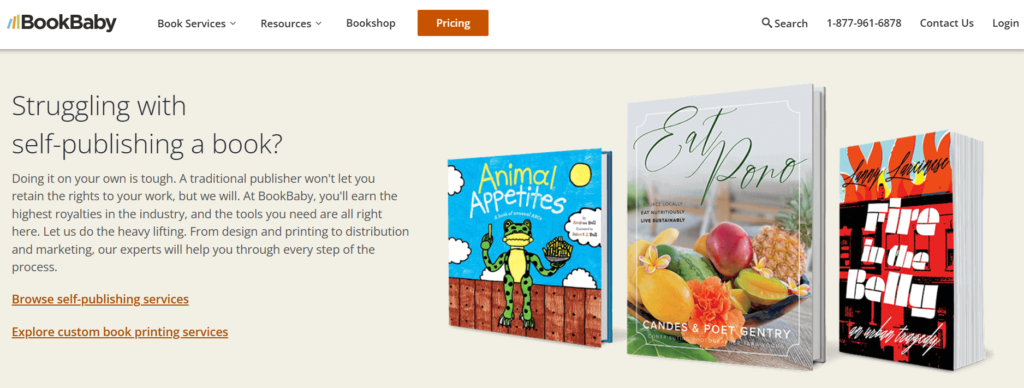
BookBaby helps authors publish and distribute their eBooks, print books, and audiobooks. They provide professional services for book design, formatting, marketing, and distribution to major platforms like Amazon and Apple Books.
With this ebook affiliate program, you can enjoy a 10% commission on new referrals for orders over $100. Payments are processed through ACH or PayPal, so make sure your account is active before enrolling in their program.
You can monitor the performance of your campaign anytime through your BookBaby Partner account dashboard.
|
Why Should You Promote Ebooks as an Affiliate?
Most new affiliates chase expensive physical products. They assume a $50 commission on a blender beats a $5 commission on a book.
But seasoned marketers know the truth: friction kills sales.
Ebooks offer a unique advantage for affiliates. You get unlimited inventory, instant delivery, and prices so low that customers often buy without thinking twice.
While other affiliates deal with shipping delays and low conversion rates, ebook affiliates own a digital asset that creates real passive income.
Here is why digital books often outperform physical ones in your business mix.
Conversion Advantages
If you are used to selling physical goods, ebook conversion rates will feel like a mistake in your dashboard—in a good way.
The “Instant Gratification” Factor: Industry data shows that ebook affiliate links convert at 2-5%. Physical products usually lag behind at a slow 1-2%. Why the gap? It comes down to friction.
Physical Products: The buyer worries about shipping costs, delivery times, and package theft.
Ebooks: The buyer clicks, pays, and reads. The gap between “wanting it” and “owning it” is less than 30 seconds.
Because ebooks are digital, they trigger impulse buys that physical goods can’t match.
A simple recommendation for a $7.99 ebook can see conversion rates as high as 8%.
The barrier to spending $8 for an instant download is almost non-existent. Compare that to ordering a physical item that requires a shipping address and a three-day wait.
Inventory and Availability
There is a specific pain reserved for affiliates who sell physical books: waking up to find your best-selling item is “Out of Stock.”
I learned this the hard way. I once reviewed a coffee table book that earned me $500/month. One day, the publisher stopped printing it.
Overnight, my income from that page dropped to zero. I spent hours trying to find a replacement, but the momentum was gone.
Ebooks solve this problem permanently.
Infinite Supply: A digital file can be sold one time or one million times. It never runs out.
Evergreen Income: A blog post you write today can still earn commissions five years from now.
This reliability builds true passive income. You don’t need to constantly check if the product is available. You build the traffic once, and the “digital shelf” stays stocked forever.
Lower Price Points Drive Volume
A common myth is that you should always aim for the highest commission per sale. Ebooks flip this logic. They prioritize volume over value.
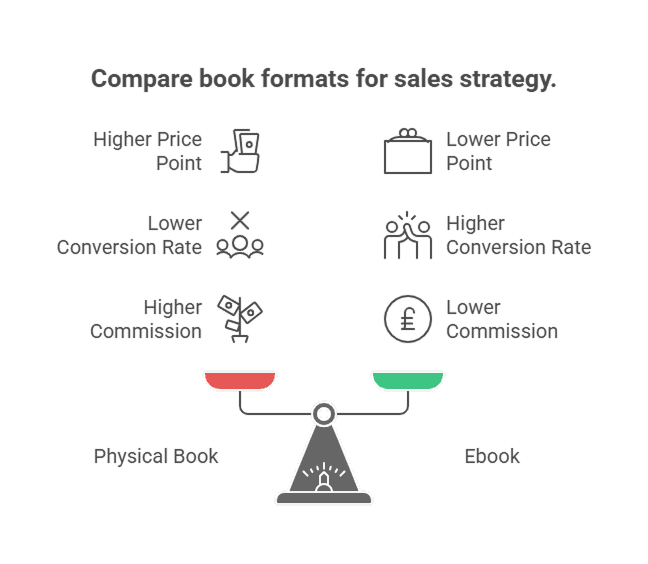
Let’s break down the math of “Price Resistance” (how hard it is to get someone to buy).
Scenario A (Physical Book): You promote a $50 hardcover. The user hesitates. They check Amazon. They check their bank account. You convert 1 out of 100 visitors.
Result: 1 Sale x $4.00 commission = $4.00 Total.
Scenario B (Ebook): You promote a $9.99 ebook. The user sees it as the price of a fancy coffee. They buy it immediately. You convert 5 out of 100 visitors.
Result: 5 Sales x $2.00 commission = $10.00 Total.
Most ebooks cost between $4.99 and $9.99. This is the “no-brainer” zone. While the commission per book is small, the number of sales is high.
It is far easier to convince ten people to spend $5 than to convince one person to spend $50.
Reader Behavior Patterns
The most underrated advantage of ebooks is the behavior of the readers themselves. Ebook buyers aren’t usually “one-and-done” shoppers. They are active consumers.
Data suggests the average ebook reader buys 15 to 20 titles per year.
Unlike a blender or a mattress, which a customer buys once every few years, book buyers are always on the lookout for their next read.
This behavior creates a snowball effect for you.
🤝 Trust: If you recommend a sci-fi ebook and the reader loves it, they trust your taste.
🔄 Returns: When they finish that book in three days, they come back to your site for the next suggestion.
💰 Value: You aren’t just earning a single commission. You are gaining a loyal follower who might buy 10+ books through your links over the next year.
Consider the Romance genre. Readers here often finish a book a week. Successful affiliates don’t just review one book; they create “curated lists” (e.g., Top 10 Summer Reads).
By tapping into this binge-reading habit, they earn recurring commissions from the same users week after week.
What Platforms Work Best for Promoting Ebooks?
Not all traffic sources are created equal. You might have 10,000 followers on Instagram, but if they aren’t clicking your links, you have an audience, not a business.
When choosing where to build your ebook affiliate empire, you face a trade-off: viral potential (social media) vs. income stability (search and email).
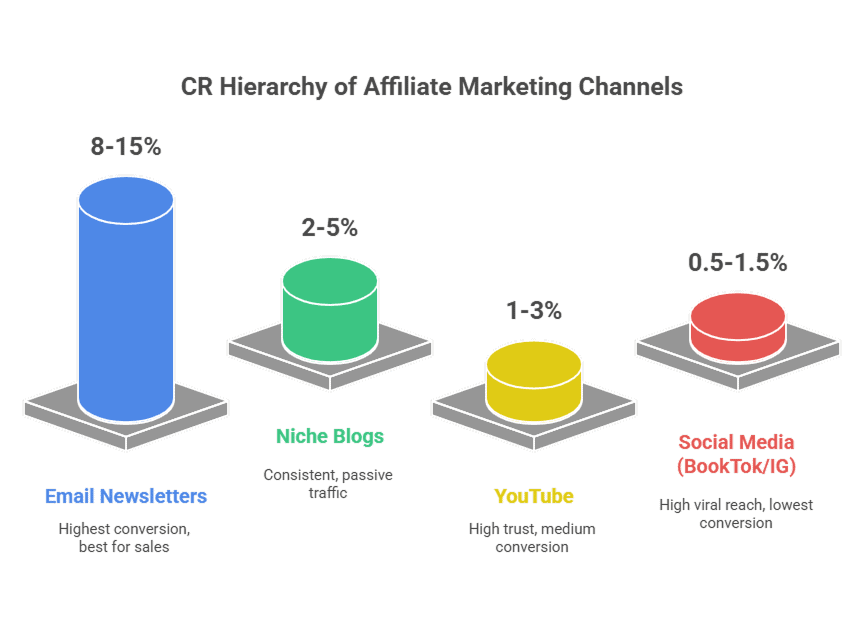
From my experience auditing affiliate portfolios, the hierarchy of profitability usually looks like this:
Email Newsletters: Highest conversion (8-15%), best for sales.
Niche Blogs: Best for consistent, passive traffic (2-5% conversion).
YouTube: High trust, medium conversion (1-3%).
Social Media (BookTok/IG): High viral reach, lowest conversion (0.5-1.5%).
Here is the breakdown of the top platforms and how to use them effectively.
Niche Blogs (Best for Long-Term Passive Income)
If your goal is to do the work once and get paid for years, a blog is your best bet.
Social media posts last about 24 hours. A blog post lasts forever. I still have reviews of business books written in 2020 that generate commissions every week in 2025.
WordPress blogs are cheap to start ($50-$150/year) but powerful.
SEO Authority: Google loves long-form content. A review of “Best Sci-Fi Books of the Year” attracts high-intent searchers—people actively looking for something to read right now.
The Math: Say you build a blog getting 500 visitors a day. That is 182,500 visitors a year. If you convert just 3% of them at a low $0.40 commission, that is $2,190/year in passive income. Scale that traffic, and it becomes a full-time income.
YouTube Book Channels (Best for Engagement and Trust)
Video reviews create trust that text can’t match. This is often called a “parasocial relationship”—viewers feel like they know you.
When a viewer sees your excitement and hears your voice, skepticism drops. If they watch 20 of your reviews, your recommendation becomes as trusted as advice from a friend.
Success here requires patience. You typically need 100-200 videos (12-24 months of work) to see traction.
But it pays off. Successful “BookTubers” often earn $1,000-$5,000 monthly by combining YouTube AdSense with affiliate commissions.
Email Newsletters (Best for Per-Follower Revenue)
If I had to start over with zero followers and could only choose one platform, I would choose email. Every time.
Email lists consistently outperform every other channel, with conversion rates of 8-15%.
No Algorithm: Your email lands directly in the inbox. You don’t fight for attention against dance videos.
Intent: Subscribers asked to hear from you. That makes them prime buyers.
Don’t overcomplicate this. Send one email a week.
Format: Story-based. Share what you are reading and why you loved it.
Tone: “I just found this,” not “Buy this now.”
Result: A small list of 1,000 engaged subscribers often generates more income than an Instagram account with 10,000 followers.
Pinterest (Best for Driving Blog Traffic)
Think of Pinterest not as a social network, but as a visual search engine. It is a secret weapon for book bloggers.
For many book blogs, Pinterest drives 30-50% of total traffic.
- How it Works: You create a vertical image (Pin) for your blog post (e.g., “7 Thrillers That Will Keep You Up All Night”).
- The Viral Lag: Pins often go viral months or years later. A Pin created in 2021 can still drive thousands of visitors in 2025.
Pro Tip: Do not use direct affiliate links on Pinterest; the platform often blocks them. Use the Pin to drive traffic to your blog post, where your affiliate links live.
BookTok & Bookstagram (Best for Brand Building)
TikTok (BookTok) and Instagram (Bookstagram) are great for growing an audience quickly. But they are hard to monetize directly.
The “Link in Bio” Problem
These platforms have high friction.
On Instagram, you can’t put links in captions. On TikTok, you can’t put them anywhere except your profile.
This forces users to leave the app and hunt for the link—a process that kills conversion rates (typically 0.5-1.5%).
Best Use Case
Use these platforms for Discovery, not Sales.
- Create short, viral content to attract attention.
- Direct that attention to your Email List or Blog.
- Monetize them there, where you have control.
Multi-Platform Strategy
The most successful affiliates don’t rely on just one platform; they build an ecosystem where each part works together.
A common and highly effective structure uses a blog as the “Home Base,” the central hub where all your deep, authoritative reviews live.
This is supported by a “Traffic Driver,” like Pinterest or YouTube, which acts as a discovery engine to constantly push new people to your blog.
The final piece is the “Monetization Engine,” an email list that captures those visitors and turns them into loyal, repeat buyers.
The key is to avoid launching all three at once.
Start by building your “Home Base.” Once you have 90 days of content, add a traffic driver.
Once you have traffic, add the email list. Layering them over six to twelve months is the secret to building a sustainable business without burning out.
How Do You Create Content That Converts Ebook Sales?
Most affiliates write reviews that sound like high school book reports: “This book is about X. It has 12 chapters. I liked it.”
That approach gets you a passing grade in school, but zero sales in the real world.
To make money, you must shift from “reporting” to “copywriting.” Content that converts doesn’t just summarize; it targets a specific problem, agitates the pain, and presents the book as the solution.
Here is the five-step framework I use to turn casual readers into buyers.
Lead with Personal Experience and Opinion
Readers don’t care about the plot summary—they can get that from Amazon. They care about your reaction.
Authenticity Beats Perfection
Reviews with a personal opening convert 40-60% better than generic ones. Enthusiasm is contagious.
Weak Opening: “Atomic Habits is a book about building good habits.” (Boring. Generic.)
Strong Opening: “I picked up this book expecting another dry lecture. Instead, the chapter on ‘identity-based habits’ changed my morning routine. I’ve read 30 self-help books this year; this is the only one I’m keeping.”
Don’t be afraid to share a struggle. Saying “This book frustrated me for 50 pages before winning me over” builds trust. It proves you actually read it.
Target Buyer-Intent Keywords
If you want sales, catch people when they have their wallets out. Target “Commercial” keywords, not just “Informational” ones.
A search for “how to build habits” is looking for free advice. A search for “Atomic Habits review” is looking for a reason to buy.
“Best [Genre] Books”: Converts at 2-4%. (e.g., “Best Sci-Fi Books of 2024”)
“[Book A] vs [Book B]”: Converts at 4-6%. (e.g., “Kindle vs Kobo”)
“Is [Book] Worth Reading?”: Converts at 5-8%. This is the highest intent; they want one final nudge.
Include Specific Reader Avatars
When you try to sell to everyone, you sell to no one. Generic praise like “Great for anyone!” is ignored.
The “Mirror” Technique You want the reader to see themselves in your description.
❌ Instead of: “This book is great for parents.”
✅️ Try: “If you are a new parent struggling to find 5 minutes of quiet time, this book’s ‘micro-habit’ framework was made for you.”
Call out specific pain points or career stages. When a reader feels understood, the sale is halfway made.
Strategic Affiliate Link Placement
I’ve seen great 2,000-word reviews fail to make a sale because the link was buried at the bottom.
For a standard blog post, use this pattern:
The “Early Bird” Link 1️⃣: Put your first link in the introduction (first 100 words). Some readers are already sold. Don’t make them scroll.
The Contextual Link 2️⃣: Place 1-2 links naturally in the body, usually when mentioning a specific benefit.
The “Last Call” Link 3️⃣: Place a clear, bold Call to Action (CTA) right before your conclusion.
Don’t hide your links. Make them stand out.
Bad: “Click here to buy.”
-> Good: “Check the current price of [Book Title] on Amazon.”
Create Urgency Without Being Pushy
You can’t use fake scarcity with ebooks—they never run out of stock. So how do you drive action?
Use Emotional Urgency.
Give the reader a genuine reason to act today.
Seasonal Relevance: “Reading this before Q4 planning season helped me implement these frameworks immediately.”
Price Logic: “This book is currently $2.99. Even if you don’t read it until next month, grabbing it at this price is a no-brainer.”
Problem-Solution: “If you are feeling stuck in your job, Chapter 3 gives you a script to use this week.”
Avoid manufactured hype like “Buy now or regret it!” It destroys trust. Focus on the benefit of solving their problem sooner.
How Do You Scale Your Ebook Affiliate Income?
Going from $0 to $100 a month proves your concept works. Going from $100 to $1,000+ requires a shift in how you operate.
You cannot scale by simply “working harder.” You are already writing as fast as you can. To break the income ceiling, you need leverage.
Scaling is about identifying what works and multiplying it, while removing yourself from repetitive tasks. It is the difference between being a “blogger” and being a “media company CEO.”
Here are the six leverage points I use to grow affiliate sites from hobby income to full-time revenue.
Double Down on Top-Performing Keywords
Your analytics dashboard is hiding a secret: The 80/20 Rule applies aggressively to affiliate sites. Usually, 10-20% of your posts generate 80% of your revenue.
The “Signal” Strategy If your post on “Best Personal Finance Books” earned $150 last month while your other 20 posts earned $5 each, that is a scream, not a whisper.
🔴Don’t: Write a random review of a sci-fi novel because you feel like it.
🟢Do: Create 10 variations of the winner. Write “Best Investing Books,” “Best Budgeting Books,” and “Best Retirement Planning Books.”
You are taking a proven winner and cloning it.
One successful article template can spawn 20-30 derivative posts.
If each earns just $50 a month, you have added $1,000-$1,500/month to your income without guessing.
Aggressive Email List Growth
Most affiliates have small lists because they rely on “passive” sign-ups. To scale, you must get aggressive.
Moving from 500 to 2,500 subscribers (5x growth) typically increases income by 7-10x.
Why? Because a larger list allows for segmentation.
You can send a “Sci-Fi” offer to one group and a “Biography” offer to another, doubling your promotions.
The “Mega-Magnet”: Create a PDF guide like “The Ultimate Investor’s Reading List” with 100+ book summaries.
Paid Acquisition: It sounds scary, but a modest $100-$300 monthly budget on Facebook Ads can add 500-1,500 subscribers.
If each subscriber is worth $1/month to you, the ROI is massive.
Hire Writers to Scale Content Production
You are the bottleneck. Most solo creators max out at 2-3 quality posts per week.
If you want a full-time income, you need help.
Many affiliates are afraid to spend money. But look at the math:
✂️Cost: You pay a niche writer $100 for a great article.
💲Return: That article earns an average of $30/month.
💹Lifetime Value: Over 24 months, that article earns $720.
You spent $100 to make $720. That is a 7:1 return. Once you see content as an investment, scaling becomes a simple math problem: “How many articles can I afford to buy this month?”
Multi-Program Diversification
Relying 100% on Amazon is dangerous. They can slash commissions or ban accounts with zero notice. Plus, you are leaving money on the table.
Here is the comparison table you need:
| Platform/Network | Best Use Case | Commission Rate | Key Benefit |
| Amazon Associates | Mainstream, high-volume traffic | Low (4%) | The highest conversion rate; almost everyone has an account. |
| ClickBank | Your warm email list | Very High (50-75%) | Best for promoting digital products like courses or book bundles. |
| BookShop.org | “Conscious consumer” or ethical angles | Good (10%) | Supports local, independent bookstores, which is a strong selling point. |
| Direct Partnerships | Flagship author launches & promotions | High (30-50%) | The highest commission potential by working directly with authors. |
By offering the right link to the right user, the same traffic can generate 40-60% more revenue.
Content Repurposing for Reach Multiplication
If you have written 50 blog posts, you have scripts for 50 YouTube videos, 50 podcasts, and 200 tweets.
Stop creating from scratch. Repurpose.
Blog Post (Source): Write your comprehensive review.
YouTube Video: Read the key points to the camera. (Time: 2 hours).
Instagram/Pinterest: Extract 5 quotes and put them on simple graphics. (Time: 15 mins).
Twitter Thread: Summarize the “Top 5 Takeaways.” (Time: 10 mins).
You get 4x the content for only 1.25x the effort.
Systems and Automation
You cannot scale if you are reinventing the wheel every Monday. You need systems.
Templates: Have a standard “Book Review” outline so you just fill in the blanks.
Spreadsheets: Use a simple link tracker. If you don’t measure it, you can’t improve it.
Asset Libraries: Create a folder of templates so you never start a design from a blank page.
Conclusion
You now have a complete roadmap for building a successful affiliate program: from choosing the right platform and setting competitive rates to recruiting quality partners and keeping them motivated.
The key is creating mutually beneficial partnerships. When you offer fair compensation, provide proper support, and work with affiliates whose audiences align with your e-books, you build a sustainable sales channel that grows over time.
Start with your core offer, take it step by step, and remember that every successful program began exactly where you are now.

Ellie Tran, a seasoned SEO content writer with three years of experience in the eCommerce world. Being a part of the UpPromote team, Ellie wants to assist Shopify merchants in achieving success through useful content & actionable insights. Ellie's commitment to learning never stops; she's always eager to gain more knowledge about SEO and content marketing to create valuable content for users. When she's not working on content, Ellie enjoys baking and exploring new places.