

A book is more likely to sell when it’s recommended by someone influential. According to a Nielsen survey, 88% of customers most trust recommendations from people they know.
We’ve scoured the web to gather the 25 best book affiliate programs. So, you can promote your favorite reads while earning extra cash. Along the way, we’ll also note some points to consider before paying affiliates.
Quick Comparison
| Program Name | Commission (%) | Cookie Duration (Days) | Niche Suitable For |
|---|---|---|---|
| Amazon Associates | 4.5% | 1 day (24h) | General books, physical books, mass-market |
| BiggerBooks | 5% | 30 days | Textbooks, student books, discount books |
| VitalSource | 3% | 30 days | eTextbooks, digital course materials, academic |
| Bookshop.org | 10% | Not stated | Indie bookstores, physical books, ethical readers |
| Books-A-Million | 5% | 30 days | General books, gifts, toys, collectibles |
| TextbookX | 5% | 30 days | Cheap textbooks, used textbooks, student niche |
| Chirp Books | Up to 20% | 7 days | Audiobooks, fiction, romance, lifestyle |
| TAN Books | 10% | 45 days | Catholic books, religious niche |
| eCampus | 5–8% | 30 days | New/used/rental textbooks, academic |
| Waterstones | 1–4% | 14 days | UK readers, fiction, premium books |
Affiliate Earnings Calculator
Estimate your affiliate income based on Traffic, CTR, AOV, and Commission rate. Drag the sliders below to explore different scenarios.
Estimated Results
These figures are for illustrative purposes – feel free to adjust them to fit your specific niche.
- Conversion Rate here is defined as the percentage of traffic that buys.
- Does not account for refunds, cancellations, or varying commission rates by product.
Top 25 Best Affiliate Programs for Book Bloggers of 2026
Amazon Associates
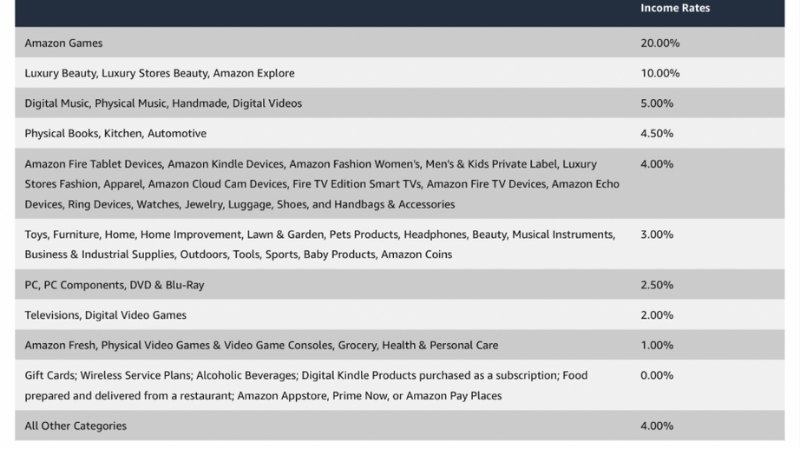
Amazon Associates is among the largest affiliate marketing programs for books in the world. They offer millions of products and programs and provide customers with a variety of genres, topics, and editions.
Amazon commission for physical books is 4.5%. The cookie duration only lasts 24 hours from the first click.
To receive a commission, you must earn at least $10 in cheque or $100 for Amazon Gift Certificate and bank transfer.
|
Bigger books
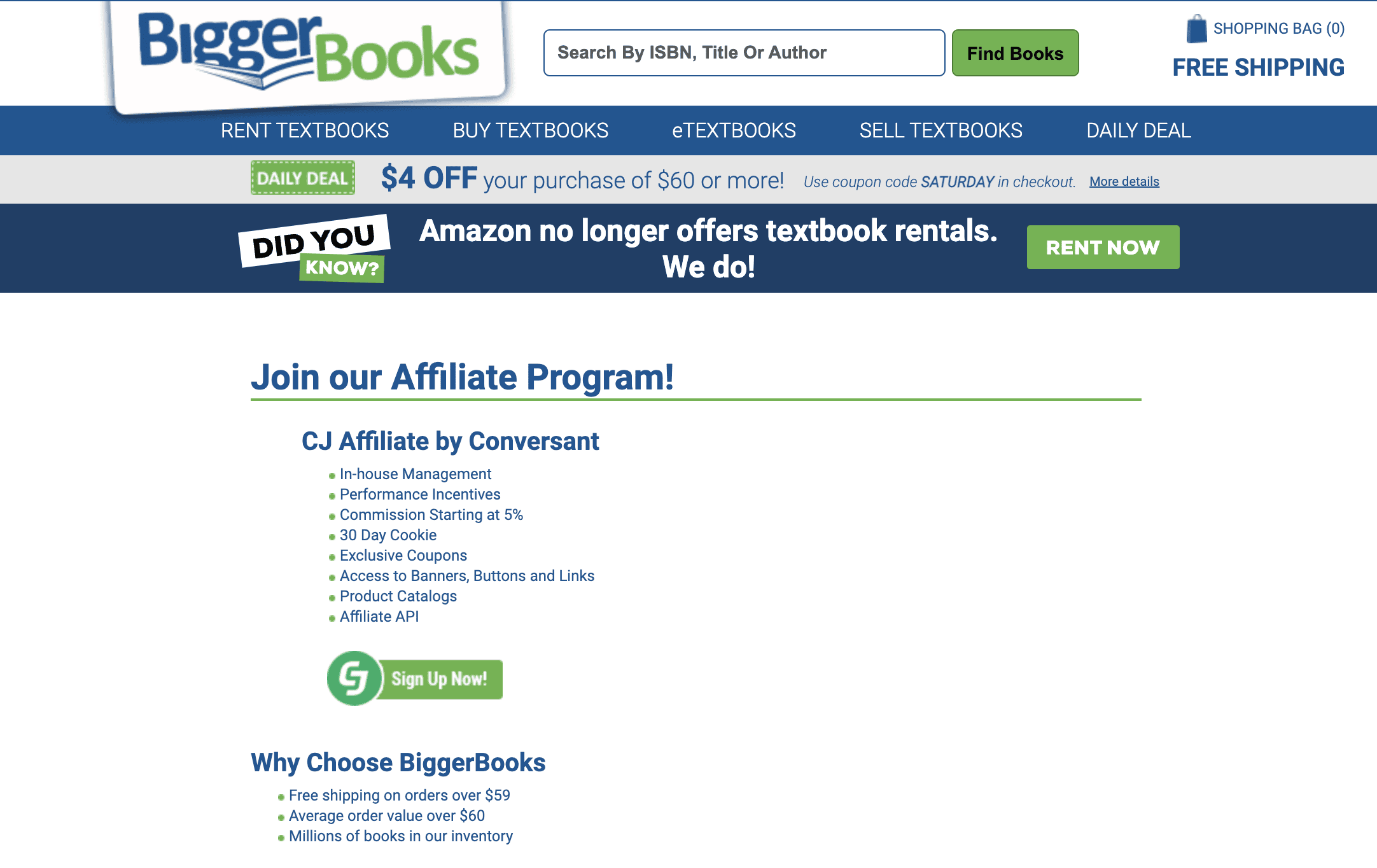
BiggerBooks is one of the fastest-growing textbook affiliate programs in the industry. With its exclusive technology, it offers a wide range of deals on books, with up to 91% savings.
This affiliate marketing program for books is powered by CJ Affiliate. The brand offers commission rates starting at 5% and a 30-day cookie duration from the first click. Moreover, the average order value is up to $60 with free shipping.
When you sign up for their affiliate program, you will receive exclusive coupons, access to banners, buttons, links, and their product catalog to promote your affiliate link.
|
Vital Source
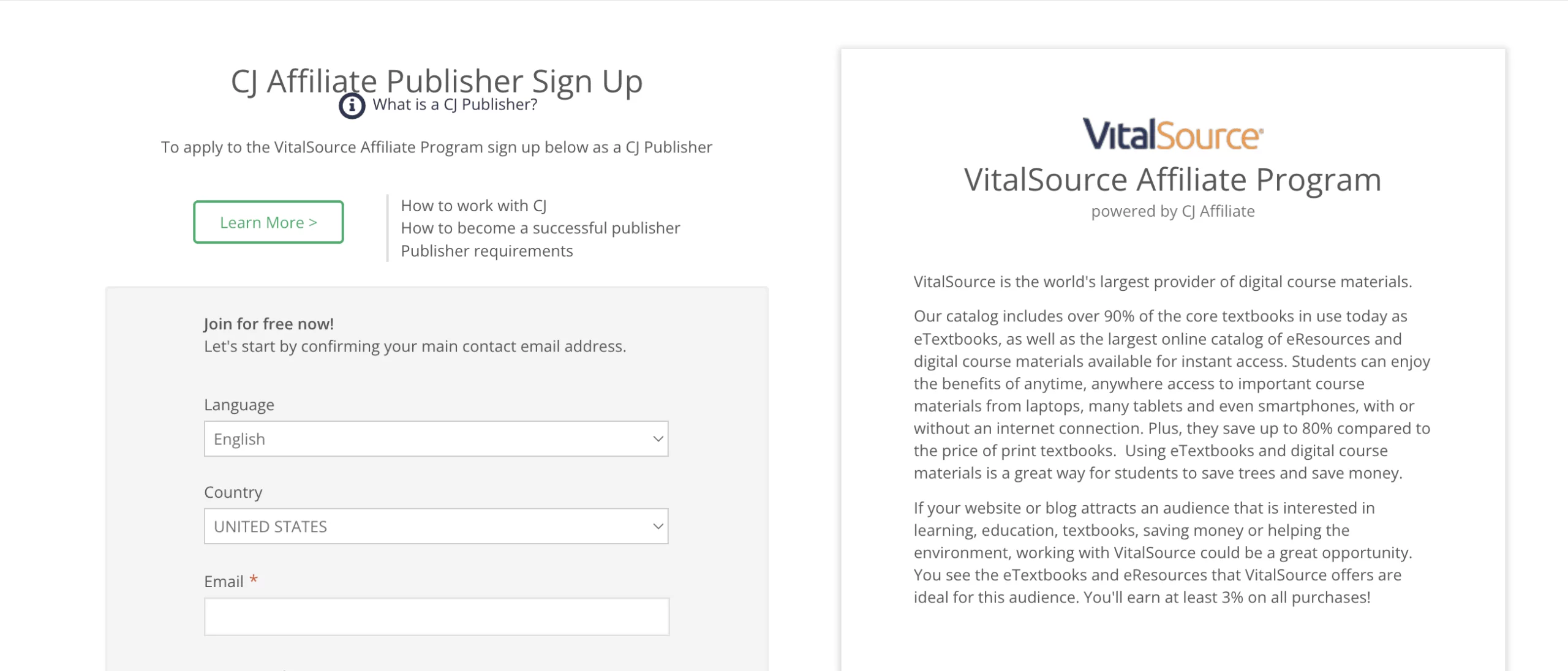
Vital Source is one of the largest providers of digital course materials in the world. They carry over 90% of all textbooks in use today, including eTextbooks, eResources, and digital course materials.
Their affiliate program is managed by CJ Affiliate and offers multiple benefits for affiliates. They give out a commission rate of at least 3% and a 30-day cookie period for promoting through affiliate links.
As part of their affiliate program for books, you will receive a wide range of promotional tools and offers, such as coupons, banners, and links. They also provide a product catalog and campaign with size requirements for their partners.
|
Bookshop
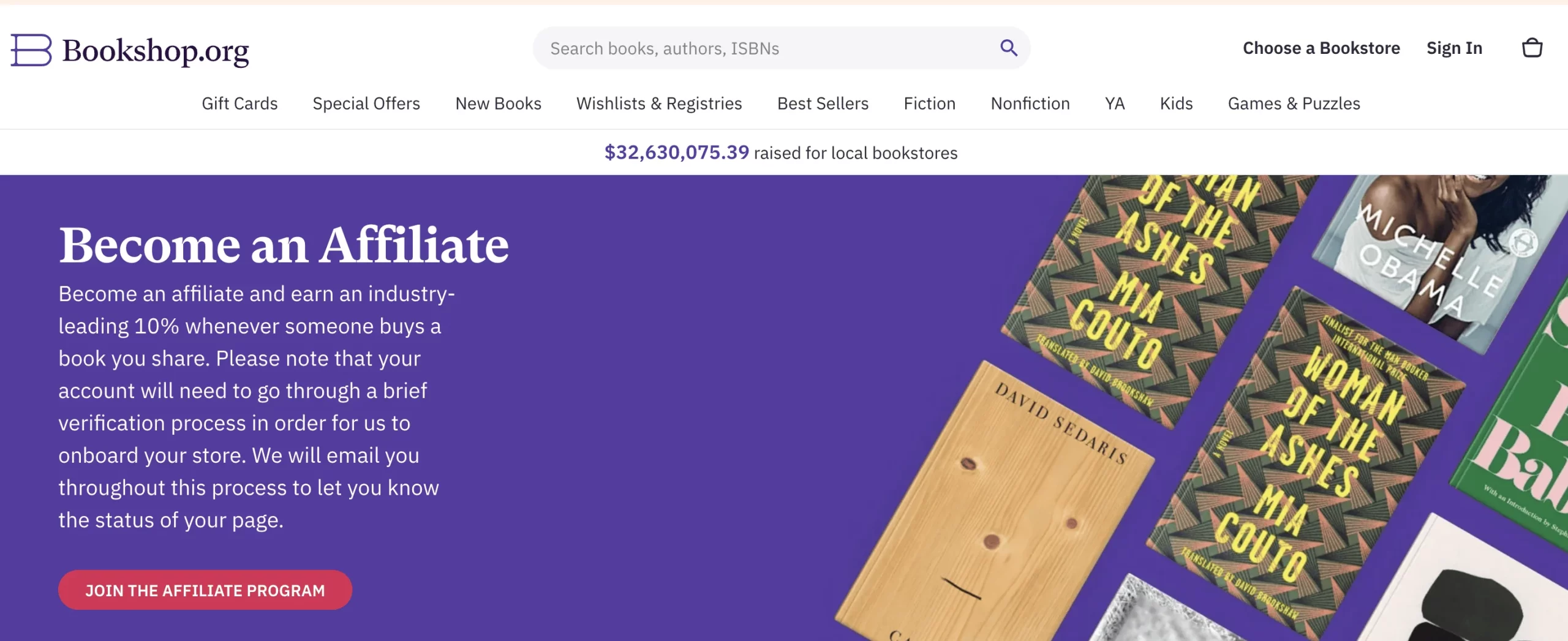
Bookshop connects readers with independent booksellers worldwide. In the past four years, it has raised more than $32 million for independent bookstores.
The bookshop affiliate program offers a 10% commission rate for their partners. Bookshop pays a transaction fee on all cashouts for affiliates. They use one of the highest grades of payment processing security – Stripe, with a payment threshold of $20.
|
Books-A-Million
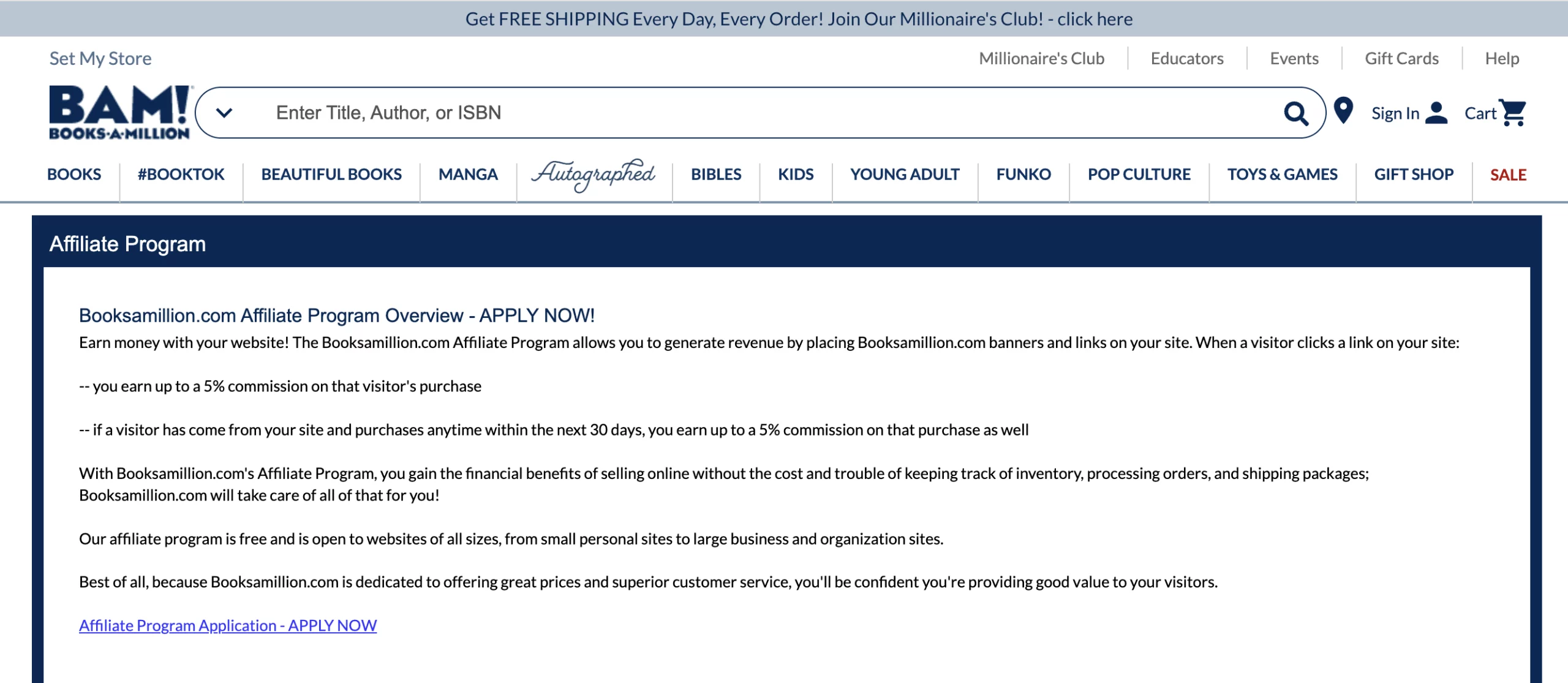
Books-A-Million has been in business for more than 100 years and is the second-leading bookstore in the US. With more than 200 stores in 32 states, they offer thousands of books, toys, games, collectibles, and more.
Commission Junction manages the Books-A-Million affiliate program. This program’s commission rate is 5%, and the cookie duration is 30 days.
Books-A-Million’s marketing team helps affiliates sell books by providing banners, links, and marketing tips. The payment threshold depends on each method. The minimum for direct deposit is $50, and for paper checks is $100.
|
TextbookX
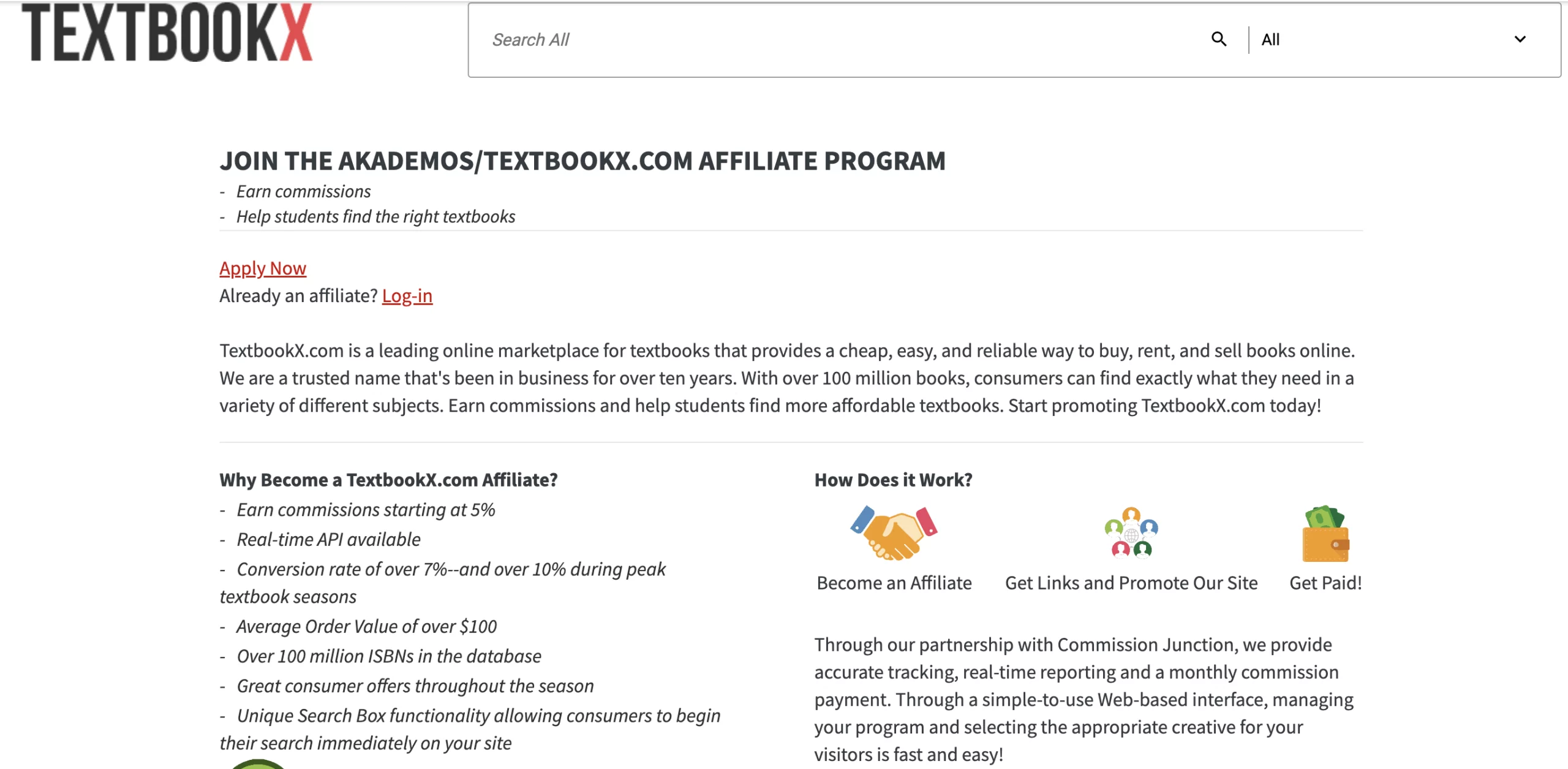
TextbookX is among the top online e-commerce sites for cheap textbooks. They offer more than 100 million books in different categories for every consumer.
The book affiliate program offers a 5% commission rate with various benefits. The conversion rate can be up to 7% and 10% during peak seasons. The average order value is over $100, which means you can earn at least $5 per sale.
To help their affiliate partners, Textbook X provides monthly newsletters with tips, special offers, unique banners, and text links.
|
Chirp Books
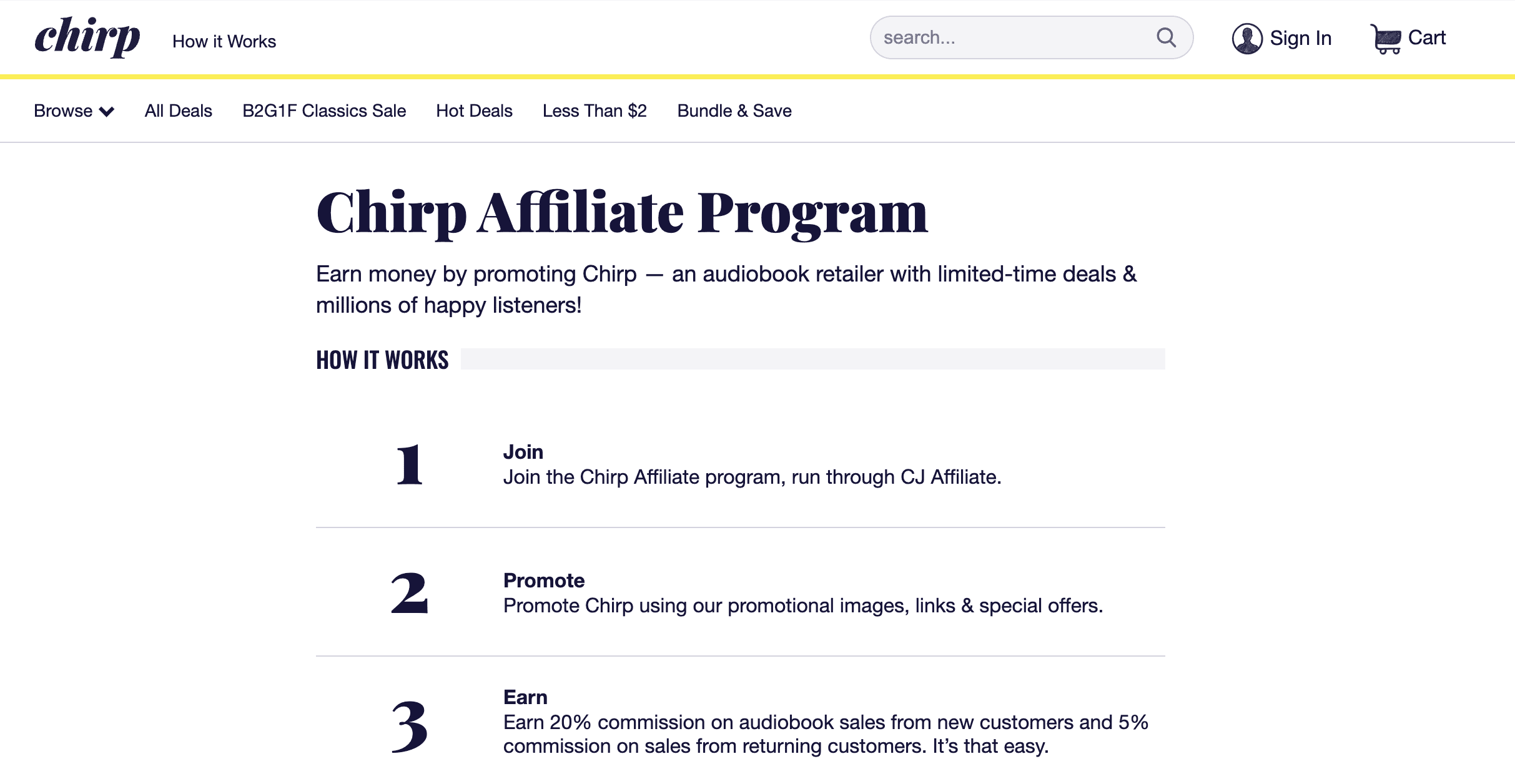
Chirp is a well-known audiobook retailer with millions of listeners. They run hundreds of limited-time books of various types, including romance, fiction, and more.
The Chirp affiliate program is run through CJ Affiliate. Commissions are up to 20% and 5% for returning customers. The cookie duration is only 7 days; however, Chirp offers various promotional materials to their partners.
Chirp’s affiliate partners will receive affiliate newsletters and coupons annually. The brand also gives out product feeds daily with banners and text links.
|
TAN Books
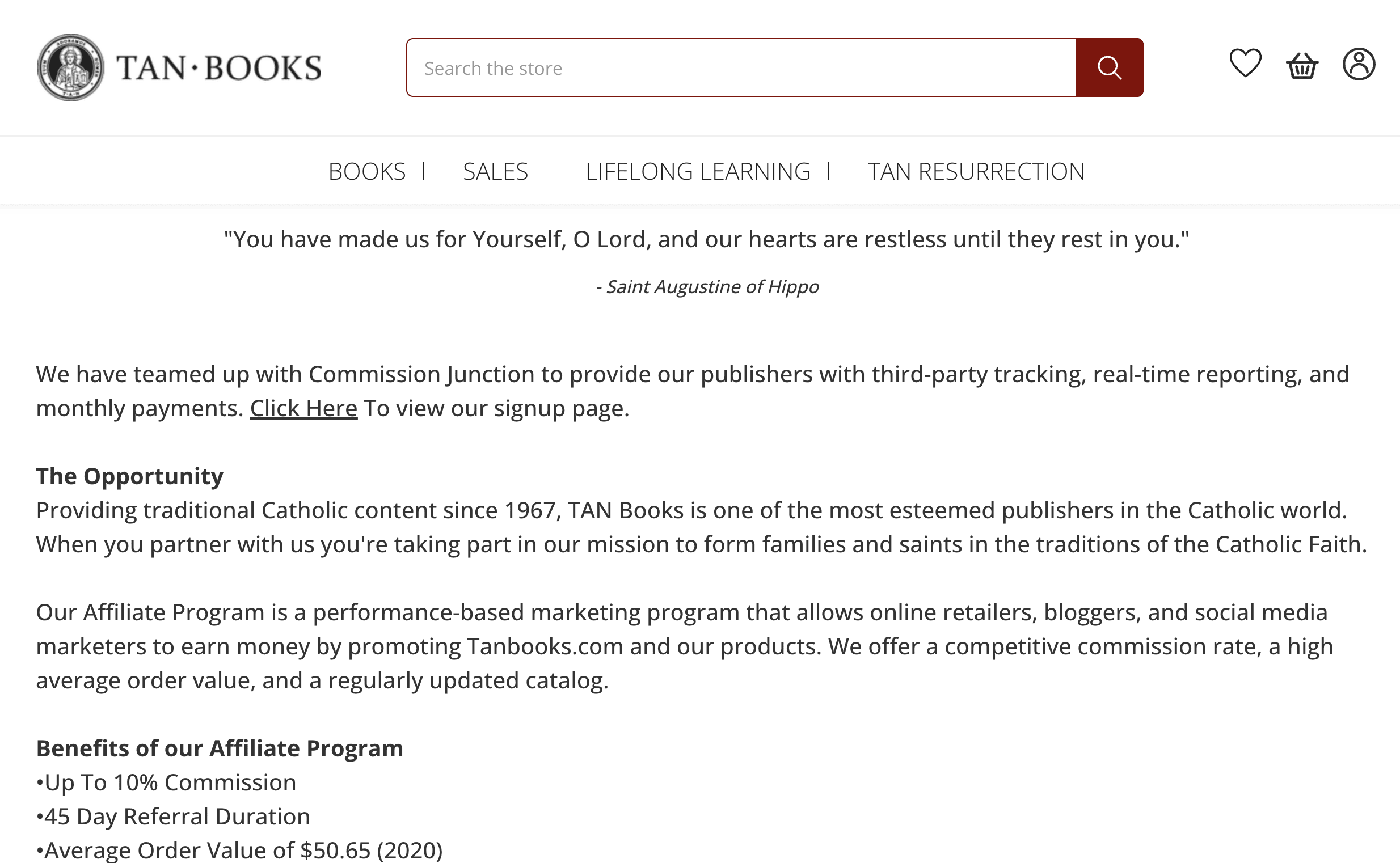
TAN Books is one of the most trusted publishers in the Catholic world. Their goal is to help people become saints through reading books.
Powered by CJ Affiliate, the Tan Books affiliate program offers a 10% commission rate and a 45-day cookie duration. Tan Books has a high average order value of $50.65 and provides a 6.4% conversion rate since 2020.
TAN Books provides their partners with a regularly updated catalog and a fully dedicated support team to help increase sales.
|
eCampus.com
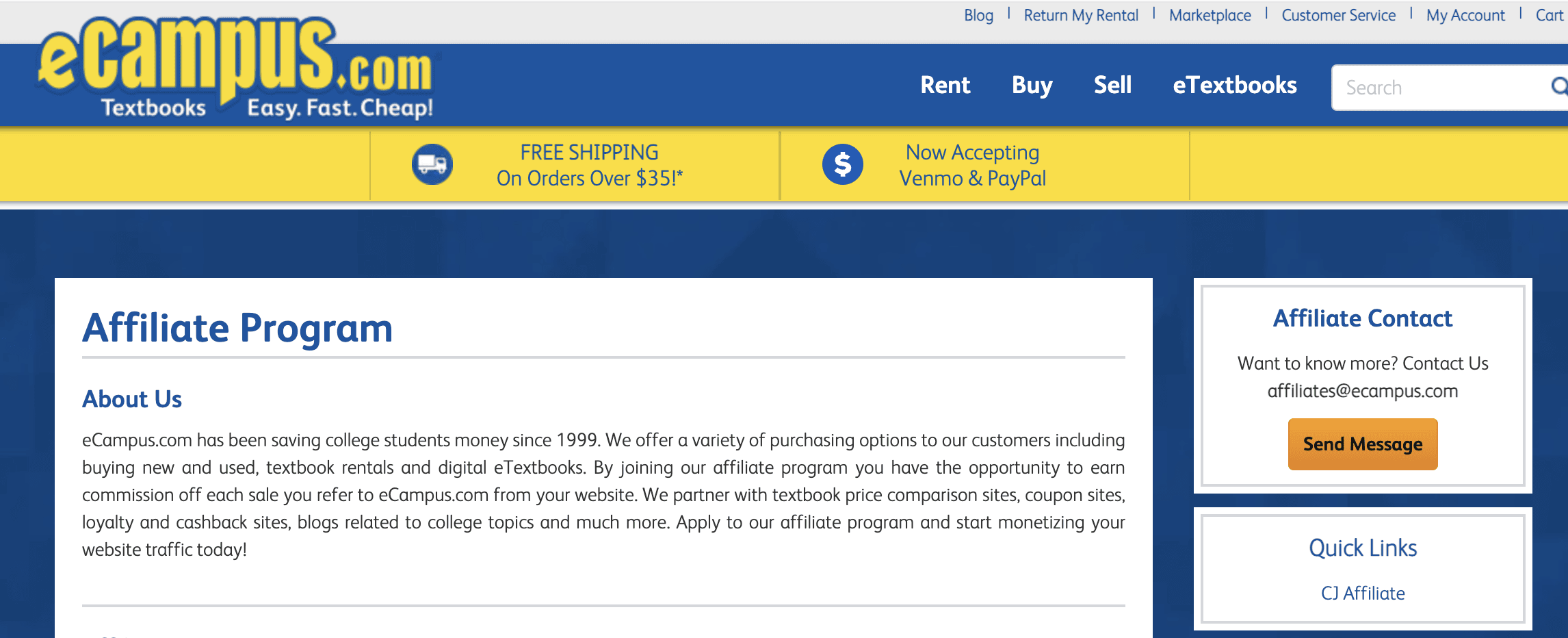
eCampus is considered as a friend of college students in buying and renting textbooks and eTextbooks. They serve as the official bookstore for over 150 schools nationwide and continue to grow.
The commission rate of their affiliate program is different for each type of book:
- 5% for New Books & eTextbooks
- 6% for Used Books
- 8% for Rentals
Moreover, for buybacks, you can receive $3 per sale. eCampus’s cookie duration is 30 days. They also provide in-house management, coupon codes, banners, links, and a product catalog for their partners.
|
Waterstones
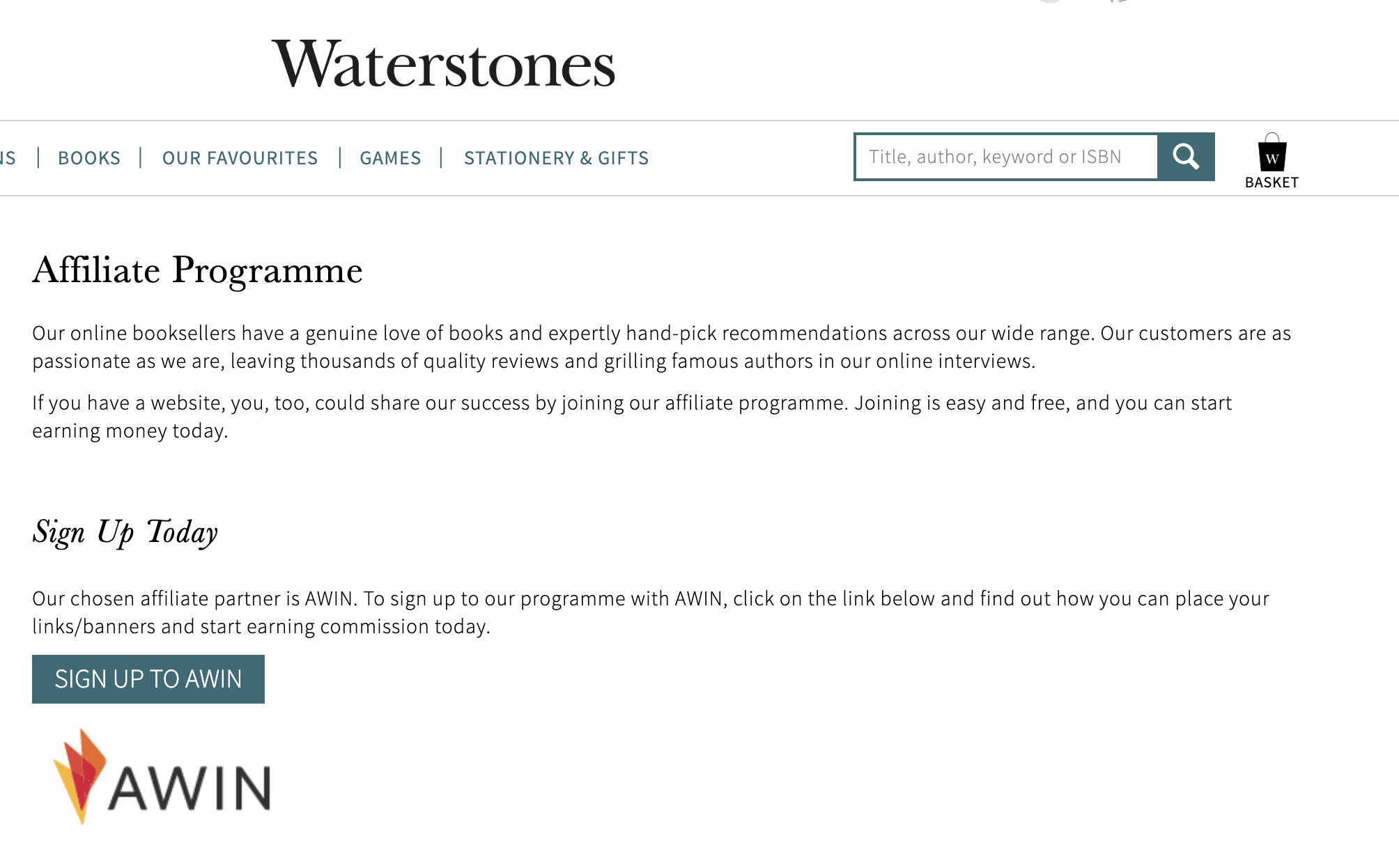
Waterstones is a leading book specialist in the UK with competitive prices. They provide shipping for any Waterstones shop order over £25 in the UK.
The commission rate is 1% for existing customers and up to 4% for new customers. The cookie duration is 14 days, and commission processing takes 28 days.
When signing up for the Waterstones book affiliate program, you can have attractive bespoke graphics and updated feeds. Waterstones also offers regular bonuses and seasonal promotions to their partners.
|
Eagle Saver
- Commission rate: 10%
- Cookie duration: Not mentioned
Eagle Saver is an online buyback merchant with the highest trust pilot rating in the industry. It offers payback for books, textbooks, Blu-rays, DVDs, audio CDs, and video games.
Second Sale
- Commission rate: 6%
- Cookie duration: Not mentioned
Second Sale is a big provider, selling more than 10 million book titles every year. The prices here are cheaper, starting at $3.78.
eBooks.com
- Commission rate: Up to 15%
- Cookie duration: 45 days
eBooks.com is a leading global bookstore with thousands of book categories. This site offers marketing and eBook fulfillment services to book publishers worldwide.
Calendar Club
- Commission rate: 10%
- Cookie duration: 30 days
Calendar Club is the UK’s biggest provider of high-quality calendars. They offer more than 6,500 products, including calendars, diaries, gifts, and more.
Bookroo
- Commission rate: 10%
- Cookie duration: 30 days
Bookroo provides monthly book subscription box services for kids ages 0 to 10. This website is targeted at moms and babies to help them develop a love for books.
AbeBooks
- Commission rate: 5%
- Cookie duration: 30 days
AbeBooks offers a wide range of products, such as books, fine art, and collectibles. Here, you can find new, used, and rare books at affordable prices.
Kobo
- Commission rate: 5-10%
- Cookie duration: 14 days
Kobo offers one of the highest-paying affiliate programs in the book industry. Their program varies, including social influencers, authors, publishers, and bloggers, as well as cashback, shopping, and coupon websites.
Biblio
- Commission rate: 5%
- Cookie duration: Not mentioned
Biblio is the largest independent marketplace for quality used, rare, and out-of-print books. Biblio has provided more than 100 million books in various categories.
Indigo Books and Music
- Commission rate: 2-5%
- Cookie duration: 7 days
Indigo Books and Music is a site where adult women and children under 10 can find books. They also offer online books, toys, gifts, and more.
Willmaker – Nolo
- Commission rate: 25-35%
- Cookie duration: 90 days
Nolo is a provider of law books all over the world. You can find any law-related books and documentaries here.
Discounted Newspapers
- Commission rate: 20%
- Cookie duration: 15 days
Discounted Newspapers offers the best deals on newspapers at a lower price. They carry any title of newspaper, including nationwide and local newspapers.
Ignatius Press
- Commission rate: 10%
- Cookie duration: 45 days
Ignatius Press affiliate program provides chances to promote Catholic books, music, movies, and more. They specialized in publishing Catholic products at a fair price.
Magazine.co.uk
- Commission rate: £4
- Cookie duration: 30 days
Magazine.co.uk is a leading independent magazine subscription website in the UK with over 3 million visitors. They offer customers exclusive offers for hundreds of different magazines and newspapers.
DiscountMags
- Commission rate: 18%
- Cookie duration: 60 days
DiscountMags offers popular magazines at the lowest price. They provide more than 6,000 magazines, free shipping, and tax-free shopping for their customers.
Spring Nature
- Commission rate: 30%
- Cookie duration: 30 days
Spring Nature is a major e-commerce book platform with more than 2,900 journals and 300,000 books for authors and readers. They lead the market in providing documents to academia, scientific institutions, and corporate R&D departments.
How Do Book Affiliate Program Commission Structures Actually Work?
Percentage-Based Commissions: The Standard Model
If you’re new to affiliate marketing, this is the model you’ll likely see first.
The percentage-based model is the standard for physical books and works exactly how it sounds: you earn a specific percentage of the product’s sale price.
But there is a critical detail that often trips up beginners: commissions are calculated on the price the customer pays, not the book’s list price.
Here is the math in action: Let’s say you link to a hardcover bestseller with a list price of $30.00.
Scenario A: The retailer sells it at full price. At a 5% commission rate, you earn $1.50.
Scenario B: The retailer discounts the book to $18.00. Your 5% commission applies to that $18.00, earning you just $0.90.
You must also read the fine print regarding formats. Retailers often assign different rates to different formats within the same program. For instance, a program might offer:
- 4.5% on Physical Books
- 0% on Digital/Ebooks (common in closed ecosystems like Kindle)
- 10% on exclusive Print-on-Demand titles
Strategic Takeaway: Because the percentage is fixed, the price is the only variable you can control. This model rewards affiliates who promote expensive items like textbooks, collector’s box sets, or limited editions.
Flat-Rate Bounties: Fixed Payments for Specific Actions
Percentage commissions rely on the value of the cart.
Flat-rate bounties (often called CPA or “Cost Per Action”) rely on a specific behavior. In the book world, this usually means driving a new subscription signup or a free trial.
Audible’s affiliate program is the best example of this model. They don’t just pay you when someone buys an audiobook. They pay you a “bounty” of $5 to $15 just for getting a user to sign up for a free trial.
It doesn’t matter if that user downloads a $50 language course or a $10 memoir. The bounty is fixed.
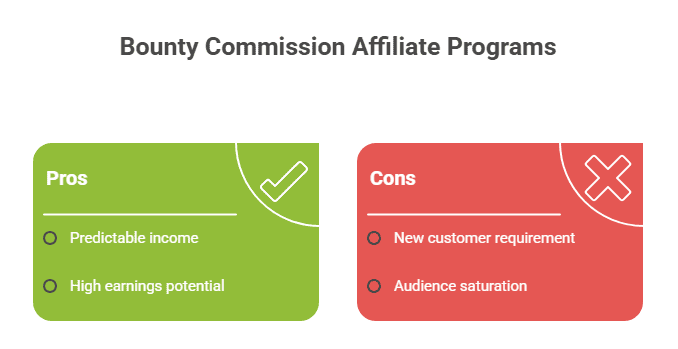
To decide if you should prioritize bounty programs, let’s weigh these pros and cons:
The Pro (Predictability): You know exactly what you will earn per signup. High bounties can quickly earn you more than percentage commissions on cheap books.
The Con (The “New Customer” Wall): Most bounty programs only pay for new customers. If your audience is already subscribed to the service, you earn $0.
Tiered Commission Structures: Earn More as You Sell More
Think of tiered commissions as “gamified” earnings. The program will reward you based on your performance.
The more you sell within a specific period (usually 30 days), the higher your commission percentage climbs.
How a tiered structure typically looks:
| Monthly Sales Volume (Units) | Commission Rate |
| 0 – 50 | 5% |
| 51 – 100 | 6% |
| 101+ | 7% |
The concept is simple: Instead of promoting many different companies a little bit, promote one company a lot.
Here is a comparison to help you understand:
❌ The Wrong Way (Spreading Out)
Imagine you have 120 customers who want to buy a book. You send them to three different bookshops:
- You send 40 people to Shop A.
- You send 40 people to Shop B.
- You send 40 people to Shop C.
The Result: Because you sold less than 50 books at each shop, you are stuck in the bottom tier. You only earn 5% commission from everyone.
✅ The Right Way (Focusing)
You take those same 120 customers, but you send them all to Shop A.
The Result:
- You have now reached 120 sales at Shop A.
- You move into the top tier (100+ sales).
- Instead of 5%, Shop A now pays you 7% commission on every book.
The Bottom Line: You sold the exact same number of books (120). However, by giving all the sales to one partner, you unlocked a bonus commission rate and made significantly more money.
How to Choose the Right Book Affiliate Programs for Your Platform
Analyze Your Audience’s Reading Format Preferences
Before you sign up for a single program, you need to know how your audience actually consumes books.
Promoting a physical bookstore to an audience of die-hard audiobook listeners is the fastest way to kill your conversion rate.
So, how can you find out what they really want without guessing?
You can use these three simple methods to gather the data:
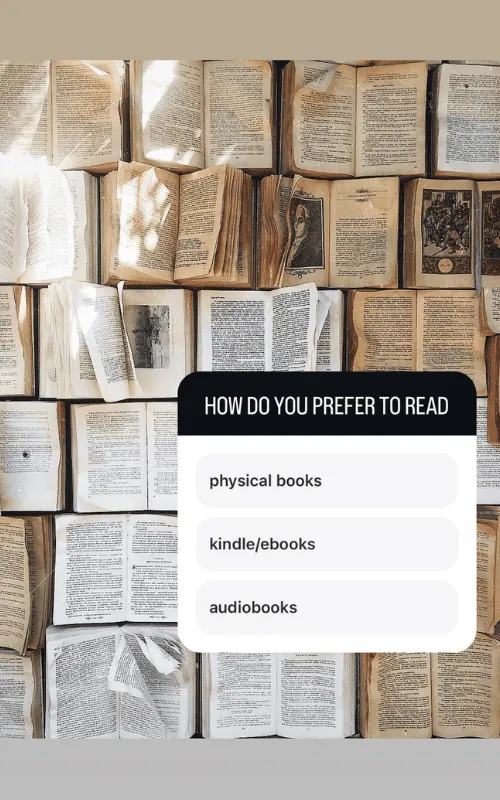
The “Instagram Poll” Method
The easiest way is to ask directly. Post a Story on Instagram with a poll asking: “How do you prefer to read?”
- A) Physical Books 📖
- B) Kindle / Ebooks 📱
- C) Audiobooks 🎧
The Comment Audit
Look at the comments on your last 5 book-related posts for clues about their habits:
- If they comment: “Just downloaded this!” → They likely prefer Ebooks.
- If they comment: “I need this for my shelf!” → They likely prefer Physical Books.
The Lifestyle Test
Look at who your followers are. Are they busy parents or professionals with long commutes?
For example, you may assume that busy people often prefer Audiobooks because they can multitask while listening.
Once you have collected this data and know what your audience prefers, simply match them to the right program using the list below:
| If your audience prefers | Prioritize these programs |
| Audiobooks | Audible, Libro.fm, Audiobooks.com |
| Ebooks | Amazon Kindle, Kobo, eBooks.com |
| Physical Books | Bookshop.org, Barnes & Noble, Blackwell’s |
| Used / Budget Books | ThriftBooks, AbeBooks, eBay Partner Network |
Identify Geographic Restrictions That Impact Your Reach
Nothing kills a commission faster than a “This item is not available in your country” error message.
One of the affiliates on the UpPromote Marketplace wrote a viral post linking exclusively to a US-based bookstore.
Later, he checked my analytics and realized 40% of his traffic came from the UK and Canada. None of those clicks resulted in sales because the retailer didn’t ship internationally.
So to help you avoid that mistake, you need to do some research beforehand.
Check Your Geo-Data: Open Google Analytics (or your platform’s insights) and look at “Audience > Geo > Location.” Note your top 3 countries.
Check Availability:
- US-Centric: Bookshop.org (US/UK specific), Barnes & Noble (mostly US).
- Global Friendly: Kobo (global), Blackwell’s (free international shipping), Amazon (universal, if you use OneLink).
Pro Tip: If you have a split audience (e.g., 50% US, 30% UK), do not just pick one. Use a localized link service (like “geni.us”) that automatically redirects US clicks to Amazon.com and UK clicks to Amazon.co.uk.
Match Program Inventory to Your Content Niche
Big retailers sell everything, but they often lack depth.
Niche retailers sell specific things, but they know them inside out. Your job is to match the inventory to your specific recommendations.
For instance, you can make a list of the last 10 books you recommended. Search for them on your potential affiliate partner’s site.
- Are they in stock?
- Is the price competitive?
- Do they have the specific edition you talked about?
If the big retailers pass this test, great.
However, if you find that they lack the specific books or specialized editions your audience needs, it is time to look for a specialized partner instead.
📚 Religious/Spiritual Content
A general retailer might carry the bestsellers, but a specialist like Christianbook.com will carry the study bibles and devotionals your audience actually wants.
📚 Academic/Textbooks
Amazon is good, but dedicated textbook rental programs like Chegg or eCampus often offer higher commissions and better rental options for students.
📚 Art/Photography
Specialists often prefer Blurb or specific museum shops. They carry high-quality, heavy art books that general warehouses might damage during shipping.
Evaluate Cookie Duration Against Your Traffic Patterns
Cookie duration is the window of time you get credit for a sale after a click. This isn’t just a technical detail. It dictates which content strategy works.
To choose the right cookie length, you must first identify which of the following two “traffic archetypes” matches your audience’s behavior.
The “Impulse” Buyer (Short Cookies are Fine)
Platform: TikTok, Instagram Stories, or “Deal of the Day” emails.
Behavior: These people see a recommendation, want it immediately, and buy it right away.
Best Fit: Since the purchase happens instantly, a short window doesn’t matter. Amazon Associates (24 hours) is perfect here.
The “Researcher” Buyer (Long Cookies are Necessary)
Platform: SEO blog posts, detailed book reviews, or “Best of” lists.
Behavior: These people take their time. They might read your review on Tuesday, think about it, discuss it with a friend, and finally buy the book on Saturday.
Best Fit: You need a longer window to catch these delayed sales. Programs like Bookshop.org (45 days) or Blackwell’s (30 days) are the best choice.
Calculate Realistic Earning Potential Per Program
Don’t just guess, do the math. Before committing to a program, you should run a simple simulation to see if it’s worth the setup time.
The Estimation Formula:
(Monthly Clicks) x (Conversion Rate) x (Average Commission $) = Estimated Monthly Earnings
Imagine you have a blog getting 2,000 visitors a month.
Scenario A (Amazon): You drive 100 clicks. Conversion is high (5%). You sell 5 books. Avg commission is low ($0.60).
=> Total: $3.00
Scenario B (Audible Bounty): You drive 100 clicks. Conversion is lower (2%) because it requires a signup. You get 2 signups. Bounty is high ($5.00).
=> Total: $10.00
Consider Your Platform’s Technical Capabilities and Link Management
Finally, you need to ensure the affiliate program actually fits into your technical setup. Even the best commission rates are useless if you can’t easily share the links with your audience.
To avoid technical headaches later, you’d better run a quick “Friction Audit” based on the primary platform you use:
Social Media (Instagram / TikTok) 📱
If you primarily use these mobile apps, remember that you cannot put clickable links in your captions.
- The Test: Does the affiliate program offer simple, clean links that look good in a LinkTree or bio tool?
- The Red Flag: Avoid programs that only give you complex, mile-long tracking URLs. They look messy and are hard to manage in a bio.
WordPress Blogs 💻
If you run a dedicated book blog, you likely use management tools like ThirstyAffiliates or Pretty Links to keep your site organized.
- The Test: Check the program’s Terms of Service. Can you use these tools?
- The Red Flag: Some programs have strict rules against “cloaking” or shortening links. If they ban these tools, managing your links manually will become a massive headache.
YouTube & Podcasts 🎙️
For audio and video formats, your audience often hears the link rather than clicking it immediately.
- The Test: Can you create a memorable, direct link?
- The Red Flag: A program that requires a Javascript widget to display the book cover is useless for a podcast. You need a simple text link that fits perfectly into your show notes.
9 Proven Strategies to Maximize Your Book Affiliate Earnings
Let’s see which strategies you can apply to your affiliate business.
Create Strategic “Recommendation Roundups” for High-Traffic Seasonal Moments
Most affiliates wait until December to post gift guides. That is a mistake.
The key to maximizing seasonal revenue is to publish 4-6 weeks before the peak. This catches the early search wave while competition is low.\
For instance, you can build “evergreen” listicles for recurring moments:
- Graduation: “10 Books Every College Grad Needs for the Real World”
- Summer: “The Ultimate Beach Reads List for [Current Year]”
- New Year: “Best Productivity Books to Crush Your Resolutions”
It’s also important to update these posts annually.
Do not create a new URL every year (e.g., /best-books-2023). Keep the URL generic (/best-books-summer) and just update the title and content.
That way, you can preserve your SEO authority and keep traffic flowing year after year.
Implement “Read Next” Recommendations to Increase Per-Transaction Value
The easiest customer to convert is the one who already trusts your taste. Do not let them leave your review after buying just one book.
At the end of every single book review, you can add a distinct section titled: “If You Loved This, Read These Next.”
Structure: Suggest 2-3 complementary titles.
The Hook: Explain the connection. “If you loved the magic system in Mistborn, you need to read The Lightbringer Series next.”
Why It Works: This leverages the “Shopping Cart Commission” model. Even if they don’t buy the second book immediately, they might add it to their cart. A $15 cart suddenly becomes a $45 cart, and you earn on the total.
Build a “Best Books” Resource Hub to Capture Evergreen Search Traffic
Standard blog feeds often feel messy. As you publish new articles, your best content eventually gets buried on page 10 where readers rarely go.
A “Resource Hub” solves that problem. The hub acts as a static, highly organized page serving as the “Wikipedia” for your specific niche, keeping top recommendations front and center.
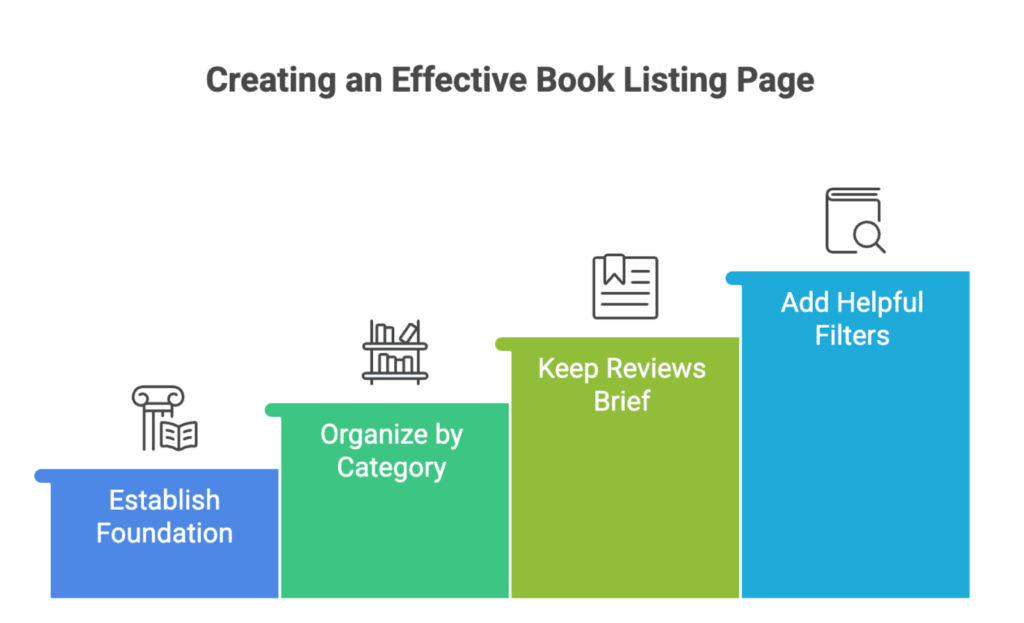
You can follow the blueprint below to build an effective Hub:
Step 1. Create the Foundation
Begin by establishing a single “Start Here” page. Focus on broad, high-volume search keywords for the title, such as “The Ultimate Guide to Sci-Fi Books” or “Essential Business Reading for 2024.”
Step 2. Organize by Category
Avoid listing books randomly. Instead, group them by sub-genre so readers can locate exactly what they need—for example, Space Opera, Cyberpunk, or Hard Sci-Fi.
Step 3. Keep it Brief
Resist the urge to write long reviews in this section. Stick to “Mini-Blurbs” consisting of only 2-3 sentences per book. Readers wanting more detail can simply click through to your full review.
Step 4. Add Helpful Filters
Improve user experience by grouping books based on difficulty or time commitment. Useful labels might include “Best for Beginners,” “Advanced Theory,” or “Quick Weekend Reads.”
Leverage Email Newsletters for Direct, High-Intent Traffic
Email subscribers act as your true VIPs.
Unlike casual visitors who stumble onto your site, these people actively requested to hear from you. Consequently, they tend to convert at a rate 3-5 times higher than your social media followers.
You can adopt the “Monthly Reading List” format to capitalize on this high level of trust.
Rather than spamming them daily, send a single, dedicated email once a month featuring a simple theme: “What I Read in [Month].”
You just need to pay attention to the things below:
- Limit choices: Feature 3-5 books max to avoid decision paralysis.
- Personalize the copy: Don’t paste the Amazon description. Write why you liked it. “I couldn’t put this down because…”
- Use Buttons: A clear “Get This Book” button performs better than a text link.
Pro Tip: If you have data on your subscribers (e.g., Fiction vs. Non-Fiction), segment your list. Sending a business biography recommendation to a subscriber who only clicks on romance novels is a wasted opportunity.
Optimize Product Link Placement for Maximum Click-Through
Where you put the link matters just as much as the link itself. Many beginners bury their affiliate links at the very bottom of a 2,000-word post. Most readers never get there.
That’s why you should use the Heat Map zones – the areas where readers naturally focus their attention.
- The Intro (The Skimmer’s Link): Place a text link in the first 300 words.
- The “Hero” Image: Make the book cover image a clickable affiliate link. This is the most common missed opportunity.
- The “Verdict” Box: If you write reviews, create a summary box at the end with a high-contrast button.
What to Avoid: “Link dumps” (a list of 20 links with no context) and hiding links in generic phrases like “click here.” Use descriptive anchor text: “Check price on Amazon” or “See reviews on Goodreads.”
Capitalize on New Release Buzz and Pre-Order Opportunities
You don’t have to wait for a book to be published to sell it. Pre-order commissions are a massive, underutilized revenue stream.
For example, you can use publisher catalogs or “Coming Soon” lists in your niche. Or you can try writing your “Most Anticipated Books of [Season]” post 4-8 weeks before the books drop.
Superfans are often actively searching for release dates and plot rumors long before the book hits shelves. If a reader clicks your link and reserves a copy, you get credit for the sale.
Use Comparative Reviews to Capture “Which Book Should I Read?” Searches
Targeting readers who are already in “buying mode” is often the most effective way to drive revenue.
Consider a user searching for “Atomic Habits vs. The Power of Habit.”
At this stage, they know they want to buy a book on the topic and are simply waiting for an expert to recommend the best choice.
That’s where you create side-by-side comparison posts. Instead of writing general reviews, you pit popular niche titles against one another to help the reader choose a winner.
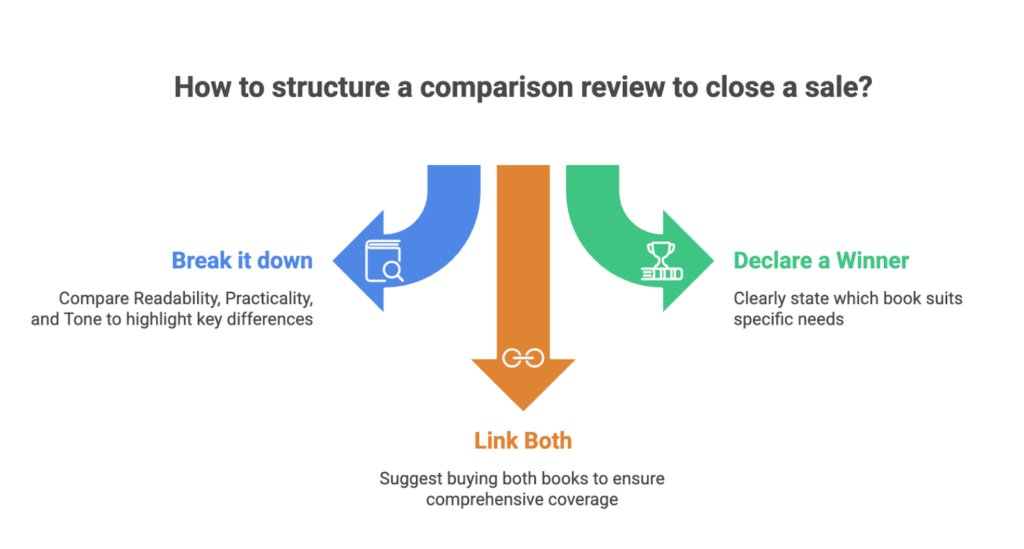
However, a simple list of similarities and differences won’t be enough to close the sale. Instead, we suggest you structure your comparison using these three steps:
Break it down: Compare Readability, Practicality, and Tone.
Declare a Winner: Don’t be wishy-washy. Say “Read Atomic Habits if you want a step-by-step guide; read The Power of Habit if you want the science behind it.”
Link Both: Ironically, people often buy both just to be sure.
These posts often have lower traffic volume than general reviews but significantly higher conversion rates.
Develop Platform-Specific Strategies for Each Traffic Source
You cannot simply copy and paste a blog post link across all social media and expect conversions.
Each platform has a unique user interface and affiliate language. To maximize clicks, you must reduce friction based on how users interact with that specific app.
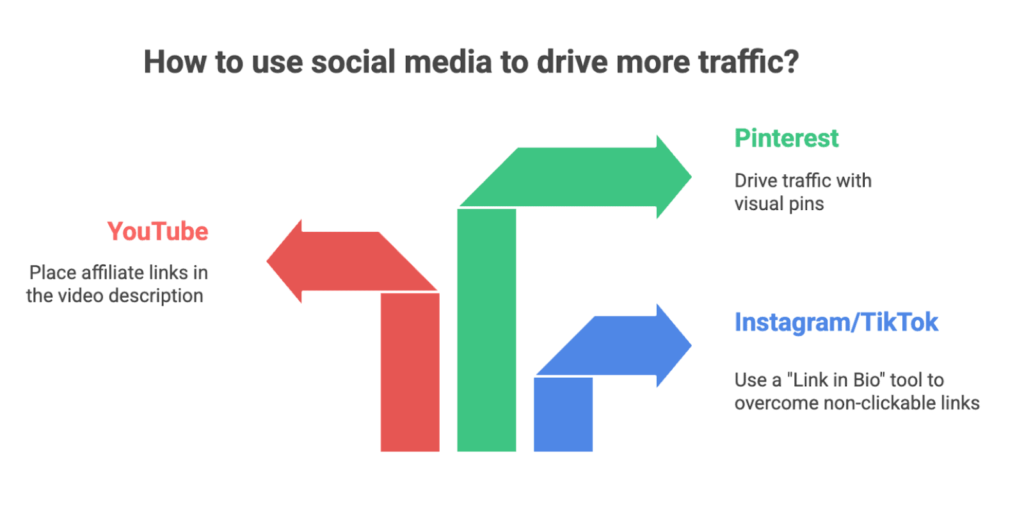
👉For Instagram and TikTok
You will face a friction barrier because the links in the captions are not clickable.
Your solution here is to use a “Link in Bio” tool like Linktree and create a folder specifically for “Book Recs.”
In your video or caption, explicitly guide the user by saying, “Click the link in my bio and look for the ‘October Reads’ folder.”
👉For YouTube
Viewers on YouTube value convenience. If they have to hunt for a link, you lose the sale.
You should place your direct affiliate links in the first two lines of the description. This ensures they are visible immediately without the viewer needing to click “Show More.”
👉 For Pinterest
Treat Pinterest as a traffic driver rather than a direct sales tool. You can create visual pins, such as book aesthetics or quotes, that link back to your blog review.
Do not link directly to retailers like Amazon from Pinterest because algorithms often penalize this behavior; instead, drive traffic to your site first.
Monitor and Optimize Based on Performance Data
Strategy without data is just guessing. You must treat your affiliate dashboard as a diagnostic tool to grow your income.
The best way is to review your performance data monthly to identify what to fix and what to scale.
Let’s follow the optimization cycle below to track properly:
First, diagnose items with high clicks but low sales.
If a book gets 100 clicks but 0 sales, you likely have a conversion issue.
Check the destination link to see if the book is out of stock or if the price is unusually high. The fix is to swap the link for a different edition or a different retailer.
Second, identify high conversion winners.
If you see a specific book selling consistently whenever you mention it, double down on this success.
Move that review to the top of your homepage, feature it in your sidebar, or pin it to the top of your social media feeds to get more eyes on it.
Finally, audit your technical hygiene to fix dead links.
Books go out of print and publishers change cover art, which often breaks image links.
You should use a broken link checker tool quarterly to ensure you aren’t sending valuable traffic to a 404 error page.
FAQs
1. What is a book affiliate program?
A book affiliate program allows publishers, retailers, or platforms to pay commissions to affiliates for referring customers who purchase books through tracked affiliate links.
2. How do book affiliate programs work?
Affiliates promote book products using special tracking links. When a visitor clicks the link and completes a purchase, the affiliate earns a commission based on the program’s commission rate.
3. Can I earn recurring commissions from book affiliate programs?
Yes — subscription-based programs like Scribd or Audible offer recurring or high one-time commissions per subscriber.
4. Are book affiliate links allowed on social media?
Most programs allow social media promotion, but some restrict paid ads. Always check program terms before running ads.
Conclusion
Your Shopify book store can reach a larger community, you just need the right strategy.
Affiliate marketing is a powerful way to do it without costing you too much. There will be a lot of work to do, but you have UpPromote.
We’ll simplify and automate all the complex tasks to help you succeed more easily. Let’s check out our pricing plans and start today.

Ellie Tran, a seasoned SEO content writer with three years of experience in the eCommerce world. Being a part of the UpPromote team, Ellie wants to assist Shopify merchants in achieving success through useful content & actionable insights. Ellie's commitment to learning never stops; she's always eager to gain more knowledge about SEO and content marketing to create valuable content for users. When she's not working on content, Ellie enjoys baking and exploring new places.