











TL;DR
Running a Shopify affiliate program costs $0–$200/month in fixed app fees plus 10–25% commission per sale — and you only pay commission when sales actually happen.
- App subscription: $0 (free plans available) to $200/month
- Commission rates: 10–25% per affiliate sale (industry average)
- Performance fees: 1–3% extra on some apps (read pricing carefully)
- Time investment: 3–5 hours/week for stores under 100 affiliates
- Year 1 fixed cost: $0–$2,400 — variable cost scales with revenue
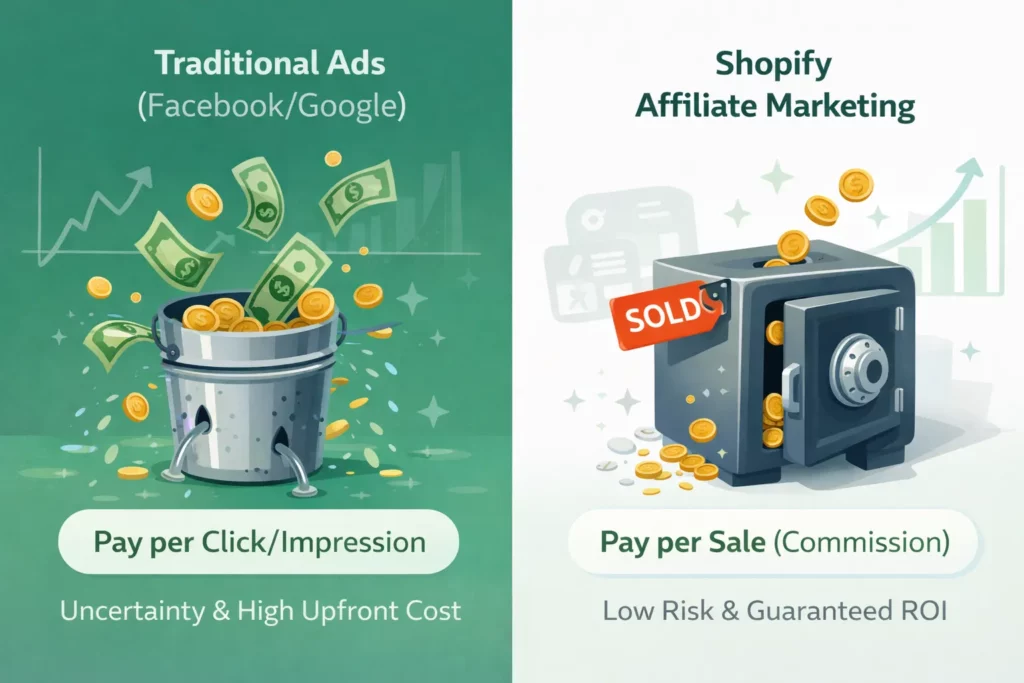
Most marketing channels demand budget upfront.
Facebook Ads charges per click whether the click converts or not. Google Ads burns through your spend on impressions.
Affiliate marketing flips that model – you pay only when an affiliate drives a sale.
That makes “how much does it cost?” a simple question with a layered answer.
The fixed costs are small and predictable. The variable costs scale with revenue, which means they only grow when your store grows.
This guide breaks down every cost line item with current 2026 pricing from the Shopify App Store.
You’ll see real commission ranges by industry and total Year 1 numbers across three store sizes. No vague estimates, just figures you can plug into your own budget.
What Are the 3 Types of Costs in Running a Shopify Affiliate Program?
A Shopify affiliate program has three cost categories: fixed costs (your app subscription), variable costs (commissions paid to affiliates), and time costs (the hours you spend managing the program).
Fixed costs can start at $0 with a free app plan. Variable costs only kick in when an affiliate drives a sale.
The breakdown below shows what each category covers and how it behaves at different revenue levels.
| Cost type | What it covers | Range | Behavior |
| Fixed (Subscription) | Affiliate app monthly fee | $0–$200/month | Charged monthly regardless of sales |
| Variable (Commission) | % paid to affiliates per sale | 10–25% per sale | Only charged when a sale happens — $0 if no sales |
| Time (Management) | Recruiting, communication, payouts | 3–5 hours/week | Hidden cost — opportunity cost of your time |
The variable structure is what sets affiliate marketing apart from every other paid channel.
Facebook Ads and Google Ads require budget upfront. You pay for clicks and impressions whether they convert or not.
A typical small store might spend $500–$5,000 per month on paid ads before seeing the first sale.
With an affiliate program, that math reverses: zero sales means zero commission owed.
Time costs are the easiest to underestimate. A store with 20 active affiliates needs roughly 3–4 hours a week to approve referrals, respond to questions, and process payouts.
Past 100 affiliates, that climbs to 8–10 hours and starts to justify a part-time hire. The number sits outside cash spend, but it belongs in the budget.
Key Takeaway: Affiliate marketing is the only major paid channel where the largest cost line — commission — scales 100% with revenue. No sales means no commission. That single property makes the channel viable for stores with thin margins or unpredictable cash flow.
How Much Do Affiliate Apps Actually Cost on Shopify?
Affiliate apps for Shopify range from $0 to $200+ per month in subscription fees.
But headline prices hide a second cost layer: performance fees on affiliate-generated revenue. Several popular apps charge 1–3% on top of the monthly fee.
Reading the pricing page matters more than picking the lowest sticker price.
The table below shows current pricing for six popular affiliate apps on the Shopify App Store, sorted from lowest to highest entry tier.
| App | Free plan | Paid tiers (monthly | Performance fee | Rating |
| BixGrow | Yes — 50 orders, 30 affiliates | Scale $14.99, Pro $24.99 | None | 4.9★ (1,204) |
| GoAffPro | Yes — unlimited affiliates | Premium $49 | None | 4.7★ (884) |
| ReferralCandy | No | Basic $29, Grow $79, Scale $249, Enterprise $799 | 10.5% / 3.5% / 1.5% / 0.25% | 4.9★ (1,452) |
| UpPromote | Yes — unlimited affiliates, 200 orders | Growth $29.99, Professional $89.99, Enterprise $199.99 | 2% / 1.5% / 1% | 4.9★ (3,289) |
| Refersion | Yes | Launch $39, Growth $129 | 3 % / 2% | 4.7★ (483) |
| Social Snowball | No | Snow Day from $249, Blizzard from $899 | 3% (Snow Day only) | 4.7★ (187) |
Source: Shopify App Store, verified April 2026. Prices in USD and subject to change.
The performance fee trap
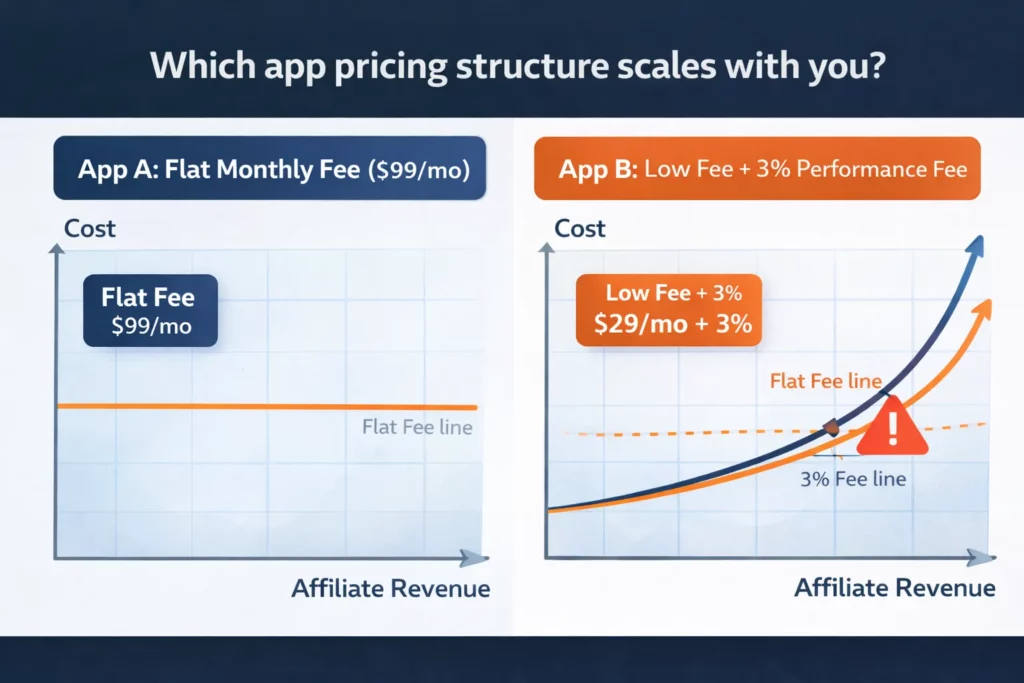
Performance fees turn the sticker price into a moving target. A $29/month plan with 3% revenue fee can cost more than a $99/month flat-fee plan once your affiliate channel scales.
Here’s the math. If your affiliate program generates $10,000/month in sales, a 3% performance fee adds $300/month on top of the base subscription. The cheaper-looking plan becomes the more expensive choice.
Four apps in the table charge performance fees: UpPromote, ReferralCandy, Social Snowball, and Social Snowball. All of them scale the fee with your success. The tradeoff is predictable — pay less upfront, more as you grow.
Which plan fits which store size
App choice should follow store revenue, not feature lists.
Most merchants don’t need advanced features until they cross $10K/month in affiliate revenue, so paying for those features earlier wastes budget.
Stores under $5K/month total revenue
➡️ Start on a free plan. UpPromote, BixGrow, and GoAffPro all offer free tiers with enough features to validate the channel.
Stores at $5K–$20K/month
➡️ A paid plan in the $29–$89 range becomes worthwhile when you hit the free plan’s referral order cap or need features like PayPal auto-payout.
Stores at $20K–$100K/month
➡️ The Professional tier (around $80–$90) pays for itself through features like MLM, lifetime commission, and fraud detection at this scale.
Stores above $100K/month
➡️ Enterprise plans unlock multi-store support, API access, and the lowest performance fees on high revenue volume.
Key Takeaway: The cheapest app isn’t always the cheapest once performance fees apply. Model your actual affiliate revenue against each plan’s fee structure before committing.
How Much Should You Budget for Affiliate Commissions?
Commission is the largest line item in an affiliate program — typically 10–25% of affiliate-generated revenue, depending on your industry and margins.
It’s also the “best” cost you’ll pay, because it only kicks in on sales that affiliates drive.
Rate-setting is where most merchants get it wrong. Go too low and affiliates pick a competitor’s program. Go too high and you eat into margin on every sale.
The table below shows the ranges most Shopify merchants land in by industry.
| Industry | Typical commission range | Notes |
| Beauty & personal care | 15–25% | Higher for new-customer acquisition |
| Apparel & fashion | 12–20% | Add a 2–5% tier bump for top creators |
| Health & wellness | 15–25% | Supplements lean toward the upper end |
| Food & beverage | 10–15% | Lower margins typical in CPG |
| Electronics | 5–12% | Thin margins require conservative rates |
| Subscription / SaaS | 20–40% (recurring) | Recurring model justifies higher rates |
Sources:
How to calculate your monthly commission budget
The formula is simple once you know two numbers: expected affiliate sales volume and your commission rate.
Monthly commission budget = Expected affiliate sales × Average order value × Commission rate
A fashion store having 50 affiliate sales a month at a $65 AOV with a 15% rate lands at $487.50 in commission. Affiliate revenue generated: $3,250. Net after commission: $2,762.50.
The anchor point that matters most is margin. Commission should never exceed 30–50% of your net profit margin.
A store with a 50% margin can afford 15–25% commission. A store with a 30% margin should cap rates at 10–15%.
Coupon vs link commission: why they shouldn’t always match
Coupon-driven referrals already include a discount the customer gets at checkout. Paying full commission on top of that discount means you’re paying twice for the same acquisition.
Most mature affiliate programs run lower commission rates on coupon sales than on link sales, typically 5–10 points lower. Setting this up manually is tedious, which is why some apps like UpPromote lets you apply a separate rate for coupon-tracked orders.
Case study: why a tight affiliate roster can beat a broad one
Nutriland’s affiliate program is a useful benchmark. The brand generated €400,000 in revenue from just 27 micro-influencers, producing 10,000 referrals. That’s roughly €14,800 per active partner.
The cost structure is what makes this work.
27 well-chosen partners require far less management time than 270 scattered affiliates. The commission budget concentrates where it performs, and milestone bonuses become economical to run.
What’s the Total Year 1 Cost? (Real Numbers by Store Size)
Total Year 1 cost for a Shopify affiliate program breaks into two parts: fixed fees of $0–$2,400 for the app subscription, plus commission that scales with revenue.
The table below maps those costs across three store sizes so you can plug in numbers that match your stage.
| Store sizes | Small Store ($5K–$10K/mo) | Growing Store ($10K–$30K/mo) | Scaling Store ($30K–$100K/mo) |
| App fees / year | $0–$360 | $360–$1,080 | $1,080–$2,400 |
| Commission / year (at 15%) | $1,800–$6,000 | $6,000–$24,000 | $24,000–$90,000 |
| Est. affiliate revenue / year | $12,000–$40,000 | $40,000–$160,000 | $160,000–$600,000 |
| Net after commission | $10,200–$34,000 | $34,000–$136,000 | $136,000–$510,000 |
| Time investment | 3–4 hrs/week | 5–7 hrs/week | 8–15 hrs/week |
Two patterns stand out.
Fixed costs stay small, even a $100K/month store spends under $2,400/year on app fees. The ratio of commission to net revenue stays constant at 85/15, because commission scales with sales, not store size.
How time investment scales (and where automation earns its keep)
Time costs climb faster than cash costs as your program grows. A small store managing 10–20 affiliates can run everything in a few hours a week.
Past 100 affiliates, weekly time investment doubles. Approving referrals, answering questions, and processing payouts consume real hours every week.
Automation is where these hours come back. UpPromote handles three layers of repeat work.
The app auto-generates affiliate coupons and tracking links at sign-up, flags suspicious referrals before commission approval, and schedules payouts via PayPal or Store Credit on your chosen cycle.
For a store with 50+ active affiliates, scheduled payouts save 2–4 hours a month on payment admin alone. Auto-generated coupons remove another 1–2 hours of weekly setup work for new affiliate sign-ups.
The hidden costs to plan for
Three cost lines sit outside the table above but affect total spend more than most merchants expect:
- Performance fees on some apps (covered in the app cost section)
- Product gifting for influencer affiliates ($50–$200 per partner)
- Tax compliance paperwork for US programs paying $600+/year to any affiliate
Together, these can add 10–20% to total program spend in Year 1. The final section breaks each down with dollar estimates.
How Does Affiliate Cost Compare to Other Marketing Channels?
Affiliate has the lowest upfront cost and lowest risk of any paid channel. It’s also the only channel that ties spend directly to sales.
The tradeoff is speed. Programs take 3–6 months to hit scale, while paid ads deliver volume the same week.
Specific CPAs vary too much by industry to generalize. What matters is cost structure, shown below across the five main channels.
| Channel | Cost structure | Upfront risk | Scale speed |
| Affiliate | Pay per sale (commission) | Near-zero | Slow (3–6 months) |
| Facebook/Instagram Ads | Pay per click/impression | High | Fast (same week) |
| Google Ads | Pay per click | High | Fast |
| Email marketing | Flat monthly fee (ESP) | Low | Medium (list-dependent) |
| SEO / Content | Labor + tooling cost | Medium | Very slow (6–12 months) |
Two observations matter.
Only affiliate and email link cost to outcome — one pays per sale, the other pays per list access. Paid ads burn budget on clicks that may never convert.
The second observation is speed.
Paid ads and email scale faster than affiliate, which is why most merchants run affiliate alongside other channels rather than replacing them.
Case study: PRX Performance’s 78% ROI
PRX Performance’s affiliate program drove $2.3M in sales and delivered a 78% ROI. The program also lifted overall website traffic by 5% from affiliate-driven exposure.
The structure is simple: commissions tied to performance tiers, exclusive codes for top affiliates, and product samples to fuel authentic content.
What makes the ROI number useful is the compounding effect. Referred customers bring more referred customers, and the traffic lift offsets part of the commission cost.
The honest tradeoff: scale speed and fraud risk
Affiliate programs take longer to ramp than paid ads for one reason. You’re recruiting and onboarding humans, not buying inventory.
Most programs need 50–100 active affiliates before referral volume stabilizes, and getting there takes months of outreach.
The second tradeoff is fraud.
Coupon abuse, self-referrals, and spam signups can erode 5–15% of your commission budget without protection.
UpPromote flags suspicious activities — same-IP signups, disposable email domains, and self-referrals. You can review and block these before paying out commission.
What Are the Hidden Costs Most Merchants Miss?
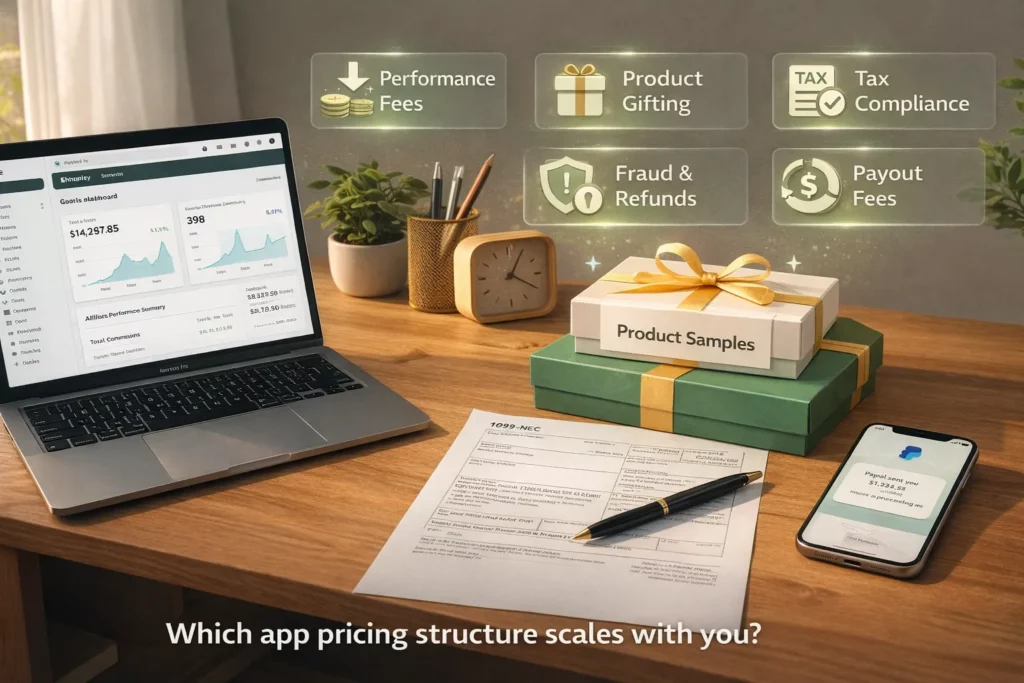
Five cost lines sit outside the main budget and can add 10–25% to Year 1 spend. Some merchants discover them after launch and scramble to adjust.
Knowing them upfront lets you pick the right app and set commission rates from the start. Here are the five hidden costs, in order of impact:
- Performance fees on some apps
- Product gifting for influencer affiliates
- Tax compliance for US programs
- Refund clawback and commission fraud
- Payment processing fees
Performance fees on some apps
Already covered in the app cost section. The short version: UpPromote, ReferralCandy, and Social Snowball charge a percentage of affiliate revenue on top of the subscription.
At $10K/month in affiliate sales, a 3% fee adds $300/month — enough to flip your total cost ranking between apps.
Product gifting for influencer affiliates
Most influencer affiliates expect a free sample before they’ll promote.
Budget $50–$200 per partner. Beauty and apparel brands sit at the lower end, electronics and premium goods at the upper end.
The cost isn’t just the product. Shipping, custom packaging, and the occasional sample that fails to produce content all add up.
A store onboarding 50 new influencer affiliates in Year 1 should budget $2,500–$10,000, most of it in the first six months.
Gifting funds acquisition, not waste. Gifted affiliates produce higher-quality content than pure commission-based ones, and the sample doubles as an onboarding experience.
Tax compliance for US programs
US-based stores must track affiliate payments for tax reporting. Starting with 2026 payments, the IRS 1099-NEC filing threshold is $2,000 per contractor per year — raised from $600 under the One Big Beautiful Bill Act.
If any affiliate earns $2,000 or more in commission within a calendar year, you need to collect their W-9 and issue a 1099-NEC by January 31 of the following year. Missing the deadline triggers IRS penalties of $60–$310 per form.
The cost is either software (tax-filing platforms charge $3–$10 per form) or the time to file them yourself. For a program with 10+ affiliates crossing the threshold, budget $100–$500/year on compliance tools.
Refund clawback and commission fraud
When a customer refunds an order, you’ve paid commission on a sale that no longer exists.
Some apps pull commission back by default. Others leave you to track and adjust. Chargebacks and returns erode 2–5% of commission budget on most stores.
UpPromote allows you to set a waiting period before orders get auto-approved. Orders only count for commission after the refund window closes. This one setting removes most of the clawback risk.
Payment processing fees
Paying affiliates costs money on top of commission itself.
PayPal’s standard business rate is 2.99% + $0.49 per goods-and-services transaction, with a 1.5% surcharge on international payouts (PayPal business fee schedule).
For a store paying out $5,000/month across 50 affiliates, processing fees alone run $150–$175/month.
Two options can cut this. PayPal’s dedicated Payouts API drops the fee to $0.25 per domestic payout, though it requires developer setup to integrate.
The second option is store credit. Paying commission as discount codes skips the processing fee — a strong fit when your affiliates also shop in your store.
Frequently Asked Questions
Can I run an affiliate program on Shopify for free?
Yes. Several apps offer free plans with full tracking, commission setup, and payouts — capped at 200 referral orders per month on most plans. You only pay commission when affiliates drive sales, so fixed cost stays at $0.
How are affiliates paid, and do I have to pay them immediately?
Most apps support PayPal, bank transfer, or store credit. Payment is not immediate — standard practice is a 30–60 day holding period after each order. The window lets refunds settle before commission releases.
How much time does managing an affiliate program take?
3–5 hours per week for stores with 20–100 affiliates. Past 200 active affiliates, time investment climbs to 8–15 hours, and most brands hire a part-time affiliate manager at that point.
Should my commission rate match my profit margin?
No — cap commission at 30–50% of your net profit margin instead. A store with a 50% margin can afford 15–25% commission. A store with a 30% margin should stay under 15%.
How does affiliate program cost compare to hiring a sales rep?
A single sales rep costs $40,000–$60,000/year in salary and benefits. An affiliate program driving similar revenue runs $12,000–$32,000/year, and you can add affiliates without growing fixed costs.
When does it make sense to switch from a free app to a paid plan?
Three signals say it’s time. You hit the free plan’s order cap, you need features like auto-payouts or MLM, or your affiliate revenue exceeds 10× the paid plan cost. Under $500/month, the free tier still makes sense.

Ellie Tran, a seasoned SEO content writer with three years of experience in the eCommerce world. Being a part of the UpPromote team, Ellie wants to assist Shopify merchants in achieving success through useful content & actionable insights.Ellie's commitment to learning never stops; she's always eager to gain more knowledge about SEO and content marketing to create valuable content for users. When she's not working on content, Ellie enjoys baking and exploring new places.
![How to Use Shopify Functions with Your Affiliate Program [2026 Guide]](https://static.uppromote.com/wp-content/uploads/2026/06/how-to-use-shopify-functions-with-affiliate-program-300x169.webp)

![How to Prevent Affiliate Fraud on Shopify: Self-Referral, Coupon Abuse & More [2026]](https://static.uppromote.com/wp-content/uploads/2026/06/how-to-prevent-affiliate-fraud-on-shopify-300x169.webp)