

TL;DR
For most Shopify stores, affiliate marketing is worth it — but not for every margin, and not overnight.
- Average ROI: $12 return for every $1 spent (12:1)
- Revenue contribution: 10–30% of total revenue for mature programs
- Total cost: 10–12% of affiliate-driven sales (commissions included)
- Timeline: 3–6 months to meaningful results
- Minimum requirement: Margins above 20% to support a 10–15% commission
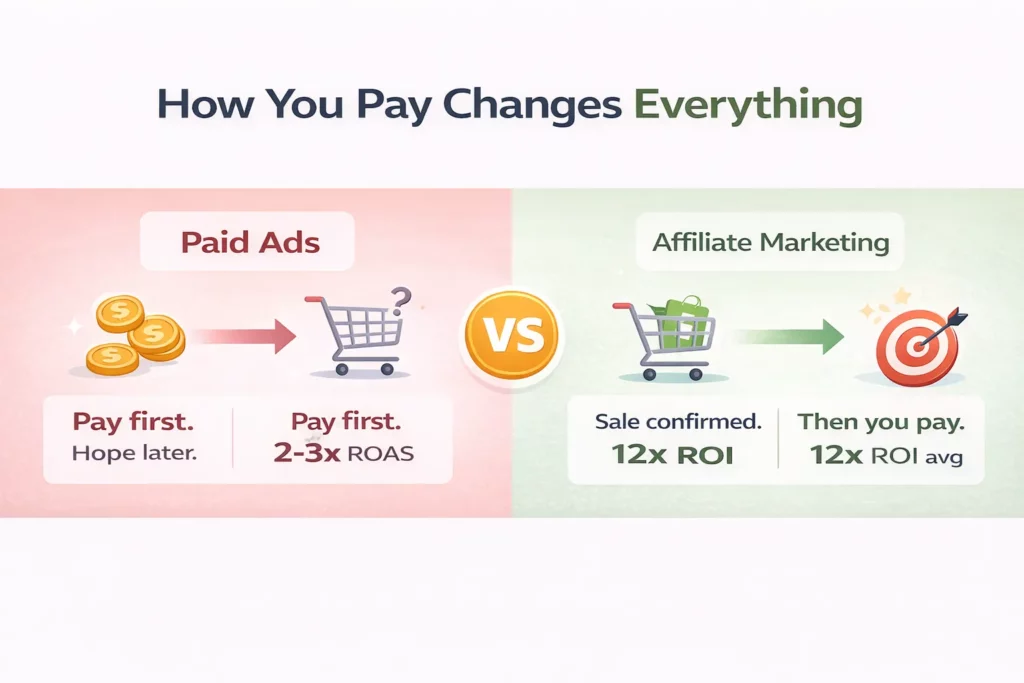
You spent $2,000 on Facebook Ads last month, and about half went to people who never clicked. The rest clicked, browsed, and left without buying.
That’s the paid ads model: pay first, hope later.
Affiliate marketing works the opposite way. You set a commission — say 10% per sale — and pay nothing until a customer buys. The affiliate handles content creation and traffic on their own.
The numbers are hard to ignore. 81% of brands run affiliate programs, and the average return is $12 for every $1 spent (Rakuten/Forrester; Shopify, 2024).
But this model isn’t for every store, every margin, or every stage of growth. This guide uses real Shopify merchant data to help you decide if an affiliate program is right for your business.
Inside, you’ll find actual ROI numbers, a full cost breakdown, and a month-by-month timeline. You’ll also see five clear signs that affiliate marketing isn’t the right move yet.
What Does Affiliate Marketing Look Like For Shopify Merchants?
Your role boils down to three things: set the commission, share brand assets, and approve the right partners.
Affiliates handle everything else – content, traffic, and promotion.
The daily workflow is simple. You create a program with a commission rate, like 10% per sale or $10 per new customer. Affiliates apply, and you approve the ones that match your brand.
Each approved partner gets a unique tracking link and, if you choose, a discount code. They promote your products through blogs, social media, email lists, or YouTube – using their own audience and content.
When someone clicks the link and makes a purchase, your affiliate app tracks the sale and assigns the commission. You pay only once the sale goes through.
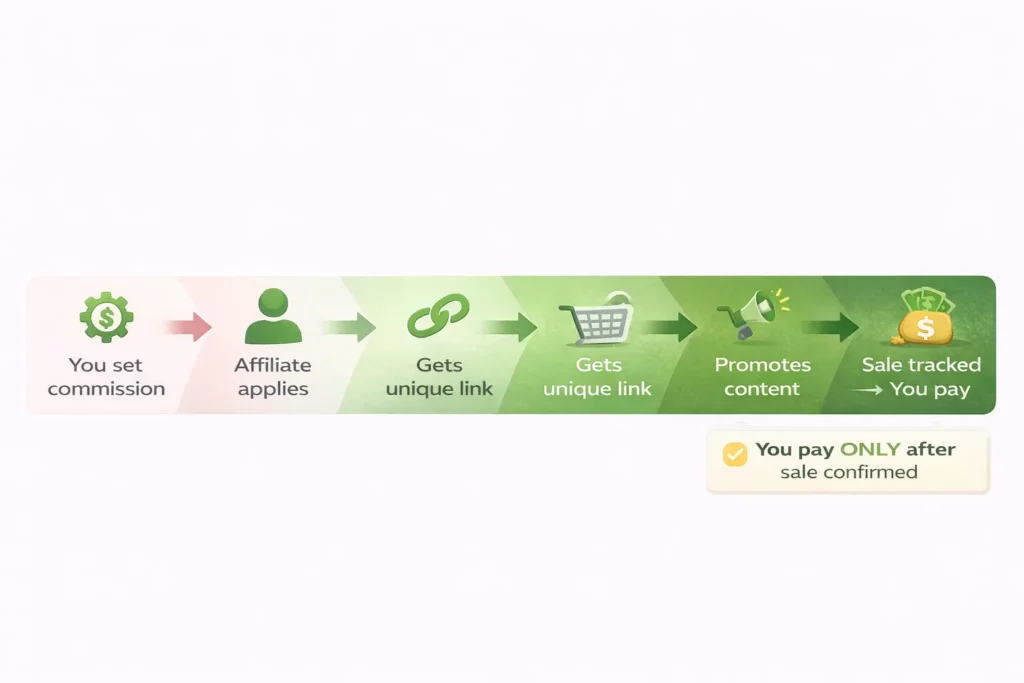
That payment structure is what sets this channel apart.
With Meta or Google Ads, you pay per click, whether or not anyone buys. With affiliates, no sale means no cost.
You’re also not hiring employees or managing freelancers. Affiliates are independent partners who earn only when they drive results. 16% of all ecommerce orders in the US and Canada now come through these partnerships.
What Does The Data Say About Affiliate Marketing Roi?
The average affiliate program returns $12 in revenue for every $1 spent. A 12:1 ROI ranks among the highest of any digital channel. Mature programs contribute 10–30% of total store revenue within their first year.
Average ROI: $12 for every $1 spent
A $500 monthly investment in affiliates, commissions, app fees, and management time should generate roughly $6,000 in revenue from that channel. That’s the 12:1 benchmark in real dollars.
Not every program hits that mark. Conservative estimates put the cost at $6.50 per $1 across all industries, while top ecommerce programs push past $15 per $1 (FirstPromoter, 2026).
Even the low end outperforms most paid ad channels.
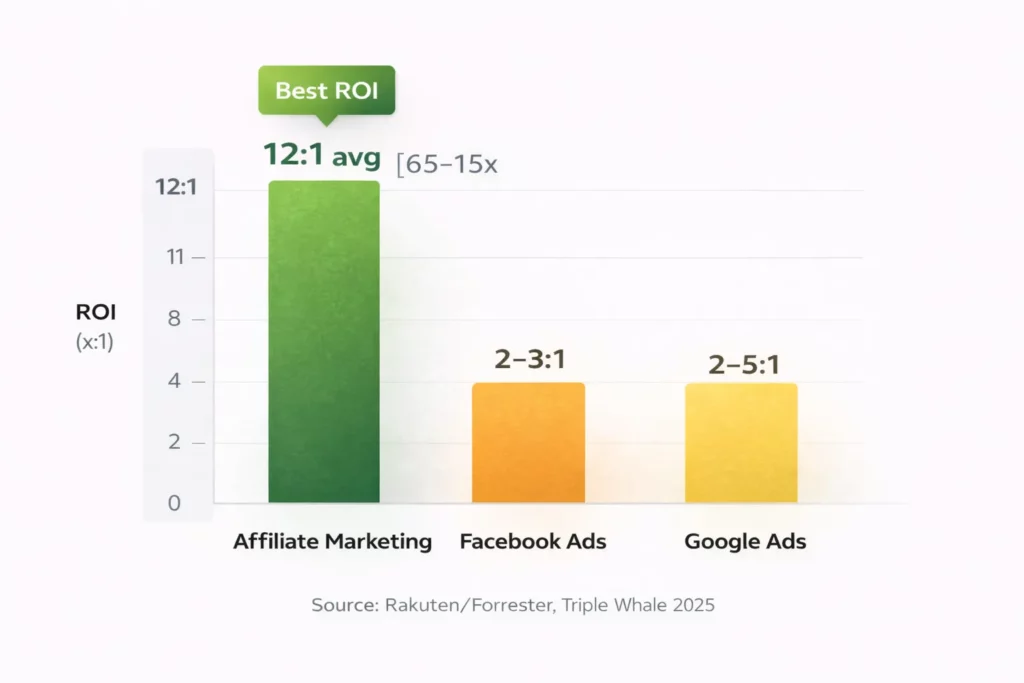
The median ecommerce ROAS on Facebook Ads is 2–3:1 — you get $2–$3 back for every $1 of ad spend (Triple Whale, 2025). And that dollar goes out whether or not anyone buys.
| Average return per $1 | $6.50–$15 (12:1 avg) | $2–$3 (2–3:1 ROAS) | $2–$5 (varies by campaign) |
| Payment model | Pay per sale | Pay per click | Pay per click |
| Risk | Low — pay after confirmed sale | High — pay upfront | High — pay upfront |
| Cost per customer | $5–$15 (at 10% commission) | $35–$55 CPA | $20–$50 CPA |
| Who creates content | Affiliates | You (or agency) | You (or agency) |
| Time to results | 3–6 months | Days to weeks | Days to weeks |
At a 10% commission on a $75 average order, each affiliate sale costs you $7.50. Facebook Ads drive the same sale cost of $35–$55 per acquisition (Pravaah, 2025).
Revenue contribution: 10–30% for active programs
65% of retailers report that affiliate programs contribute up to 20% of annual revenue. High-growth DTC brands often reach 15–30% within their first year.
Shopify’s published data confirms this range. Moonboon, a DTC baby brand, partnered with 300 micro-influencers and generated over $1M in affiliate sales — roughly 10% of monthly net revenue at a 6.5:1 ROI (Shopify, 2024).
Brands on UpPromote show similar patterns. PRX Performance generated $2.3M in affiliate sales with a 78% ROI by structuring tiered commission programs for different partner levels.
Carnivore Bar followed a similar path, growing from 50 to 500 affiliates in just over a year. Affiliate sales now account for 40% of total revenue.
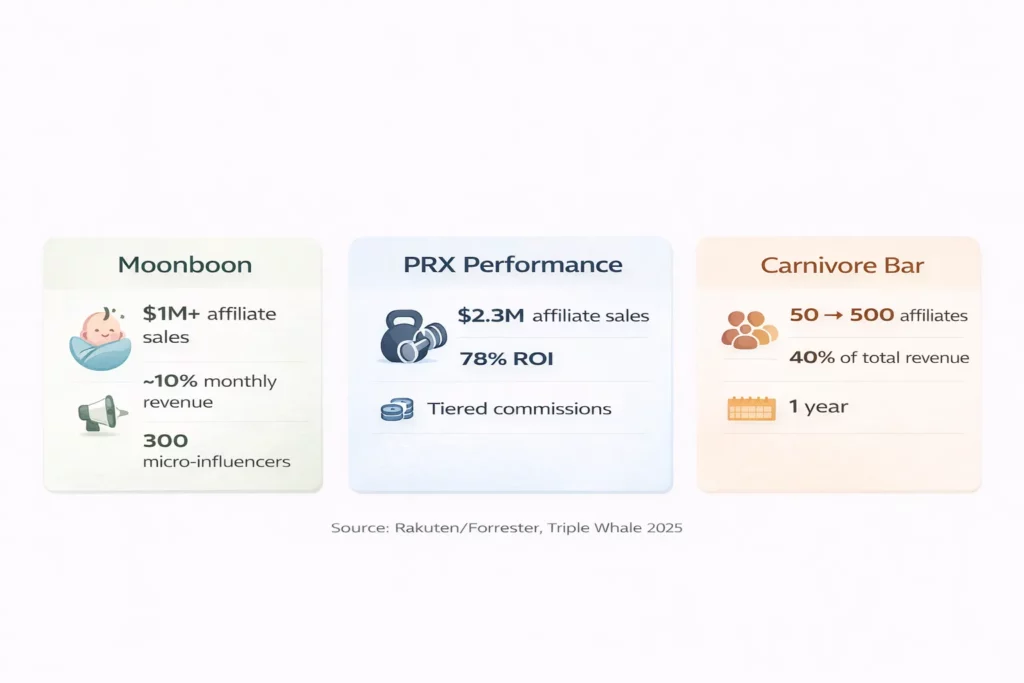
These aren’t outlier results from enterprise brands. PRX sells home gym gear, and Carnivore Bar is a specialty food company. The model works across categories if your margins support a 10–15% commission.
What Does It Actually Cost To Run An Affiliate Program?
Most Shopify stores spend 10–12% of affiliate-driven revenue on the total program — software, fees, and commissions combined. That’s less than half what paid ads would cost for the same sales.
Four costs make up your total spend.
Software is the smallest line item. UpPromote’s free tier, for example, includes tracking, fraud detection, and analytics — while paid plans across the industry range from $29.99 to $199.99 per month.
Performance fees are the cost most merchants miss. Many paid plans charge 1–2% of affiliate-referred revenue in addition to the subscription. On $10,000 in monthly affiliate sales, that adds $100–$200.
Commissions are your biggest expense, and the only one that scales with revenue. Most Shopify DTC brands pay 10–15% per sale. At an average order of $75, each affiliate transaction costs $7.50–$11.25.
Your time is the cost most guides ignore. Expect 2–4 hours per week on application reviews, affiliate questions, and performance checks.
Here’s what those costs look like at three program sizes:
| Monthly affiliate revenue | $5,000 | $25,000 | $100,000 |
| App subscription | $0 (free plan) | $89.99 | $199.99 |
| Performance fee | $0 | $375 (1.5%) | $1,000 (1%) |
| Commissions (10%) | $500 | $2,500 | $10,000 |
| Total monthly cost | ~$500 | ~$2,965 | ~$11,200 |
| Cost as % of revenue | 10% | 11.9% | 11.2% |
The medium scenario shows the gap. You spend about $2,965 to generate $25,000 in affiliate revenue, roughly 12% of that revenue.
The same $25,000 from Facebook Ads would require $8,300–$12,500 in ad spend at a 2–3:1 ROAS (Triple Whale, 2025). That’s 33–50% of revenue, three to four times the affiliate cost.
→ For a detailed analysis by store size, see our full cost breakdown guide.
What Should You Realistically Expect In Months 1 Through 12?
Month 1 won’t generate meaningful revenue – expect under $500 from affiliates at best. But by month 6, most active programs contribute 5–15% of total store sales.
Here’s what that growth curve looks like in practice.
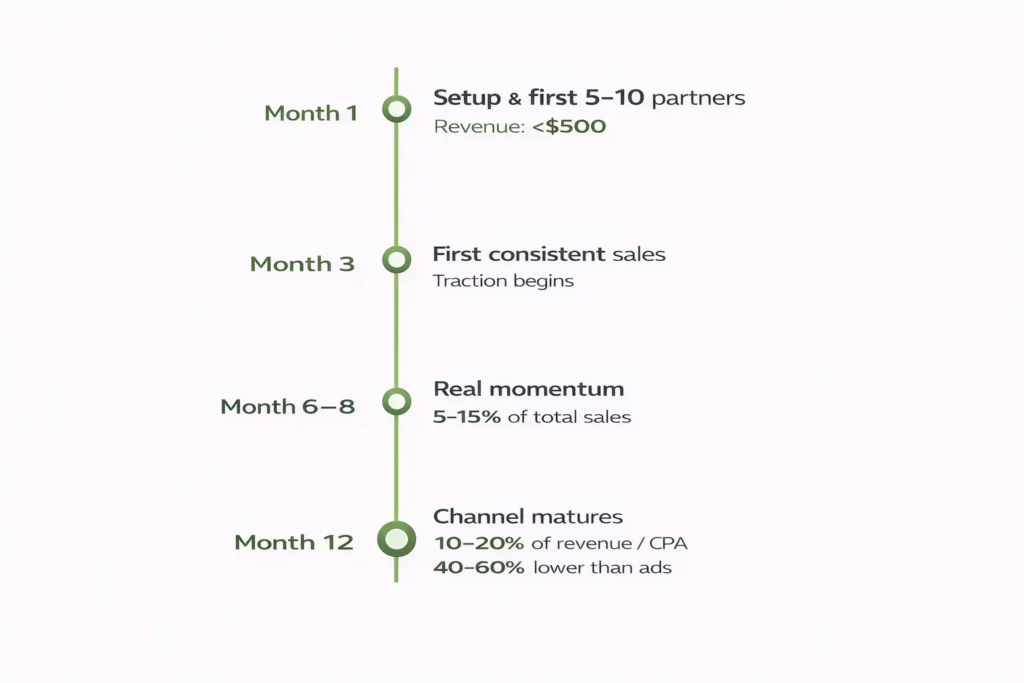
Month 1 is pure setup — installing your app, setting commission rates, and recruiting your first 5–10 partners. Most early affiliates will be existing customers or micro-influencers you contact directly.
Month 3 is when traction starts. Your first consistent affiliate sales come in, and you see which partner types work best — bloggers, micro-influencers, or customer advocates.
TréSkin, a skincare brand using UpPromote, hit this milestone fast. The brand reached $120,000 in affiliate revenue within three months by creating tiered programs for different partner levels.
Months 6 – 8 turn that early traction into real momentum. Affiliate revenue should account for 5–15% of total sales, and your top performers begin to separate from the rest.
Efavormart followed a similar growth curve. The events and décor brand generated over $800,000 in affiliate sales within eight months by recruiting matching affiliates and providing training resources.
Month 12 is where the channel matures. Active programs at this stage contribute 10–20% of total revenue, and your cost per customer through affiliates runs 40–60% lower than paid ads.
Here’s the part most guides skip. The 12:1 ROI is an average across mature programs — not a month-1 number. Early returns may be flat while you invest time building the foundation.
You also don’t need hundreds of affiliates to see results. Most small-to-medium Shopify stores get 60–80% of affiliate revenue from their top 10–20 partners.
Key Takeaway: Affiliate marketing compounds over time. Month 1 builds the foundation, month 3 shows traction, and months 6–12 are when the channel becomes a predictable revenue stream.
When Is Affiliate Marketing Not Worth It?
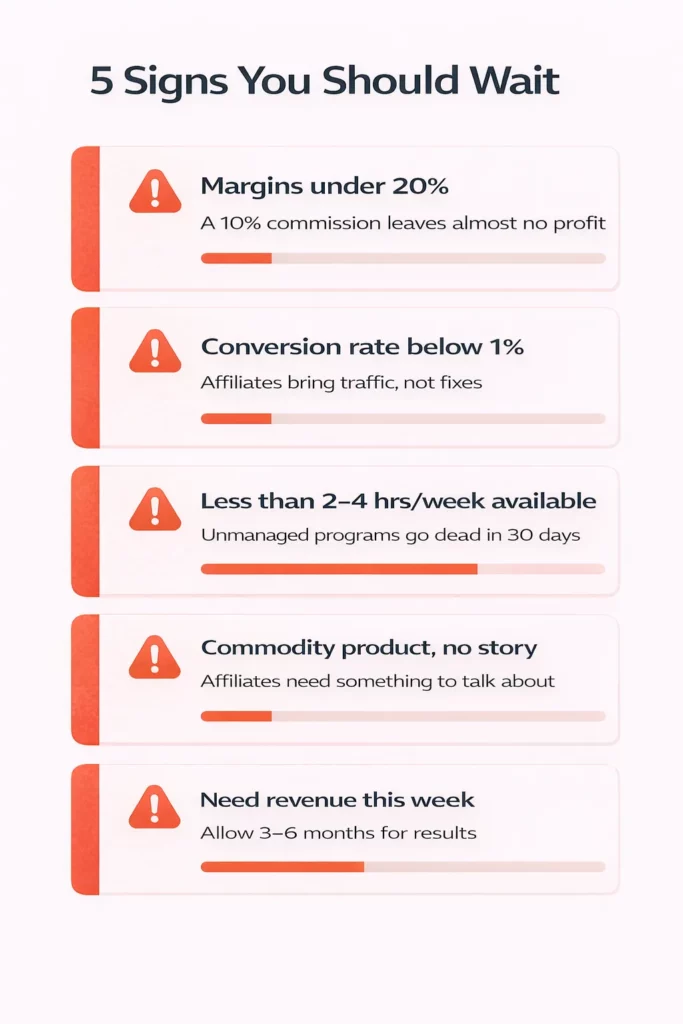
Affiliate marketing works for most Shopify stores — but not every store, and not always right now. Five common situations signal you should wait.
- Your margins can’t absorb a commission.
If your profit margin is under 20%, a 10–15% affiliate commission eats most of your profit. Quick math on a $50 order: 15% margin gives you $7.50 in profit, and a 10% commission costs $5.00. That leaves $2.50 per sale, not enough to sustain a program.
- Your store hasn’t found product-market fit.
Affiliates drive traffic – they don’t fix a weak product page, unclear pricing, or a confusing checkout. If your conversion rate sits below 1%, the problem is your store, not your traffic source.
- You have zero hours to manage it.
An unmanaged program is worse than no program at all. Affiliates who get no response to their questions go inactive within 30 days. The minimum time commitment is 2–4 hours per week.
- Your product doesn’t spark conversation.
Affiliates need a story to tell. Commodity products with no clear difference from competitors are hard to promote. The model works best with unique products, strong branding, or items that trigger an emotional response.
- You need revenue this week.
Paid ads can generate sales within days. Affiliate programs take 3–6 months to build momentum. If your priority is short-term cash flow, affiliates aren’t the right channel yet.
Here’s a simple test.
Can you afford to pay 10% of each sale and wait three months for meaningful results?
If yes, the channel is worth testing. If no, focus on paid acquisition first and revisit affiliates once your cash flow stabilizes.
→ Not sure whether an affiliate or a referral program fits your stage better? Read our affiliate vs. referral comparison guide.
How To Test Affiliate Marketing In 30 Days (Without A Big Commitment)
You don’t need to go all-in to find out if affiliates work for your store. A 30-day test with five partners and zero ad spend gives you a clear signal.
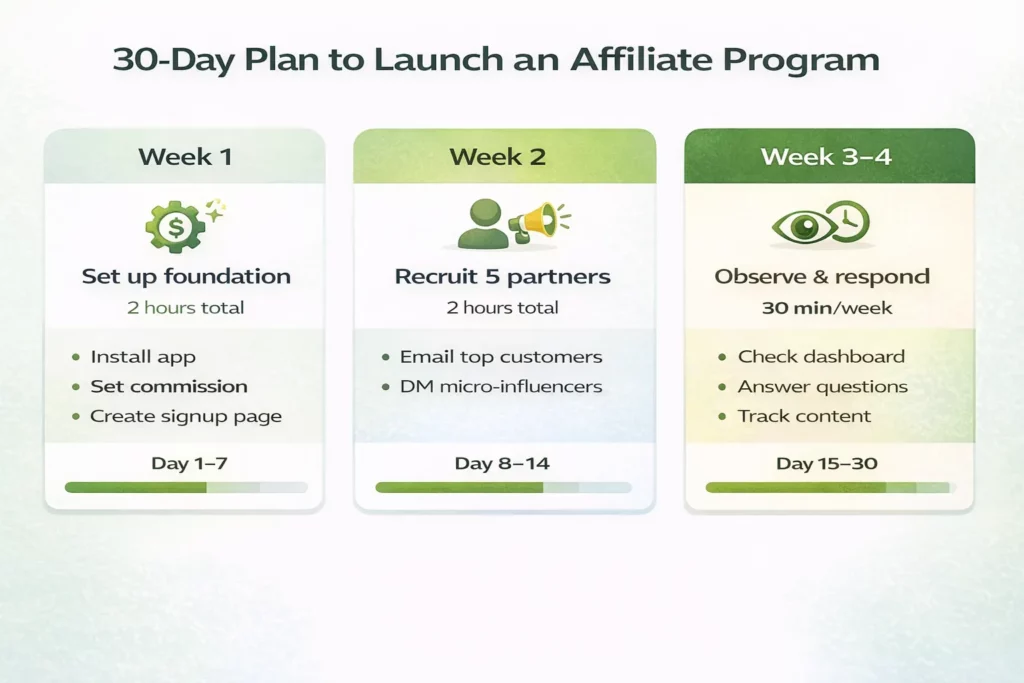
Week 1: Set up your foundation (2 hours)
Install a free affiliate app, set your commission rate at 10–15%, and create a simple registration page. UpPromote’s free plan includes one program, tracking links, coupon codes, fraud detection, and an analytics dashboard — enough infrastructure for this entire test.
Week 2: Recruit your first five partners (2 hours).
Email your top 10 customers and ask if they want to earn commission by recommending your brand. Then, message 3–5 micro-influencers in your niche who already post about similar products. Your best first affiliates are people who already know what you sell.
Weeks 3–4: Observe and respond (30 minutes per week).
Check your dashboard, answer affiliate questions, and track which partners posted content. Don’t optimize yet — just gather data.
After 30 days, ask three questions.
Did at least one affiliate generate a sale?
Did any partner create content about your brand?
Was the weekly time investment manageable?
Even one sale is a positive signal. It means the model works for your product. And a 3-month commitment is worth the investment.
If zero affiliates engaged at all, the problem is usually the offer. Revisit your commission rate, the types of partners you recruited, or the ease of your signup process.
→ Ready for the full walkthrough? Follow our step-by-step affiliate program setup guide.
The Bottom Line
For most Shopify stores with healthy margins, a product people want to talk about, and willingness to invest 3–6 months. Yes, affiliate marketing is worth it.
The data backs it up. The average program returns $12 for every $1 spent, and mature programs contribute 10–30% of total revenue. The total program cost runs 10-12% of affiliate-driven sales, less than half of what paid ads cost for the same results.
But it’s not instant, it’s not passive, and it’s not for everyone. If your margins are too thin or your store isn’t converting yet, fix those first.
The lowest-risk path forward is a 30-day test with five partners and a free plan. One sale proves the model. Three months of consistency prove the channel.
Frequently Asked Questions
What is the average ROI of affiliate marketing for Shopify stores?
The industry average is $12 in revenue for every $1 spent — a 12:1 ROI. Conservative estimates sit around $6.50 per $1, while top ecommerce programs exceed $15 per $1. For mature Shopify programs running 12 months or longer, affiliate-driven revenue represents 10–20% of total store sales.
How much does it cost to start an affiliate program on Shopify?
You can start for free with several Shopify affiliate apps. Paid plans with more features range from $30–$200 per month. Your biggest ongoing cost is commissions — typically 10–15% per sale — which you only pay after a sale happens. Most stores spend 10–12% of affiliate-generated revenue on the total program.
How long does it take to see results from an affiliate program?
Expect minimal revenue in month 1, which is primarily a setup phase. Most Shopify stores see consistent affiliate sales by month 3 and meaningful revenue contribution (5–15% of total sales) by months 6–8. Programs running 12 months or longer typically contribute 10–20% of total revenue.
Is affiliate marketing better than Facebook Ads for Shopify?
They serve different purposes. Affiliate marketing costs 10–12% of driven revenue and takes 3–6 months to build, but you only pay after confirmed sales. Facebook Ads deliver faster results but cost 33–50% of driven revenue at a median 2–3:1 ROAS, with payment required upfront. Most successful stores use both channels together.
How many affiliates do I need for meaningful results?
Quality matters more than quantity. Most small-to-medium Shopify stores get 60–80% of their affiliate revenue from their top 10–20 partners. Start with 5–10 quality affiliates — existing customers and niche micro-influencers — and grow from there based on performance data.

Ellie Tran, a seasoned SEO content writer with three years of experience in the eCommerce world. Being a part of the UpPromote team, Ellie wants to assist Shopify merchants in achieving success through useful content & actionable insights. Ellie's commitment to learning never stops; she's always eager to gain more knowledge about SEO and content marketing to create valuable content for users. When she's not working on content, Ellie enjoys baking and exploring new places.
![How to Recruit Affiliates for Your Shopify Store: The Complete Recruitment Playbook [2026]](https://static.uppromote.com/wp-content/uploads/2026/04/how-to-recruit-affiliates-for-your-shopify-store-300x169.webp)