












TL;DR
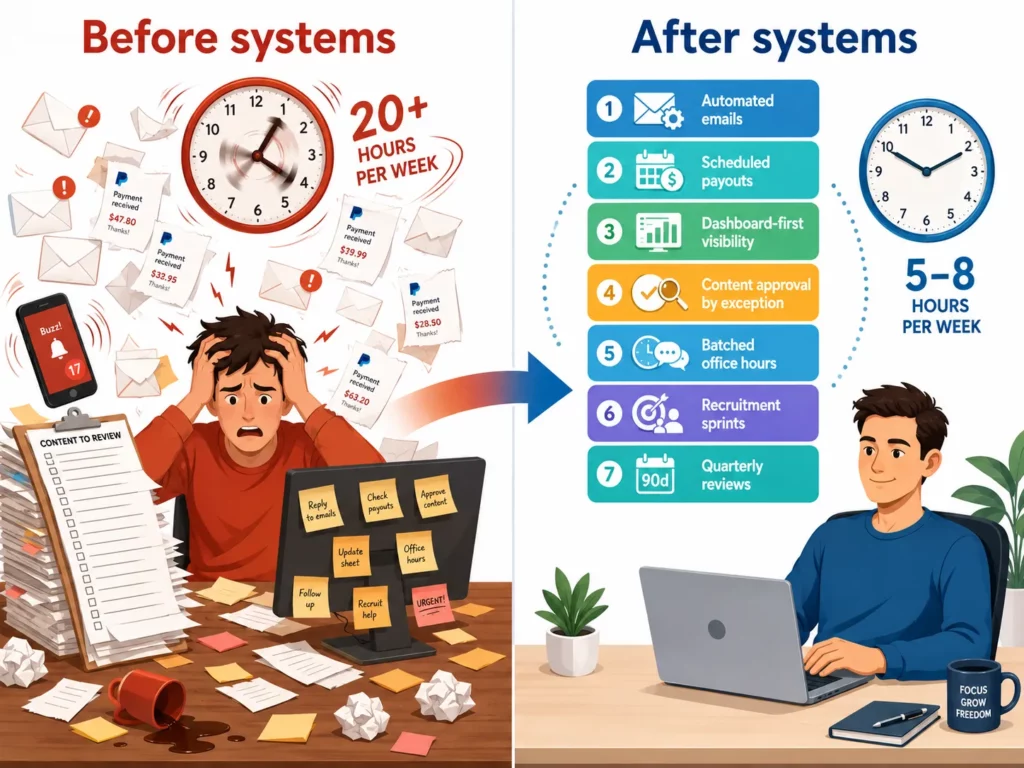
Managing 100+ affiliates takes 5-8 hours a week with the right systems, not the 20+ hours most merchants spend.
Seven systems below can make the difference:
- Three-tier segmentation (Pareto rule: top 20% drive ~80% of revenue)
- Automated email sequences
- Monthly batch payouts
- Dashboard-first management
- Content approval by exception
- Batched office hours
- Quarterly reviews
Ten affiliates is manageable. You know each partner by name, reply to every email personally, and process payouts one by one.
But fifty affiliates gets messy. The inbox fills up. Payouts eat a full afternoon. Some partners slip through cracks.
A hundred affiliates may break the manual approach entirely.
The math explains why. A hundred partners at fifteen minutes each per week equals twenty-five hours. That is a full-time job on top of running your store.
The Pareto principle makes the problem worse and the solution clearer. Across affiliate programs, the top 20% of partners consistently drive around 80% of revenue.
In a hundred-affiliate program, roughly twenty generate most of your results. The other eighty need management, but not the same kind.
The merchants who scale past a hundred affiliates without burning out don’t work more hours. They build systems that match effort to value — personal attention where it pays, automation everywhere else.
How Do You Segment 100+ Affiliates by Value?
Segment every affiliate into one of three performance tiers: a top group that gets personal attention, a middle group that runs on automation, and a bottom group that gets re-engaged or removed.
This single system cuts management time roughly in half. It stops you from spending equal effort on partners with wildly unequal output.
The split follows the Pareto pattern that shows up in nearly every affiliate program. Your top 20% of affiliates produce most of your revenue. The middle 60% contribute modestly. The bottom 20% produce little or nothing.
Each group will need a different management approach. The table below maps the three tiers to time investment.
| Tier | Share of affiliates | Typical revenue share | Management style | Your time |
| A-Tier (top 20%) | ~20 of 100 | ~80% of revenue | Personal: monthly check-ins, custom deals, ambassador path | 60% |
| B-Tier (middle 60%) | ~60 of 100 | ~15% of revenue | Automated: monthly email updates, standard commission, self-service resources | 30% |
| C-Tier (bottom 20%) | ~20 of 100 | ~5% or $0 | Minimal: quarterly re-engagement email, remove after 6 months inactive | 10% |
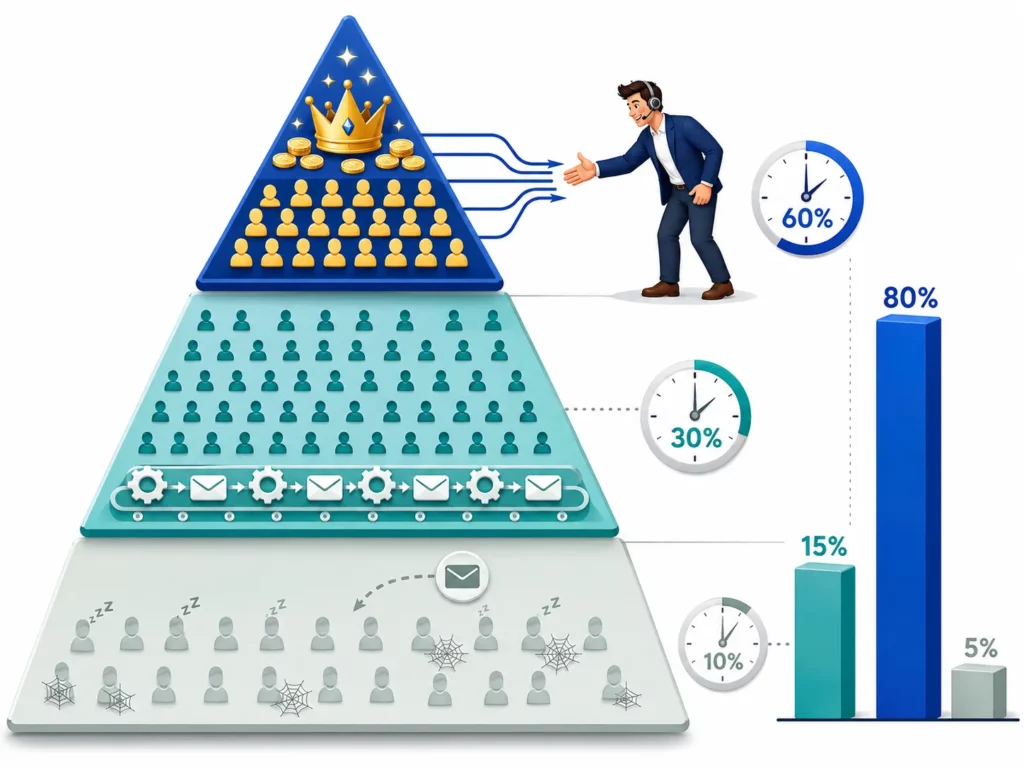
Without segmentation, a hundred affiliates at fifteen minutes each per week equals twenty-five hours. That is unsustainable for any solo founder or small team.
With segmentation, the math shifts. Twenty A-Tier partners at thirty minutes per week equals ten hours. Sixty B-Tier partners on automated workflows take roughly two hours of oversight. C-Tier takes almost none.
Total: around twelve hours. The automation systems in the next section push that below eight.
The math holds at volume. GoldieLocks splits 2,900 active affiliates into just two segments: salon retailers at 15% base commission and hand-picked influencers chosen for brand fit.
Top performers earn up to 25%, and the highest-producing affiliate has generated over 1,000 orders at that rate. A small team manages nearly three thousand partners because segmentation replaced equal-time-for-everyone with proportional attention.
Once you define tiers, the next question is how to move affiliates between them without manual review.
UpPromote’s auto tier commission feature handles this. When an affiliate crosses a sales or order threshold you set, the system promotes them to a higher-commission program on its own.
Your A-Tier grows itself as B-Tier affiliates hit milestones.
What Systems Cut Affiliate Management From 20 Hours to 5?
Seven systems handle the repetitive 80% of affiliate management: communication, payouts, dashboards, content review, questions, recruitment, and performance reviews.
Each one replaces a manual habit with a structured process. Combined, they cut weekly management time from 20+ hours to roughly 5-8.
Here is what each system replaces and roughly how much time it saves per week.

| System | Replaces | Estimated weekly savings |
| Automated email sequences | Writing the same welcome, update, and re-engagement emails by hand | ~4 hours |
| Scheduled monthly payouts | Processing individual payments weekly | ~2 hours |
| Dashboard-first management | Reacting to inbox all day | ~2 hours |
| Content approval by exception | Reviewing every piece of affiliate content | Variable |
| Batched office hours | Answering questions in real time throughout the day | ~3 hours |
| Monthly recruitment sprint | Recruiting one-by-one whenever you remember | Context-switching savings |
| Quarterly reviews | Daily check-ins and ad-hoc performance tracking | ~1.7 hours (amortized) |
Communication on Autopilot
The biggest time sink is writing the same emails over and over: welcome messages, first-week check-ins, monthly reports, and inactivity nudges. At a hundred affiliates, that volume buries any inbox.
The fix has two parts.
First, sync your affiliate list to an email platform like Klaviyo, Omnisend, or Mailchimp and build triggered sequences that fire without you.
Welcome email on approval. Materials email on day two. Performance report on the first of each month. Re-engagement email after thirty days of inactivity. Set once, runs forever.
Second, batch all non-urgent affiliate questions into scheduled office hours. Two sessions per week, say Tuesday and Thursday from 2 to 4 PM, with a clear note in your welcome email: “Questions? We respond during office hours within 24 hours.”
A-Tier affiliates are the exception. They earn same-day replies because their revenue justifies the attention. Everyone else gets batched.
Together, automated sequences and batched responses save roughly seven hours per week versus the all-day-every-day inbox approach.
Payouts and Dashboard
Manual payouts are the second-biggest time drain. Processing individual PayPal transfers weekly for a hundred affiliates takes hours and invites errors.
Monthly batch payouts with a minimum threshold solve both problems. Set a schedule, say the first of each month, with a $25 or $50 minimum. Affiliates below the threshold roll over to next month.
UpPromote supports scheduled auto-payouts through both PayPal and store credit. You set the frequency and minimum, and the system calculates owed commissions and sends payments to all eligible affiliates on schedule.
Communicate the policy once: “Payouts processed monthly on the 1st. Minimum: $25.” That one sentence eliminates weekly payout questions.
The other half of this system is shifting from inbox-first to dashboard-first management.
Instead of opening email each morning and reacting, you can open your analytics dashboard and scan four things in fifteen minutes: new applications, flagged orders, top performer movement, and total revenue.
Content, Recruitment, and Reviews
Three systems share a common principle: do them in focused batches instead of continuously.
Content review is the most frequent. At a hundred affiliates producing four posts a month, reviewing every piece means four hundred items. That is not realistic for one person.
The fix is approval by exception: review A-Tier content before it goes live, spot-check 10-20% of B-Tier monthly, and skip C-Tier entirely.
What triggers a closer look? Only clear violations: brand guideline misuse, missing FTC disclosures, competitor mentions, or customer complaints.
Recruitment needs a longer cycle. Instead of adding one or two affiliates whenever you remember, compress all outreach into the first week of each month. Prospecting, marketplace applications, application review.
Then stop. Weeks two through four: zero recruitment, full focus on the affiliates you already have.
Reviews operate on the longest cycle. Every ninety days, step back from daily operations and re-segment: promote strong B-Tier affiliates to A, demote underperformers, remove anyone inactive for six months.
Hold short calls with your top five performers and check commission rates against competitors. Total quarterly investment: about five hours every ninety days.
Your Weekly Schedule
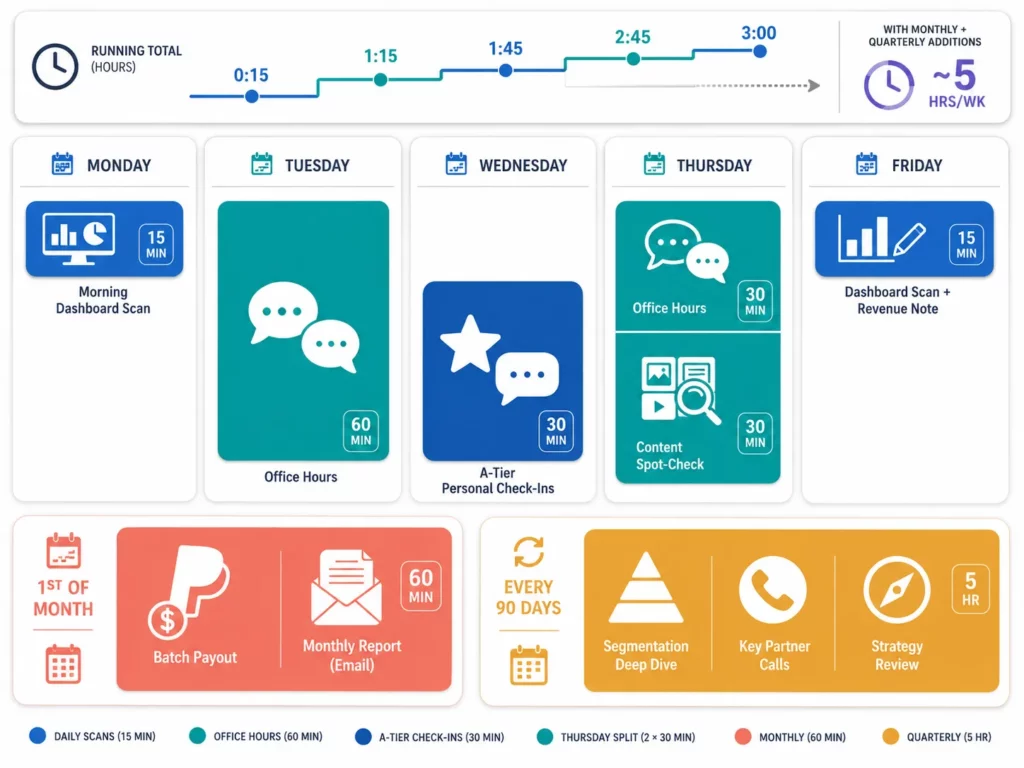
When all seven systems run together, the weekly time commitment looks like this:
| Day | Activity | Duration |
| Monday | Dashboard scan: applications, fraud flags, revenue | 15 min |
| Tuesday | Office hours: batch affiliate questions | 60 min |
| Wednesday | A-Tier personal check-ins (2-3 DMs or emails) | 30 min |
| Thursday | Office hours + content spot-check (10 pieces) | 60 min |
| Friday | Dashboard scan + weekly revenue note | 15 min |
| 1st of month | Batch payout processing + monthly report email | 60 min |
| 1st week of month | Recruitment sprint: outreach, applications, review | 3-4 hours |
| Every 90 days | Full review, re-segmentation, A-Tier calls, strategy | 5 hours |
Weekly routine: three hours. Add the monthly and quarterly tasks amortized across weeks, and the average lands around five hours per week for a hundred-plus affiliates.
That gap between twenty hours and five is the difference systems make. Vetain runs over 8,000 referrals per month through its affiliate channel by stacking several of these systems at once.
The stack includes auto-tier commissions between programs, performance bonuses tied to sales goals, and scheduled PayPal auto-payouts.
The result: 40% of total sales from affiliate marketing, managed without proportional overhead.
Which Tasks Should You Automate and Which Need a Human?
The seven systems above cover the biggest time sinks. But new tasks appear as a program grows, and each one needs the same decision: automate it or keep it human?
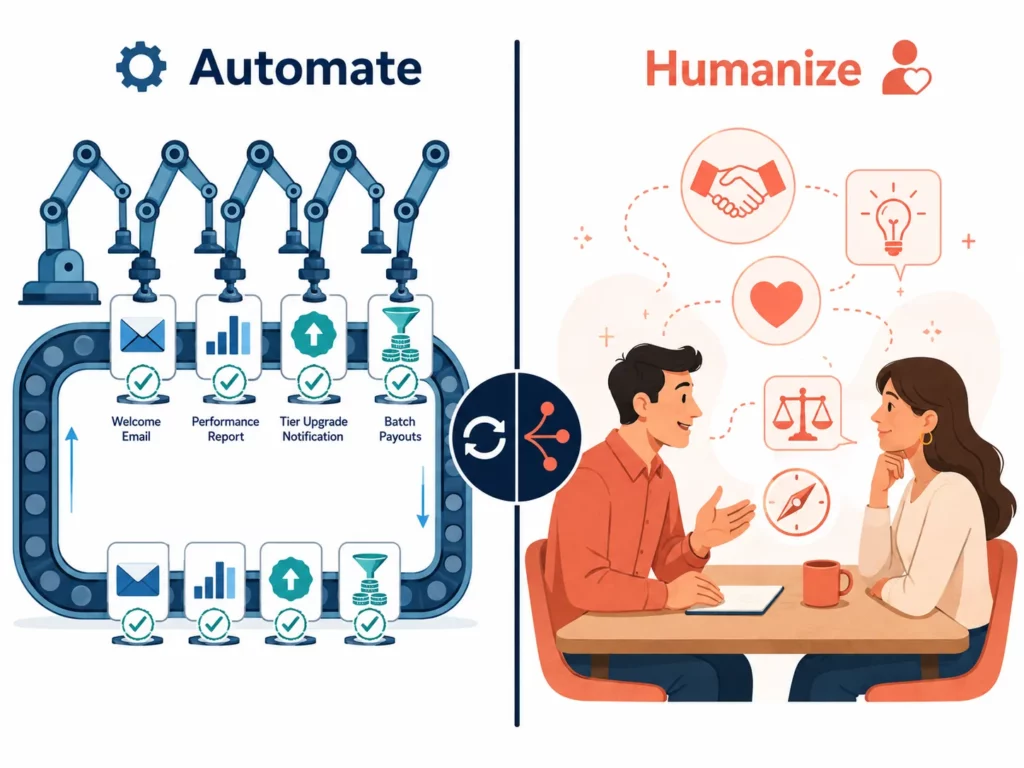
Automate anything that repeats identically every time: emails, payouts, reports, fraud flags. Keep a human in the loop for anything that requires judgment: relationships, negotiations, strategy, conflict resolution.
Roughly 80% of affiliate management tasks fall into the first category.
The dividing line is simple. If the task is a thing that gets delivered the same way to everyone, automate it. If the task is an interaction that changes based on context, keep it human.
| Task | Automate ✅ | Keep Human 🧑 | Why |
| Welcome email | ✅ | Same for everyone | |
| Monthly performance report | ✅ | Data-driven, no personalization needed | |
| Tier upgrade notification | ✅ | Threshold-triggered | |
| Inactivity re-engagement | ✅ | Standard sequence | |
| Payout processing | ✅ | Batch, rules-based | |
| Fraud flagging | ✅ (initial) | 🧑 (final decision) | App flags, human judges |
| A-Tier check-in | 🧑 | Relationship requires human | |
| Custom deal negotiation | 🧑 | Strategy requires human | |
| Commission structure changes | 🧑 | Business decision | |
| Content strategy | 🧑 | Creative direction | |
| Conflict resolution | 🧑 | Empathy required | |
| Ambassador invitations | 🧑 | Personal, selective |
A useful shorthand: automate the noun, humanize the verb. Automate the email. Humanize the relationship. Automate the payout. Humanize the negotiation. Automate the report. Humanize the strategy.
If it repeats identically, a system should handle it. If it requires reading the room, you should handle it.
This principle shows up in how Altenew structures its affiliate payments. Professional affiliates receive cash commissions. Customer advocates receive auto store credit.
The automation handles the mechanical split. The team reserves personal attention for an inner circle of influencers receiving free products and early access each month.
The program tracked 25,000 orders in year one with affiliates contributing 15-25% of total revenue. That scale runs on automated delivery for the majority and personal attention for the few who drive outsized results.
When Should You Hire Help (And What to Delegate First)?
A solo merchant can manage up to a hundred affiliates with the seven systems above. Between a hundred and three hundred, a part-time virtual assistant keeps the workload sustainable.
Beyond three hundred or $50K monthly in affiliate revenue, a dedicated manager makes more sense.
| Metric | Solo (with systems) | VA or part-time | Full-time manager |
| Active affiliates | Under 100 | 100-300 | 300+ |
| Monthly affiliate revenue | Under $10K | $10K-$50K | $50K+ |
| Hours/week on management | Under 8 | 8-15 | 15+ |
When you reach the VA stage, delegate in this order. Application review and approval first, because it is repetitive and rule-based. Outreach email sending second, where you write the templates and the VA personalizes and sends.
Monthly payout processing comes third. Content spot-checking fourth. Keep A-Tier relationships, commission strategy, and new initiative planning for yourself.
A VA at five to ten hours per week costs roughly $200-$600 per month. A full-time affiliate marketing manager in the US averages $66K-$100K per year (Glassdoor, 2026).
The gap is wide enough that most programs between $10K and $50K monthly should hire a VA first, not a full-time manager.
When you do add someone, UpPromote’s staff account feature lets you grant dashboard access with role-based permissions. Your VA or manager sees only what they need to do their job.
What Mistakes Do Most Merchants Make When Scaling Past 100 Affiliates?
Five mistakes show up in nearly every affiliate program that tries to scale past a hundred partners without systems. The most expensive one is also the most intuitive.
| # | Mistake | What happens | Fix |
| 1 | Treating all 100 affiliates equally | 80% of time goes to the bottom 80% of earners | Segment A/B/C tiers. Spend 60% of time on top 20%. |
| 2 | Answering every email immediately | Zero proactive time, constant reactive mode | Office hours. Batch responses. FAQ document. |
| 3 | Running manual payouts weekly | 2+ hours per week on a mechanical task | Monthly batch payout with $25 minimum threshold. |
| 4 | Reviewing every piece of content | 400 pieces per month at scale is impossible | Approval by exception. Spot-check 10-20%. |
| 5 | Recruiting continuously instead of in sprints | Constant context-switching, low-quality outreach | Monthly recruitment sprint. Weeks 2-4: manage only. |
Mistake number one deserves a closer look because it feels like the right thing to do. Giving every affiliate equal attention sounds fair. But time is finite, and equal is not the same as proportional.
Thirty minutes monthly on a five-dollar affiliate costs more in time than their output. The same effort on a two-thousand-dollar affiliate returns four hundred times more.
That gap is the reason fair does not mean equal. Fair means proportional to value and potential. A-Tier affiliates earned more attention through results, and segmentation is the fix.
What Changed in 2026?
Affiliate apps now offer deeper native automation. Auto-tier promotions, scheduled payouts, triggered emails, and fraud flagging all run inside the app without external tools.
The 80% automation target in this guide is achievable without stitching together five different platforms.
Moreover, AI has become a practical co-manager. Tools like ChatGPT and Claude handle performance data analysis, draft affiliate emails, and flag patterns in program metrics that a human would miss at scale.
Frequently Asked Questions
Can you really manage 100 affiliates in 5-8 hours per week?
Yes, with all seven systems in place. Without systems, expect 15-25 hours. The two highest-impact changes are segmentation (stop giving equal time to every affiliate) and email automation (stop writing the same messages manually). Implement those two first and weekly time drops to 8-10 hours. Add the remaining five systems to reach 5-8.
Should you remove inactive affiliates from your program?
Yes, after six months of zero activity and no response to re-engagement emails. Inactive accounts clutter the dashboard, skew performance metrics, and occasionally become coupon leak vectors. The exception is a high-follower affiliate who may reactivate seasonally. Tag those as dormant instead of removing them.
How do you handle an A-Tier affiliate threatening to leave for a competitor?
Listen first. The concern is usually a higher commission elsewhere or feeling undervalued. Counter within your margins: a commission bump, exclusive products, or a co-creation opportunity. If the affiliate generates $2,000 or more per month, investing to retain them costs far less than replacing them. Losing a top performer means losing a disproportionate share of program revenue.
How do you filter a dashboard when it shows 100+ affiliates?
Filter by what needs attention today rather than viewing everyone at once. Daily: filter by active affiliates with clicks in the last 30 days and scan top performers. Monthly: filter by inactive for 60-plus days and either re-engage or remove. Sorting by revenue over the last 90 days is the fastest way to identify tier changes.
Does automating communication make the program feel impersonal?
Only the affiliates who do not engage receive fully automated communication, and they rarely notice because their interaction level is already low. A-Tier affiliates still get personal check-ins, custom deals, and direct messages. The partners who drive meaningful revenue feel valued. Automation frees the time to make that happen.
At what point do these systems break down?
One person with strong systems can manage 300-500 affiliates. Beyond 500, a dedicated manager is necessary. Beyond 1,000, a small team (manager plus VA plus outreach specialist) becomes the standard structure. The systems themselves scale, but human attention capacity has a ceiling.

Ellie Tran, a seasoned SEO content writer with three years of experience in the eCommerce world. Being a part of the UpPromote team, Ellie wants to assist Shopify merchants in achieving success through useful content & actionable insights.Ellie's commitment to learning never stops; she's always eager to gain more knowledge about SEO and content marketing to create valuable content for users. When she's not working on content, Ellie enjoys baking and exploring new places.
![How to Use Shopify Functions with Your Affiliate Program [2026 Guide]](https://static.uppromote.com/wp-content/uploads/2026/06/how-to-use-shopify-functions-with-affiliate-program-300x169.webp)

![How to Prevent Affiliate Fraud on Shopify: Self-Referral, Coupon Abuse & More [2026]](https://static.uppromote.com/wp-content/uploads/2026/06/how-to-prevent-affiliate-fraud-on-shopify-300x169.webp)