











TL;DR
Around 20% of affiliate traffic is fraudulent, and coupon code leaks are the most common type Shopify merchants face.
- Most common fraud: Coupon codes leaked to Honey, RetailMeNot, and deal sites
- Cost estimate: 10–20% of affiliate revenue lost without protection
- Detection: 8 red flag metrics with specific thresholds
- Prevention: 3 layers — program design, app features, weekly monitoring
- Setup cost: $0 for most methods — built-in app protections + 15 min/week audits
Your affiliate program is likely leaking money right now, and the cause is simpler than you think. It is a coupon code sitting on Honey or RetailMeNot.
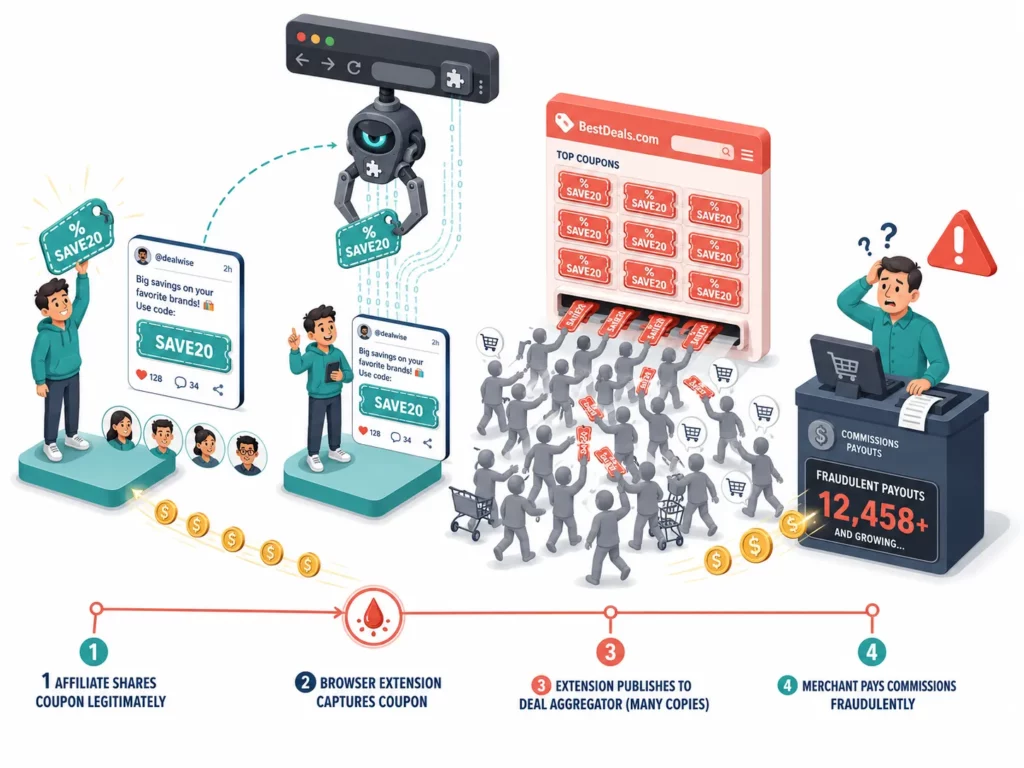
Here is how it works. An affiliate shares a code like “SARAH15.” A browser extension scrapes it. Thousands of random shoppers use it at checkout. The affiliate earns commission on every one of those sales, without driving any of them.
That one mechanic alone hits 5–10% of all transactions . Across the industry, roughly 20% of all affiliate traffic is fraudulent .
The damage gets worse when no one is watching. Two affiliates once stole $28 million from eBay through cookie stuffing before anyone caught on.
Most Shopify merchants find this kind of damage months later, buried in commission reports. The good news: eight fraud types cause the bulk of those losses, and each one leaves a trail you can spot.
Once you know the patterns, prevention comes down to the right setup and a short weekly routine.
How Big Is the Affiliate Fraud Problem?
A store earning $25,000 a month from affiliates stands to lose $2,500–$5,000 of that to fraud.
Most merchants never notice because the money disappears inside commission payouts that look normal on the surface.
The problem is growing alongside the channel itself. U.S. affiliate spend is on track to hit $13.8 billion in 2026 (EMARKETER), and digital ad fraud across all channels could reach $172 billion by 2028 .
More money in the channel means more incentive for bad actors. At different revenue levels, the cost adds up fast.
| Monthly Affiliate Revenue | Est. Fraud Rate | Monthly Loss | Annual Loss |
| $5,000 | 10–20% | $500–$1,000 | $6,000–$12,000 |
| $10,000 | 10–20% | $1,000–$2,000 | $12,000–$24,000 |
| $25,000 | 10–20% | $2,500–$5,000 | $30,000–$60,000 |
| $50,000 | 10–20% | $5,000–$10,000 | $60,000–$120,000 |
Conservative range. Actual fraud rate varies by industry, program controls, and affiliate vetting quality.
The flip side of those numbers is just as clear. Most of these losses come from a handful of fraud types that are straightforward to prevent.
Knowing which ones to prioritize starts with understanding how they work.
8 Types of Affiliate Fraud Shopify Merchants Face
Not all affiliate fraud looks the same. Shopify stores face a different mix than SaaS or lead-gen businesses, and coupon leaks top the list by a wide margin.
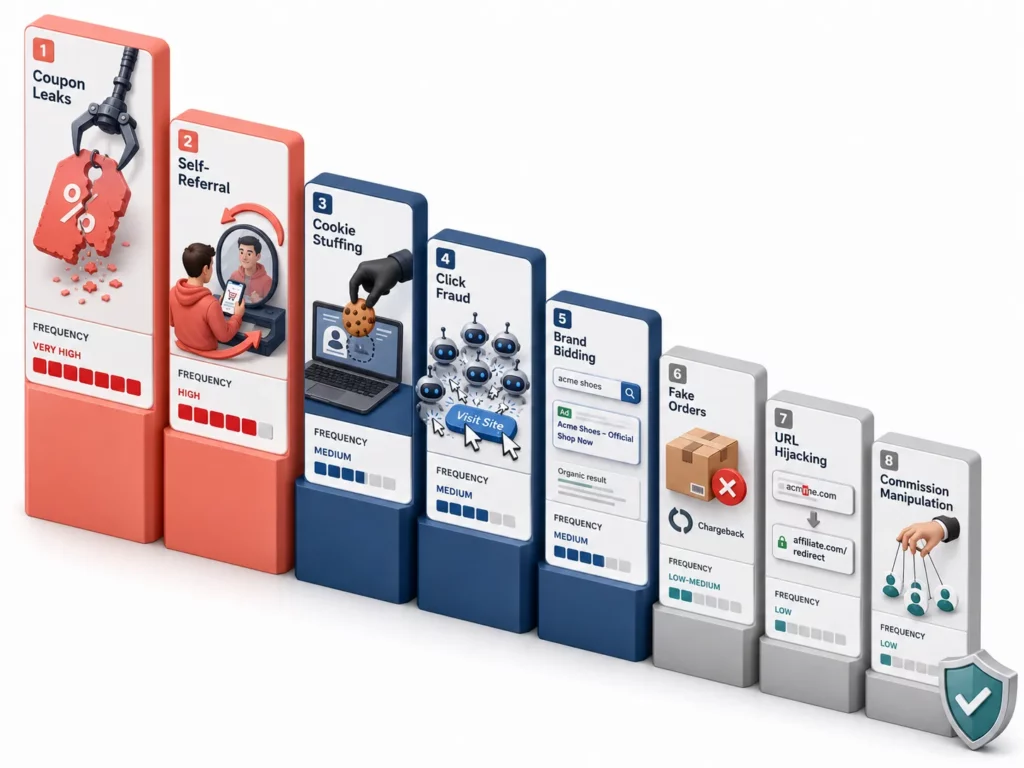
Here are all eight types, ranked by how often they hit ecommerce stores.
| # | Fraud Type | How It Works | Shopify Frequency | Detection |
| 1 | Coupon code leaks | Codes scraped by Honey or posted on deal sites — random shoppers use them | Very high | Easy |
| 2 | Self-referral abuse | Affiliate buys own products through their link or code | High | Easy |
| 3 | Cookie stuffing | Hidden cookies dropped on unrelated visitors to claim credit for organic sales | Medium | Hard |
| 4 | Click fraud | Bots generate fake clicks on affiliate links to inflate metrics | Medium | Medium |
| 5 | Brand bidding | Affiliate runs PPC ads on your brand keywords to steal organic traffic | Medium | Medium |
| 6 | Fake leads/orders | Fake COD orders or stolen card purchases — you get chargebacks, they get paid | Low–Med | Medium |
| 7 | URL hijacking | Typo domains redirect to your store through an affiliate link | Low | Hard |
| 8 | Commission manipulation | Multiple accounts to game tiered commission thresholds | Low | Hard |
The Four Most Common Types
These four types account for the vast majority of fraud Shopify merchants face.
They range from simple coupon abuse to bot-driven traffic manipulation, and the first two are easy to catch once you know what to look for.
🏷️ Coupon code leaks top the list . An affiliate’s code ends up on Honey or a deal site, random shoppers use it, and the affiliate earns commission on sales they never drove.
Auto-apply discount links fix this by removing the visible code entirely. A separate guide covers coupon leak prevention in depth.
🔄 Self-referral abuse is different but just as easy to catch. The affiliate buys through their own link to pocket commission plus the discount. Some do it once; others use gift cards or multiple accounts.
🍪 Cookie stuffing is a step up in difficulty. The affiliate drops tracking cookies onto visitors of unrelated sites , and if those visitors later buy from you, the affiliate claims credit.
The eBay case is the textbook example. One affiliate collected $28 million this way before the FBI caught on.
🤖 Click fraud is the last of the top four. Bots send fake clicks to inflate traffic numbers. For pay-per-sale stores the direct cost is low, but bad data leads to wrong calls about which affiliates to keep.
Types 5–8: Less Common, Higher Complexity
The other four show up less often but are harder to catch when they do. Most Shopify stores encounter them only as their programs scale.
🔍 Brand bidding targets your existing traffic. An affiliate runs Google Ads on your brand name, and shoppers click the ad instead of your organic listing. You pay both the inflated CPC and the affiliate commission.
📦 Fake orders take a different form. The affiliate places COD or stolen card purchases, collects commission, and leaves you with the chargeback. Tools like Chargeflow automate chargeback alerts so these disputes get flagged and disputed before they turn into permanent losses.
🔗 URL hijacking works through typo domains (yourbrad.com) that redirect visitors through an affiliate link. Commission manipulation is the least common — an affiliate creates multiple accounts to game tiered thresholds.
How to Detect Affiliate Fraud (Red Flag Metrics)
Catching fraud early is the difference between losing a few hundred dollars and losing tens of thousands. Most fraud leaves a data trail, and eight metrics can help you spot it.
The thresholds below are guidelines, not exact cutoffs, but they flag the right patterns.
| # | Metric | Normal Range | Red Flag | Likely Fraud Type |
| 1 | Click-to-sale ratio | 20:1 to 50:1 | >100:1 | Click fraud, cookie stuffing |
| 2 | Sudden traffic spike | Gradual growth | 5x+ overnight | Bot traffic, click fraud |
| 3 | Geographic mismatch | Matches target market | 80%+ from non-target countries | Bot farms |
| 4 | Same-IP clusters | Diverse IPs | 10+ orders from same IP | Self-referral, fake orders |
| 5 | Orders without clicks | Some (coupon-only) | High volume, zero clicks | Coupon leaks |
| 6 | Affiliate refund rate | Store average (2–5%) | Affiliate-specific >15% | Fake orders |
| 7 | Commission spike | Steady growth | 3x+ month-over-month | Any fraud type |
| 8 | New affiliate high volume | Builds over weeks | 50+ sales in first week | Self-referral, fake orders |
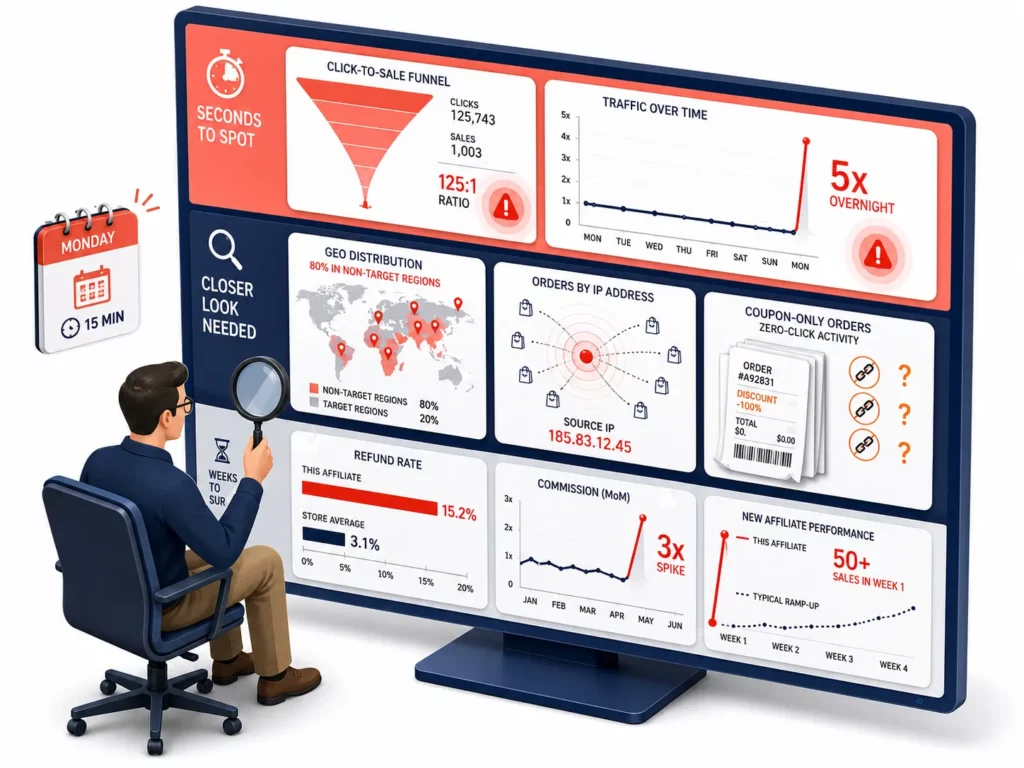
These eight metrics split into three groups based on how fast they surface.
Metrics 1–2 show up in a quick dashboard glance. A click-to-sale ratio above 100:1 means an affiliate is sending traffic that barely converts, pointing to bots or cookie stuffing.
A traffic spike of 5x overnight with no clear cause tells a similar story. Both of these red flags take seconds to check.
Metrics 3–5 require a closer look at the data. Geographic mismatch shows when 80%+ of traffic comes from countries you do not sell to. Same-IP clusters point to self-referral rings. Orders with zero link clicks signal coupon leaks.
Metrics 6–8 only emerge over weeks. A refund rate triple your store average, commission spikes with no matching promotion, and new affiliates hitting 50+ sales in week one are patterns a single check would miss.
Most affiliate dashboards already report these numbers, such as clicks, orders, conversion rates, and IP data. The data is there; you just need a routine to check it.
7 Prevention Methods (Layered Defense)
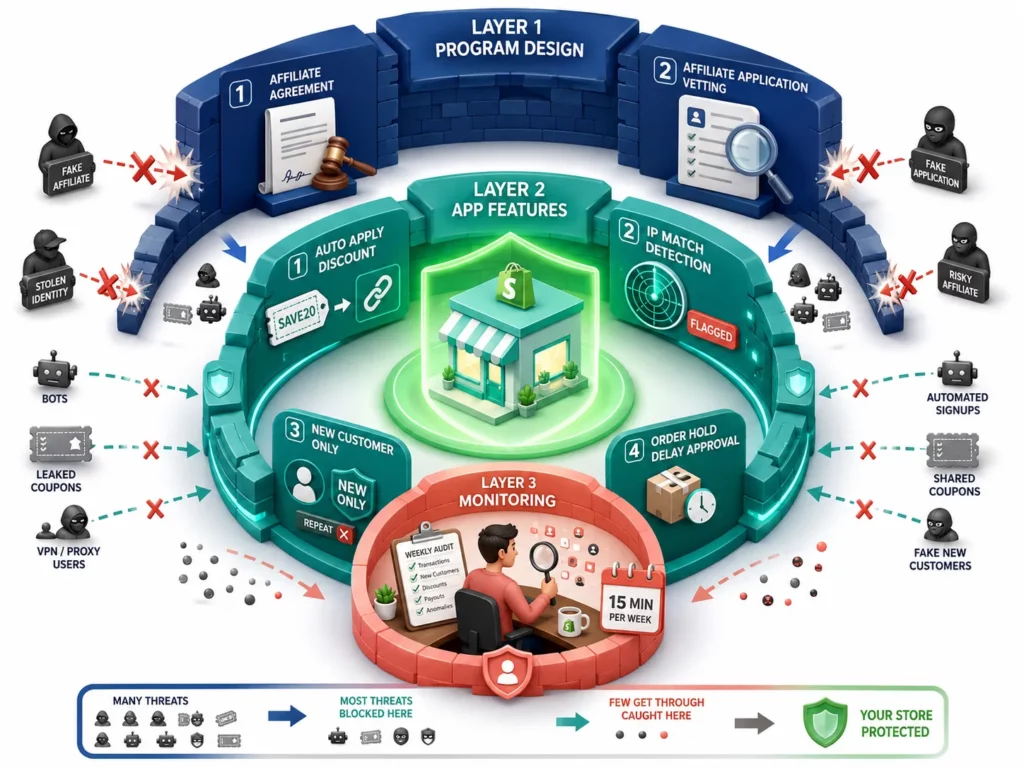
No single fix stops all affiliate fraud.
The best approach stacks three layers: design your program to block fraud at the start, use app features to automate protection, and monitor weekly to catch what slips through.
The seven methods below map to those three layers.
| # | Method | Layer | Prevents | Setup |
| 1 | Strong affiliate agreement | Design | All types (legal basis to act) | One-time |
| 2 | Vet affiliates before approving | Design | Fake affiliates, low quality | 5 min/app |
| 3 | Auto-apply discount links | App | Coupon leaks (#1 fraud type) | One-time |
| 4 | Fraud detection (IP + email flags) | App | Self-referrals, duplicates | One-time |
| 5 | New-customer-only commission | App | Self-referral repeat abuse | One-time |
| 6 | Order approval delay | App | Fake orders, COD fraud | One-time |
| 7 | Weekly audit checklist | Monitor | All types (catch exceptions) | 15 min/week |
Let’s dive deep into each layer
Layer 1: Program Design
Your agreement is the legal foundation. Without a clause that names prohibited activities and allows termination, you have no way to act when fraud happens.
A separate guide covers the full affiliate program agreement template, including clawback language for forfeited commissions.
Vetting is the second defense. Five minutes per application is enough to check for a real website, active social presence, and content that fits your brand. Auto-approve should stay off for new programs.
Layer 2: App Features
Auto-apply discount links solve the #1 fraud type at the source. The discount applies through the affiliate link instead of a visible code, so extensions and coupon sites have nothing to scrape.
Fraud detection handles the patterns that program design cannot. Apps like UpPromote flag self-referrals, same-IP signups, and disposable emails , then let you review and block flagged accounts.
Layer 3: Monitoring
No automated system catches everything. A 15-minute weekly check using the metrics from the previous section is the safety net. The full checklist appears later in this guide.
Key takeaway: Three layers, seven methods. Layer 1 (design) blocks fraud at the start. Layer 2 (app) automates protection. Layer 3 (monitoring) catches what slips through. Most methods cost nothing beyond initial setup.
Weekly Fraud Audit Checklist (15 Minutes)
A weekly check catches the majority of fraud before it gets expensive. The goal is consistency, not depth. Fifteen minutes every Monday is more effective than a deep dive once a quarter.
Here is the eight-point routine:
All clear? See you next Monday. In case you find a flag, follow the response protocol below.
What to Do When You Catch a Fraudulent Affiliate
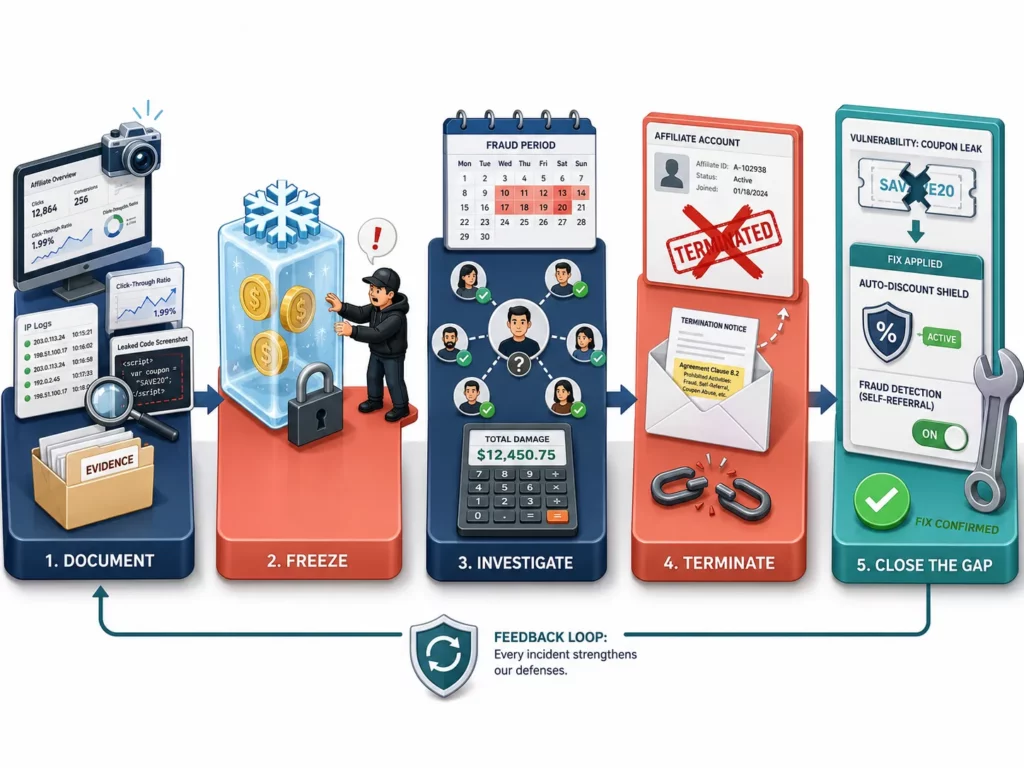
Finding fraud is step one. How you respond determines whether it happens again. A clear protocol protects your money and your legal standing.
Step 1: Document everything first. Screenshots of dashboard data, IP logs, click-to-sale ratios, and leaked codes. Export the affiliate’s activity report for the review period. You need evidence before taking action.
Step 2: Freeze pending commissions. Hold all unpaid commissions for the flagged affiliate until the investigation is complete. Do not pay while a case is open.
Step 3: Investigate the scope. How long has the fraud been active? How much commission was paid on fraudulent activity? Is this one bad actor or a pattern across multiple affiliates?
Step 4: Terminate and communicate. End the affiliate’s account and send a clear message citing the specific clause they violated. Reference your agreement. Vague language like “we decided to end the partnership” gives you no legal standing.
Step 5: Close the gap. Ask what allowed the fraud in the first place. Leaked codes? Enable auto-discount. Self-referrals? Check that fraud detection is active. Missing agreement clause? Update the template.
If your agreement includes a clawback clause, you can withhold pending commissions and reverse paid ones. Without that clause, recovery is much harder. Include clawback language before fraud happens.
What Changed in 2026?
Affiliate fraud is not standing still. Six shifts are reshaping how merchants need to think about protection this year.
The Capital One Shopping lawsuit sent a signal across the industry. Content creators sued over cookie replacement by a browser extension, and Capital One settled for about $4 million .
The outcome put browser extension behavior under a spotlight that is not fading anytime soon.
The technology side is shifting just as fast. AI-powered fraud detection is growing, with platforms using machine learning to spot patterns that manual reviews miss, including click velocity anomalies and referral timing gaps.
Fraudsters are adapting in parallel. Cookie stuffing is shifting away from third-party cookies toward first-party data tricks and browser fingerprinting. Server-side tracking is a stronger defense.
Synthetic identity fraud adds another layer of difficulty. AI-generated fake profiles with deepfake photos and polished bios make vetting harder. Manual review of affiliate applications matters more now than it did a year ago.
The industry mindset has shifted as well. Fraud is no longer treated as an occasional incident. The working assumption for 2026 is that fraud is an operating condition built into incentive structures, not a one-off surprise.
Frequently Asked Questions
How common is affiliate fraud for Shopify stores?
Industry-wide, roughly 20% of affiliate traffic is fraudulent. For Shopify stores, coupon leaks are far more common than cookie stuffing. With proper protections like auto-apply discount links, vetting, and an agreement, fraud rates drop to a manageable 2–5%.
Are coupon leaks actually fraud?
It depends on intent. An affiliate posting a code on a coupon site on purpose is fraud. A code scraped by Honey without the affiliate’s knowledge is not the affiliate’s fault, but it still costs you money. Removing the visible code with auto-apply discount links fixes both problems.
I suspect fraud but I am not sure — what should I do?
Do not terminate right away. Document the specific data points, then monitor closely for two to four weeks. If the pattern continues, ask the affiliate for an explanation. Base your decision on data and their response.
Can UpPromote detect cookie stuffing?
UpPromote tracks click-to-sale ratios and IP data, so anomalies tied to cookie stuffing show up in reports. Direct detection of the cookie-planting mechanism requires dedicated tools like TrafficGuard or Anura. For most Shopify stores, ratio monitoring plus weekly audits is enough.
Should I auto-approve affiliate applications?
Not for new programs. Manual review takes five minutes per application and blocks the majority of bad actors at the door. Consider auto-approve only when your program is mature and you have strong automated filters in place.
Does fraud protection cost extra money?
Core fraud detection in UpPromote ships on the free plan. Weekly audits cost 15 minutes of time. For 95% of Shopify stores, the total extra cost is zero. Dedicated fraud tools like TrafficGuard or Spider AF run $200–$1,000+ per month and are only needed at enterprise scale.
Can a terminated affiliate sue me?
If your agreement includes clear termination and prohibited activity clauses, backed by documented evidence, the risk is very low. Standard agreements include commission forfeiture language. For disputes over $5,000+, consult an attorney.
Will fraud prevention hurt my legitimate affiliates?
Not if done right. Auto-apply links increase conversion rates for affiliates. IP tracking runs in the background. Manual approval adds a 24–48 hour delay that most affiliates expect. Frame it as protection for honest partners: their genuine referrals get accurate credit and timely payment.

Ellie Tran, a seasoned SEO content writer with three years of experience in the eCommerce world. Being a part of the UpPromote team, Ellie wants to assist Shopify merchants in achieving success through useful content & actionable insights.Ellie's commitment to learning never stops; she's always eager to gain more knowledge about SEO and content marketing to create valuable content for users. When she's not working on content, Ellie enjoys baking and exploring new places.
![How to Use Shopify Functions with Your Affiliate Program [2026 Guide]](https://static.uppromote.com/wp-content/uploads/2026/06/how-to-use-shopify-functions-with-affiliate-program-300x169.webp)
![How to Prevent Affiliate Fraud on Shopify: Self-Referral, Coupon Abuse & More [2026]](https://static.uppromote.com/wp-content/uploads/2026/06/how-to-prevent-affiliate-fraud-on-shopify-300x169.webp)