











TL;DR
Most Shopify stores do not need Shopify Plus to run a profitable affiliate program, but stores processing $200K+/month with 200+ affiliates gain measurable advantages from Plus-exclusive checkout controls.
- Plus-exclusive advantage: Extensible checkout blocks 125+ coupon-injecting browser extensions
- Not Plus-exclusive: Shopify Flow, fraud detection, automated payouts, tiered commissions
- Upgrade threshold: $200K+ monthly revenue, 200+ affiliates, $2,300+/month in recoverable losses
- ROI reality: Plus rarely pays for itself through affiliate savings alone
- Key apps at scale: UpPromote, Refersion, Impact
A fifteen-affiliate program on Shopify Basic can run smoothly. Approvals take five minutes, payouts go through PayPal once a month, and fraud is barely a concern.
Once that program scales to 200 affiliates, $50K in monthly affiliate revenue, and 5,000 referred orders, the problems shift.
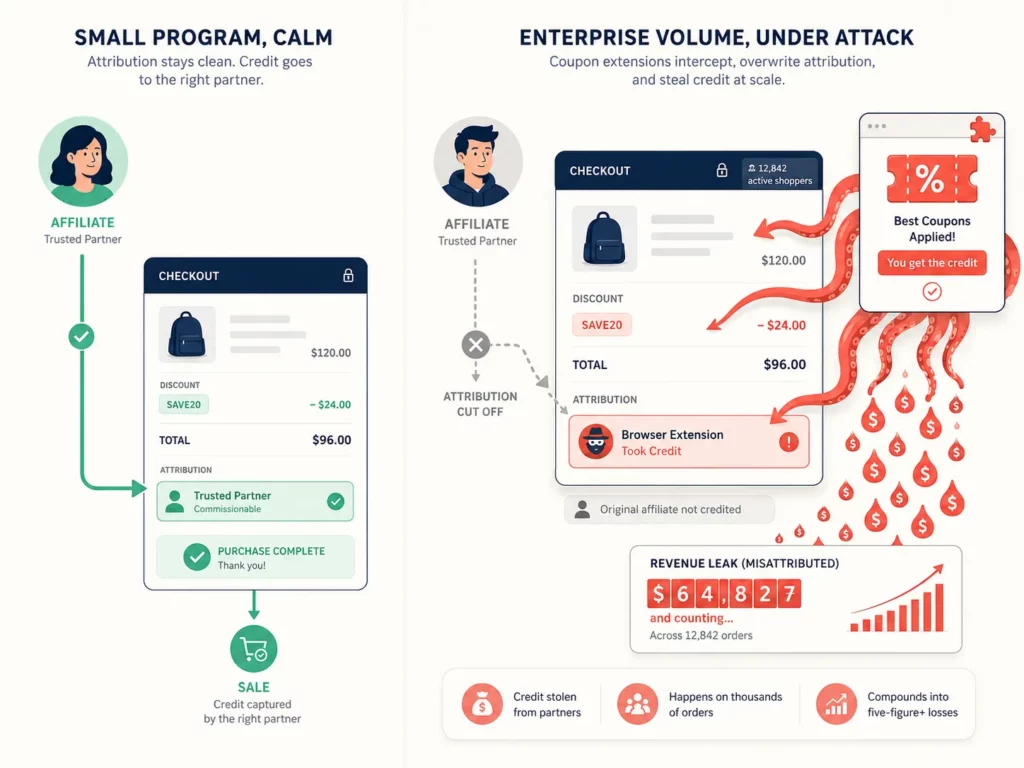
Coupon-injecting browser extensions can intercept sales at checkout, crediting the wrong source. Manual payouts may consume hours every cycle, while commission logic that worked for a single flat rate now needs tiers, product overrides, and new-customer bonuses.
These are not “bigger” versions of small-program problems. They require different infrastructure.
Shopify Plus, at $2,300 per month, could provide that infrastructure. Yet the price raises a fair question: which enterprise affiliate capabilities require Plus, and which come from your affiliate app regardless of plan?
In this blog, we’re going to separate the two: which features require Plus, which do not, the best apps for enterprise scale, and when the upgrade pays for itself.
What Makes an Affiliate Program “Enterprise”?
An affiliate program becomes “enterprise” not when it gets bigger, but when it starts facing problems that small-program tools cannot solve.
Those problems typically surface once a store crosses roughly 200 active affiliates and $50K per month in affiliate-driven revenue.
Revenue, affiliate count, and commission complexity tend to move together. The point where they demand enterprise-grade infrastructure clusters around the same growth stage.
| Dimension | Small Program | Mid-size | Enterprise |
| Active affiliates | 5–50 | 50–200 | 200–5,000+ |
| Monthly affiliate revenue | $1K–$10K | $10K–$50K | $50K–$500K+ |
| Commission structures | 1–2 types | 2–3 types | 5+ (tiered + product-specific + new-customer + recurring) |
| Payout complexity | Manual | Semi-automated | Fully automated + tax compliance |
| Fraud exposure | Low | Moderate | High — coordinated patterns |
The rightmost column might look like a natural step up from the middle tier. In practice, the jump introduces problems that no amount of manual effort can keep up with.
The most visible cost is coupon leakage. Browser extensions like Honey and Coupert can inject discount codes at checkout, overwriting affiliate tracking and claiming credit for sales the affiliate drove.
At enterprise volume, even a modest leak rate may translate into thousands per month in misattributed revenue.
Those losses would be easier to contain if the rest of the operation were not already strained. Yet 200 affiliates generating tiered commissions, refund adjustments, and product-specific overrides can overwhelm any manual workflow.
As the financial stakes rise, so does the sophistication of fraud.
Small programs may see the occasional self-referral. Enterprise programs face coordinated patterns: cookie stuffing, self-referral rings, and abuse networks that basic detection will miss.
The final pressure is regulatory. In the US, any merchant paying $600 or more to an affiliate in a calendar year must file a 1099-NEC.
With 200+ affiliates, that could mean dozens of filings and manual tracking at that scale invites errors with real penalties.
Which Shopify Plus Features Unlock Enterprise Affiliate Capabilities?
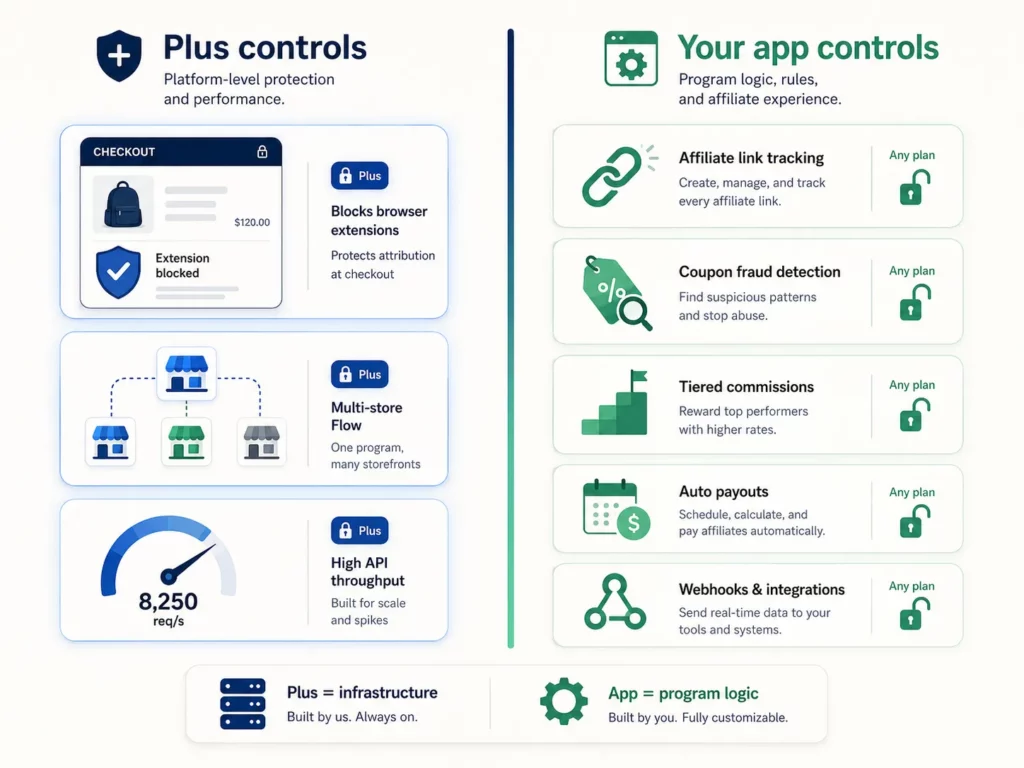
There are three Shopify Plus capabilities matter most for enterprise affiliate programs: checkout-level coupon blocking, multistore Shopify Flow automation, and higher API throughput.
Yet tracking, fraud detection, tiered commissions, and automated payouts all come from the affiliate app, not the Shopify plan. Most enterprise affiliate features sit on that side of the line.
Here is how the most common affiliate-related capabilities split between Plus and standard plans.
| Capability | Without Plus | What Plus Adds |
| Coupon extension blocking | Not available at checkout level | Third-party apps can block 125+ browser extensions at checkout |
| Shopify Flow | Available on all paid plans | Multistore automation + deeper third-party app connectors |
| API access | Standard endpoints and rate limits | Higher rate limits for bulk operations and custom reporting |
| Multi-store management | One store per account | Unified program across multiple storefronts |
| Checkout customization | Standard checkout | Full Checkout Extensibility with UI Extensions |
How Extensible Checkout Blocks Coupon Leaks
Checkout-level coupon blocking is the clearest Plus-only advantage for affiliate programs.
Apps like KeepCart and Promo Pirates use Checkout Extensibility to block over 125 browser extensions before they can inject discount codes.
This capability remains exclusive to Plus stores. For programs where coupon leakage costs thousands per month, that single feature could justify a meaningful portion of the $2,300 subscription.
What Shopify Flow Requires Plus For
Shopify Flow is often listed alongside extensible checkout as a Plus feature, yet the reality has changed. Flow is now free on every paid Shopify plan, Basic, Grow, and Advanced included.
In practice, common affiliate automations run the same regardless of plan. Tagging new affiliates, triggering tier upgrades on sales milestones, and sending re-engagement emails through Klaviyo all work on a $39 Basic store.
What Plus adds is multistore capability and deeper third-party app connectors. For a single-store merchant managing 500 affiliates, Flow on a standard plan may cover every automation need.
Meanwhile, the features that power daily affiliate operations come from the affiliate app, not from Shopify Plus. Tracking links, coupon attribution, fraud detection, tiered commissions, and scheduled payouts all work regardless of plan.
UpPromote’s fraud detection, for example, flags suspicious signups, self-referrals, and abnormal order patterns. Its API and webhook access on the Enterprise tier connects affiliate data to CRM or BI tools without requiring Plus.
That distinction matters. Plus controls the checkout and platform infrastructure, while your affiliate app controls the program logic.
What Are the Best Affiliate Apps for Enterprise Shopify Plus Stores?
At enterprise scale, an affiliate app needs to handle hundreds of partners, complex commissions, automated payouts, and fraud detection.
Pricing models can vary more than the listed subscriptions suggest. Most apps charge a revenue-based fee on top of the monthly rate, so the true cost will depend on program volume.
| App | Shopify App Store | Enterprise pricing | Key enterprise feature |
| UpPromote | 4.9★, 3,400+ reviews | $199.99/mo + 1% rev fee | Customization multi-store, API & webhooks |
| Refersion | 4.7★, 480+ reviews | $199/mo | SKU & email-level tracking, Multi-currency support, 30+ email & marketing integrations |
| Social Snowball | 4.4★, 180+ reviews | From $899/mo | TikTok Shop, Creator Search & Outreach, Social listening |
| Impact | External platform | Custom pricing | Global network, multi-touch attribution |
Ratings and review counts from apps.shopify.com, May 2026. Pricing may vary by plan and contract terms.
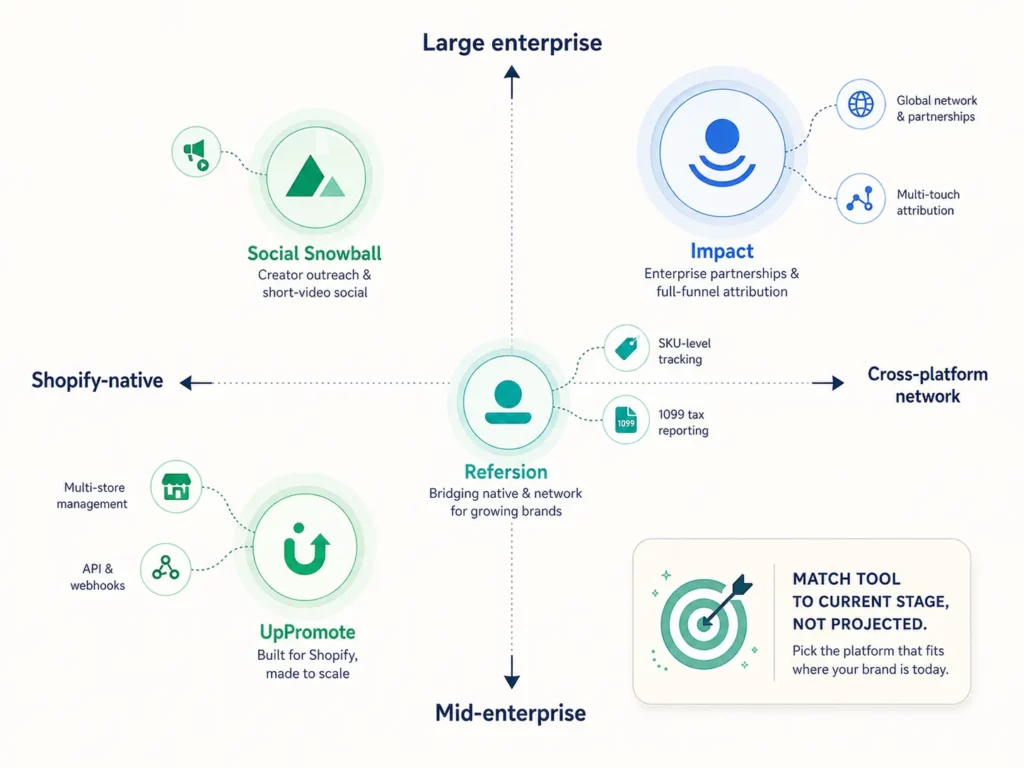
For a Shopify-only store with 200 to 2,000 affiliates, a Shopify-native app can typically cover the full range of enterprise needs.
That range may stretch further than mid-size merchants expect. GoldieLocks manages 2,900 active affiliates on UpPromote, split into salon retail partners at 15% and influencers selected for brand fit.
Once a program spans platforms beyond Shopify, the calculus shifts. Impact operates as a standalone network with global reach, multi-touch attribution, and ML-based fraud detection.
Refersion, meanwhile, sits between the two models. It offers first-party tracking, network integrations, and built-in 1099 tax automation for US merchants.
👉The practical advice: match the tool to your current stage rather than your projected one. A 30-affiliate program rarely needs infrastructure built for 2,000, and migrating later will cost far less than overpaying now.
When Should You Upgrade to Shopify Plus for Your Affiliate Program?
Shopify Plus rarely pays for itself through affiliate program savings alone. The upgrade makes financial sense when combined benefits from checkout control, automation, and fraud prevention exceed $2,300 per month.
The question is not whether Plus will improve your affiliate operations. It is whether that improvement justifies $2,300 per month on top of your existing plan.
| Signal | Stay on current plan | Consider Plus |
| Monthly revenue | Under $200K | $200K+ |
| Active affiliates | Under 150 | 150+ |
| Coupon leak cost | Under $500/mo | $1,000+/mo |
| Commission types | 1–2 structures | 3+ with product and customer rules |
| Checkout control | Not needed | Need extension blocking |
| Store count | Single store | 2+ stores |
For stores that match most of the signals in the right column, a rough cost-benefit calculation can clarify the decision.
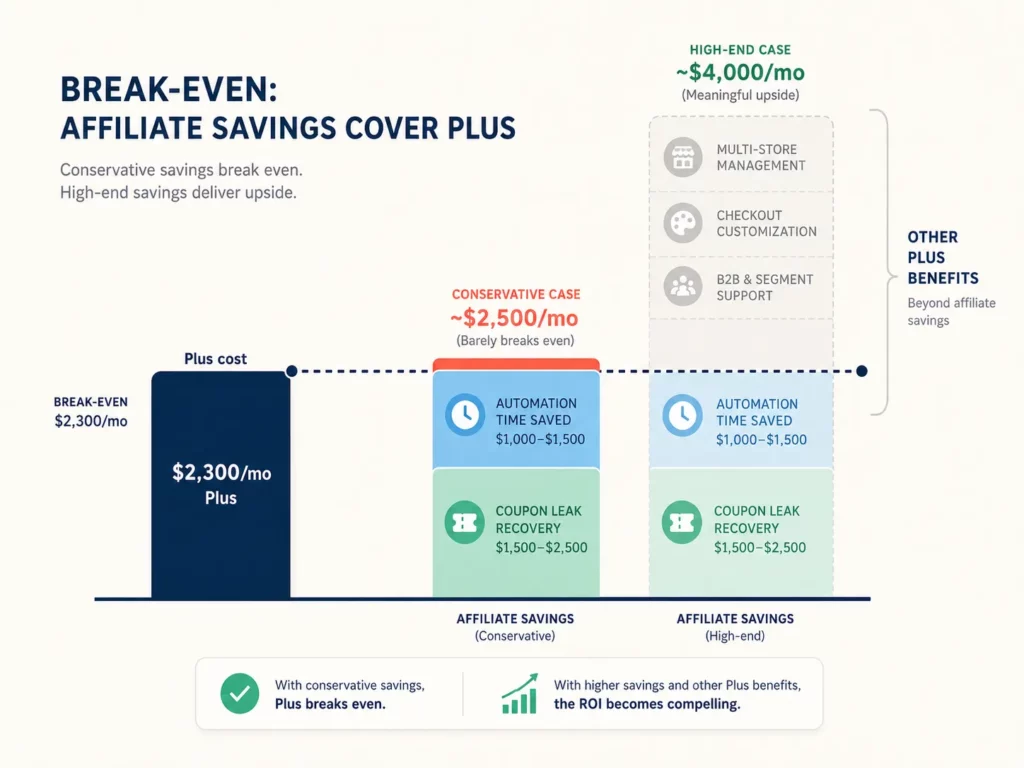
Consider a store processing $300K per month with 150 active affiliates. Extensible checkout could recover $1,500 to $2,500 per month in coupon leakage alone.
Meanwhile, Shopify Flow automation might save 10 to 15 hours of manual work per month. At a typical manager’s rate, that translates to roughly $1,000 to $1,500 in recovered time.
At the conservative end, those combined savings total around $2,500 per month. At the high end, $4,000 or more. The $2,300 Plus subscription would need to sit near the lower bound just to break even on affiliate benefits.
In practice, most merchants who upgrade do so for reasons beyond affiliate marketing. Checkout customization, B2B wholesale, multi-store management, and higher API limits all factor in.
Affiliate savings become one line in a broader ROI calculation rather than the sole justification.
Yet below $200K per month in revenue with fewer than 150 affiliates, the math rarely works. The enterprise features you need will come from your affiliate app’s higher tier.
How Should You Structure an Enterprise Affiliate Team?
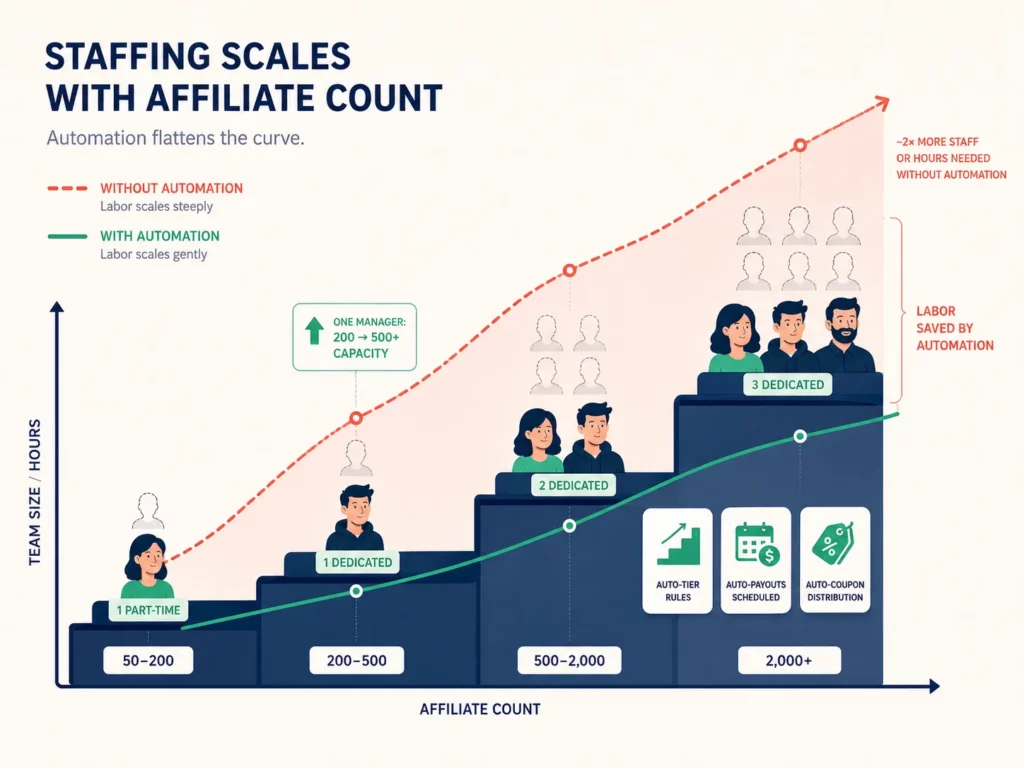
Most affiliate programs can run without dedicated staff until they cross 200 active partners. Beyond that point, the workload outpaces what a part-time marketing manager can absorb.
Management hours scale with affiliate count, yet automation will compress that curve.
| Affiliate count | Staff needed | Estimated hours/week |
| 50–200 | Part-time (existing marketing manager) | 10–15 |
| 200–500 | 1 dedicated affiliate manager | 30–40 |
| 500–2,000 | 1–2 people | 40–60 |
| 2,000+ | 2–3 people | 80+ |
Estimates based on industry benchmarks for programs with automated payouts and fraud detection in place. Without automation, each tier may require roughly double the hours.
Once a program reaches the 200-affiliate mark, the manager’s week fills with application reviews, performance checks, payout processing, and partner communication on different cadences.
Missing any of those cycles compounds into real cost. Unanswered questions lead to disengagement, delayed payouts erode trust, and unreviewed applications slow recruitment.
Automation handles the repetitive layers. When tier upgrades, coupon assignments, and payout schedules run without manual input, the manager’s time shifts from processing to strategy.
UpPromote, for instance, auto-promotes affiliates to higher commission tiers when they hit sales milestones and runs PayPal payouts on a set schedule.
New affiliates can also receive a unique coupon code at approval without manual setup. Those three automations alone could shift one manager’s effective capacity from 200 affiliates to 500 or more.
What Changed for Enterprise Affiliate Programs in 2026?
Three shifts in 2026 affect how enterprise affiliate programs operate on Shopify.
Each one changes a layer of the tracking and attribution stack, and together they may reshape how programs assign credit.
Shopify Functions replace Script Editor
Shopify Functions will replace the legacy Script Editor in June 2026. The change gives all merchants access to custom discount logic and payment filtering through an app-based framework.
Enterprise programs that relied on Plus-exclusive Scripts can now build equivalent checkout logic through Functions on any plan.
Server-side tracking replaces cookies
Meanwhile, third-party cookies continue to lose ground. Server-side tracking has become the default for programs that need reliable attribution.
Click-ID matching and first-party data collection replace the browser-based cookies that Safari and Firefox already restrict.
Multi-touch attribution becomes the standard
Multi-touch attribution, in turn, follows from both changes. When server-side tracking captures the full customer journey, programs can move beyond last-click and credit every affiliate who contributed to a sale.
Frequently Asked Questions
Do I need Shopify Plus to run an affiliate program?
No. Basic Shopify at $39 per month supports the vast majority of affiliate program needs. Plus becomes worth evaluating at $200K or more in monthly revenue with 200 or more affiliates, for checkout-level extension blocking.
Can Shopify Plus pay for itself through affiliate savings alone?
Seldom on its own. The affiliate-specific savings from Plus, coupon leak prevention and automation time, range from $2,500 to $4,000 per month. Most merchants who upgrade justify the cost through a combination of affiliate benefits, checkout customization, B2B features, and multi-store management.
How many affiliates require a dedicated affiliate manager?
Around 200 active affiliates. Below that threshold, a marketing manager can handle the program part-time at 10 to 15 hours per week. Automation tools like scheduled payouts and auto-tier upgrades can extend one manager’s capacity to 500 or more partners.
What is multi-touch attribution and does my program need it?
Multi-touch attribution tracks every affiliate interaction on the path to a sale, not just the last click. Enterprise programs with 100 or more partners should consider it because last-click misses most of the affiliate contributions that influenced a purchase.
How long does it take to build an enterprise affiliate program from scratch?
Expect two to four weeks for a full enterprise setup from scratch, including app configuration, automation workflows, fraud rules, and an initial recruitment batch. Migration from a basic program to enterprise takes one to two weeks.
Which affiliate app features matter most at enterprise scale?
Automated payouts, fraud detection, tiered commission structures, and API access matter most at scale. These features reduce manual workload and prevent revenue loss as affiliate count and transaction volume grow.
Is 1099 tax automation available through Shopify affiliate apps?
Some apps offer built-in 1099-NEC generation for US merchants. Refersion includes this as a core feature. Other apps export the data needed for an accountant to generate the filings. Automation becomes important once 50 or more US-based affiliates earn above the $600 annual threshold.

Ellie Tran, a seasoned SEO content writer with three years of experience in the eCommerce world. Being a part of the UpPromote team, Ellie wants to assist Shopify merchants in achieving success through useful content & actionable insights.Ellie's commitment to learning never stops; she's always eager to gain more knowledge about SEO and content marketing to create valuable content for users. When she's not working on content, Ellie enjoys baking and exploring new places.
![How to Use Shopify Functions with Your Affiliate Program [2026 Guide]](https://static.uppromote.com/wp-content/uploads/2026/06/how-to-use-shopify-functions-with-affiliate-program-300x169.webp)

![How to Prevent Affiliate Fraud on Shopify: Self-Referral, Coupon Abuse & More [2026]](https://static.uppromote.com/wp-content/uploads/2026/06/how-to-prevent-affiliate-fraud-on-shopify-300x169.webp)