












TL;DR
If your Shopify store sells to shoppers in the EU or UK, GDPR and the ePrivacy Directive apply to your affiliate program — affiliate cookies, affiliate signup data, and shared customer data all count.
- Cookie consent: Tracking cookies need consent — they aren’t “strictly necessary”
- Who’s covered: Any store selling to EU shoppers, wherever it’s based
- Max fine: Up to €20M or 4% of global annual turnover
- The fix: 7 steps, from a consent banner to a breach plan
- Backup tracking: Coupon codes still work when cookies are declined
If your store sells to shoppers in the EU or UK, GDPR already applies to your affiliate program. It isn’t optional and it isn’t just about checkout or email.
Most merchants treat GDPR as an email rule. In truth, affiliate programs fall inside its scope too: the tracking cookies, the data affiliates share at signup, and customer details passed through referral links.
Cookies are the piece most programs overlook. Under the ePrivacy Directive (Article 5(3)), reading or storing one needs the visitor’s consent first. It isn’t “strictly necessary” to run the site.
Location won’t save you, either: GDPR Article 3 reaches any store selling to EU shoppers. Consent failures also fall in the GDPR’s higher penalty tier: up to €20M or 4% of global turnover.
The good news is the fixes are practical, not complicated. This guide will show you seven steps, a checklist, and privacy-policy wording to adapt.
Disclaimer
This guide is educational, not legal advice. GDPR and the ePrivacy Directive are complex rules. They also work differently for each business and each EU country.
So before you act on anything here, check your duties with a data-protection lawyer who knows your case. Privacy law keeps shifting, too, so treat this as a starting point, not the final word.
Why Does GDPR Apply to Your Affiliate Program?
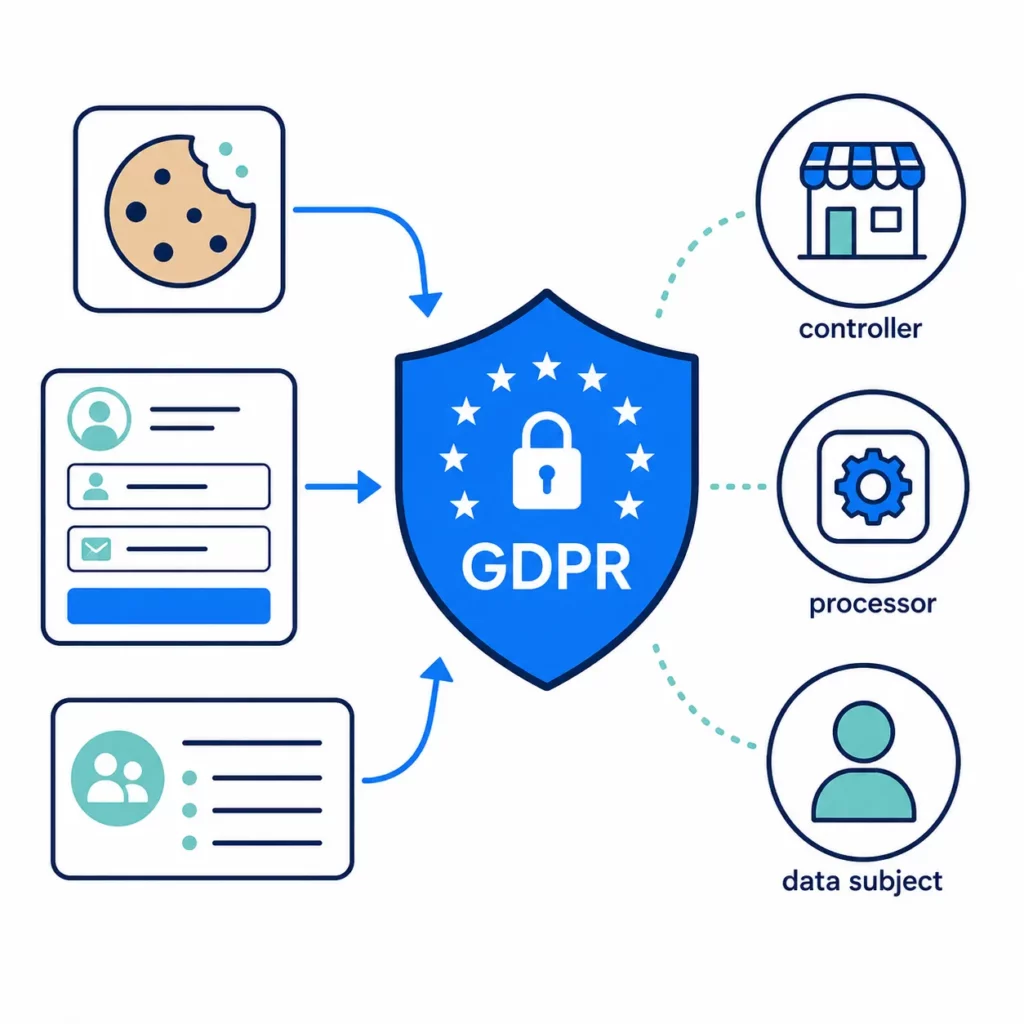
GDPR applies in two cases: your store is based in the EU, or it sells to people who are. Either way, an affiliate program runs on personal data, and three kinds of it sit in GDPR’s scope.
The tracking cookie is the one most programs forget. When a shopper clicks an affiliate link, it records who referred them and what they buy. As that ties back to a person, GDPR counts it as personal data.
An affiliate’s own details are more obvious. At signup, they hand over a name, an email, payout details, and sometimes tax forms: all of it personal data.
The third kind slips by for a different reason. Some programs share a customer’s name or email with the referring affiliate for follow-up. That hands someone else’s personal data to a third party, so it needs its own legal basis.
Handling those three flows assigns each party a role under GDPR, and each role carries different duties.
| Role | Who it is | What it means for you |
| Data controller | You, the merchant | You decide why and how the data is collected, so the main compliance duty is yours. |
| Data processor | Your affiliate app (e.g., UpPromote) | It processes data on your behalf, which is why you need a data processing agreement (DPA) with it. |
| Data subject | Your customers and affiliates | The people the data is about. They hold rights — access, correction, deletion — covered in Step 5. |
In short, the buck stops with you. The app helps, but the seven steps ahead are yours to put in place.
What Are the 7 Steps to a GDPR-Compliant Affiliate Program?
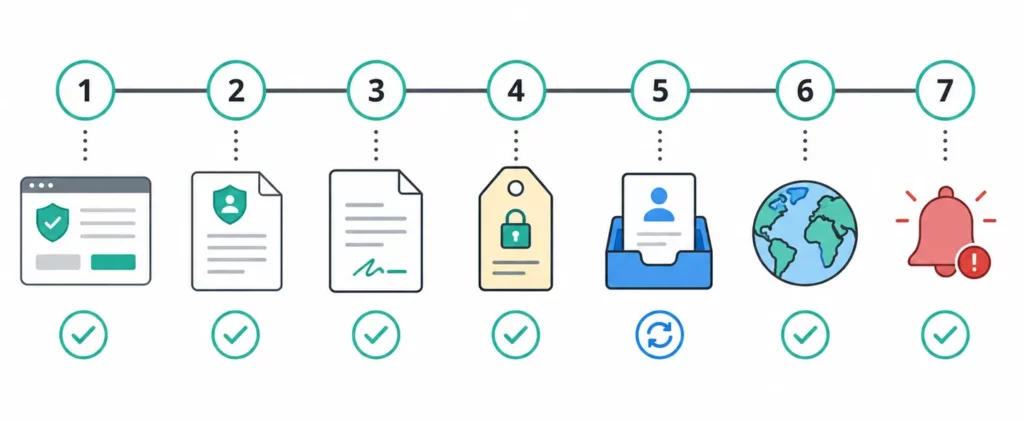
Compliance sounds heavy, but for an affiliate program it comes down to seven steps and most are one-time tasks you can finish in an afternoon. Only one, handling data requests, keeps running after that.
Here’s how the seven break down by effort and how often each comes back around.
| # | Step | Typical effort | One-time or ongoing? |
| 1 | Add a cookie consent banner | ~30–60 min | One-time setup |
| 2 | Update your privacy policy | ~30 min | One-time, review each year |
| 3 | Sign a DPA with your affiliate app | ~15 min | One-time |
| 4 | Set affiliate disclosure rules | ~15 min | One-time |
| 5 | Honour data subject requests | As they arrive | Ongoing |
| 6 | Check cross-border data transfers | A quick review | One-time, if data leaves the EU |
| 7 | Write a breach response plan | 1–2 hours | One-time, review each year |
The list looks long, even if the work doesn’t take long. It starts with the step most programs get wrong: cookie consent.
Step 1: Get Cookie Consent Before the Affiliate Cookie Fires
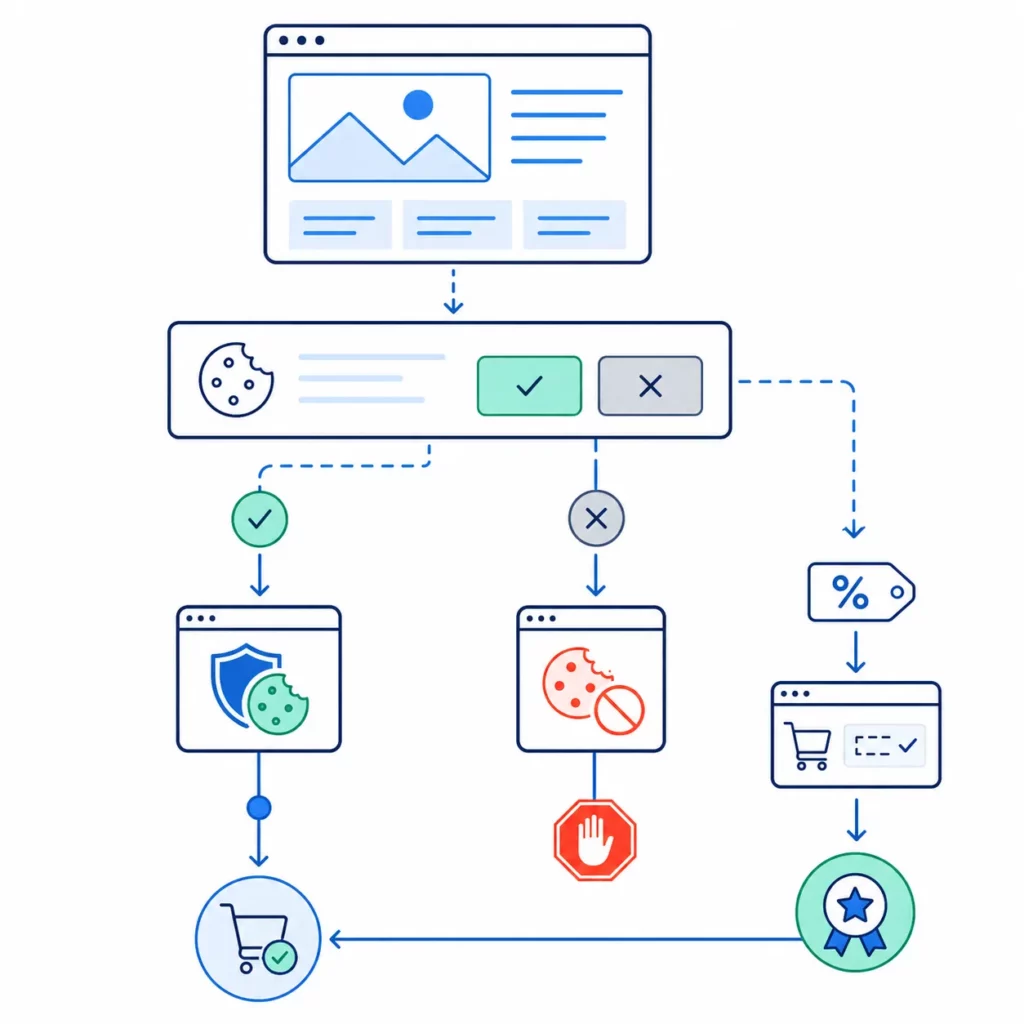
Affiliate tracking cookies aren’t “strictly necessary,” so under the ePrivacy Directive you must ask for the visitor’s consent before placing one. Without it, no cookie can be set, which means the visit may go untracked and the affiliate could lose the credit.
In practice, the sequence matters. The consent banner has to load first; only once the visitor accepts marketing cookies can the affiliate cookie drop and begin tracking.
A refusal flips the outcome. If a shopper rejects those cookies, the click might still register, but no cookie is stored. A return visit days later would then go untracked for that affiliate.
Consent also has to take the right form. Under GDPR Recital 32, it must be a clear, affirmative action, which means silence, pre-ticked boxes, or inactivity will not count.
Putting this in place means adding a cookie-consent app built for Shopify, such as Pandectes or CookieYes. You would then file the affiliate cookie under “Marketing” rather than as essential, so it fires only once a visitor opts in.
No banner will ever earn 100% consent, however, so the strongest programs add a backup that does not depend on cookies.
Coupon codes are the simplest of these. Because the shopper types the code at checkout, the order can be credited whatever they chose on the banner.
Step 2: What Should Your Privacy Policy Say About Affiliate Tracking?
Your privacy policy has to account for the affiliate program, not just checkout and email.
At a minimum, it should spell out what tracking data you collect, why, how long you keep it, and who processes it on your behalf.
Transparency is the point here. A shopper can’t consent to tracking the policy never mentions. Leaving the program out, then, can undermine the consent you collected in Step 1.
The wording doesn’t have to be elaborate. Here is a block you can adapt, dropping in your own cookie duration, app name, and contact email.
Affiliate Program Tracking
We run an affiliate program with partners who promote our products. When you click an affiliate link or use an affiliate discount code, we may collect:
- A tracking cookie (only with your consent): records which affiliate referred to you, the time, and the pages you view. Cookie duration: [30] days.
- Purchase data: the order total and products bought, linked to the referring affiliate so we can calculate commission.
- Discount code usage: which affiliate code was applied at checkout.
This data is handled by our affiliate management platform, [your affiliate app], under a Data Processing Agreement, and is used only for commission attribution and program management.
You can withdraw cookie consent at any time through our cookie settings. Affiliate tracking through discount codes does not rely on cookies.
To access, correct, or delete your data, contact [your email].
Swapping in your details takes a few minutes.
You can fold the block into your store’s existing privacy policy, or host it on a separate page linked from the footer. Either option works, as long as shoppers can find it.
One review a year keeps it current. Whenever you switch affiliate apps, change a cookie duration, or start sharing new data, the policy should move with it.
Step 3: Do You Need a Data Processing Agreement With Your Affiliate App?
A data processing agreement, or DPA, is the contract between you, the controller, and your affiliate app, the processor. As that app will be handling personal data on your behalf, GDPR Article 28 says you must have one in place.
The good news is that you almost never have to write it yourself. Most reputable affiliate apps already publish a DPA. Your job, then, comes down to finding it and accepting it.
And finding it is no struggle, either. You can begin with the app’s terms of service or privacy page. If nothing’s linked there, a quick message to support will often turn one up.
Not every DPA is built to the same standard, though. Before accepting one, it helps to know what a thorough version should include. A solid agreement will cover each of these:
- What’s processed: the data the app touches, handled only on your instructions
- How it’s secured: the technical and organisational measures protecting it
- Retention and exit: how long data is kept, and whether it’s returned or deleted when you leave
- Sub-processors: which other services the app relies on, and your right to object
- Breach notification: the app must tell you fast enough to meet your own 72-hour deadline
Running a candidate’s DPA against that list should take only a few minutes. If something’s missing, like a sub-processor or breach clause, you can ask questions or look elsewhere.
Step 4: How Must Affiliates Disclose the Relationship?
Anyone promoting your products has to tell their audience the relationship is commercial.
In the US, the FTC enforces that; the EU and UK have their own versions. Your job is to require disclosure in writing and then hold affiliates to it.
The clearest standard comes from the US. Under the FTC Endorsement Guides, an affiliate who earns a commission must disclose that connection. A clear, visible “#ad” counts; a buried hashtag does not.
The EU and UK will expect the same transparency, though they reach it by different routes:
| Rule | What it requires | Who it falls on |
| FTC (US) | Disclose the affiliate connection in clear, visible terms (e.g., “#ad”) | The affiliate; the brand carries primary liability |
| ASA / CAP Code (UK) | Label affiliate and sponsored content so it reads as advertising | The affiliate and the advertiser |
| DSA (EU) | Online platforms must label ads and name the advertiser behind them | The platform hosting the content |
| GDPR (EU) | Be transparent about the data the affiliate link collects | You, as the controller |
The throughline is the same: the audience must be able to tell that a recommendation is paid.
The DSA now pushes this further, asking the big platforms to label ads outright, so unlabelled affiliate content stands out more than before.
Since enforcement tends to land on you, the safest move is to build disclosure into the affiliate agreement. A short clause does the job:
Affiliates must disclose their commercial relationship with [Brand] in all content that promotes us, in line with applicable laws, including the FTC Endorsement Guides, GDPR transparency rules, and local advertising codes. Disclosure must be clear, conspicuous, and written in the language of the audience.
Add it to your terms, then point new affiliates to it during onboarding, so no one can later claim they didn’t know.
Step 5: How Do You Handle Data Access and Deletion Requests?

Both customers and affiliates can ask to see, correct, or delete the data you hold. Under GDPR Article 12, you then have one month to respond.
With that clock ticking, a process set up in advance keeps each request quick rather than a scramble.
These requests take a handful of common shapes, and because your response differs for each, it helps to see them side by side:
| Request | What they’re asking | Your response | Deadline |
| Access | “What data do you hold on me?” | Send them everything you store | One month |
| Erasure | “Delete my data” | Remove it, and tell your app to do the same | One month |
| Rectification | “Correct my data” | Fix the inaccurate details | One month |
| Portability | “Send me my data to reuse” | Export it in a common format, like CSV | One month |
| Objection | “Stop using my data for this” | Stop, unless you have overriding grounds | Without undue delay |
| Withdraw consent | “I take back my cookie consent” | Stop tracking and drop the cookie | Right away |
At first glance the deadlines look tight, yet most requests are routine once you know where the data lives. For the rare complex case, you can even extend the month by two more, provided you tell the person why.
For a customer, you would delete their Shopify record and ask your app to clear the linked tracking data. An affiliate who leaves is similar, though you must then keep whatever tax law requires you to retain.
All of this gets easier with one habit: collecting less data from the start. After all, the fewer fields your signup form asks for, the less you will ever store, share, or dig up later.
Many affiliate apps make this easy by letting you shape the signup form. With UpPromote, for instance, you can decide which fields a new affiliate fills in. The form then stays lean, and you hold only what the program needs.
Step 6: Can Your Affiliate Data Leave the EU?
Your affiliate app, and its servers, may sit in the US or somewhere else outside the EU.
When that happens, your customers’ and affiliates’ data crosses a border. The GDPR allows that only with a valid safeguard in place.
For US transfers, two routes cover most cases. The first applies when your provider is certified under the EU-US Data Privacy Framework. The EU counts that as adequate, so data can move without extra steps.
The second route covers providers that are not certified. They must rely on Standard Contractual Clauses instead, the GDPR’s approved contract terms under Article 46.
Outside the US, the same logic holds. A handful of countries carry their own EU adequacy decision, so transfers there need no extra step. Everywhere else, Standard Contractual Clauses do the work again.
In most cases, you will not arrange any of this yourself. Your affiliate app and other processors handle the mechanism, so your job is to confirm they have one. To check, read their privacy or compliance page, or you can ask support which route they use.
Step 7: What Do You Do If Affiliate Data Is Breached?
If your affiliate data leaks or your app is hacked, the clock starts at once.
Under GDPR Article 33, you then have 72 hours to report a risky breach to the regulator. A plan written in advance is what will save you here.
When a breach happens, your response follows a clear sequence:
- Your app tells you. As a processor, your affiliate app must report any breach to you without undue delay, so your contract should put that in writing.
- You weigh the risk. Decide whether the breach could harm the people involved, because that judgment shapes every step that follows.
- You notify the regulator. If a real risk exists, report it to your supervisory authority within 72 hours, and attach your reasons if you run late.
- You tell the people, if needed. Where the risk is high, Article 34 says you must also warn the affected individuals without undue delay.
One more habit closes the loop: write down every breach, even the ones too minor to report. The GDPR expects that record, and it will prove to a regulator that you handled the duty with care.
What Should Be on Your GDPR Affiliate Checklist?
Everything above comes down to a handful of concrete actions. Run through this list before you launch, and again whenever your program changes. If you can tick every box, your affiliate program sits on solid GDPR footing.
Consent & tracking
☐ A consent banner blocks the affiliate cookie until the visitor agrees.
☐ Consent is opt-in, with no pre-ticked boxes.
☐ Withdrawing consent is as simple as giving it.
☐ You have a cookie-independent fallback, such as coupon codes, for users who decline.
Transparency & disclosure
☐ Your privacy policy names affiliate tracking, the data it collects, and why.
☐ The policy lists your affiliate app as a data processor.
☐ Affiliates must disclose the commercial relationship in every promotion.
☐ That disclosure duty is written into your affiliate agreement.
Contracts & data
☐ A Data Processing Agreement is in place with your affiliate app.
☐ You know where your affiliate data is stored and transferred.
☐ Any transfer outside the EU rests on a valid safeguard, the DPF or SCCs.
☐ You collect only the affiliate and customer data you need.
Rights & breaches
☐ You can find, export, and delete a person’s data on request.
☐ You respond to data requests within one month.
☐ You have a breach plan, including the 72-hour reporting window.
☐ You keep a record of every breach, reported or not.
No single box makes you compliant on its own. Together, though, they turn a vague legal worry into a routine you can repeat and prove.
What Changed for Affiliate Privacy in 2026?
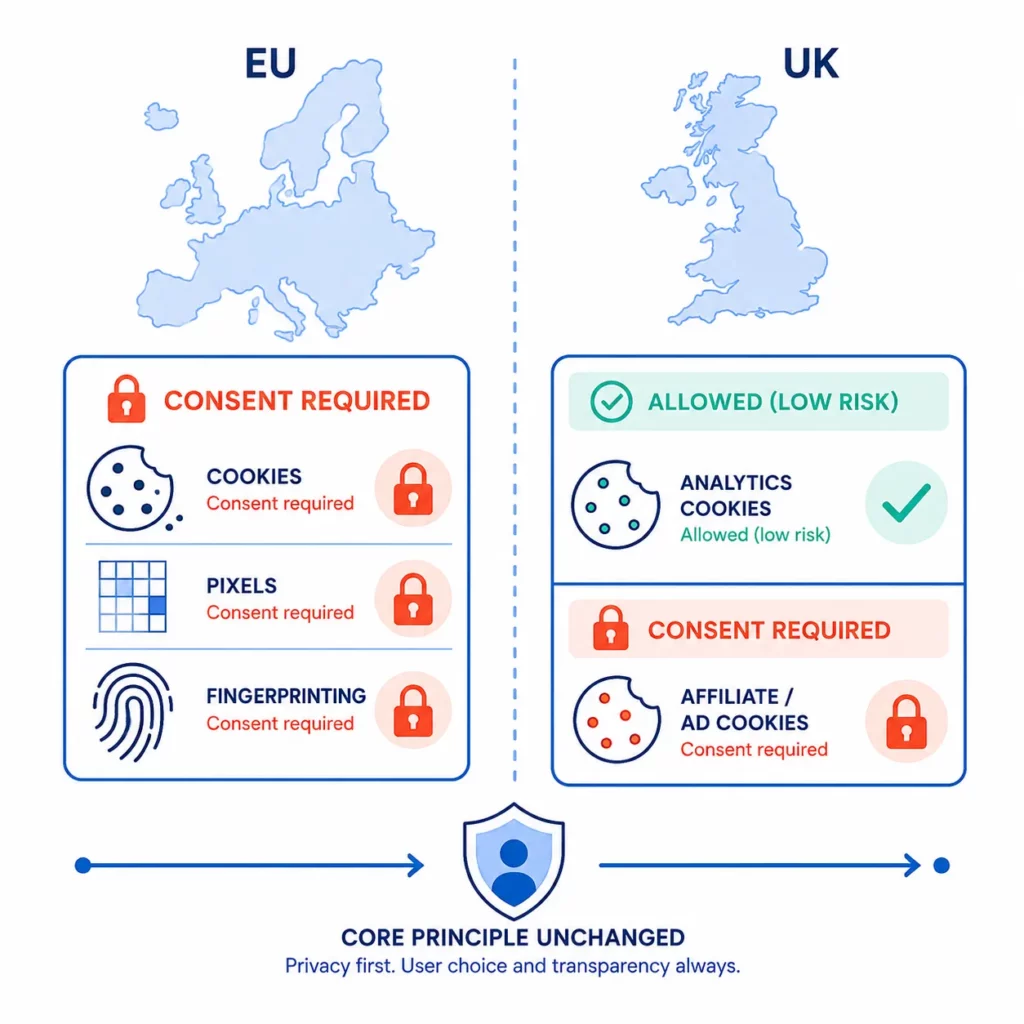
The rules around affiliate tracking kept shifting through 2025 and into 2026. None of them rewrite the basics, but a few will shape how you handle consent and where your risk sits.
First, the EU’s long-promised ePrivacy Regulation was withdrawn after years of deadlock. The older ePrivacy Directive still rules cookies, country by country. So you may face different rules in each EU market you sell to.
At the same time, regulators widened what counts as tracking. Recent EU guidance treats pixels and fingerprinting like cookies. As a result, your affiliate links now sit inside the consent rule, and a cookie-only banner may fall short.
Across the Channel, the UK relaxed parts of its cookie regime. The Data (Use and Access) Act 2025 now lets sites use some low-risk cookies, such as basic analytics, without consent.
Affiliate and advertising cookies, though, are not on that list. They still need consent, and the fine for skipping it can now reach £17.5 million.
The throughline across all three is steady: consent before tracking, transparency about data, and a real plan for rights and breaches. The details may shift by year and by country, but that core has not moved.
Frequently Asked Questions
Does GDPR apply to my Shopify store if I’m based outside the EU?
Yes. GDPR follows the shopper, not the store. If you sell to or market toward people in the EU, you must comply with it, no matter where in the world your business sits.
Do affiliate marketing cookies require consent under GDPR?
Yes. Affiliate cookies track behavior for commercial gain, so they count as non-essential. You must get clear, opt-in consent before the cookie fires; silence or a pre-ticked box does not qualify.
Can I track affiliate sales without cookies?
Yes. Unique coupon or discount codes can tie a sale to an affiliate without storing anything on the shopper’s device. They make a useful backup for visitors who decline cookie consent.
Do I need a Data Processing Agreement with my affiliate app?
Yes. Under GDPR, any company that processes personal data on your behalf must be bound by a Data Processing Agreement. Your affiliate app is a processor, so this contract is required, not optional.
How long do I have to respond to a data deletion request?
One month from the date you receive it. You can extend that by up to two more months for complex requests, but you must tell the person about the delay and the reason.
What should I do if my affiliate data is breached?
Assess the risk first. If the breach could harm people, you must notify your supervisory authority within 72 hours. Where the risk is high, also tell the affected individuals, and record every incident.

Ellie Tran, a seasoned SEO content writer with three years of experience in the eCommerce world. Being a part of the UpPromote team, Ellie wants to assist Shopify merchants in achieving success through useful content & actionable insights.Ellie's commitment to learning never stops; she's always eager to gain more knowledge about SEO and content marketing to create valuable content for users. When she's not working on content, Ellie enjoys baking and exploring new places.
![How to Use Shopify Functions with Your Affiliate Program [2026 Guide]](https://static.uppromote.com/wp-content/uploads/2026/06/how-to-use-shopify-functions-with-affiliate-program-300x169.webp)
![How to Prevent Affiliate Fraud on Shopify: Self-Referral, Coupon Abuse & More [2026]](https://static.uppromote.com/wp-content/uploads/2026/06/how-to-prevent-affiliate-fraud-on-shopify-300x169.webp)


![Affiliate Program Not Growing? 10 Common Mistakes Shopify Merchants Make [2026]](https://static.uppromote.com/wp-content/uploads/2026/06/affiliate-program-not-growing-300x169.webp)