












TL;DR
Affiliate program ROI = (affiliate revenue − total costs) ÷ total costs × 100.
The trap is “total costs”: most merchants count only commissions and miss discounts, platform and performance fees, management time, and samples.
- Four metrics to track: ROI (profitability), ROAS (efficiency), CPA (acquisition cost), CLV ratio (long-term value)
- Benchmark: affiliate ROAS averages 12:1, or $12 per $1 spent
- Realistic range: 3:1–8:1 in year one, 8:1–15:1 once mature
“Your affiliate program made $8,000 last month and paid $1,200 in commissions. Is that a good ROI?”
It depends, and the $1,200 is a trap: it’s the only cost most dashboards show you.
In reality, it runs higher: affiliate discounts (~$800), platform and app fees (~$90), five hours a week of management ($150), and product samples ($200).
That brings the true cost to $2,440, so the real return is ($8,000 − $2,440) ÷ $2,440 = 228%.
Still excellent, but not the number the dashboard showed.
Numbers like that are why affiliate marketing earns its reputation: the channel averages a 12:1 ROAS, or $12 per $1 spent (Shopify).
That’s an industry average, though. Real programs run 3:1 to 20:1, depending on niche, commission, and how well you run things.
To find where yours lands, this guide covers four formulas, a cost breakdown, three worked examples, a copy-ready dashboard, and five levers to lift ROI.
What Costs Go Into Affiliate Program ROI?
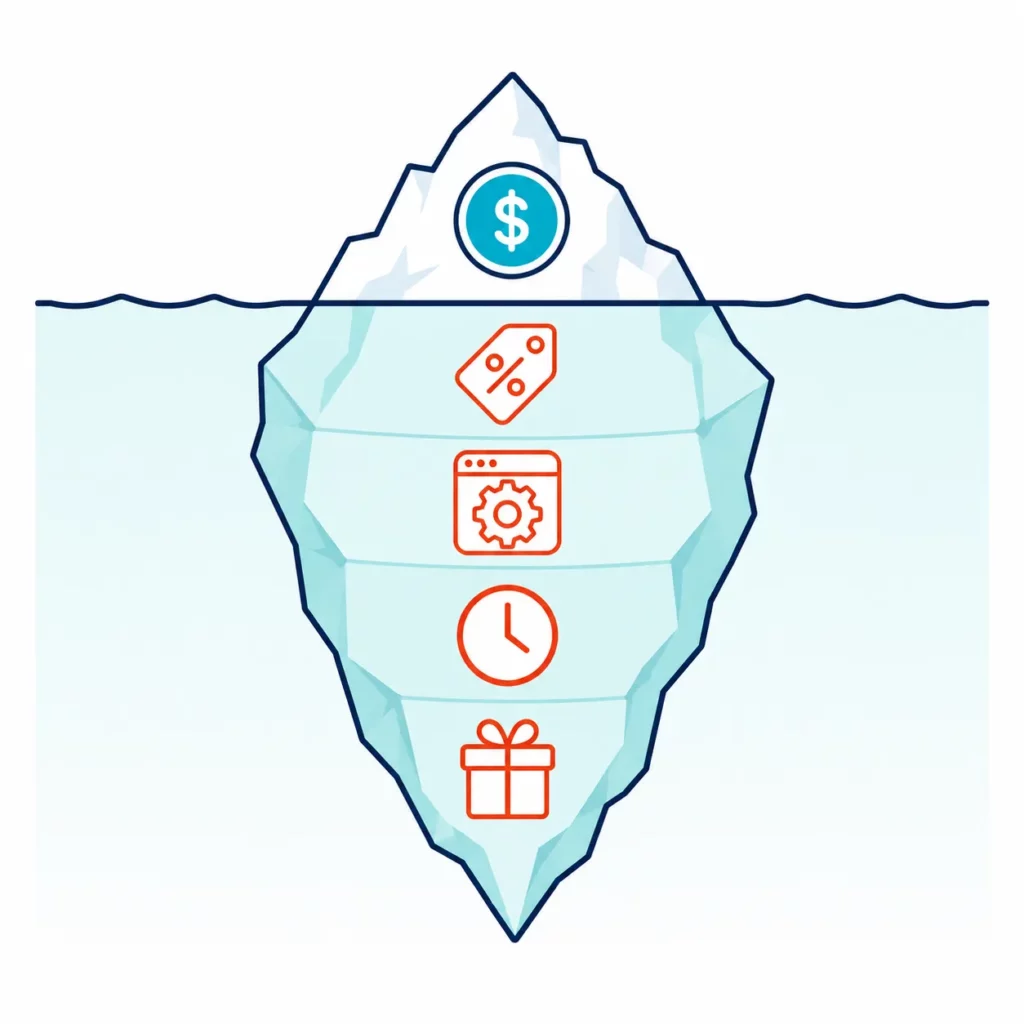
Affiliate program costs reach well beyond the commissions on your dashboard.
They also cover discounts, platform fees, management time, and samples. With those hidden lines left out, a program can look twice as profitable as it is.
Here’s the full picture, with the line items merchants most often miss flagged on the right.
| Cost category | What it covers | Monthly estimate (mid-size store) | Often missed? |
| Commissions | % or flat fee per affiliate sale | $800–3,000 | No |
| Affiliate discounts | Markdowns affiliates pass to buyers (10–15%) | $500–2,000 | Yes — the big one |
| App subscription | Monthly affiliate-app plan | $0–200 | No |
| Performance fee | % of affiliate-referred revenue (many apps) | $50–250 | Yes |
| Management time | Hours × your (or a manager’s) rate | $150–2,000 | Yes |
| Product samples / gifting | Free products sent to affiliates | $100–500 | Yes |
| Creative production | Banners, photos, video for affiliates | $50–300 | Sometimes |
Affiliate discounts do the most damage, because they scale just like commissions. On 100 affiliate orders at an $80 average value, a 15% discount adds $1,200 in markdowns.
That’s the same as the $1,200 in commissions on those orders. Counting one but not the other understates your variable cost by half.
Discounts at least look like a cost, but the platform charge hides inside what seems fixed. Beyond the monthly subscription, many affiliate apps also take a performance fee, a small slice of affiliate-referred revenue.
On the free tier, many affiliate apps like UpPromote still cover tracking, fraud detection, and analytics. Paid plans run from about $30 to $200 a month, with a 1–2% performance fee on top.
Even the platform fee lands on an invoice. Your own time never does. Five hours a week on applications, affiliate questions, and performance checks is real labor, or about $600 a month at a $30 rate.
A part-time manager pushes that past $2,000. None of it appears in the app, which is why it drops out of the ROI math.
4 Formulas to Measure Affiliate Program Performance
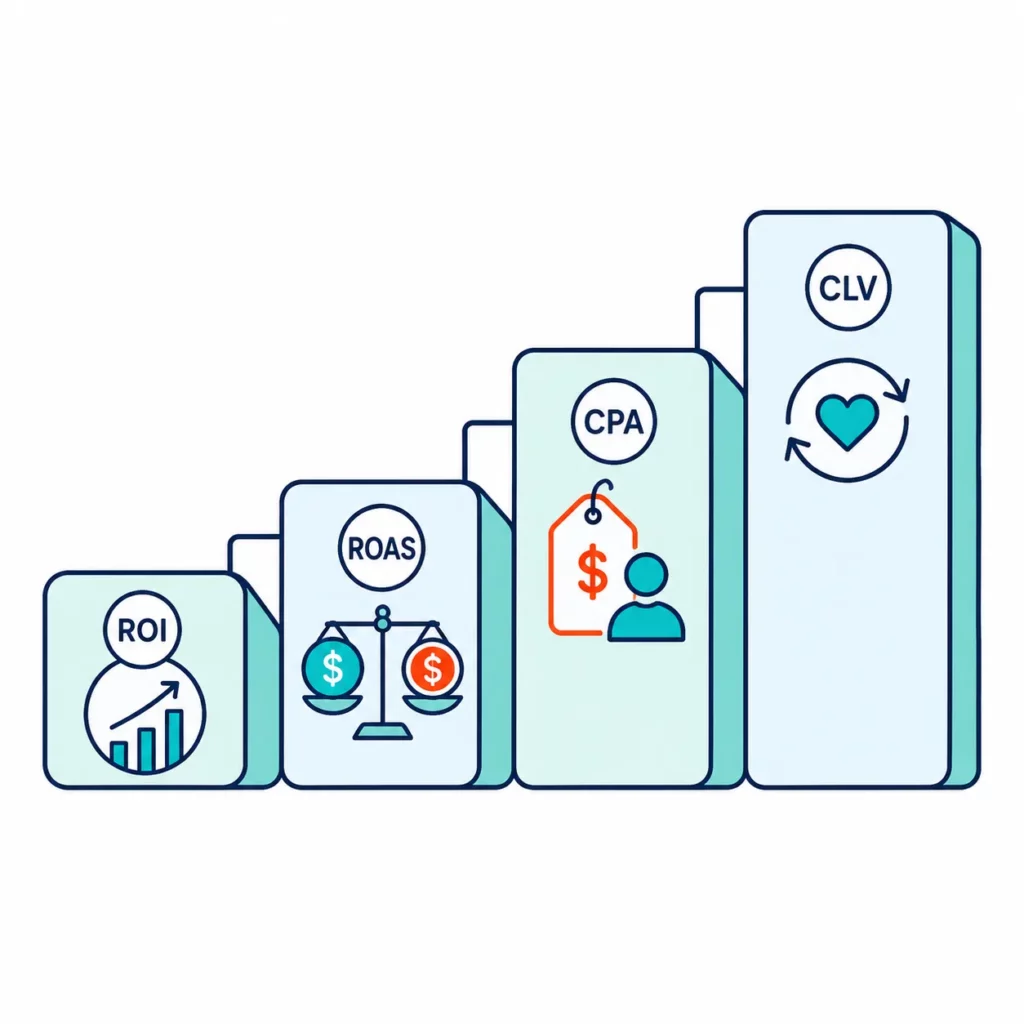
No single number tells you whether an affiliate program is working. Four formulas do, and they stack. ROI shows whether you’re profitable, ROAS how efficient, CPA whether you beat other channels, and CLV ratio whether the customers are worth keeping.
Most inputs already sit in your affiliate app’s analytics: revenue, commissions, orders, new customers. Management time and total discounts you add by hand.
ROI = (affiliate revenue − total costs) ÷ total costs × 100.
The opening program runs ($8,000 − $2,440) ÷ $2,440 = 228%. Above 100% means profit, and Shopify suggests aiming for around 400% (Shopify).
ROI shows profit, but not how hard each dollar works.
ROAS = revenue ÷ costs = $8,000 ÷ $2,440 = 3.3:1, healthy for year one against the 12:1 channel average (Shopify).
Next to alternatives, the real question is cost per customer.
CPA = costs ÷ new customers = $2,440 ÷ 80 = $30.50, which should sit below your Google or Meta CPA.
A low CPA pays off if those customers return, which is where the CLV ratio comes in. CLV ratio = lifetime value ÷ CPA = $180 ÷ $30.50 = 5.9:1. The standard floor is 3:1, so 5.9:1 says the program is worth scaling.
| Metric | Answers | Formula | This program | Benchmark |
| ROI | Profitable? | (revenue − costs) ÷ costs × 100 | 228% | >100% = profit; ~400% strong (Shopify) |
| ROAS | Efficient? | revenue ÷ costs | 3.3:1 | 12:1 avg (Shopify); 3–8:1 year one |
| CPA | Cheaper than ads? | costs ÷ new customers | $30.50 | below your paid-ads CPA |
| CLV ratio | Worth keeping? | lifetime value ÷ CPA | 5.9:1 | 3:1+ healthy |
3 Worked Examples: Affiliate ROI at Three Store Sizes
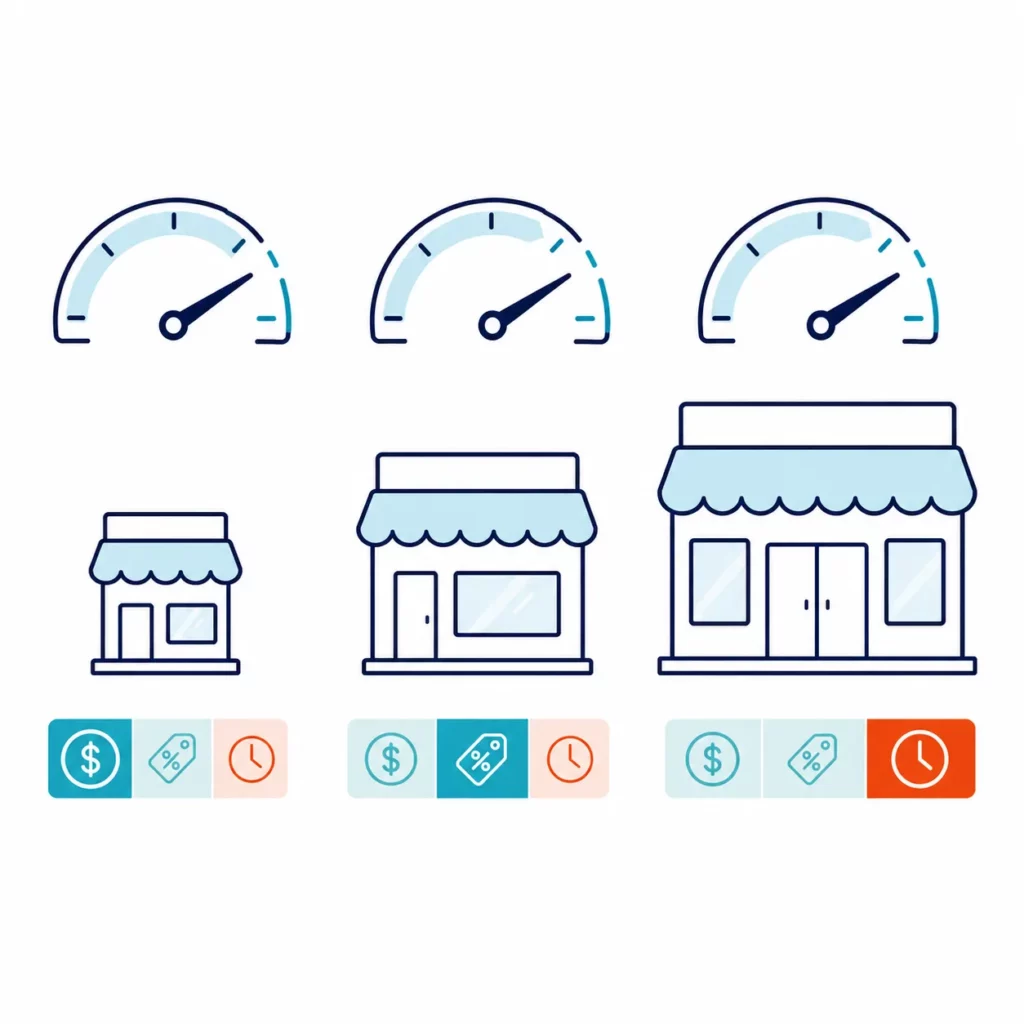
Run the four formulas across three store sizes and a pattern appears: ROI barely moves.
Small, medium, and large all land near 180–200%, because costs rise in step with revenue. What changes is which cost dominates, and whether the numbers say scale.
The same affiliate program, modeled at three store sizes:
| Line item | Small ($10K/mo store) | Medium ($50K/mo store) | Large ($200K/mo store) |
| Affiliate revenue | $1,500 | $8,000 | $40,000 |
| Orders × AOV | 25 × $60 | 100 × $80 | 400 × $100 |
| Commissions | $225 (15%) | $1,200 (15%) | $4,800 (12%) |
| Affiliate discounts | $150 (10%) | $960 (12%) | $4,000 (10%) |
| App subscription | $0 (free) | $90 | $200 |
| Performance fee | $0 | $120 (1.5%) | $400 (1%) |
| Management time | $75 | $240 | $4,000 |
| Samples / creative | $50 | $200 | $800 |
| Total cost | $500 | $2,810 | $14,200 |
| Cost as % of revenue | 33% | 35% | 36% |
| ROI | 200% | 185% | 182% |
| ROAS | 3.0:1 | 2.85:1 | 2.82:1 |
| CPA | $25 | $35 | $44 |
| CLV ratio | 7.2:1 | 6.8:1 | 7.9:1 |
At $1,500 a month, the program runs on a free plan, so platform cost is zero. Beyond commissions, the only overhead is three hours of your time and a few samples, about $125.
The result is a clean 3:1 ROAS and a 7.2:1 CLV ratio, which says customers this cheap to acquire are worth recruiting harder.
Once you scale to $8,000, discounts become the line that moves: at 12% they reach $960, nearly the $1,200 in commissions, and pull ROAS just under 3:1. Trimming them to 10% saves about $160 a month.
At $40,000, a new line dominates: the $4,000 manager. But volume earns it back. Across 320 new customers the total still runs about 36% of revenue, ROI holds near 182%, and a 7.9:1 CLV ratio argues for scaling harder, not pulling back.
Key Takeaway: Healthy programs hold ROI near 180–200% at any size, since cost scales with revenue. What matters is the dominant cost and the CLV ratio, not the headline number.
Affiliate ROI vs Paid Ads: How the Channels Compare
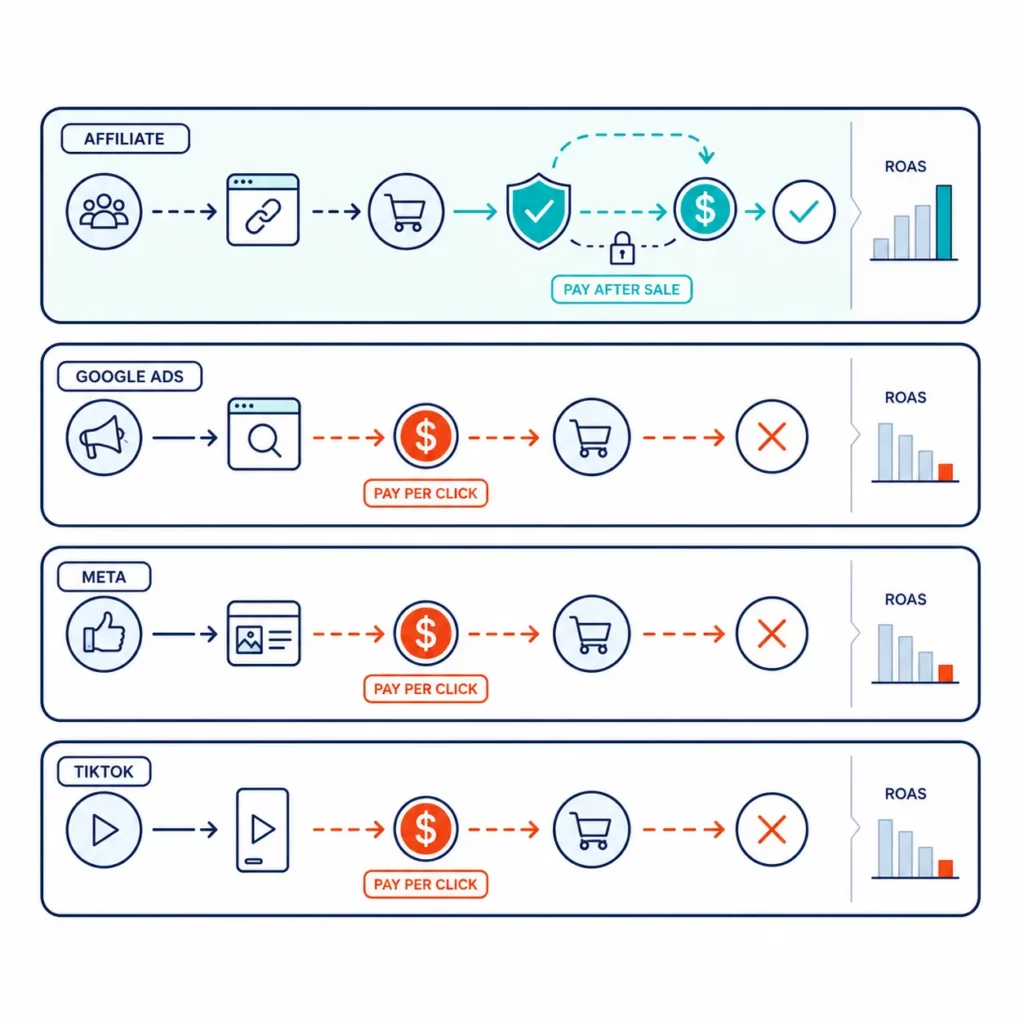
Affiliate marketing isn’t always the highest-ROAS channel; paid search often beats a young program.
Its real edge is risk: you pay affiliates only after a sale, while paid channels charge per click whether or not anyone buys.
How the four channels stack up:
| Affiliate | Google Ads | Meta | TikTok | |
| Avg ROAS | 3–12:1 | 4.5:1 | 2.2:1 | 1.4:1 |
| You pay | per sale | per click | per click | per click |
| Upfront budget | none | required | required | required |
| Who makes the content | the affiliate | you | you | you |
ROAS benchmarks: Onramp Funds, 2025; affiliate mature average, Shopify.
On raw ROAS, paid search leads at 4.5:1, Meta sits near 2.2:1, and TikTok trails at 1.4:1 (Onramp, 2025). A first-year affiliate program lands around 3:1, yet a mature one averages 12:1, above every paid channel (Shopify).
The difference that matters is risk-adjusted. Paid ads bill per click, so a $38 Meta CPA (Triple Whale) is spent whether the visitor buys or not. Affiliate CPA in the examples above ran $25 to $44, and you pay it on a completed sale, not a click.
That makes the channels complementary, not rival. Affiliates give you a low-risk, compounding base, while paid ads buy speed when you need to scale fast.
5 Levers to Improve Your Affiliate ROI
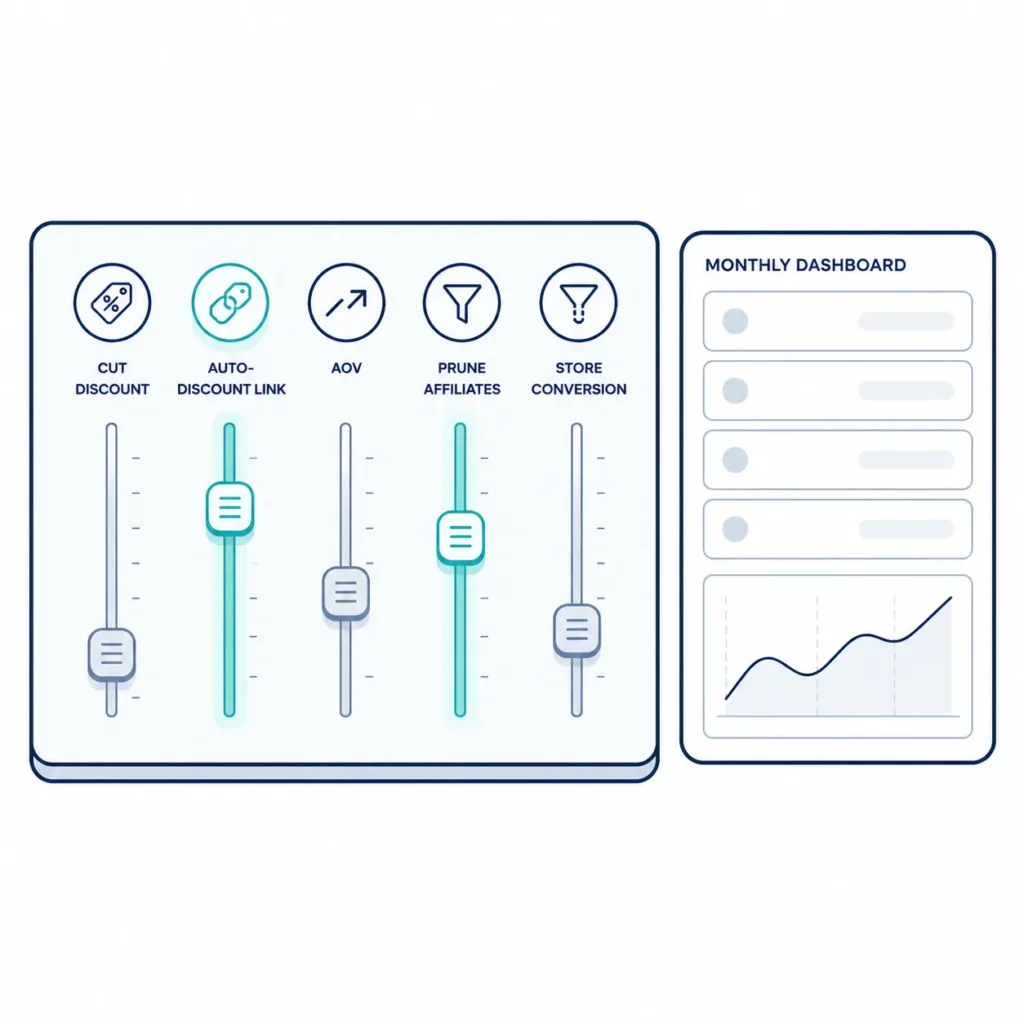
Five levers below can move affiliate ROI, from a single setting change to a full conversion overhaul. Two reward attention first: closing the coupon leak, and pruning the affiliate mix.
Each lever, with its payoff and the effort it takes:
| Lever | What it does | ROI impact | Effort |
| 1. Cut the discount | drop 15% → 10% | ~$160/mo at mid-size | Easy |
| 2. Switch to auto-discount | discount via the affiliate link, no code | stops coupon-leak losses, drops blocker-app cost | Easy |
| 3. Lift AOV | bundles and upsells for affiliate traffic | more revenue at the same cost | Medium |
| 4. Prune the affiliate mix | retire inactive partners, back the top ones | shifts spend to proven performers | Medium |
| 5. Raise store conversion | CRO on product pages and checkout | more sales per affiliate click | Hard |
The biggest quick win is the coupon leak.
When an affiliate shares a discount code, it spreads to deal sites and browser extensions. Un-referred shoppers then grab the markdown, and you pay commission you never earned.
Routing the discount through the affiliate’s tracked link closes that leak: an auto-discount applies at checkout with no code to copy or share.
Pruning the affiliate mix is the slower lever, yet it pays off just as well. Most programs earn the bulk of their revenue from a small core of partners.
GoldieLocks shows how lopsided the split can get: one of its affiliates alone has driven more than 1,000 orders.
A Monthly Affiliate ROI Dashboard (Copy-Ready Template)
Affiliate ROI is a monthly number, not a daily one. A single big order swings the day-to-day figures, while a full month gives enough data to show a trend you can act on.
One pass takes about fifteen minutes:
MONTHLY AFFILIATE ROI — [Month / Year]
REVENUE (pull from analytics)
Affiliate revenue: $______
Orders / AOV: ______ / $______
New customers: ______
COSTS (add by hand)
Commissions: $______
Discounts: $______
App + performance fee: $______
Management time: $______
Samples / creative: $______
TOTAL COST: $______
METRICS
ROI = (revenue − cost) ÷ cost × 100 = ______%
ROAS = revenue ÷ cost = ______:1
CPA = cost ÷ new customers = $______
CLV = lifetime value ÷ CPA = ______:1
- LAST MONTH
ROI ↑/↓ ______%
CPA ↑/↓ $______
THIS MONTH’S MOVE:
____________________________________
The revenue side mostly fills itself: affiliate software like UpPromote report affiliate sales, orders, clicks, and commissions, with date and program filters. The cost side you add by hand.
What Changed in 2026?
The big 2026 shift isn’t whether affiliate marketing works; it’s that your tracked ROI now understates the real one. Two measurement changes drive that.
Third-party cookies are fading, so some affiliate sales now go untracked, often across devices. Server-side tracking is closing the gap, which means your true ROI may run a little above what the dashboard reports.
Attribution is the second piece. Last-click hands all the credit to the final touch, so an affiliate who introduced the customer earlier earns nothing.
Shopify now points merchants toward multi-touch attribution, which shares credit across partners but makes the ROI math more involved.
Frequently Asked Questions
- What’s a good ROI for an affiliate program?
A healthy program returns three to eight times its cost in year one, about 200% to 700% ROI. Mature programs approach 12:1. New ones often start near 3:1 and climb as affiliates ramp up.
- Why is my affiliate ROAS below 12:1?
The 12:1 figure is an average across mature programs, not a starting point. New programs carry setup costs and fewer active affiliates, so early ROAS often sits between 3:1 and 5:1. It usually rises as top affiliates gain traction.
- Should I track affiliate ROI weekly or monthly?
Monthly suits most stores. Weekly numbers swing on a single large order, so they mislead more than they help. A full month gathers enough orders to reveal a real trend, which is what you act on. Very high-volume stores can review weekly.
- Are affiliate discounts a real cost?
Yes. A discount code shared by an affiliate reduces revenue on every order it touches, so it belongs in your cost total alongside commissions. Leaving it out inflates ROI and hides how much each sale earns.
- Is negative ROI normal in the first month?
Often, yes. Setup work, sample products, and creative assets land in month one before sales build, so early ROI can dip below zero. The picture usually turns positive within a few months as affiliates start converting.
- How do I separate affiliate revenue from organic sales?
Affiliate tracking assigns each sale to the link or code that drove it, keeping those orders separate from organic ones. Without tagging, you risk crediting the program for sales it never drove, which overstates ROI.

Ellie Tran, a seasoned SEO content writer with three years of experience in the eCommerce world. Being a part of the UpPromote team, Ellie wants to assist Shopify merchants in achieving success through useful content & actionable insights.Ellie's commitment to learning never stops; she's always eager to gain more knowledge about SEO and content marketing to create valuable content for users. When she's not working on content, Ellie enjoys baking and exploring new places.
![How to Use Shopify Functions with Your Affiliate Program [2026 Guide]](https://static.uppromote.com/wp-content/uploads/2026/06/how-to-use-shopify-functions-with-affiliate-program-300x169.webp)

![How to Prevent Affiliate Fraud on Shopify: Self-Referral, Coupon Abuse & More [2026]](https://static.uppromote.com/wp-content/uploads/2026/06/how-to-prevent-affiliate-fraud-on-shopify-300x169.webp)

![Affiliate Program Not Growing? 10 Common Mistakes Shopify Merchants Make [2026]](https://static.uppromote.com/wp-content/uploads/2026/06/affiliate-program-not-growing-300x169.webp)