












TL;DR
In 2026, affiliate marketing is a mature, proven channel for Shopify stores: low-risk, pay-after-sale, and still growing fast.
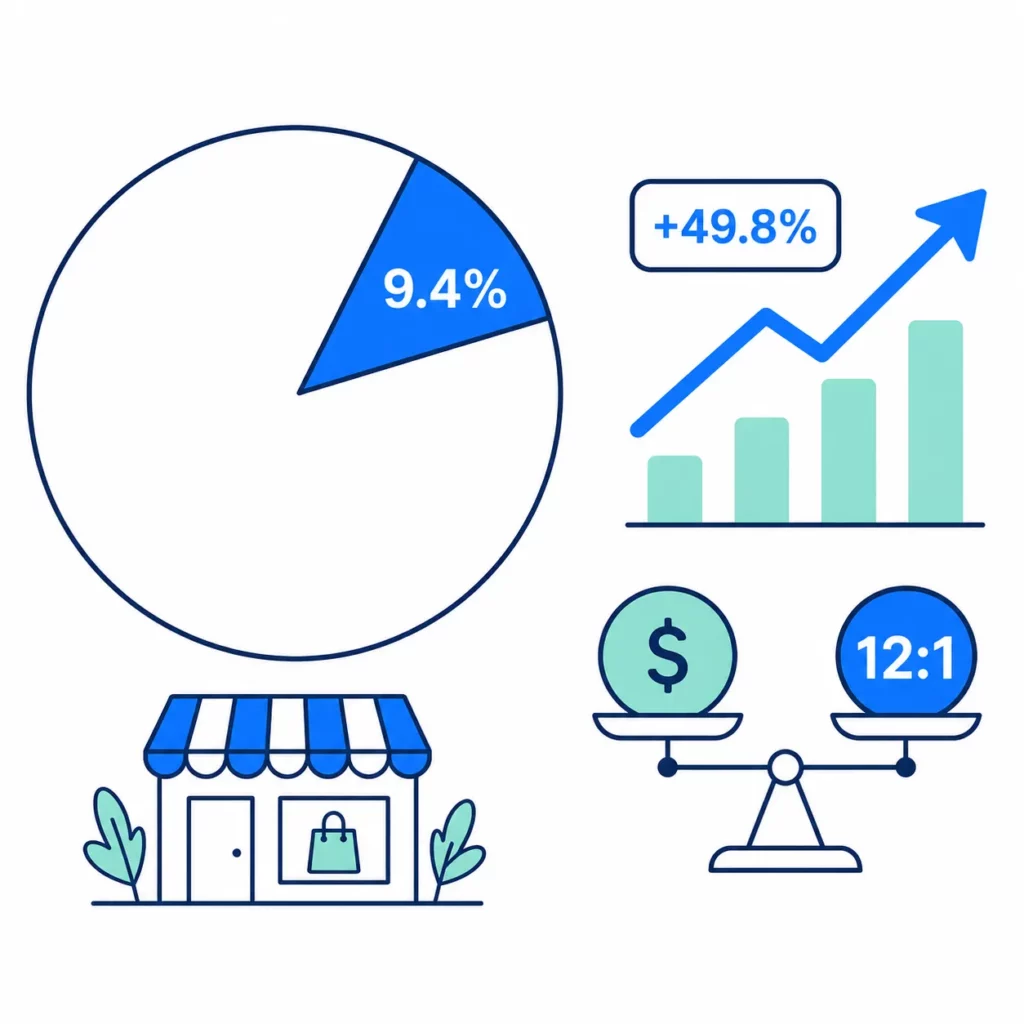
- Market size: affiliate marketing drove $113B in US ecommerce in 2024, about 9.4% of all online sales (PMA)
- Return: roughly 12:1 ROAS, among the highest of any digital channel (Shopify)
- Conversion: affiliate traffic converts at 1–3%, with top programs near 5% (impact.com)
- Revenue share: about 15% of online revenue for brands that run a program; 15–30% once mature (PMA + merchant data)
- Commissions: typically 5–30%, set by product category (Post Affiliate Pro)
- Growth: US affiliate spend rose 49.8% from 2021 to 2024, about twice ecommerce’s pace (PMA)
Affiliate marketing on Shopify has grown up. What began as a scrappy way to earn a few extra sales is now a core revenue channel: measured, regulated, and competitive.
Yet most “state of the industry” numbers come from press releases and vendor decks, inflated to sell a story. This report takes a different route.
It pulls verified benchmarks from primary sources like Shopify, the PMA, and impact.com. Then it pairs them with real outcomes from Shopify merchants who publish their results.
Where a number cannot be confirmed, it is flagged, not guessed.
Inside, you will find what the channel delivers in 2026: its size, the commissions merchants pay, how well programs convert, where affiliates come from, and how brands handle fraud and compliance.
You will also see how results are split by industry, what shifted year over year, and where affiliate marketing is heading next. The goal is simple: real numbers you can plan around, not hype.
How was this report compiled?
This report is compiled from two kinds of data: published industry research, sourced at every figure, and documented results from named UpPromote merchant case studies.
The aim behind both is practical: to help you benchmark your own Shopify affiliate program against real numbers, not generic averages.
Those case studies draw on a sizable base: more than 150,000 ecommerce brands use UpPromote, which tracked over $1 billion in GMV in 2025. Even so, this report does not analyze that full dataset.
Instead, the Shopify-specific figures come from individual case studies, each with a named brand and a published result. Industry benchmarks fill in the rest, cited section by section.
Each type of figure traces to a different source:
| Data type | Where it comes from | What it supports |
| Industry benchmarks | Published research — Shopify, Rakuten/Forrester, the Performance Marketing Association, Impact, CHEQ, and others, linked per stat | Market size, ROAS, conversion, fraud rates |
| Shopify merchant outcomes | UpPromote’s published case studies — 45+ named brands across 10+ industries | Revenue share, commission levels, recruitment and industry results |
| Platform context | UpPromote’s Shopify App Store listing (4.9 stars, 3,400+ reviews) | Scale and standing of the merchant sample |
| Compliance references | Primary texts — FTC, GDPR/ICO guidance, IRS | Disclosure, consent, and tax obligations |
Two limits will come with this mix.
First, because case study results come from merchants who chose to share them, they skew toward programs that worked.
Second, pooled industry benchmarks can run higher or lower than a Shopify-only number.
When a figure has no traceable primary source at all, this report describes the pattern in words instead of inventing one.
How big is affiliate marketing on Shopify in 2026?
Affiliate marketing is now a core acquisition channel, not a side bet. The global market hit $18.5 billion in 2024 (Cognitive Market Research).
On Shopify, the draw is the return. The platform reports a store can expect about 12:1 on ad spend, triple the 4:1 it calls a solid benchmark.
Such returns explain the near-universal adoption. A Forrester study for Rakuten found 81% of advertisers and 84% of publishers running affiliate programs, and rising.
Widespread adoption now translates into serious revenue. In 2024, affiliate marketing drove $113 billion in US online sales, or 9.4% of the total (Performance Marketing Association). For brands that lean on the channel, the figure climbs to 15%.
And the channel keeps accelerating. US affiliate spend rose 49.8% from 2021 to 2024, almost double the rate of ecommerce overall (PMA).
Across separate studies, the numbers line up.
| The affiliate channel in 2026 | Figure | Source |
| Global market size (2024) | $18.5 billion (~40% in North America) | Cognitive Market Research |
| Brands running a program | 81% of advertisers, 84% of publishers | Rakuten / Forrester |
| US ecommerce sales via affiliate (2024) | $113 billion (9.4% of all US online sales) | Performance Marketing Association |
| Share of sales for brands that use it | ~15% | Performance Marketing Association |
| Reported return on ad spend | ~12:1 (vs ~4:1 solid ad benchmark) | Shopify |
For a Shopify merchant, the efficiency may matter more than the totals. Affiliate budget turns into cost only when a sale closes, so the return can run well ahead of pay-per-click ads.
What commission rates do Shopify affiliate programs use?
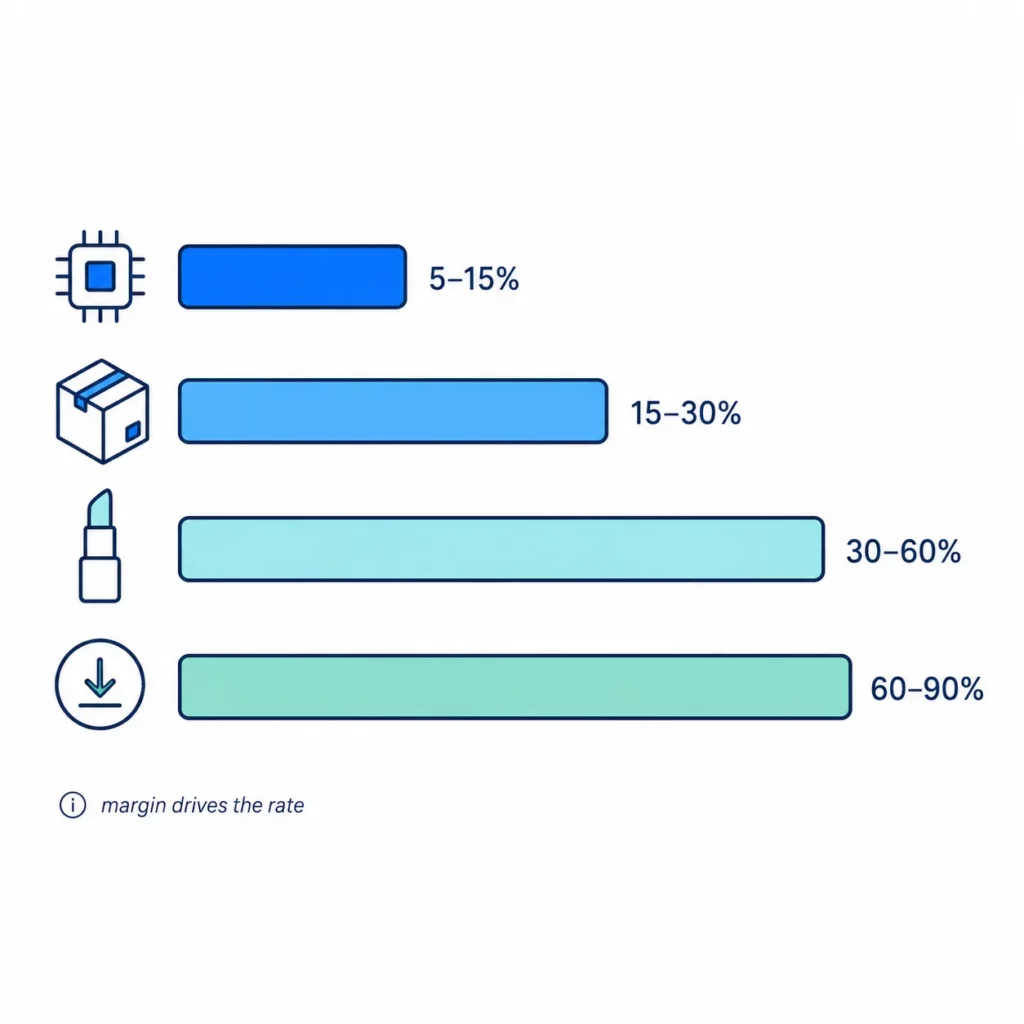
Most Shopify affiliate programs pay 5% to 30% of each sale, and the right number depends on your profit margin. In particular, physical-goods brands tend to land between 5% and 20%.
The bands shift with each vertical.
- Electronics & B2B: 1–10%
- Physical products (general): 5–20%
- Fashion & beauty: 8–18%
- Digital products & SaaS: 20–50%
Margin explains this gap.
Electronics carry thin margins, so they pay least, while beauty, supplements, and digital goods can fund 20% or more. A sustainable rule sets commission near 20% to 30% of gross profit.
In practice, those ranges show up across real Shopify programs. Jenni Bag, a fashion brand, pays 20%, whereas GoldieLocks runs 15% to 25% in beauty.
GoldieLocks’s two-rate setup points to a wider choice. The question is not just how much to pay, but how to structure it.
Beyond a flat percentage, a brand might add a higher rate for first-time customers, or a tier that climbs with performance.
How do merchants track affiliate sales and stop coupon leaks?
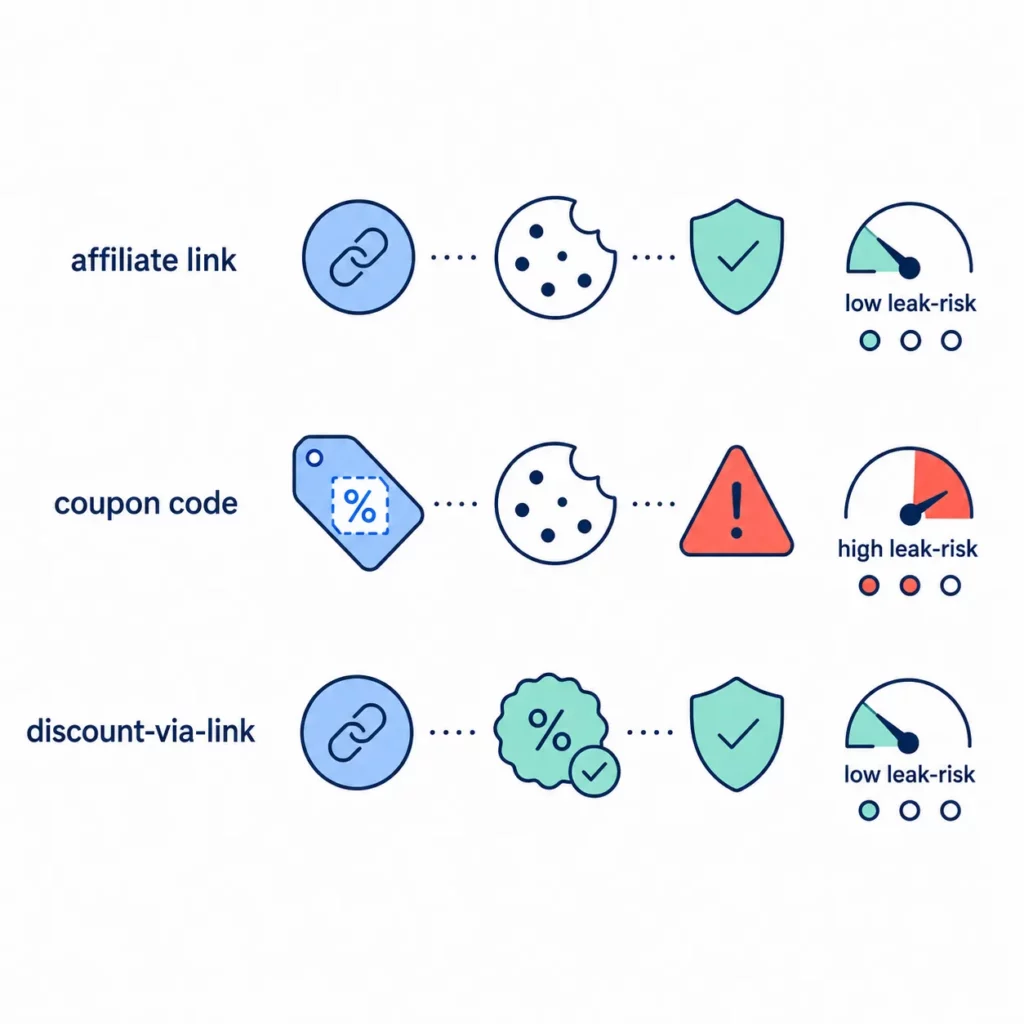
Shopify merchants track affiliate sales in two ways: a unique affiliate link, or a discount code tied to each partner. Most programs run both, because each can cover what the other misses.
Start with the link. It sets a cookie on click and credits the affiliate when that visitor buys.
The trouble is that cookies get blocked, so a shopper who clicks on mobile but buys on a laptop may slip through uncredited.
A code will help close that gap. Since it credits the affiliate whenever the code is used, on any device, it keeps working even when the cookie fails.
But the code brings a problem of its own. Once it leaks onto deal sites, strangers grab the discount, so margins erode and the affiliate is paid for sales they never drove.
The fix removes that leak at the source. Affiliate software like UpPromote allows customers to apply the discount through the affiliate link itself, so no code exists to copy, share, or post on a deal site.
The trade-offs line up cleanly.
| Tracking method | How it credits the sale | Leak risk |
| Affiliate link | Cookie set on click | None (nothing to share) |
| Coupon code | Code entered at checkout | High (codes scraped to deal sites) |
| Discount via the link | Discount auto-applies through the link | None (no code to leak) |
How well do affiliate programs actually perform?
Affiliate performance comes down to three numbers: conversion rate, revenue share, and return per dollar. A strong program holds up on all three.
Affiliate traffic converts at 1–3%, and the best programs can reach 5%.
The pull is trust: a shopper who arrives through a recommendation is already half-sold. Impact.com’s 2025 data adds nuance. Shoppers now research longer, then buy fewer but larger orders.
Revenue share follows. For brands that run a program, affiliates drive about 15% of online sales, and mature programs reach 15–30%. Each sale returns around 12 to 1, so the channel scales without the rising cost of ads.
Real merchant programs show the upper end in practice.
| Brand | Category | Affiliate program result |
| PRX Performance | Home & Garden | $2.3M in affiliate sales, 78% ROI |
| Glow Collection | Home & Garden | 2,800+ affiliates; $5,000–6,000 in monthly commissions |
| SilverCeuticals | Health | ~30% of revenue; top affiliates drive $50K–$100K+ monthly sales |
One pattern runs through every program above. A small core of affiliates drives most of the revenue, while the rest may chip in only now and then. The real work, then, is not just recruiting; it is spotting that core early and keeping it active.
How do merchants find and recruit affiliates?
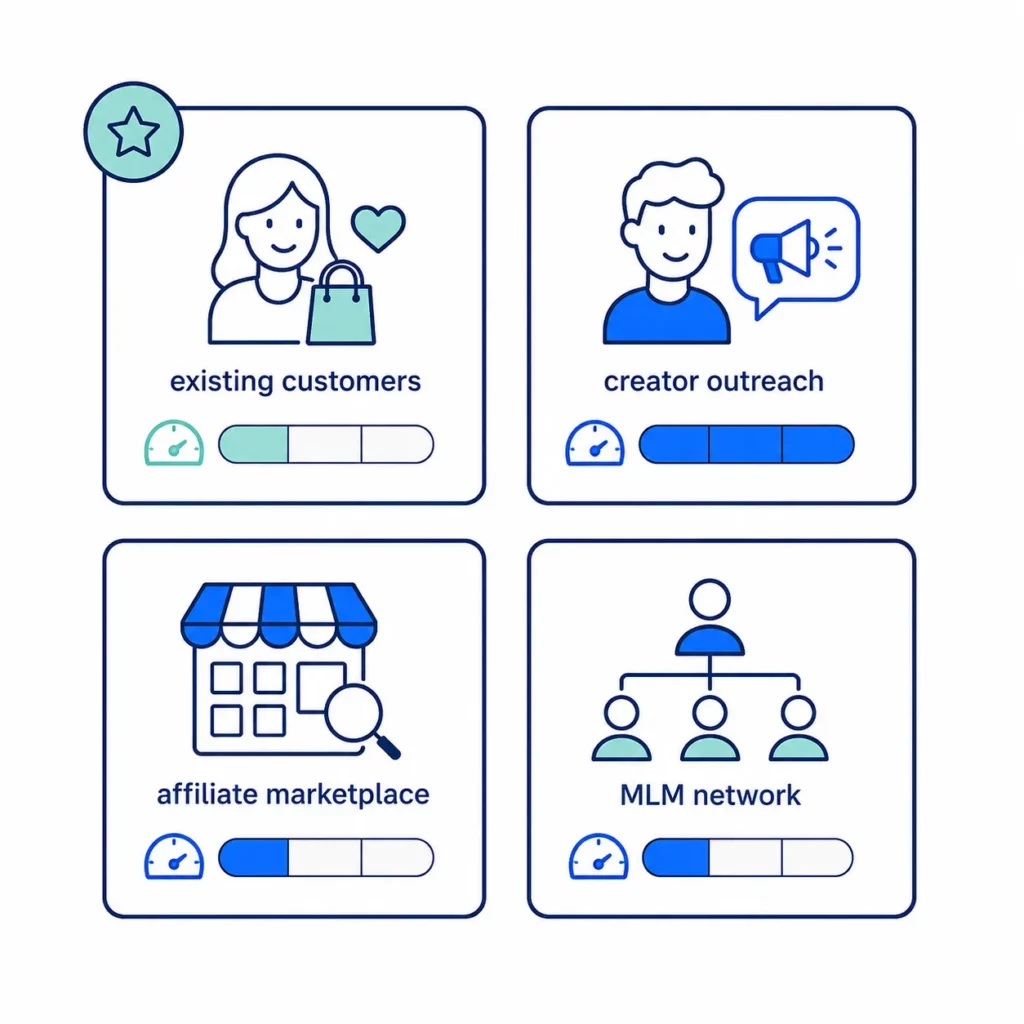
Affiliates often come from four channels. The warmest is the one many merchants skip: their own customers.
They differ in how much outreach each demands.
| Channel | How it works | Effort |
| Existing customers | Invite buyers to share a link or join as affiliates | Low |
| Creator outreach | Hand-pick influencers by audience fit, send samples | High |
| Affiliate marketplace | List the program so affiliates find and apply | Low (passive) |
| Affiliate networks (MLM) | Affiliates recruit sub-affiliates for downline commission | Medium |
Existing customers convert best because the trust is already there. A customer-referral tool lets a shopper share a link after buying, then earn store credit when a friend orders. Your most active sharers can graduate into full affiliates.
Creator outreach takes more work, and the instinct is to chase follower counts. Freewell Gear did the opposite, hand-picking creators by product expertise and sending free samples.
The last two channels run on their own. Affiliate marketplaces like UpPromote Marketplace showcases your program where affiliates browse and apply, which helps merchants who dislike cold outreach.
A network, or MLM, structure goes further. Affiliates recruit others for a slice of downline sales, so the roster could grow without you.
How do merchants prevent affiliate fraud and stay compliant?
Two risks may shadow every affiliate program: fraud and compliance. Both can be managed, but only if you build the controls early.
Fraud is not rare. In 2022, CHEQ found that 17% of affiliate traffic was fraudulent, costing an estimated $3.4 billion. Most of it traces to a few familiar tricks.
| Common scam | What it looks like | How it’s caught |
| Self-referral | An affiliate buys through their own link | Match the buyer to the affiliate’s identity |
| Fake signups | Many accounts from one IP or disposable emails | Flag duplicate IPs and throwaway domains |
| Cookie stuffing | Tracking cookies forced without a real click | Spot clicks with no genuine engagement |
The defense is detection plus a second look. UpPromote’s fraud detection can help merchants flag self-referrals, duplicate IPs, and disposable-email signups.
It also helps to delay approval until the return window closes, so refunded orders never earn a commission.
Besides, compliance is the quieter risk. In the US, affiliates must disclose that they earn a commission; the FTC treats it as a material connection that has to be clear and conspicuous. A plain line such as “I earn a commission” in the caption is enough.
In the EU and UK, the rules reach the cookie itself. Affiliate tracking pixels need prior consent under GDPR and ePrivacy. The UK’s ICO confirmed it in 2026. Consent banners will suppress some tracked sales, so plan for it.
Which industries see the strongest affiliate results?
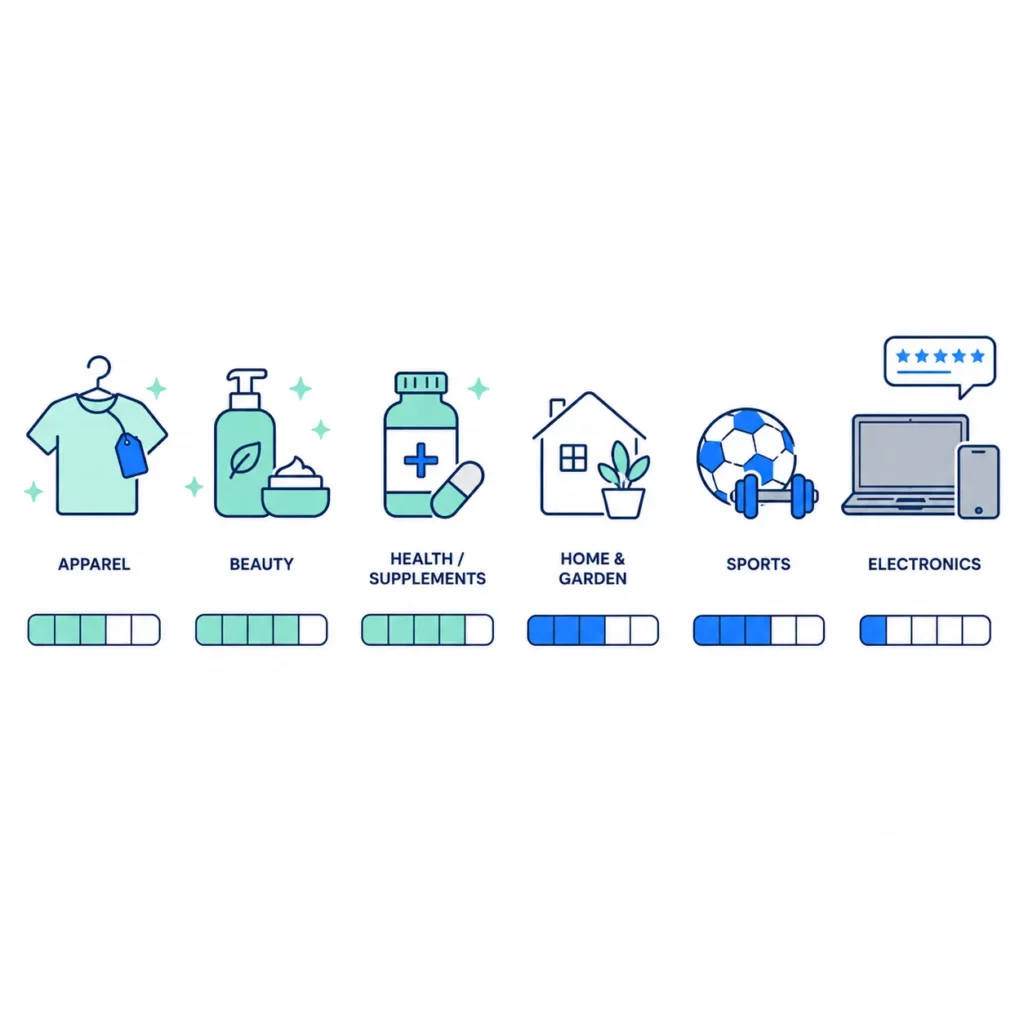
Affiliate marketing works in nearly every niche, but how far it goes varies. In some, it drives most of the sales. In others, it plays a smaller part.
These examples span both ends of that range.
| Industry | Real Shopify example | Affiliate result |
| Apparel & fashion | Saledress | $1.8M in affiliate revenue (2022) |
| Beauty & skincare | TréSkin | $120K in 3 months |
| Health & supplements | Blushield USA | 70–80% of revenue from affiliates |
| Home & garden | Window Cleaning Resource | $800K in 6 months |
| Sports & outdoors | Holbrook Pickleball | 87% jump in referral orders |
| Consumer electronics | Freewell Gear | $350K in 2 months |
The biggest wins come where buying runs on trust. Beauty, supplements, and fashion sell on advice, so a creator’s word can carry real weight.
Electronics are different. Buyers want proof first, which favors expert reviews over big followings.
Commission rates still follow the category. Fashion and beauty sit near 8–18%, physical goods 5–20%, and electronics often 1–10%, where thin margins can cap payouts.
Some niches are still hard to benchmark. Pet, fine jewelry, and subscription boxes are growing fast, yet few Shopify results are on record. Treat early numbers there with care.
What’s changing in affiliate marketing year over year?
Three shifts are reshaping affiliate marketing in 2026: budgets are growing, the funnel is stretching, and tracking is tightening.
Start with the money. Affiliate spend in the US grew 49.8% from 2021 to 2024, about twice the pace of ecommerce itself (PMA, 2025). The channel is pulling budget, not losing it.
The funnel is shifting too. In 2025, impact.com saw affiliate clicks rise about 2% while conversions fell about 6%, as shoppers research longer before buying (impact.com, 2025). The orders that land are bigger, so average order value can climb even as conversion slips.
Tracking, meanwhile, is getting stricter. Privacy rules now reach the affiliate cookie itself; the UK’s ICO confirmed in 2026 that tracking pixels need consent. More programs will lean on consented, first-party, and code-based tracking.
What’s next for affiliate marketing on Shopify?
No one can predict 2027, but three signals already point the way. AI is changing discovery, programs are getting choosier, and tracking is moving to consent.
Start with discovery. More shoppers now ask AI assistants for product picks, not just search bars. Brands cited in those answers will win the click, so affiliate content is shifting to earn AI mentions, not only rankings.
Programs are likely to get smaller and sharper. The best returns already go to brands that pick a few high-fit partners and recruit by data, not follower count.
Tracking keeps moving toward consent. As cookie rules tighten, programs may lean on consented, first-party, and code-based attribution. The teams that prepare now will lose the fewest sales to a banner.
Frequently Asked Questions
What is a good affiliate conversion rate for a Shopify store?
Affiliate traffic usually converts at 1–3%, since it arrives through a trusted recommendation. Strong, well-matched programs can reach 5%. If your rate sits below 1%, the cause is often affiliate fit, not the offer itself.
What commission rate should I offer affiliates?
Most Shopify programs pay 5–30%. Fashion and beauty sit around 8–18%, physical goods 5–20%, and electronics 1–10%. A sustainable rule is to keep commissions near 20–30% of your gross profit, so margins stay healthy.
Do affiliates legally have to disclose they earn a commission?
Yes. In the US, the FTC treats an affiliate commission as a material connection. It must be disclosed up front and in plain view. A short line such as “I earn a commission” near the link meets the rule.
Do affiliate tracking cookies require consent in the EU and UK?
Generally yes. Affiliate tracking cookies and pixels need prior opt-in consent under GDPR and ePrivacy rules. They record user behavior, so consent applies. Cashback or loyalty programs the user signed up for are narrow exceptions.
How much of my store’s revenue can affiliate marketing realistically drive?
For brands that run a program, affiliate marketing drives roughly 15% of online revenue on average. Mature programs often reach 15–30%, and in trust-heavy niches like supplements it can climb higher still.
How do I stop affiliates from earning commissions on coupon leaks?
Coupon codes leak when they get scraped onto deal sites, so strangers redeem them. The cleanest fix is to apply the affiliate discount through the tracking link itself, leaving no shareable code to leak.

Ellie Tran, a seasoned SEO content writer with three years of experience in the eCommerce world. Being a part of the UpPromote team, Ellie wants to assist Shopify merchants in achieving success through useful content & actionable insights.Ellie's commitment to learning never stops; she's always eager to gain more knowledge about SEO and content marketing to create valuable content for users. When she's not working on content, Ellie enjoys baking and exploring new places.
![How to Use Shopify Functions with Your Affiliate Program [2026 Guide]](https://static.uppromote.com/wp-content/uploads/2026/06/how-to-use-shopify-functions-with-affiliate-program-300x169.webp)

![How to Prevent Affiliate Fraud on Shopify: Self-Referral, Coupon Abuse & More [2026]](https://static.uppromote.com/wp-content/uploads/2026/06/how-to-prevent-affiliate-fraud-on-shopify-300x169.webp)

![Affiliate Program Not Growing? 10 Common Mistakes Shopify Merchants Make [2026]](https://static.uppromote.com/wp-content/uploads/2026/06/affiliate-program-not-growing-300x169.webp)