











TL;DR
Micro-influencers (10K–100K followers) are the highest-ROI tier for Shopify affiliate programs. They convert better than macro-influencers and most will accept commission-only deals.
- Best tier: Micro-influencers (10K–100K) — higher engagement, niche audiences
- Finding them: 8 free methods before spending on paid platforms
- Outreach key: Personalize every message — reference specific content
- Vetting priority: Engagement rate and content quality over follower count
- Deal to start: Free product + 10–15% commission per sale
Influencer marketing and affiliate marketing used to sit in separate budgets. One paid for exposure. The other paid for sales. That wall is coming down fast.
Brands that combine influencer and affiliate programs see 46% higher affiliate-based sales than brands running affiliate programs alone (impact.com, 2024).
The model works because one creator fills two roles. They post content for awareness while their affiliate link drives sales — same person, same audience, one commission.
The best results often come from smaller creators. Micro-influencers bring higher engagement and niche audiences that convert better, making them the highest-ROI tier for most Shopify stores.
But knowing that doesn’t get you very far without a system. Most merchants struggle with the same four questions: where to find the right influencers, how to reach out, what to check before approving, and how to structure a deal.
This guide walks through the full process, from finding your first candidates to tracking their sales 30 days later.
You’ll get 8 free finding methods, platform search playbooks, 3 outreach templates, an 8-criteria vetting checklist, deal structures, and a 7-day onboarding plan.
Why Influencer-Affiliates Beat Sponsored Posts for Shopify Stores
A sponsored post costs $500–$5,000 upfront and delivers one piece of content.
Whether that post drives zero sales or a hundred, you pay the same amount. An influencer-affiliate earns 15–25% commission per sale, and only when a sale happens.
The difference between the two models shows up in every part of the partnership.
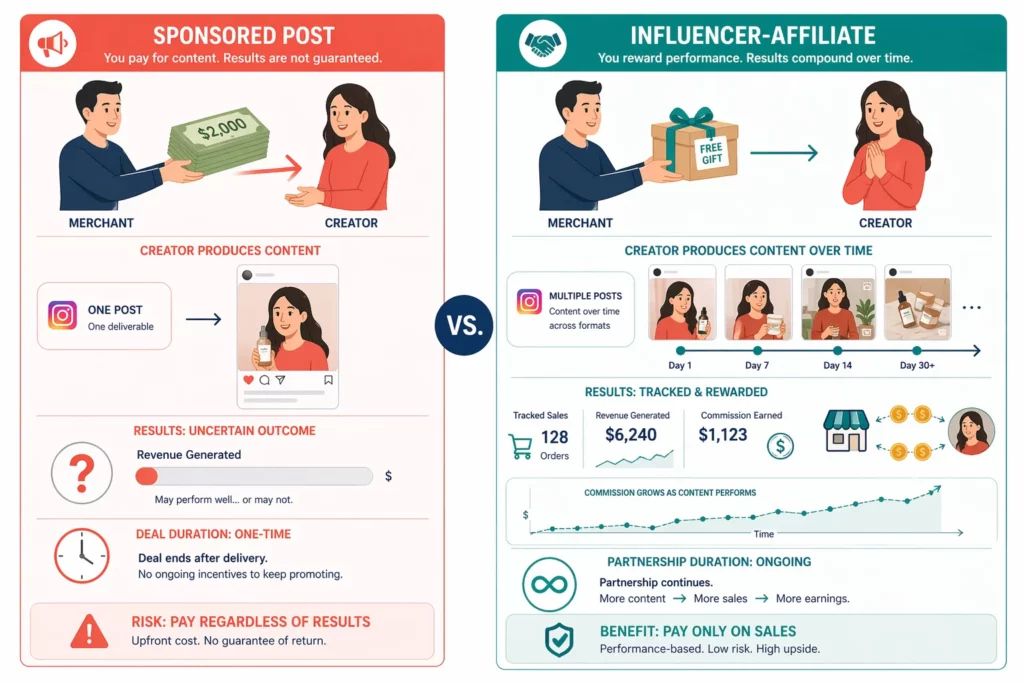
| Factor | Sponsored post | Influencer-affiliate |
| Payment | Flat fee upfront ($500–$5K+) | Commission per sale (15–25%) |
| Risk | High — you pay regardless of results | Low — you pay only when a sale closes |
| ROI clarity | Hard to measure beyond likes | Clear — tracked sales, revenue, AOV |
| Creator motivation | Deliver the post, move on | Drive ongoing sales to keep earning |
| Duration | One post, one story | Ongoing partnership |
| Scalability | Limited by your budget | Grows with revenue — more sales, more commission |
| Best for | Brand awareness | Revenue and customer acquisition |
The risk row is what matters most for smaller Shopify stores.
A $2,000 sponsored post that generates $400 in sales is a $1,600 loss. The same creator on a 15% commission would have earned $60 and you would still have $340 in profit.
That math explains why the two models are merging.
Creators post the same content they would in a sponsorship deal, but earn through an affiliate link instead of a flat fee. The brand pays less upfront. The creator earns more over time if the content performs.
Micro-influencers in particular tend to prefer this model. Many already use and trust the products they promote, so commission feels like a fair trade.
That preference makes them easier to recruit. They skip the back-and-forth of flat-fee deals and earn passive income from a single link that keeps working after the post goes live.
Micro vs Nano vs Macro: Which Influencer Tier Should You Target?
Micro-influencers (10K–100K followers) are the sweet spot for Shopify affiliate programs.
They have engaged, niche audiences; most will work on a commission-only or gifting-plus-commission basis.
Each tier trades off reach against engagement and cost. The table below shows where each one fits.
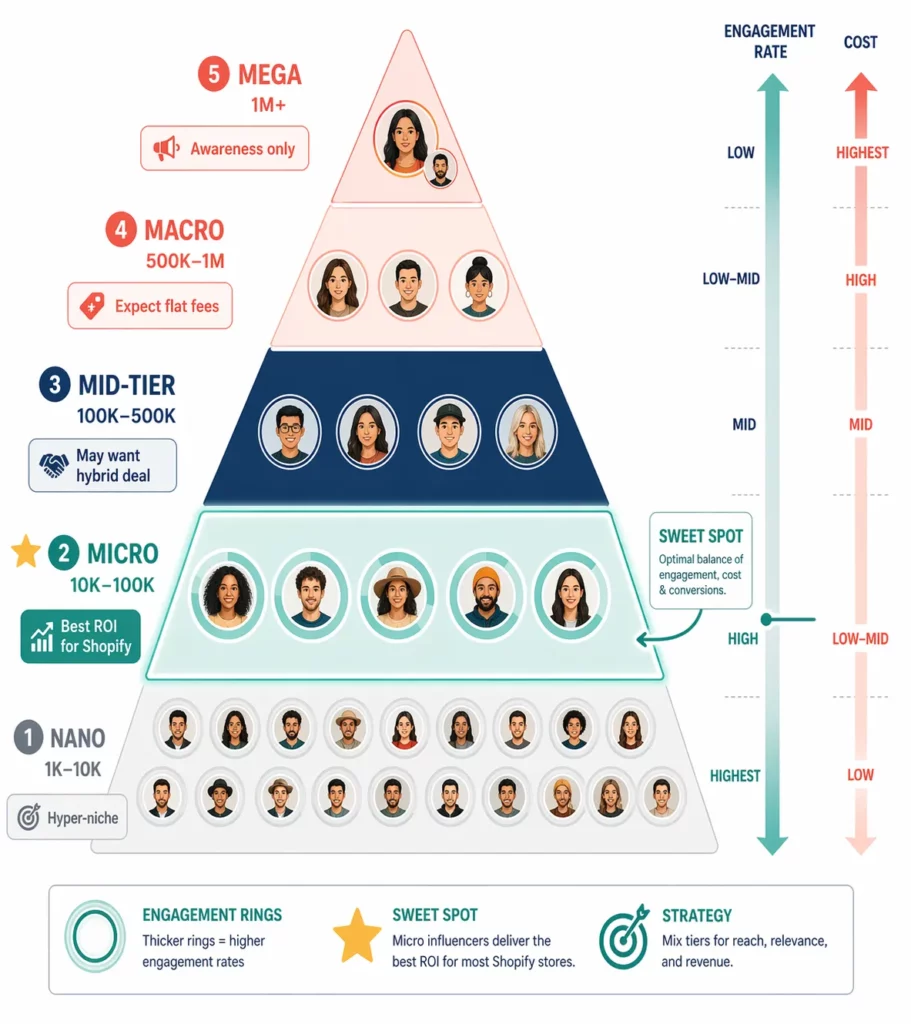
| Tier | Followers | Engagement rate | Accept commission-only? | Best for |
| Nano | 1K–10K | Highest (4–8%) | Yes — eager for any partnership | Hyper-niche products, local brands |
| Micro | 10K–100K | High (2–5%) | Yes — most will | Sweet spot: niche reach + scale |
| Mid-tier | 100K–500K | Moderate (1–3%) | Sometimes — may want hybrid | Growing brands with some budget |
| Macro | 500K–1M | Lower (0.5–2%) | Rarely — expect flat fees | Brand awareness, product launches |
| Mega | 1M+ | Lowest (<1%) | No — require paid deals | Mass awareness only |
Engagement rates are cross-platform industry averages. Actual rates vary by niche and platform.
The engagement column tells the story. A nano-influencer with 5,000 followers and a 6% engagement rate reaches 300 people who care.
Scale that up to a macro-influencer with 500,000 followers and a 1% rate, and you reach 5,000. But those 5,000 are spread across a much broader, less targeted audience.
For affiliate programs, that targeting gap matters more than raw reach. A smaller, focused audience is more likely to click an affiliate link, trust the recommendation, and buy.
Nutriland only needed 27 influencers to generate €400,000 in revenue and 10,000 referrals, nearly €15,000 per creator.
The practical starting point for most Shopify stores: recruit 10–15 micro-influencers on a commission-only or gifting-plus-commission deal. That gives you enough data to identify which creators drive real sales before scaling further.
8 Free Methods to Find Influencer-Affiliates for Your Shopify Store
You can build a qualified list of 20–30 influencer candidates in a single afternoon without paying for any discovery platform.
The eight methods below are ranked by lead quality, starting with the ones most likely to say yes.
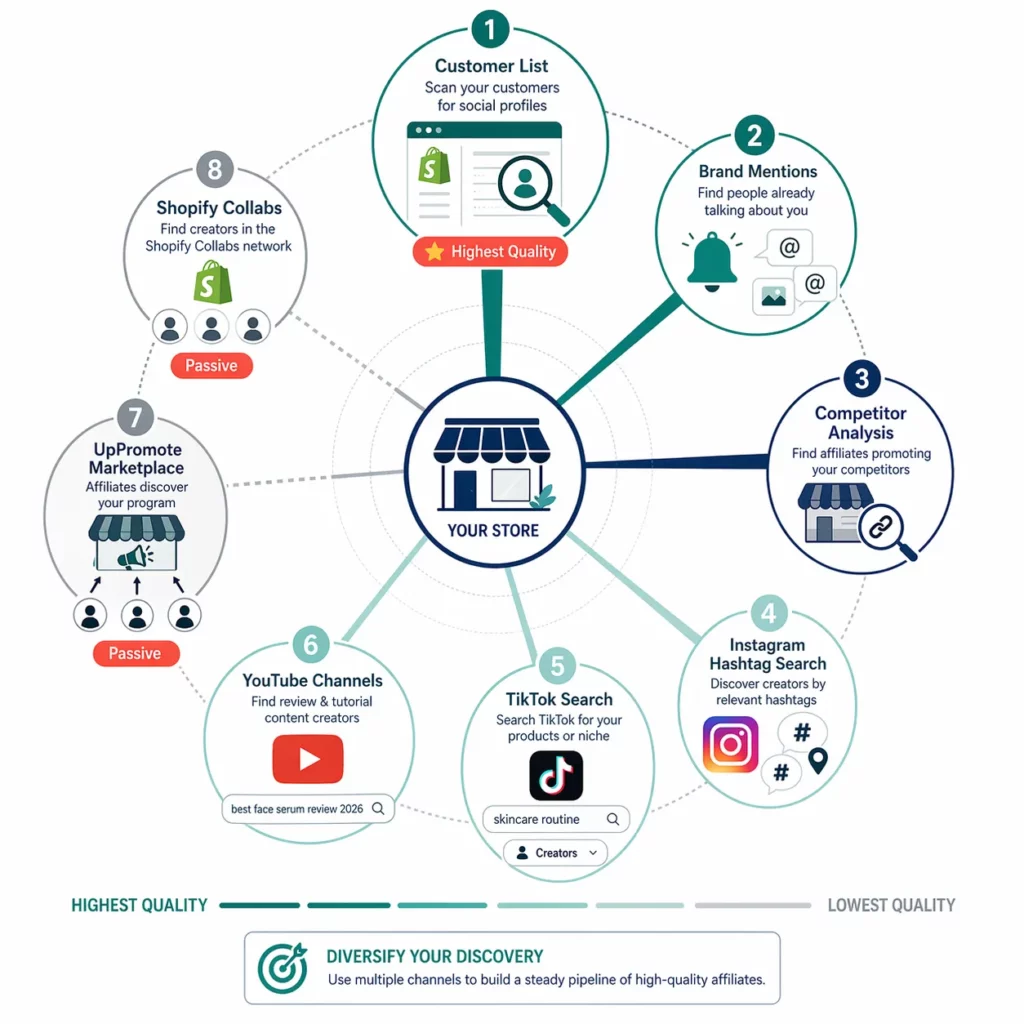
| # | Method | Lead quality | Time | Why it works |
| 1 | Mine your customer list | Highest | 30 min | They already bought and love your product |
| 2 | Brand mention monitoring | Very high | 15 min/day | They’re already posting about you for free |
| 3 | Competitor affiliate analysis | High | 1 hr | They already know the affiliate model |
| 4 | Instagram hashtag + location | Medium-high | 45 min | Visual niches: fashion, food, beauty |
| 5 | TikTok creator search | Medium-high | 45 min | Video-first, Gen Z, trending content |
| 6 | YouTube niche channels | High | 45 min | Long-form reviews, lasting SEO value |
| 7 | UpPromote Marketplace | Medium | 15 min | Affiliates find you — passive recruitment |
| 8 | Shopify Collabs | Medium | 15 min | Free, Shopify-native creator network |
Method 1: Mine your customer list
Your best affiliate candidates have already bought from you. In Shopify Admin, sort customers by repeat purchases and check who has a social media presence.
Someone who bought twice and has 15,000 Instagram followers is the ideal recruit. If your affiliate app supports converting customers directly, you can upgrade your best buyers to affiliate status in a few clicks.
→ Deep dive: How to Turn Customers into Affiliates
Method 2: Monitor brand mentions
Spend five minutes each morning searching your brand name and handle on Instagram and TikTok. People already posting about your product without being paid are your highest-quality leads.
A DM that opens with “We noticed your post about [product]” converts far better than any cold outreach.
Method 3: Analyze competitor affiliates
Google “[ competitor brand ] affiliate program” and “[ competitor brand ] discount code.” The influencers promoting competitors already understand the model and create content in your niche.
Offering a better commission or product can shift their focus to your program.
Method 4: Search Instagram by hashtag and location
Start with 5–10 niche hashtags in your category, such as #cleanbeauty, #homegymsetup — and tap the “Recent” tab to surface micro-influencers instead of celebrities.
Look for posts with 500–5,000 likes from accounts in the 10K–100K range. A business email or “collabs” in the bio signals they’re open to partnerships.
Method 5: Search TikTok for niche creators
Use the search bar with product category keywords and filter by “Users.” TikTok’s Creative Center (creative.tiktok.com) also lets you browse trending creators by category and region.
Focus on accounts with 10K–100K followers posting content that matches your brand. Smaller accounts on TikTok tend to be more responsive to partnership offers.
Method 6: Find YouTube reviewers in your category
Search “[product category] review 2026” and filter by upload date to find active channels.
Channels with 5K–100K subscribers are the sweet spot — large enough to drive traffic, small enough to respond to outreach.
Check the “About” tab for a business email. That line signals the creator is open to brand deals.
Method 7: List your offer on the UpPromote Marketplace
This flips the direction, instead of you searching for affiliates, affiliates search for you.
List your offer with your commission rate and product niche. Affiliates browsing the UpPromote marketplace can discover your program and apply to join.
Set it up once, and it works as a passive channel alongside your active outreach.
Method 8: Use Shopify Collabs
Shopify Collabs’s free tool connects brands with creators and includes built-in affiliate tracking.
The creator pool is smaller than dedicated platforms, but it costs nothing and runs inside your Shopify admin.
How to Write Outreach Messages That Actually Get Replies
Personalized outreach that references a specific post or video converts several times better than generic mass DMs.
The difference is showing the creator you’ve seen their work, not just their follower count.
The easiest way to prove you’ve done that homework: name something specific.
First, mention a specific piece of their content by name..
Second, lead with what they get (commission rate, free product), not your brand story.
Third, keep it short and save the details for after they reply “interested.”
The three templates below put this into copy-ready messages, one for each platform.
Template 1: Instagram DM
Hi [Name]! Loved your [specific reel/post about X] — your audience clearly trusts your picks.
We make [product category] and think you’d be a great fit for our affiliate program: [X]% commission on every sale + free [product] to try first.
Interested? I’ll send the details. No strings attached.
— [Your name], [Brand]
This works because it opens with a specific content reference, states the offer in concrete terms, and closes with a low-pressure ask.
Template 2: Email
Subject: [Name] × [Brand] — earn [X]% on something you’d actually use
Hi [Name],
I’ve been following your [platform] content, especially [specific post/video about topic]. Your take on [niche] lines up with what we do at [Brand].
We’re inviting select creators to our affiliate program:
- [X]% commission on every sale you refer • Free [product] shipped to you — no strings • A personal discount code for your audience
Our partners typically earn $[range]/month depending on audience size. If you’re interested, just reply “in” and I’ll set everything up this week.
No long-term commitment — try it for 30 days.
[Your name] [Brand] | [website]The email format gives room for more detail. The “reply in” CTA reduces friction — one word is easier than writing a full response.
Template 3: TikTok Comment-to-DM
The two-step approach builds familiarity before the ask. A public comment first shows you’re a real brand, not a spam account.
Step 1 — Public comment on their video (genuine, not salesy)
“ This is such a helpful [review/tutorial]! We make something similar — love your take on [topic] 🙌”
Step 2 — Wait 24–48 hours. If they reply or like your comment, DM
“ Hey [Name]! Thanks for the reply. We’d love to send you [product] free + offer [X]% commission if you share it with your audience. Interested? ”
8-Criteria Vetting Checklist for Influencer-Affiliates (+ 5 Red Flags)
Follower count tells you how many people might see a post. It tells you nothing about whether those people will buy.
Engagement rate and content quality are the two criteria that predict affiliate revenue. Everything else is secondary.
Take a quick look at the checklist below to see what to check before approving any influencer into your program.
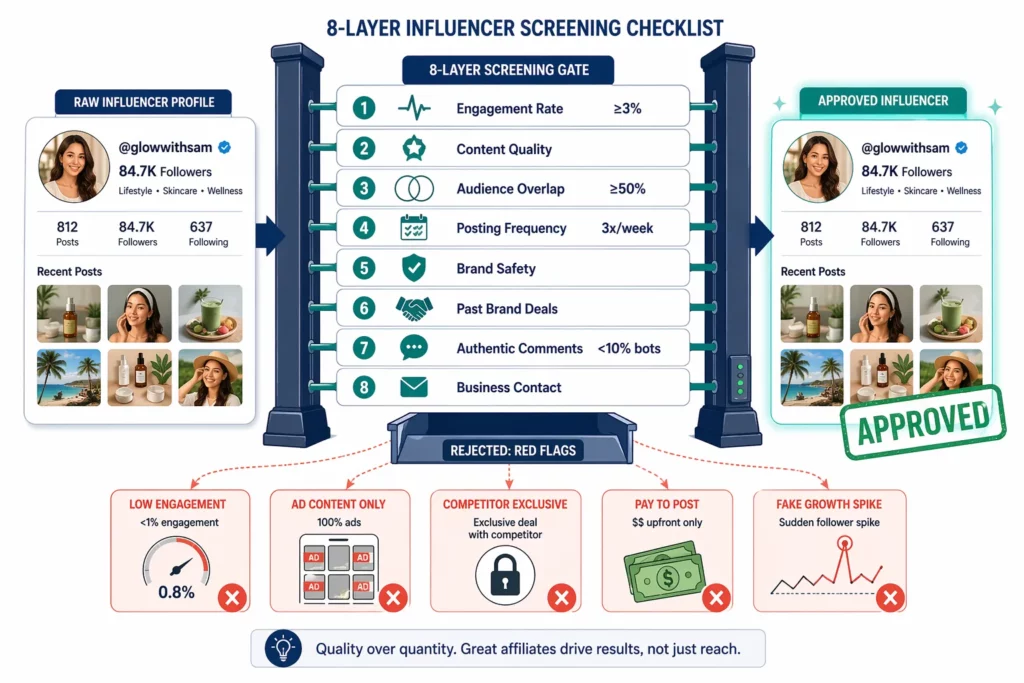
| # | Criteria | How to check | Minimum standard |
| 1 | Engagement rate | (Avg likes + comments) ÷ followers × 100 | ≥3% Instagram, ≥5% TikTok |
| 2 | Content quality | Scroll 20 recent posts: visuals, captions, storytelling | Consistent quality, on-brand fit |
| 3 | Audience overlap | Do their followers match your customer profile? | ≥50% overlap in age, location, interest |
| 4 | Posting frequency | How often they publish | Active at least 3x per week |
| 5 | Brand safety | Any controversial or offensive content? | Zero red flags |
| 6 | Past brand deals | Do they promote other brands? How well? | Some experience, but not 100% ads |
| 7 | Authentic comments | Read 20 comments — real conversations or bot spam? | Less than 10% generic/bot comments |
| 8 | Business contact | Email in bio or “open to collabs” signal? | Preferred but not required |
Freewell Gear shows what happens when you weight those top criteria heavily.
The camera accessories brand screened creators for product knowledge above all else, not follower count. That focus produced $350,000 in affiliate revenue in two months across roughly 700 creators.
Passing all eight criteria is only half the job. These five patterns should rule out a candidate on the spot.
| Red flag | Why reject |
| Engagement below 1% despite high followers | Likely purchased followers — fake audience, zero sales |
| Every post is a paid ad | Audience tunes out ads — low conversion, “sellout” perception |
| Under competitor exclusivity | Cannot promote your brand while contractually bound elsewhere |
| Demands upfront payment only (no commission) | Not interested in performance — misaligned incentives |
| Sudden follower spikes (5K–10K in one day) | Purchased followers — check Social Blade for growth pattern |
A full vetting pass takes about five minutes per candidate.
Check the follower count (10K–100K range), scan the last 10 posts for engagement, and scroll 20 posts for content quality and brand safety.
Then read 20 comments to spot bot activity and check the bio for contact info. If a candidate fails two or more criteria, move on.
Deal Structures: Commission-Only vs Gifting vs Hybrid
Most Shopify stores should start with gifting plus commission, like sending a free product and offer 10–15% per sale. It costs one product upfront and gives the influencer a real experience to talk about.
The four deal types below fit different budgets and influencer tiers. Match your starting point to your store’s stage.
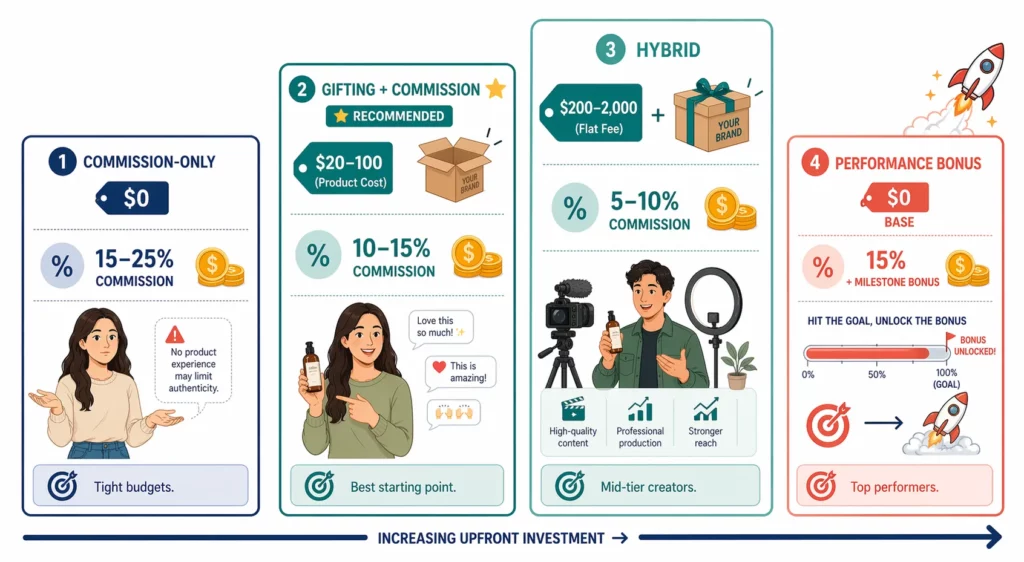
| Deal type | Upfront cost | Commission | Best for | Influencer appeal |
| Commission-only | $0 | 15–25% | Tight budgets, testing | Medium — no product = harder sell |
| Gifting + commission | Product cost ($20–100) | 10–15% | Recommended start | High — free product + earnings |
| Hybrid (fee + commission) | $200–2,000 | 5–10% | Mid-tier / macro creators | Very high — guaranteed income |
| Performance bonus | $0 base | 15% + bonus at milestone | Top performers | High — gamification |
Commission-only works when the influencer already knows your product or when the price point is low enough that they can buy it themselves.
The risk is thin content without trying the product, the promotion often feels generic.
Gifting plus commission removes that risk. You ship one product, the creator uses it, and they promote from real experience. The cost of one unit ($20–100) is small compared to the lifetime value of an active affiliate.
The setup takes less than a minute. You just need to pick a product from your Shopify catalog, create a gift order in your affiliate app like UpPromote, and the system logs it as a program cost. No manual tracking needed.
Meanwhile, Hybrid deals make sense for mid-tier creators (100K+ followers) who expect payment for content production. The flat fee covers their time; the commission keeps them motivated to drive sales long-term.
A performance bonus works on top of any deal type. Set a target — “$50 extra when you hit 50 sales this month” — and the software will track progress toward the milestone for you.
In practice, the beauty brand Kess Berlin combines commissions, flat fees per post, and free product samples for their influencer roster. Forty-four active influencers generated over 44,000 referrals.
How to Onboard Influencer-Affiliates in the First 7 Days
The first week after approval decides whether an influencer posts or ghosts. A clear onboarding plan with product, content assets, and personal check-ins makes the difference.
Here’s what that plan looks like day by day.
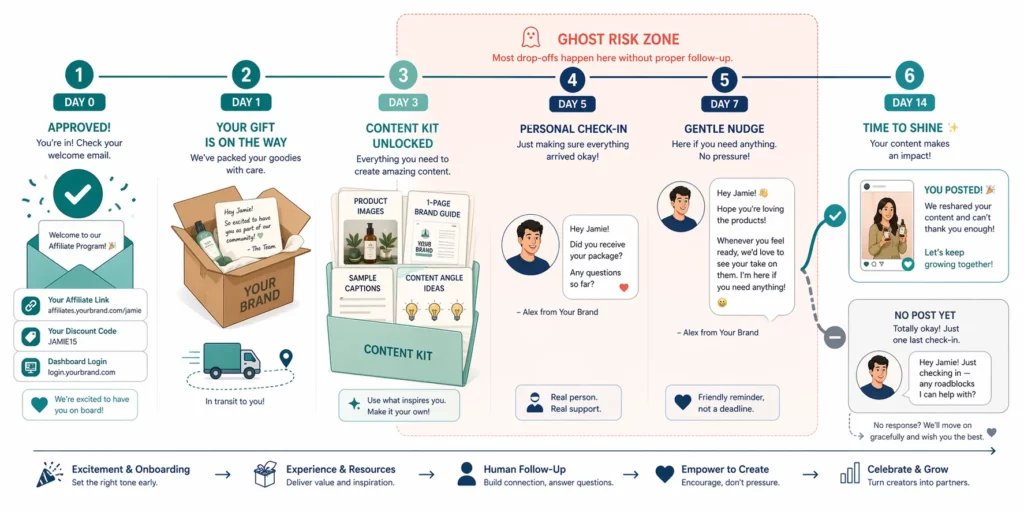
| Day | Action | What to include |
| Day 0 | Approve + welcome | Affiliate link, discount code, dashboard login |
| Day 1 | Ship product | Handwritten note: “Can’t wait to see your take on [product]” |
| Day 3 | Send content kit | Product images, brand guidelines (1 page), 3–4 content angle ideas, sample captions |
| Day 5 | Personal check-in | “Did you receive [product]? Any questions?” — personal, not automated |
| Day 7 | Gentle nudge | “Excited to see your content whenever you’re ready — let me know if you need anything” |
| Day 14 | Performance review | Posted? → Thank + reshare. Not posted? → One final check-in, then move on |
The Day 3 content kit is what separates programs that produce content from ones that stall. Upload product images, a one-page brand guide, and sample captions to a shared gallery.
From there, every approved affiliate can download those files straight from their dashboard — no email threads, no shared drive links.
The Day 5 check-in matters just as much. A personal message shows the creator they’re working with a real person. That small touch cuts ghost rates more than any incentive.
→ Read more: 7-Day Affiliate Onboarding Sequence
How to Track and Measure Influencer-Affiliate Performance
Track five KPIs per influencer and review them monthly.
Earnings per click (EPC) is the single most useful metric, showing whether an influencer’s traffic is high-quality, not just high-volume.
Each one has a benchmark and a clear next step when the number falls short.
| KPI | Formula | Benchmark | If below benchmark |
| Clicks | Total link clicks | 100+ per month | Content isn’t reaching people — suggest new angles |
| Conversion rate | Sales ÷ clicks | 3–5% | Audience may not match your product — review fit |
| Sales | Orders from this affiliate | 5+ per month | Low volume — try a bonus incentive |
| Revenue | Total $ from this affiliate | Track the trend | Declining = time to check in |
| EPC | Revenue ÷ clicks | $0.50+ | Traffic quality issue — wrong audience or weak CTA |
You won’t need a separate spreadsheet. Affiliate software like UpPromote pulls all five metrics into one analytics dashboard — filterable by date range and program.
One export can cover the entire monthly review.
You can sort affiliates by revenue, highest first.
The top 20% are your best performers — thank them and offer a tier upgrade or exclusive perks. The middle 60% need a light push: send content ideas, check in, suggest new products to promote.
The bottom 20% deserve patience, not pressure. If an affiliate stays inactive for three months after onboarding and check-ins, remove them and focus your time on the creators who are producing.
Frequently Asked Questions
How many influencers should I recruit to start?
Start with 10–15 micro-influencers. Not all of them will post — expect roughly half to publish content in the first month. Five to eight active influencer-affiliates is enough to generate meaningful data. Scale to 30–50 in months two and three based on what performs.
Should I pay a flat fee if an influencer asks for one?
It depends on their tier. For nano and micro-influencers (under 50K followers), offer gifting plus commission instead. Most will accept. For mid-tier creators (50K–200K), a hybrid deal can work if their content quality and audience match are strong.
The key rule: never pay a flat fee without a commission part. Remove the performance incentive and you remove the drive to sell.
Is it normal for influencers to post once and stop?
Yes — it happens often and is one of the most common challenges in influencer-affiliate programs. Solutions include a structured onboarding sequence, monthly product seeding to keep interest fresh, performance bonuses for milestones, and personal monthly check-ins. Ask them: “What would help you share more?”
Should I gift the product or let influencers buy it?
Always gift. Asking an influencer to buy your product adds friction and delays the partnership. Gifting lets you control the experience — packaging, timing, and a personal note. The cost of one product ($20–100) is small compared to the lifetime value of an active affiliate.
Can I recruit influencers who already promote a competitor?
Yes — unless they’re under an exclusivity clause. An influencer promoting a competitor is proof they understand the affiliate model, create content in your niche, and have a relevant audience. Offer a stronger commission or a better product experience, and many will add your program or shift focus.
How do I spot fake followers?
Three checks cover the basics. First, engagement below 1% on an account with 50K+ followers usually means a purchased audience. Second, generic comments — emoji-only or “nice pic!” on every post — point to bot activity.
Third, check Social Blade for sudden follower spikes of 5K–10K in a single day. That pattern almost always means purchased followers.
What is the difference between UpPromote Marketplace and Shopify Collabs?
They serve different sides of the same problem. UpPromote Marketplace is passive — you list your offer and affiliates find you. Shopify Collabs is active — you search for creators and reach out. The two are complementary: list on the marketplace for inbound leads while using Collabs and manual search for targeted outreach.

Joan, a creative mind and author behind UpPromote blog. Writing has always been my sanctuary, a place where I can explore my imagination and share my unique perspective on the world of eCommerce. Through my words, I strive to explain the complexities of the digital world and showcase its potential for innovation, growth, and limitless opportunities.
![How to Use Shopify Functions with Your Affiliate Program [2026 Guide]](https://static.uppromote.com/wp-content/uploads/2026/06/how-to-use-shopify-functions-with-affiliate-program-300x169.webp)
![How to Prevent Affiliate Fraud on Shopify: Self-Referral, Coupon Abuse & More [2026]](https://static.uppromote.com/wp-content/uploads/2026/06/how-to-prevent-affiliate-fraud-on-shopify-300x169.webp)