












TL;DR
MLM for affiliate programs lets each affiliate recruit sub-affiliates and earn network commission from downline sales, turning 20 partners into 200 without manual outreach.
- Commission flow: Affiliate C sells $100 → C earns 5%, upline B earns 3%, A earns 1%
- Recommended depth: ≤3 levels for most Shopify stores
- Total cost: 9–11.5% of order value across all levels
- Key rule: Total MLM commission across all levels should stay under 50% of net profit
You recruit 20 affiliates. Each week, you spend three to five hours on outreach to add five more. At that pace, growth stays linear, and your calendar is the limit.
MLM changes that math. Instead of recruiting alone, your 20 affiliates each bring in two or three partners, and 20 can become 60, then 180. The network grows while you send zero extra outreach emails.
That kind of growth has real proof behind it. Direct selling companies using multi-level structures generated $167.6 billion in global sales in 2023 (WFDSA, 2024), and ecommerce affiliate programs now apply the same model.
One thing worth noting early: MLM in this article refers to legitimate multi-tier commissions earned from product sales. Pyramid schemes, which pay for recruiting rather than selling, are illegal.
Inside this article, you’ll find how MLM works, when it fits your store, step-by-step setup on Shopify, commission math, app options, and network management.
What Is MLM in Affiliate Marketing? (And How Is It Different from Pyramid Schemes?)
MLM in affiliate marketing is a multi-tier commission model. Affiliates earn from their own sales and from sales made by affiliates they recruit.
Each level takes a share of its downline’s revenue, so every recruiter has a built-in reason to help their recruits sell more. That incentive alignment is what makes the model scale.
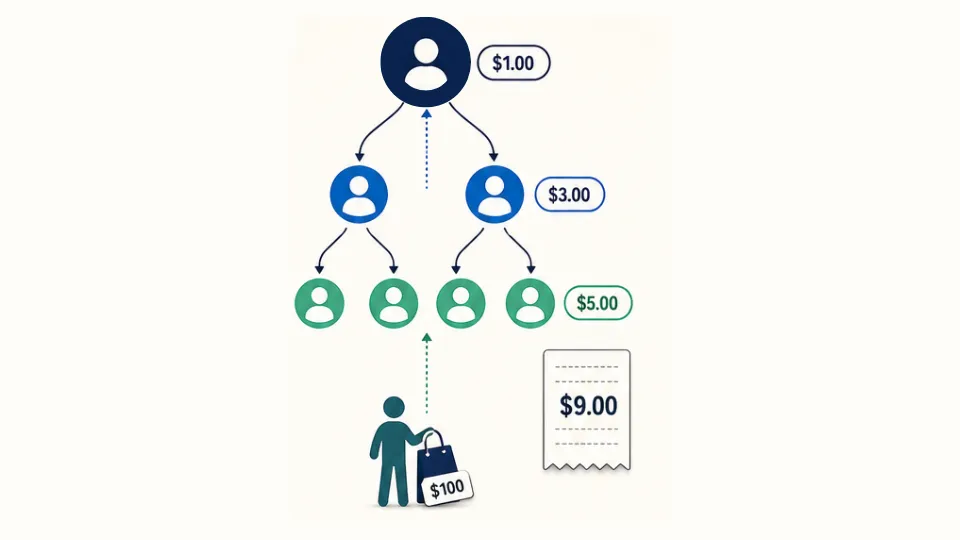
Here is how the commission flow typically works. Imagine Affiliate A joins your program, then recruits Affiliate B, who in turn recruits Affiliate C.
When a customer buys $100 through Affiliate C’s link:
- C (direct affiliate): earns 5% = $5.00
- B (Level 1 upline — recruited C): earns 3% = $3.00
- A (Level 2 upline — recruited B): earns 1% = $1.00
- Total commission paid: $9.00
Without MLM, only C would earn $5.00. With MLM, all three share $9.00, and both B and A now have a reason to help C succeed.
That dynamic, uplines earning from downline sales, often raises a fair question: how does this differ from a pyramid scheme? The answer comes down to what generates the revenue.
| Factor | Legitimate MLM Affiliate | Pyramid Scheme (Illegal) |
| Revenue source | Product sales | Recruitment fees |
| Commission based on | Downline sales volume | Downline joining |
| Join fee | $0 (free to join) | $50–$500+ to participate |
| Real product sold? | Yes | Often none |
| Sustainable? | Yes — sales-driven | No — collapses without new recruits |
| Legal? | Yes | No |
In a legitimate MLM affiliate program, commissions come from actual product purchases. No affiliate pays to join, and the system can sustain itself as long as products keep selling.
Pyramid schemes work the opposite way. When recruitment slows, the structure collapses because no real product sales exist underneath.
Beyond legality, that difference has a practical upside.
When uplines earn from downline performance, a coaching dynamic can emerge. Affiliate A doesn’t just recruit B and walk away — A wants B to sell because A earns from B’s results.
The same logic cascades through every level. Each recruiter becomes a mentor, each level adds momentum, and the network can grow without the merchant managing every relationship.
When Should You Use MLM? (And When NOT To)
MLM works best when your affiliate program already has momentum.
If you layer multi-level commissions on top of an unstable base, you may end up with more complexity than growth. It is a scaling strategy, not a starting one.
A few factors shape whether MLM would work for your store: product type, audience behavior, and program maturity. Some fit MLM well, while others may call for a different approach.
| Scenario | Use MLM? | Why |
| Community-driven products (fitness, beauty, wellness) | ✅ Yes | Members recruit each other through shared interests |
| Subscription or recurring-revenue products | ✅ Yes | Ongoing purchases create ongoing network commissions |
| Loyal customer base ready to scale | ✅ Yes | Existing customers can become affiliates who recruit others |
| High-ticket, low-volume products | ⚠️ Maybe | Fewer transactions mean smaller network commissions and less upline motivation |
| New store with fewer than 100 orders per month | ❌ Not yet | Build a basic affiliate program first, then layer on MLM |
| Products requiring high trust or expertise (medical, financial) | ❌ No | Multi-level structures can make quality control harder and increase brand risk |
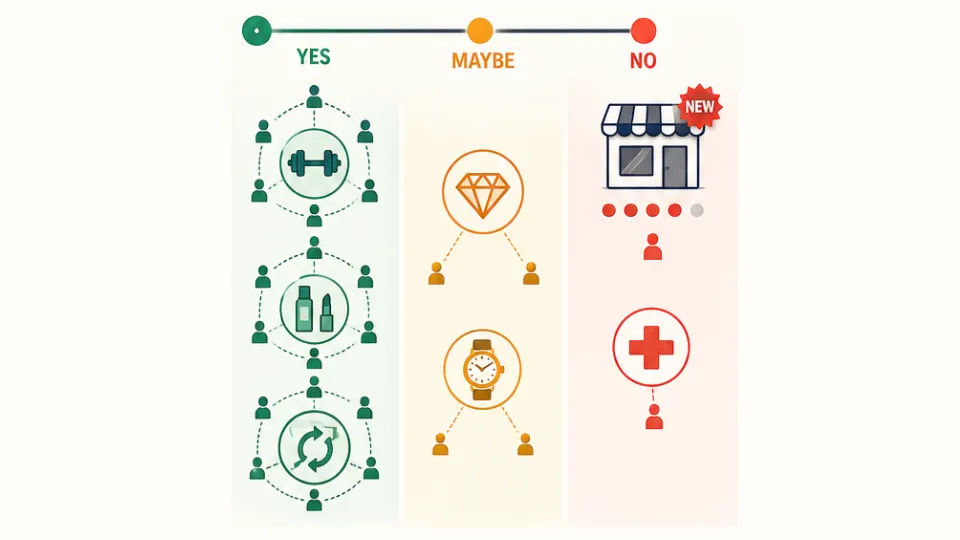
Of those scenarios, community-driven niches see the strongest results because members already recruit within their own circles. Blushield USA leans into that pattern; their multi-level affiliate network now drives 70–80% of total revenue.
Results like that depend on having the right foundation first.
You would want at least 20 active affiliates and three months of data before turning MLM on. That baseline shows whether your margins can handle the added commission layers.
Fraud protection also matters more once MLM is active. The model can amplify abuse along with growth, so your affiliate agreement should spell out how network commissions work. It should also cover which activities could lead to removal.
Some affiliate apps, including UpPromote, will let you activate MLM on a per-program basis. That way, you can test it on one program without changing your other commission structures.
How to Set Up MLM on Shopify (Step-by-Step)
Setting up MLM on Shopify takes under ten minutes.
The process comes down to three decisions: how many commission levels to include, what rates to set, and whether to add a recruitment bonus.
The steps below use UpPromote as the reference, since it supports per-program MLM and visual tree tracking. The same logic applies to any app with multi-level commission support.
Step 1: Activate MLM for your program.
Navigate to Outreach > Affiliate Recruitment > Multi-level Marketing, then select the program you want to enable. Toggle MLM on. Since the feature works per program, you can leave it off for programs that do not need a multi-level structure.
Step 2: Set your commission levels and rates
This is the most important step. Choose how many levels deep your network commissions will go, keeping in mind that three levels works well for most stores. Rates should descend from the direct affiliate down to each upline.
Step 3: Choose your commission base
Network commissions can be based on the total sale or on the direct affiliate’s commission. Total sale tends to be simpler and more motivating for most programs.
Step 4: Assign the invited affiliate program
When an existing affiliate recruits someone new, that person needs to land in a program. You can place them in the same program or route them into a separate starter track with different terms.
Step 5: Add a recruitment bonus (optional)
Recruitment bonuses are optional but effective. A one-time payout of $5 to $10 per approved recruit can motivate affiliates to build their networks rather than focus on selling alone.
Step 6: Save, test, and verify
Save your settings and test the full flow. Log in as an affiliate, confirm the network link appears, share it, and verify the new signup shows as a downline.
Once your levels are set, the total commission across all tiers will determine your cost per order. Two common structures show the range.
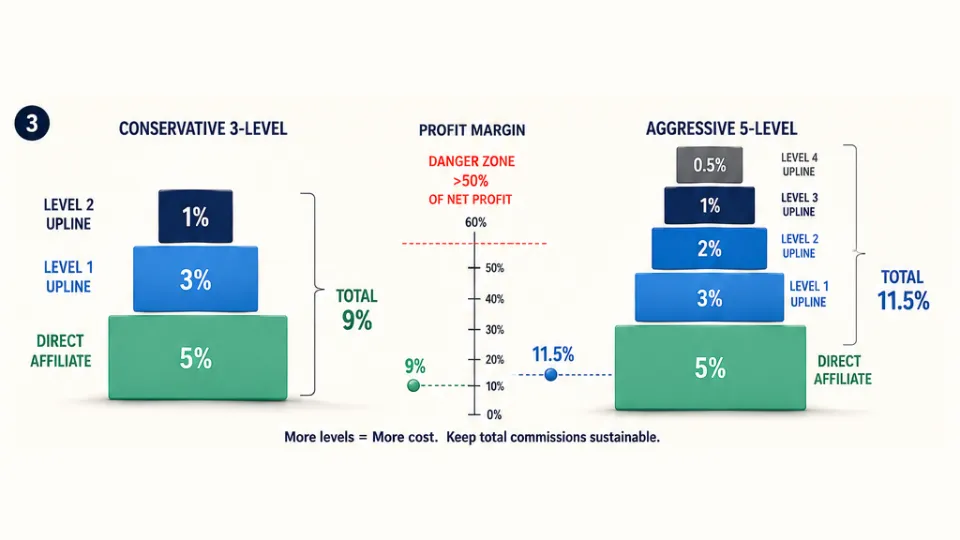
Example A: Conservative 3-Level
| Level | Rate | On a $100 order |
| Direct affiliate | 5% of sale | $5.00 |
| Level 1 upline | 3% of sale | $3.00 |
| Level 2 upline | 1% of sale | $1.00 |
| Total paid | $9.00 |
A three-level structure keeps total payouts lean. If your network grows strong enough to warrant deeper reach, five levels can spread incentives further, though that added depth will raise the per-order cost.
Example B: Aggressive 5-Level
| Level | Rate | On a $100 order |
| Direct affiliate | 5% of sale | $5.00 |
| Level 1 upline | 3% of sale | $3.00 |
| Level 2 upline | 2% of sale | $2.00 |
| Level 3 upline | 1% of sale | $1.00 |
| Level 4 upline | 0.5% of sale | $0.50 |
| Total paid | $11.50 |
At the five-level rate above, $11.50 of every $100 order goes to commissions, for an effective rate of 11.5%. Before you commit to any structure, make sure the total payout across all levels stays under 50% of your net profit per order.
Which Shopify Apps Support MLM?
Several Shopify apps support MLM, but they vary in depth and scope. Your choice will depend on whether you need MLM as a standalone tool or as part of a larger affiliate suite.
Budget, MLM depth, and feature completeness all play a role. The five apps below support MLM on Shopify, with data from the Shopify App Store as of May 2026.
| App | Rating | Reviews | Starting Price | MLM Highlights |
| UpPromote | 4.9★ | 3,380+ | Free to install | Per-program MLM, visual tree, recruitment bonus, subscription tracking |
| BixGrow | 4.9★ | 1,200+ | Free plan available | Flexible network commissions, visual MLM tree |
| ReferrLy | 5.0★ | 960+ | Free plan available | MLM + email automation + popups |
| GoAffPro | 4.7★ | 890+ | Free plan available | Multi-level support, mobile app for affiliates |
Ratings and review counts can shift over time, so check the current numbers before deciding. What matters most is whether the app’s MLM features match the complexity of your program.
If you need MLM as part of a full affiliate suite, UpPromote is worth considering. It combines multi-level commissions with tiered programs, a marketplace, and subscription tracking.
If budget is the main concern, GoAffPro offers a free plan with multi-level support. BixGrow sits in the middle with flexible network commission options and a visual MLM tree. ReferrLy rounds out the group with its top rating and built-in email tools for affiliate onboarding.
Key takeaway: No single app fits every store. Weigh MLM depth against the other features your program needs, then start with a free plan to test before committing.
How to Manage Your MLM Network
MLM requires more active management than a flat affiliate program.
The structure amplifies growth, but it can also amplify fraud, inactive branches, and unchecked costs. Without regular monitoring, those issues will compound.
Five metrics below can tell you whether your network is healthy or drifting toward problems. Tracking them monthly will help you catch issues before they spread.
| KPI | What It Measures | Action If Low |
| Network depth | How many levels are generating sales | Encourage Level 1 affiliates to recruit |
| Active rate per level | Percentage of affiliates with at least one sale at each level | Coach or remove inactive affiliates |
| Network commission cost | Total MLM commission as a percentage of revenue | Reduce levels or lower rates if above 15% of revenue |
| Recruitment rate | New recruits per affiliate per month | Increase recruitment bonus or improve onboarding |
| Top recruiter output | Which affiliates build the largest, most productive networks | Reward top recruiters with bonuses or higher tiers |
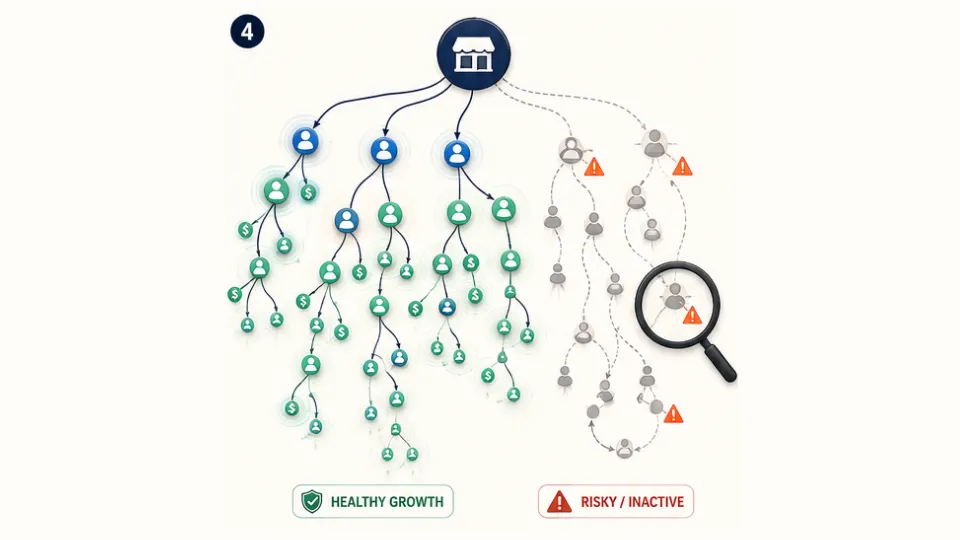
Of those, network depth and active rate per level are the most revealing. If most activity stops at Level 1, your affiliates may not be recruiting. That limits the network effect MLM is built to create.
A monthly audit can keep the structure on track. Start by checking total MLM commission cost against revenue to make sure the model is still paying for itself.
Then look for inactive branches, affiliates with downlines but zero sales, and decide whether to coach or remove them. Suspicious patterns like same-IP signups or circular recruitment are worth flagging early.
Your top recruiters deserve attention too, since they build the largest networks and can shape downline performance. Recognizing them with bonuses or higher tiers may multiply their impact.
Visualizing the network makes this kind of oversight easier. In UpPromote, the MLM tree view shows uplines and downlines on a visual board. You can also export the full network for deeper review outside the app.
Common MLM Mistakes and How to Avoid Them
Most MLM mistakes come from moving too fast or skipping the math. The structure is quick to enable, but a poorly configured network can take months to correct.
A few patterns show up repeatedly across programs that struggle with MLM. The table below captures the most common ones along with practical fixes.
| Mistake | Problem | Fix |
| Too many levels (more than 5) | Commission costs climb fast and the network becomes hard to manage | Start with 3 levels and scale only when data supports it |
| Equal rates across all levels | Uplines earn the same as the direct affiliate, removing the incentive for direct sales | Use descending rates: 5% → 3% → 1% |
| No recruitment bonus | Affiliates focus on selling and do not recruit, which limits network growth | Add a $5–$10 one-time bonus per approved recruit |
| Skipping fraud monitoring | Fake accounts, self-referrals, and circular networks go undetected | Review IP patterns and recruitment chains monthly |
| Enabling MLM on day one | Adds complexity before the basic program has proven itself | Build a stable affiliate base of 20+ first, then add MLM |
| No MLM terms in the affiliate agreement | Disputes arise over how network commissions are calculated or paid | Add an MLM clause covering rules, payouts, and prohibited activities |
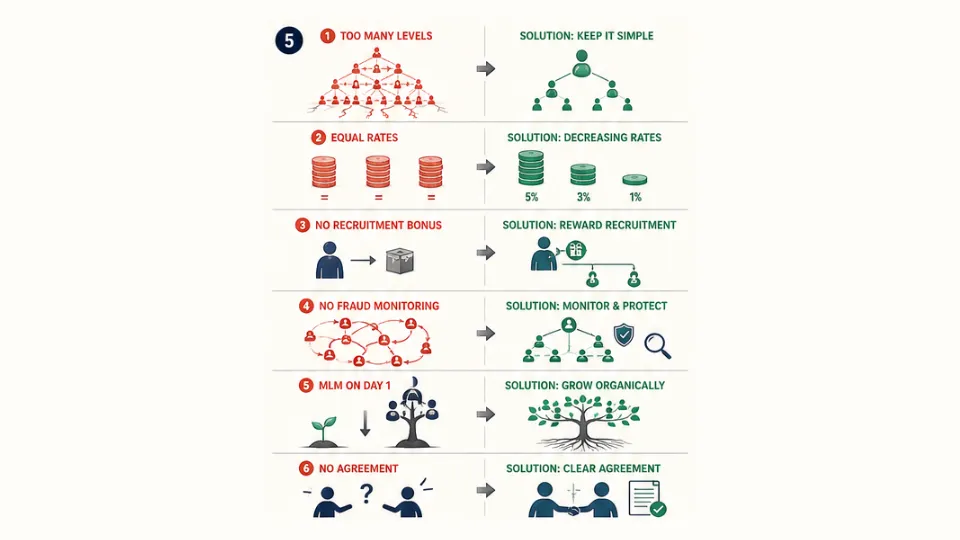
Setting too many levels and ignoring the margin check tend to cause the most damage. A five-level structure may sound appealing, but if total commission across all levels exceeds your net margin, every MLM-driven sale becomes a loss.
Starting with three levels and running the numbers first can prevent that entirely.
Frequently Asked Questions
Is MLM for affiliate programs legal?
Yes, as long as commissions are based on product sales rather than recruitment fees. Legitimate MLM affiliate programs pay when downline affiliates generate real purchases. If affiliates earn money for recruiting alone, with no product sold, the structure crosses into illegal pyramid scheme territory.
How many MLM levels should I use?
Three levels works well for most Shopify stores. Going beyond five tends to push commission costs higher without a proportional return in network growth. Start with three and add levels only once your data shows the depth can justify the added expense.
Should I base network commissions on the total sale or the direct affiliate’s commission?
Total sale is the simpler and more motivating option for most programs. On a $100 order with a 5% base rate, a 3% network commission on the total sale gives the upline $3. Basing it on the affiliate’s commission instead would yield 3% of $5, which is only $0.15.
Does MLM cost a lot in commissions?
It depends on levels and rates. A three-level structure at 5%, 3%, and 1% adds up to 9% of order value. A five-level structure can reach 11.5% or more. The key rule is to keep total commission across all levels under 50% of net profit per order.
What happens if a downline affiliate stops selling?
Nothing, from a cost perspective. Network commissions are tied to actual sales, so an inactive affiliate generates zero commissions at every level. The only impact is a missed opportunity. Pruning inactive affiliates quarterly keeps the network clean and reporting accurate.
Can I turn off MLM for one specific affiliate?
Most apps configure MLM at the program level, not per affiliate. To exclude someone, you can move them to a program that does not have MLM enabled. Another option is to set network commission rates to zero for specific levels, which removes the multi-level payout without changing program membership.

Ellie Tran, a seasoned SEO content writer with three years of experience in the eCommerce world. Being a part of the UpPromote team, Ellie wants to assist Shopify merchants in achieving success through useful content & actionable insights.Ellie's commitment to learning never stops; she's always eager to gain more knowledge about SEO and content marketing to create valuable content for users. When she's not working on content, Ellie enjoys baking and exploring new places.

![How to Use Shopify Functions with Your Affiliate Program [2026 Guide]](https://static.uppromote.com/wp-content/uploads/2026/06/how-to-use-shopify-functions-with-affiliate-program-300x169.webp)

![How to Prevent Affiliate Fraud on Shopify: Self-Referral, Coupon Abuse & More [2026]](https://static.uppromote.com/wp-content/uploads/2026/06/how-to-prevent-affiliate-fraud-on-shopify-300x169.webp)