











TL;DR
A hybrid influencer-affiliate program pairs creator content (brand awareness) with affiliate tracking (revenue attribution), so every post can map directly to measurable sales.
- ROI benchmark: Olipop’s creator community delivers a 982% ROI and contributes 12% of total sales through product seeding + performance commissions (Shopify, 2025)
- Revenue lift: Brands combining both channels see 46% higher affiliate-driven sales than affiliate-only programs (impact.com, 2024)
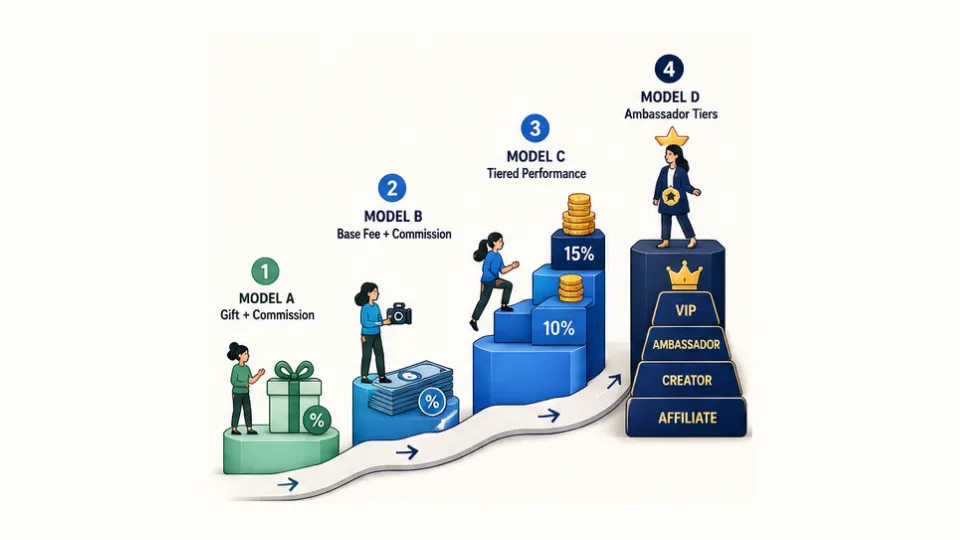
- 4 models: Gift + commission ($0 upfront), base fee + commission, tiered performance bonuses, ambassador tiers
- Start here: Ship a free product + offer 15–25% commission per sale — lowest risk, best for testing
- Setup: One affiliate app with multiple programs can manage all tiers from a single dashboard
Most Shopify stores run influencer and affiliate marketing as separate programs. Influencers handle content and awareness, while affiliates drive tracked sales through links and codes.
That separation may be leaving revenue on the table. When brands merge both channels into one program, the result can be striking: 46% higher affiliate-driven sales (impact.com, 2024).
The lift comes from one shift in how creators get paid. Instead of a flat fee for a single post, the content itself carries an affiliate link, so every sale ties back to the partner who made it. Awareness and revenue land in the same report.
Olipop shows what that model can look like at scale. Its creator base now drives 12% of total sales at a 982% ROI (Shopify, 2025). That return came from product samples and commissions, not flat fees.
This guide will walk you through four hybrid models, step-by-step Shopify setup, real brand examples, and a full-funnel content framework.
Why a Hybrid Program Outperforms Either Model Alone
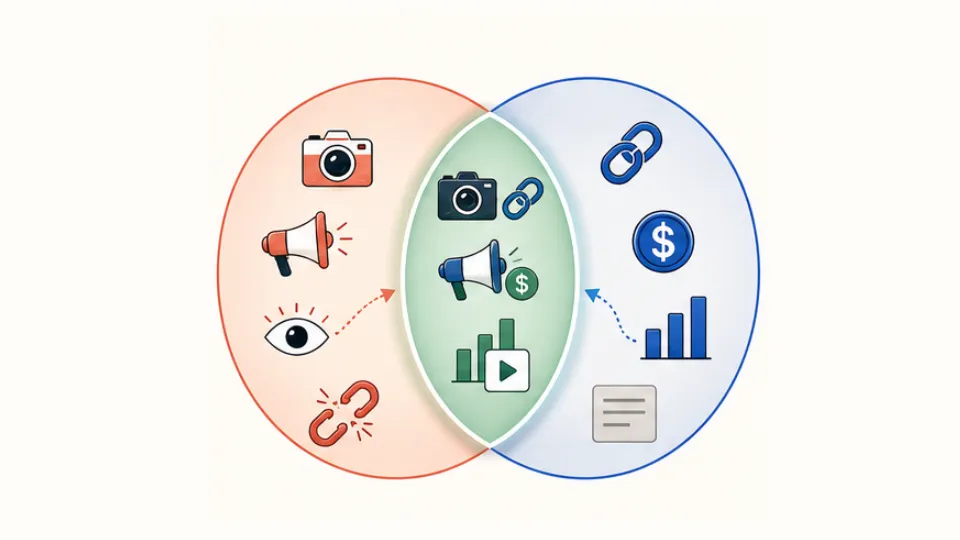
Influencer programs and affiliate programs each solve half the growth equation. The challenge is that each model gives up what the other delivers, and that tradeoff can cost real revenue.
A pure influencer deal means paying a creator upfront for a post. You get content, reach, and engagement. What you may not get is a clear connection between that post and your checkout page.
Shopify’s influencer pricing guide shows how those economics can turn. A $2,000 campaign producing 50 sales at $75 AOV with 40% margin yields only $1,500 in profit, a net loss of 25% (Shopify, 2026).
Without a tracked link or code, there would be no way to confirm whether those sales even came from the creator.
The pure affiliate model flips that problem. Every sale is tracked, and every commission ties to a click or code.
The content behind those clicks, however, can stay thin — a text link in a sidebar, a coupon on a deal site. When affiliates earn per sale, they may see little reason to invest in content that builds brand perception.
A hybrid program can resolve both tradeoffs.
The creator produces a quality review or tutorial, and that content carries an affiliate link. The brand gets awareness that maps directly to revenue, while the creator earns both recognition and performance income.
| Factor | Pure Influencer | Pure Affiliate | Hybrid |
| Upfront cost | High ($500–$5K/post) | $0 (commission-only) | Low–Medium ($0–$500 + commission) |
| Revenue tracking | Weak (impressions only) | Strong (link/code) | Strong |
| Content quality | High (professional) | Varies (often low-effort) | High (incentivized + tracked) |
| Brand awareness | High | Low–Medium | High |
| Sales attribution | Poor | Excellent | Excellent |
| Creator motivation | Deliver post, done | Drive sales (ongoing) | Both: create + sell |
| Risk | High (pay regardless) | Zero (pay for results) | Low (small upfront + performance) |
4 Hybrid Models: Choose Based on Budget and Goals
The right hybrid structure depends on where your program stands today. A store testing its first creator deal would need a different setup than one with fifty proven partners.
Four models cover that range, and most brands will move through them in sequence rather than locking into one.
Model A: Gift + Commission ($0 Cash Upfront)
Ship a free product, let the creator try it, and offer 15–25% commission on every sale their content drives. Your only upfront cost is the product itself, typically $20–$100 per creator.
That low barrier is why nano and micro-influencers (1K–50K followers) often accept this structure. The product carries real value, and the commission offers uncapped earnings.
Shopify’s influencer pricing guide recommends starting here: begin with gifting and affiliate partnerships to test channels with minimal risk (Shopify).
Model C: Tiered Performance (Gamified Progression)
Once Model A reveals which creators drive steady sales, tiered commissions can keep them motivated over time. A creator might start at 10%, move to 15% after 25 monthly sales, and reach 20% at 50.
Setting those thresholds in advance means the upgrade can happen without manual review. That removes one of the biggest bottlenecks in scaling a creator roster: tracking who earned what and when.
Model D: Ambassador Tiers (Mature Programs)
As a program matures, some creators will outperform the rest by a wide margin. Formalizing that gap into named tiers would give top performers a clear reason to stay and a visible path to grow.
| Tier | Who | Compensation | Perks |
| Affiliate | Anyone approved | 10–15% commission | Tracking link + code |
| Creator | Active content makers | 15–20% + free products | Product seeding + brand materials |
| Ambassador | Top 10% by sales | 20–25% + base fee ($500+) | All above + exclusive access |
| VIP | Top 1–2 creators | Custom deal | Revenue share + advisory role |
In practice, those layers stack. The beauty brand Kess Berlin combines commissions, flat fees per post, and product samples for their influencer roster.
Model B: Base Fee + Commission (When Budget Allows)
Pay $200–$2,000 for a set of agreed content (two Reels and a YouTube video, for example), then add 10–15% commission on sales. The base covers production time, while the commission ties long-term earnings to results.
It works best when you need specific formats or exclusivity from mid-tier creators (50K–200K followers).
These four models differ most in upfront cost and where they sit in a program’s lifecycle.
| Model | Upfront | Commission | Best For | Budget (10 creators) |
| A: Gift + Commission | Product only ($20–$100) | 15–25% | Testing, budget-tight | $200–$1,000 + commission |
| B: Base Fee + Commission | $200–$2K/creator | 10–15% | Mid-tier, specific deliverables | $2,000–$20,000 + commission |
| C: Tiered Performance | Product only | 10% → 15% → 20% | Long-term, gamification | $200–$1,000 + scaled commission |
| D: Ambassador Tiers | Varies by tier | Varies by tier | Mature programs | Custom |
Step-by-Step: Set Up a Hybrid Program on Shopify
A hybrid program runs multiple creator tiers through a single Shopify store. These six steps cover the full setup, and each one builds on the last.
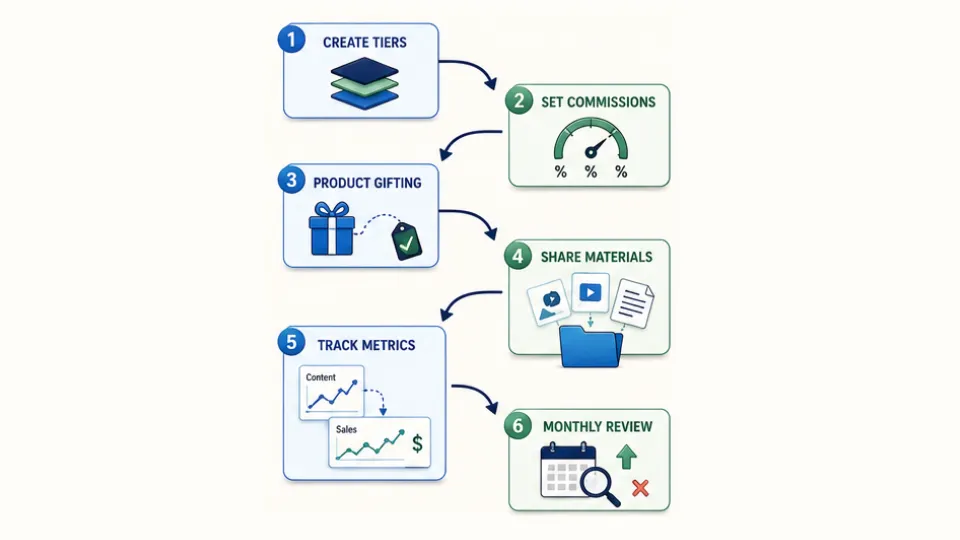
Step 1: Create Separate Program Tiers
Start by deciding how many tiers your program needs. Most hybrid setups call for at least two: one for commission-only affiliates and another for content creators who receive product samples and higher rates.
A third tier for top ambassadors can come later. Each tier should function as its own program, with a separate commission rule, registration page, and set of perks.
Apps that support multiple programs can keep these tiers independent while running from one dashboard.
Step 2: Set Commission Rates per Tier
With tiers in place, the next step is assigning a commission rate to each one. A common structure would be 10–15% for general affiliates, 15–20% for active creators, and 20–25% for ambassadors.
The gap between tiers gives creators a financial reason to produce more and better content. If certain products carry thin margins, you can exclude them from commission or set a lower product-level rate.
Step 3: Set Up Product Gifting
Product gifting is what separates a hybrid program from a standard affiliate setup. When a creator receives a free sample, they can produce authentic content — an unboxing, a review, a tutorial — rooted in real experience with the product.
UpPromote’s gift feature (Professional plan) lets you send products directly through the app. The system creates a tracked gift order, so you can see which creators received samples and whether those samples led to content and sales.
Step 4: Share Marketing Materials
Creators produce stronger content when they have assets to work with. Upload product photos, sample captions, video angles, and a brief brand guide to a shared media gallery that affiliates access from their dashboard.
That gallery becomes the single source of truth for creator content. Instead of emailing files one by one, every new affiliate gets the full kit the moment they join.
Step 5: Track Hybrid Metrics
Standard affiliate metrics still apply: clicks, orders, revenue, and conversion rate. A hybrid program adds one layer on top of those — content output per creator.
Compare each creator’s posting activity against their sales data. A creator producing strong content but few sales may need a better landing page. A creator driving sales with minimal content could be ready for an ambassador upgrade.
Step 6: Monthly Review and Tier Upgrades
Set a monthly cadence to review the roster. Creators who cross a threshold (say, 25+ referrals and consistent posting) could move up to the ambassador tier. Those with zero sales and no content after 60 days may need a check-in or removal.
If those upgrade rules are defined in advance, auto-tier tools can handle the promotion without manual work. The review then shifts from spreadsheet tracking to relationship building and content quality.
Real Examples: Brands Running Hybrid Successfully
Three patterns show up across brands that make hybrid programs work. Each one points to a lever that separates high-ROI programs from those that plateau after launch.
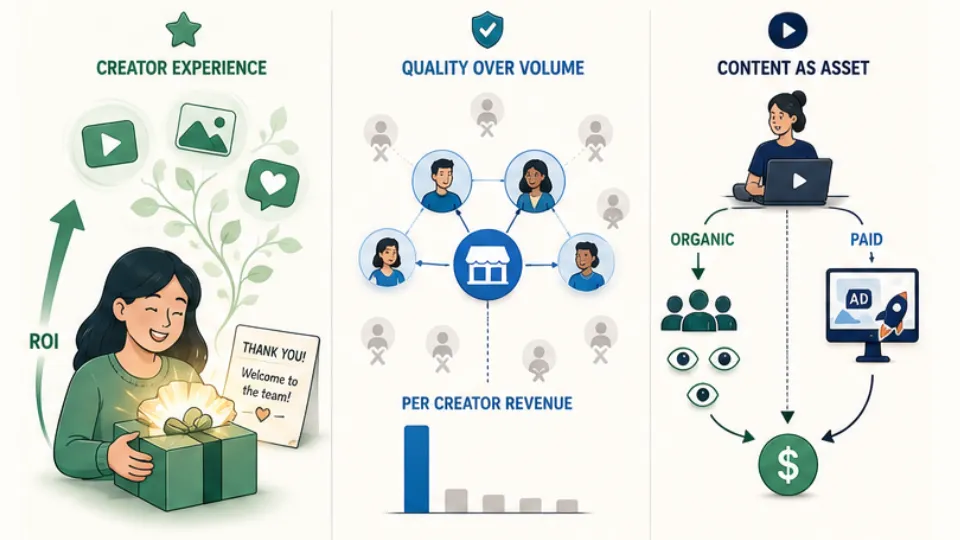
Invest in the creator experience, not just the commission
A 982% ROI might sound like an outlier, but Olipop built it through a system, not luck. The soda brand combines product seeding with performance commissions, giving creators tailored packages and real material to work with rather than just a tracking link.
When creators feel that level of investment, their content tends to carry more weight. Olipop’s community now contributes 12% of total sales at that 982% return (Shopify, 2025).
Vet for quality, not volume
Mass recruitment sounds efficient, but the math can point the other way. With just 27 micro-influencers, Nutriland generated €400,000 in revenue and over 10,000 referrals – roughly €14,800 per creator.
The brand kept each relationship close: exclusive discount codes, milestone bonuses, and direct messaging. A small roster with strong support may outperform a large one left to figure things out alone.
Treat creator content as a reusable asset
Most hybrid programs stop at organic reach. AlphaInfuse pushed further by paying affiliates both commissions and flat fees per post, then reusing their video content as paid ad creative.
That loop turns each creator into two assets at once. Organic content drives affiliate sales, while the same videos can fuel paid campaigns. The combined result: $400,000 in monthly sales through the affiliate channel.
Key Takeaway: All three brands invest beyond the tracking link. Olipop invests in experience. Nutriland invests in close relationships. AlphaInfuse invests in content repurposing. The hybrid model works when creators receive something worth more than a commission rate alone. -e
Content Stack Strategy: Full-Funnel Creator Attribution
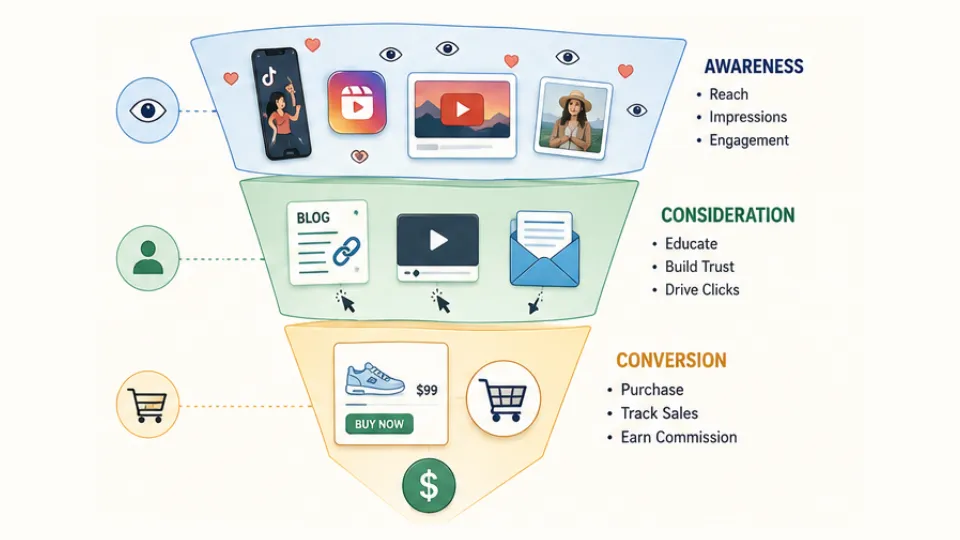
A single post from a creator gives your brand one touchpoint. A content stack from that same creator, video, blog, social post, and tracked link, can cover the full purchase journey. Every stage ties back to one partner.
How the stack works
Buyers rarely convert on first contact. They may watch a TikTok review, search for a YouTube comparison, click a blog link, then use a discount code at checkout.
When all four touchpoints carry the same affiliate link, the entire path maps to one creator.
That changes how you measure value. Instead of judging a partner by one post, you can see how their full content set moves buyers from awareness to purchase.
Building the stack
Each layer serves a different funnel stage, and all of them feed into one tracking system.
| Funnel Stage | Content Type | What Gets Tracked |
| Awareness | TikTok/Reels unboxing, YouTube review, lifestyle photo | Impressions, engagement, brand mentions |
| Consideration | Blog post with affiliate link, YouTube link, link-in-bio | Clicks, link visits, time on site |
| Conversion | Discount code (“[CREATOR]15”), auto-apply link | Sales, revenue, commission, AOV |
The tracked layer at the bottom ties the funnel together. Each creator’s unique link or code connects top-of-funnel content to bottom-line sales, so ROI per creator becomes visible across every stage.
Managing a Hybrid Program: One Platform vs. Separate Tools
Most Shopify stores under $100K in monthly revenue can run a hybrid program with a single affiliate app. Separate influencer tools become worth the cost only when creator discovery needs outgrow built-in options.
The key question: do you need a dedicated influencer CRM for outreach and content approval? Or can your affiliate app’s built-in tools handle that scope?
For most stores, the affiliate app covers enough.
| Approach | What You Use | Monthly Cost | Best For |
| Single app | UpPromote (tracking + multiple programs) | $29.99–$199.99 + perf. fee | Stores under $100K/mo |
| App + free discovery | UpPromote + Shopify Collabs | $29.99–$199.99 + perf. fee | Adding creator outreach |
| App + influencer platform | UpPromote + GRIN, Aspire, or CreatorIQ | $500–$2,000+/mo combined | Large creator rosters ($100K+/mo) |
| Enterprise | Impact or Partnerize | Custom pricing | Stores $500K+/mo |
One cost detail worth noting: UpPromote charges a performance fee on referred revenue in addition to the subscription. The rate is 2% on Growth, 1.5% on Professional, and 1% on Enterprise.
Shopify Collabs is free and handles creator discovery plus gifting. UpPromote handles tracking, commissions, and program tiers. The two work together without overlap: find creators through Collabs, then invite them into your UpPromote program for tracked sales.
Frequently Asked Questions
How much more does a hybrid program cost than a pure affiliate program?
Model A (gift + commission) adds only the product cost — typically $20–$100 per creator. For ten creators, that means $200–$1,000 on top of normal commission spend. The higher content quality that gifting produces can improve conversion rates enough to offset that cost.
Should I start with a hybrid program or a pure affiliate program first?
A pure affiliate program is the better starting point. It lets you validate tracking, commission structure, and materials before adding the gifting layer.
After one to two months, you can upgrade top performers to hybrid by sending product samples and raising their commission rate.
How do I track ROI per creator in a hybrid program?
Each creator’s affiliate link or code gives you sales data. Divide revenue from that creator by total cost (product samples + any base fee + commission paid) to get ROI per creator.
Your affiliate dashboard will show revenue per affiliate. Content output like posts and engagement may need a simple spreadsheet until you build a more formal process.
A creator wants a flat fee but no commission. Should I accept?
Not if your goal is revenue. A flat fee without commission removes the performance incentive entirely. Counter with a smaller base plus commission, and frame the commission as upside, not a limit.
If the creator insists on flat-only, they may not be the right fit for a hybrid program built around tracked sales.
Can I run a hybrid program on UpPromote’s free plan?
The free plan supports one program and basic tracking, which works for testing a commission-only setup. A hybrid program needs multiple programs for separate tiers, and that starts at the Growth plan ($29.99/month).
Start free to validate the concept, then upgrade when you add creator and ambassador tiers.
Shopify Collabs vs. UpPromote — which should I use for a hybrid program?
Both — they handle different parts of the workflow. Shopify Collabs covers creator discovery and gifting at no cost. UpPromote covers tracking, commissions, and program management.
The flow: find creators through Collabs, invite them to your UpPromote program, track sales, and manage payouts from one dashboard.
When should I introduce a base fee (Model B)?
Three conditions should line up first. The creator has a following large enough to justify content fees (50K+ is a common bar). You need specific content (a set of Reels or a YouTube video). And your budget supports $2,000 or more per month for the creator program.

Ellie Tran, a seasoned SEO content writer with three years of experience in the eCommerce world. Being a part of the UpPromote team, Ellie wants to assist Shopify merchants in achieving success through useful content & actionable insights.Ellie's commitment to learning never stops; she's always eager to gain more knowledge about SEO and content marketing to create valuable content for users. When she's not working on content, Ellie enjoys baking and exploring new places.
![How to Use Shopify Functions with Your Affiliate Program [2026 Guide]](https://static.uppromote.com/wp-content/uploads/2026/06/how-to-use-shopify-functions-with-affiliate-program-300x169.webp)

![How to Prevent Affiliate Fraud on Shopify: Self-Referral, Coupon Abuse & More [2026]](https://static.uppromote.com/wp-content/uploads/2026/06/how-to-prevent-affiliate-fraud-on-shopify-300x169.webp)