












TL;DR
Ten affiliate metrics matter, but three decide almost everything: EPC (revenue quality per click), conversion rate (traffic quality), and active rate (program health).
- EPC benchmark: $0.50+ acceptable, $1.00+ good
- Conversion rate: 3–5% median, 8%+ top quartile
- Active rate: 20–30% of affiliates producing at least one sale
- Review cadence: Weekly surface check (15 min), monthly deep dive (45 min)
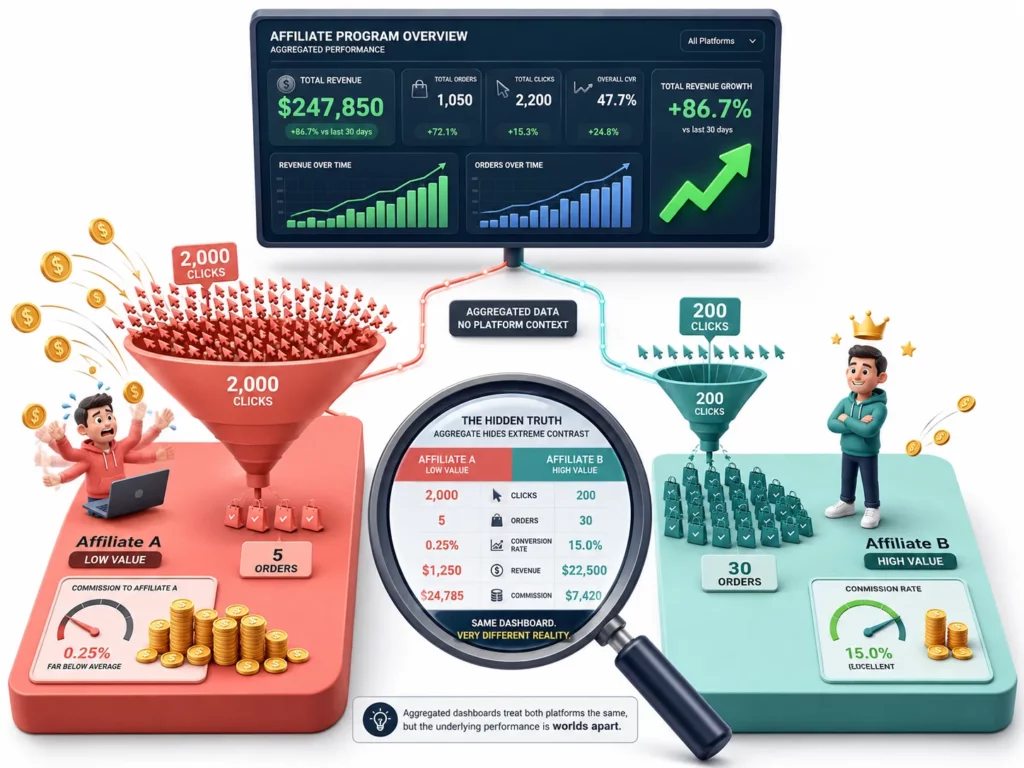
You have 50 affiliates. Your dashboard shows 5,000 clicks, 150 sales, and $12,000 in revenue this month. The numbers look solid.
But which affiliates drove those 150 sales? Affiliate A sent 2,000 clicks and produced 5 sales, a 0.25% conversion rate. Affiliate B sent 200 clicks and produced 30 sales, a 15% conversion rate.
Affiliate A costs more in commission per sale yet delivers far less value. Without per-affiliate metrics, both partners look the same.
Shopify’s own blog lists 20 affiliate marketing metrics worth tracking.
However, most merchants need fewer than half that number. The ones who get results tend to focus on the same three.
According to the ReferralCandy dataset (Q1 2026) , top-quartile programs drive 8%+ conversion rates and contribute up to 30% of total store revenue. The gap usually comes down to which metrics the merchant tracks and how often they act.
The 10 metrics below are ranked by importance, each with a 2026 benchmark, an action threshold, and a review cadence. Three of them matter more than the other seven combined.
Which Affiliate Metrics Should You Track First?
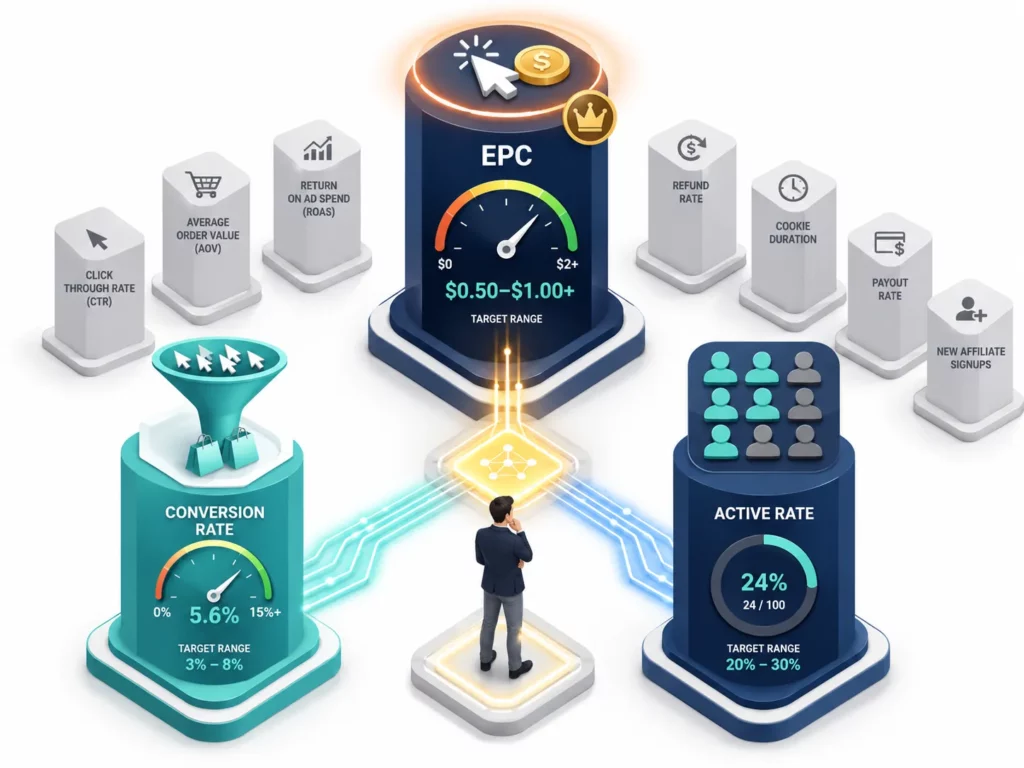
These three metrics separate merchants who manage their affiliate program from merchants who guess: EPC (revenue quality per click), conversion rate (traffic quality), and active rate (program health).
The table below shows each metric’s formula, a 2026 benchmark range, and why it earns priority over the other seven.
| Metric | Formula | 2026 Benchmark | Why It’s a Priority |
| EPC (Earnings Per Click) | Total Revenue ÷ Total Clicks | $0.50+ acceptable, $1.00+ good | Combines traffic volume, conversion, and order value into one number |
| Conversion Rate | Sales ÷ Clicks × 100 | 3–5% median, 8%+ top quartile | Shows whether clicks turn into purchases |
| Active Rate | Affiliates with ≥1 sale ÷ Total Affiliates × 100 | 20–30% | Measures how much of your roster produces anything at all |
EPC: The Single Most Important Metric
EPC compresses three variables into one number: how much traffic an affiliate sends, how well that traffic converts, and how much each order is worth.
That compression is what makes it useful. Instead of toggling between three reports, you get a single ranking.
Consider two affiliates in the same program. Affiliate A sends 1,000 clicks and produces 10 sales worth $800 total. EPC: $0.80. Affiliate B sends 500 clicks and produces 25 sales worth $2,000 total. EPC: $4.00.
Affiliate B generates five times more revenue per click despite sending half the traffic. If you sorted by clicks alone, you would invest in the wrong partner.
That per-partner lens is what makes EPC practical at any scale. A small roster with high output per partner often outperforms a large roster where most members send empty clicks.
The beauty brand Kess Berlin runs their affiliate program with just 44 active influencers. Those 44 generated over 44,000 referrals, roughly 1,000 per creator.
Conversion Rate: What EPC Alone Can Hide
EPC is the best single metric, but it has a blind spot. An affiliate with a $3.00 EPC might be converting at 2% on high-ticket products. The revenue looks strong, but the low conversion rate signals an audience that barely fits your store.
Over time, that mismatch shows. The affiliate exhausts the few interested buyers in their audience, and the numbers start to slide.
The ReferralCandy Q1 2026 dataset puts the median affiliate conversion rate for DTC brands at 3–5%, with top performers clearing 8%.
Below 1%, the traffic source is misaligned. The affiliate’s audience does not match your customer profile, and no amount of creative assets will fix that gap.
Above 5%, the affiliate is sending high-intent visitors who deserve more investment — a higher commission tier, exclusive products, or early access to launches.
Active Rate: The Health Check Most Merchants Skip
Even strong EPC and solid conversion numbers lose their meaning if only a handful of affiliates produce them. Active rate answers a different question: how many partners in your roster have generated at least one sale in a given period?
It is a program-level metric rather than an individual one, and it shifts the focus from star performers to the roster as a whole.
An active rate between 20% and 30% is typical for established programs. Below 15%, the problem is usually onboarding rather than recruitment: affiliates signed up but never received the resources, content ideas, or motivation to start promoting.
Above 30% signals a well-run program worth scaling. The affiliates who joined are producing, and adding more partners at that activation rate compounds results.
Key Takeaway: EPC measures individual affiliate value, conversion rate measures traffic quality, and active rate measures program health. Start with these three. Add the remaining seven once your program has enough volume to make them meaningful.
What Additional Metrics Matter When Your Program Scales?
Once your top three metrics are stable, the question shifts from whether the program works to where you should invest and where you should cut.
Seven additional metrics answer that question across three layers: revenue quality, buyer quality, and long-term financial health.
The table below covers each metric’s formula, a benchmark, and the review cadence that matches its rate of change.
| Metric | Formula | Benchmark | Review Cadence |
| AOV (Affiliate-Driven) | Revenue ÷ Orders | Compare to store-wide AOV | Monthly |
| Revenue per Affiliate | Total Revenue ÷ Active Affiliates | $100–500/mo for micro-influencers | Monthly |
| New Customer % | New customer orders ÷ Total affiliate orders × 100 | 60–80% | Monthly |
| Refund Rate (Affiliate) | Refunded orders ÷ Total affiliate orders × 100 | Below 5% | Monthly |
| Affiliate LTV | Avg cumulative revenue per affiliate over lifetime | Track the trend, not a fixed target | Quarterly |
| Commission ROI | Affiliate Revenue ÷ Total Commission Paid | 5:1 or higher | Monthly |
| Click-to-Sale Time | Avg days from first click to purchase | 1–7 days typical | Quarterly |
Revenue Quality: AOV and Revenue per Affiliate
Compare your affiliate-driven AOV to your store-wide average. If affiliate AOV runs more than 20% lower, affiliates may be attracting discount-seekers rather than your target buyers.
Coupon leaks are a common cause. Visitors find the code on a deal site and apply it to a purchase they would have made anyway.
Order quality is only half the picture. Revenue per affiliate puts a dollar figure on how much each active partner contributes monthly.
At $100–500 per month for a typical micro-influencer, this metric helps you decide which affiliates deserve a higher commission or an exclusive product offer.
Acquisition Quality: New Customer % and Refund Rate
New customer percentage is the metric most merchants undertrack.
If more than half of your affiliate orders come from returning customers, those affiliates are discounting existing demand rather than acquiring new buyers.
The commission on those repeat sales is wasted; the customer would have bought anyway.
One structural fix is a higher payout for first-time orders. UpPromote’s new customer commission feature detects whether a buyer has purchased before and applies the higher rate only when the order is new.
That gives affiliates a direct financial reason to target fresh audiences instead of remarketing to your existing base.
Refund rate is the other acquisition signal. An affiliate-specific refund rate above 10% usually points to misleading claims, overpromising, or outright fraud. Catching it early depends on having a buffer between the sale and the commission.
The solution is that you set a delay window before commissions finalize.
For example, a 14-day hold means refunded orders never generate a payout. The buffer protects your margins without requiring you to manually review every transaction.
Financial Health: Commission ROI, LTV, and Click-to-Sale Time
Commission ROI divides affiliate revenue by total commission paid. Anything above 5:1 is healthy; below 4:1, commissions are too generous or conversion too low.
PRX Performance , a home gym brand, tracked this ratio from the start. The brand generated $2.3M in affiliate sales with a 78% ROI by tiering commissions based on each affiliate’s performance, paying more to partners who proved they could convert.
Affiliate LTV tracks cumulative revenue per partner. A rising trend is healthy; a decline signals re-engagement is overdue.
How quickly those sales happen matters for a different reason. Click-to-sale time measures the gap between an affiliate click and a completed purchase.
If most sales close within three days, a 30-day cookie window is more than sufficient.
If they stretch past three weeks, consider extending the window to 45 or 60 days so affiliates receive credit for the sales they influence.
How Do You Turn Dashboard Data into Decisions?
Your affiliate dashboard shows clicks, orders, and revenue at a glance. The real skill is knowing which numbers to act on and which to ignore.
Most merchants check the dashboard, see a number trending up, and move on. The ones who grow their programs use the same data to make specific decisions every week.
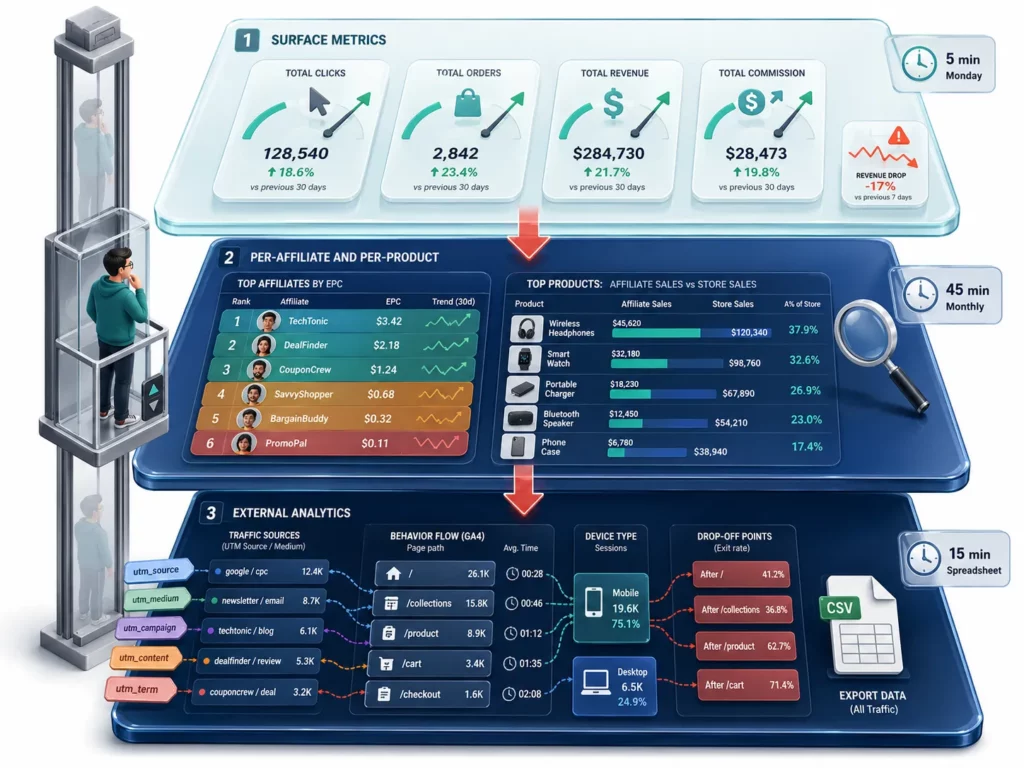
Three layers of data feed those decisions, and each layer answers a different question.
Layer 1: Surface Metrics — Is the Program Trending Up or Down?
Total clicks, total orders, total revenue, and total commission paid — these are the numbers you check every Monday in under five minutes. They answer one question: is the program moving in the right direction this week compared to last week?
UpPromote’s analytics shows these figures alongside referral sources and conversion rates. That is enough for the weekly surface check described in the next section.
If you see a sudden spike or drop, the surface layer tells you that something changed. It does not tell you why . For that, you need the next layer.
Layer 2: Per-Affiliate and Per-Product Data — Where Should You Invest?
Sorting affiliates by revenue reveals your top performers. Sorting by conversion rate reveals who sends the highest-quality traffic.
The two lists rarely match, and the gap between them is where the best tuning decisions live.
Product-level data adds another dimension. UpPromote’s product analytics compares each product’s total store sales against its affiliate-referred sales over the past 30 days.
If affiliates sell one product heavily but ignore your highest-margin items, that is a content and incentive problem you can fix with targeted commission rates or product-specific creative assets.
Layer 3: External Analytics — What Happens Between Click and Purchase?
Your affiliate app tracks the click and the sale. GA4 tracks everything in between: pages browsed, time on site, device type, and drop-off points.
Many affiliate apps can append UTM parameters to tracking links. If yours does, GA4 can break down affiliate traffic by source, medium, and campaign, giving you behavior data the affiliate dashboard alone cannot show.
If your app supports data export, a CSV download lets you calculate metrics missing from your dashboard: EPC, active rate, new customer percentage, and commission ROI.
Fifteen minutes with a spreadsheet each month fills the gap between surface data and the deeper numbers that drive decisions.
What Does a Weekly and Monthly Review Look Like?
A 15-minute weekly check catches problems before they grow. A 45-minute monthly review reveals which affiliates to promote, nurture, or remove. A quarterly strategic session decides whether the program needs more investment or restructuring.
Most merchants skip one of these cadences and pay for it later. Weekly catches spikes and drops. Monthly segments the roster and ties actions to numbers. Quarterly zooms out to program-level direction.
All three together keep the program moving without consuming your calendar.
Weekly: 15 Minutes Every Monday
Your dashboard is the starting point: compare this week’s clicks, orders, and revenue against last week. Flag any affiliate with an unusual pattern; a sudden spike could signal a viral post or fraud, and a sudden drop could signal churn.
Pending applications and open messages round out the check. The weekly review is a surface scan, not a deep dive. If everything looks normal, you are done in ten minutes.
Monthly: 45 Minutes on the First of the Month
The monthly review is where numbers turn into actions. Calculate EPC, conversion rate, active rate, commission ROI, and new customer percentage for the past 30 days. Then segment your roster into three groups: top 20%, middle 60%, and bottom 20%.
Your top performers deserve recognition. Some affiliate apps automate this step. UpPromote’s auto-tier feature , for example, promotes an affiliate to a higher commission program the moment they cross a sales milestone you define.
Conditions can include referral sales, earned commissions, or order volume, so the promotion happens without manual review.
Your middle 60% needs a nudge: a check-in email, fresh content ideas, or a reminder about upcoming promotions. These affiliates are active but not yet consistent, and a small push often moves them up.
Your bottom 20% needs a decision. If an affiliate has been inactive for three or more months with no sales, removing them keeps the roster clean and your active rate accurate.
This kind of review pays off most at scale. GoldieLocks , a haircare brand with 2,900 active affiliates, uses regular segmentation to identify rising leaders.
That process surfaced one standout: a single affiliate who generated over 1,000 orders at a 25% commission rate. Without a structured monthly review, that partner might have stayed buried in a roster of thousands.
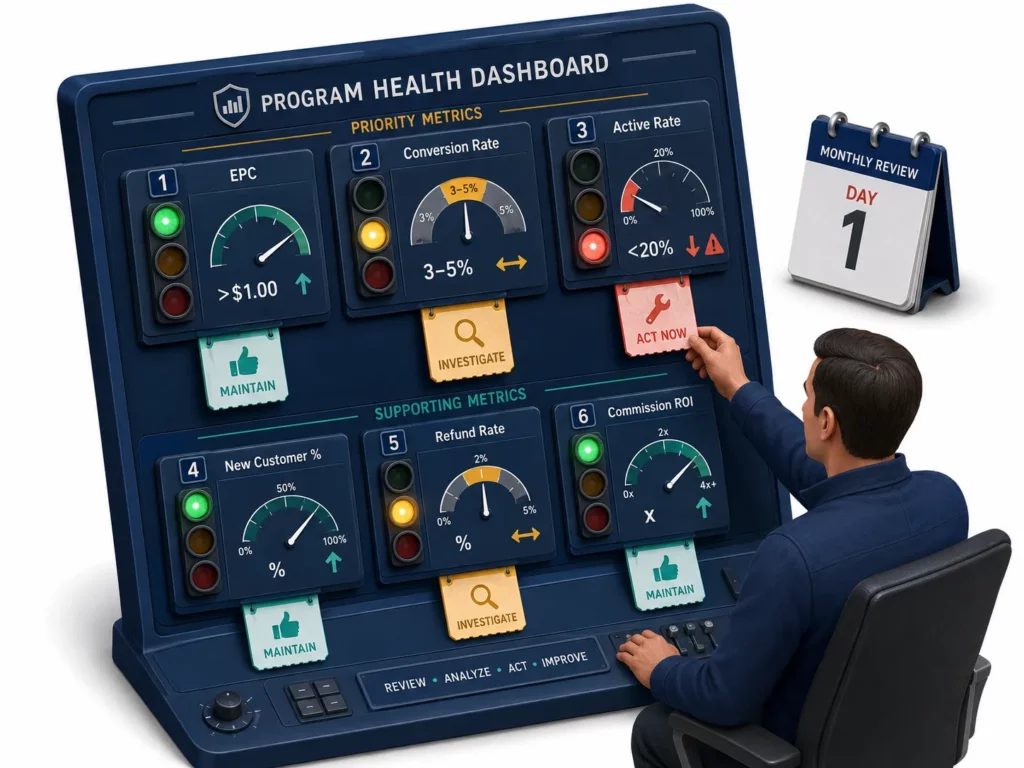
The action matrix below turns each core metric into a color-coded signal so you know where to focus.
| Metric | Green (On Track) | Yellow (Watch) | Red (Act Now) |
| EPC | Above $1.00 | $0.50–$1.00 | Below $0.50 |
| Conversion Rate | Above 5% | 3–5% | Below 3% |
| Active Rate | Above 30% | 20–30% | Below 20% |
| New Customer % | Above 70% | 50–70% | Below 50% |
| Refund Rate | Below 3% | 3–5% | Above 5% |
| Commission ROI | Above 8:1 | 5–8:1 | Below 5:1 |
Quarterly: One Hour at the End of Each Quarter
The quarterly review steps back from individual affiliates and looks at the program as a whole.
Three questions guide it: is affiliate revenue growing as a share of total store revenue? Is affiliate LTV trending up or down? Does the commission structure still attract the right partners?
If two or more metrics sit in the red zone for a full quarter, the program needs structural changes — not just individual affiliate adjustments.
What Metric Mistakes Do Merchants Make Most Often?
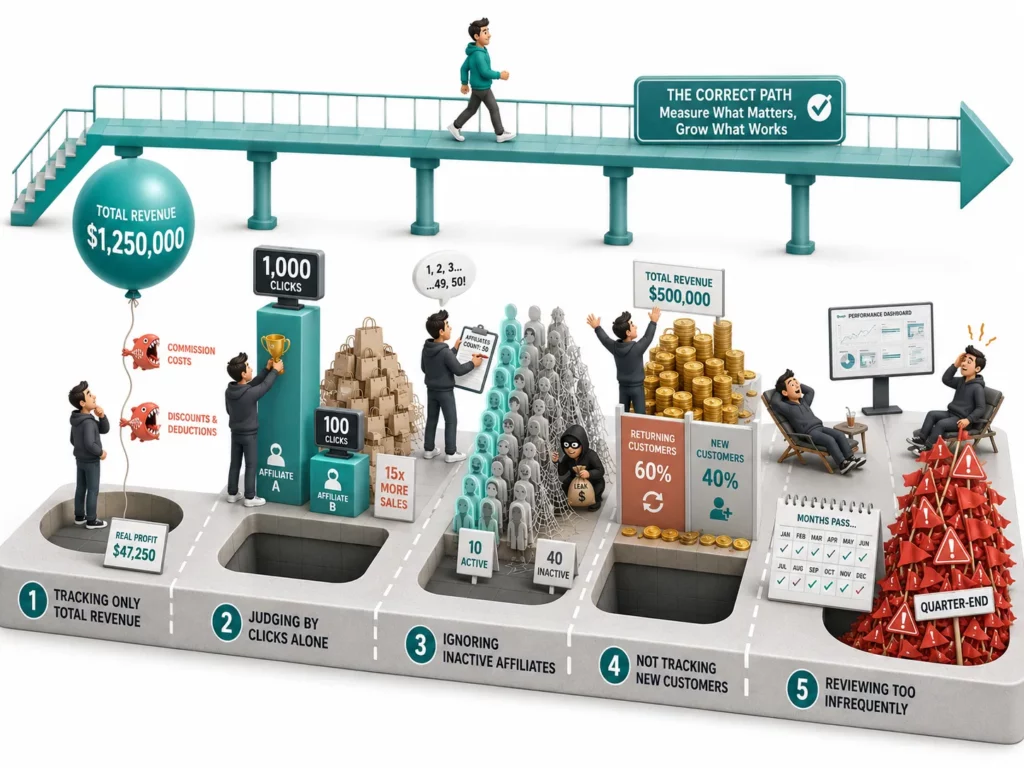
Five measurement habits quietly drain affiliate program ROI. Most merchants catch them only after months of misallocated commissions, but each one is fixable with the metrics covered above.
Mistake 1: Tracking Only Total Revenue
Total revenue is the most visible number on any dashboard and the least useful on its own. A program that generates $12,000 in revenue sounds healthy until you subtract $3,000 in commissions and $2,000 in discounts.
The profit is $7,000, not $12,000. Commission ROI tells the full story. Total revenue does not.
Mistake 2: Judging Affiliates by Clicks Alone
This mistake follows from the first. If revenue is the only headline number, clicks become the next proxy and a misleading one.
An affiliate who sends 1,000 clicks and produces 2 sales has a 0.2% conversion rate. An affiliate who sends 100 clicks and produces 15 sales converts at 15%. EPC and conversion rate separate volume from value.
Mistake 3: Ignoring Inactive Affiliates
Fifty affiliates on your roster, ten active. The other forty sit idle, cluttering your list and inflating your total count.
Over time, dormant accounts can become a fraud vector as cookieless tracking gaps widen, inactive coupons circulate without oversight.
Review quarterly. Remove any affiliate with three or more months of zero sales.
Mistake 4: Not Tracking New Customer Percentage
A program that generates $20,000 in revenue sounds impressive. But if 60% of those orders come from returning customers who would have purchased anyway, only $8,000 represents new business.
New customer percentage is the metric that separates new revenue from recycled demand.
This gap matters more as the industry shifts toward LTV-focused measurement. Top programs in 2026 track not just how many sales affiliates drive, but how valuable those customers remain 90 days later.
Mistake 5: Reviewing Too Infrequently
All four mistakes above compound when no one checks the numbers regularly. Monthly is the minimum cadence for a meaningful review. Quarterly-only reviews miss fraud signals, miss churn, and miss the window to re-engage a slipping top performer.
The review framework from the previous section prevents this. Fifteen minutes a week catches problems before they get expensive.
Frequently Asked Questions
Which metric matters most for small stores?
EPC. For stores with fewer than 20 affiliates, EPC reveals which partners drive revenue per click, not just traffic. Sort by EPC and invest in the top performers first.
How often should I review affiliate metrics?
Weekly for a surface check (15 minutes): clicks, sales, unusual patterns. Monthly for a deep dive (45 minutes): calculate KPIs and segment affiliates. Quarterly for strategic direction (one hour).
How do I fix a low conversion rate (below 2%)?
Three causes: audience mismatch (the affiliate’s followers are not your customers), landing page issues (traffic goes to the wrong page), or store-level conversion problems (checkout friction, weak product pages).
How can I tell if an affiliate is committing fraud?
Five signals: refund rate above 10%, high clicks with near-zero conversions, repeat orders from the same IP, sudden unexplained spikes, and frequent commission disputes. Flag, investigate, and terminate if confirmed.
What is a good EPC?
Above $0.50 is acceptable, above $1.00 is good, and above $2.00 is excellent. Benchmarks vary by industry because of differences in average order value. Compare within your category.
Do I need to track metrics outside my affiliate app?
Yes. GA4 adds behavior data (bounce rate, time on site, device split) your app cannot show. Shopify Analytics adds order-level data like new versus returning customers. Use all three sources together.

Ellie Tran, a seasoned SEO content writer with three years of experience in the eCommerce world. Being a part of the UpPromote team, Ellie wants to assist Shopify merchants in achieving success through useful content & actionable insights.Ellie's commitment to learning never stops; she's always eager to gain more knowledge about SEO and content marketing to create valuable content for users. When she's not working on content, Ellie enjoys baking and exploring new places.

![How to Use Shopify Functions with Your Affiliate Program [2026 Guide]](https://static.uppromote.com/wp-content/uploads/2026/06/how-to-use-shopify-functions-with-affiliate-program-300x169.webp)

![How to Prevent Affiliate Fraud on Shopify: Self-Referral, Coupon Abuse & More [2026]](https://static.uppromote.com/wp-content/uploads/2026/06/how-to-prevent-affiliate-fraud-on-shopify-300x169.webp)