











TL;DR
Commission gets affiliates to join. Bonuses and gifts are what keep them active after the initial excitement fades.
- Core principle: Variable, unexpected rewards beat predictable commission at sustaining motivation
- 8 bonus types: First-sale bonus, milestone rewards, seasonal accelerators, product gifting, exclusive early access, leaderboard prizes, anniversary bonuses, re-activation offers
- Budget: 5–10% of total affiliate commission spend
- $0 options available: Early access and public recognition cost nothing but build insider loyalty
- Start small: First-sale bonus only ($25–$50 per affiliate, one-time), then layer types as revenue grows
You offer 15% commission. Month one, affiliates post content, share links, and drive sales. By month three, half of them have gone quiet. By month six, only your top handful are still active.
The commission rate never changed. So why did the effort drop?
Because commission becomes expected. Psychologists call this hedonic adaptation: the brain adjusts to steady rewards and stops treating them as special. What felt generous in January feels like baseline by April.
Shopify recommends tiered commission structures that raise rates as affiliates sell more, turning promotion into a game worth playing.
The logic applies beyond tiers. Bonuses, surprise gifts, and time-limited accelerators all introduce the variability that flat commission cannot.
This article will break down eight bonus types, when each one works best, how much to budget, and how to set them up without overcomplicating your program.
Why Do Affiliates Lose Motivation Even When Commission Stays the Same?
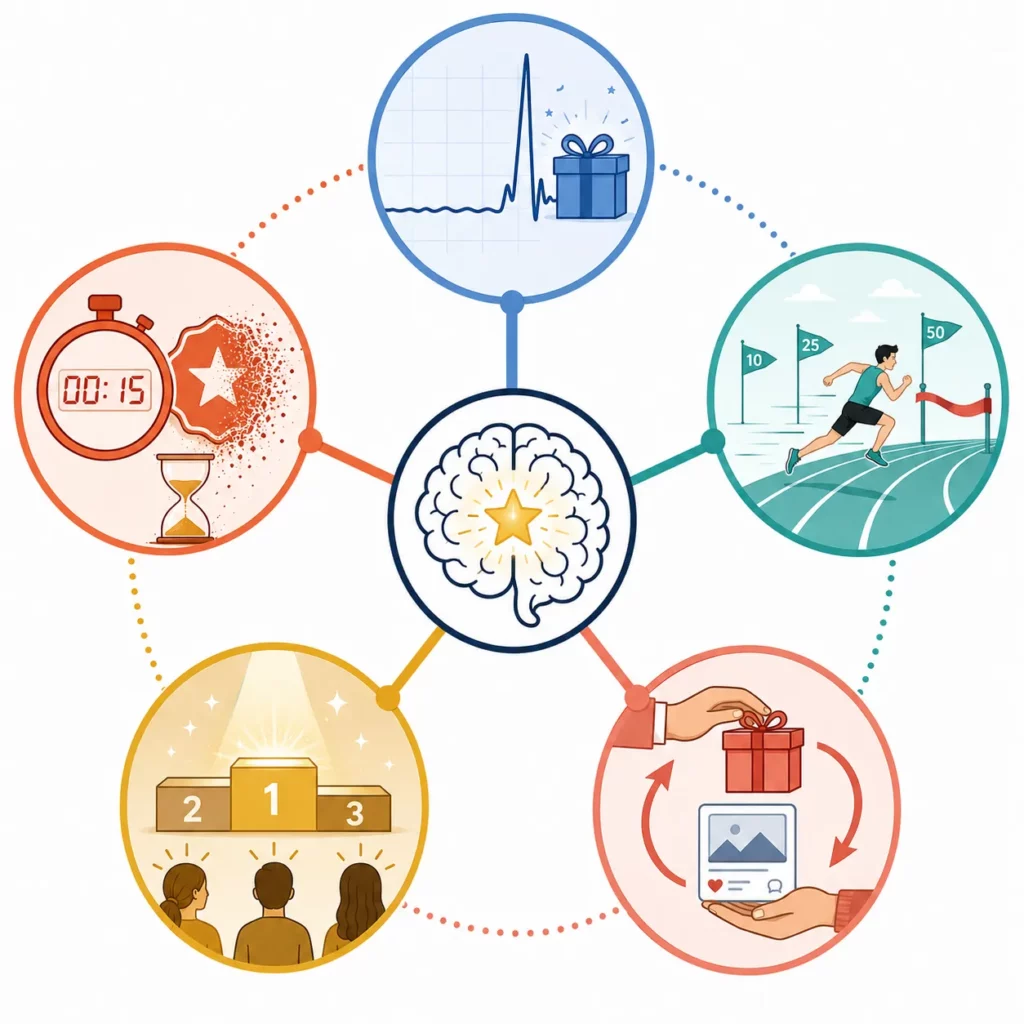
Affiliates lose motivation because predictable rewards stop feeling like rewards. The reason is not the rate itself — it is how the brain processes consistent input, and each mechanism points to a different bonus type that counteracts it.
The first driver is hedonic adaptation. A 15% commission excites a new affiliate in their first week. By month three, that same rate feels like baseline, not a reward.
Variable rewards break the pattern. A surprise gift, a seasonal rate boost, or a milestone bonus works because the affiliate cannot predict when the next one arrives.
The second driver builds on the first. The goal gradient effect shows that people work harder as they approach a visible target.
An affiliate sitting at 22 out of 25 sales for a $50 bonus will push harder for those last three. Milestone bonuses exploit this by giving affiliates a finish line they can see from where they stand.
Reciprocity is the third driver, and it works differently from the first two. Sending a surprise product box is not a payment for results. It is a gesture that makes the affiliate feel valued, and valued partners want to give back.
Affiliates who receive unexpected gifts tend to post on their own and promote with real enthusiasm, not just duty.
Each driver maps to a different bonus category, and the most effective programs layer all three.
| Driver | Mechanism | Bonus type that activates it |
| Hedonic adaptation | Brain adjusts to predictable rewards | Surprise gifts, seasonal accelerators |
| Goal gradient | Effort increases near a visible target | Milestone bonuses, leaderboard competitions |
| Reciprocity | Unexpected gift creates positive obligation | Product gifting, exclusive early access |
| Status | Recognition among peers drives effort | Leaderboard prizes, VIP tier upgrades |
| Loss aversion | Fear of losing a temporary perk | Time-limited accelerators, expiring bonuses |
What Are the Most Effective Bonus Types for Shopify Affiliate Programs?
Every stage of the affiliate lifecycle, from first sale to second year, has a bonus type designed to keep partners moving.
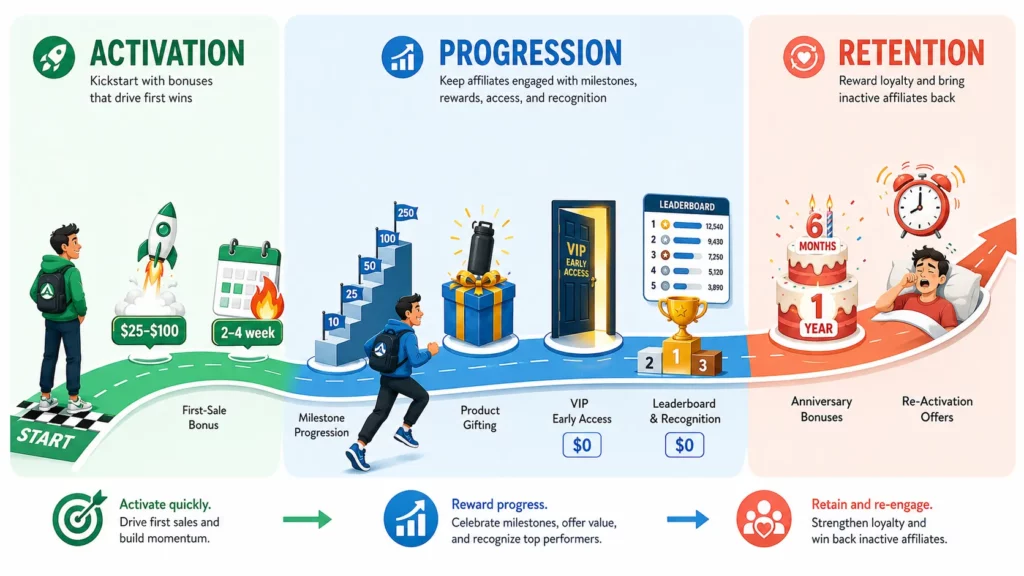
They split into three stages: activation (getting new affiliates to produce), progression (keeping active ones climbing), and retention (preventing churn or winning back dormant partners).
Not every program needs all eight from day one. The table below groups them by when they matter most, what they cost, and which motivation driver they tap into.
| # | Bonus type | Trigger | Typical amount | Goal | Cost pattern |
| 1 | First-sale bonus | Affiliate completes first sale | $25–$100 | Activate new affiliates | One-time |
| 2 | Milestone rewards | Hits 10 / 25 / 50 / 100 sales | $25–$500 (escalating) | Sustain progression | Per milestone |
| 3 | Seasonal accelerator | Peak season (BFCM, holidays) | +5–10% extra commission | Capitalize on peak traffic | Time-limited (2–4 weeks) |
| 4 | Product gifting | Quarterly or new product launch | Product value $20–$100 | Generate fresh content + reciprocity | Quarterly |
| 5 | Exclusive early access | New product or collection drop | $0 (early access only) | Build insider loyalty | $0 |
| 6 | Leaderboard prizes | Top 3 monthly performers | $50–$500 + public recognition | Drive competition and status | Monthly fixed |
| 7 | Anniversary bonus | 6-month or 1-year mark | $50–$200 | Reward long-term loyalty | Annual |
| 8 | Re-activation offer | 30+ days inactive | $25 bonus or +5% for 30 days | Win back dormant affiliates | As needed |
Two of these eight cost nothing. Exclusive early access (type 5) and the public recognition side of leaderboards (type 6) build loyalty through status, not money.
For programs with tight budgets, those two plus a first-sale bonus cover all three lifecycle stages at minimal spend.
How Do You Activate New Affiliates With a First-Sale Bonus?
A first-sale bonus gives new affiliates a specific, time-limited reason to make their first promotion happen. It targets the single biggest drop-off point in any program: the gap between signing up and producing results.
Most new affiliates never make a first sale. They join, receive their link and coupon code, and then go quiet.
A good activation rate sits around 10% or higher according to Shopify. That means the vast majority of signups need a push to cross that first threshold.
The fix is simple: offer $25–$100 on top of their normal commission when they close their first sale within 30 days.
The bonus works because it is specific (one sale, not “sell more”), time-bound (30 days creates urgency), and generous relative to the effort required.
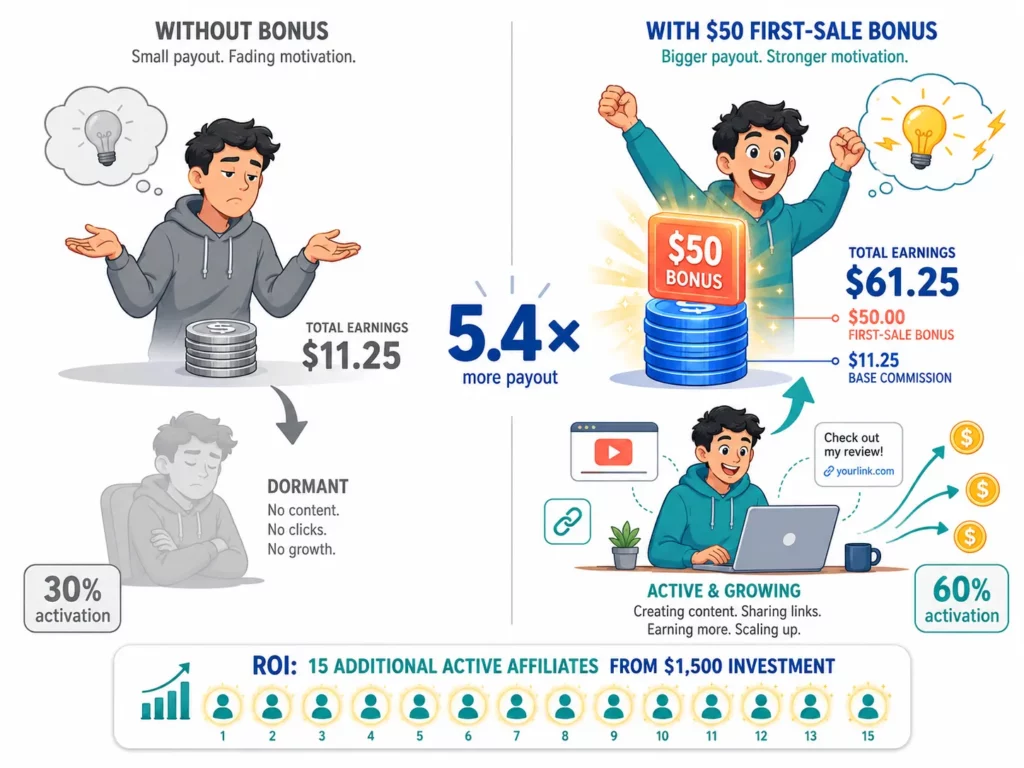
For instance, consider the math on a 15% commission program with a $75 average order. Without a first-sale bonus, the affiliate earns $11.25 on their first sale. With a $50 bonus, that first payout jumps to $61.25.
The difference between $11 and $61 is often the difference between an affiliate who tries and one who doesn’t.
Fifty new affiliates per quarter at a $50 bonus and a 60% activation rate costs $1,500. Without the bonus, assume a 30% rate instead.
That extra $1,500 produces 15 additional active affiliates who go on to generate revenue for months. The one-time cost pays for itself quickly.
Setting this up takes one step in most affiliate tools. Define the trigger as one completed order within 30 days of approval, set the reward as a flat cash bonus, and the system tracks progress and notifies the affiliate automatically.
UpPromote’s bonus feature, for example, lets you set conditions based on order count and attach a fixed reward that gets added to the affiliate’s next payout.
How Do Milestone Rewards and Tier Upgrades Keep Affiliates Progressing?
Milestone bonuses set visible targets that get harder to ignore the closer an affiliate gets. Pairing them with automatic tier upgrades turns a one-time cash reward into a permanent commission increase, giving affiliates two reasons to keep climbing.
The goal gradient effect from the psychology section explains why this structure works. An affiliate at 22 out of 25 sales will push harder than one at 5 out of 25.
Each milestone needs to feel reachable from the previous one, with rewards that escalate as the targets get bigger.
A five-tier structure covers the full arc from first achievement to elite status.
| Milestone | Reward | What it signals to the affiliate |
| 10 sales | $25 cash | First achievement — validates their effort is paying off |
| 25 sales | $50 cash + free product | Solidifies the habit, adds a tangible reward |
| 50 sales | $100 cash + product bundle | Significant enough to celebrate and share |
| 100 sales | $250 cash + permanent commission bump (+2–5%) | Elite status, permanent upgrade worth protecting |
| 250 sales | $500 cash + brand collaboration opportunity | Partner-level recognition, not just affiliate |
The 100-sale tier is the turning point. A permanent commission increase means the affiliate earns more on every future sale, not just a one-time payout. That ongoing value makes switching to a competitor’s program costly.
Altenew layers performance bonuses with email reminders and sends 30–35 free products each month to their inner circle of influencers.
That combination of cash milestones, product gifting, and exclusive early access helped affiliates contribute 15–25% of total revenue and drive 25,000 tracked orders in year one.
Meanwhile, Vetain went leaner. Instead of product gifts, the health brand tied bonuses to specific sales goals and paired them with automatic tier upgrades so top performers earned higher rates without manual work.
Both brands use the same principle: short-term bonuses keep affiliates engaged this month, while tier upgrades keep them engaged next year.
When Should You Use Seasonal Accelerators, Product Gifts, and Exclusive Access?
Seasonal accelerators capture extra effort during peak traffic. Product gifts generate authentic content through reciprocity. Exclusive early access builds insider loyalty at zero cost.
All three work because of when you deploy them, not just what you offer.
Seasonal accelerators add a temporary commission boost during your highest-traffic periods. A store running 15% base commission might offer +5% during BFCM (November 15–30), pushing the effective rate to 20% for two weeks.
The math favors the merchant. If affiliates drive $10,000 in sales during that window, the extra 5% costs $500. The extra revenue from affiliates promoting harder during peak season typically runs three to five times that amount.
Limit accelerators to two or four windows per year: BFCM, Valentine’s Day, Back-to-School, or your biggest seasonal event. Scarcity keeps each window special.
Moreover, product gifting shifts the reward from cash to something affiliates can touch, unbox, and share with their audience.
The content that comes back is often worth more than the product cost.
Freewell Gear, a camera accessories brand, sends free product samples to trusted creators without requiring specific scripts or post quotas. That approach produced $350,000 in affiliate revenue in two months across roughly 700 creators globally.
Carnivore Bar took a similar path in the specialty food space, using product samples as the primary relationship tool. The brand grew from 50 to 500 affiliates in just over a year, with affiliate sales accounting for 40% of total revenue.
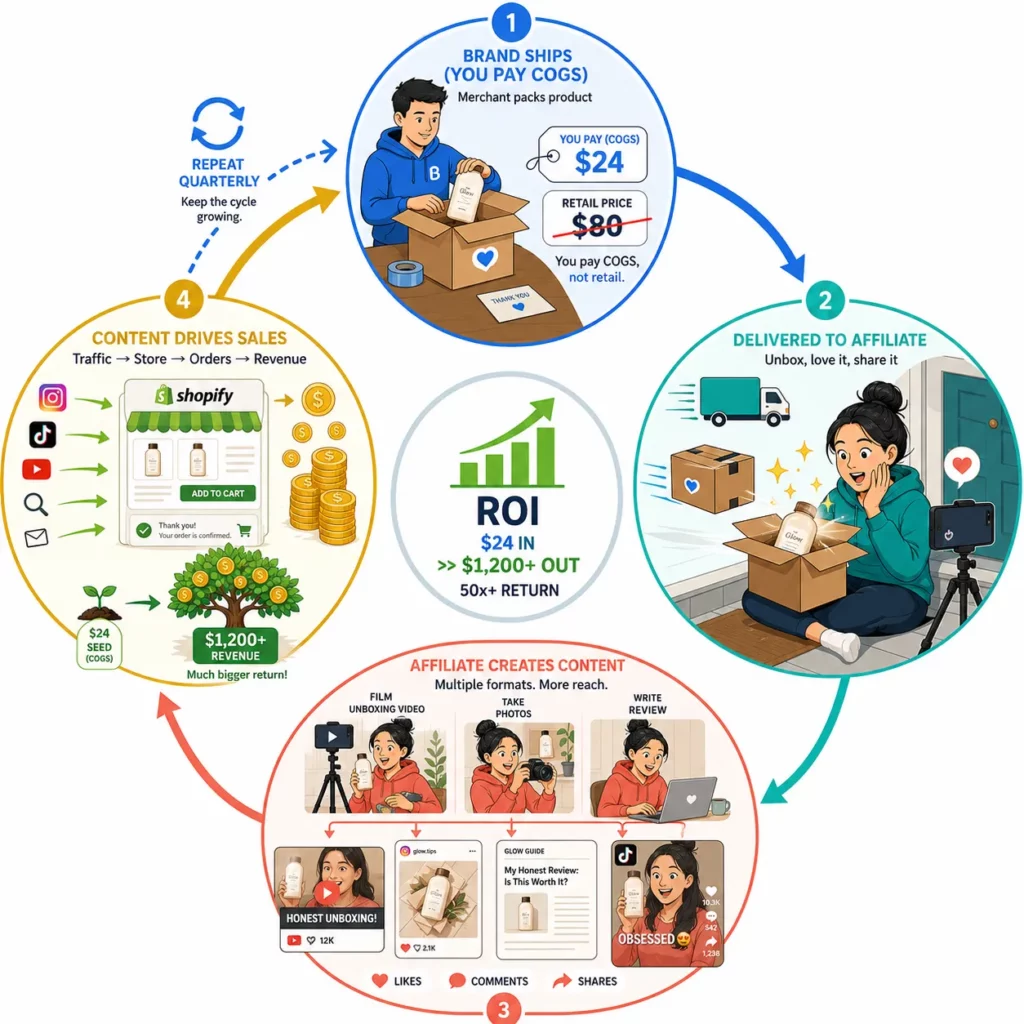
The logistics are straightforward. Pick products from your Shopify catalog, create a gift order, and the affiliate receives the item for free while you track the shipment.
UpPromote’s gift handles this inside the app, so you do not need a separate shipping process.
Finally, exclusive early access costs nothing and yet ranks among the most effective loyalty plays.
Give affiliates a preview of new products, collections, or sale events one to two weeks before the public launch.
The value is not the product. It is the feeling of being an insider with information no one else has yet.
How Do Leaderboards, Anniversary Bonuses, and Re-Activation Offers Work?
Leaderboards create competition among top performers. Anniversary bonuses reward tenure that most programs never acknowledge. Re-activation offers recover dormant partners before they drift away for good.
Each one targets a different lifecycle moment.
Leaderboard prizes turn your top affiliates into visible benchmarks. Announce the top three each month through your affiliate newsletter or a shared dashboard.
Pair the ranking with a cash reward: $200 for first place, $100 for second, $50 for third.
The public element matters as much as the cash. Affiliates who see peers ranked above them think “I could be there next month.”
The sports brand Holbrook Pickleball built monthly sales contests into their program and rewarded top performers with gifts. That structure produced an 87% boost in referral orders, 173 new affiliate signups, and an 86% rise in affiliate-driven revenue.
In addition, anniversary bonuses recognize loyalty at six months, one year, and two years. A $50 bonus at the six-month mark, $100 at one year, and $200 at two years signals that you value the person, not just their output.
Most programs never acknowledge tenure. A thank-you email with a cash bonus sets you apart.
Next, re-activation offers target affiliates who have gone quiet for 30 days or more. The message is simple: “We noticed you haven’t had a sale recently. Close one in the next 14 days and earn a $25 bonus on top of your commission.”
Time-limited urgency plus a cash incentive will give dormant affiliates a reason to re-engage now rather than later. You can set this up as a bonus with a short qualifying window.
How Much Should You Budget for Affiliate Bonuses and Gifts?
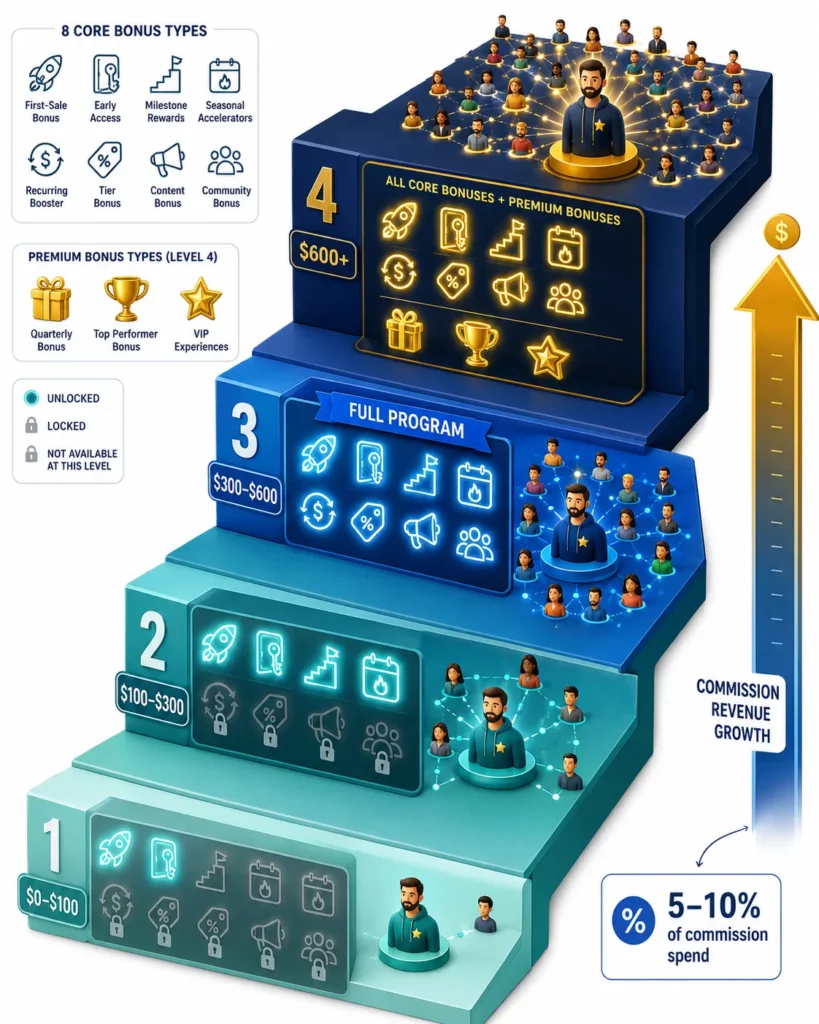
Set aside 5–10% of your total affiliate commission spend for bonuses and gifts. That range covers everything from a single first-sale bonus to a full eight-type program, and it scales with your revenue rather than needing a lump sum upfront.
Here is what that looks like at five revenue levels, assuming a 15% base commission rate and an 8% bonus allocation.
| Monthly affiliate revenue | Commission (15%) | Bonus budget (8% of commission) | What it covers |
| $5,000 | $750 | $60 | First-sale bonuses only |
| $10,000 | $1,500 | $120 | First-sale + one seasonal accelerator |
| $25,000 | $3,750 | $300 | All eight types at moderate amounts |
| $50,000 | $7,500 | $600 | All eight types + quarterly gift boxes |
| $100,000 | $15,000 | $1,200 | Full program + monthly leaderboard prizes |
If your budget is under $100 per month, start with a first-sale bonus and early access. Both cover the most critical lifecycle stages (activation and retention) at minimal or zero cost.
As commission revenue grows, add milestone rewards next, then seasonal accelerators. Leaderboard prizes and anniversary bonuses come last.
| Monthly budget | Prioritize | Add later |
| Under $100 | First-sale bonus + early access | Everything else |
| $100–$300 | Add milestones + seasonal accelerators | Leaderboard, anniversary |
| $300–$600 | All eight types at moderate amounts | — |
| $600+ | All eight types + quarterly gift boxes | — |
What Changed About Affiliate Bonuses in 2026?
The way Shopify merchants use affiliate bonuses shifted in the past year — toward automation, non-cash rewards, and tighter feedback loops. Each shift makes the case for planned bonuses over flat commission alone.
Gamification is now standard. Leaderboards, badges, and progress bars are showing up in dashboards. Affiliates expect to see how close they are to their next reward.
Store credit bonuses are growing. Instead of cash, some brands offer store credit worth more than the same cash bonus. A $75 store credit costs the merchant closer to $30 in product cost.
The affiliate spends the credit in your store, bringing in extra revenue on top of the bonus.
Experience-based rewards are emerging for top tiers. Beyond cash and products, premium brands now offer events, factory tours, and co-creation projects to their best affiliates. These non-cash rewards build loyalty that money alone cannot match.
AI-triggered re-activation is in early stages. Some platforms are beginning to detect when affiliate activity drops and auto-send a re-engagement offer.
The technology is still maturing, but the direction is clear: bonuses will move from calendar-driven to event-driven.
Key Takeaway: The 2026 trend is toward smarter, more automatic bonus systems. Gamification, store credit, and AI-triggered bonuses are all moving from nice-to-have to expected.
Frequently Asked Questions
Do affiliate bonuses actually increase ROI, or just increase costs?
Bonuses increase ROI when they trigger a specific action. A $50 first-sale bonus that wakes up an otherwise quiet affiliate can bring in $500–$2,000 in yearly revenue from that one partner. The key is tying every bonus to a clear goal, not handing out blanket rewards.
Should you offer cash bonuses or product gifts?
Both work, but for different purposes. Cash is direct and valued by everyone, making it the better fit for milestone rewards and leaderboard prizes. Product gifts cost less than their retail value (you pay cost of goods, not sticker price) and create content when affiliates post unboxing or review videos.
Should bonuses be available to all affiliates or only top performers?
It depends on the type. First-sale bonuses and seasonal accelerators should be open to everyone because they serve broad activation and effort goals. Leaderboard prizes work best when limited to the top three or five. Milestones are open to all but only earned by those who hit the target.
How do you prevent affiliates from gaming the bonus system?
Three safeguards cover most risks. Set a holding period of 14–30 days before any bonus pays out, so refunds are caught first. Use fraud detection to flag self-purchases and repeat IP orders. Limit bonuses to new-customer orders only if self-referral is a concern.
How often should you offer bonuses?
A healthy cadence mixes always-on types (first-sale bonus, milestones), periodic types (seasonal accelerators two to four times per year, leaderboard monthly, gifts quarterly), and as-needed types (re-activation, anniversary). That adds up to roughly one touchpoint per affiliate per month.
What is the minimum budget to start a bonus program?
Zero, if you start with early access and public shoutouts. The first cash type to add is a first-sale bonus at $25–$50 per affiliate, which costs only when it works. A program spending $60 per month on bonuses (8% of $750 in commission) can run a solid first-sale bonus with money left for one seasonal push per year.

Ellie Tran, a seasoned SEO content writer with three years of experience in the eCommerce world. Being a part of the UpPromote team, Ellie wants to assist Shopify merchants in achieving success through useful content & actionable insights.Ellie's commitment to learning never stops; she's always eager to gain more knowledge about SEO and content marketing to create valuable content for users. When she's not working on content, Ellie enjoys baking and exploring new places.
![How to Use Shopify Functions with Your Affiliate Program [2026 Guide]](https://static.uppromote.com/wp-content/uploads/2026/06/how-to-use-shopify-functions-with-affiliate-program-300x169.webp)

![How to Prevent Affiliate Fraud on Shopify: Self-Referral, Coupon Abuse & More [2026]](https://static.uppromote.com/wp-content/uploads/2026/06/how-to-prevent-affiliate-fraud-on-shopify-300x169.webp)