











TL;DR: The gap between a 3% reply rate and 15–25% comes down to five elements: personalized hook, concrete offer, clear CTA, short length, and a follow-up sequence.
- Reply rate: 3–5% generic vs. 15–25% for top-performing personalized outreach
- Optimal length: Under 80 words per email
- Follow-up lift: A single follow-up boosts responses by 65.8%
- Structure: Subject line → hook → offer → CTA → sign-off
- Templates: 6 copy-paste templates covering every recruitment scenario
“ Hi [Name], I love your content! Want to be our affiliate? ”
That is the email most merchants send and the one most influencers delete without reading.
It is easy to see why. The average cold email reply rate is just 3.43% ( Instantly Benchmark Report, 2026 ), and generic affiliate pitches fall right in that range. Creators receive dozens of partnership requests every week, and most sound identical.
The good news: the fixes are small. A single follow-up lifts responses by 65.8% (Backlinko). Even email length matters — messages under 80 words outperform longer formats across the board.
This guide walks you through all three levers: the anatomy of a high-converting recruitment email, six copy-paste templates, subject line formulas, and a tested follow-up sequence.
Why Most Affiliate Recruitment Emails Fail (5 Mistakes)
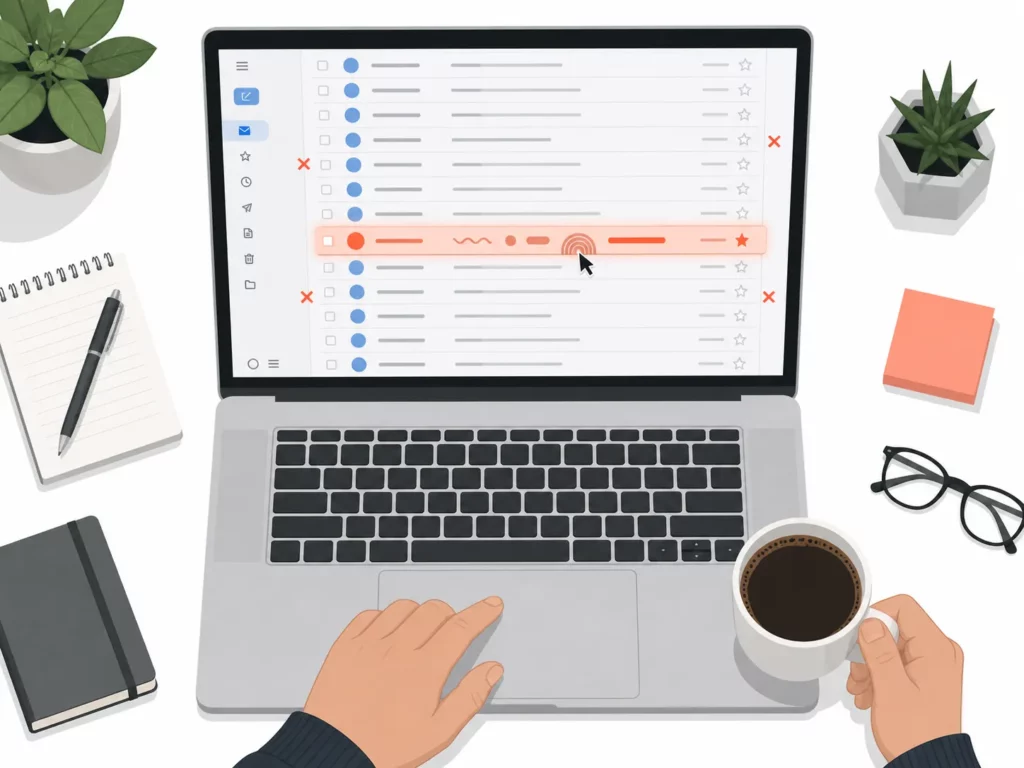
Most affiliate recruitment emails fail for the same five reasons: generic openings, seller-focused messaging, excessive length, vague calls-to-action , and no follow-up . The merchants who avoid these mistakes consistently outperform the 3% average.
The pattern is easy to spot once you see it side by side.
Mistake 1: Generic opening
❌ “ Hi, I love your content! Want to collaborate? ”
✅ “ Your recent review of [specific product] — especially the part about [specific detail] — caught our attention .”
Influencers detect mass-sending within seconds. A specific reference proves you actually looked at their work, and that separates your pitch from the dozens of others sitting in their inbox.
Mistake 2: Leading with your story instead of their benefit
❌ “ We’re [Brand], founded in 2020. We make organic skincare products… ”
✅ “ Earn 20% commission + free products sharing what your audience already loves. ”
Your first two sentences should answer one question: what does the affiliate get? Brand story belongs in paragraph two — if it is needed at all.
Mistake 3: Too long
❌ A 300-word email explaining your brand, mission, product line, and partnership terms.
✅ A focused message under 80 words.
Best-performing cold email campaigns average fewer than 80 words per first-touch message. Say enough to spark interest. Save the details for after they reply.
Mistake 4: No clear CTA
❌ “ Let me know if you’re interested in discussing potential synergies… ”
✅ “ Reply ‘in’ and I’ll set everything up today. ”
One specific action. Low effort. No ambiguity. The easier you make it to respond, the more responses you get.
Mistake 5: No follow-up
❌ Send one email → wait → give up.
✅ Send → wait 5–7 days → follow-up #1 → wait 5–7 days → follow-up #2 → stop.
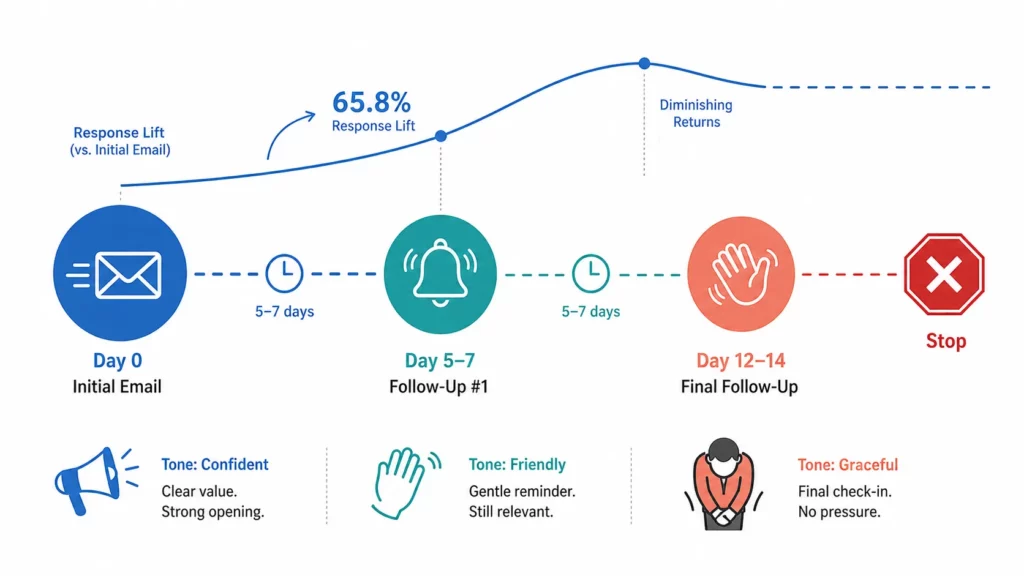
Most merchants send a single email and move on. A single follow-up alone lifts response rates by 65.8% ( Backlinko study — 12 million outreach emails). Two follow-ups is the sweet spot. Three or more risks damaging your reputation.
Anatomy of a High-Converting Recruitment Email (5 Elements)
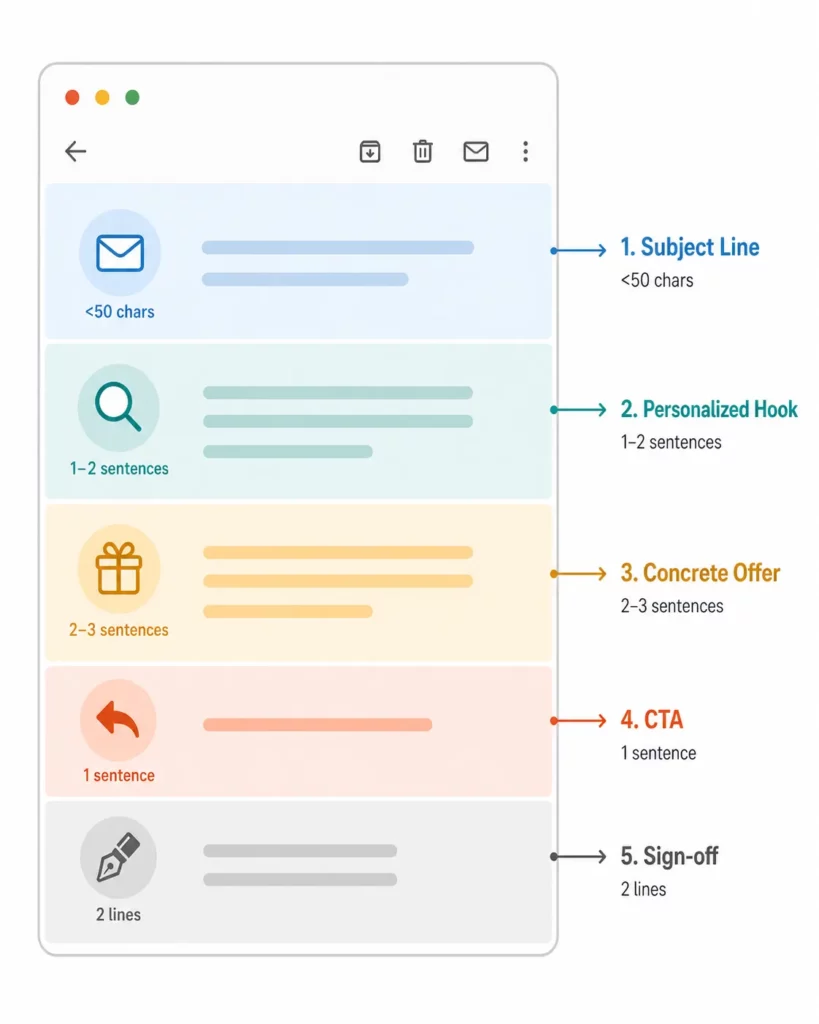
Every high-converting recruitment email follows the same five-part structure: subject line , personalized hook, concrete offer, low-commitment CTA , and professional sign-off .
The order matters — rearranging these elements drops response rates.
Element 1: Subject line (under 50 characters)
The subject line decides whether your email gets opened or skipped. Include the recipient’s name or a specific reference to their content — generic subjects like “Collaboration Opportunity” land in the archive.
Element 2: Personalized hook (1–2 sentences)
Reference a specific piece of their content — a blog post, a video, a review. This proves your email is not a mass blast and gives the creator a reason to keep reading.
Element 3: Concrete offer (2–3 sentences)
State the commission rate, whether you send free product, and what discount their audience gets. “20% commission + free serum” outperforms “competitive compensation package” every time.
The discount code takes care of itself — each affiliate gets a unique code at signup. In UpPromote, this happens automatically, so you can promise it in your pitch before they even join.
Element 4: Low-commitment CTA (1 sentence)
“Reply ‘in’ and I’ll set everything up” works because it asks for one word — no forms, no research, no commitment.
Element 5: Professional sign-off (2 lines)
Name, title, brand, website. Keep it to two lines — skip the ten-line signature blocks.
The table below maps each element to its target length and role in the email. Total: under 80 words, 5–7 sentences.
| Element | Length | Purpose | Example |
| Subject line | <50 chars | Get opened | “[Name] × [Brand] — 20% commission” |
| Hook | 1–2 sentences | Prove personalization | “Your [specific post] caught our eye…” |
| Offer | 2–3 sentences | Show concrete value | “20% commission + free [product]” |
| CTA | 1 sentence | Drive reply | “Reply ‘in’ — I’ll set you up today” |
| Sign-off | 2 lines | Professional close | “Name, Brand, URL” |
6 Recruitment Email Templates (Copy-Paste Ready)
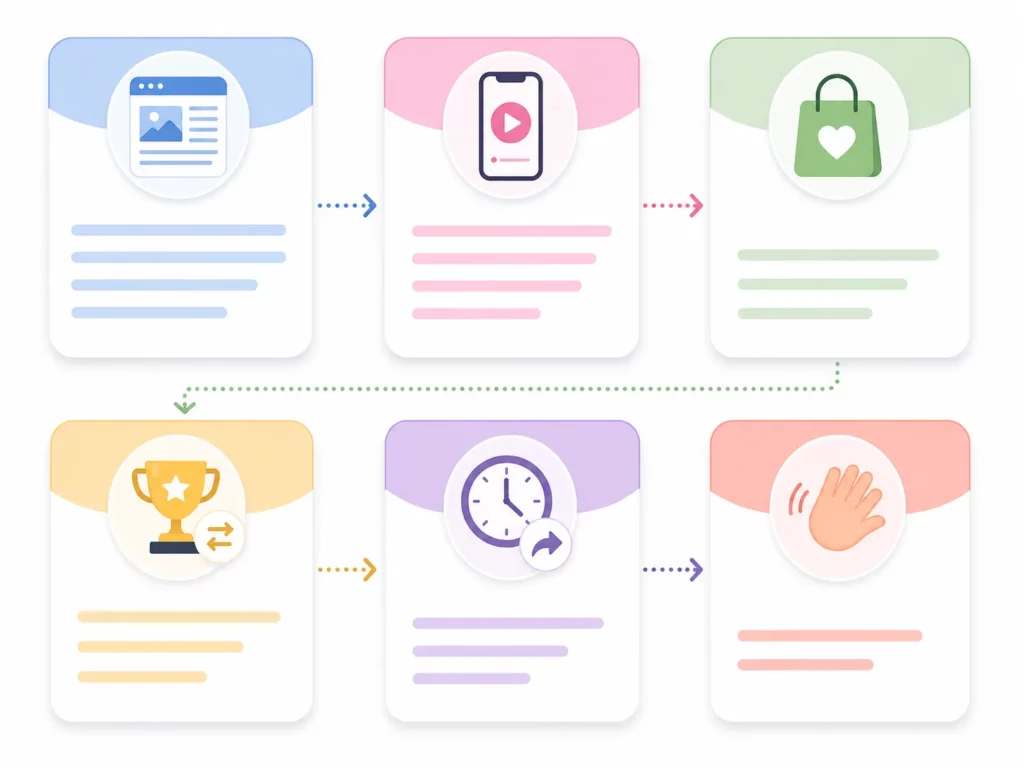
The six templates below cover every common recruitment scenario, from cold blogger outreach to re-engaging someone who did not reply.
Each one follows the five-element framework from the section above: subject, hook, offer, CTA, sign-off.
Pick the template that matches your situation, swap the brackets for your details, and send.
Template 1: Cold Blogger / Content Creator
This template works for bloggers and content creators who share their email on their site or contact page.
Subject: [Name], your [topic] content + [Brand]?
Hi [Name],
Your article on [specific post title/topic] was genuinely helpful — especially [specific detail you liked]. Your readers clearly trust your recommendations.
I’m [Your name] from [Brand]. We make [1-sentence product description].
Would you be interested in joining our affiliate program?
→ [X]% commission on every sale you refer → Free [product] shipped to you → [Y]% discount code for your readers
Reply “in” and I’ll send full details + ship your product this week. No long-term commitment.
[Your name] [Brand] | [website]Best for: bloggers, review sites, and niche content creators with a public email or contact form.
Template 2: Instagram / TikTok Influencer (DM)
DMs need a shorter, more casual tone — no subject line, and a faster path to the offer.
Hey [Name]! 👋
Your [specific reel/post about topic] was great — your audience clearly vibes with [niche].
We make [product] and think your followers would love it. Want to try it free + earn [X]% on every sale?
→ Free [product] shipped to you → [X]% commission per sale → [Y]% off for your followers
Interested? I’ll send details!
— [Name], [Brand]
Best for: Instagram and TikTok DMs. Emoji is acceptable on social platforms — skip it in email.
Template 3: Existing Customer → Affiliate
Repeat customers who already tag your brand on social media make the strongest affiliate prospects. They know the product, they trust it, and their audience has already seen them use it.
Subject: You already love [Product] — want to earn sharing it?
Hi [Name],
You’ve purchased [Product] [X times] — and we noticed you tagged us on [platform]. Thank you!
Customers like you make the most authentic affiliates. Would you like to earn [X]% commission every time someone buys through your personal link?
→ [X]% commission on every referral sale → Your own discount code to share → [Y]% off for friends you refer
Takes 30 seconds to join: [SIGNUP LINK]
No minimums. Share whenever you feel like it.
[Your name], [Brand]Best for: repeat customers (2+ purchases) and customers who tag or mention your brand on social media.
Template 4: Recruit a Competitor’s Affiliate
Affiliates already promoting a competitor have a proven track record — they understand the model and have the right audience. Your pitch needs to offer something their current program does not.
Subject: [Name] — a better commission on [niche]?
Hi [Name],
I noticed you’re promoting [Competitor] in your [content type]. Your [niche] audience is exactly who we serve at [Brand].
We’d love to offer you:
→ [X]% commission (vs [Competitor’s estimated rate]) → Free [product] to compare → [Y]-day cookie window → Automatic discounts through your link — no coupon codes needed
Many affiliates run multiple programs — happy to coexist. But we think you’ll prefer our [specific differentiator: higher commission / better product / longer cookie].
Worth a quick look? Reply and I’ll send details.
[Your name], [Brand]Best for: influencers or bloggers already promoting competitors. Do not bash the competitor — offer a better deal instead.
Template 5: Follow-Up #1 (5–7 Days After Initial Email)
If your first email went unanswered, sending a follow-up five to seven days later is standard, not pushy. Inboxes fill up fast, and your message may have gotten lost.
Subject: Quick follow-up — [Brand] affiliate invite
Hi [Name],
Just bumping my email from [date] in case it got buried — I know inboxes are hectic.
Quick recap: [X]% commission + free [product] + [Y]% off for your audience.
Still interested? Reply “yes” and I’ll get everything set up.
If the timing isn’t right, totally understand — no hard feelings!
[Your name], [Brand]Best for: any scenario where the initial email (Templates 1–4) received no response. Wait at least five days before sending.
Template 6: Follow-Up #2 / Final
The final follow-up signals that this is your last message, which creates soft urgency. Including a signup link keeps the door open if they change their mind later.
Subject: Last note from me — [Brand]
Hi [Name],
This is my last email about this — I promise!
Our affiliate program ([X]% commission + free [product]) is open whenever you’re ready. Here’s the signup link for future reference: [LINK]
Wishing you all the best with your [content/channel/blog]. Keep creating great stuff!
[Your name], [Brand]Best for: final contact after one unanswered follow-up. Some affiliates respond because “last” triggers action.
Every template above includes a signup link; and the page behind it matters. Match the colors, logo, and form fields to your brand so the registration page feels like a natural extension of your email.
The table below helps you match each scenario to the right template and channel.
| Scenario | Template | Channel | Response level |
| Blogger or review site | #1 | Moderate | |
| Instagram / TikTok creator | #2 | DM | Moderate |
| Existing customer | #3 | Highest — pre-existing trust | |
| Competitor’s affiliate | #4 | Lower volume, high-value leads | |
| No response after 5–7 days | #5 | Same as initial | Additive |
| Still no response | #6 | Same as initial | Additive — final touch |
Subject Line Formulas That Get Opened
The subject line carries more weight than any other part of your recruitment email. Personalized subjects boost open rates by roughly 31% (Belkins, 2025 — 5.5 million emails analyzed).
Keep them under 50 characters so they show in full on mobile screens.
You can consider using the formulas below to match every scenario from the templates earlier.
| Formula | Example | Why it works |
| [Name] × [Brand] — [benefit] | “Sarah × GlowSkin — earn 20% sharing” | Personal + clear benefit |
| Your [content] + our [product]? | “Your skincare reviews + our serums?” | Curiosity + relevance |
| [Name], [detail] caught our eye | “Maria, your TikTok on acne scars caught our eye” | Ultra-personalized |
| Earn [X]% sharing [category] | “Earn 20% sharing clean beauty products” | Direct benefit, no fluff |
| Quick question about your [platform] | “Quick question about your YouTube channel” | Curiosity gap |
| [Name] — a better commission on [niche]? | “James — a better commission on fitness gear?” | Competitive angle |
Every subject line needs the reader’s name or a nod to their content. Generic subjects like “Collaboration Opportunity” go straight to the archive.
Skip ALL CAPS, stacked exclamation marks, and emoji. The simplest test: would you open this from a stranger?
Follow-Up Sequence: When, How Many, What Tone
Most replies do not come from your first email. 42% of all cold email replies come from follow-up messages , not the initial send (Instantly, 2026). Skipping follow-ups means leaving nearly half your responses on the table.
The sequence is simple.
Day 0: Send your initial email (Templates 1–4).
Day 5–7: Send Follow-Up #1 (Template 5). Keep the tone friendly, recap your offer in one line, and add one new element — social proof, a bonus, or a time-limited perk.
Day 12–14: Send Follow-Up #2 / Final (Template 6). Signal that this is your last message, leave a signup link, and close on a positive note.
After that: Stop. Do not send a fourth email.
A single follow-up lifts response rates by 65.8% (Backlinko). A second adds a smaller but real bump.
Beyond two, returns drop fast. The risk of annoying a future partner outweighs the slim chance of a late reply.
Moreover, Instantly’s 2026 data shows a clear pattern: launch sequences on Monday or Tuesday, and send follow-ups on Wednesday — the peak reply day.
The best send window is 9:30–11:30 AM in the recipient’s local time zone. Friday performs worst across the dataset.
Personalizing at Scale (When You Send 50+ Per Week)
Personalizing five emails is easy. Fifty per week is not, unless you sort your prospects into tiers and match the effort to the value.
The table below breaks outreach into three levels based on how much each prospect is worth to your program.
| Tier | Time per email | When to use | What to personalize |
| Full (5 min) | High | Top 10 dream affiliates | Specific post, why their audience fits, earnings estimate |
| Medium (2 min) | Medium | 20–30 qualified leads | Name, platform, niche, one specific content reference |
| Light (30 sec) | Low | 20–30 volume outreach | Name, platform, niche category |
Full effort pays off when the affiliate is worth it. Freewell Gear built their entire roster that way — the camera gear brand skipped follower counts entirely.
Instead, they screened every creator for one thing: whether they understood the product well enough to explain it.
That single filter produced $350,000 in affiliate revenue in two months across roughly 700 creators.
Tools that help you scale
A spreadsheet is enough to start: name, platform, followers, email, date sent, response, status. For merge-tag outreach at volume, Gmail templates or Mailchimp handle the [Name] and [Niche] fields for you.
When not to mass-send
Template #4 (competitor recruit) should always get full effort — a generic pitch to someone earning from a rival program will not land.
DMs on Instagram and TikTok should always be manual. Mass DMs trigger spam flags and risk account bans.
What Changed in 2026
Cold email open rates have dropped over the past two years, partly because Apple’s privacy features inflated earlier numbers. Reply rate is now the more reliable metric (Instantly, 2026).
That shift makes personalization more important than ever — not less.
Shorter emails are winning. Messages under 80 words now set the bar for first-touch outreach. Anything over 150 words faces steep drop-off.
Omnichannel outreach is the new default. Email alone no longer gets the best results. A LinkedIn comment or social DM before your pitch — so the prospect knows your name first — lifts responses across the board.
AI drafts still need a human pass. AI tools can build a first draft from an influencer’s profile in seconds. But the output works best as a starting point, not a send-ready message.
A quick edit for voice and genuine detail still separates good outreach from obvious automation.
Video intros are emerging. Some brands now send short Loom or video DMs instead of text. The format stands out, though adoption is still early.
Frequently Asked Questions
How many affiliate outreach emails should I send per week?
Aim for 20–30 personalized emails per week to build a steady pipeline. At a 15–25% reply rate, that produces roughly 3–8 responses and 2–4 signups. Weekly consistency matters more than large one-time blasts.
Should I send an email or a DM?
Use the channel where the creator is most active. Bloggers and YouTubers with a public email prefer email — it feels professional. Instagram and TikTok creators are easier to reach through DMs. If an email address appears in their bio, email is usually the better choice.
How many characters should my subject line be?
Keep subject lines under 50 characters. Most mobile screens cut off anything longer, and the recipient may never see your key message. Include the creator’s name or a specific reference to their content.
What should I do if an influencer does not reply after two follow-ups?
Move on — for now. Three or more emails without a response crosses from persistent into pushy. Bookmark their profile and revisit in two to three months with a fresh angle, such as a new product launch. Do not reference your old unanswered emails.
Should I include the commission rate in my first email?
Yes. A specific number like “20% commission” is clear, actionable, and sets you apart from vague pitches that say “competitive rates.” Leaving the rate out adds friction — the creator has to ask before deciding whether to engage.
What is the ideal length for a recruitment email?
Keep your first-touch email under 80 words. Data from the Instantly Benchmark Report (2026) shows that the best-performing cold email campaigns stay below that threshold. Say enough to spark interest, then save the full details for after they reply.

Ellie Tran, a seasoned SEO content writer with three years of experience in the eCommerce world. Being a part of the UpPromote team, Ellie wants to assist Shopify merchants in achieving success through useful content & actionable insights.Ellie's commitment to learning never stops; she's always eager to gain more knowledge about SEO and content marketing to create valuable content for users. When she's not working on content, Ellie enjoys baking and exploring new places.
![How to Use Shopify Functions with Your Affiliate Program [2026 Guide]](https://static.uppromote.com/wp-content/uploads/2026/06/how-to-use-shopify-functions-with-affiliate-program-300x169.webp)
![How to Prevent Affiliate Fraud on Shopify: Self-Referral, Coupon Abuse & More [2026]](https://static.uppromote.com/wp-content/uploads/2026/06/how-to-prevent-affiliate-fraud-on-shopify-300x169.webp)