












TL;DR
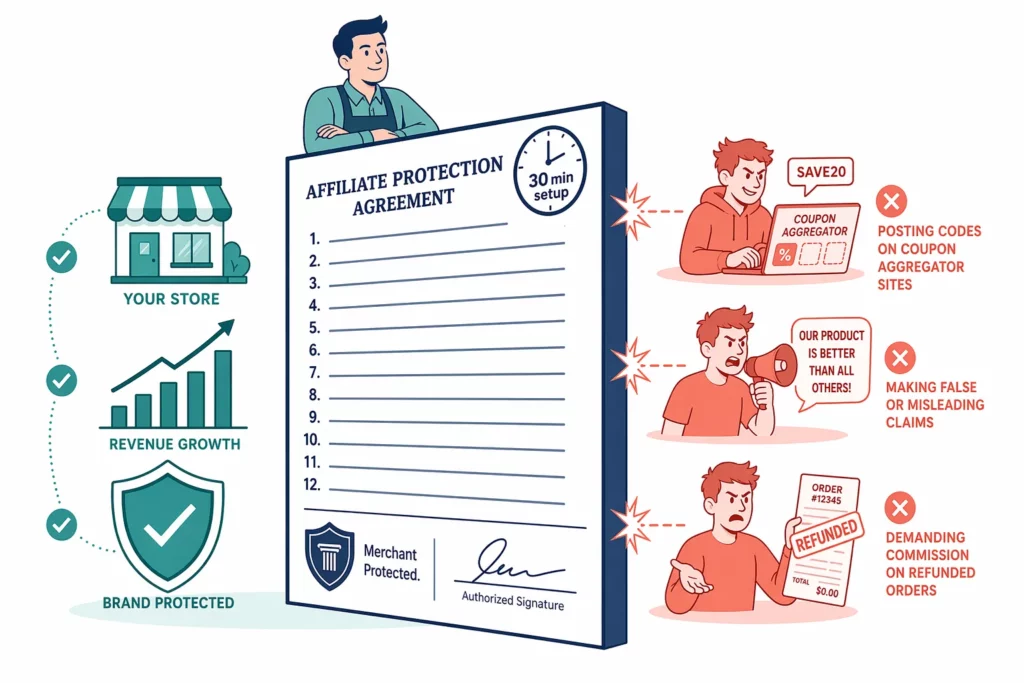
An affiliate agreement protects your brand, sets partner expectations, and gives you legal ground to terminate bad actors — set one up in 30 minutes with the free template below.
- Clauses needed: 12 — commissions, FTC disclosure, prohibited activities, coupon policy, termination
- FTC risk: Merchants face liability if affiliates skip disclosure — your agreement documents compliance
- Coupon leak prevention: Prohibit code posting on coupon aggregator sites
- Template: Free copy-paste version below — customize brackets and paste into your affiliate app
- Lawyer needed? Only for regulated products, high revenue, or prior legal disputes
Most Shopify merchants launch their affiliate program without a written agreement. When everything runs smoothly, no one notices.
When a dispute hits, an affiliate posts misleading claims, a coupon code leaks to a deal site, or someone demands commission on a refunded order, there is no document to fall back on. The result is lost revenue, damaged relationships, and legal exposure.
An affiliate agreement does not need to be complex or written by a lawyer. But it does need to cover 12 clauses, from commission rules to FTC compliance to banned activities.
That last point carries real weight. The FTC revised its Endorsement Guides in 2023 and requires affiliates to disclose their link to any brand they promote.
Merchants can face penalties if their affiliates fail to comply. A written agreement is your documented compliance effort.
In this blog, we will walk through all 12 clauses, explain why each one matters, and include a free template you can set up in 30 minutes.
Why Do You Need an Affiliate Agreement? (And What Happens Without One)
An affiliate agreement serves three goals: it protects you, it sets clear rules for partners, and it gives you the right to remove affiliates who break the terms.
Without one, every dispute turns into a judgment call with no proof behind it.
Legal safety is the most obvious benefit. If an affiliate posts false product claims and a customer takes action, a written agreement shifts part of the blame — the affiliate broke guidelines they agreed to.
The same applies to FTC rules. Your agreement requiring disclosure shows a compliance effort that strengthens your position.
Clear rules cut the gray areas that cause friction. Rates, payout schedules, refund handling, approved channels — if any of this is left open, disputes follow.
The right to remove matters most when things go wrong. PandaDoc’s affiliate contract template includes a standard clause: affiliates who break the agreement forfeit all earned commissions.
Without that clause, you may still owe payment to an affiliate running fake traffic.
What Should an Affiliate Program Agreement Include? (12 Clauses)
Every affiliate agreement needs 12 clauses.
Some handle operations like commission rates, payment terms, tracking. Others handle safety like FTC compliance, banned activities, exit rights.
Skipping any of them leaves a gap that shows up only when a problem occurs.
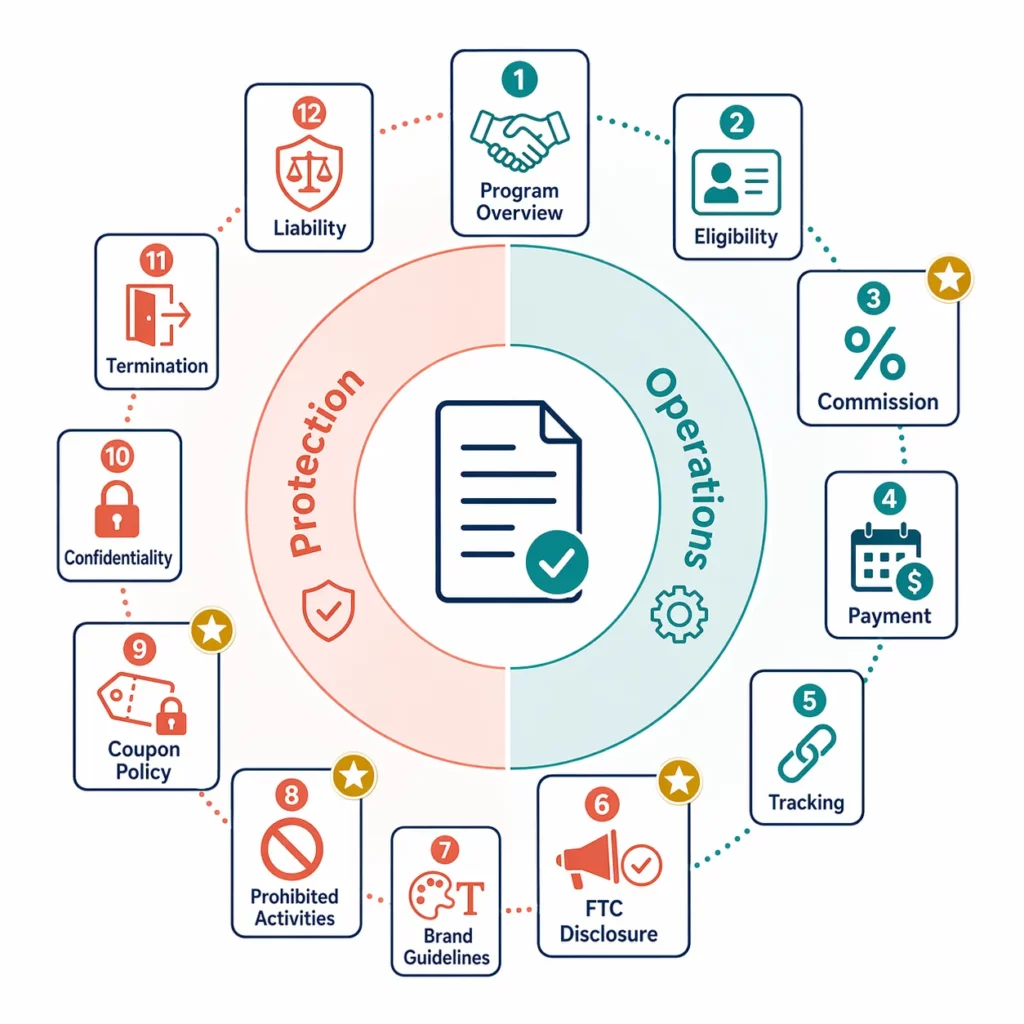
| # | Clause | What it protects |
| 1 | Program Overview | Defines the relationship as contractor, not employee |
| 2 | Eligibility & Enrollment | Controls who can join and your right to reject |
| 3 | Commission Structure | Prevents rate disputes and sets excluded products |
| 4 | Payment Terms | Locks schedule, method, minimum, and tax responsibility |
| 5 | Tracking & Attribution | Clarifies how referrals are credited and disputes resolved |
| 6 | FTC Disclosure | Documents your compliance effort — merchants face liability |
| 7 | Brand & Content Guidelines | Prevents false claims that create legal exposure |
| 8 | Prohibited Activities | Blocks spam, trademark bidding, coupon leaks, fraud |
| 9 | Coupon Code Policy | Prevents revenue leakage from code sharing on deal sites |
| 10 | Confidentiality | Protects commission rates and program data from competitors |
| 11 | Termination & Modification | Gives you the right to end the relationship and modify terms |
| 12 | Limitation of Liability | Limits your exposure for affiliate actions outside your control |
Clause 1: Program Overview
The most important legal point comes first: the affiliate is an independent contractor, not an employee, agent, or partner. Without this clause, an affiliate could claim employee benefits or act as your official voice.
Template: “By enrolling in the [Brand] Affiliate Program, you agree that you are an independent contractor. Nothing in this Agreement creates an employment, agency, or partnership relationship between you and [Brand].”
Clause 2: Eligibility & Enrollment
Define who qualifies, typically 18+ with an active website, blog, or social media account that produces original content.
Your brand should reserve the right to accept or reject any applicant at its sole discretion, for any reason. That gives you full control over program quality.
Template: “Applicants must be 18+ years old and operate a website, blog, or social media account with original, compliant content. [Brand] reserves the right to accept or reject any application at its sole discretion.”
Clause 3: Commission Structure
Cover the full picture: rate, type (percent of net sale), excluded items, holding period, and your right to change rates with advance notice. Leaving any of these vague invites will dispute the moment a commission is denied.
If you use UpPromote, excluded products and collections can be set up in program settings, so the agreement and the app stay in sync.
Template: “Affiliates earn [X]% commission on net sale amount (excluding shipping, taxes, gift cards, and sale items). Commissions are held for [30] days before payout eligibility. [Brand] may modify commission rates with 14 days written notice.”
Clause 4: Payment Terms
Spell out every detail affiliates will ask about: payout schedule, minimum payout, payment method, currency, and tax duty. Gaps here lead to support tickets and friction on both sides.
Template: “Commissions are paid monthly on the 15th for the prior month’s approved commissions. Minimum payout: $[25]. Payment via PayPal. Affiliates are responsible for accurate payment information and for all taxes on commissions earned.”
Note for US merchants: If an affiliate earns $600+ per year, you must issue a 1099-NEC. Collect a W-9 during onboarding.
Clause 5: Tracking & Attribution
Your agreement should cover the tracking method (affiliate links, coupon codes, or both), cookie length, credit model, and dispute process.
It should also name your tracking dashboard as the final source of truth — this prevents arguments over third-party data gaps.
Template: “Referrals are tracked via unique affiliate links and/or coupon codes. Cookie duration: [30] days. Attribution: last-click model. [Brand]’s tracking dashboard data is definitive. Disputes must be submitted within 30 days of the transaction date.”
Clause 6: FTC Disclosure Requirements
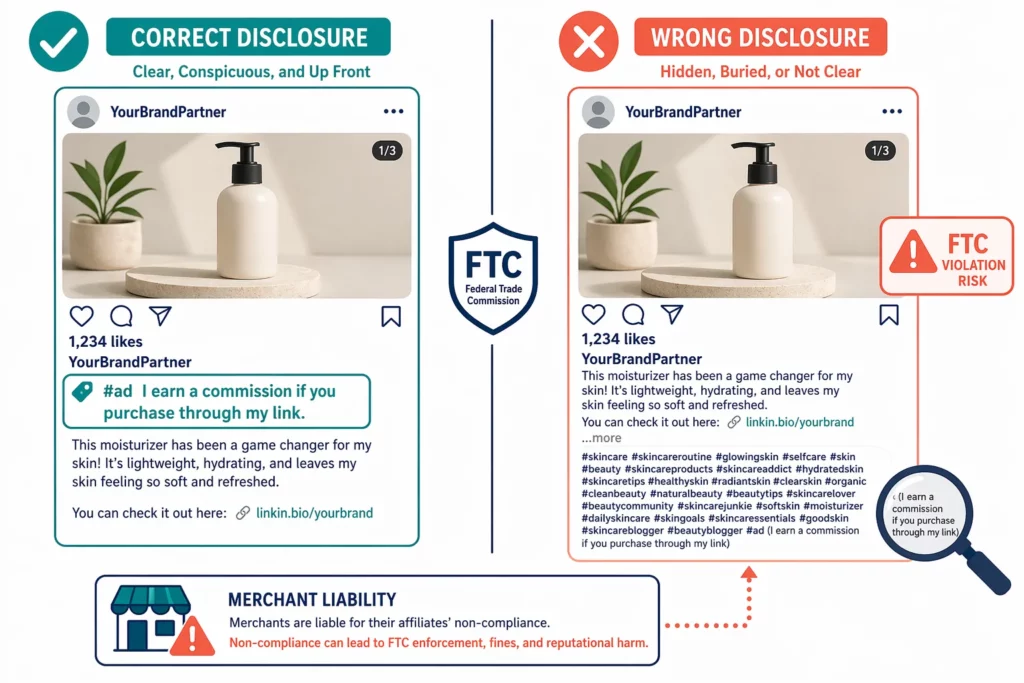
This clause carries more weight than most merchants think. The FTC’s Endorsement Guides require affiliates to disclose their tie to the brand — and merchants can face penalties if affiliates skip it.
Your agreement should state how to disclose, where to disclose, and what happens if they do not.
Template: “Affiliate MUST clearly disclose the affiliate relationship in ALL content promoting [Brand]. Acceptable disclosures include ‘#ad,’ ‘#sponsored,’ or clear text such as ‘I earn a commission if you purchase through my link.’ Disclosure must be prominent — not buried in hashtags or fine print. Non-compliance may result in immediate termination.”
Clause 7: Brand & Content Guidelines
Define what affiliates can and cannot say about your products. This is critical for stores selling health, beauty, or financial items, where false claims create legal risk.
List approved claims, ban medical or guaranteed-results language, and set rules for logo usage.
Template: “Affiliates may not claim that [Brand] products cure, treat, or prevent any medical condition. All claims must be truthful and substantiated. [Brand] logos may be used only as provided in the media kit — no modification permitted.”
Clause 8: Prohibited Activities
This is the clause most merchants skip, and the one they need most. A detailed list of banned activities is the legal basis for removal when affiliates damage your brand or drain your budget.
Here are the most common violations and their results.
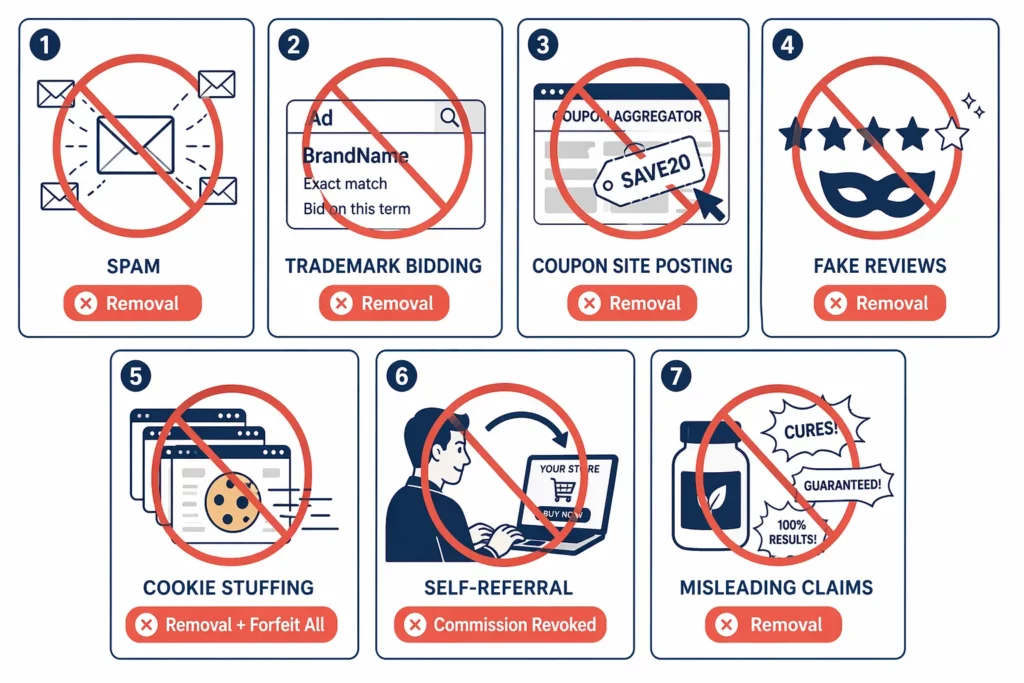
| Activity | Why it’s banned | Result |
| Spam (email, SMS, social) | Legal risk + brand damage | Removal |
| Trademark bidding (PPC ads on your brand name) | Cannibalizes your organic and paid search | Removal |
| Posting codes on coupon sites | Revenue leakage — customers who would have bought anyway | Removal + forfeit commissions |
| Fake reviews or testimonials | FTC violation + brand damage | Removal |
| Cookie stuffing or forced clicks | Click fraud | Removal + forfeit all |
| Self-referral purchases | Commission fraud | Commission revoked |
| Misleading product claims | Legal liability for the merchant | Warning → removal |
UpPromote’s fraud detection flags problems like self-referrals, duplicate IPs, and throwaway email signups before they cost you. The agreement covers what the tool cannot catch.
Template: “Affiliates may NOT: (a) send spam or unsolicited messages, (b) bid on [Brand] trademarks in PPC ads, (c) post affiliate codes on coupon sites or deal forums, (d) create fake reviews, (e) use cookie stuffing or forced clicks, (f) purchase products through their own affiliate link, (g) make misleading claims about products.”
Clause 9: Coupon Code Policy
Coupon leaks are one of the fastest ways to lose affiliate ROI. A customer on your checkout page finds the code on a deal site, applies it, and the affiliate earns commission on a sale that would have happened anyway.
Your agreement should ban posting codes outside the affiliate’s own audience.
Template: “Affiliate coupon codes are exclusively for sharing with the Affiliate’s own audience. Posting codes on coupon aggregation sites, browser extensions, deal forums, or publicly accessible directories is strictly prohibited. [Brand] reserves the right to deactivate compromised codes immediately and claw back commissions attributed to leaked code usage.”
If your tracking method shifts from coupon codes to auto-applied discounts , add a transition clause to the agreement.
Clause 10: Confidentiality
Rates, performance data, and business plans should stay internal. If affiliates share your rates, rivals can undercut you. A simple clause prevents this.
Template: “Affiliate agrees to keep confidential all non-public information about the Program, including commission rates, program policies, and business data. Affiliate may not publicly disclose commission rates or program performance data without written consent from [Brand].”
Clause 11: Termination & Modification
Both parties should be able to exit the agreement with notice — 14 days is standard. For banned activity violations, removal without notice should apply.
The clause also needs to address pending commissions and how program changes reach affiliates.
Template: “Either party may terminate this Agreement at any time with 14 days written notice. [Brand] may terminate immediately without notice for violation of prohibited activities. Upon termination, Affiliate must remove all affiliate links. Legitimate pending commissions are paid within 30 days. Commissions attributed to fraudulent activity are forfeited.”
Clause 12: Limitation of Liability
The final clause limits your exposure for actions outside your control, including the affiliate’s business choices, tax duties, and any claims arising from their content. It also covers technical issues like temporary tracking gaps.
Template: “[Brand] shall not be liable for indirect, incidental, or consequential damages arising from participation in the Program. The affiliate is responsible for compliance with all applicable laws. [Brand] is not responsible for tracking interruptions beyond reasonable control.”
How to Use This Free Affiliate Agreement Template
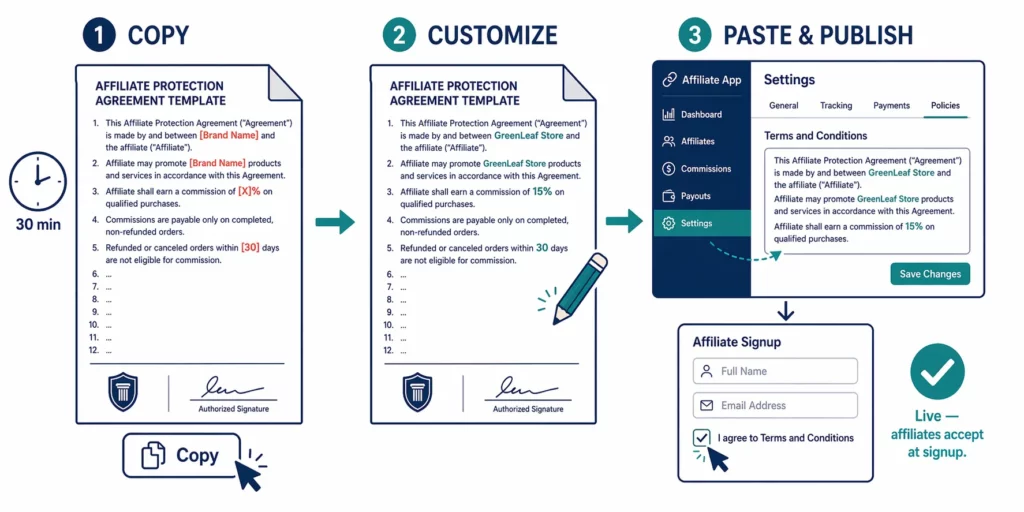
The template below covers all 12 clauses. Copy it, swap every bracketed field with your brand details, and paste it into your affiliate app’s Terms and Conditions settings.
Affiliates accept the terms when they sign up, no separate contract needed.
=========================================
[BRAND NAME] AFFILIATE PROGRAM AGREEMENTEffective Date: [DATE]
=========================================
- PROGRAM OVERVIEW
By enrolling in the [Brand Name] Affiliate Program (“Program”), you (“Affiliate”) agree to these terms. Affiliate is an independent contractor, not an employee, agent, or partner of [Brand Name].
- ELIGIBILITY
Applicants must be 18+ and operate a compliant website, blog, or social media account. [Brand Name] may accept or reject any application at its sole discretion.
- COMMISSION
– Rate: [X]% of net sale amount
– Excluded: shipping, taxes, gift cards, sale items
– Holding period: 30 days (to account for refunds)
– [Brand Name] may modify rates with 14 days notice
- PAYMENT
– Schedule: Monthly, on the 15th
– Minimum payout: $[25]
– Method: PayPal [or specify alternatives]
– Currency: USD
– Tax: Affiliate responsible for all applicable taxes
- TRACKING & ATTRIBUTION
– Methods: Affiliate links and/or coupon codes
– Cookie duration: [30] days
– Attribution: Last-click model
– [Brand Name]’s tracking dashboard is definitive
– Disputes must be submitted within 30 days
- FTC DISCLOSURE (REQUIRED)
Affiliate MUST disclose affiliate relationship in ALL, promotional content. Use: “#ad,” “#sponsored,” or clear disclosure text. Disclosure must be prominent and visible. Non-compliance = immediate termination.
- BRAND GUIDELINES
– Use logos only as provided in media kit
– No modification of brand assets
– No medical, financial, or guaranteed results claims
– All claims must be truthful and substantiated
- PROHIBITED ACTIVITIES
Affiliates may NOT:
(a) Send spam or unsolicited communications
(b) Bid on [Brand Name] trademarks in PPC ads
(c) Post affiliate codes on coupon/deal sites
(d) Create fake reviews or testimonials
(e) Use cookie stuffing or forced clicks
(f) Purchase products through own affiliate link
(g) Make misleading claims about products
(h) Associate [Brand Name] with adult, gambling, or illegal content
- COUPON CODE POLICY
– Codes exclusively for Affiliate’s own audience
– Posting on coupon sites = immediate termination
– Leaked codes deactivated immediately
– Commissions from leaked usage may be clawed back
– [Brand Name] may switch to auto-apply discount links at any time
- CONFIDENTIALITY
Commission rates, program data, and business information are confidential. Do not disclose publicly without written consent.
- TERMINATION
– Either party: 14 days written notice
– Immediate termination for prohibited activities
– Post-termination: remove all affiliate links
– Legitimate pending commissions paid within 30 days
– Fraudulent commissions forfeited
- LIABILITY
By enrolling, Affiliate confirms they have read, understood, and agreed to all terms above.
=========================================
DISCLAIMER : This template is for informational purposes only and does not constitute legal advice.Consult a qualified attorney before use.
=========================================
Frequently Asked Questions
Do I legally need a written affiliate agreement?
It depends on your region, but in practice — yes. Without a written agreement, you cannot enforce program rules, remove bad actors with documented cause, or show FTC compliance effort. Most affiliate apps include a Terms and Conditions field where affiliates agree to your terms at signup.
Is a free template enough for legal protection?
For most small and mid-sized Shopify stores, a template covering 12 clauses handles the bulk of cases. Stores selling regulated products, working across borders, or earning high monthly revenue should consult a lawyer. A template is a strong starting point, not a stand-in for legal advice.
Do affiliates need to sign a separate contract?
Most affiliate apps handle acceptance through a click-to-agree box at signup. When an affiliate clicks “I agree to Terms and Conditions,” that counts as binding acceptance in most places. A separate signed document is not needed.
How often should I update my affiliate agreement?
Review it at least once a year. Common triggers include changes to rates, new banned activities (such as AI content rules), shifts in tracking methods, and FTC updates. Let affiliates know at least 14 days before changes take effect.
What if an affiliate violates terms but I have no agreement?
Your best option is to create an agreement right away and require all existing affiliates to accept the new terms through your app. You can still remove the problem affiliate — but expect pushback without a document behind your choice.
Are commission clawback clauses enforceable?
If the agreement states that commissions from banned activity are forfeited and the affiliate agreed at signup, the clause holds in most cases. For large amounts, consult a lawyer. For smaller amounts, clear language in the agreement is enough.

Ellie Tran, a seasoned SEO content writer with three years of experience in the eCommerce world. Being a part of the UpPromote team, Ellie wants to assist Shopify merchants in achieving success through useful content & actionable insights.Ellie's commitment to learning never stops; she's always eager to gain more knowledge about SEO and content marketing to create valuable content for users. When she's not working on content, Ellie enjoys baking and exploring new places.

![How to Use Shopify Functions with Your Affiliate Program [2026 Guide]](https://static.uppromote.com/wp-content/uploads/2026/06/how-to-use-shopify-functions-with-affiliate-program-300x169.webp)

![How to Prevent Affiliate Fraud on Shopify: Self-Referral, Coupon Abuse & More [2026]](https://static.uppromote.com/wp-content/uploads/2026/06/how-to-prevent-affiliate-fraud-on-shopify-300x169.webp)