











TL;DR
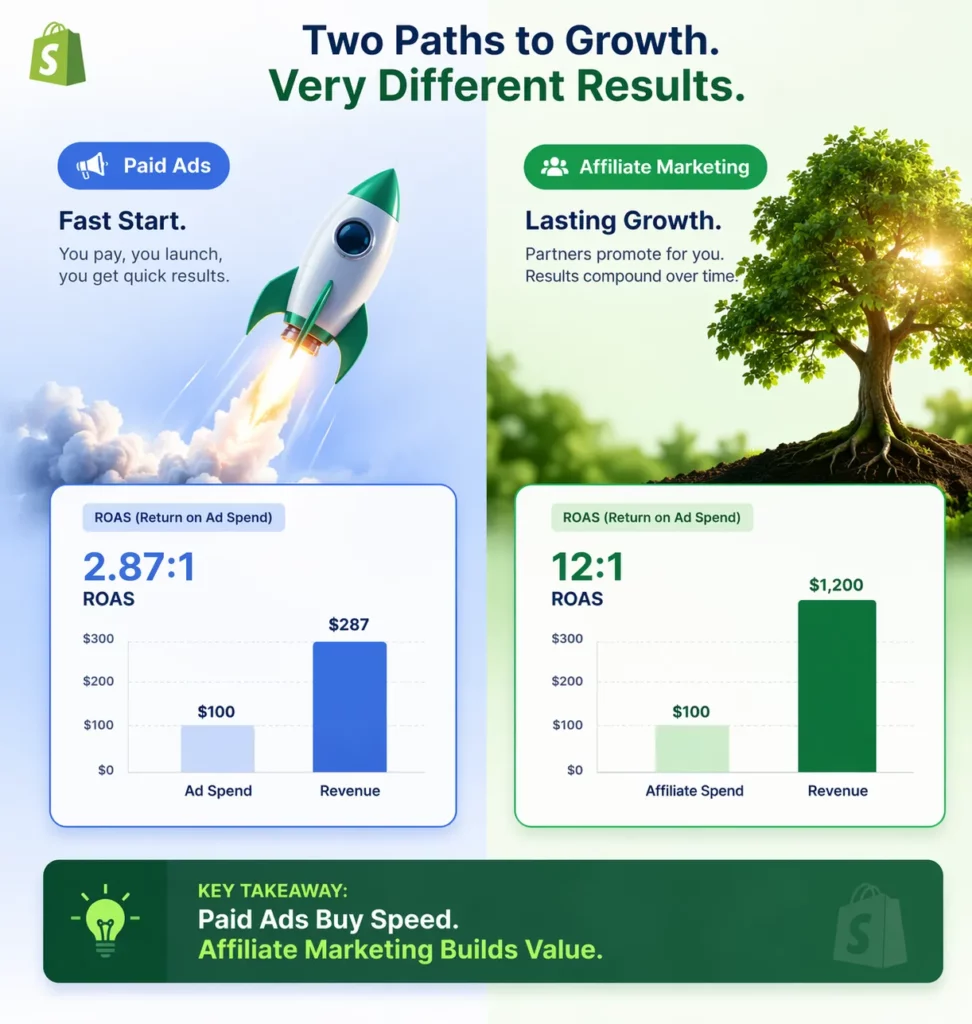
Affiliate marketing delivers a 12:1 average ROAS, while ecommerce paid ads hover near 2.87:1 in 2025 — but paid ads scale faster. The right answer isn’t either/or: use both.
- Affiliate ROAS: 12:1 on average
- Ecommerce paid ads ROAS: ~2.87:1 average in 2025
- Cost model: Affiliates = pay per sale. Paid ads = pay per click (upfront risk)
- Speed: Paid ads drive sales in days. Affiliate programs need 3–6 months to ramp
- LTV edge: Referred customers worth 16% more than non-referred
Every Shopify merchant asks the same question when rising ad costs start eating margin: pour more into ads, or build an affiliate program?
Meta CPMs climbed double digits year-over-year through 2025, and iOS privacy updates continue to dent targeting precision. Affiliate marketing, the pay-only-when-someone-buys model, looks increasingly attractive by comparison.
But this isn’t an either/or decision.
Affiliate and paid ads solve different problems on different timelines. The strongest Shopify stores run both — using ads for speed and affiliates for lower-cost sustained acquisition.
This guide compares the two channels on ROAS, CPA, scalability, and customer lifetime value. Then it shows when each channel wins and how to blend them for a lower blended CPA.
How Does Affiliate Marketing ROI Compare to Paid Ads on Shopify?
Affiliate marketing delivers a 12:1 average ROAS — roughly four times the 2.87:1 average for ecommerce paid ads in 2025.
But paid ads win on speed, scale, and immediate control, which is why most Shopify stores run both rather than picking one.
| Metric | Affiliate Marketing | Facebook/IG Ads | Google Ads | TikTok Ads |
| Average ROAS | 12:1 | 2–4:1 | 2.87–4:1 | 1.5–2:1 |
| Cost model | Pay per SALE | Pay per CLICK | Pay per CLICK | Pay per CLICK |
| Upfront budget risk | $0 (commission only) | $500–5,000+/mo | $500–5,000+/mo | $500–3,000+/mo |
| Time to first sale | 2–8 weeks | 1–3 days | 1–3 days | 1–7 days |
| Scalability | Medium (partner-dependent) | High (budget-dependent) | High (budget-dependent) | High |
| Platform dependency | Low (diversified affiliates) | High (single platform) | High (single platform) | High |
| iOS/privacy impact | Minimal | Heavy | Moderate | Moderate |
The 12:1 figure comes from the Performance Marketing Association’s study, and seven major networks including Awin, CJ, and Rakuten report similar results.
Ecommerce paid ads sit at a 2.87:1 average in 2025 (Onramp Funds), with Google Search the strongest subset at roughly 4:1 for high-intent queries.
The gap looks dramatic, but the real difference sits in the cost model.
Paid ads charge you per click. The first $1,000 of spend might return zero sales if targeting or creative misses.
Meanwhile, affiliate programs flip the risk: partners only earn when a sale closes, so a weak affiliate costs you nothing beyond setup time.
Paid ads earn back their disadvantage on speed. You can launch a campaign today and see sales tomorrow, while affiliate programs need 2–8 weeks for the first referral sale.
That gap makes ads the right tool for flash launches, inventory pushes, and urgent cash flow needs.
When Should You Choose Affiliate Marketing Over Paid Ads?
Affiliate marketing wins on tight budgets, pressured margins, and products that need trust-building content.
However, paid ads win on speed, impulse conversions, and stores without an existing customer base to seed affiliate partnerships.
The decision rarely comes down to preference.
It comes down to your store’s stage, margin structure, and what the product actually needs from a marketing channel.
| Your situation | Prioritize | Why |
| Monthly marketing budget under $1,000 | Affiliate | $0 upfront. Paid ads need $500–1,000/mo minimum to test. |
| Need sales now (flash sale, product launch) | Paid Ads | Affiliate programs need 2–8 weeks to ramp. Ads drive traffic within 24 hours. |
| Rising ad CPA is eating margin | Add Affiliate | Commission-based costs scale with revenue, not with CPM inflation. |
| Product needs reviews or tutorials to convert | Affiliate | Creators build reviews and demo content. Ads can’t earn that trust. |
| Impulse product with AOV under $30 | Paid Ads | Commission per sale ($3–5) is too small to attract quality affiliates. |
| High-ticket product ($200+) | Affiliate | Commission per sale ($30–50+) attracts serious creators. |
| Existing customer base loves the product | Affiliate (referral) | Customers become affiliates at near-zero cost. |
High-ticket stores benefit most from affiliate channels.
A 15% commission on a $400 scooter pays an affiliate $60 per sale — enough to fund content creation, reviews, and sustained promotion.
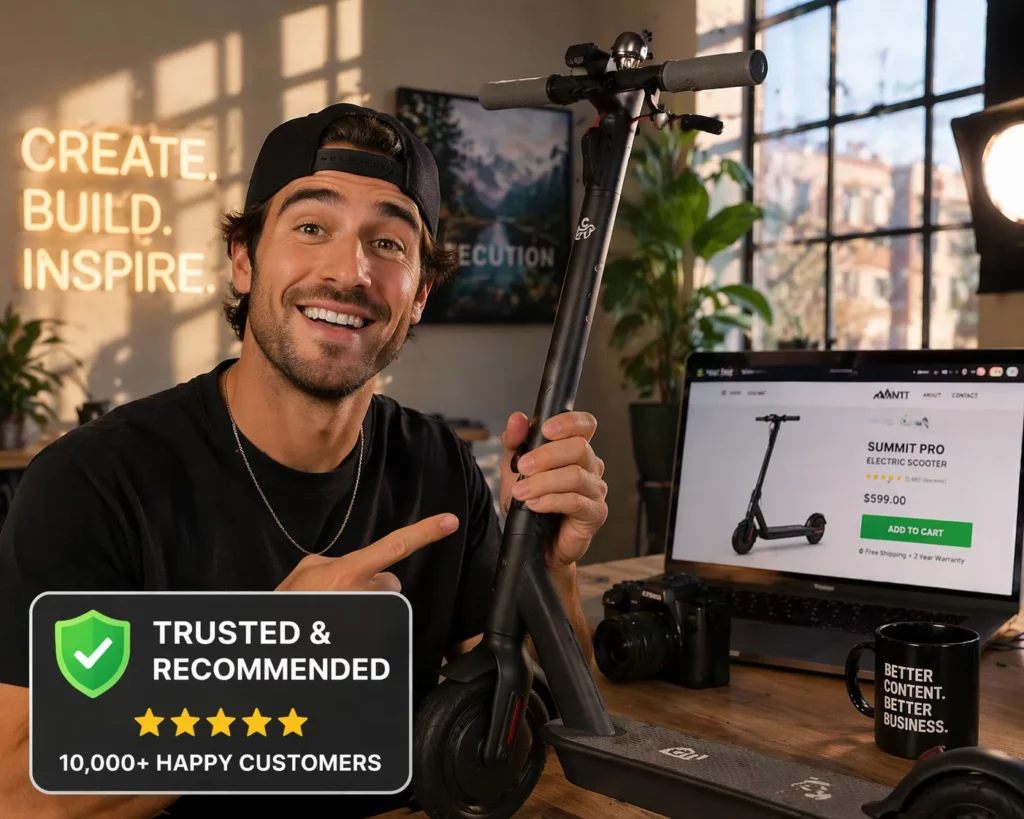
Apollo Scooters, an electric scooter brand running its program on UpPromote, built affiliate marketing into 15–20% of total revenue through tiered commissions and free samples for reviewers.
The ceiling goes higher in categories where customers want expert validation before buying.
Blushield USA, a health brand selling EMF protection, runs affiliate marketing as its dominant channel — 70–80% of total revenue. The product needs education and credibility, which creators deliver better than cold ads.
Key Takeaway: Choose affiliate marketing when budget is tight, margins are pressured, or the product needs trust to convert. Choose paid ads when speed, impulse conversion, or raw volume matters most.
How Can You Run Affiliate Marketing and Paid Ads Together?
The highest-performing Shopify stores don’t pick one channel — they layer both.
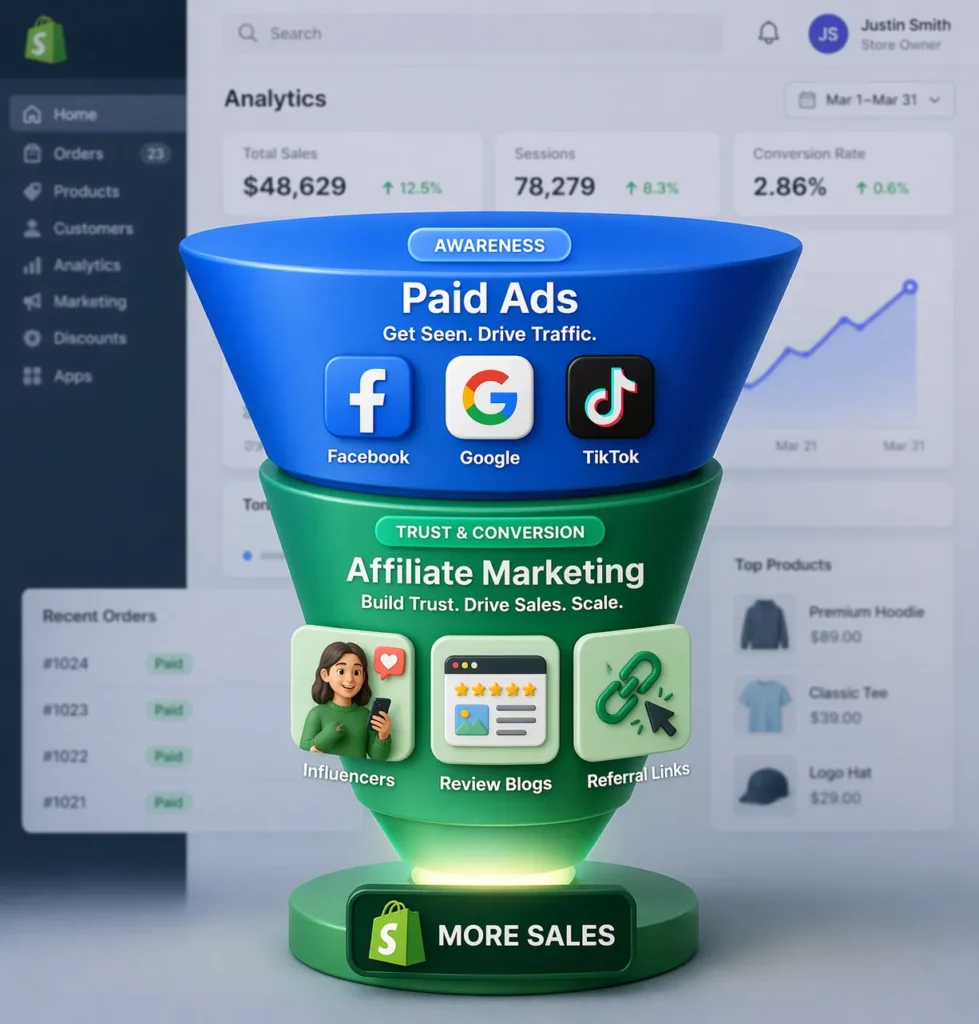
Paid ads handle awareness and immediate conversion, affiliates handle trust and sustained acquisition. And the two channels lower blended CPA when they run in parallel.
The trick is assigning each channel to the funnel stage where it wins.
Ads dominate cold-traffic reach, while affiliates dominate consideration and social proof. Forcing either to do the other’s job wastes budget.
Paid Ads: Top-of-Funnel Reach
Paid ads are the fastest way to get your product in front of people who’ve never heard of your brand. Meta and Google can put you in front of thousands of new eyeballs within hours of campaign launch.
The tradeoff is trust. Cold audiences see an ad as an interruption, not a recommendation, so conversion rates stay in the 1–2% range for most ecommerce categories.
Affiliates: Middle and Bottom-of-Funnel Trust
Affiliates slot in where ads lose leverage: the consideration phase.
A blog review, a YouTube tutorial, or a TikTok demo answers the questions a cold ad creates — “Does this actually work? Is this brand legit? What’s it like to use?”
This is why creator-driven affiliate revenue grew 51% year over year in 2025, according to Impact’s 2025 year-end report. Shoppers increasingly want validation from someone they trust before they click buy.
Let Affiliates Run Their Own Paid Ads
Some affiliates run their own paid ad campaigns. They buy Facebook or Google ads pointing at your store and earn commission only on closed sales.
The blocker is usually tracking. Affiliates running paid ads need conversion data flowing back to their ad accounts to optimize campaigns properly.
UpPromote’s Enterprise plan solves this with two tracking features. Affiliates can add their own Facebook Pixel ID to track pageviews and conversions from their affiliate link.
A Postback URL sends referral event data to trackers like Voluum or RedTrack. Affiliates get what they need to scale their ads.
The fix comes down to giving affiliates their own tracking.
With UpPromote, your affiliates can drop their Facebook Pixel ID into the dashboard and see pageviews and conversions from their affiliate link in their own Facebook Ads account.
Moreover, the Postback URL feature does the same job for affiliates using ad trackers like Voluum or RedTrack, firing conversion event data to their tracker after each referral.
Either way, affiliates get real conversion data to optimize against.
Retarget Affiliate-Driven Traffic
Not every affiliate click converts on the first visit. A shopper reads a creator’s review, clicks through, browses, and leaves without buying — standard behavior for considered purchases.
Retargeting ads close that loop.
Someone who already engaged with a trusted affiliate’s content is warmer than cold traffic. That’s why retargeted visitors convert at 20–40% higher rates than cold retargeting audiences across most ecommerce verticals.
Budget Allocation by Store Stage
The mix between paid ads and affiliate shifts as a program matures. Early on, ads carry the volume while you recruit affiliates.
As the affiliate base grows, budget shifts toward the lower-CPA channel.
| Monthly store revenue | Paid ads share | Affiliate share | Why |
| $5K–10K | 70–80% | 20–30% | Ads drive immediate sales. Affiliate program still building. |
| $10K–30K | 60–70% | 30–40% | Affiliates starting to contribute. Shift budget gradually. |
| $30K–100K | 50–60% | 40–50% | Affiliates mature enough to lower blended CPA. |
| $100K+ | 40–50% | 50–60% | Stable affiliate revenue. Reduce platform-dependency risk. |
The target for stores above $100K/month is 50–60% of marketing budget flowing through affiliate.
Not because ads stop working, but because affiliate revenue is more resilient to ad platform policy changes and CPM inflation.
Glow Collection reached 30% of total revenue from affiliates while running paid ads in parallel. The affiliate channel complemented their paid ads rather than replacing them.
Why Do Affiliate-Acquired Customers Have Higher Lifetime Value?
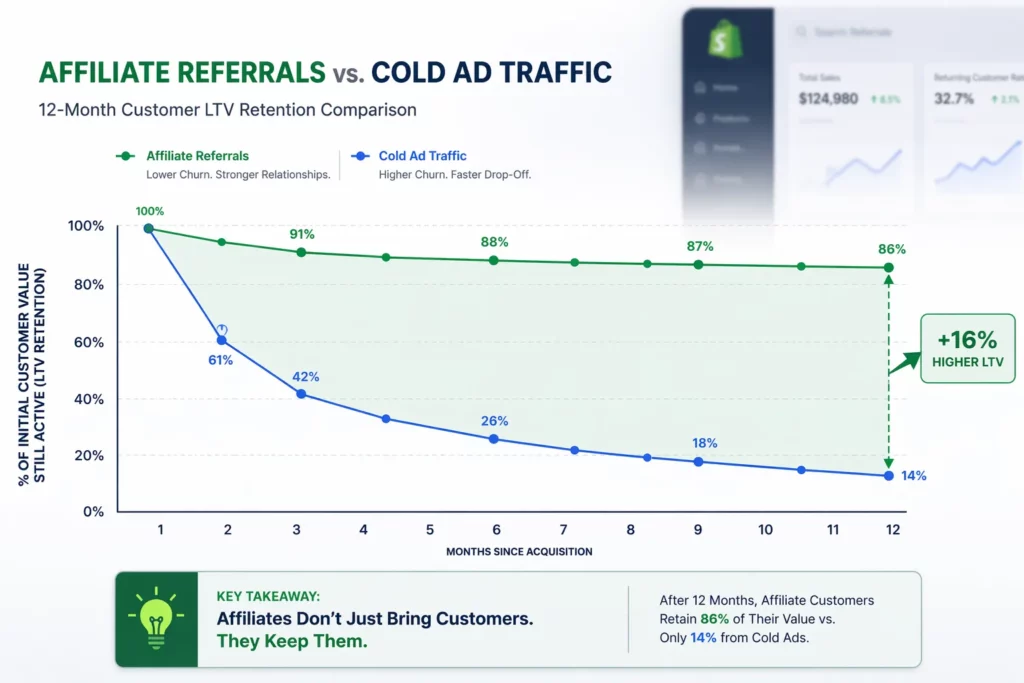
Customers acquired through affiliate and referral channels are worth 16% more over six years than customers from any other channel, according to Wharton School research on 10,000 accounts. The gap widens to 25% after adjusting for lower acquisition costs.
The same study found referred customers churn at 18% lower rates than non-referred customers. That gap persists across the full six-year period rather than eroding over time.
The mechanism is trust transfer. A customer who bought because someone they know (or a creator they follow) recommended your product starts with pre-validated expectations.
Cold ad traffic arrives skeptical. Those customers compare three alternatives before buying and defect faster when a competitor runs a better sale.
The higher-LTV pattern compounds for stores optimizing on margin rather than volume.
A $35 affiliate CPA producing $220 LTV over 12 months delivers a 6.3× return. A $25 paid ad CPA producing $140 LTV returns 5.6× on cheaper first-sale economics.
This is why first-click ROAS undersells affiliate channels. The channel’s real value shows up in repeat purchases and lower refund rates — metrics that only reveal themselves 6–12 months after acquisition.
Key Takeaway: Referred and affiliate-acquired customers have 16% higher LTV and 18% lower churn than customers from other channels. Evaluate affiliate ROI on 12-month customer value, not just first-sale CPA.
What Changed in 2026?

Paid ad economics keep tightening while affiliate and creator channels take share. The strategic gap between the two widened in 2025 and continues into 2026, which shifts how most Shopify stores should think about budget allocation for the year ahead.
Privacy updates keep eroding ad targeting. iOS and browser-level changes have cut Meta and Google retargeting precision year after year, so paid-ad CPA keeps rising while affiliate costs stay flat against revenue.
Google AI Overviews compress paid ad real estate. AI answers occupy the top of many results while Google Ads ROAS declined across 13 of 14 industries in 2025 (Triple Whale).
TikTok regulatory uncertainty makes single-platform dependency riskier. Ongoing ban debates and policy shifts in major markets mean any store relying heavily on TikTok Ads faces platform risk that affiliate channels don’t share.
Creator-affiliate hybrids keep accelerating. Creator-driven affiliate revenue grew 51% year over year through 2025 (Impact, 2025), and brands treating creators as affiliates rather than one-off sponsorships are compounding those gains into 2026.
The net effect is a widening margin advantage for diversified stores. Affiliate-anchored programs hedge against platform volatility and CPM inflation in ways pure paid ads cannot.
Frequently Asked Questions
Can affiliate marketing fully replace paid ads?
For most Shopify stores, no. Affiliate programs need 3–6 months to ramp and scale slower than paid ads, so stores needing immediate revenue still rely on ads for volume.
Restricted categories (CBD, firearms, health) sometimes run affiliate-only because ad platforms exclude them. For everyone else: run both, shift toward affiliate over time.
Which channel should a new Shopify store ($0 revenue) start with?
A new store should start with paid ads at $10–20/day to test product-market fit. Affiliate programs are hard to seed without social proof.
Reviews, sales history, and brand recognition make affiliate outreach far more effective. Once a store has 50+ monthly orders and validated product-market fit, add an affiliate program as the second channel.
If affiliate CPA is lower, why don’t all stores run affiliate-only?
Three reasons. Affiliate programs take 3–6 months to generate meaningful revenue, which is too slow for stores needing immediate cash flow.
Management is constant — recruitment, onboarding, payouts — and paid ads don’t demand it. Merchants also have less control over how affiliates describe products, which some brands can’t accept.
I’m spending $5,000/month on Facebook Ads. How much should I shift to affiliate?
A 20–30% shift is right for a $5,000/month ad spender. That means $1,000–1,500/month into affiliate setup and commissions.
Paid ads should stay on at reduced spend while affiliates ramp. After 3–6 months, push the shift to 40–50% — and watch blended CPA throughout.
How much budget do I need to test both affiliate and paid ads?
A minimum of $500–1,000/month covers both channels at a testing level. Split it $300–500 for paid ads (initial traffic) and $200–500 for affiliate setup and commissions.
At that budget, paid ads drive immediate sales while affiliate revenue emerges in months 3–4.
Which channel works better for subscription products?
Affiliate marketing typically works better for subscription products. Recurring commission models attract affiliates who stay engaged long-term because they earn on every renewal, not just the first sale.
Paid ads for subscriptions carry higher CPAs because campaigns must convince shoppers to commit to a recurring charge. That’s a harder conversion than a one-time purchase.
Subscription brands often pair affiliate programs with targeted retargeting rather than heavy cold-traffic ad spend.

Ellie Tran, a seasoned SEO content writer with three years of experience in the eCommerce world. Being a part of the UpPromote team, Ellie wants to assist Shopify merchants in achieving success through useful content & actionable insights.Ellie's commitment to learning never stops; she's always eager to gain more knowledge about SEO and content marketing to create valuable content for users. When she's not working on content, Ellie enjoys baking and exploring new places.
![How to Use Shopify Functions with Your Affiliate Program [2026 Guide]](https://static.uppromote.com/wp-content/uploads/2026/06/how-to-use-shopify-functions-with-affiliate-program-300x169.webp)

![How to Prevent Affiliate Fraud on Shopify: Self-Referral, Coupon Abuse & More [2026]](https://static.uppromote.com/wp-content/uploads/2026/06/how-to-prevent-affiliate-fraud-on-shopify-300x169.webp)