












TL;DR
Hire an affiliate manager when your program crosses 50 active affiliates or $10,000 per month in affiliate revenue — below that threshold, automation can handle most of the work.
- Hiring threshold: 50+ affiliates or $10K+/mo affiliate revenue
- Recommended first hire: Freelancer, $25–$50/hr, 3-month trial
- Full-time salary (US): $66K–$100K/year (25th–75th percentile)
- Time signal: You spend more than 8–10 hours/week on affiliate tasks
- Manager ROI: Typically 5–15% of the affiliate revenue they manage
Your first month managing affiliates feels easy. Ten partners, a few emails, one payout cycle. Two hours a week covers everything.
Six months later, though, fifty affiliates may be waiting on approvals. Emails could sit unanswered for days, and your top performer might not have been paid on time.
Recruitment stalls because there is no bandwidth left. The program is growing, yet you have become its biggest bottleneck.
Once that gap opens, the costs compound quietly. Every week without a dedicated manager can mean missed recruits, frustrated partners, and revenue that plateaus.
In practice, most Shopify merchants hit this wall somewhere between 40 and 60 active affiliates.
Fortunately, the hiring cost is proportional to what the channel generates. An affiliate marketing manager in the US earns $66,000 to $100,000 per year at the 25th–75th percentile (ZipRecruiter, 2026).
Freelancers on Upwork typically charge $25 to $50 per hour (Upwork, 2026), while agencies may run $1,500 to $5,000 per month. Either way, a well-managed program can generate several times that cost in affiliate-driven sales.
Below, we’ll walk you through when to hire, what the role involves day to day, three hiring options with cost comparisons, a copy-paste job description, eight interview questions, and a 30-day onboarding plan.
When Do You Actually Need an Affiliate Manager?
Most Shopify merchants can self-manage their affiliate program until roughly 50 active partners or $10,000 per month in affiliate revenue. Past either mark, the workload shifts from a side task into a role that needs its own person.
The shift rarely happens overnight. Instead, it follows a pattern that maps closely to program size.
| Program stage | Affiliate count | Monthly affiliate revenue | Recommended action |
| Early | Fewer than 20 | Under $5K | Self-manage with automation |
| Growing | 20–50 | $5K–$10K | Self-manage; consider a VA for admin tasks |
| Threshold | 50+ | $10K+ | Hire a dedicated manager (freelancer or part-time) |
| Scaling | 100+ | $25K+ | Full-time manager or agency |
| Mature | 200+ | $50K+ | Manager plus support staff |
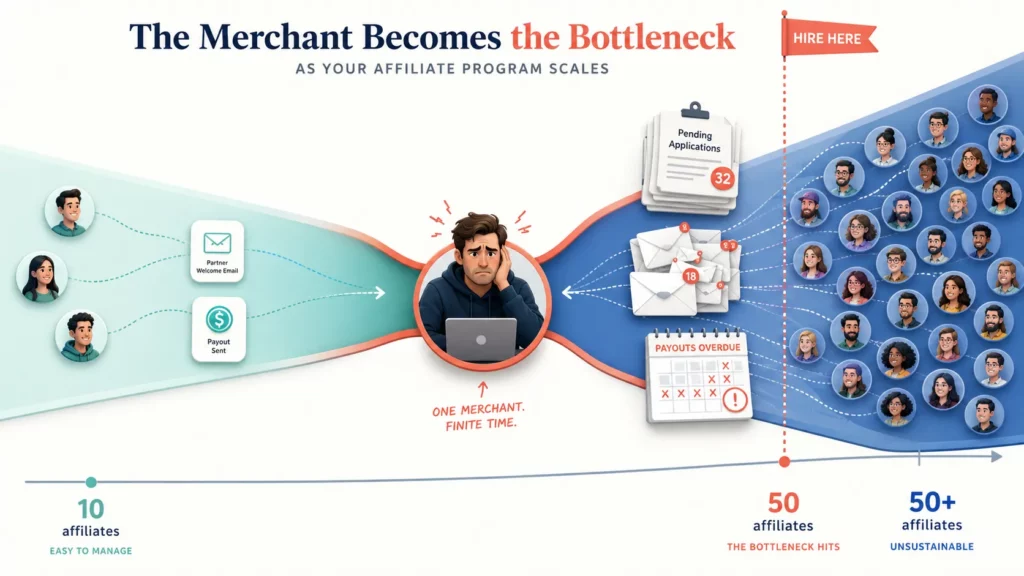
The first warning sign is usually a backlog of pending applications. When new affiliates wait five or more days for approval, many will join a rival program before you even see their profile.
As the backlog grows, data review disappears next. No one checks which affiliates need support or which ones deserve a raise. Revenue flattens even though partner count keeps climbing.
Eventually, affiliate tasks will spill into your core work. Product planning, campaign strategy, and customer support all suffer because you spend eight to ten hours a week on the program alone.
Automation can delay that tipping point, though it cannot remove it. UpPromote include a built-in analytics dashboard and scheduled PayPal auto-payouts, which may handle 60 to 70 percent of routine admin on their own.
Yet the remaining 30 to 40 percent, outreach, relationship building, and strategy, still requires a human. Once that share of the work outgrows what you can handle yourself, it is time to hire.
What Does an Affiliate Manager Actually Do?
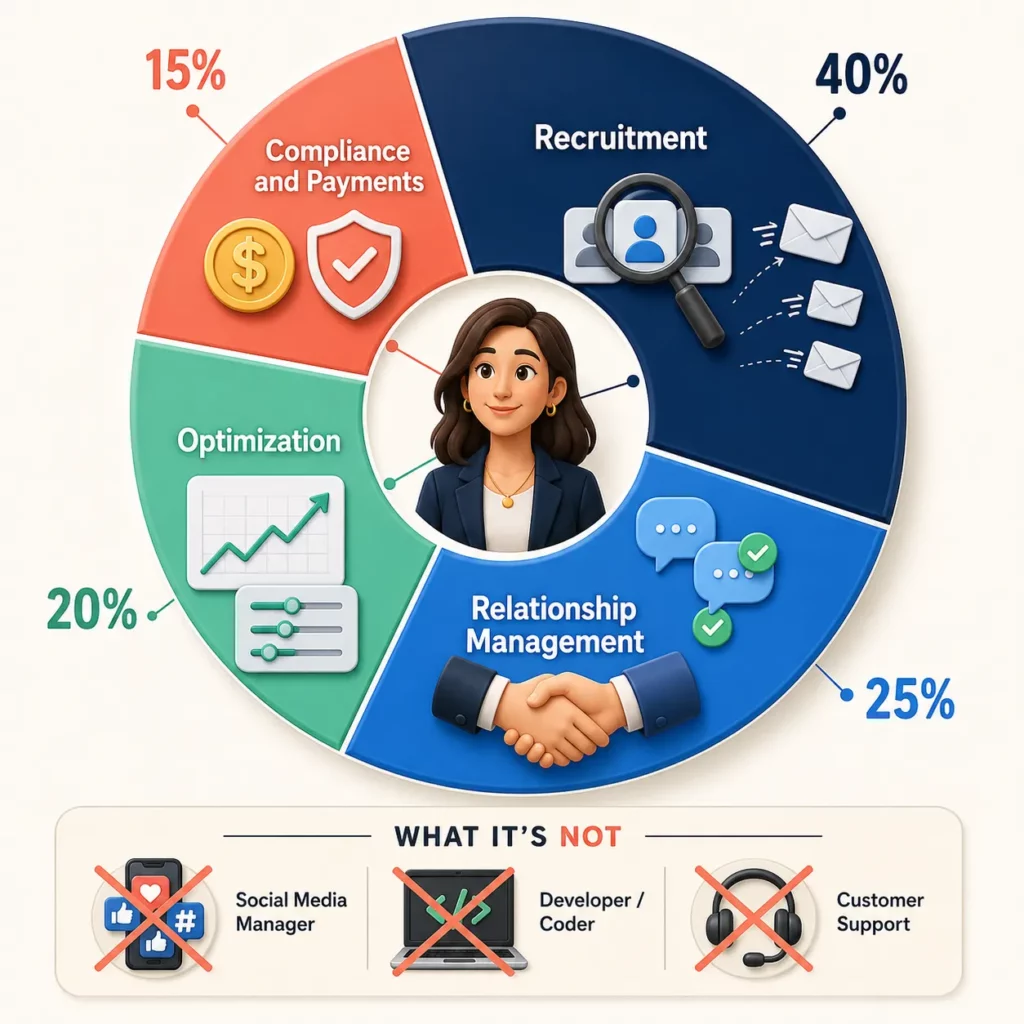
The role splits into four areas: finding new affiliates, keeping them engaged, lifting their results, and handling pay plus compliance.
How a manager divides the week will vary, yet the pattern below holds for most stores once they pass 50 partners. Each area feeds the next.
| Responsibility | Share of time | Core activities |
| Recruitment | ~40% | Outreach emails, application review, influencer sourcing |
| Relationship management | ~25% | Onboarding, check-ins, dispute handling, rewarding top performers |
| Optimization | ~20% | Performance analysis, commission testing, content suggestions |
| Compliance and payments | ~15% | Payout processing, fraud checks, FTC monitoring |
Recruitment takes the largest share because it drives growth. A strong hire will typically send 20 to 30 outreach emails per week. They vet each applicant for audience fit, not just follower count.
All of that sourcing only pays off, however, if new affiliates stay active. Regular check-ins, fast replies, and a clear way to resolve disputes can keep partners promoting month after month.
Once those relationships are stable, the next lever is data. A capable manager might review click rates, earnings per click, and conversion numbers each week.
Those patterns can then shape commission changes or creative refreshes that lift the whole program.
One common mix-up worth noting: this role is not a social media manager, a developer, or a support agent. The job is managing partner relationships, not your brand accounts, codebase, or help desk.
Should You Hire In-House, a Freelancer, or an Agency?
For most stores that just crossed the hiring threshold, a freelancer is the safest starting point.
After all, the program may not yet bring in enough revenue to justify a full-time salary. A part-time contractor lets you test the role before making a bigger commitment.
The right fit depends on your revenue stage and how much direction you can provide day to day.
| Factor | In-house (full-time) | Freelancer / contractor | Agency |
| Typical cost | $66K–$100K/year + benefits | $25–$50/hr ($2–4K/mo part-time) | $1,500–$5,000/mo retainer |
| Time commitment | Long-term salaried role | Flexible, hourly or project-based | Monthly contract |
| Availability | ~40 hrs/week dedicated | 10–20 hrs/week | Varies by retainer |
| Ramp-up time | 2–4 weeks | 1–2 weeks | ~1 week (experienced team) |
| Your involvement | Low after onboarding | Medium — ongoing direction needed | Low to medium |
| Best for | $25K+/mo affiliate revenue | $10–25K/mo affiliate revenue | $10–50K/mo, need expertise fast |
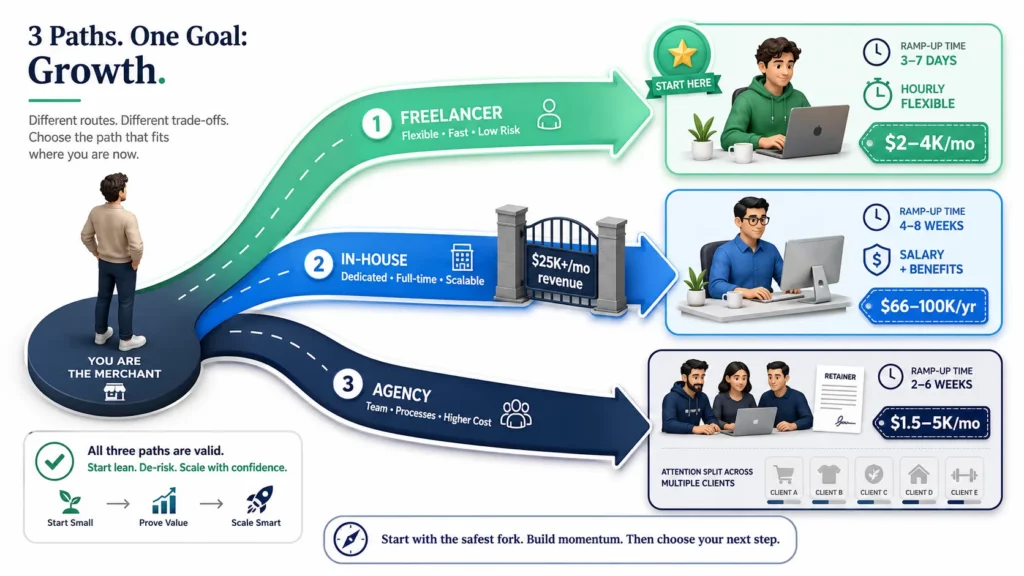
A freelancer at 10 to 20 hours per week will typically cost $2,000 to $4,000 per month. You can start with a three-month contract, set clear targets, and evaluate before extending.
Remote hiring has widened the talent pool as well. Skilled managers in Southeast Asia, Eastern Europe, and Latin America may charge $15 to $30 per hour, while still bringing solid recruitment and data skills.
At some point, though, full-time makes sense once affiliate revenue can cover the salary with room to spare. A common benchmark is five times the manager’s annual cost.
Alternatively, an agency could be the right path if you need experienced help fast and would rather skip the hiring process. Retainers run $1,500 to $5,000 per month and typically include a small team.
The trade-off is less brand closeness, since the agency divides its attention across several clients.
What Should Your Affiliate Manager Job Description Include?
A strong job posting does three things at once. It defines the scope of the role, sets targets the new hire can be measured against, and includes a screening question that filters out generalists early.
In practice, most merchant-written JDs fall short on the last two points. Phrases like “manage our affiliate program” tell applicants nothing about volume, tools, or growth goals.
Without a screening question, you may end up interviewing candidates who sound good on paper yet cannot explain how they would grow your pipeline.
The template below covers scope, targets, and a built-in filter so you can customize it and post within minutes.
Affiliate Marketing Manager — [Brand Name] [Remote / Location] · [Part-Time / Full-Time]
About us: [2–3 sentences: brand, products, mission. State current affiliate count and monthly revenue.]
Responsibilities: Recruit 15–30 new affiliates per month · Vet and approve applications within 24 hours · Onboard new partners with a welcome sequence and content kit · Maintain relationships through monthly check-ins and performance updates · Monitor data and optimize commissions, creatives, and campaigns · Process payouts accurately and on time · Ensure FTC compliance and brand guideline adherence · Report monthly on signups, active rate, revenue, and ROI
Requirements: 1–3 years in affiliate or influencer marketing · Comfortable reading dashboards and spotting trends · Strong written communication · Organized enough to manage 50–200+ relationships · Self-starter who works with minimal supervision
Nice to have: Experience in [your niche] · Familiarity with Shopify affiliate platforms · Social media sourcing skills · Basic design (Canva-level)
Compensation: [Salary range or hourly rate] · [Benefits if applicable] · Performance bonus tied to revenue growth
To apply: Send your resume plus brief answers to: (1) What is the largest affiliate program you have managed? (2) How would you recruit 20 new affiliates in your first 30 days for a [your niche] brand?
Question two in the template is the strongest single filter. Candidates who can name specific channels, sketch a timeline, and estimate results have likely run recruitment before.
Vague replies like “I would do outreach” with no detail on where or how suggest the person would need heavy coaching from day one.
What Interview Questions Reveal the Right Affiliate Manager?
The best interview questions probe four skills at once: recruiting, vetting, problem-solving, and reading data. A single well-framed question can surface more than one of these.
The eight questions below are grouped by what they test, along with what a strong answer tends to include.
| Question | What it tests | Strong answer signal |
| Walk me through how you would recruit 20 affiliates in your first 30 days. | Strategy and speed | Names specific channels, sets a realistic timeline |
| How do you decide whether an affiliate is worth approving? | Vetting judgment | Mentions engagement rate and audience overlap, not just follower count |
| An affiliate’s coupon code leaked on a browser extension. What do you do? | Problem-solving | Deactivate code, issue a new one, notify the affiliate, adjust tracking |
| A top performer asks for a higher commission. How do you respond? | Negotiation and retention | Asks for data first, then discusses a tiered structure |
| How would you re-activate affiliates who stopped promoting? | Retention and creativity | Check-in email, fresh product samples, bonus incentive, new content ideas |
| What metrics do you review each week? | Data literacy | Clicks, conversion rate, earnings per click, active rate, revenue per affiliate |
| Tell me about a program you scaled. Share the numbers. | Track record | Specific growth figures: “X to Y affiliates, $A to $B revenue in Z months” |
| Have you used UpPromote or another Shopify affiliate app? | Platform readiness | Any Shopify app experience signals a fast ramp-up |
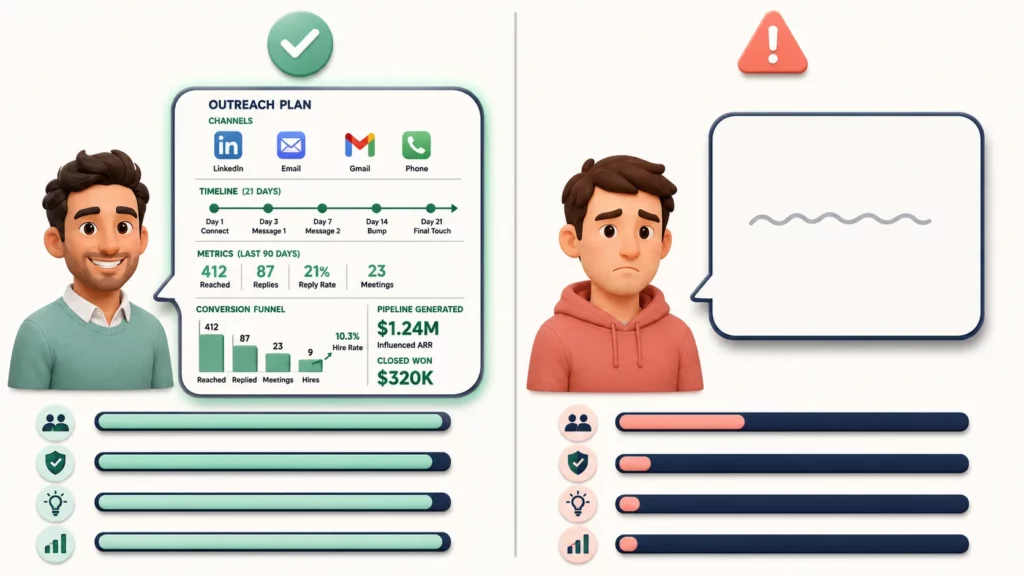
Across all eight, one pattern sets strong hires apart. Seasoned managers give specifics: channel names, timelines, metrics, dollar figures.
Weaker candidates, by contrast, fall back on broad claims like “I would do outreach” or “I managed many affiliates” without any detail to back them up.
The clearest red flag, though, is someone who can only talk about finding new partners. If they have nothing to say about keeping affiliates active, reviewing data, or staying compliant, the role may be too broad for them.
Where Do You Find Qualified Affiliate Manager Candidates?
Where you search depends on which path you chose. Freelancer channels differ from full-time job boards, and agencies have their own discovery process.
The channels below are ranked roughly by how well they match each hiring model.
| Channel | Best for | Cost to post | Candidate quality |
| Upwork | Freelancers | Free | Medium-high (filter by reviews and success score) |
| LinkedIn Jobs | Full-time and freelance | Free–$300 | High (professional profiles) |
| Fiverr Pro | Freelancers | Free | Medium (vet carefully) |
| Indeed | Full-time roles | Free–$500 | Medium |
| Affiliate communities | Targeted niche hires | Free | High (industry-specific) |
| Agencies (e.g., Acceleration Partners) | Managed service | $1,500–$5K/mo | High (expert teams) |
| Referrals from other merchants | Warm leads | Free | Highest |
If you are starting with a freelancer, Upwork tends to offer the best mix of volume and filtering tools.
Search “affiliate marketing manager,” then narrow by rate ($25–$50 per hour), job success score (90 percent or above), and total hours logged (100-plus). Profiles with reviews that mention “recruitment” or “affiliate manager” are worth a closer look.
What Should Your Affiliate Manager Deliver in the First 30 Days?
A new manager’s first 30 days should follow three phases: understand the current program, fix what is broken, and then start growing. Setting these milestones upfront can give you a clear way to judge whether the hire is working.
The timeline below breaks each phase into outputs you can check off together.
| Phase | Timeframe | Key deliverables |
| Understand | Week 1 | Full program audit, top-10 and bottom-10 affiliate lists, commission structure review, overdue payment log |
| Fix | Week 2 | All overdue payments cleared, pending applications answered within 24 hours, personal outreach to top performers |
| Grow | Weeks 3–4 | 20–30 outreach emails per week, registration page refresh, monthly reporting template, 10–15 new signups |
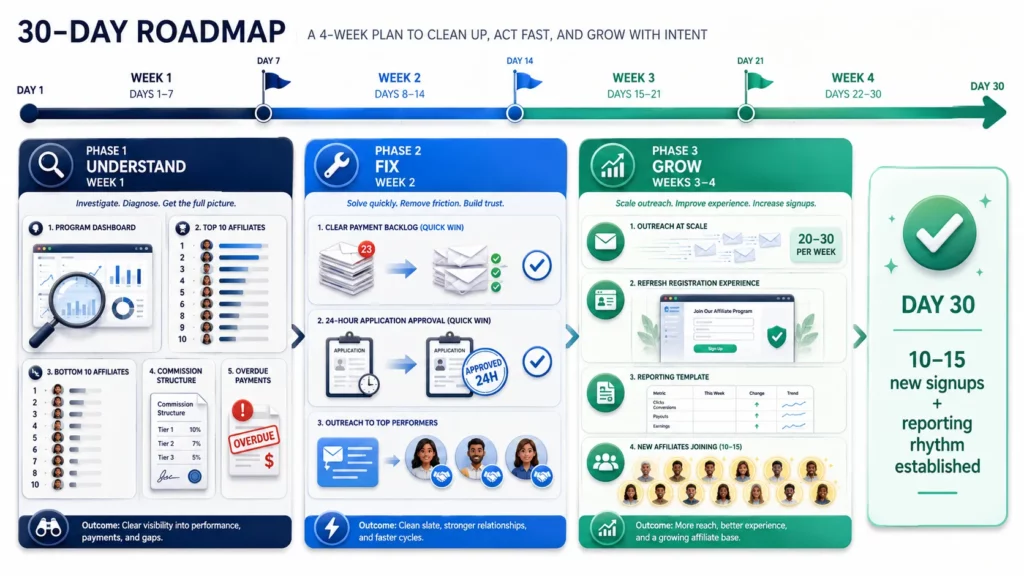
The first week is purely about learning.
Your new hire should review every active affiliate, audit the commission structure, flag overdue payments, and identify the top ten and bottom ten performers.
Week two shifts to quick wins that affiliates will notice right away.
Clearing a payment backlog, answering pending applications, and reaching out to top performers all send the same signal: someone is now paying attention.
From there, weeks three and four are where recruitment begins in earnest.
With the audit done and relationships refreshed, the manager can launch outreach and tighten the registration page.
By day 30, you should see 10 to 15 new affiliate signups and a monthly reporting rhythm in place.
Frequently Asked Questions
Should I hire an affiliate manager before reaching 50 affiliates?
Usually not. Below 50 affiliates, automation can handle tracking, payouts, and basic reports. You may only need two to five hours a week. If even that time is tight, a part-time virtual assistant can cover the admin work.
Does an affiliate manager need Shopify experience?
Preferred but not required. Knowing Shopify helps because the manager already gets how orders, discounts, and checkout work. Someone with solid affiliate skills but no Shopify background can pick it up within a week.
Should I hire in-house or start with a freelancer?
Start with a freelancer on a three-month trial at roughly $2,000 to $4,000 per month. If the results are strong, you can convert the role to full-time. If not, ending a freelance contract is far simpler than unwinding a salaried position.
How much does an affiliate manager cost?
Full-time managers in the US typically earn $66,000 to $100,000 per year. Freelancers charge $25 to $50 per hour, and agencies run $1,500 to $5,000 per month. A useful rule is to keep total cost at or below 15 to 20 percent of the affiliate revenue they manage.
Who should the affiliate manager report to?
In most setups, the manager reports to the marketing lead or, in smaller stores, the founder. A weekly check-in plus a monthly report on new signups, active rate, and total revenue is usually enough to stay aligned.
What if I cannot afford to hire an affiliate manager yet?
Three options can help. A virtual assistant at $5 to $15 per hour can handle payments and applications while you own the strategy. You could also maximize your platform’s automation for tracking and payouts, or assign affiliate tasks to a current team member part-time.

Ellie Tran, a seasoned SEO content writer with three years of experience in the eCommerce world. Being a part of the UpPromote team, Ellie wants to assist Shopify merchants in achieving success through useful content & actionable insights.Ellie's commitment to learning never stops; she's always eager to gain more knowledge about SEO and content marketing to create valuable content for users. When she's not working on content, Ellie enjoys baking and exploring new places.
![How to Use Shopify Functions with Your Affiliate Program [2026 Guide]](https://static.uppromote.com/wp-content/uploads/2026/06/how-to-use-shopify-functions-with-affiliate-program-300x169.webp)

![How to Prevent Affiliate Fraud on Shopify: Self-Referral, Coupon Abuse & More [2026]](https://static.uppromote.com/wp-content/uploads/2026/06/how-to-prevent-affiliate-fraud-on-shopify-300x169.webp)