












TL;DR
Most DTC Shopify brands start affiliates at 10–15% per sale or $10–$15 flat for new-customer orders, then tier up top performers.
- Industry range: Fashion 10–20%, beauty 15–25%, supplements 20–40%, electronics 3–8%
- Margin formula: Net profit margin × 30–50% = max affordable commission
- 5 commission types: Percentage, flat, tiered, product-specific, new-customer
- Cookie default: 30 days, adjusted by product decision cycle
- Minimum margin: 20%+ net to support a standard 10–15% rate
Commission rate is the single biggest lever in your affiliate program. Too low and no one signs up. Too high and every sale cuts your margin.
The sweet spot sits between — but where depends on your industry, your margin, and how long your buying cycle runs.
Most DTC brands anchor to 10–15% per sale or $10–$15 flat for new-customer orders (ReferralCandy, 2026). That range is a starting point, not a rule.
A beauty brand on 75% margins can afford 20%. An electronics store on 25% margins cannot.
This guide covers 2026 benchmarks across 10 Shopify industries, a margin-based calculator, all five commission structures, tiered examples from real stores, and a cookie duration guide.
What Is an Affiliate Commission Rate (And Why It Matters)?
An affiliate commission rate is the amount you pay an affiliate for every sale they drive — a percentage of revenue (like 15%) or a flat fee (like $10 per order).
That single number decides three things: which affiliates join your program, how hard they push your products, and whether the program stays profitable once sales start coming in.
Quality of affiliates you attract. Top affiliates compare programs before signing up. Offer 5% when the niche average is 15%, and the best partners join a competitor instead.
How hard they promote. Active affiliates run 3–5 programs at once and allocate effort toward whichever pays most for similar work. Your rate is your priority score inside their workflow.
Program profitability. Commission too high loses money per sale. Too low and nobody drives volume. The gap is where your program lives or dies.
Here’s how each commission level plays out for affiliates and for your margin.
| Commission Level | Affiliate Response | Business Outcome |
| Too low (<5%) | Few signups, minimal effort | Program stalls |
| Competitive (10–20%) | Steady signups, active promotion | Sustainable growth |
| Too high (>30%) | Many signups, some low-quality | Margin risk, coupon abuse |
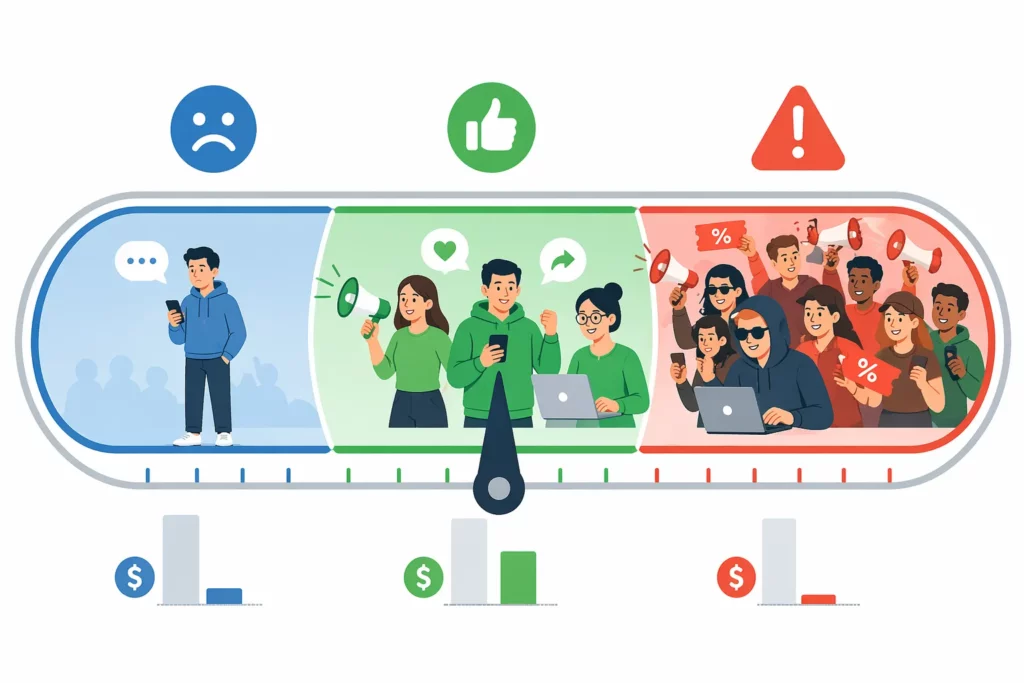
Key Takeaway: Commission rate is the single biggest lever in your affiliate program. The rest of this guide helps you find the exact number that works for your margins and your industry.
How Do You Calculate Your Maximum Affordable Commission Rate?
Your maximum commission comes from one formula: net profit margin × 30–50% = max affordable commission rate. You’re sharing profit, not revenue.
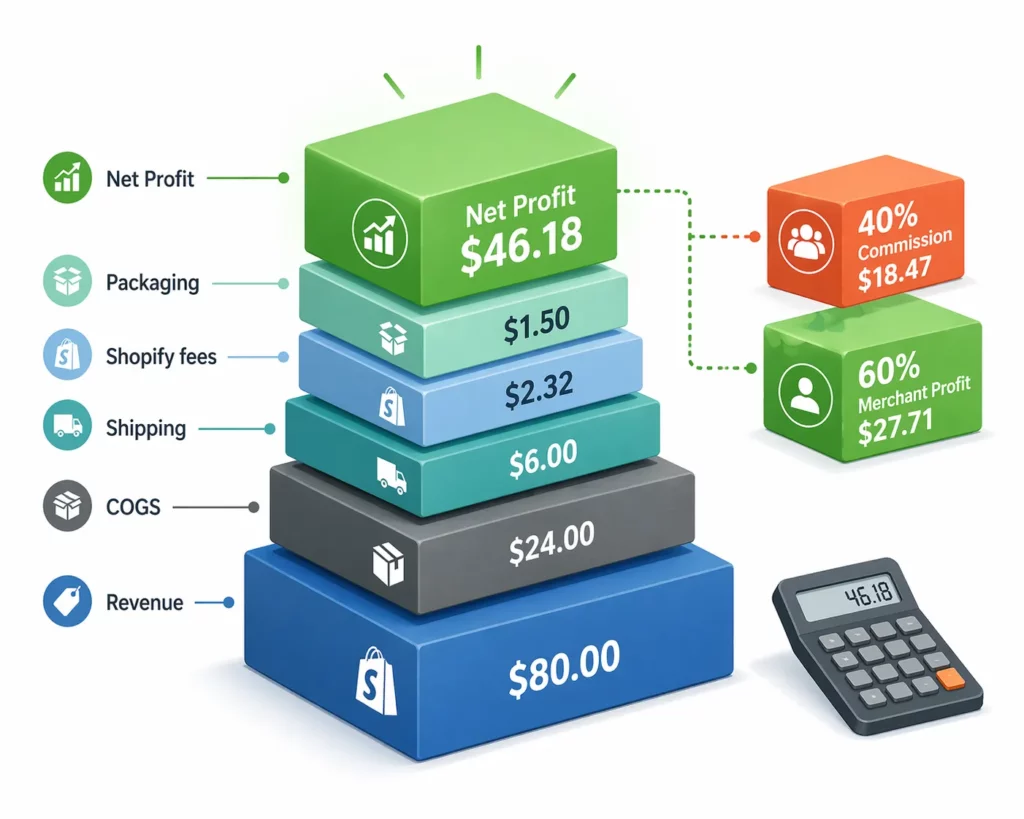
That distinction matters. A $80 product doesn’t mean $80 of profit. After COGS, shipping, Shopify fees, and packaging, the actual profit is half the price tag or less.
STEP 1 — Net Profit Per Order
Revenue: $80
– COGS: –$24
– Shipping: –$6
– Shopify fees (~2.9%): –$2.32
– Packaging: –$1.50
NET PROFIT: $46.18 (57.7% margin)
STEP 2 — Commission Budget (30–50% of net profit)
Conservative (30%): $46.18 × 30% = $13.85 → ~17% of $80
Balanced (40%): $46.18 × 40% = $18.47 → ~23% of $80
Aggressive (50%): $46.18 × 50% = $23.09 → ~29% of $80
STEP 3 — Factor in Affiliate Discount
15% discount to customer: –$12 → adjusted revenue $68
Adjusted net profit: $34.53
Balanced commission (40%): $13.81 → ~17% of original $80
TOTAL COST PER AFFILIATE SALE:
Discount $12 + Commission $13.81 = $25.81 (32.3% of revenue)
The quick reference below converts any margin into a safe commission range. Find your net margin row and pick the column that fits your growth stage.
| Net Profit Margin | Conservative (30%) | Balanced (40%) | Aggressive (50%) |
| 30% | 9% | 12% | 15% |
| 40% | 12% | 16% | 20% |
| 50% | 15% | 20% | 25% |
| 60% | 18% | 24% | 30% |
| 70% | 21% | 28% | 35% |
ReferralCandy’s 2026 commission guide echoes the same principle: start with profit, not revenue. Set a cap so commissions never push the order negative.
There are two traps here.
First, stacking a customer discount on a commission doubles your cost per sale — $12 discount plus $13 commission gives up 32% of the order, not 17%.
Second, paying commission on sale items turns every referred order into a net loss. Exclude discounted SKUs from commission.
Apps like UpPromote let you set diverse tiered commissions on order value — set different rates for orders under $100 vs. over $500 in program settings.
What Are the Average Affiliate Commission Rates by Industry? [2026 Shopify Benchmarks]
Commission rates vary across Shopify categories. Beauty brands often pay 15–25%, fashion sits at 10–15%, electronics stays at 3–8%, and supplements can run up to 40%.
The spread reflects how much margin each category carries and how long the customer stays with you after the first purchase.
The 10 industries below cover the most common Shopify categories, with rates anchored to 2026 platform data from ReferralCandy, Impact, and Post Affiliate Pro.
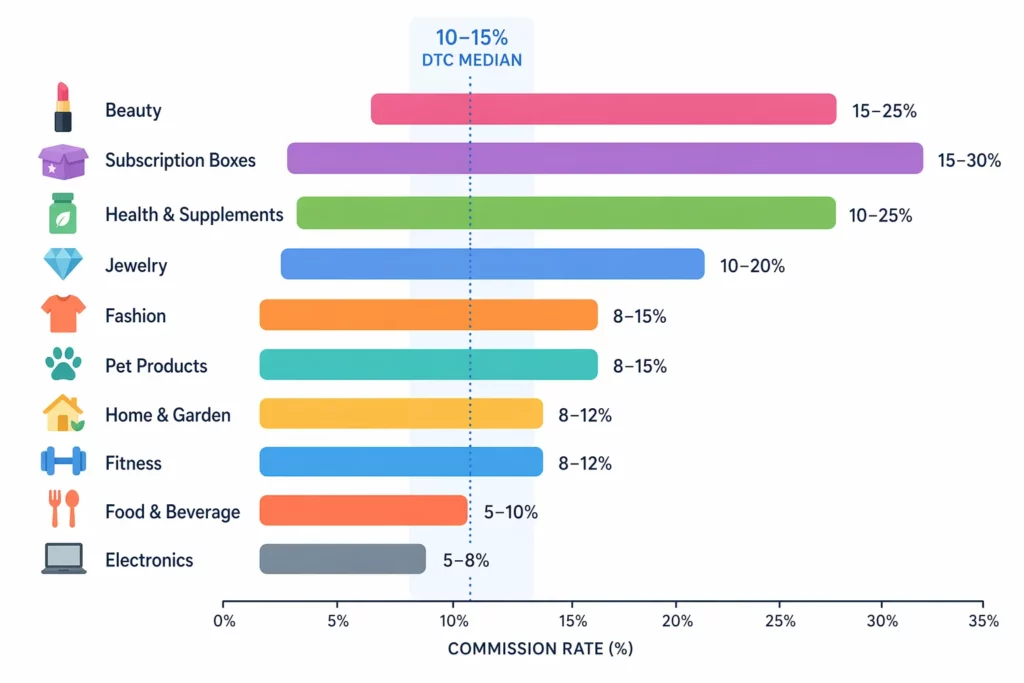
| Industry | Commission Range | Typical Median | Customer Discount | Cookie Window | Why the Range |
| Fashion & Apparel | 8–15% | 12% | 10–15% | 30 days | Margins 50–70%, seasonal cycles |
| Beauty & Skincare | 12–20% | 15% | 10–20% | 30 days | High margins, strong repeat purchase |
| Health & Supplements | 10–25% | 15% | 15–25% | 30–60 days | Subscription LTV justifies higher payouts |
| Electronics & Gadgets | 5–8% | 6% | 0–5% | 14–30 days | Margins 15–30%, high AOV |
| Food & Beverage | 5–10% | 8% | 10–15% | 14–30 days | Mid margins, repeat orders |
| Home & Garden | 8–12% | 10% | 10% | 30 days | Margins 50–60%, considered purchase |
| Pet Products | 8–15% | 12% | 10–15% | 30 days | Subscription-friendly, loyal buyers |
| Fitness & Sports | 8–12% | 10% | 10% | 30 days | Mid-margin, moderate AOV |
| Jewelry & Accessories | 10–20% | 12% | 10–15% | 30–60 days | High AOV, longer decision cycles |
| Subscription Boxes | 15–30% | 20% | First-box deal | 30–60 days | High LTV offsets higher first-order payout |
Sources: ReferralCandy 2026 commission guide , ReferralCandy LTV-based commission data , Post Affiliate Pro 2025 industry rates .
Why the numbers differ so much
The “Why the Range” column in the table points to the same driver in every row: gross margin.
High-margin categories can afford high rates. Beauty and skincare run on 70–80% gross margins, which supports 15–20% commissions.
Electronics runs on much tighter margins — often 15–30% — so even a 5% commission takes a meaningful bite (ReferralCandy LTV guide, 2025 ).
Subscription businesses justify higher first-order rates. A customer worth $240 over 6 months makes a $10 upfront commission — 25% of a $40 first order — look cheap. That’s why supplement and subscription-box programs pay 20%+ without breaking.
High-ticket flips the percentage math. On a $500 electronics order, 5% pays $25 per sale. On an $80 fashion order, 15% pays $12.
The electronics affiliate earns more per sale despite the lower percentage. That’s why low-margin high-ticket categories still attract affiliates.
How to use these benchmarks
Knowing why rates differ is step one — the next step is checking whether your margin supports the median.
Find your industry row, note the median, and run the margin calculator from Section 2. If the output exceeds the median, start at the median. If it falls short, exclude low-margin SKUs before the rate works.
What Are the 5 Main Types of Affiliate Commission Structures?
Five commission structures cover every scenario a Shopify store will run into: percentage of sale, flat fee, tiered, product-specific, and new-customer-only.
Most mature programs combine two or three — a percentage base layered with product-specific overrides, for example, plus tiers for top performers.
Over 80% of affiliate programs use cost-per-sale as the primary model (Post Affiliate Pro, 2025 ). Flat fees and hybrids layer on for specific use cases.
The table below maps each structure to the situation it fits best.
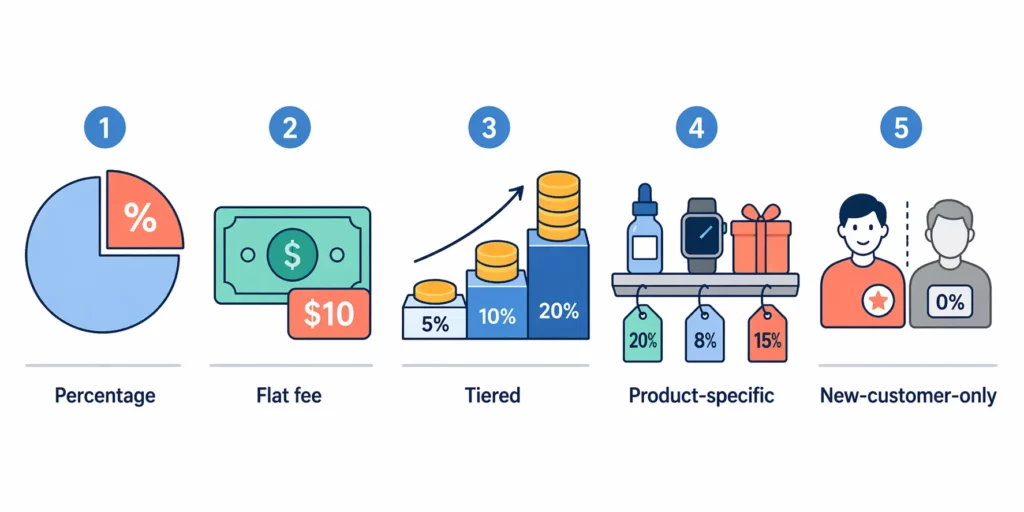
| Type | How It Works | Best Fit | Example |
| Percentage (CPS) | Affiliate earns X% of each order | Most DTC stores, default choice | 15% of $80 order = $12 |
| Flat fee (CPA) | Fixed $ per qualifying order | Consistent AOV, first-order bonuses | $10 per new-customer order |
| Tiered | Rate climbs as affiliate hits milestones | Motivating long-term performers | 10% → 15% → 20% by monthly sales |
| Product-specific | Different rate per product or collection | Mixed-margin catalogs | Skincare 20%, accessories 8% |
| New-customer-only | Higher rate on first-time buyers only | Acquisition-focused programs | 20% new, 0% repeat |
The table above gives the overview — the real question is which structure matches the problem your store has: wide AOV swings, mixed margins, or retention dropping.
Percentage (the default starting point). Easy to understand, scales with AOV, and works across every affiliate type.
It struggles only when order value swings wildly — $20 accessory orders alongside $500 bundles — because a flat rate over-rewards cheap orders and under-rewards big ones.
Flat fee. Predictable cost and often more attractive on high-ticket items — a $25 flat fee on a $200 order beats a 5% commission that pays $10. Flat fees also work as first-order bonuses on top of a percentage base.
Tiered. The strongest lever for retaining active affiliates. Clear progression (10% → 15% → 20%) gives top performers a reason to keep scaling rather than splitting attention across competitors.
Product-specific. A must-have for any store with variable margins across categories. Charging 15% on a skincare serum with 80% margin makes sense; the same 15% on a 30%-margin tool does not.
New-customer-only. The right choice when your returning-customer rate is high and acquisition cost matters more than repeat-purchase commissions.
Paying 20% on first orders and 0% on returns concentrates spend where the affiliate moved the needle.
UpPromote supports all five commission structures . Auto tier commission handles milestone upgrades, Special product commission overrides rates per collection, and New customer commission detects first-time buyers.
How Do You Build a Tiered Commission Structure That Motivates Affiliates?
A tiered commission structure raises the rate at defined milestones — for example, 10% on the first 20 monthly sales, 15% at 21–50, and 20% above 50.
The structure gives new affiliates a starting point and gives top performers a reason to keep scaling instead of switching to a competitor.
The three designs below show how tiering plays out at different price points and program stages.
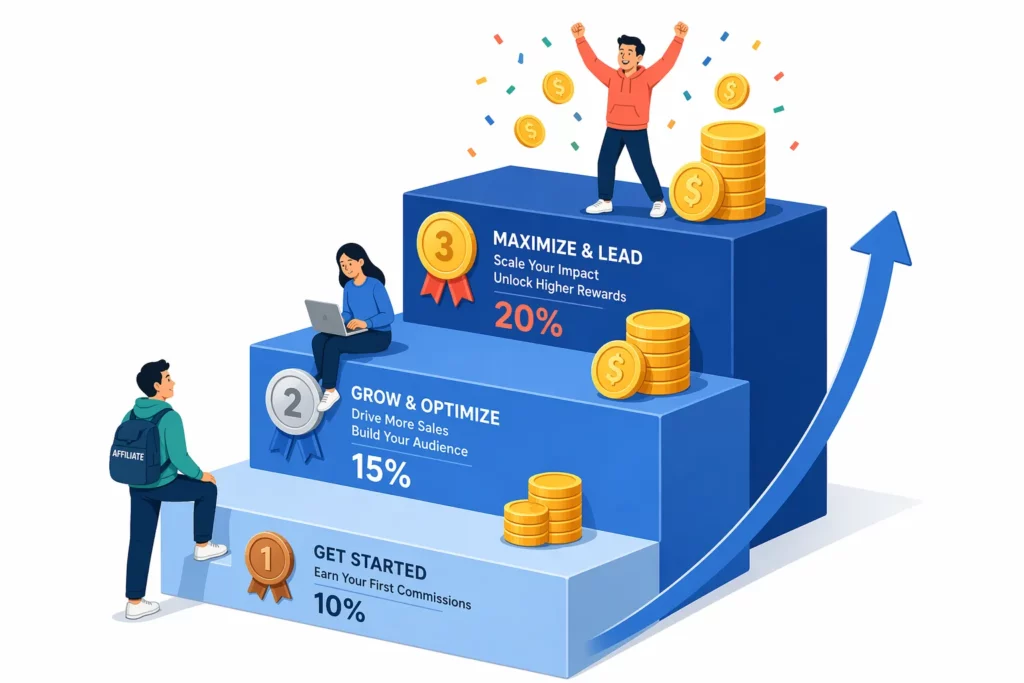
Design A: Simple 3-Tier (Standard DTC Store)
| Tier | Monthly Sales | Commission |
| Bronze | 1–20 | 10% |
| Silver | 21–50 | 15% |
| Gold | 51+ | 20% |
Best for stores just adding tiers. The 5-point jumps give affiliates a clear reason to push past each threshold.
Design B: 4-Tier with Performance Rewards (Beauty Brand)
Adding a fourth tier and non-monetary perks turns a simple rate ladder into a retention tool — affiliates stay because the relationship grows, not just the percentage.
| Tier | Monthly Sales | Commission | Extras |
| Starter | 1–10 | 15% | — |
| Rising | 11–30 | 20% | Free products |
| Pro | 31–75 | 25% | Products + early access |
| Elite | 76+ | 30% | Products + exclusive collection access |
GoldieLocks , a beauty brand, runs this model live — 15% base for salon affiliates, up to 25% for top performers.
The program has 2,900 active affiliates, and the top affiliate has driven 1,000+ orders at the 25% rate (UpPromote case study).
Design C: Revenue-Based (High-Ticket Store)
When unit prices vary from $50 to $2,000, counting orders is the wrong metric — revenue-based tiers shift the milestone to total dollar value instead.
| Tier | Monthly Revenue | Commission |
| Base | $0–$2K | $15 flat per order |
| Growth | $2K–$5K | $20 flat |
| Premium | $5K–$10K | $25 flat |
| VIP | $10K+ | $30 flat + 5% revenue bonus |
Revenue-based tiers reward total value delivered, not just order count — a better fit for catalogs where AOV varies.
When Should You Use Special Product Commission Rates?
Special product commission overrides the default rate for specific products or collections.
If margin varies by more than 20 points across your catalog, one blanket rate either bleeds margin on low-margin SKUs or under-pays affiliates on high-margin ones.
A mixed-margin beauty catalog shows the logic. A $65 serum with 75% margin can sustain a 20% commission; a $120 skincare tool with 35% margin cannot.
The table below maps a realistic skincare catalog to the commission each SKU category can afford.
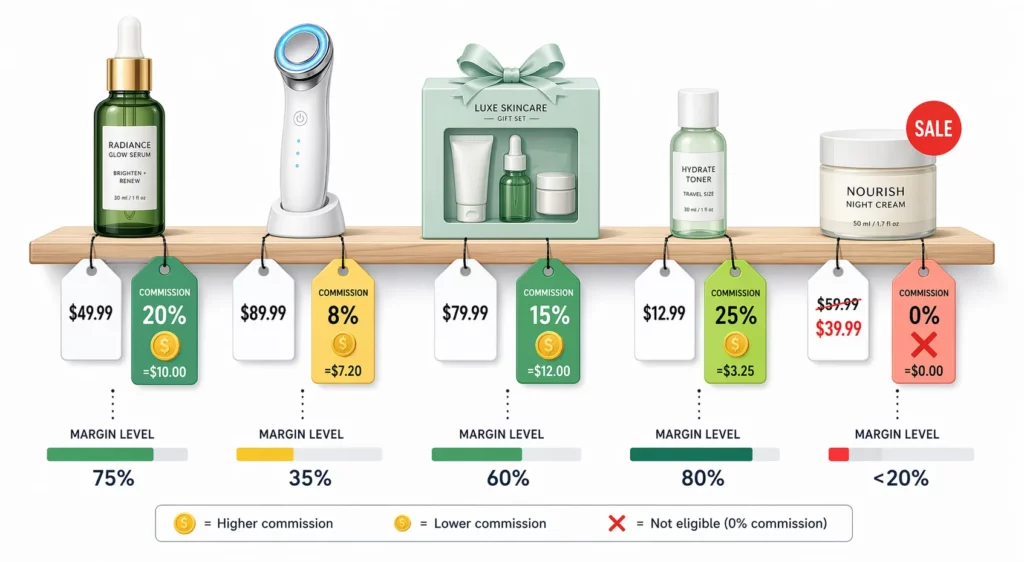
| Collection | Avg Price | Net Margin | Commission | Affiliate Earns |
| Skincare Serums | $65 | 75% | 20% | $13.00 |
| Skincare Tools | $120 | 35% | 8% | $9.60 |
| Gift Sets | $85 | 60% | 15% | $12.75 |
| Travel Sizes | $25 | 80% | 25% | $6.25 |
| Sale Items | Varies | <20% | 0% (excluded) | $0 |
Altenew , a craft and stationery brand, runs this exact approach. Alongside tiered commissions and a centralized media gallery, the brand sets special commissions for specific products and collections.
Affiliates now contribute 15–25% of total revenue, with 25,000 orders tracked in the program’s first year .
Should You Pay Affiliates on New Customers Only or Every Order?
New-customer-only commission pays affiliates a higher rate on first-time buyers (15–25%) and either a reduced rate or 0% on returning customers.
The model fits stores with strong repeat-purchase rates. Returning customers buy again whether or not an affiliate is involved — paying full commission on them overspends on acquisition the affiliate didn’t drive.
New-customer-only isn’t the only option, though. Most stores land somewhere on the spectrum between full commission on every order and zero on repeats.
The following table shows the three models and where each fits.
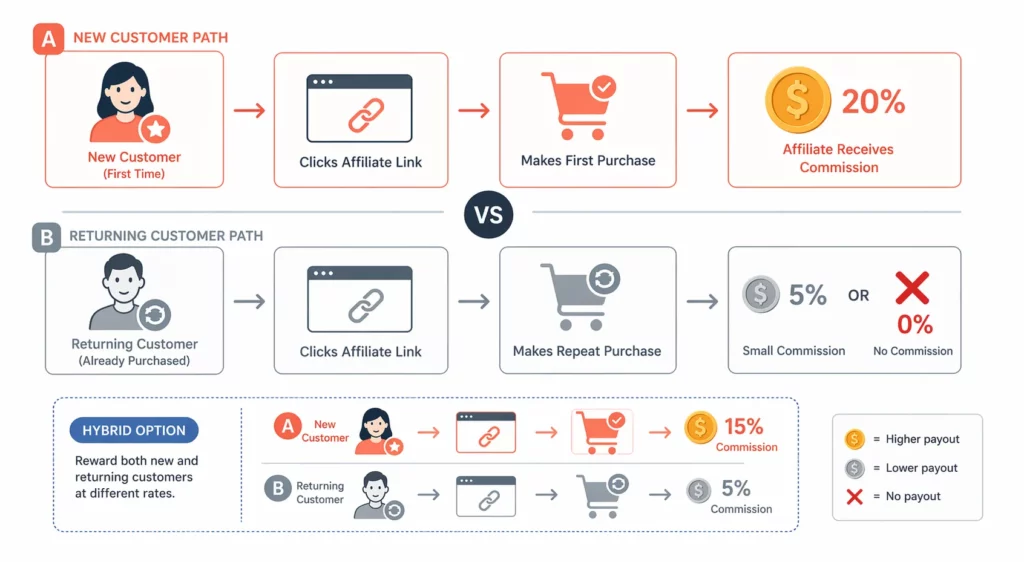
| Model | How It Works | Pros | Cons | Best For |
| All orders | Same rate on every order from affiliate’s customers | Simple, affiliates earn more | Pays for repeat purchases that would happen anyway | Low repeat-purchase stores |
| New customer only | Commission only on first-time buyers | Acquisition spend stays tight | Affiliates earn less lifetime value | High repeat + strong LTV |
| Hybrid (recommended) | High rate on new, reduced on returning | Balances acquisition and retention | More complex to explain | Most DTC stores |
A hybrid — say, 20% on new and 5–10% on returning customers — is what most growth-stage Shopify brands settle on. Affiliates keep upside on repeat orders without overpaying for already-loyal customers.
ReferralCandy’s 2026 commission guide confirms the pattern.
Many DTC merchants bias payout toward first-order acquisition, which attracts creators who add real reach rather than coupon harvesters.
A related model works the opposite way: Lifetime commission pays the affiliate on every future order from customers they referred, rewarding long-term relationships rather than pure acquisition.
How Long Should Your Affiliate Cookie Duration Be?
Cookie duration is the window of time after an affiliate click during which a purchase still earns commission for that affiliate.
The industry default is 30 days, which captures 93–98% of conversions in most ecommerce programs .
The right window depends on how long your customers take to decide. Impulse products need short windows; high-ticket products need long ones.
Getting this wrong silently breaks affiliate trust — they see clicks without commissions and assume your tracking is broken.
The table below maps typical buying cycles to recommended cookie windows.
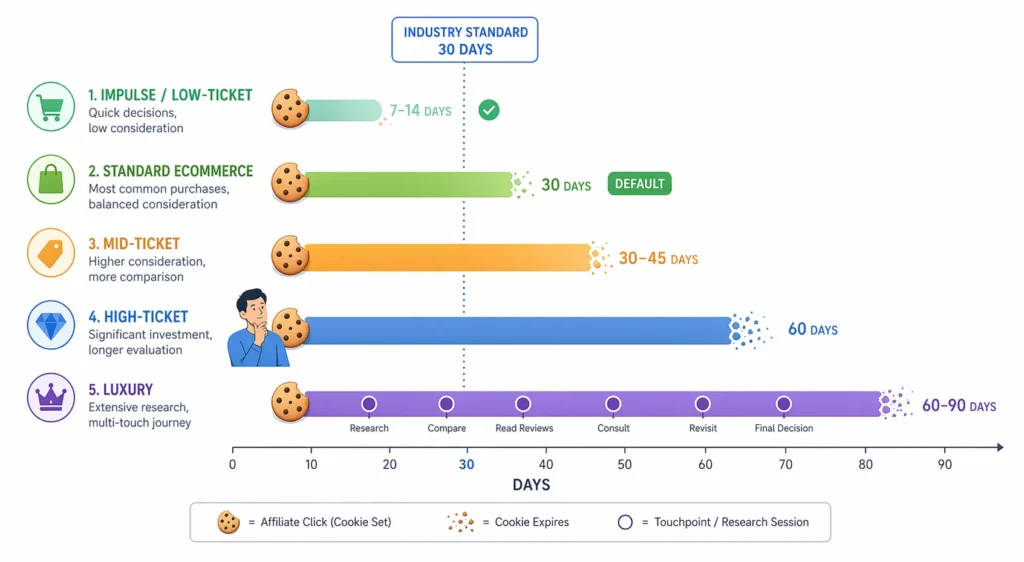
| Product Type | Price Range | Typical Decision Cycle | Recommended Cookie |
| Impulse / low-ticket | Under $30 | Minutes to hours | 7–14 days |
| Standard ecommerce | $30–$100 | 1–7 days | 30 days (default) |
| Mid-ticket | $100–$200 | 3–14 days | 30–45 days |
| High-ticket | $200–$500 | 1–4 weeks | 60 days |
| Luxury | $500+ | 2–8 weeks | 60–90 days |
| Subscription | $20–$60/mo | 1–2 weeks | 30–45 days |
Why 30 days became the default
The table above recommends 30 days for the three largest categories, and that convergence isn’t accidental. Conversion data across affiliate networks shows most purchases close inside a 30-day window.
Extending to 60 or 90 days provides diminishing returns — you capture a few more conversions but significantly inflate commission costs.
Amazon Associates runs the shortest commercial window at 24 hours, and the cost is measurable.
Industry analysis suggests that short window costs affiliates roughly 35% of potential commissions compared to a 30-day cookie — and the gap grows on products over $100.
Cookie tracking in 2026
The tracking layer itself has shifted.
Safari and Firefox block third-party cookies by default, so most platforms now use first-party cookies, server-side tracking, and coupon-code backup attribution.
Cookie duration still matters, but it’s no longer the only attribution layer you should depend on.
Key Takeaway: Start at 30 days unless your product data justifies a shorter or longer window. Never drop below 14 days for anything non-impulse. A competitive cookie window, 45 to 60 days on considered purchases, is one of the cheapest ways to attract better affiliates.
What Commission Structures Do Real Shopify Stores Use?
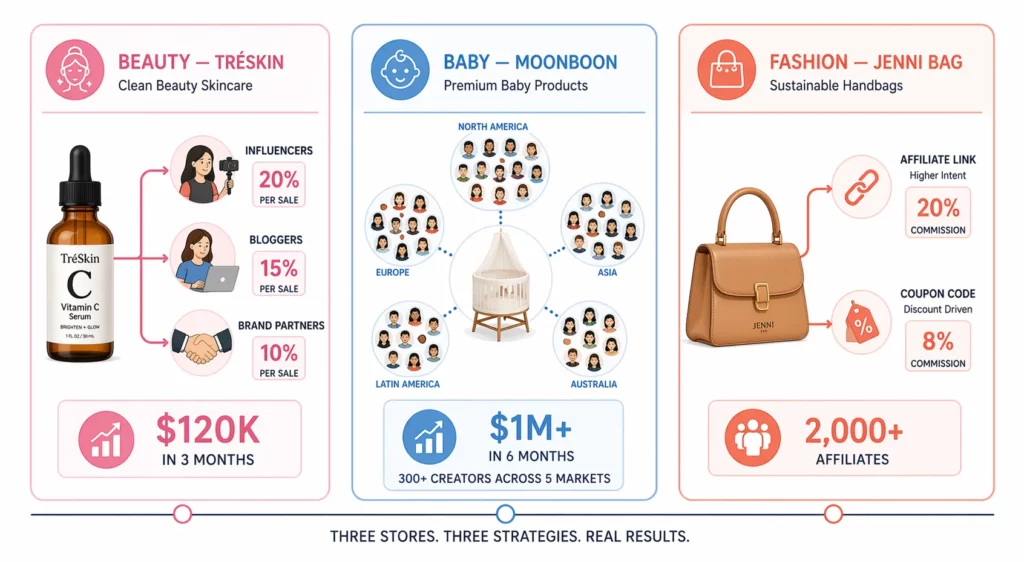
The three real Shopify programs show how these concepts combine in practice.
Different industries, different sizes, but all three built their structure around margin math first and affiliate motivation second.
Example 1: TréSkin (Beauty & Skincare)
TréSkin , a Shopify skincare brand, runs a segmented program that creates different commission programs for different affiliate groups — separating lifestyle influencers from long-term brand partners.
| Element | Setup |
| Commission model | Segmented programs per affiliate group |
| Recruitment | UpPromote Marketplace listing |
| Result | $120,000 in affiliate revenue within 3 months |
TréSkin’s core move: matching commission rates to each affiliate segment rather than running one flat structure (UpPromote case study).
Example 2: Moonboon (Baby & Kids, Subscription)
Moonboon , a Danish DTC baby brand featured by Shopify, partnered with 300+ micro-influencers across 5 markets and generated over $1M in affiliate sales.
| Element | Setup |
| Commission rate | ~10% per sale |
| Affiliate count | 300+ creators across 5 markets |
| Contribution | ~10% of monthly net sales |
| Result | $1M+ in affiliate revenue |
Moonboon favors selective recruitment — fewer, better creators at a moderate commission rather than flooding the program with low-effort signups (Shopify, 2024).
Example 3: Jenni Bag (Fashion & Accessories)
Jenni Bag , a fashion retailer, runs an open-registration program with a generous flat commission and a differentiated rate for coupon-driven versus link-driven sales.
| Element | Setup |
| Base commission | 20% with weekly payouts |
| Affiliate count | 2,000+ affiliates |
| Coupon sales | Lower commission rate (coupon code commissioning) |
| Ad policy | Affiliates can run Google Ads with their own budget |
| Contribution | 15–20% of total orders |
The coupon-vs-link split matters. Jenni Bag uses coupon code commissioning to pay a lower rate on coupon-driven orders.
Those orders often come from bargain shoppers the brand could have reached on its own, so the affiliate’s actual influence on the sale is smaller.
What the three have in common
TréSkin, Moonboon, and Jenni Bag run different industries at different scales with different rates. But the structural decisions underneath are the same.
- Margin math before market match. Each program’s rate sits within what the profit margin can sustain, not just what competitors pay.
- Segmentation where it matters. TréSkin splits by affiliate type, Moonboon screens for quality, Jenni Bag differentiates coupon vs. link traffic.
Key Takeaway: Successful programs seldom rely on a single flat rate. The patterns that work are segmented — by affiliate type, by referral method, or by product — and grounded in the merchant’s actual margin rather than a competitor’s headline rate.
How Do You Know If Your Commission Rate Is Too High or Too Low?
Setting the right commission rate is one decision. Knowing whether it’s still right three months later is a different problem, and it shows up in six measurable places.
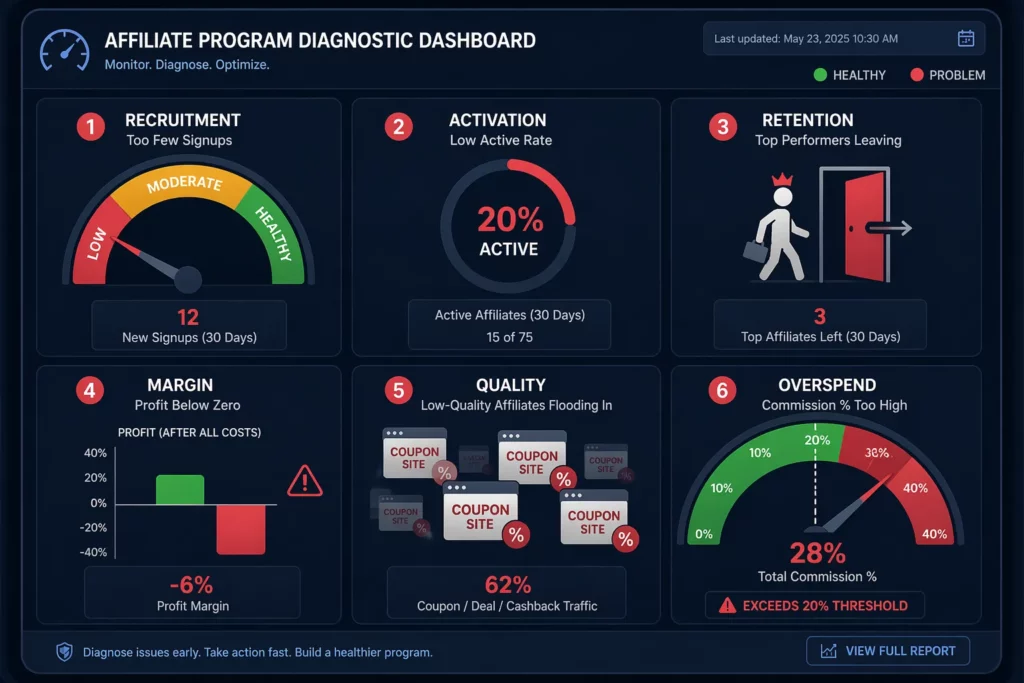
| Symptom | Cause | Fix |
| Fewer than 5 signups per month | Rate is below the industry benchmark | Raise to the industry median for your category |
| Signups come in, but under 20% become active | Base rate isn’t motivating enough | Add tiers and improve affiliate-facing materials |
| Top performers are leaving for competitors | Competitor rates or cookie windows beat yours | Match or add non-monetary perks (free products, early access) |
| Margin goes negative on referred orders | Combined rate + discount exceeds net profit | Lower rate or discount, exclude low-margin SKUs |
| Most referrals come from coupon sites | Program is too generous with too few controls | Add new-customer-only commission or vet affiliates before approval |
| Commissions exceed 20% of affiliate-driven revenue | Structural overpay across the program | Audit top affiliates; remove underperformers |
Review metrics quarterly
Most of the symptoms in the table don’t appear overnight — they build over weeks. Tracking four metrics on a quarterly cycle catches the drift early.
- Signup rate. Are you attracting new affiliates at a steady pace, or has recruitment stalled?
- Active rate. What percentage of signups drive at least one sale per month?
- Revenue per active affiliate. Is your top 20% delivering 60%+ of affiliate revenue (the typical pattern)?
- Profit per referred order. After commission and discount, what’s the net margin on an affiliate sale versus a direct sale?
These four metrics move together. If signups look healthy but active rate drops, you’re attracting the wrong affiliate type.
What Changed for Affiliate Commissions in 2026?
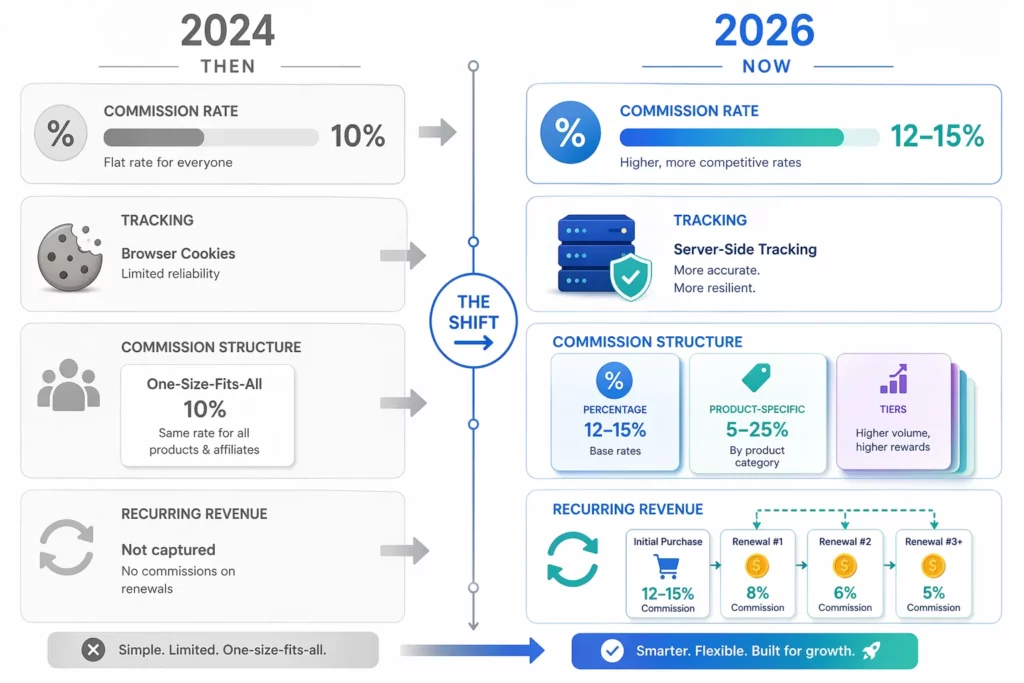
Five shifts have moved commission strategy in 2026. Most aren’t dramatic, but together they shift what a competitive program looks like compared to 2024.
Cookieless tracking is the new baseline.
With Safari and Firefox blocking third-party cookies by default, programs relying on browser-side tracking lose attribution on a measurable share of clicks.
Server-side tracking and coupon-code backup attribution are now standard, not premium.
✅ Baseline commission rates are trending up.
Rising paid ad costs have pushed merchants to compete harder for affiliate attention.
The rate that recruited solid affiliates two years ago — 10% — now sits closer to 12–15% as a competitive baseline in most DTC categories.
✅ Recurring commissions for subscription brands are mainstream.
Affiliates earning commission only on the first subscription order have been replaced by structures paying on every renewal for 6 to 12 months.
The math justifies it: a $40/month customer over 6 months delivers $48 in lifetime commission at 20% — versus $8 on a single first-order payment.
✅ Hybrid structures are the default for mature programs.
Most growth-stage Shopify brands now run 2–3 commission types: a percentage base, product-specific overrides, and tiers for top performers.
Apps like UpPromote integrate with five major Shopify subscription apps — Recharge, Bold, Appstle, Seal, and Recurpay.
Commission tracks across every renewal once a customer subscribes through an affiliate link.
Frequently Asked Questions
What is the average affiliate commission rate for ecommerce stores?
Most DTC Shopify brands pay between 10% and 20% per sale, with a median in the 12–15% range. Specific industries vary: beauty runs 15–25%, electronics 3–8%, supplements 20–40%, and fashion 10–15%.
Should I pay a flat fee or a percentage of sales?
Percentage commission is the default and works for most stores because it scales with order value. Flat fees fit two specific cases: high-ticket products (where a $25 flat fee beats a 5% commission) and first-order acquisition bonuses layered on top of a percentage base.
What is the best cookie duration for an affiliate program?
Thirty days is the industry default and captures 93–98% of conversions for standard ecommerce. Use 7–14 days for impulse purchases, 30 days for products in the $30–$200 range, and 60–90 days for high-ticket items above $500. Never go below 14 days for non-impulse products.
Should I pay commission on returning customers?
Most growth-stage Shopify brands run a hybrid: 15–25% on new customers and 5–10% on returning customers. Returning customers buy again whether or not an affiliate is involved, so paying full commission on them overspends on acquisition the affiliate didn’t drive.
Do tiered commissions improve affiliate performance?
Tiered commissions outperform flat structures for retaining top affiliates. The reason: top performers see a clear path to higher earnings inside your program rather than splitting their effort across competitors. Set the first upgrade threshold low (10–20 monthly sales) so new affiliates can reach it and stay engaged.
A competitor offers 25% — should I match them?
Not necessarily. Three other factors matter as much as the rate: your store’s conversion rate, your cookie duration, and the quality of the materials you give affiliates. A 3% conversion rate at 15% commission earns affiliates more than a 1% conversion rate at 25%.
How do recurring commissions work for subscription brands?
Recurring commissions pay the affiliate every time a referred subscription renews, not just on the first order. A $40/month customer over 6 months generates $48 in commission at a 20% rate — versus $8 on a single first-payment model. Most affiliate platforms integrate with major subscription apps to track renewals on a recurring basis.
Does my commission rate affect SEO?
Indirectly, yes. A higher commission rate attracts more affiliates, which produces more content and backlinks pointing to your store. Search engines treat those backlinks as authority signals, so a competitive commission program tends to boost organic visibility over time as a side effect.

Ellie Tran, a seasoned SEO content writer with three years of experience in the eCommerce world. Being a part of the UpPromote team, Ellie wants to assist Shopify merchants in achieving success through useful content & actionable insights.Ellie's commitment to learning never stops; she's always eager to gain more knowledge about SEO and content marketing to create valuable content for users. When she's not working on content, Ellie enjoys baking and exploring new places.
![How to Use Shopify Functions with Your Affiliate Program [2026 Guide]](https://static.uppromote.com/wp-content/uploads/2026/06/how-to-use-shopify-functions-with-affiliate-program-300x169.webp)

![How to Prevent Affiliate Fraud on Shopify: Self-Referral, Coupon Abuse & More [2026]](https://static.uppromote.com/wp-content/uploads/2026/06/how-to-prevent-affiliate-fraud-on-shopify-300x169.webp)