












TL;DR
US affiliate programs carry three compliance duties (tax reporting, FTC disclosure, and data privacy), and several of the rules changed in 2026.
- Tax: Collect a W-9 at signup, then file a 1099-NEC once an affiliate earns $2,000+ a year via ACH, check, or cash. Because PayPal and Stripe issue their own 1099-K at $20,000 and 200+ transactions, you won’t file for those payments.
- FTC: Affiliates must disclose the paid relationship, and merchants share the liability, since each violation can reach $53,088.
- International: Meanwhile, GDPR (EU) and CCPA (California) govern affiliate data and tracking-cookie consent.
- Bottom line: In practice, a W-9 at onboarding, a disclosure clause in your agreement, and a January 31 reminder will cover most of it.
⚠️ This article is informational only and is not legal or tax advice. Consult a qualified accountant or attorney for your situation.
Most Shopify merchants will run an affiliate program for months before anyone brings up the IRS or the FTC. At first it can feel like a big-brand worry, yet one missed form or undisclosed post could turn it into a five-figure problem.
Crucially, the FTC expects brands to monitor their endorsers, so a partner’s slip can hit the brand too, and each violation may reach $53,088.
Tax brings its own calendar, and here too the rules moved in 2026. Under the One Big Beautiful Bill Act, the 1099-NEC threshold rose from $600 to $2,000, while the 1099-K threshold returned to $20,000 and 200 transactions.
As a result, fewer affiliates now cross the line that triggers a form, though the ones who do will still need reporting by January 31.
In this guide, we’ll turn all three areas (tax, FTC disclosure, and data privacy) into plain-language checklists and a year-round calendar.
None of it is legal advice, though; for your situation, a qualified accountant or attorney would be the right call.
How do W-9 and 1099 rules apply to affiliate payments?
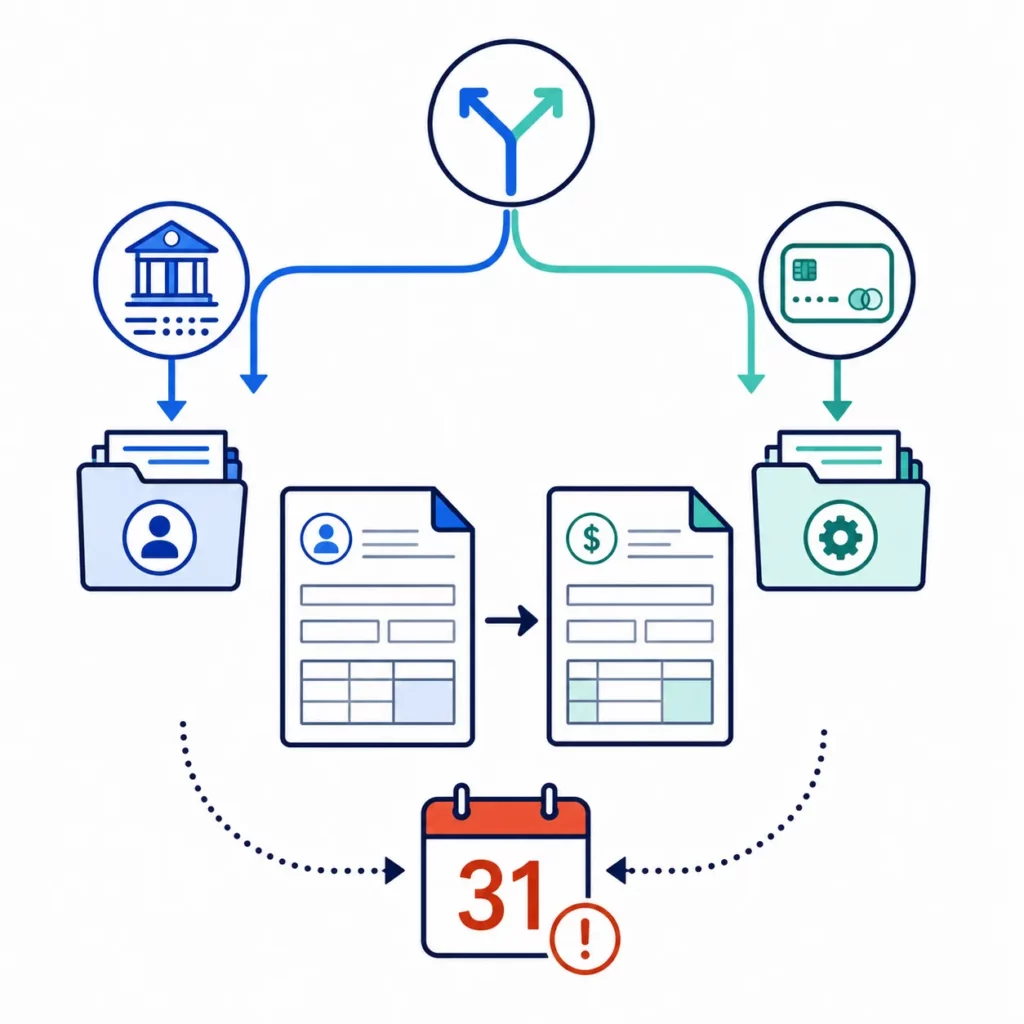
For US affiliates, the system comes down to two forms and one habit: collect a W-9 before you pay anyone, then report what you paid. Which form you file depends on how the money reaches them.
Direct payments put the reporting on you: for ACH, check, or cash, you file a 1099-NEC once an affiliate earns $2,000 or more in a year.
Processor payments flip that. Because PayPal and Stripe file their own 1099-K once an affiliate clears $20,000 and 200 transactions, you won’t issue a 1099-NEC for the same money.
The sequence itself starts at signup. A W-9 records the affiliate’s name, address, and taxpayer ID, the details you’ll need at filing.
Gathering that up front beats chasing it in January, so many merchants fold it into onboarding. Tools like UpPromote let you customize the registration form affiliates fill in at signup, so those details land before the first payout.
With W-9s on file, tracking takes over, and method drives the form rather than the amount.
From there, filing is mostly bookkeeping. Once an affiliate crosses $2,000 in cash-equivalent payments, you send a 1099-NEC and file a copy with the IRS by January 31.
The $2,000 line is itself new: through tax year 2025 it sat at $600, so older guidance still cites the lower figure.
Who files which form comes down to how each payout is made:
| Payment method | Who files the form | Form | 2026 threshold |
| ACH / direct deposit | You (the merchant) | 1099-NEC | $2,000 / year |
| Check or cash | You (the merchant) | 1099-NEC | $2,000 / year |
| PayPal | PayPal | 1099-K | $20,000 + 200 transactions |
| Stripe | Stripe | 1099-K | $20,000 + 200 transactions |
| Venmo | PayPal (parent) | 1099-K | $20,000 + 200 transactions |
| Store credit | Generally not reported | None | Confirm with an accountant |
1099-NEC threshold is $2,000 for 2026 payments (filed in 2027); it was $600 through tax year 2025. The 1099-K threshold returned to $20,000 and 200 transactions for 2025 onward under the One Big Beautiful Bill Act.
The store-credit row is the one that surprises people. Credit usually reads as a discount rather than income, so it often sits outside 1099 reporting; once it turns redeemable for cash, though, it can look like payment.
Who is liable for FTC disclosure — the merchant or the affiliate?
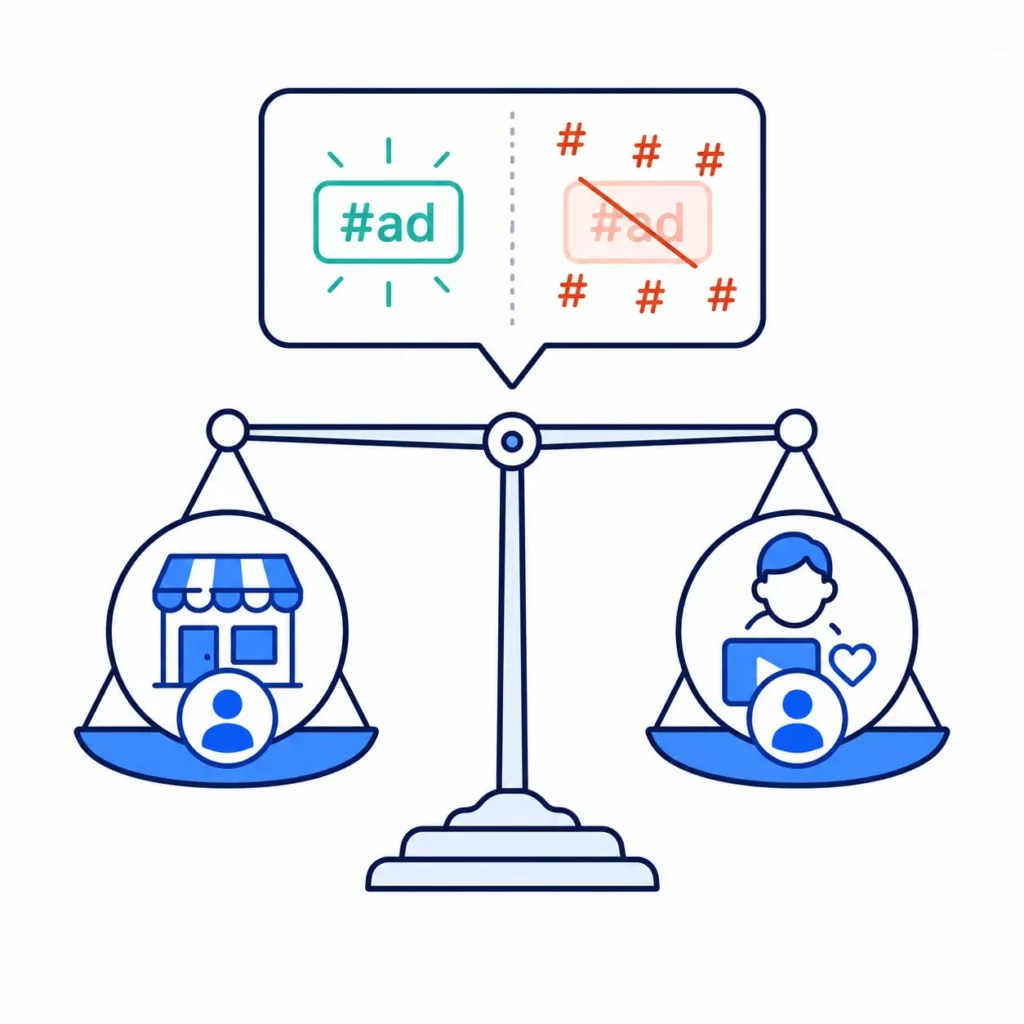
The answer is both. The FTC requires every affiliate to disclose a paid relationship, regardless of follower count, payment size, or platform.
It also holds the brand responsible. A merchant who funds or benefits from an undisclosed endorsement can be on the hook even when the affiliate posted alone.
Disclosure kicks in around any material connection, and that net is wider than cash. Free products, discount codes, store credit, commission, even early access all count as compensation in the FTC’s eyes.
Where the disclosure has to appear changes by platform, even though the bar stays constant:
| Platform | Where the disclosure must appear |
| First line of the caption, or a “Paid partnership” label up top; not buried under a wall of hashtags | |
| TikTok | Spoken or on-screen in the first few seconds, plus “#ad” early in the caption |
| YouTube | A verbal mention in the first 30 seconds and in the top lines of the description; the built-in “paid promotion” label supplements, it doesn’t replace |
| Blog / website | At the top, before any affiliate links. Example: “This post contains affiliate links; I may earn a commission at no extra cost to you” |
The pattern is the same across all four: a viewer should catch the disclosure without tapping or scrolling for it.
For merchants, the takeaway is that disclosure cannot be fully delegated. The FTC expects advertisers to guide their affiliates, monitor what they post, and fix problems, so “I didn’t know” carries little weight as a defense.
Protection starts in the affiliate agreement, where a single clause can require FTC-compliant disclosure on every post. A documented requirement also becomes your evidence of good-faith effort if a question ever arises.
A clause only works if affiliates know how to follow it, which is why ready-made disclosure lines per platform matter.
Neither holds up without follow-through, so a quick monthly spot-check of five to ten posts catches slips early. A friendly nudge usually fixes the first miss, and repeat offenders can simply be removed.
What international rules (GDPR, CCPA) affect affiliate programs?
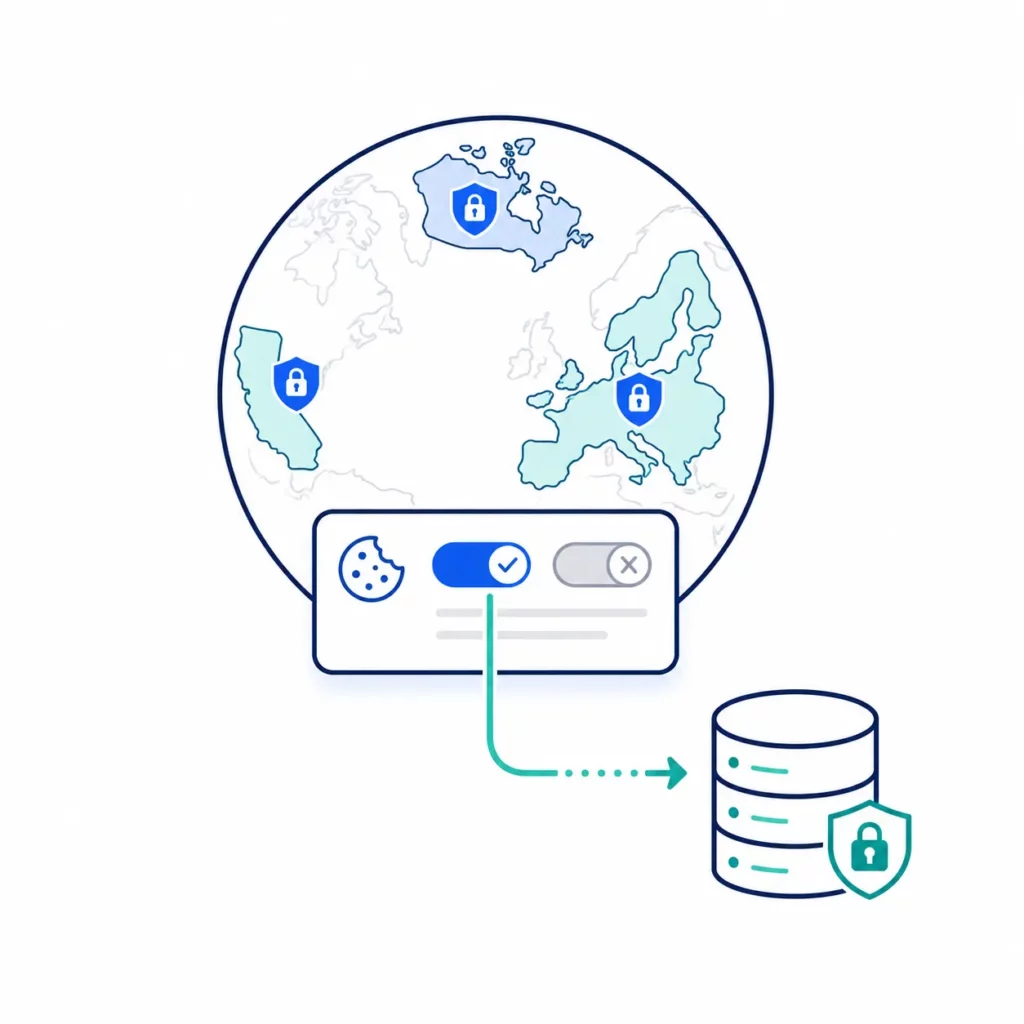
If your store and your affiliates all sit in the US, FTC and IRS rules cover you.
The moment a customer or an affiliate is based abroad, a second layer of privacy law comes into play, mostly around tracking cookies and the personal data you hold on affiliates.
Which rules apply depends on where your buyers and partners are based:
| Regulation | Region | What it covers | Affiliate-program impact |
| GDPR | EU / EEA | Personal data protection | Tracking cookies need consent; affiliate names and emails are personal data you must store securely |
| CCPA | California, US | Consumer data rights | California shoppers can opt out of data sharing; affiliate tracking counts as collection you must disclose |
| PIPEDA | Canada | Personal data protection | Similar to GDPR; cookie consent needed for Canadian visitors |
| UK rules | United Kingdom | Advertising and data standards | Disclosure must be especially prominent; data handling mirrors GDPR |
In practice, two things matter most.
Consent always comes first. In the EU and UK, affiliate tracking cookies count as personal data, so no consent means no tracking, which means no commission to attribute.
Most Shopify cookie-consent tools handle the banner side automatically, though it’s worth confirming yours passes consent through to your affiliate app.
Data storage is the second piece. Affiliate names, emails, and payment details all qualify as personal data, so they need secure handling and, on request, the ability to access or delete them.
Cross-border pairings add one step: a US merchant with an EU affiliate should put a short data-processing clause in the agreement.
What’s the annual affiliate compliance calendar?
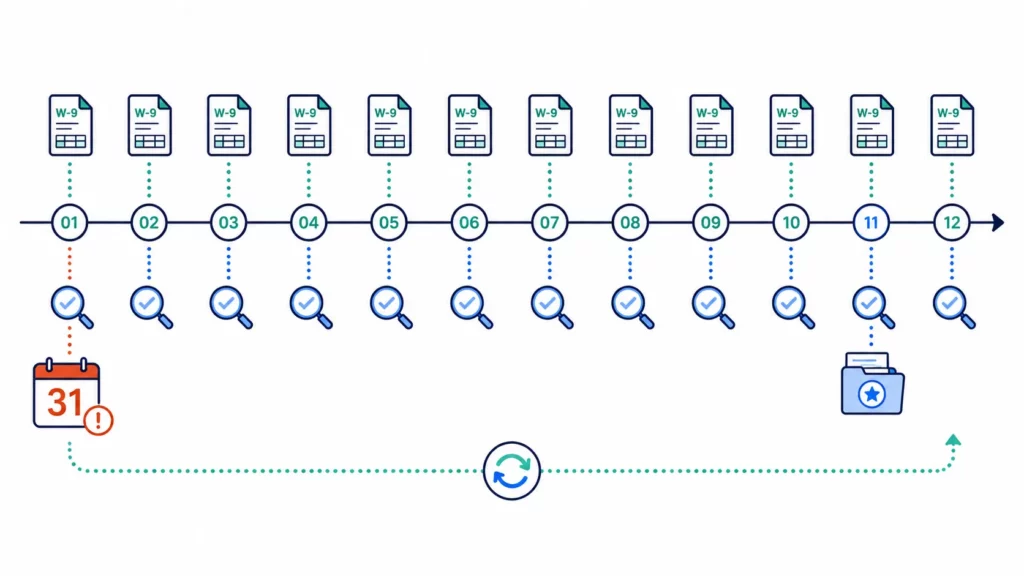
Compliance fails on forgotten dates more than on misunderstood rules. A light recurring rhythm keeps it from piling up in January.
Here’s the cadence most programs can run on with little effort:
| When | Task | Details |
| Ongoing | Collect a W-9 from each new US affiliate | At signup, before the first payout |
| Ongoing | Spot-check disclosures | Review five to ten affiliate posts a month |
| Monthly | Track cumulative payouts per affiliate | Flag anyone nearing $2,000 |
| Quarterly | Run a compliance audit | W-9s complete? Disclosures clean? Agreement current? |
| November | Prep the 1099-NEC filing | Confirm W-9 data, reconcile payments, list $2,000+ affiliates |
| January 31 | File 1099-NEC forms | Send copies to affiliates and the IRS |
| Annually (Q1) | Update the affiliate agreement | Reflect any FTC or tax changes |
| Annually | Review the privacy policy | Update cookie and tracking disclosures |
The November and January rows carry the real weight.
November is the prep month: reconcile what you paid, confirm every W-9 is on file, and pull the list of affiliates who crossed $2,000.
Clean payment records make that reconciliation quick. Tools like UpPromote can export commission invoices with the tax details already on them, so you and each affiliate end up with matching documentation at filing time.
January 31 is the hard stop, and the IRS penalty climbs the longer you wait. November prep is really what protects that deadline.
Key takeaway: Put two reminders on the calendar: start 1099 prep in November and file by January 31. Then, add a five-minute disclosure spot-check each month, and compliance turns from a year-end scramble into a background task.
What changed for affiliate compliance in 2026?
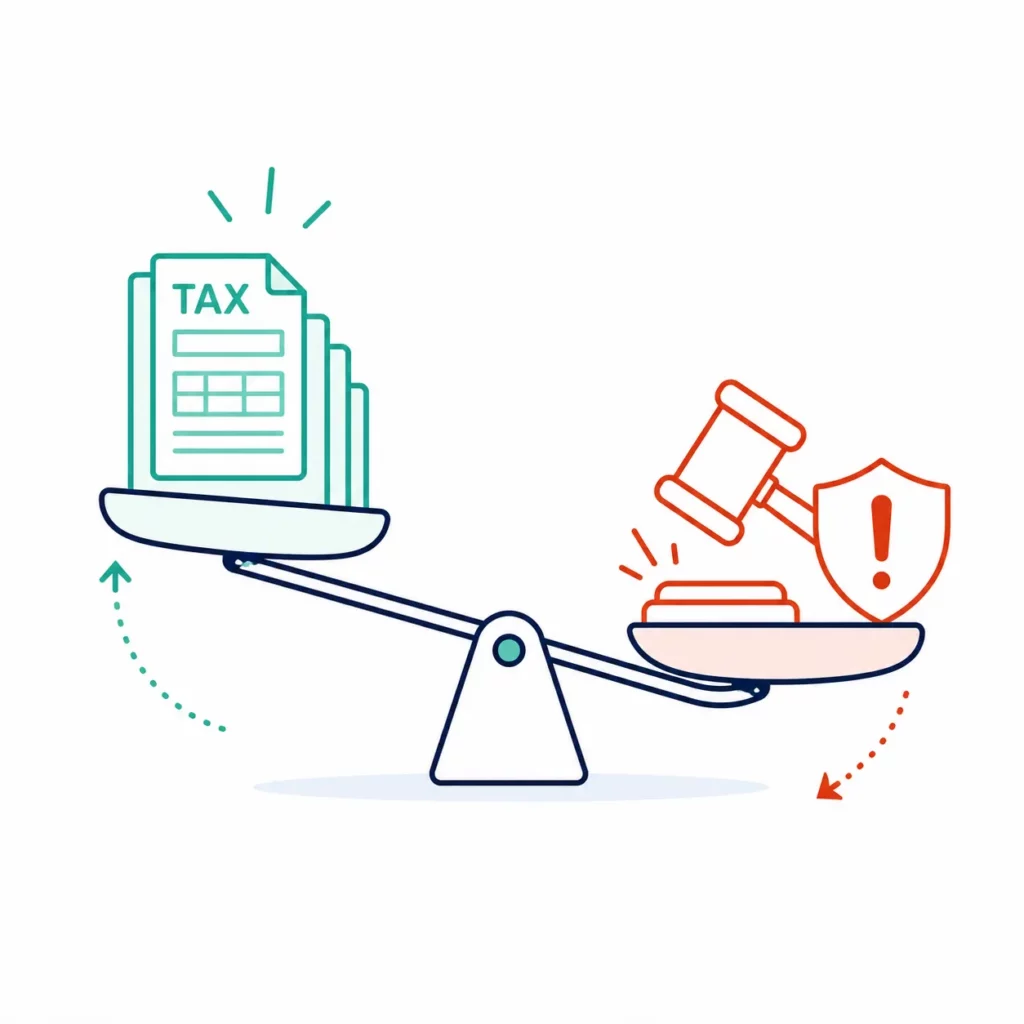
Two changes pulled in opposite directions in 2026: tax reporting got lighter, while FTC enforcement got heavier.
On the tax side, the One Big Beautiful Bill Act raised the 1099-NEC threshold to $2,000 and put the 1099-K threshold back at $20,000 and 200 transactions.
Fewer affiliates now generate a form, though every dollar of commission stays taxable whether or not one is issued.
Lighter filing doesn’t soften the penalties for the forms you still owe.
A missed 1099 triggers IRS penalties that climb with time: $60 a form within 30 days, $130 through August 1, and $340 after that, plus $680 for intentional disregard and no cap.
The FTC moved the other way. Its Consumer Reviews and Testimonials Rule has made fake or AI-generated reviews penalty-backed since October 2024.
Brands still answer for what their affiliates post, and a 2026 freeze on inflation adjustments holds the per-violation ceiling at $53,088 instead of nudging it higher.
Frequently Asked Questions
If I pay affiliates through PayPal, do I need to file a 1099?
No, not a 1099-NEC. As a third-party processor, PayPal files its own 1099-K once an affiliate clears $20,000 and 200 transactions, so the reporting falls on PayPal rather than you. You should still collect a W-9 and track these payments for your own records.
Do store-credit rewards need a 1099?
Usually not. Store credit typically counts as a discount rather than income, so it sits outside 1099 reporting. The exception is credit that can be redeemed for cash, which may become taxable, so confirm large or cash-like rewards with an accountant.
Do affiliates outside the US need a W-9 or 1099?
No. W-9 and 1099 forms apply only to US persons and businesses. For non-US affiliates, collect a W-8BEN instead, which certifies foreign status; commissions usually carry no US withholding unless a treaty applies. Check the specifics with an international tax advisor.
Is the merchant or the affiliate responsible for FTC disclosure?
Both. The affiliate must disclose the paid relationship, and the FTC can also hold the brand responsible for an undisclosed post. The strongest protection is a disclosure clause in your agreement, ready-made wording for affiliates, and a quick monthly check of what they publish.
Does a small affiliate program still need to worry about compliance?
Yes. FTC disclosure rules apply no matter how many affiliates you have or how small the payments are. On tax, you only file a 1099-NEC for affiliates you pay $2,000 or more, but disclosure and basic W-9 collection apply from your first affiliate.
Do I need to hire an accountant or lawyer for affiliate compliance?
It depends on scale. Small programs can usually self-manage with a W-9 process, a disclosure clause, and a filing reminder. Once annual payouts reach the tens of thousands, an accountant’s review pays off, and international affiliates are where a lawyer’s input matters most.

Ellie Tran, a seasoned SEO content writer with three years of experience in the eCommerce world. Being a part of the UpPromote team, Ellie wants to assist Shopify merchants in achieving success through useful content & actionable insights.Ellie's commitment to learning never stops; she's always eager to gain more knowledge about SEO and content marketing to create valuable content for users. When she's not working on content, Ellie enjoys baking and exploring new places.
![How to Use Shopify Functions with Your Affiliate Program [2026 Guide]](https://static.uppromote.com/wp-content/uploads/2026/06/how-to-use-shopify-functions-with-affiliate-program-300x169.webp)

![How to Prevent Affiliate Fraud on Shopify: Self-Referral, Coupon Abuse & More [2026]](https://static.uppromote.com/wp-content/uploads/2026/06/how-to-prevent-affiliate-fraud-on-shopify-300x169.webp)