











TL;DR
Seasonal affiliate campaigns can generate a disproportionate share of annual affiliate revenue, but only if you treat them as separate playbooks, not extensions of your everyday program.
- Three levers: Temporary commission boost, season-specific creatives, higher audience discount
- BFCM prep: 8 weeks minimum (start early October)
- Commission boost range: +3–10% above everyday rate, depending on season
- Seasons covered: BFCM, Christmas, Valentine’s, Mother’s Day, Back-to-School, Summer
- Post-campaign: Thank → Transition → Review cycle to retain seasonal affiliates year-round
Affiliates and partners drove 21.8% of Cyber Monday 2025 revenue in the U.S., up 7.4% from the year before (Adobe, 2025). Peak shopping seasons are where the affiliate channel delivers its strongest results.
Yet most affiliate programs aren’t built to capture that seasonal spike. They run the same commission rate, the same creatives, and the same messaging whether it’s March or Black Friday.
The result is predictable. Affiliates don’t know about your seasonal offers, so they don’t promote them. Revenue sits on the table during the weeks your audience is most ready to buy.
By the end of this guide, you’ll have a complete 8-week BFCM timeline, five compact playbooks for other seasonal peaks, the three levers behind every campaign, and a retention plan for keeping affiliates active between seasons.
Why Do Seasonal Affiliate Campaigns Need a Different Playbook?
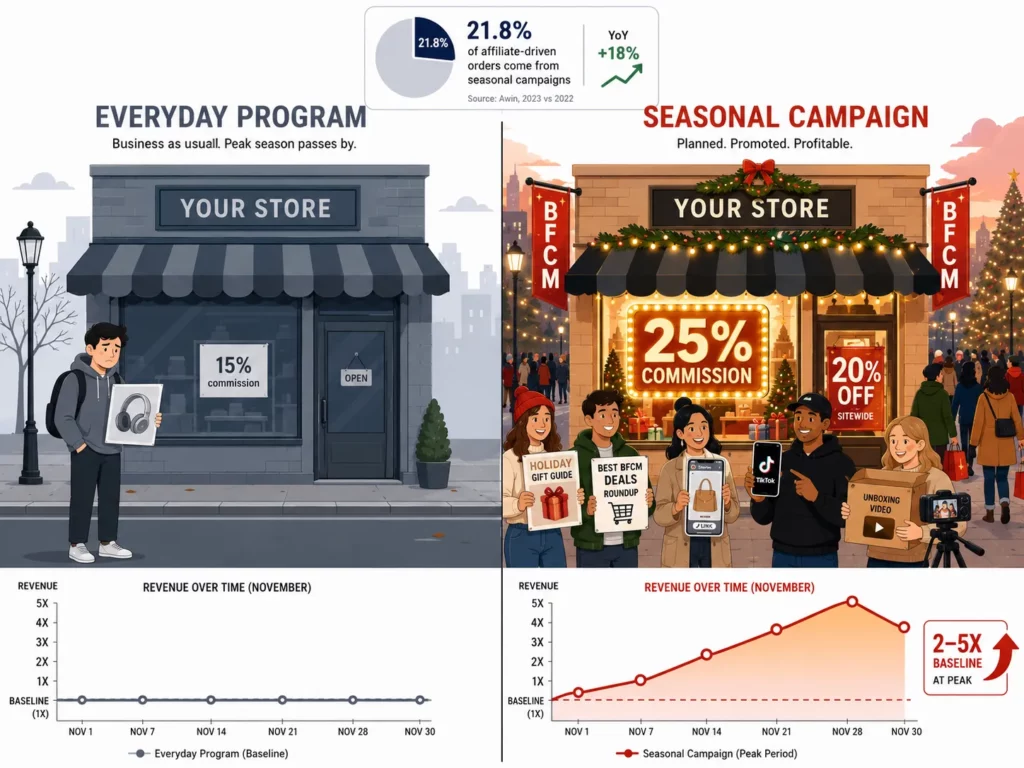
Seasonal affiliate campaigns need a separate strategy for three reasons: competition spikes, time windows shrink, and audience intent shifts. The same commission rate that works in March will get buried in November.
During BFCM, every brand in your niche runs promotions at once. Your affiliates will juggle multiple brands and prioritize whoever pays more during the campaign window.
If your rate stays flat while a competitor adds 5–10%, your partners have a clear reason to push the other brand first.
That pressure grows when the window is short. “25% commission this week only” triggers action. “15% commission always” gets put off for later, which usually means never.
Seasonal content will also convert at a higher rate because it matches what the audience is already searching for. A “Holiday Gift Guide” in December draws readers who are ready to buy. The same product pitched as a generic review won’t carry that urgency.
The gap between everyday and seasonal touches every part of your program.
| Dimension | Everyday Program | Seasonal Campaign |
| Commission | Standard rate (e.g., 15%) | Boosted rate (+5–10%) |
| Creative materials | Evergreen product images | Season-specific banners and captions |
| Audience discount | Standard (e.g., 10%) | Higher (15–25%) |
| Messaging | Product benefits | Gift-giving, deals, urgency |
| Duration | Ongoing | 1–4 weeks |
| Affiliate briefing | One-time onboarding | Season-specific brief before each campaign |
| Revenue vs. baseline | Baseline | 2–5× baseline during peak |
What Are the Three Levers Behind Every Seasonal Campaign?
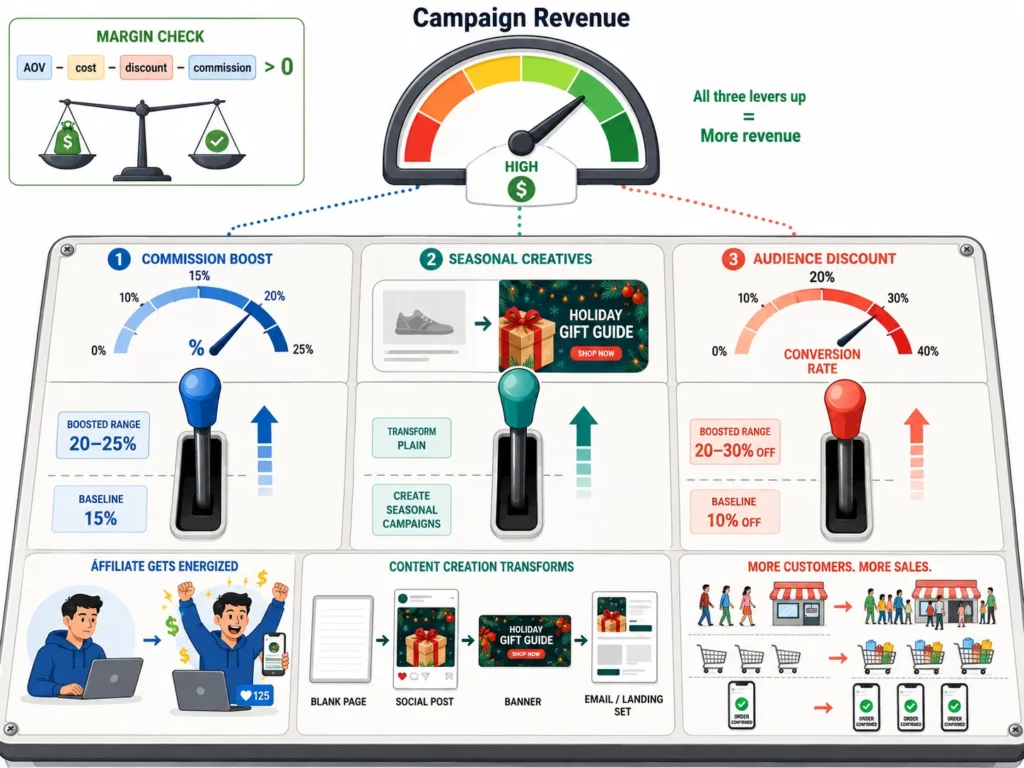
Every seasonal affiliate campaign adjusts three things: the commission rate, the creative materials, and the audience discount. The intensity changes by season, but the levers stay the same.
Lever 1: Temporary Commission Boost
A higher rate during peak season signals to affiliates that this window matters more than an average week. The boost doesn’t need to be dramatic, even 3–5% above your everyday rate can shift behavior when paired with a deadline.
Here is how the boost scales across six seasonal peaks.
| Season | Everyday Rate | Boosted Rate | Duration |
| BFCM | 15% | 20–25% | 2–4 weeks |
| Christmas | 15% | 18–22% | 3 weeks |
| Valentine’s Day | 15% | 18–20% | 2 weeks |
| Mother’s / Father’s Day | 15% | 18–20% | 2 weeks |
| Back-to-School | 15% | 17–20% | 3 weeks |
| Summer | 15% | 17–18% | 4–6 weeks |
The boost only works if your margin stays positive after both the higher commission and the seasonal discount stack together.
A quick check: take your average order value, subtract product cost, the seasonal discount, and the boosted commission. If the number is still positive, you can run the campaign without losing money per sale.
You also don’t need to match the top end of each range. Even a 3% lift above your everyday rate can shift affiliate behavior when it comes with a clear start and end date. The deadline does as much motivational work as the percentage itself.
Lever 2: Seasonal Creative Materials
A boosted rate gets attention, but affiliates still need something to post. Seasonal materials can close the gap between wanting to promote and hitting publish.
You’ll want to have these ready before launch: product images with seasonal styling, banner ads with campaign messaging, and sample captions. Content angle ideas like gift guides or deal roundups will also help.
From there, you can upload everything to a shared asset library your affiliates access on their own.
UpPromote, for example, includes a media gallery where affiliates grab banners, images, and videos from their account. No email threads or shared drives needed.
Lever 3: Higher Audience Discount
The third lever targets the customer side. A bigger discount during peak season will lift conversion rates, which means affiliates earn more per post and naturally promote harder.
| Season | Everyday Discount | Seasonal Discount |
| BFCM | 10% | 20–30% |
| Christmas | 10% | 15–20% |
| Other seasons | 10% | 12–15% |
Not every merchant needs deep discounts. FlagFlex kept commission rates flat during BFCM and focused on customer deals instead (BOGO plus free shipping). That approach still delivered a 30% revenue lift.
How to Run a BFCM Affiliate Campaign (8-Week Timeline)
BFCM is the single largest affiliate revenue event of the year. Preparation starts eight weeks before the event, which means early October for a late-November campaign.
Merchants who brief affiliates six weeks early capture spending that’s gone by Black Friday itself.
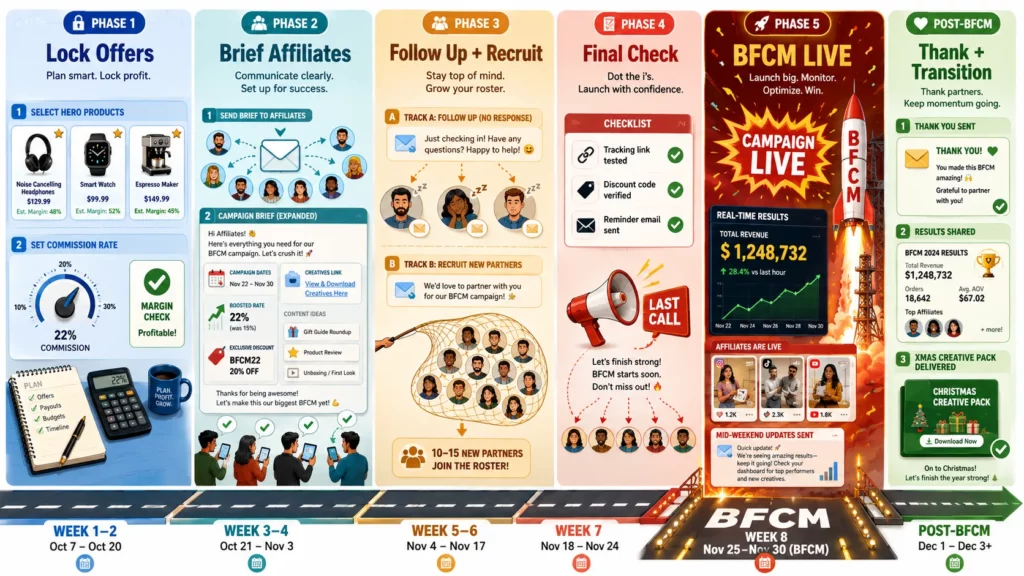
Weeks 1–2 (early October): Lock your offers
Decide your BFCM discounts, hero products, and flash sale schedule.
Then you’ll need to calculate your boosted commission rate. Your margin should stay positive after the higher discount and the higher commission stack together.
Weeks 3–4 (mid October): Brief your affiliates
Send a BFCM briefing email to every affiliate on your roster with campaign dates, the boosted rate, the audience discount, a link to creatives, and two to three content ideas.
Built-in email tools work well here. UpPromote includes bulk email on the free plan, so you can brief your full roster without switching to a separate platform.
Weeks 5–6 (late October): Follow up and recruit
This is when you’ll want to contact affiliates who didn’t respond to the first briefing. You can also reach out to 10–15 new partners for a seasonal push.
Week 7 (mid November): Final check
Test all tracking links and discount codes. Send a “last call” reminder confirming exact dates and deals.
Week 8 (BFCM week): Communicate in real time
Send a “Campaign Live” note on Black Friday morning. Share early results mid-weekend to keep momentum going.
Post-BFCM (within 48 hours): Thank and transition
Thank your top performers with a personal message. Share campaign results: total revenue, top affiliates, year-over-year comparison.
Then shift gears right away. “Christmas creatives are ready now” should land in your affiliates’ inboxes before the BFCM buzz fades.
Vetain’s BFCM 2024 campaign shows a different approach. The brand kept its tiered commission year-round, including BFCM, rather than creating a separate seasonal rate. BFCM GMV hit €408,302, an 87% increase from the pre-BFCM period.
Here is a briefing template you can adapt for your own program.
BFCM Affiliate Briefing Template
Subject: BFCM 2026 — Your Commission Boosted to [X]% + Everything You Need
Hi [Name],
BFCM is [X weeks] away, and here’s everything you need to maximize earnings:
- Dates: [Start] — [End]
- Your commission: [X]% (boosted from [Y]%)
- Audience discount: [Z]% off sitewide
- Your link: [link]
- Creatives: [portal link]
Content ideas: “[Product] Gift Guide for [audience]” · “My BFCM Picks: [X]% off [Product]” · “Last chance — [Brand] deals ending tonight”
Post early. BFCM shoppers compare across stores before buying — first impressions win.
Questions? Reply here. I’ll respond within 2 hours during BFCM week.
How to Adapt the Playbook for Five Other Seasonal Peaks
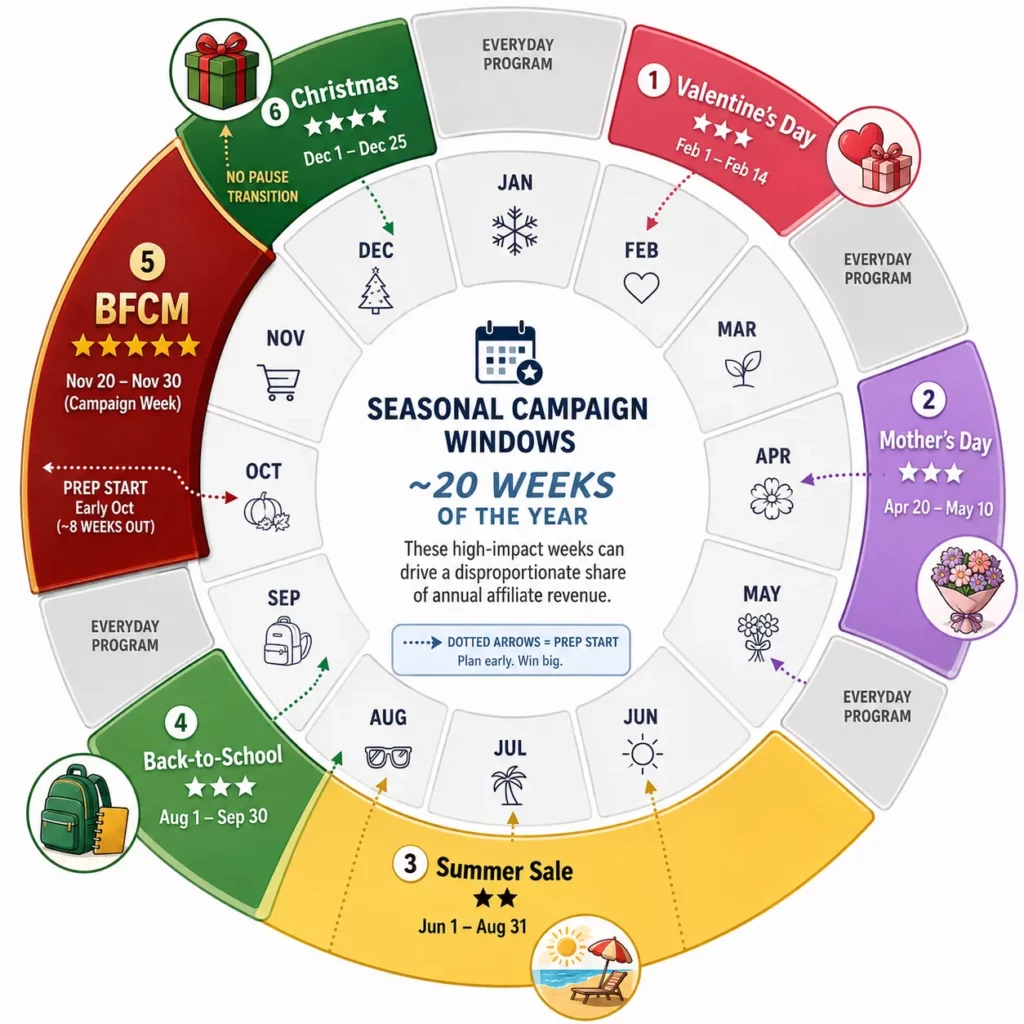
BFCM gets the most attention, but five other seasonal windows can add meaningful affiliate revenue when you chain them back to back with no gap between campaigns.
The most important transition is BFCM to Christmas. Don’t pause after Cyber Monday. Swap your creatives from “deals” to “gifts,” keep the boosted commission active, and brief affiliates on shipping deadlines.
The message shifts from urgency to generosity, but the momentum stays.
That same gifting mindset carries into Valentine’s Day and Mother’s Day, which makes both strong fits for beauty, jewelry, fashion, and food brands. A three-week prep window and a 3–5% commission boost will usually be enough for either one.
Back-to-School moves away from gifting entirely. The buyer profile is different — students, parents, and college-bound shoppers — and student-specific discount codes that stack with the affiliate code can lift conversions during this window.
Summer is the longest campaign window but the lowest intensity. A smaller commission bump (2–3%) spread across six to eight weeks can keep affiliates posting without straining your margins.
Here is how all six seasons compare on timing, commission boost, and revenue potential.
| Season | Peak Dates | Prep Start | Commission Boost | Revenue Potential |
| BFCM | Late November | Early October (8 weeks) | +5–10% | ★★★★★ |
| Christmas | Dec 1–25 | Nov 1 (4 weeks) | +3–7% | ★★★★☆ |
| Valentine’s Day | Feb 1–14 | Jan 20 (3 weeks) | +3–5% | ★★★☆☆ |
| Mother’s Day | Early May | Mid April (3 weeks) | +3–5% | ★★★☆☆ |
| Back-to-School | Aug–Sep | July 1 (4 weeks) | +2–5% | ★★★☆☆ |
| Summer Sale | Jun–Aug | Mid May (6–8 weeks) | +2–3% | ★★☆☆☆ |
How to Keep Seasonal Affiliates Active Year-Round
Seasonal campaigns bring in new affiliates and wake up dormant ones. Without a plan for what happens after the campaign ends, both groups go quiet within weeks.
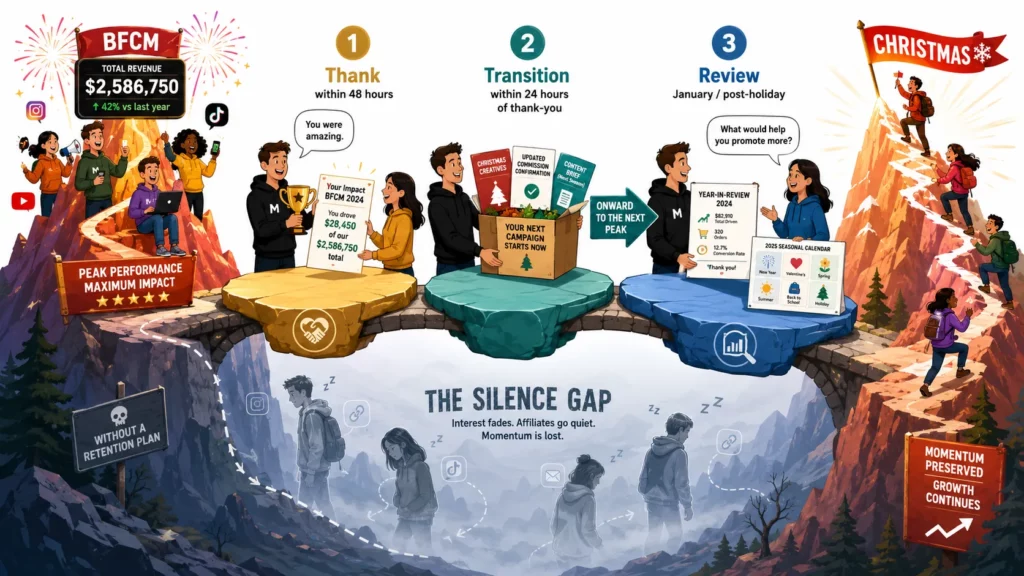
The simplest first step is a personal thank-you that includes results. “Our BFCM campaign generated $X. You drove $Y of that.” Recognition with specific numbers is a stronger motivator than most merchants expect.
UpPromote’s in-app chat makes these messages easy to send — you can reach any affiliate without switching to email, and the conversation history stays attached to their profile for the next campaign.
From there, a “what’s next” email should follow within 24 hours. BFCM to Christmas is the easiest transition: share new creatives, confirm the commission rate, and give affiliates a reason to keep posting.
Once the holiday campaigns wrap, you can send an annual review to your top performers in January. Preview the seasonal calendar for the year ahead and celebrate their wins.
Then, close with one question: “What would help you promote more this year?” That conversation often surfaces ideas you wouldn’t find on your own.
Frequently Asked Questions
How much should I boost affiliate commissions during BFCM?
Most merchants boost rates 5–10% above their everyday commission during BFCM. For example, if your standard rate is 15%, a BFCM rate of 20–25% is typical. Factor in the higher audience discount (20–30%) and confirm your margin stays positive after both increases stack.
When should I start preparing for a BFCM affiliate campaign?
Eight weeks is the recommended lead time, with affiliate briefings going out six weeks before the event. Four weeks is the minimum. Stores that launched early-access campaigns in late October captured budget that was already spent by Black Friday.
Do I need separate seasonal creatives or can I use evergreen materials?
Seasonal creatives outperform evergreen materials during peak periods. A holiday gift guide image paired with a seasonal caption converts better than a generic product shot in December. The investment is small: two to three hours per season to create a batch of banners, images, and captions.
If I can only run one seasonal campaign, which season should I pick?
BFCM. It carries the highest consumer spending intent, the longest prep window, and the strongest affiliate response. If you run two campaigns, add Christmas (transition from BFCM with no gap). If three, add Valentine’s Day for its gifting intent.
How do I reactivate affiliates who went dormant after BFCM?
Three steps within 48 hours of the campaign ending. First, a thank-you email with their personal results. Second, a transition email with Christmas creatives and the next campaign brief. Third, a January annual review. Some affiliates only activate during peaks, and that’s fine.
Can I convert BFCM customers into affiliates?
Yes. Customers who just bought at a BFCM discount are ideal affiliate candidates. A post-purchase email or thank-you page widget inviting them to join your program can turn seasonal buyers into year-round promoters.

Ellie Tran, a seasoned SEO content writer with three years of experience in the eCommerce world. Being a part of the UpPromote team, Ellie wants to assist Shopify merchants in achieving success through useful content & actionable insights.Ellie's commitment to learning never stops; she's always eager to gain more knowledge about SEO and content marketing to create valuable content for users. When she's not working on content, Ellie enjoys baking and exploring new places.
![How to Use Shopify Functions with Your Affiliate Program [2026 Guide]](https://static.uppromote.com/wp-content/uploads/2026/06/how-to-use-shopify-functions-with-affiliate-program-300x169.webp)

![How to Prevent Affiliate Fraud on Shopify: Self-Referral, Coupon Abuse & More [2026]](https://static.uppromote.com/wp-content/uploads/2026/06/how-to-prevent-affiliate-fraud-on-shopify-300x169.webp)