











TL;DR
Recurring commissions pay affiliates on every subscription renewal, not just the first order.
Most subscription brands choose one of three commission models: first-order-only (20–30%, simple), lifetime recurring (10–15% per renewal, ongoing), and time-limited recurring (15–20% for 6–12 months, recommended). Time-limited balances affiliate motivation with margin protection.
- Recommended model: Time-limited recurring (15–20% for 6–12 months)
- First-order rate: 20% to incentivize the initial sale
- Renewal rate: 10–15%, declining over time
- Compatible apps: Recharge, Bold, Appstle, Seal, Recurpay
- Setup time: Under 15 minutes once your subscription app is connected
Subscription products give you something most one-time stores don’t: a customer who pays you again and again. A $40-per-month subscriber who stays eight months is worth $320 in lifetime value.
But most affiliate programs don’t reflect that. A 20% commission on the first order gives your affiliate $8 for a customer who could generate $320.
Affiliates can see that math clearly, and when a competing program offers more, they’ll shift their energy there.
You won’t lose them to a better product. You’ll lose them to a better commission structure.
Recurring commissions change that equation. Instead of a single payout, the affiliate earns a cut of every renewal. At 15% on $40 per month, the same referral would earn $6 each month the subscriber stays, $48 over eight months instead of $8.
Now the affiliate has a reason to send you subscribers who stick around, not just ones who try and cancel. You pay only from revenue that’s already in your account.
Inside this blog, you’ll find three commission models for subscription brands, a calculator to set the right rate for your margins, and a step-by-step setup guide for UpPromote’s five subscription app integrations.
What Are Recurring Commissions and Why Do Subscription Brands Need Them?
A recurring commission pays the affiliate on every renewal, not just the first order. This aligns what affiliates earn with what the customer is actually worth.
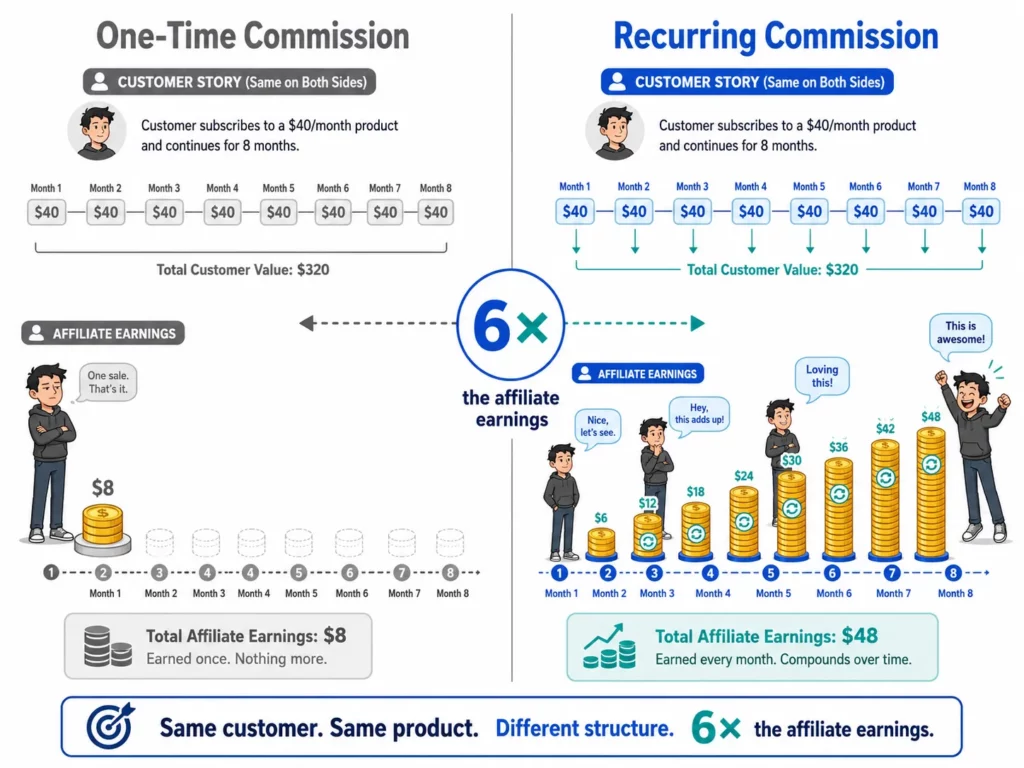
The difference shows up fast. With a one-time 20% commission on a $40-per-month subscription, your affiliate earns $8 on the first order. The customer stays eight months and generates $320. The affiliate’s total: still $8.
With a 15% recurring commission, that same affiliate would earn $6 every month the customer stays. Eight months later, $8 becomes $48, without any additional work from the affiliate.
That structural shift changes how affiliates approach your program, starting with the quality of subscribers they send you.
When commissions recur, affiliates earn more from customers who stay longer. A subscriber who churns after one month is worth $6 to the affiliate. One who stays twelve months is worth $72. The incentive to refer quality is built into the math.
In addition, that quality focus also makes your program more competitive. Experienced affiliates already earn recurring income from SaaS programs. Subscription brands that offer the same model can attract those partners instead of losing them to software companies.
The downstream effect is loyalty. Affiliates earning passive income from your program stay longer, create deeper content, and build audiences that keep converting.
3 Recurring Commission Models (Which to Choose)
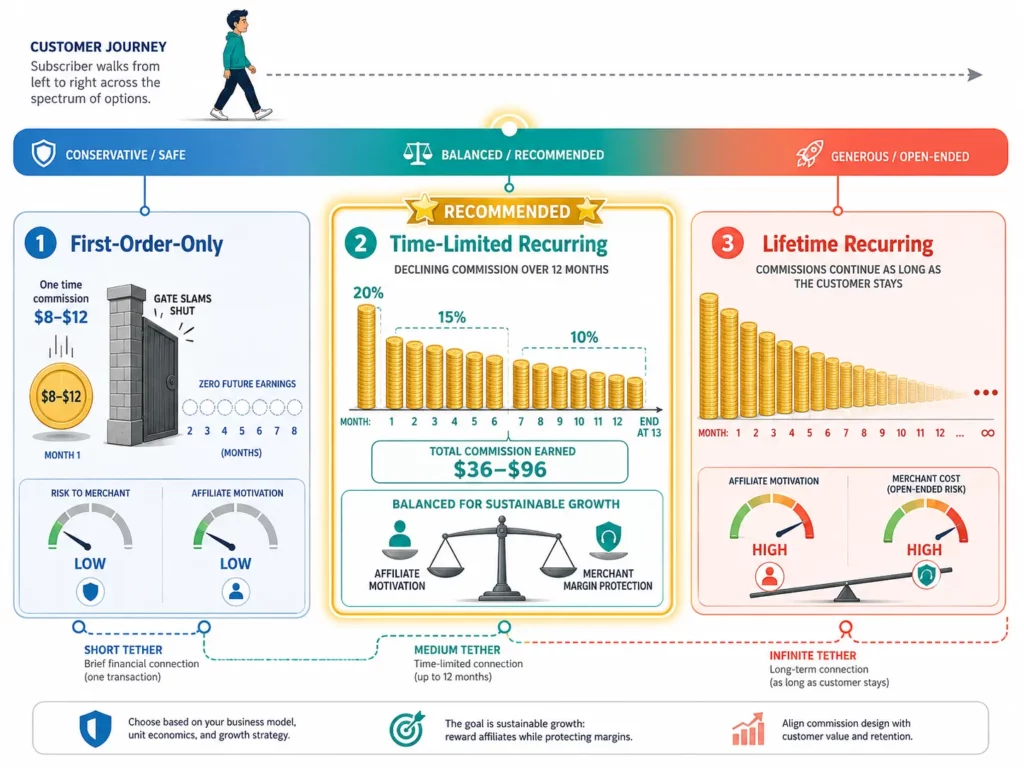
Not all recurring commissions work the same way. The options range from conservative to generous, and most subscription brands should start somewhere in the middle.
Each model makes a different tradeoff between affiliate motivation and your long-term margin.
| Model | Rate | Duration | Affiliate earns (8-mo sub, $40/mo) | Best for |
| First-order-only | 20–30% | First order only | $8–12 | Simple programs, tight margins |
| Lifetime recurring | 10–15% | While subscriber active | $48–72+ | High-margin products, retaining top affiliates |
| Time-limited recurring | 15–20% | 6–12 months | $36–96 | Recommended — balanced motivation + margin protection |
The right model depends on where your subscription business stands today. Here’s how each one plays out.
First-Order-Only: Simple but Limited
You pay the affiliate once, 20–30% of the first order, and nothing after that. The cost is predictable, and the setup requires no extra configuration.
But the affiliate’s incentive ends the moment the customer subscribes. Whether that subscriber stays one month or twelve, the payout is the same.
This can still work while you’re testing a new subscription product or validating your retention rates. It just won’t hold the attention of experienced affiliates for long.
Lifetime Recurring: Maximum Motivation, Open-Ended Cost
On the other end of the spectrum, lifetime recurring pays 10–15% on every renewal for as long as the subscriber stays active. The affiliate builds compounding income, and the motivation to send high-retention customers is as strong as it gets.
The tradeoff is open-ended liability. A customer who stays two years means two years of commission payments. This model works well for high-margin subscriptions (60%+ gross margin), but the math can get tight for products with thinner margins.
Time-Limited Recurring: The Recommended Starting Point
Most subscription brands don’t need either extreme. Time-limited recurring pays 15–20% for a fixed window — typically 6 to 12 months — then drops to zero.
This gives you the strongest balance. Affiliates are motivated to refer subscribers who stay, because longer retention means more income within the window. And your margin improves after the cap, turning every month beyond it into fully retained revenue.
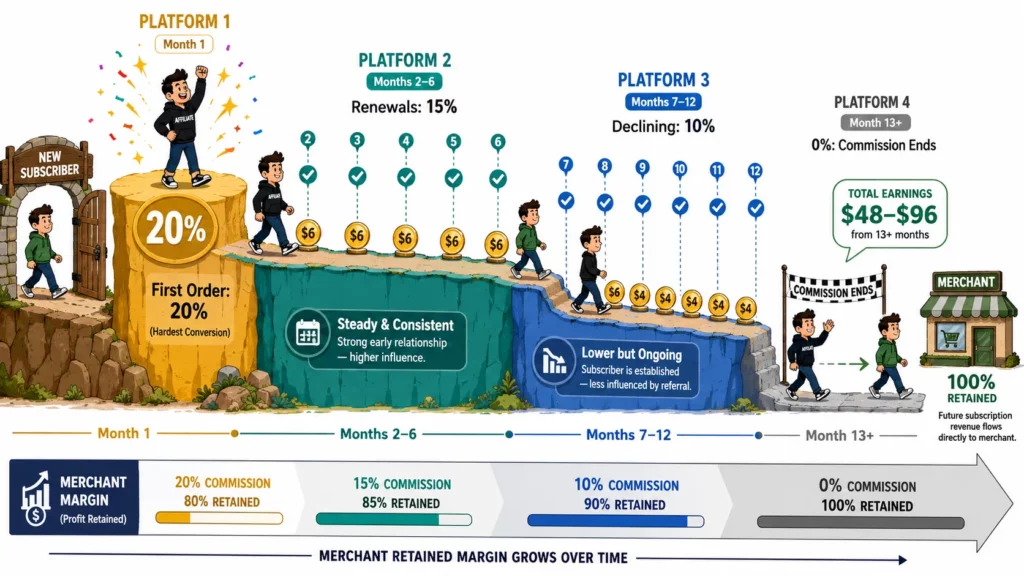
A declining rate structure within that window can sharpen the balance even further.
| Customer stage | Commission rate |
| First order | 20% (higher to incentivize the initial sale) |
| Months 2–6 | 15% |
| Months 7–12 | 10% (declining) |
| Month 13+ | 0% (commission ends) |
The first order carries the highest rate because that’s the hardest conversion to drive.
Renewal rates step down over time as the subscriber becomes more established and more likely to stay without the affiliate’s influence.
How to Connect Your Subscription App for Recurring Commissions
Before you can pay affiliates on renewals, your affiliate app needs to connect with your subscription platform. UpPromote supports five subscription apps out of the box.
If you’re already running one of these, the setup takes about 15 minutes.
| App | Rating | Reviews | Pricing | Notes |
| Appstle | 5.0★ | 6,891 | Free; paid from $10/mo. 0% txn fee | Built for Shopify |
| Seal Subscriptions | 4.9★ | 2,667 | Free; paid from $5.95/mo. 0% txn fee | Built for Shopify |
| Recharge | 4.8★ | 2,130 | From $25/mo (no txn fee, ≤50 subs); $99/mo + 1.49% + 19¢ | Enterprise-ready |
| Recurpay | 4.9★ | 484 | Free + 3.5% txn; paid from $19/mo + 2% | Budget-friendly |
| Bold Subscriptions | 4.2★ | 367 | From $24.99/mo + 2% txn fee | Legacy, feature-rich |
Source: Shopify App Store, May 2026.
The connection works the same way regardless of which subscription app you use. Inside UpPromote, go to Settings → Integration → Subscription/Payment Apps, find your app in the list, and switch the toggle on.
For most apps, that toggle is all you need. Recharge adds one authorization step, and Seal asks you to enable order tagging in its own settings.
Before you announce recurring commissions to your affiliates, run a test. Place a subscription order through an affiliate link and confirm that the renewal generates a commission, not just the first charge.
This catches integration issues before they affect your affiliates’ trust in the program.
Once the connection is live, every subscription renewal through an affiliate’s link will track as a referral order automatically. You configure the commission rate and duration inside your program settings, the same place you’d set any other commission structure.
How to Calculate the Right Recurring Commission Rate
The right rate starts with your margin, not with industry benchmarks. What you can afford to pay per renewal depends on how much profit each subscription charge generates after costs.
Here’s how the math works for a $40-per-month subscription.
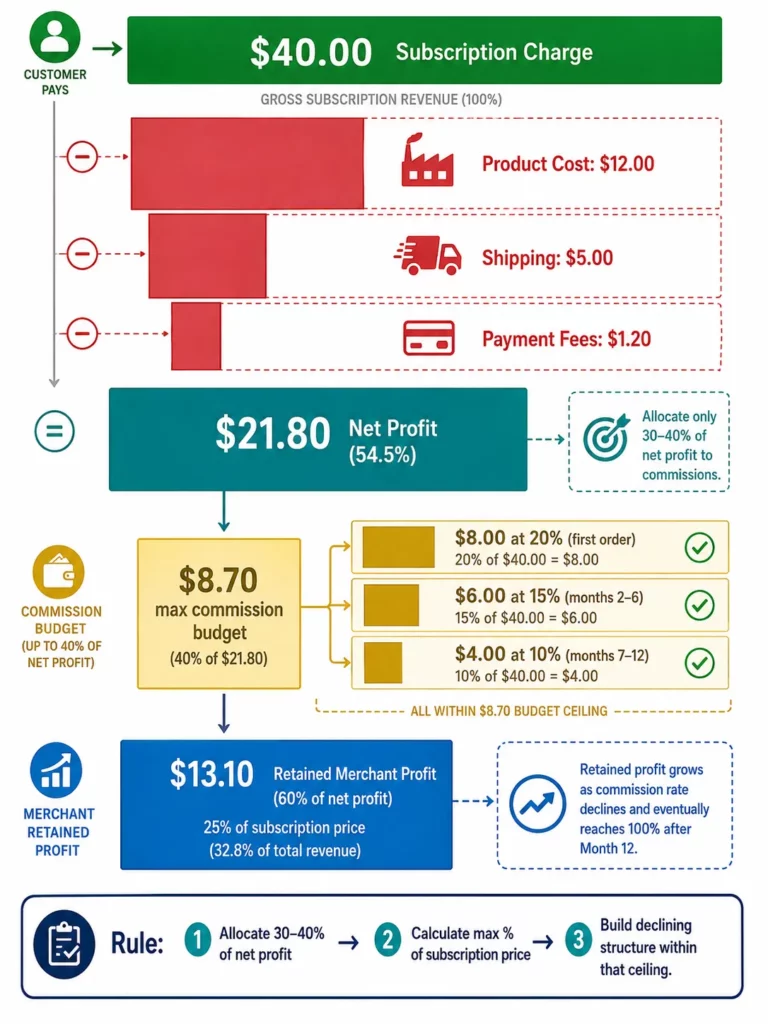
Start with your net profit per shipment. If your product costs $12 to make, $5 to ship, and Shopify takes roughly $1.20 in payment fees, your net profit per charge is about $21.80 (a 54.5% margin).
A common rule of thumb is to allocate 30–40% of that net profit toward affiliate commission. At 40%, your maximum budget is roughly $8.70 per month, which works out to about 22% of the subscription price.
That gives you room for a declining structure: 20% on the first order, 15% on renewals through month 12, and 0% after that. All three rates stay within your margin budget.
The rates shift depending on what you sell. Higher-margin categories can afford more generous recurring payouts, while lower-margin products may need a shorter commission window or a steeper decline.
| Subscription type | Price range | Typical margin | First order | Recurring | Duration |
| Beauty box | $35–50 | 50–65% | 20–25% | 12–15% | 6–12 months |
| Supplements | $30–60 | 60–80% | 25–35% | 15–20% | 6–12 months |
| Coffee / food | $15–30 | 40–55% | 15–20% | 8–12% | 6 months |
| Pet supplies | $25–45 | 50–60% | 18–22% | 10–15% | 6–12 months |
| Clothing box | $40–80 | 45–60% | 15–20% | 10–15% | 6–12 months |
The pattern across categories is consistent: first-order rates run higher because that’s the hardest conversion to drive.
Recurring rates step down to protect your margin over time. The commission window should match how long the affiliate’s referral still influences the subscriber’s decision to stay.
How Do Recurring Commissions Change Affiliate Behavior?
The commission model shapes how affiliates promote, not just how much they earn.
When the payout structure shifts from one-time to recurring, the effects cascade through affiliate behavior.
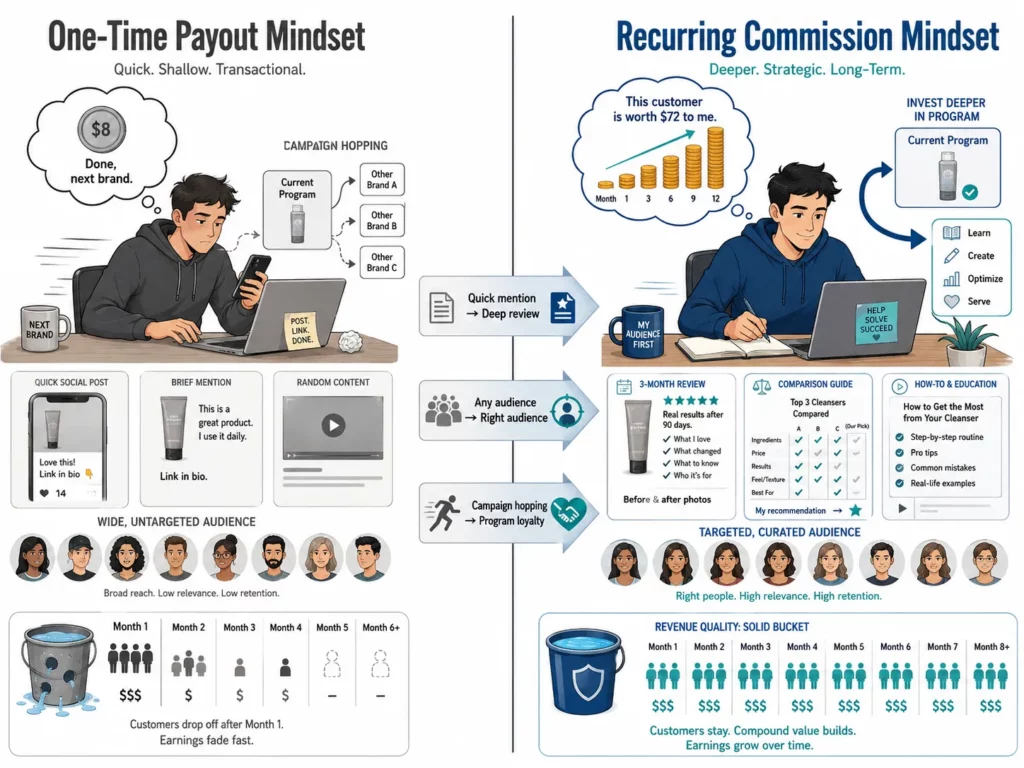
Recurring commissions give affiliates a direct financial stake in subscriber retention. A customer who churns after month one earns the affiliate $6. One who stays a year earns $72.
When the math is that clear, affiliates naturally target audiences who are likely to stick around.
And once retention becomes the priority, the content changes too. A three-month review or a detailed product comparison becomes worth the effort when recurring income is at stake.
Quick mentions with a link in bio don’t build the kind of trust that keeps subscribers paying.
Better content leads to better-informed subscribers, and better-informed subscribers churn less.
Those shifts compound into program loyalty. Affiliates earning recurring income from your program don’t cycle through campaigns looking for the next brand to promote.
They stay and become long-term partners, which means your acquisition costs go down over time while output goes up.
What Changed in 2026?
A year ago, recurring commissions were a competitive advantage for subscription brands running affiliate programs. In 2026, they’ve become the baseline.
Experienced affiliates now evaluate subscription programs on whether commissions recur, not just whether they exist. Programs still offering one-time payouts only face a growing disadvantage when recruiting partners who have recurring options elsewhere.
Declining rate structures have gained traction alongside this shift. More brands now set higher first-order rates and step commissions down over 6 to 12 months, rather than paying a flat percentage on every renewal.
This approach protects margin while still giving affiliates a meaningful income window.
The broader trend is convergence between subscription commerce and affiliate marketing. As more Shopify stores add subscription products, the demand for affiliate tools with built-in subscription tracking continues to grow.
Frequently Asked Questions
Do I have to pay recurring commissions forever?
Only if you choose the lifetime recurring model. Most subscription brands use time-limited recurring instead, which caps commission at 6 to 12 months. After the cap, the affiliate earns nothing on future renewals, and you retain 100% of the subscription revenue from that point forward.
What happens when a subscriber pauses their subscription?
No payment means no commission. If a subscriber pauses for a month, no charge is processed and the affiliate doesn’t earn anything for that period. When the subscriber resumes and a new charge goes through, commission tracking picks back up automatically.
What happens if a subscriber upgrades or downgrades their plan?
Commission adjusts based on the actual payment amount. If a subscriber moves from a $40 plan to a $60 plan, the affiliate’s percentage applies to $60. A downgrade to $25 means commission is calculated on $25. Most subscription-affiliate integrations handle this through the payment webhook without manual adjustment.
Do affiliates prefer recurring commissions or a higher one-time payout?
It depends on the affiliate type. Professional affiliates (bloggers, influencers managing multiple programs) tend to prefer recurring because it compounds over time. Casual referrers often prefer a higher one-time payout for the immediate reward. Offering both options can work well.
Can I combine a one-time bonus with recurring commissions?
Yes. A common structure is a higher one-time bonus on the first order (say 20%) plus a lower recurring rate on renewals (say 10% for 12 months). The bonus motivates the initial referral, and the recurring rate motivates quality. Most affiliate apps that support subscription tracking can handle this setup.
Does every affiliate app support recurring commission tracking?
No. Recurring commission tracking requires a direct integration between your affiliate app and your subscription platform. Not every tool supports this, so confirm compatibility before committing. Look for apps that explicitly list subscription integrations, and test a renewal before going live.

Ellie Tran, a seasoned SEO content writer with three years of experience in the eCommerce world. Being a part of the UpPromote team, Ellie wants to assist Shopify merchants in achieving success through useful content & actionable insights.Ellie's commitment to learning never stops; she's always eager to gain more knowledge about SEO and content marketing to create valuable content for users. When she's not working on content, Ellie enjoys baking and exploring new places.
![How to Use Shopify Functions with Your Affiliate Program [2026 Guide]](https://static.uppromote.com/wp-content/uploads/2026/06/how-to-use-shopify-functions-with-affiliate-program-300x169.webp)

![How to Prevent Affiliate Fraud on Shopify: Self-Referral, Coupon Abuse & More [2026]](https://static.uppromote.com/wp-content/uploads/2026/06/how-to-prevent-affiliate-fraud-on-shopify-300x169.webp)