











TL;DR
Affiliate marketing pays off for most Shopify stores with 20%+ product margins — but only after several months of active setup and recruitment.
- Revenue contribution: 15–40% of total sales for mature programs
- Commission range: 3–25% depending on product category
- Payout model: Pay only after sales clear — no upfront spend
- Timeline to results: Several months to first meaningful revenue
- Minimum margin needed: 20%+ to support standard commissions
Every Shopify owner faces the same wall: Meta and Google ad costs keep climbing, email lists saturate, and SEO takes months to show. Paid ads burn cash on impressions that never convert.
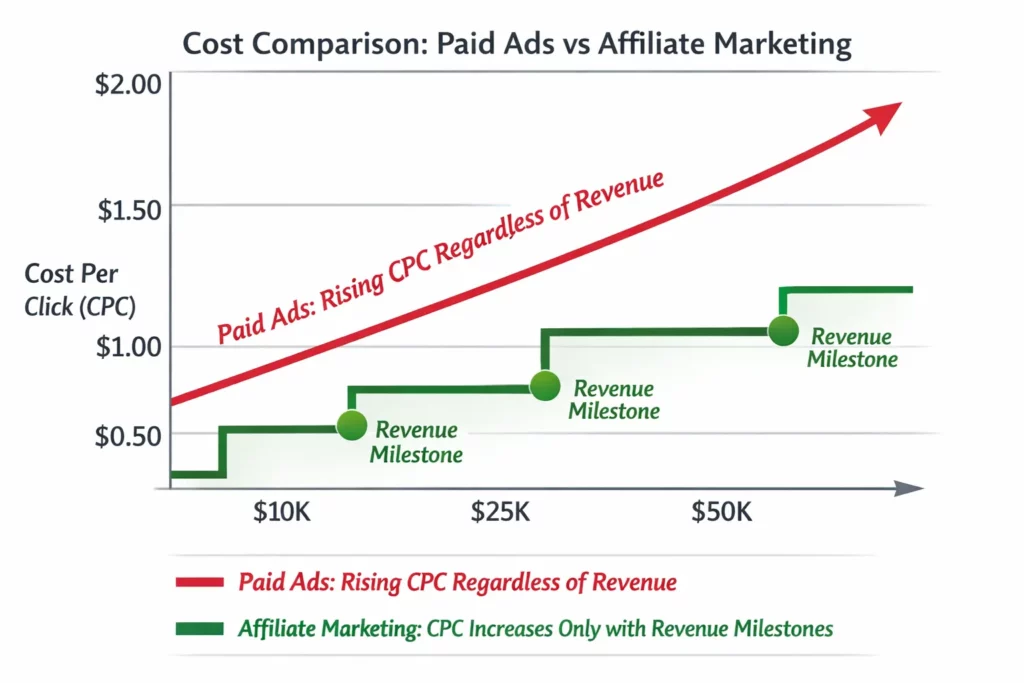
Affiliate marketing works differently. You pay only when a sale clears — no upfront spend. Your cost scales with revenue, not impressions.
That’s why affiliate marketing has become a core revenue channel for Shopify merchants of every size.
Getting started is simpler than most think — this guide walks you through the entire playbook. You’ll see how it works, what it costs, what to expect in your first 90 days, and seven steps to launch this week.
Real merchant data backs every claim — not vendor hype.
How Does Affiliate Marketing Work for a Shopify Store?
Affiliate marketing on Shopify operates on a performance-based model.
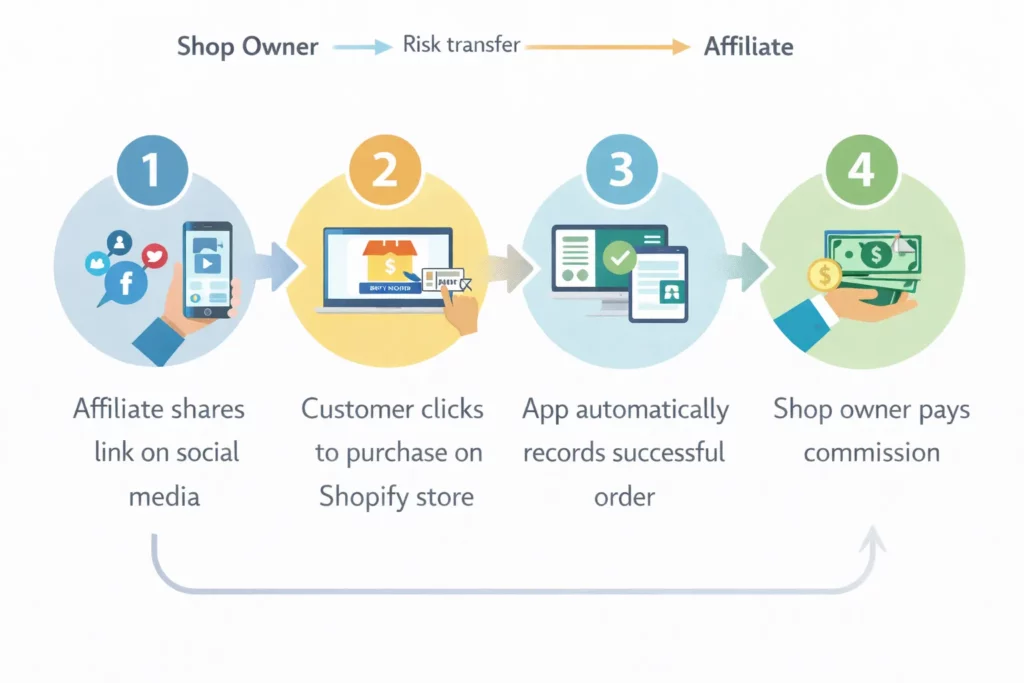
A partner shares their unique link on Instagram, YouTube, a blog, or email. When a visitor clicks and buys, your app tracks the sale and credits the partner’s commission.
The partners, customers, creators, and publishers, earn commission on every sale they drive. You only pay after the sale clears. That shifts risk off your ad budget and onto shared success.
This is the opposite of paid ads. You pay for clicks and impressions there; you pay only for revenue here.
And those partners aren’t limited to one type.
Your best customers can become affiliates, earning commission on friends they refer.
Content creators — bloggers, YouTubers, TikTokers — fit the model too, alongside coupon sites, deal communities, and niche publishers.
How Does Affiliate Marketing Compare to Other Shopify Marketing Channels?
Affiliate marketing is the only major Shopify marketing channel where you pay after a sale closes. Paid ads, SEO, email, and influencer deals all require upfront investment before any revenue lands.
That cost model is the core difference. With affiliates, the financial risk of a failed attempt sits with the partner, not you.
| Affiliate marketing | Pay-per-sale | Minimal (app fee) | Partner absorbs effort | Several months |
| Meta ads (Facebook / Instagram) | Pay-per-click / impression | High | You pay for every click | Days |
| Google Ads (Search / Shopping) | Pay-per-click | Moderate to high | You pay for every click | Days to weeks |
| SEO | Content + time | Low cash, high time | Compounds slowly or not at all | 6–12 months |
| Email marketing | List building + software | Low after setup | You own the channel | Days (with list) |
| Influencer (flat-fee) | Fixed payment upfront | Moderate to high | You pay regardless of the result | 1–4 weeks |
Paid ads deliver revenue within days of launch, but every failed click still costs you.
Meanwhile, affiliate marketing takes several months to ramp up, but partners absorb the cost of tests that don’t convert.
That contrast is why most stores shouldn’t pick just one channel. The smarter play: run affiliate alongside paid ads and email, they feed each other.
Meta retargeting captures affiliate traffic that didn’t convert on the first visit. Email nurtures affiliate-referred customers into repeat buyers. Your affiliate program turns happy customers from any source into new acquisition partners.
They compound, not compete.
Key takeaway: Affiliate marketing is the only Shopify channel where you pay only after a sale clears, making it the ideal complement to paid ads, not a replacement.
How Much Revenue Can Affiliate Marketing Generate for a Shopify Store?
Mature Shopify affiliate programs generate 15–40% of total revenue, with outliers reaching 70–80% in niche verticals.
The range depends on product category, commission structure, and how long the program has been running.
These ranges come from tracked merchant data, not projections. The spread tells you which categories punch above their weight.
High-ticket products set one anchor.
Apollo Scooters, an electric scooter brand, drives 15–20% of total revenue through affiliates. High average order values do the heavy lifting, and even moderate commission rates produce meaningful payouts, which keep partners motivated.
Piper Blue Makeup sits in a different zone.
This beauty brand pulls in $30,000 monthly from 800+ affiliates, accounting for 30–40% of total revenue. Visual products thrive here because influencers can demo them in one clip.
At the extreme end sits Blushield USA. The health-tech brand drives 70–80% of total revenue — affiliates are their entire distribution channel.
Those outliers live in niches where word-of-mouth trust beats paid advertising.
This isn’t a handful of outliers. More than 150,000 eCommerce brands run affiliate programs on UpPromote today.
Of those, 3,246 stores generate over $100K per month in Shopify GMV, and another 7,436 hit the $50K+ monthly mark. Together, merchants on the platform tracked over $1 billion in affiliate GMV in 2025.
These numbers come from mature programs — not month-one results. Setup, recruitment, and iteration take several months of active work before an affiliate channel delivers meaningful revenue.
Industry benchmarks suggest most programs reach full maturity over a 6–12 month period (Bell Interactive).
How Much Revenue Can Affiliate Marketing Generate for a Shopify Store?
Mature Shopify affiliate programs generate 15–40% of total revenue, with outliers reaching 70–80% in niche verticals.
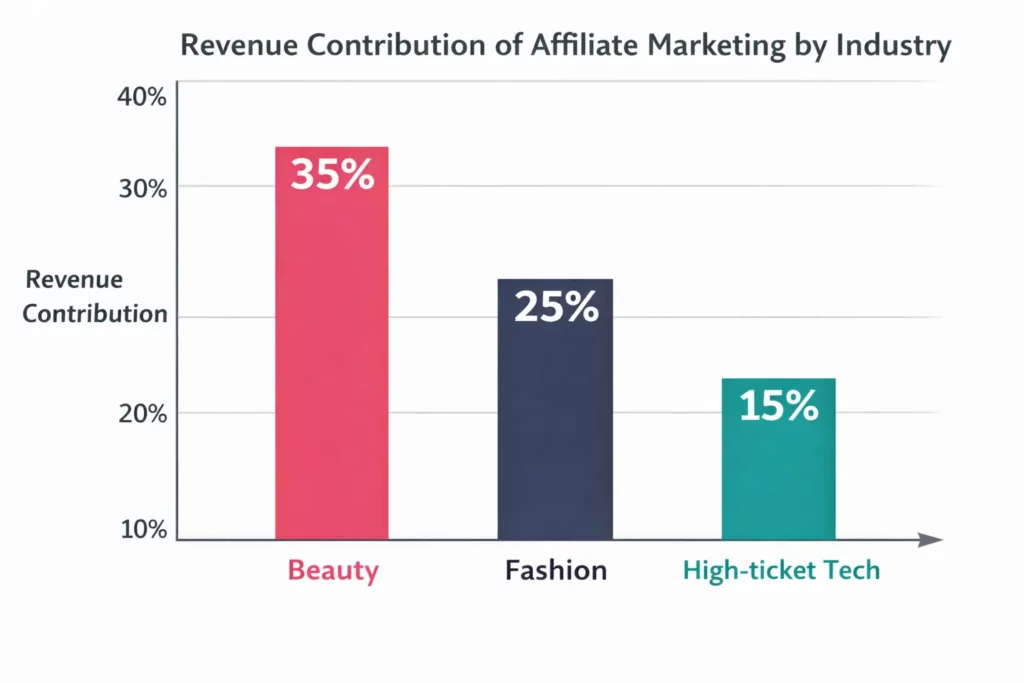
The range depends on product category, commission structure, and how long the program has been running.
These ranges come from tracked merchant data, not projections. The spread tells you which categories punch above their weight.
Apollo Scooters anchors the high-ticket end. The electric scooter brand drives 15–20% of total revenue through affiliates.
High average order values do the heavy lifting, and even moderate commission rates produce meaningful payouts that keep partners motivated.
Piper Blue Makeup occupies the mid-range. The beauty brand pulls $30,000 monthly from 800+ affiliates — 30–40% of total revenue. Visual products thrive here because influencers can demo them in one clip.
At the extreme end sits Blushield USA. The health-tech brand drives 70–80% of total revenue — affiliates are their entire distribution channel.
Those outliers live in niches where word-of-mouth trust beats paid advertising.
Where you’ll land depends on two things: how visual your product is, and how strong word-of-mouth runs in your category.
Visual products in trust-driven niches sit at the higher end; commodity products sit at the lower end.
But every range above assumes a mature program. Setup, recruitment, and iteration take several months of active work before an affiliate channel delivers meaningful revenue.
Industry benchmarks suggest most programs reach full maturity over a 6–12 month period (Bell Interactive).
Is Your Shopify Store Ready for Affiliate Marketing?
Not every Shopify store is ready for affiliate marketing. Five prerequisites separate stores that will see ROI within several months from stores that will burn effort with no return.
Getting any of these wrong makes affiliates walk away or drains your margin. Check each one before recruiting your first partner.
| Criterion | Minimum threshold | Why it matters |
| Product margin | 20%+ after COGS | Covers 5–15% commission + 1.5–2% app fee, leaves net profit |
| Product-market fit | Converts cold traffic; positive reviews | Affiliates won’t promote products their audience won’t buy |
| Existing customer base | At least 100 past customers | Your first (and easiest) affiliates come from happy buyers |
| Demonstrable product | Visual, explainable in <60 seconds | Creators can’t sell what they can’t show |
| Multi-month runway | Team time + cash for setup | Programs don’t break even in the first weeks |
The margin rule is the hardest stop. If your product has 15% margin, a 10% commission plus a 2% app fee leaves 3% before Shopify fees and shipping. One refund wipes out three orders’ profit.
Product-market fit matters almost as much. Affiliates run the same traffic test your ads run: does the page convert?
If cold traffic converts below 1%, affiliates will log in once, push traffic, see no commission, and disappear.
Unlike those first two, the last three criteria accelerate your ramp rather than block it. Without a customer base, you’ll recruit more slowly. With a complex product, creator options narrow. With less runway, you’ll quit before results show.
What if you score low on margin or product-market fit? Don’t launch yet.
Each weak prerequisite has a clear fix. Bundle products to lift margin, fix your product page conversion, or acquire 50–100 customers through paid ads first.
Key takeaway: Affiliate marketing rewards stores with 20%+ margins, proven product-market fit, and a multi-month runway — fix any weak prerequisite before recruiting your first partner.
How to Set Up Your First Shopify Affiliate Program in 7 Steps
Setting up your first Shopify affiliate program takes 1–2 weeks of focused work. Seven steps move you from app install to your first tracked sale — and from there, the program runs itself with check-ins each week.
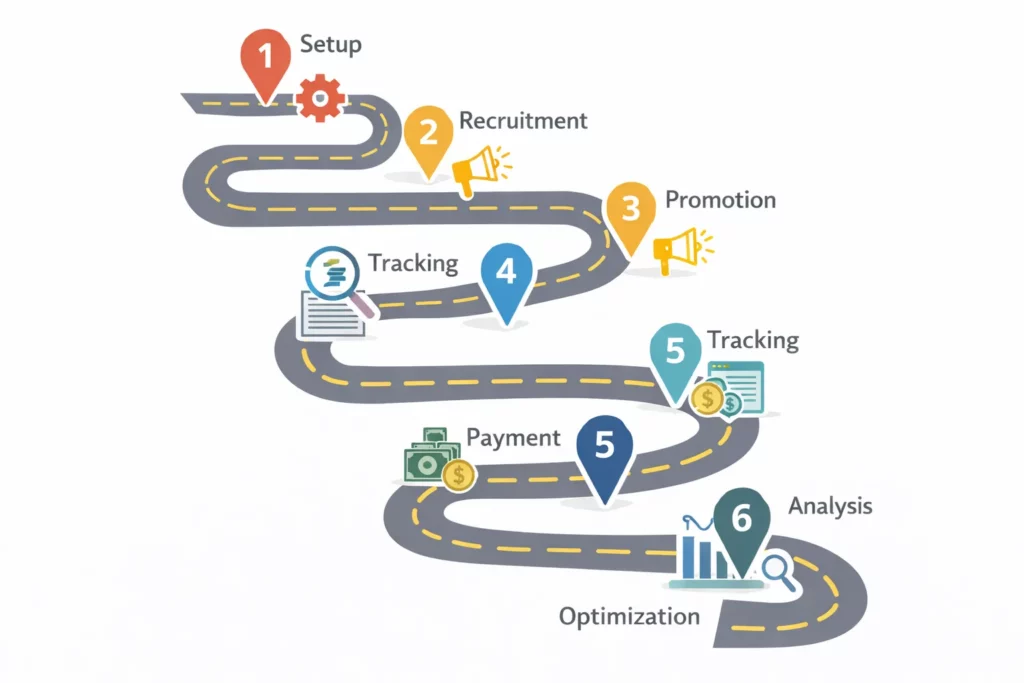
The order below matters. Each step unblocks the next, and skipping ahead creates friction that slows recruitment in week 3 or 4.
Step 1: Pick an affiliate marketing app (Day 1)
The right app handles tracking, payouts, and partner management without you touching code. Look for Shopify-native integration, fraud detection, and flexible commission rules. Most apps offer free plans with low referral caps, so you can test before paying.
Most installs take 5 minutes. Spend the next 30 clicking through the dashboard to map where commissions, referrals, and approval queues live before any affiliates sign up.
Step 2: Set your commission structure (Day 1–2)
Your commission rate decides whether affiliates apply. The standard for physical products is 5–15%, digital goods 20%+, and high-ticket items 3–8%. Start at the high end of your range — you can tier down later.
The math comes before the percentage. Take your gross margin, subtract Shopify fees and shipping, and you’ll see the maximum commission you can pay without losing money on every sale.
Step 3: Build your registration page (Day 2)
Your registration form is where serious affiliates separate from spammers. The essential fields are name, audience size, content channels, and one example of past promotion work. Every extra question costs you sign-ups, so cut anything optional.
The page itself needs to look like your brand. Add your logo, a one-paragraph pitch on why your program is worth joining, and clear terms — commission rate, payout schedule, and approval criteria.
Step 4: Build your asset library (Day 3–5)
Affiliates with assets sell more than those without. Your shared folder needs product photos, brand logos, copy templates, and 3–5 product videos. Tools like UpPromote include a media gallery, so partners download everything from one place.
Pre-written captions cut the biggest source of friction. Write 5 short post templates for Instagram, TikTok, and email — the lower the lift for affiliates, the faster they post.
Step 5: Recruit your first 10 affiliates (Week 1–2)
Your first 10 affiliates should already love your product. Repeat buyers and 5-star reviewers make the strongest converts. Email your top 50 with an affiliate invite — most will say yes.
Your second wave comes from outside your customer base. Search Instagram and TikTok for niche hashtags, find creators with 5K–50K followers, and send each one a personal note.
Step 6: Define approval rules and fraud protection (Day 5)
Not every referral order should auto-approve. Set a delay window — 14 days is standard — so refunds and chargebacks resolve before commissions lock in. Most affiliate apps include fraud detection that flags self-referrals and suspicious IP patterns.
Fraud rules need a check-in at week 4 and week 12. Patterns shift as your program grows — early bad actors can become real revenue leakage by month 3.
Step 7: Set your payout schedule and iteration loop (Week 2 onward)
Your payout cadence sets affiliate trust. Most stores pay every two weeks or every month — pick one and stick to it. A 15-minute review each week surfaces top performers you can promote to higher commission tiers.
By month 2, you’ll know which affiliates convert and which don’t. The top 20% deserve a commission bump; the bottom 50% need re-engagement or removal.
What Commission Rate Should You Pay Shopify Affiliates?
Commission rates for Shopify affiliate programs vary by product category — apparel programs often pay 15–20%, beauty 15–25%, and high-ticket physical goods 3–8%.
The right rate for your store depends on margin, customer lifetime value, and what your direct competitors offer.
Your margin sets the ceiling. Your maximum commission is whatever you can pay after Shopify fees, COGS, and shipping while still hitting your target net margin.
That ceiling shows up in real numbers. A $50 item with 40% gross margin loses ~5% to fees and shipping, leaving 35%. A 15% commission keeps 20% net. A 25% commission leaves 10% — one refund from unsustainable.
With the math settled, the next question is what’s competitive in your niche. The table below shows starting ranges for the most common store types.
| Product type | Recommended starting range | Why |
| Apparel/fashion | 15–20% | Margins of 50–70% support higher % |
| Beauty (professional) | 15–25% | High repeat purchase + strong margins |
| High-ticket physical | 3–8% | Order value carries the payout |
Two case studies anchor those ranges. Jenni Bag, a fashion brand, runs a flat 20% commission and pays partners every week.
GoldieLocks pays salon affiliates 15% base and bumps to 25% for top performers
That tiered approach matters more than the rate alone. By month three, your top affiliates deserve more than your bottom tier, and tier-based commissions deliver the bump without manual work.
Apps like UpPromote include auto-tier commission feature — once an affiliate hits a sales threshold, they move into the next bracket without you lifting a finger.
Even with the right rate and structure, three commission mistakes show up in every program audit:
- Setting rates too low to compete with similar stores in your niche
- Building flat structures that pay the same to your top 1% and your bottom 50%
- Promising rates your math can’t sustain after returns and refunds
How Do You Recruit Your First 50 Affiliates?
Your first 50 Shopify affiliates come from three sources, recruited in order: existing customers, niche creators, and passive marketplace listings.
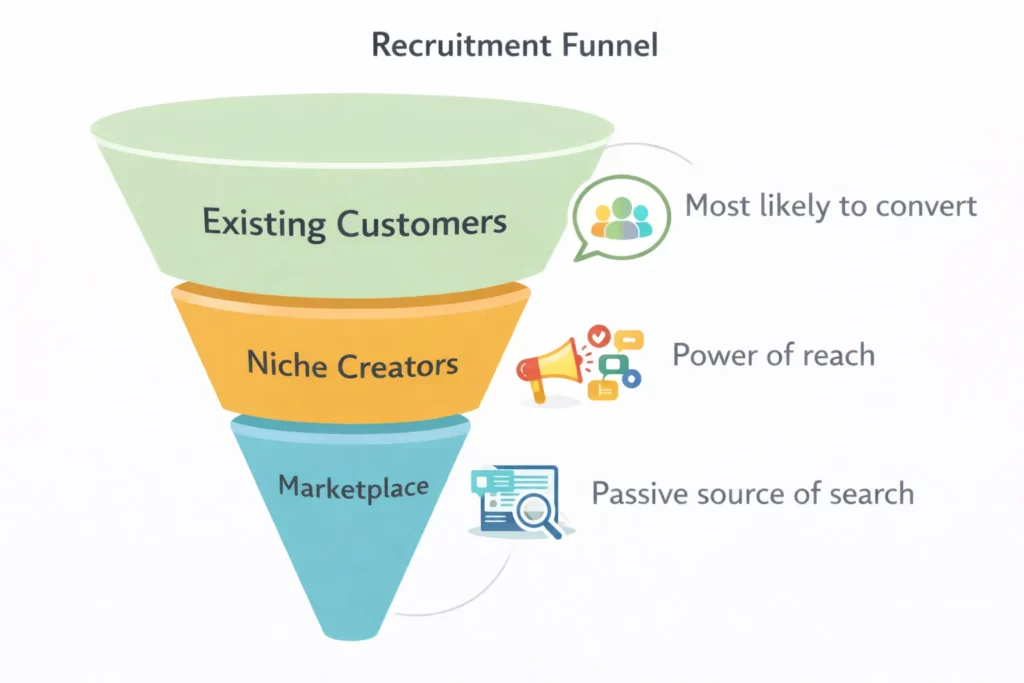
Each source has a different conversion rate and effort cost, and the order matters because warmer leads make the first weeks easier.
Customers convert fastest because they already trust you. Creators take more outreach but bring audience reach. Marketplace listings work in the background once your other channels are running.
Channel 1: Your Existing Customers (Highest Conversion)
Your best buyers already love your product. They’re the lowest-effort recruits in your pipeline.
Pull a list of customers who’ve bought twice or left a 5-star review, then send a personal invite from your store email.
Your invite needs three things: a clear commission offer, a 1-click signup link, and one sentence on why you picked them.
Long pitches kill response rates — keep it under 100 words.
Piper Blue Makeup built a base of 800+ affiliates this way, much of it from converted customers and beauty community insiders. Their program now drives $30,000 per month in affiliate sales.
Channel 2: Niche Creators (5K–50K Followers)
Creators with 5K–50K followers are the sweet spot for cold outreach. They have engaged audiences, lower rates than mega-influencers, and most are open to affiliate deals.
Your search starts inside your product’s hashtag and your top competitors’ tagged photos. Fit beats follower count every time.
Your first message should be short — three sentences max. Reference one specific post they made, name your offer, and link to a 1-click signup form.
Freewell Gear hand-picks affiliates by technical product expertise, not follower count. The approach built a global network of ~700 creators and generated $350,000 in affiliate revenue within two months.
Channel 3: Marketplace Listings (Passive Recruitment)
Marketplace listings let affiliates find you, not the other way around. Partners browse offers in your niche and apply on their own — no outreach required.
UpPromote Marketplace allows merchants to publish their offers to a built-in network of affiliates. Marketplace recruits convert slower than direct outreach, but the channel runs in the background once your program is live.
Of those 50 sign-ups, only 10–15 will become active affiliates in month one. Most programs follow a Pareto pattern; a small handful of partners drive most of your revenue.
How Do You Track and Optimize Your Shopify Affiliate Program?
A healthy Shopify affiliate program tracks 5 core metrics every week and runs a cohort review every month.
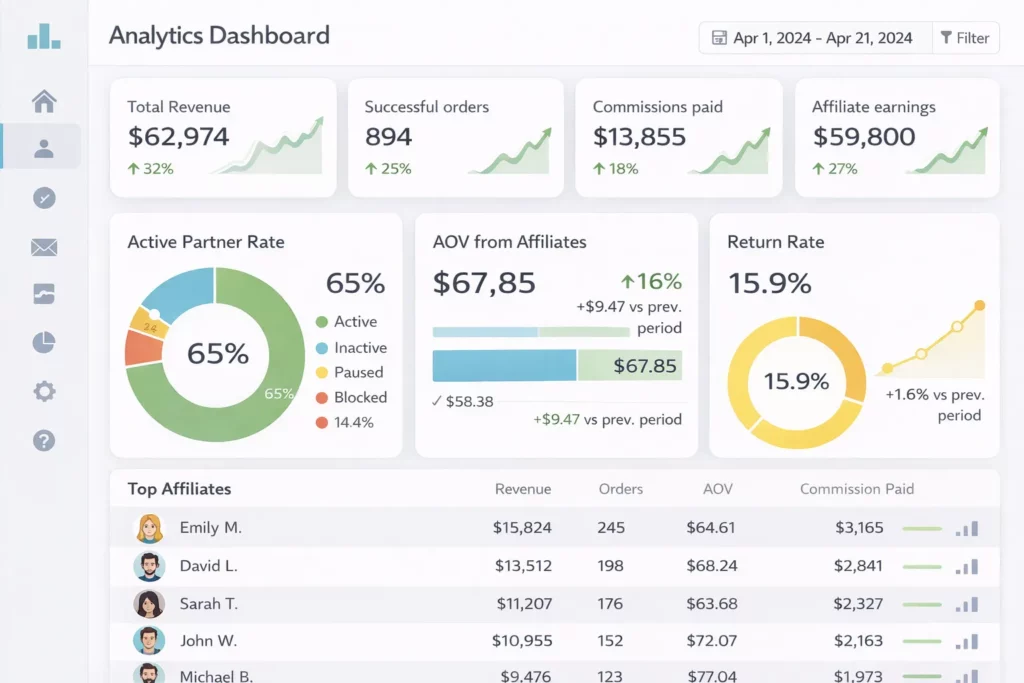
These numbers tell you which affiliates to promote, which to remove, and which products move best through partner channels.
A weekly check-in catches problems before they grow.
A deeper review each month surfaces patterns: top performers ready for promotion, dead accounts to re-engage, and partner-only winners.
The five metrics below cover the full quality picture — recruitment efficiency, performance distribution, partner mix, and audience fit.
| Metrics | What it tells you | What good looks like |
| Active affiliate rate | Share of sign-ups making at least one sale | 1 in 4 sign-ups |
| Top affiliate concentration | Revenue from top 20% of partners | Pareto pattern (60–80%) |
| Referral conversion rate | Quality of clicks affiliates send | At or above your organic rate |
| Referral AOV | What partners drive per order | Match or beat store AOV |
| Referral refund rate | Audience fit and product expectation match | At or below store average |
The Pareto pattern is the most important to monitor. When top performers pull away, promote them fast, commission bumps, gifts, exclusive previews, before a competitor poaches them.
Refund rate is the second signal worth watching. A spike means an affiliate is overselling or targeting the wrong audience — flag the partner, then retrain or remove.
A 15-minute review each week covers all five metrics. Open the dashboard, scan top performers, check active rate, flag refund spikes. That’s the ritual.
Most affiliate apps include a built-in analytics dashboard. UpPromote, for example, ships a performance dashboard that shows total affiliates, clicks, orders, commissions, and conversion rates in a single view.
The deeper review each month goes beyond the week’s quick checks.
You can group affiliates by signup month, find which sources produce the most active partners, and double down on what converts.
What Mistakes Do First-Time Shopify Affiliate Programs Make?
Five mistakes kill most first-time Shopify affiliate programs in their first 90 days.
- Launching before product-market fit
- Approving every applicant
- Ignoring fraud signals
- Treating all affiliates the same
- Quitting before the first results compound.
Each one is preventable. None of them appear in vendor pitch decks, but they appear in every program audit.
Mistake 1: Launching Before Product-Market Fit
Affiliates can’t sell what doesn’t already convert. If your cold traffic converts below 1%, partners will push traffic, see no commission, and disappear within two weeks.
Product-market fit needs to come first. Run paid ads to your top product, hit 1.5%+ conversion from cold traffic, then open the affiliate program.
Mistake 2: Approving Every Applicant
Open-door programs attract spammers and coupon scrapers, not promoters. Within month one, your list fills with dead accounts and fake sign-ups.
A vetting bar costs almost nothing. Ask for audience size, content channel, and one example of past promotion — even a 60-second review filters most of the noise.
Mistake 3: Ignoring Fraud Signals
Self-referrals, IP clusters, and disposable email sign-ups drain commission budgets without warning. Most first-time merchants notice only after a payout cycle exposes the leak.
Most affiliate apps include fraud detection — UpPromote, for example, flags self-referrals, suspicious IP patterns, and disposable email domains by default. Turn it on day one.
Mistake 4: Treating All Affiliates the Same
A flat program pays your top 1% the same as your bottom 50%. Top performers feel undervalued and leave; bottom performers have no incentive to climb.
Tiering from week one solves both problems. A simple 2-tier structure — base rate plus a top-performer rate — needs no complex setup.
Mistake 5: Quitting Before Results Compound
Most affiliate programs show their first meaningful revenue several months after launch. Merchants who quit after the first month or two never see the curve bend.
The first stretch is setup, recruitment, and friction. Once active partners start converting at scale, patience pays.
Which Affiliate Marketing Trends Should Shopify Stores Watch in 2026?
Four trends are reshaping Shopify affiliate programs in 2026: short-form video, AI-generated content vetting, customer-affiliate convergence, and hybrid payment models. Each updates a playbook you already run.
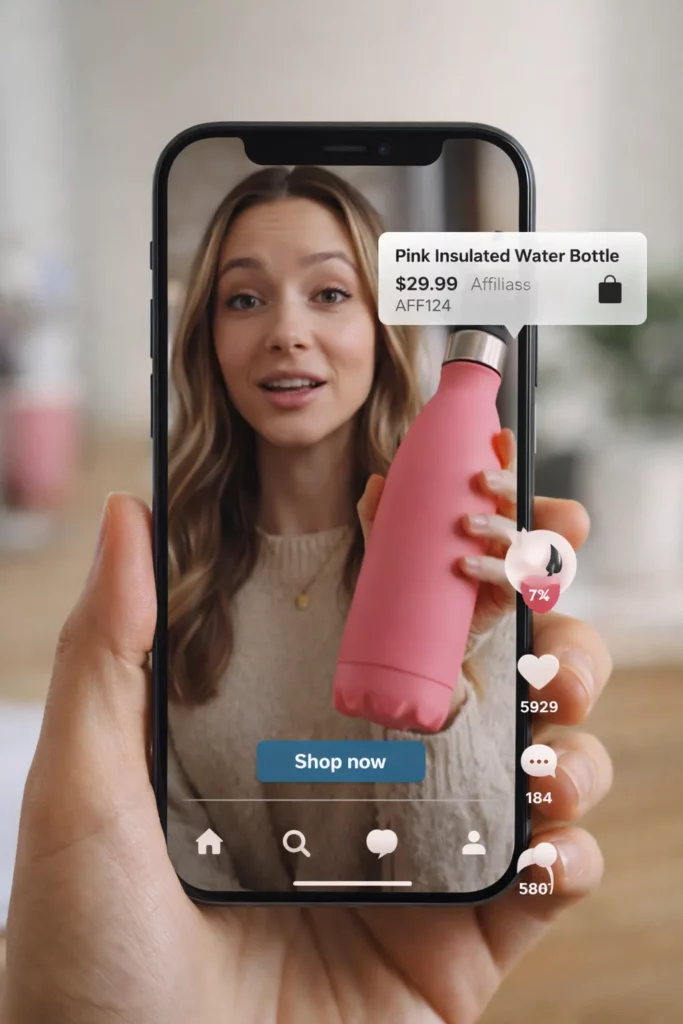
Trend 1: Short-Form Video Drives Affiliate Discovery
TikTok, Instagram Reels, and YouTube Shorts are now the default product discovery layer for younger buyers. Affiliates with strong short-form skills outperform blog-only partners in most physical product categories.
Your media gallery needs short-form-ready assets. Think vertical product clips, 15-second demos, and editable raw footage — not the polished brand video from last year.
Trend 2: AI-Generated Content Forces Tighter Vetting
Affiliates now use AI tools to scale content production. Quality runs from polished to spam — and some brands have started requiring AI disclosure on product reviews.
Your vetting process needs an update. Add one question on content production methods to your registration form, and spot-check new affiliates’ first three posts.
Trend 3: Customer-Affiliate Convergence
The line between a customer who refers friends and a formal affiliate is blurring. Tiered ladders now move buyers from casual referrer to active affiliate to ambassador.
Your program needs entry points for customers not ready for formal affiliate status. A simple referral link with a small commission is the doorway most buyers walk through first.
Trend 4: Hybrid Payment Models Replace Cash-Only
Cash commission alone is no longer the default. Top programs mix cash with store credit, free products, and exclusive access — each motivating a different partner type.
Altenew differentiates payment by affiliate type: cash for professional creators, store credit for customer advocates. The split keeps both groups motivated without inflating the cash line.
Frequently Asked Questions
How much does it cost to start affiliate marketing on Shopify?
Most Shopify stores spend $0–30 per month on an affiliate app plus commission on every tracked sale. Free plans cover the basics: tracking, low referral caps, and a registration form.
Paid plans starting around $30 unlock fraud protection, automated payouts, and unlimited programs.
Do I need a Shopify app for affiliate marketing?
Yes, once your program crosses 5 active affiliates. Tracking referrals manually breaks down beyond a handful of partners — you’ll lose sales attribution, make commission errors, and miss fraud signals.
Apps automate every part of this for under $30 per month on entry plans.
How long does it take to see results from a Shopify affiliate program?
Most programs deliver meaningful revenue after several months of active setup and recruitment. The first stretch covers app setup, registration page, asset library, and recruiting your first 10 affiliates. Revenue starts to compound once active partners post on a regular schedule.
What’s the difference between affiliate marketing and influencer marketing?
Affiliate marketing pays a partner after a sale closes; influencer marketing pays a fixed fee upfront regardless of result.
Affiliate marketing shifts risk to the partner and works for any store with margin to share. Influencer marketing works when you need brand awareness and have budget for guaranteed posts.
Can small Shopify stores succeed with affiliate marketing?
Yes — small stores with 20%+ margins and proven product-market fit often outperform larger ones. Niche stores attract niche affiliates who know which audience converts. The smaller and more focused the product, the more powerful word-of-mouth recruitment becomes.
How do you pay Shopify affiliates?
Most affiliate apps support PayPal, store credit, or bank transfer for payouts. Cash via PayPal is the standard for professional creators; store credit works for customer-affiliates who shop your brand anyway.
Pick a single payout cadence — every two weeks or every month — and stick to it.
What products work best for affiliate marketing on Shopify?
Visual, story-driven products with margins above 30% perform best in affiliate channels. Beauty, fashion, home goods, and health products thrive because creators can demo them in a single clip.
Commodity products with thin margins struggle because they leave no room for competitive commission rates.
Is affiliate marketing worth it for Shopify stores in 2026?
Yes for most stores — affiliate marketing remains one of the few channels where you pay only after a sale closes. With paid ad costs rising every quarter, the pay-after-sale model is becoming more valuable, not less.
The caveat: your store needs 20%+ margins and proven product-market fit before launch.

Ellie Tran, a seasoned SEO content writer with three years of experience in the eCommerce world. Being a part of the UpPromote team, Ellie wants to assist Shopify merchants in achieving success through useful content & actionable insights.Ellie's commitment to learning never stops; she's always eager to gain more knowledge about SEO and content marketing to create valuable content for users. When she's not working on content, Ellie enjoys baking and exploring new places.
![How to Use Shopify Functions with Your Affiliate Program [2026 Guide]](https://static.uppromote.com/wp-content/uploads/2026/06/how-to-use-shopify-functions-with-affiliate-program-300x169.webp)

![How to Prevent Affiliate Fraud on Shopify: Self-Referral, Coupon Abuse & More [2026]](https://static.uppromote.com/wp-content/uploads/2026/06/how-to-prevent-affiliate-fraud-on-shopify-300x169.webp)