











TL;DR
Small Shopify stores ($2K–$10K/month in revenue) can run profitable affiliate programs starting at $0 — but only after hitting minimum readiness thresholds.
- Minimum readiness: 50+ orders/month, 30%+ margin, 1%+ conversion rate
- Upfront cost: $0 on free-tier affiliate apps
- Realistic first-6-month revenue: $500–$3,000/month from affiliates
- Time investment: 2–3 hours per week
- Best starting channel: Existing customers, not influencers
“My store is still small — should I even bother with affiliate marketing?” It’s the most common question from merchants doing $2K–$10K per month.
Here’s the flip side most beginners miss.
Most small-to-mid Shopify stores don’t run affiliate programs at all, which means the channel is wide open for whoever moves first in a niche.
Affiliate marketing is uniquely built for small stores. Zero upfront cost, no marketing team required, and you only pay after a sale clears — with an average return of $12 for every $1 spent across the industry (Rakuten, 2023).
This guide shows you exactly when to start, what it costs at your size, and a lean 6-month playbook built for 2–3 hours of work per week.
When Is the Right Time for a Small Store to Start an Affiliate Program?
You’re ready when three conditions hold at once: 50+ orders per month, product margin above 30%, and a site conversion rate of 1% or higher. Hit all three and affiliate marketing becomes a growth lever.
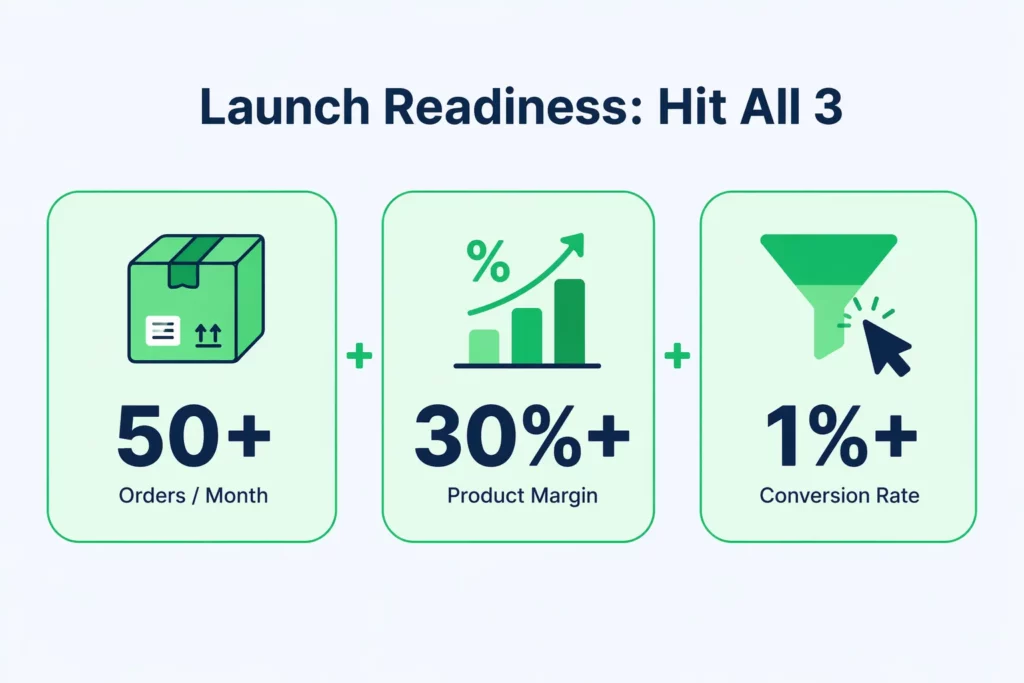
Miss any one and you’ll burn time on a channel your store can’t yet support. Affiliates promote stores where visitors convert and where the commission math works — a store doing 20 orders a month at 15% margin gives them nothing worth pushing.
Here’s the full readiness picture across seven criteria:
| Criteria | Not ready ❌ | Ready ✅ | Ideal 🎯 |
| Monthly revenue | < $2,000 | $2,000–$5,000 | $5,000+ |
| Monthly orders | < 30 | 50+ | 100+ |
| Product margin | < 25% | 30%+ | 50%+ |
| Conversion rate | < 0.5% | 1%+ | 2%+ |
| Product reviews | 0–5 | 10+ | 50+ |
| Social proof | None | Some UGC/tags | Active community |
| Available time | 0 hrs/week | 2–3 hrs/week | 5+ hrs/week |
If most of your answers sit in the “Not ready” column, your priority is product-market fit, not affiliate recruitment. Work on reviews, conversion rate, and customer base first. Revisit affiliate marketing once you hit the “Ready” thresholds.
If you’re in the “Ready” or “Ideal” column, every month of delay hands revenue to competitors who launch first.
But “ready” by the numbers and “ready” in practice aren’t always the same thing — three real-world signals tell you the timing is now.
📱 Social media activity. The clearest signal comes from social. Customers who tag your product in stories or posts are promoting you for free. Formalizing that relationship turns free mentions into a trackable channel.
💸 Rising ad costs. If you’re spending $500+ per month on Meta or Google ads and watching CPA climb, a pay-per-sale channel caps the downside.
👥 Niche creator density. Categories like beauty, food, fitness, and fashion are full of micro-creators looking for small brands to partner with. Visible creator activity in your niche means the recruitment pool already exists.
How Much Does an Affiliate Program Cost for a Small Store?
You can launch an affiliate program for $0 upfront using a free-tier app. Commissions are the one cost that scales. They kick in after a sale clears — cash never leaves before revenue arrives.
That payment structure is what makes affiliate marketing well-suited to small stores. No subscription to justify in month one, no ad budget to recoup, no minimum spend.
Here’s what total spend looks like across the first 12 months for a store doing roughly $5,000/month:
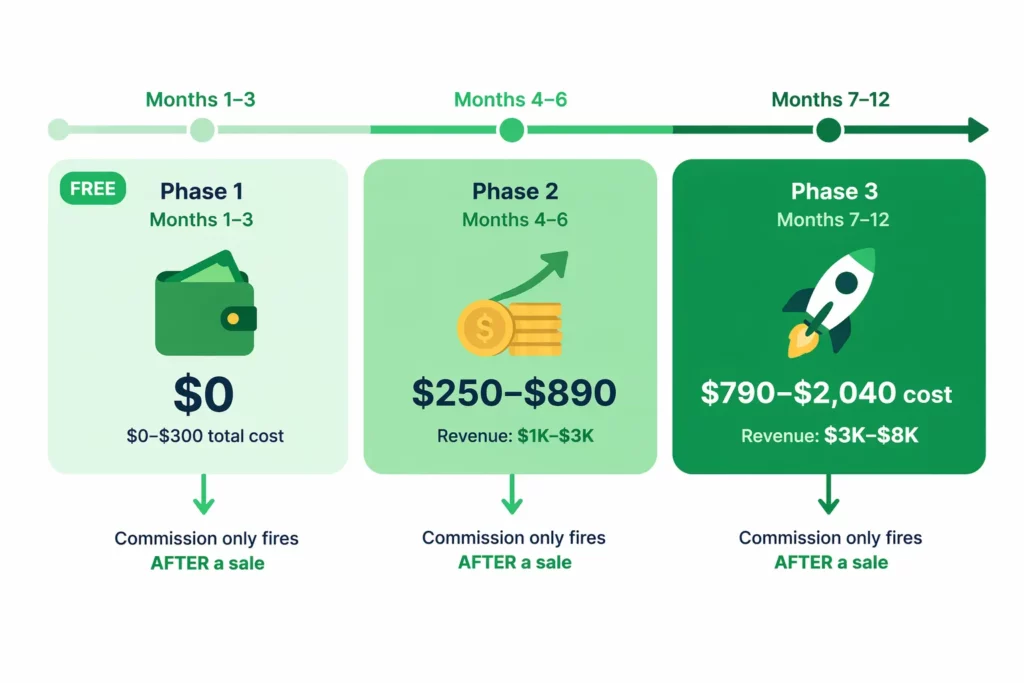
| Cost item | Months 1–3 | Months 4–6 | Months 7–12 |
| App subscription | $0 (free plan) | $0–$30/mo | $30–$90/mo |
| Performance fee on app | $0 | $0–$60/mo | $60–$150/mo |
| Commission payouts | $0–$200/mo | $200–$600/mo | $600–$1,500/mo |
| Product gifting | $0–$100 | $50–$200 | $100–$300 |
| Time investment | 2–3 hrs/week | 3–4 hrs/week | 3–5 hrs/week |
| Total cash cost | $0–$300 | $250–$890 | $790–$2,040 |
| Affiliate revenue | $0–$1,000 | $1,000–$3,000 | $3,000–$8,000 |
Assumptions: 15% commission rate, gradual recruitment from 5 to 30 affiliates over 12 months.
The first three months are the cheapest stretch you’ll get.
Most free-tier apps on the Shopify App Store cover the basics, link tracking, fraud detection, and an analytics dashboard, without taking a cut.
UpPromote’s free plan, for example, includes those plus 200 referral reviews per month. That’s enough headroom for most small stores in their first 6–12 months.
Once revenue starts flowing, paid plans on most apps add a small performance fee, usually 1–2% of affiliate-driven revenue on top of subscription.
Case data confirms it works at smaller scales too.
PRX Performance reported a 78% ROI on its program, and Soundbrenner — a smaller operation — saw affiliates contribute 7–15% of total revenue.
Key Takeaway: Total upfront cost to launch is $0 if you use a free-tier app. Commissions fire after a sale clears, so the program funds itself from the revenue it generates, making this the lowest-risk paid channel a small Shopify store can run.
What’s the Lean Affiliate Launch Plan for a Small Store?
A six-month plan with 2–3 hours of work per week is enough to validate, optimize, and scale an affiliate program at small-store size.
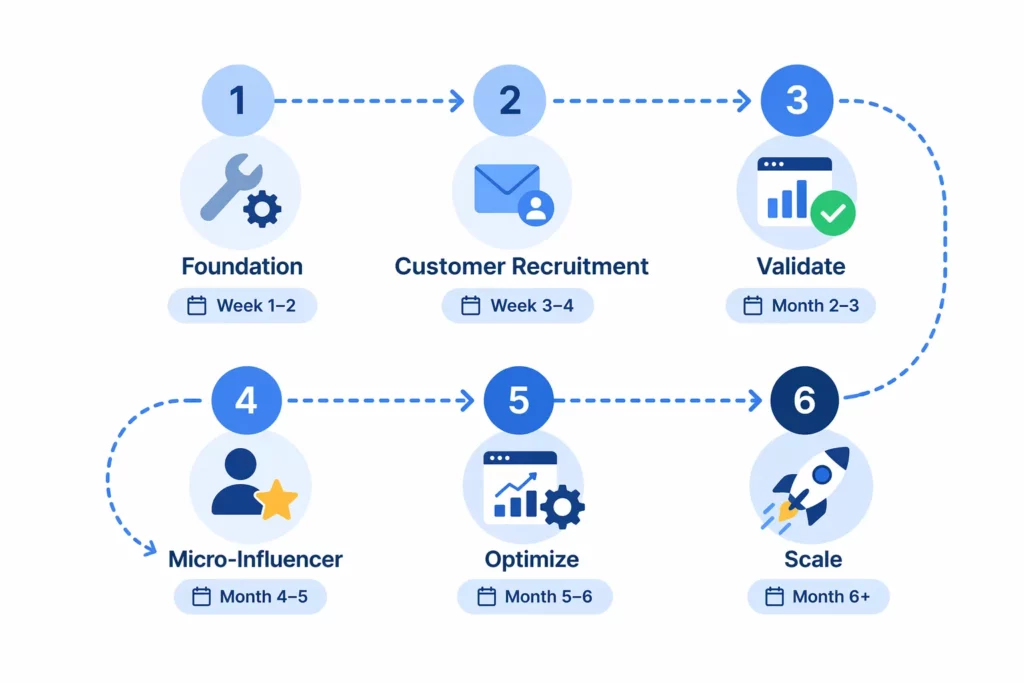
The plan is sequential for a reason: each phase builds the foundation the next one needs.
Recruiting micro-influencers before validating with customers wastes the warm channel; optimizing before validating means optimizing the wrong things.
Here’s what that sequence looks like month by month:
| Phase | Timeline | Key actions | Target outcome |
| 1. Foundation | Weeks 1–2 | Install a free-tier app, set commission rate, customize the registration page, prepare 5–10 product images | Setup complete |
| 2. Customer-first recruitment | Weeks 3–6 | Email top 30–50 customers, enable post-purchase signup, DM social media taggers | 10–15 signups, 3–5 active |
| 3. Validate | Months 2–3 | Track first sales, identify top performers, adjust commission if needed | $500–$1,500 in affiliate revenue |
| 4. Micro-influencer outreach | Months 3–4 | Reach out to 20–30 micro-creators in your niche, send product gifts to top 5 | 25–40 total signups |
| 5. Optimize | Months 4–5 | Create a separate higher-commission program for top performers, send a monthly update email, refresh marketing materials | 10–15 active affiliates |
| 6. Scale decision | Month 6 | Review affiliate revenue as % of total, upgrade app plan if needed, set Year 1 goals | $2,000–$5,000/month |
The reason this sequence works for small stores comes down to recruitment economics.
Cold outreach to influencers gets ignored; warm invitations to existing customers convert at higher rates because the trust already exists.
Your customer list is also the cheapest channel you’ll ever use.
Sending a launch email to 30 loyal customers costs nothing and takes an hour. Reaching the equivalent through influencer outreach takes weeks and often requires free product samples.
Snogo Straws, a small Food & Drink brand, illustrates the upside. By combining physical referral cards, segmented programs for different affiliate groups, and product samples, the brand grew affiliate marketing into 25% of total sales.
What Mistakes Do Small Stores Make with Affiliate Programs?
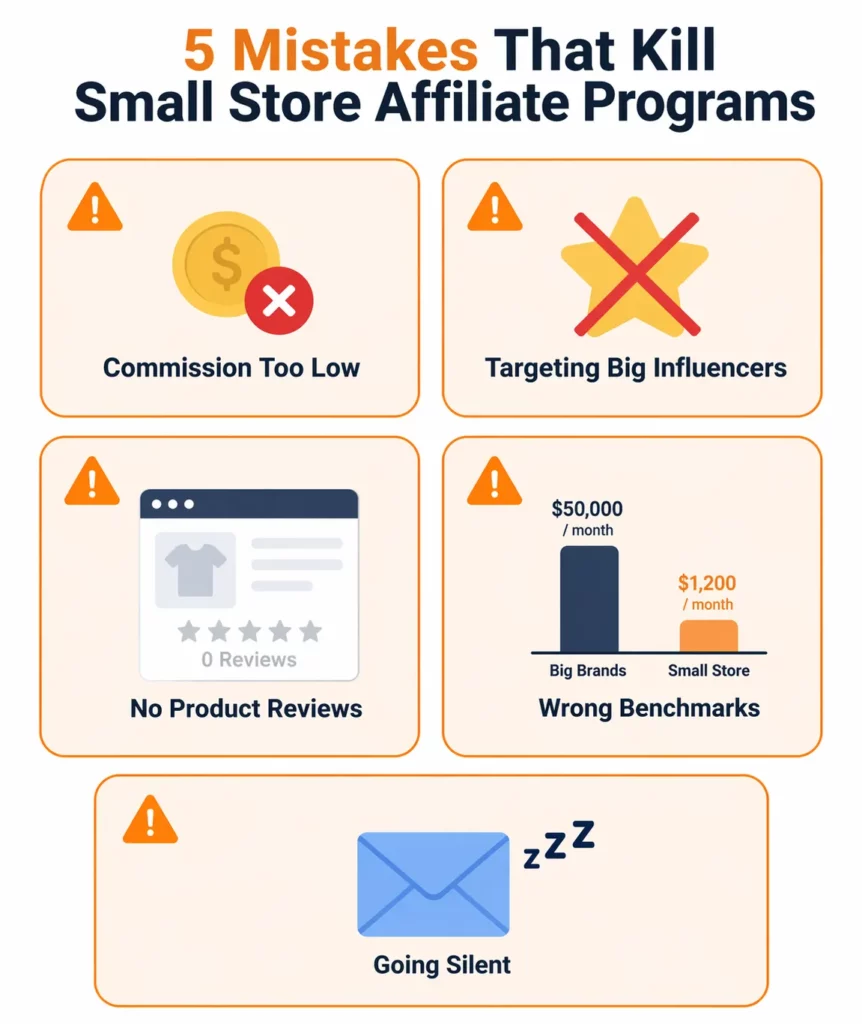
Small stores fail at affiliate marketing for different reasons than enterprise programs do. Most apply enterprise playbooks built for $1M+ stores and burn out before the program validates.
The wrong assumptions cluster around five places: commission rates, influencer tier, social proof, benchmarks, and post-launch communication.
💰 Setting commission too low
Many small-store owners undercut commission to protect margin — “my margin is 40%, so I’ll only pay 5%.”
The math kills the program. A 5% commission on a $50 average order is $2.50 per sale, and no affiliate promotes for $2.50.
The fix: pay 30–50% of net margin. A 40% margin supports 12–20% commission, enough to attract micro-creators in most niches.
🤝 Targeting big influencers instead of micro-creators
DMing a 500K-follower influencer seldom produces a reply for a small brand with no media kit.
Micro-creators (1K–10K followers) reply at higher rates and accept commission-only deals. Per Later’s 2025 Influencer Marketing Report, 73% of brands now prefer micro and mid-tier creators for the engagement-to-cost ratio.
🔍 Launching before product reviews stack up
Affiliates send traffic to product pages. If those pages have 3 reviews, conversion drops and the affiliate quits.
Get to 20+ reviews before launch. Affiliates need social proof on the landing page, not just on the storefront.
📊 Comparing your results to enterprise case studies
Eight-figure affiliate revenue from large brands like Efavormart ($800K in 8 months) sets the wrong baseline.
For a small store, $500–$1,500 per month from affiliates in months 3–6 is on track. Pitstop Nutrition runs at about 36 referral orders per day — proof that the model scales down, not just up.
📧 Going silent after recruitment
Approving an affiliate and never emailing again is the fastest way to kill activation.
Fifteen minutes per week is enough — one short update on a new product, a seasonal hook, or a shoutout to a top performer.
This is where small stores have an advantage: personal communication that big brands automate away.
What’s Changed in 2026 for Small Stores Running Affiliate Programs?
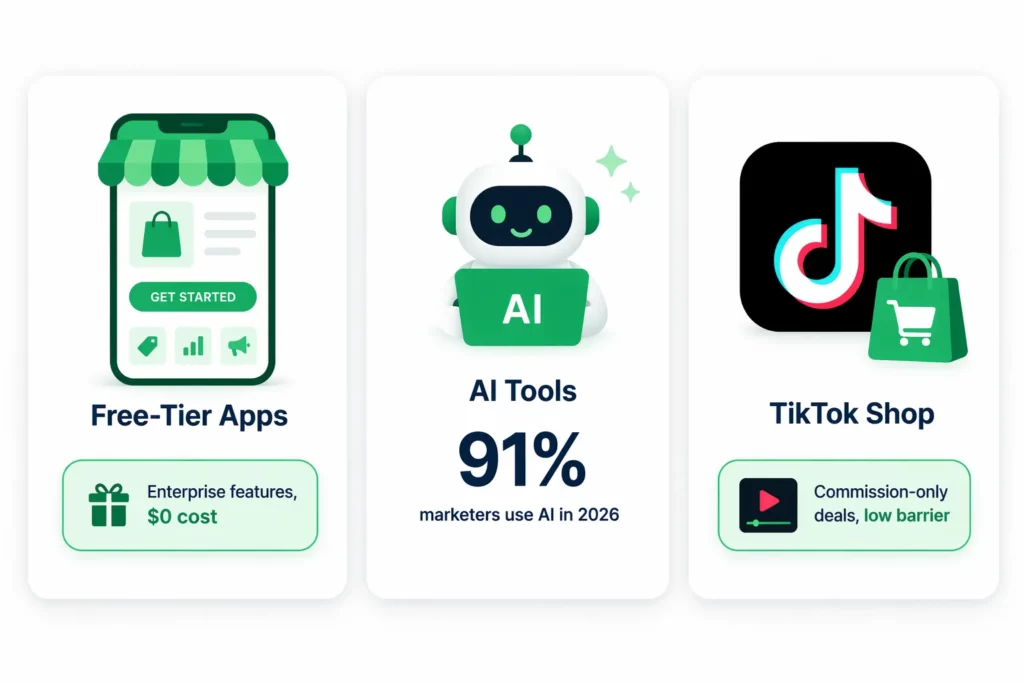
Three shifts in 2026 make affiliate marketing more accessible to small stores than at any point in the past five years.
Free-tier app features have caught up to what enterprise tools offered three years ago. AI is no longer enterprise-only. And TikTok Shop has lowered the recruitment barrier for niche brands.
The first shift is the maturation of free plans. UpPromote has expanded its free tier to cover 200 referral reviews per month, fraud detection, an analytics dashboard, and a customizable registration form.
These features used to sit behind paid plans on most apps. For a store doing under $5,000/month, that’s enough infrastructure for the entire first year.
AI tools are the second equalizer. Per Jasper’s State of AI in Marketing 2026, 91% of marketers now use AI in their work — up from 63% the previous year.
That adoption includes solo operators and small teams, not just enterprise. For affiliate programs, it means AI-assisted recruitment outreach, email personalization at scale, and content briefs that take an hour instead of a day.
TikTok Shop is the third shift. Beauty, food, fitness, and fashion brands can plug into a creator network where commission-only deals are the norm and where micro-creators look for small brands to feature.
The barrier to entry for affiliate-driven TikTok content is lower than for any traditional channel.
Frequently Asked Questions
Is my Shopify store too small for affiliate marketing at $3,000/month in revenue?
No — not if your margin is 30%+ and you process 50+ orders per month. At that size, expect $300–$600/month in affiliate revenue (10–20% of total) within 3–6 months by starting with loyal customers as your first affiliates.
How many products do I need before launching an affiliate program?
A minimum of 5–10 active products is enough, though stores selling a single hero product also succeed when demand is clear. What matters more is product reviews; aim for 20+ on each main product before launch.
Will micro-influencers accept commission-only deals from a small Shopify store?
Yes. Most micro-creators (1K–10K followers) accept commission-only or commission-plus-free-product deals. They prioritize authentic, niche brands over large ones with rigid contracts.
Is 2–3 hours per week enough to manage an affiliate program?
For 10–30 affiliates, yes, split across application reviews (15 min), one weekly update email (30 min), dashboard checks (15 min), and prospect outreach (1–2 hours). At 50+ active affiliates, plan on 5+ hours/week.
Should I pay affiliates in store credit or cash commission?
Both, depending on affiliate type. Customer-referrers usually prefer store credit (they want more of your products); external affiliates and bloggers prefer cash. Most affiliate apps let you run two programs in parallel.
When should I upgrade from a free affiliate app plan to a paid one?
Upgrade when you hit your plan’s monthly review limit (commonly 200/month) or need features it lacks — auto-tier commission, advanced analytics, white-label branding. If the paid plan costs under 5% of monthly affiliate revenue, it pays for itself.

Ellie Tran, a seasoned SEO content writer with three years of experience in the eCommerce world. Being a part of the UpPromote team, Ellie wants to assist Shopify merchants in achieving success through useful content & actionable insights.Ellie's commitment to learning never stops; she's always eager to gain more knowledge about SEO and content marketing to create valuable content for users. When she's not working on content, Ellie enjoys baking and exploring new places.
![How to Use Shopify Functions with Your Affiliate Program [2026 Guide]](https://static.uppromote.com/wp-content/uploads/2026/06/how-to-use-shopify-functions-with-affiliate-program-300x169.webp)

![How to Prevent Affiliate Fraud on Shopify: Self-Referral, Coupon Abuse & More [2026]](https://static.uppromote.com/wp-content/uploads/2026/06/how-to-prevent-affiliate-fraud-on-shopify-300x169.webp)