




You’ve found a creator who fits your store, you’ve invited them to your affiliate program, and they’ve replied with a rate card. Maybe it’s a fee per post. Maybe it’s a fee on top of your commission. Maybe it’s a promise of so many views, in return for a fee.
Most negotiation guides will help you get that fee down: bundle the deliverables, trim the scope, add a bonus. You still end up paying for posts whether or not they sell anything.
If what you want from creators is orders, there’s a better move: change what you’re negotiating. Instead of haggling over the price of a post, negotiate the terms of a commission deal, and make those terms good enough that a creator who can sell your product will take them.
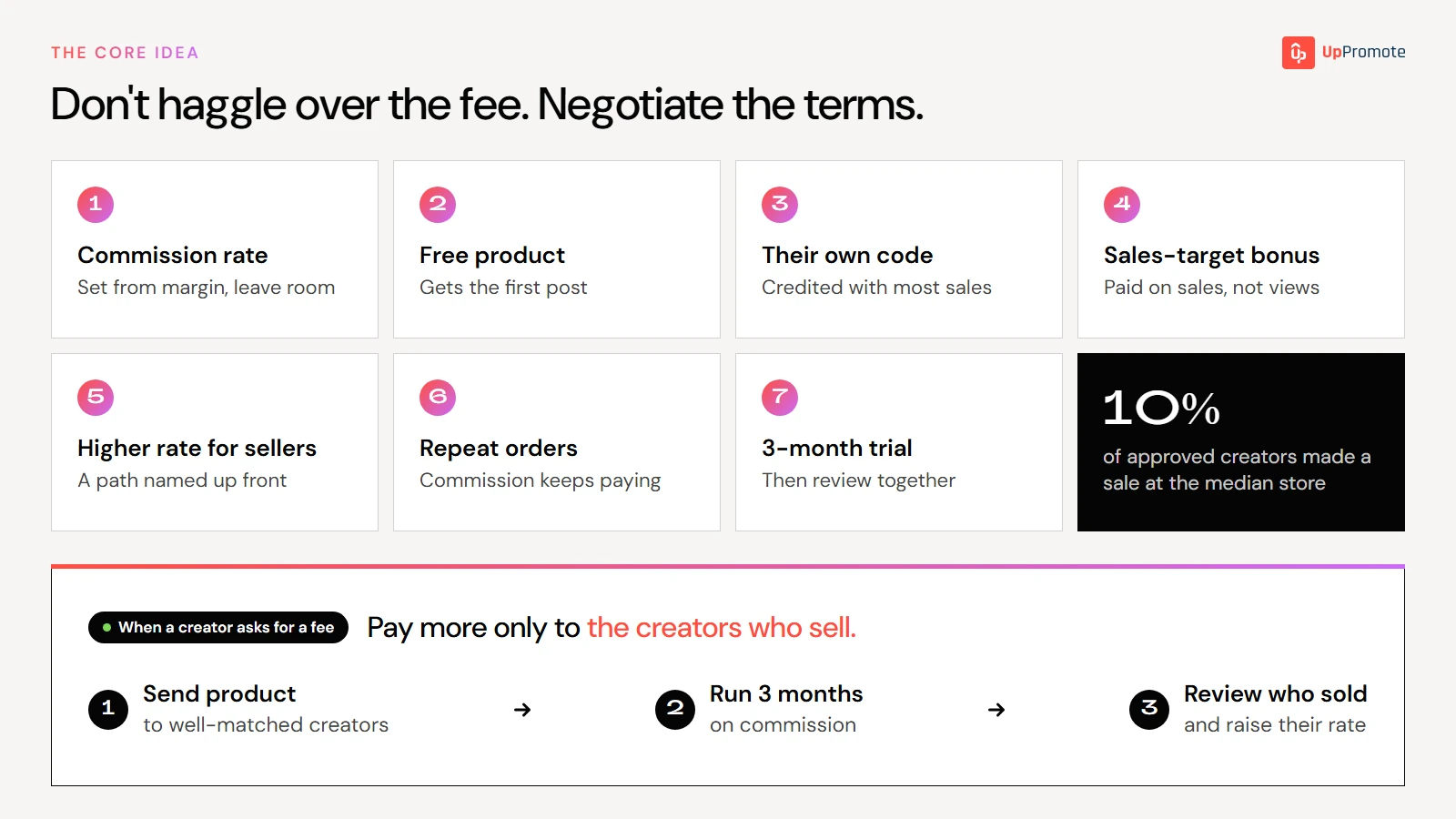
Below are the seven terms worth putting on the table, what we’ve seen in creator programs on UpPromote, and a reply you can adapt the next time a rate card lands in your inbox.
Why do creators ask for a fee?
Because a fee is guaranteed and commission isn’t.
A fee is paid whether or not the post sells. Commission depends on things the creator doesn’t control: whether their audience wants your product, your price, your product page, your stock. A creator can make a good post and still earn nothing from it.
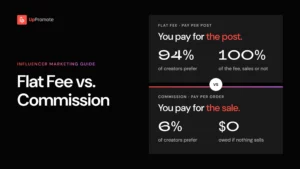
Creators know this. In a November 2023 survey by the agency The Motherhood, 94% of the 200-plus influencers asked said they prefer a flat fee over pay based on sales. The same piece says creators are unhappy when brands approach them with commission offers without a negotiated base rate.
So a creator who asks for a fee isn’t being difficult. They’re moving the risk off themselves.
Why is a fee your risk?
Because you pay it before you know whether the post sells, so the sales risk moves from the creator to you.
A fee fixes the cost of the post, not the cost of an order. Take a $300 post for a product with a $50 average order. If the post brings in one order, that order cost you $300. If it brings in 50, each one cost you $6. You only find out which after you’ve paid.
And most posts land near the low end, because most creators don’t sell. On UpPromote, at the median store, just 10.14% of approved creators made a confirmed sale. That’s across 2,095 stores with at least 20 approved creators. At one store in four, the share was 25% or more.
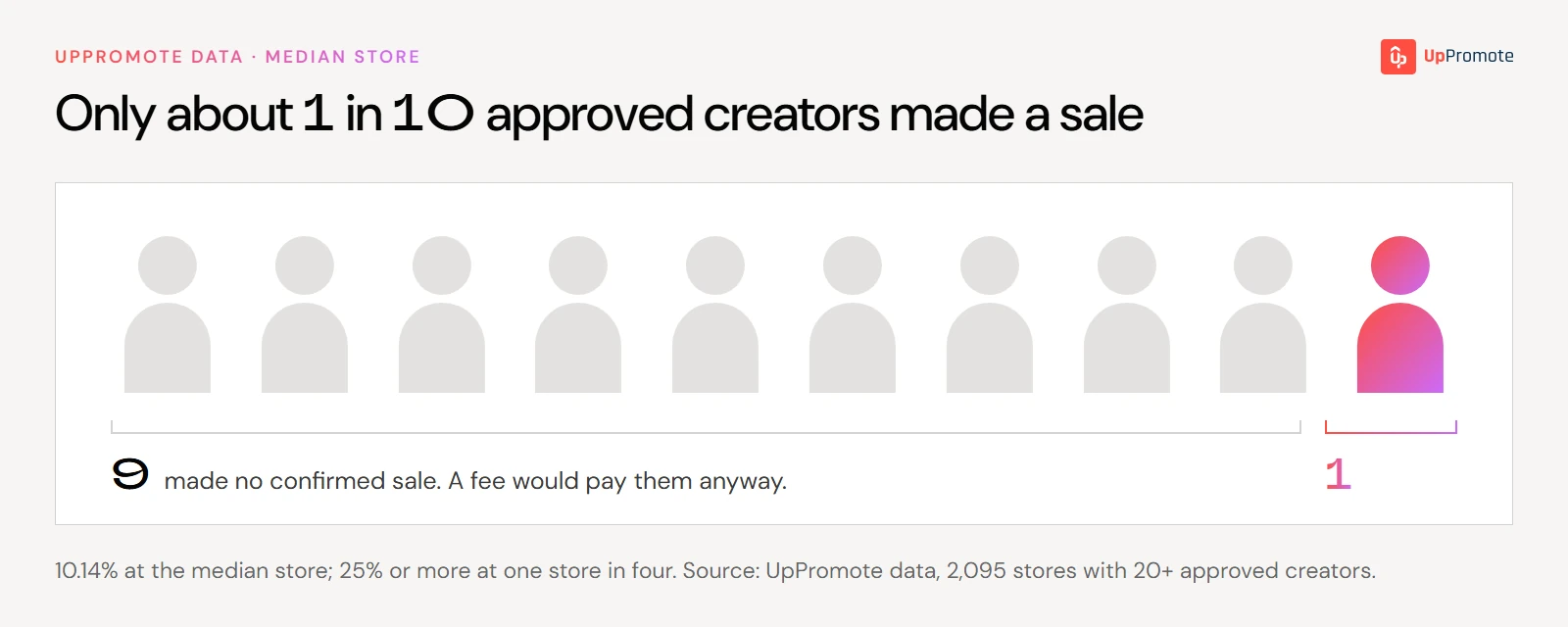
Had those stores paid every approved creator a fee, most of the fees would have bought no sale. That doesn’t prove fee deals sell less, since creators who are paid up front may post more often than creators on commission. But a fee goes to every creator, and only a few of them turn into sellers.
What a fee does buy is reach, a post on the date you agreed, the specific creator you wanted, and content you might reuse. It doesn’t buy orders, or any protection when the post underperforms. Adding commission on top doesn’t change that: the fee still goes to the creators who sell nothing.
Fees can pay off with the right partner. Gamers Only pays four partners, including a podcast, flat monthly fees, and they drove about 3,000 of the roughly 6,500 affiliate sales the brand made in eight months. The catch is that you only find out who the right partner is after you’ve paid.
Commission flips that: you pay only when there’s an order, at a cost per order you set in advance. Your job in the negotiation is to make a commission deal good enough that a creator who can sell will take on that risk. That’s what the terms below are for.
If you’re still choosing between the two models, see our comparison of flat fees and commission, which works through the break-even math; for typical per-post rates, see how much to pay influencers.
Which creators are worth negotiating with?
The ones whose audience buys what you sell. A commission deal only pays off when that’s true, so judge the creator by fit, not follower count. Three things matter most:
- Their audience is your customer. Read the comments, not the follower count. Are these people who’d buy what you sell?
- They know the subject. A creator who already talks about your category is more believable than one who doesn’t.
- Your product fits their format. Can they work it into the kind of post they already make, without it looking like an ad?
While you’re there, check for bought followers and engagement that doesn’t match the audience size. Our guide to vetting influencers has the full checklist.
A creator who passes is worth the terms below.
7 terms to negotiate in a commission deal
Think of these as the levers you can move instead of the fee. You won’t need all seven for every creator, but the more of them a creator can see in your offer, the less a fee matters.
1. The commission rate
The rate is where most of the money is, but it’s rarely the term that wins the deal on its own.
Set it from your margin, not from what other brands pay, and know your ceiling before the conversation starts. Don’t open at that ceiling: keep room above your starting rate for the creators who prove they sell (term 5). Our guide to influencer commission rates shows how to work the number out.
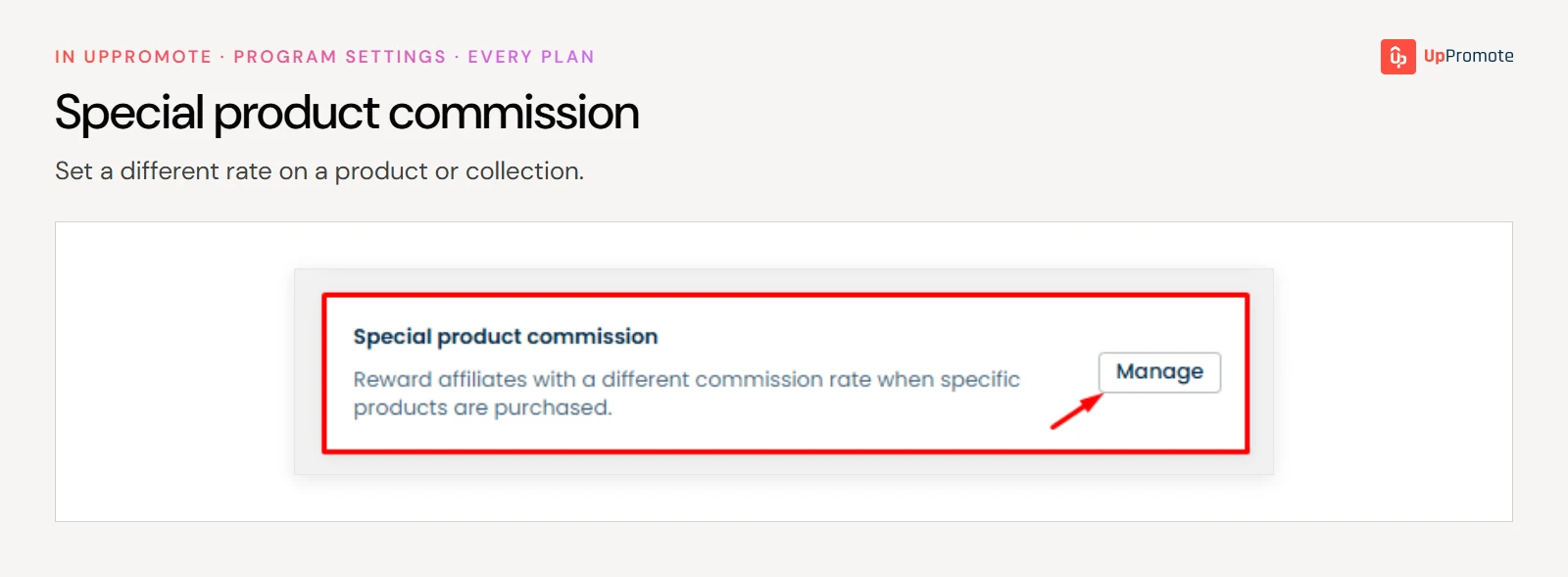
If a creator is going to feature one product, the rate doesn’t have to be the same across your store. You can set a different rate on a product or collection with Special product commission, which every UpPromote plan has.
2. Free product
Product is what gets the first post. Commission is what pays for the sales after it.
That’s how The Carnivore Bar runs its creator program without upfront fees. Rather than opening sign-ups to anyone, it sends free samples first and invites the creators who love the bars to join, and it sometimes trades a box of bars for content.
The first message is a simple offer, as Marketing Director Joshua Perrault describes it:
Hey, have you tried our product before? If not, we’d love to send you some to try.
Joshua Perrault, Marketing Director at The Carnivore Bar
The brand’s affiliate program grew from 50 to 500 members in just over a year.
With smaller creators, product may be enough to start the conversation. Don’t rely on product alone, though: paired with commission, it gives the creator a reason to keep posting once the first box is gone.
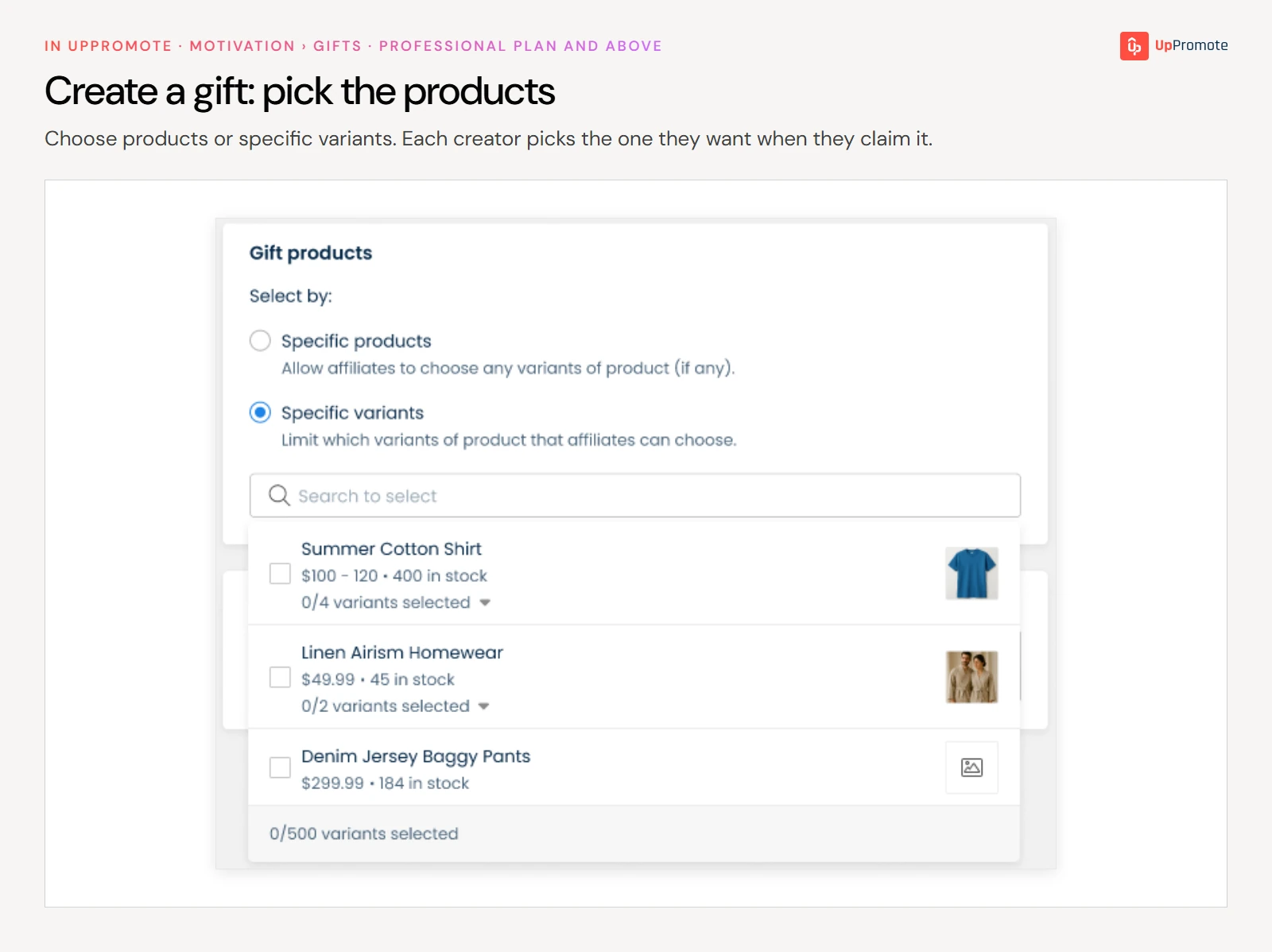
On Professional and above, UpPromote’s Gifts can send free or discounted products to creators automatically when they join, or by hand. How to run the gifting itself is covered in our influencer gifting guide.
3. Their own discount code
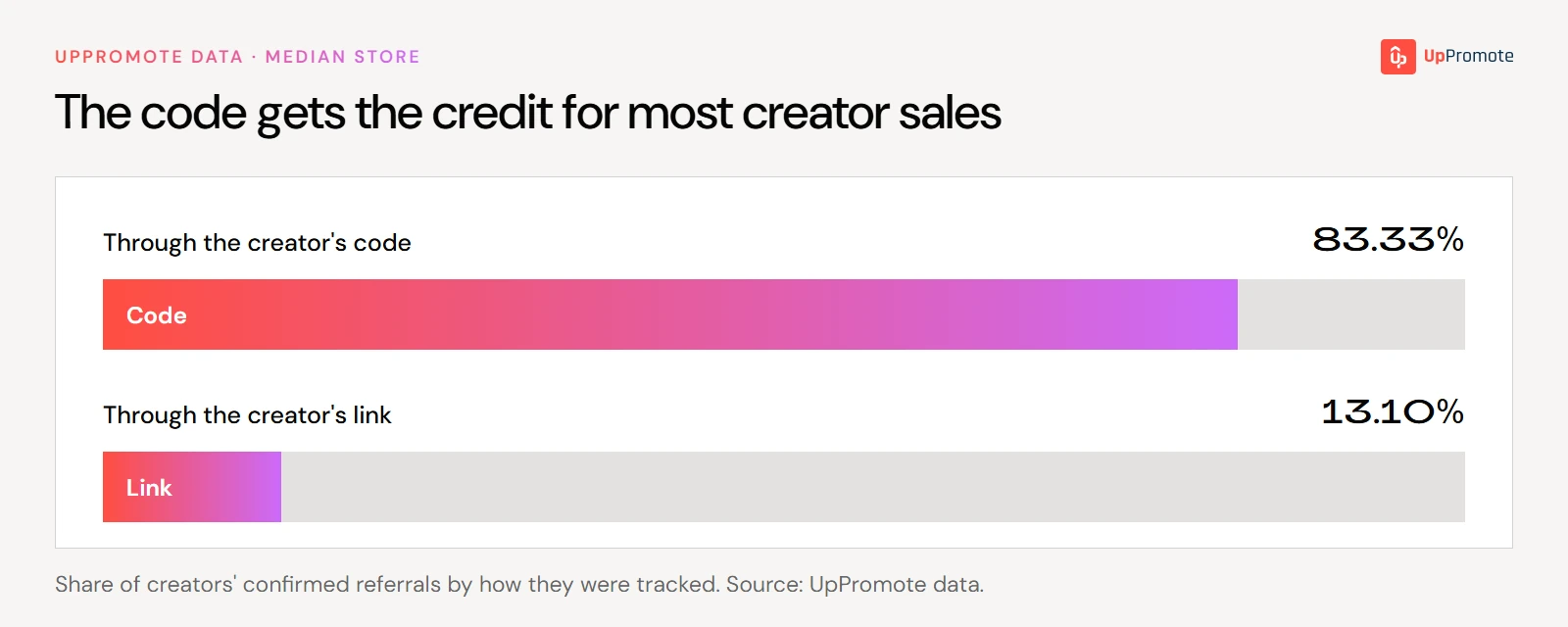
Give every creator a code of their own. At the median store, it’s the code that gets the credit for most creator sales: 83.33% of creators’ confirmed referrals came through their code, and 13.10% through their link.
What about the size of the discount? A bigger code discount didn’t come with more creators selling:
| Code discount | Creators with a confirmed sale |
| Under 10% off | 18.51% |
| 10–14% off | 20.61% |
| 15–19% off | 17.62% |
| 20% or more off | 17.85% |
These are different creators at different stores, so the table doesn’t prove the discount makes no difference. But it gives you no reason to give up more margin to win a deal. The code is the term to offer; a bigger discount is optional.
A code named after the creator is also easier for their audience to remember. Naughty Nuts gives each influencer a personal 10% code the moment they join.
A code only gets the credit if the app is tracking codes. Stores with coupon tracking switched off record almost no code sales.
To set this up in UpPromote:
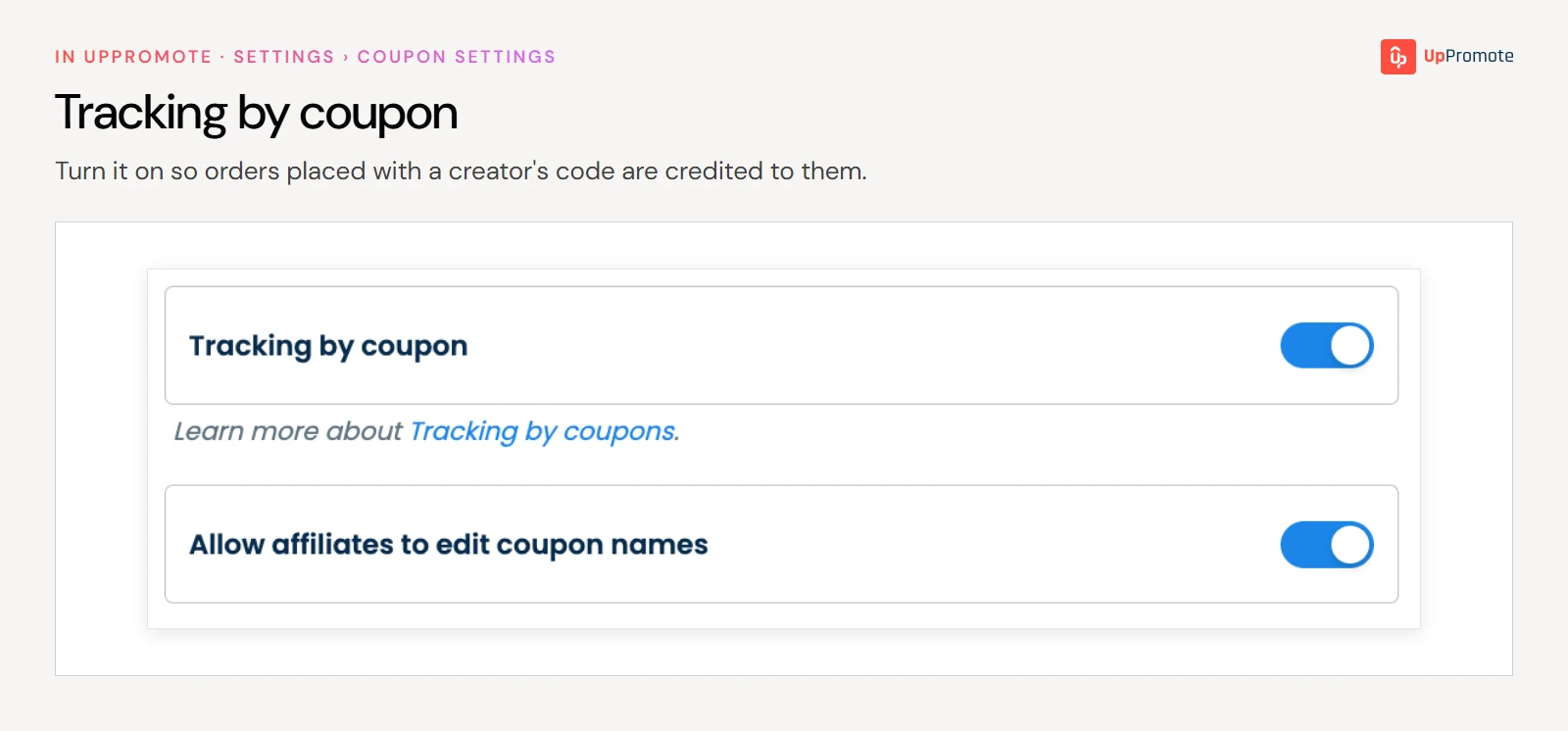
- Go to Settings > Link & coupon > Coupon settings and turn on Tracking by coupon. It’s off by default, and orders paid with a creator’s code aren’t credited to them until it’s on, so do this before you create or assign any codes.

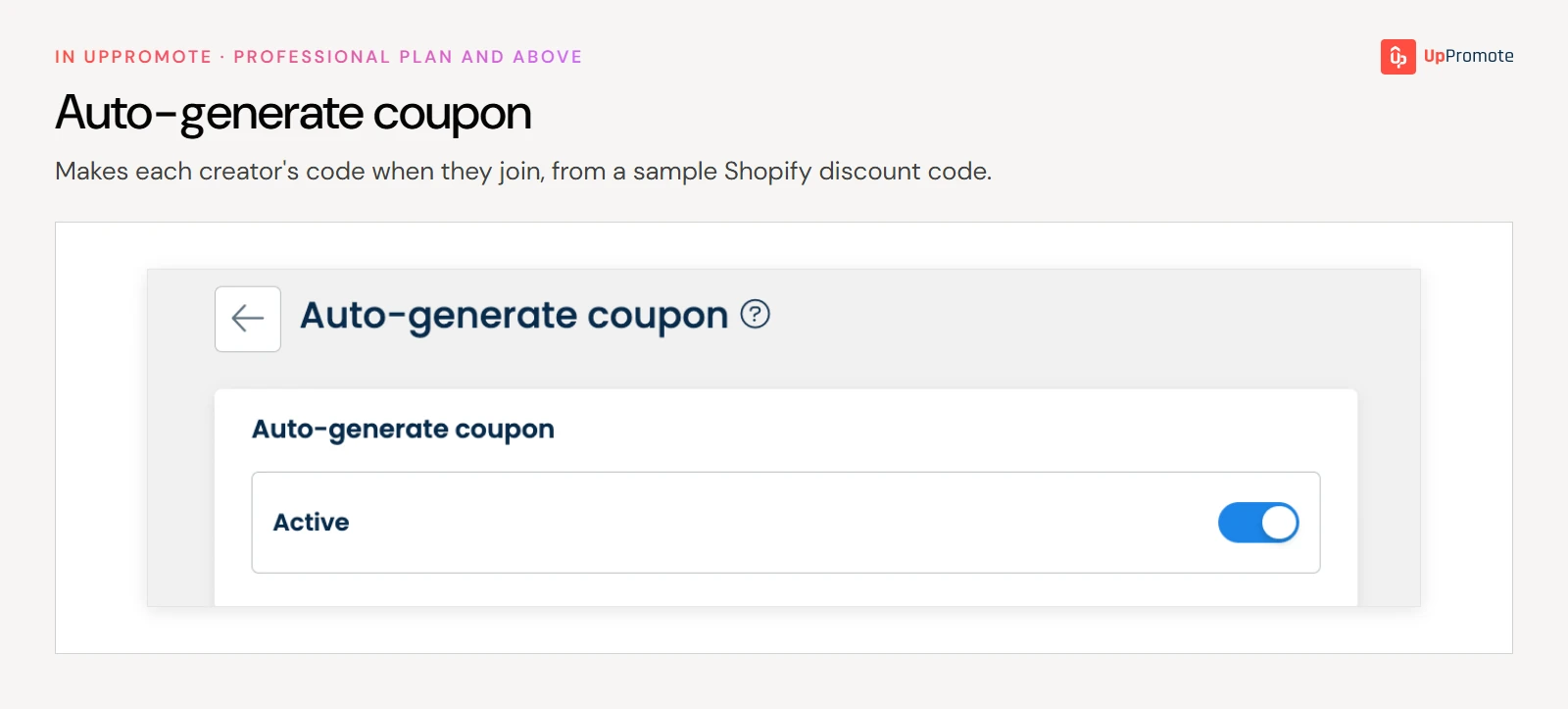
- Create the codes. On Professional and above, Auto-generate coupon makes each creator’s code when they join, from a sample Shopify discount code, or lets them choose their own at signup. On Free and Growth, you assign each creator’s code by hand.

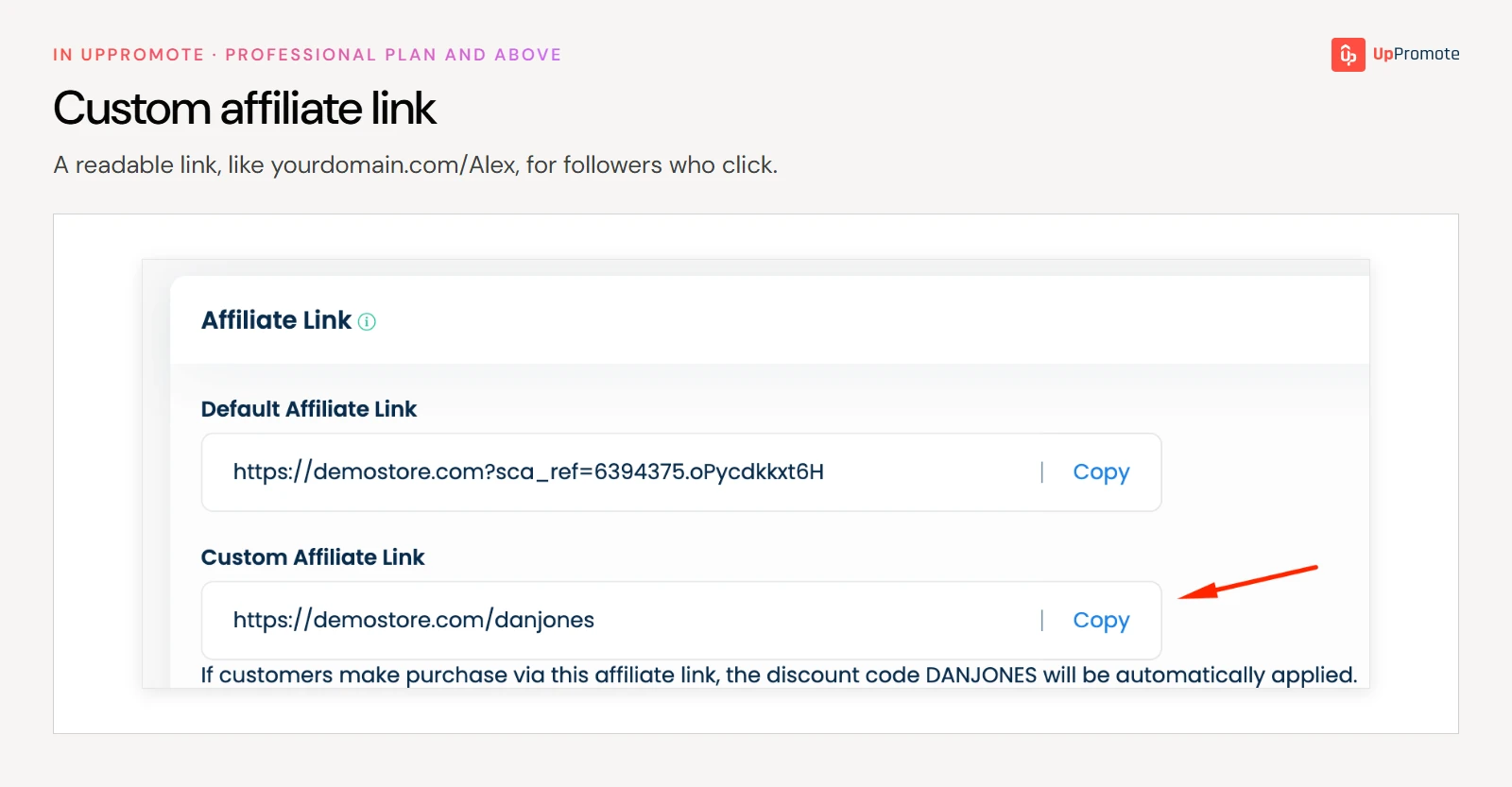
- Give each creator a link as well, for followers who click rather than type. On Professional and above, you can make it readable, like yourdomain.com/Alex, with a custom link.

4. A bonus for hitting a sales target
A bonus pays extra when a creator reaches a target in a set period. It’s the commission version of the “performance bonus” that fee-based guides suggest, except it’s paid on sales instead of views.
Pongbot pays a standard 10% commission and adds a monthly bonus of $20 to $550 for affiliates who hit their sales goals.
As Kyle, Operation Manager at Pongbot, explained:
We are just a startup company and we want to get more exposure and get more partners around the world. So we have to do the best we can offer for our partners.
Kyle, Operation Manager at Pongbot
Within about three months of launching the program, affiliates were driving about 20% of Pongbot’s sales.
In UpPromote, Bonuses are on Professional and above. On Growth, you can pay a bonus by hand by adding a referral for a fixed amount.
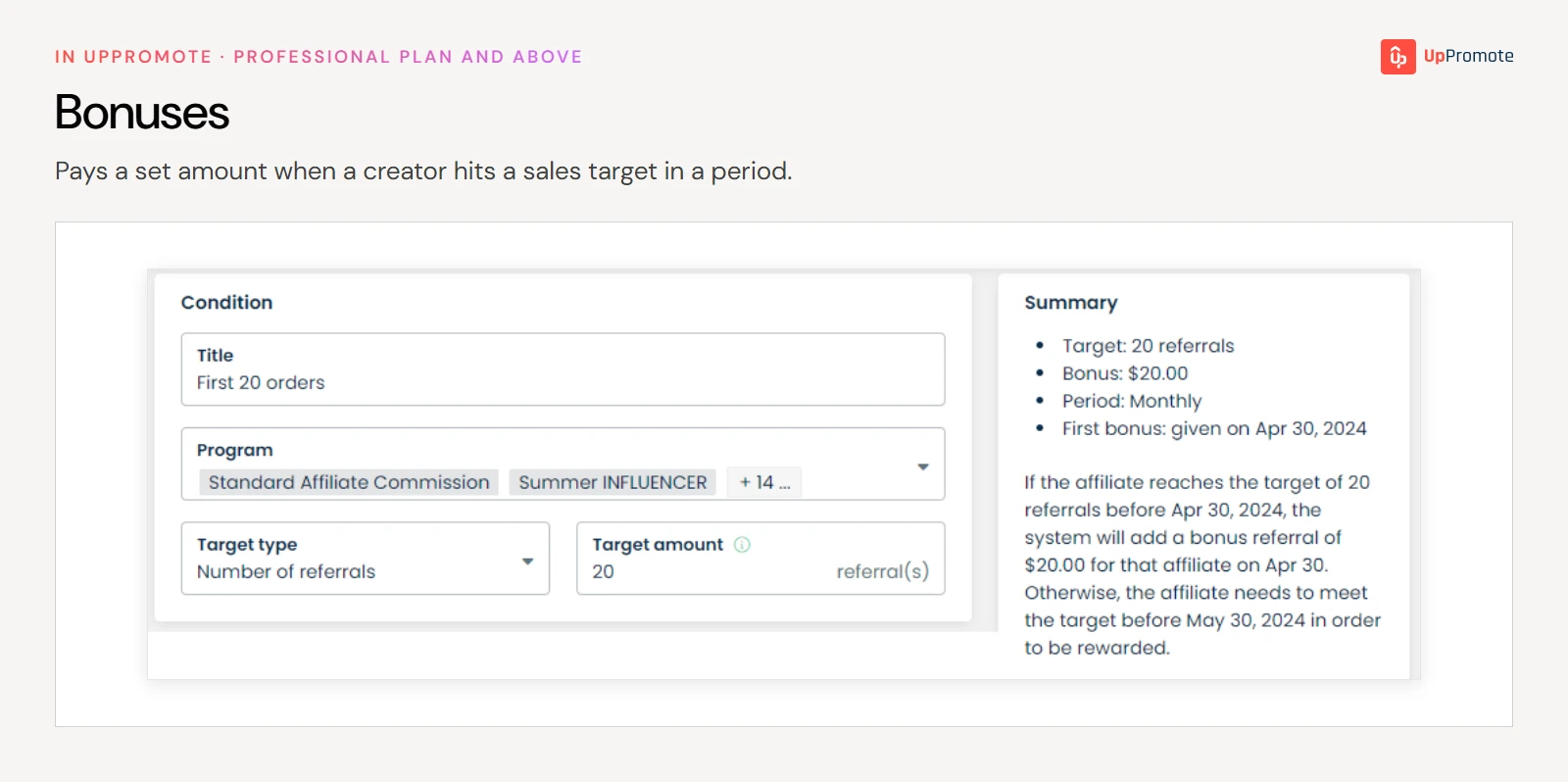
One thing a bonus can’t do is stand in for a fee. Merchants have asked our support team whether they could pay a creator’s fixed monthly fee through the app, and a bonus won’t do that job, because every bonus needs a target of at least one sale. It only pays when the creator sells, which is exactly what makes it a better term to offer.
5. A higher rate for creators who prove they sell
This is the term that answers a fee request best: a clear path to a higher rate, at a threshold you name up front.
It works because the creators who sell can earn real money. Across 833 stores with at least 10 selling creators, the top creator at the median store brought in 27.14% of creators’ confirmed referrals and earned $524.30 in commission. At one store in four, the top creator earned $1,587.20 or more.
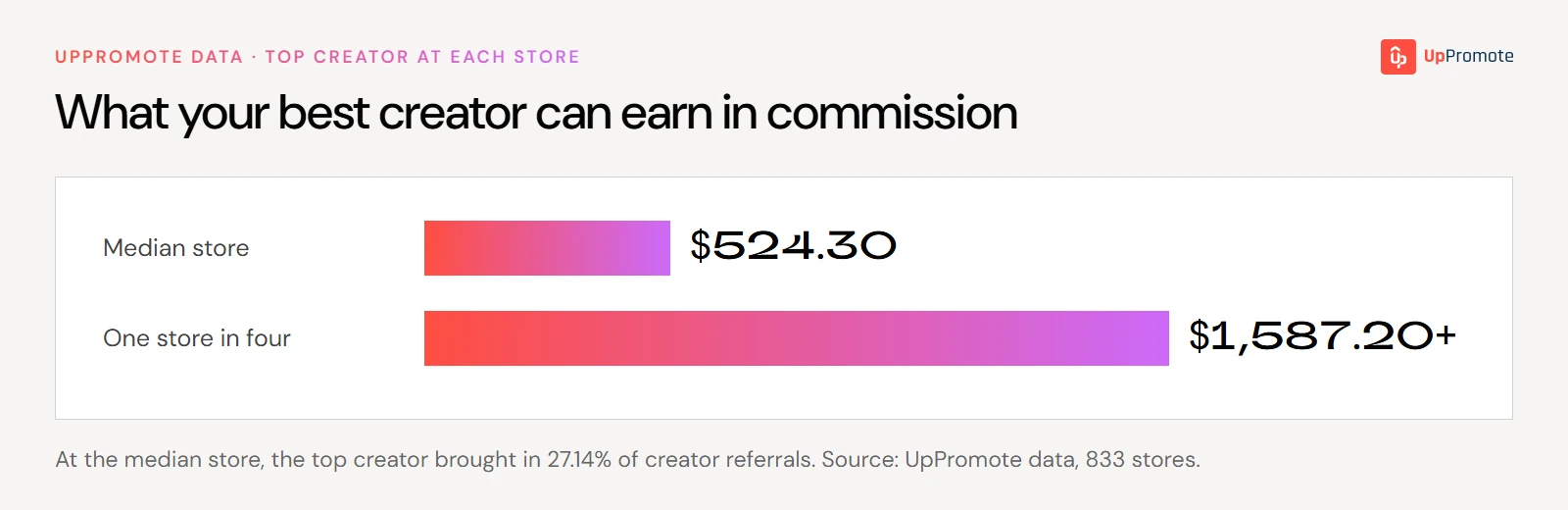
That’s the number to show a creator who asks for a fee. Not what the average creator earns, but what your best one earns, and exactly what it takes to get their rate.
You can publish the path as a ladder. Nubeo Watches starts affiliates at 10% on full-priced watches, then moves them to 12% at $1,500 in monthly sales, 15% at $5,000 and 17% at $10,000.
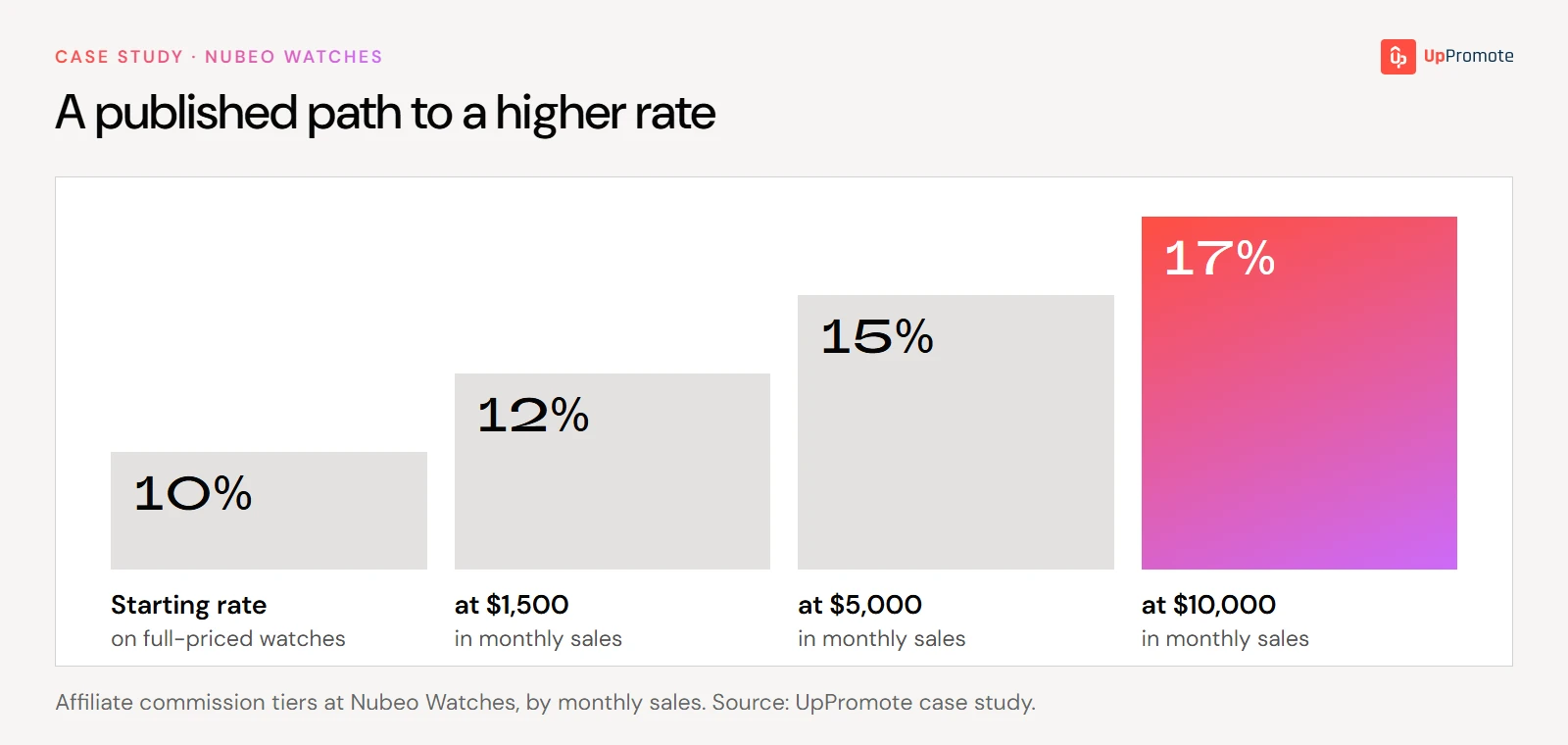
There’s always another step to take – just like in a video game.
Joaquin Cadenas, Digital Marketing Executive at Nubeo Watches
At its peak, affiliates brought in up to 30% of the brand’s total sales in a month.
Or you can negotiate it one creator at a time. GoldieLocks pays all its salon affiliates 15%, and one salon owner who has driven over 1,000 orders earns 25%, a rate negotiated on performance. The brand now runs a program of nearly 2,900 active affiliates.
Either way, keep the higher rate for the few who earn it. Send product to plenty of well-matched creators, then pay more only to the ones who sell.
To set it up in UpPromote:
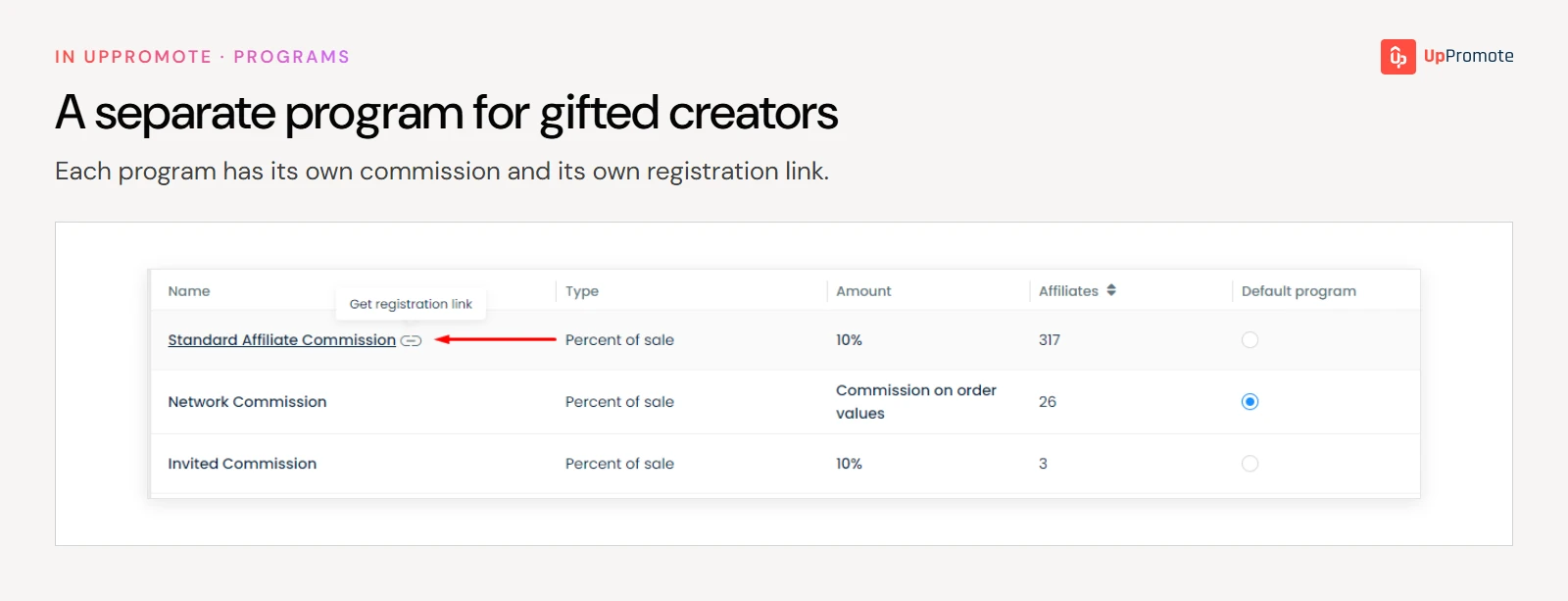
- By hand: create a second program with the higher rate and move the creator into it from their affiliate profile. Separate programs need the Growth plan or above.

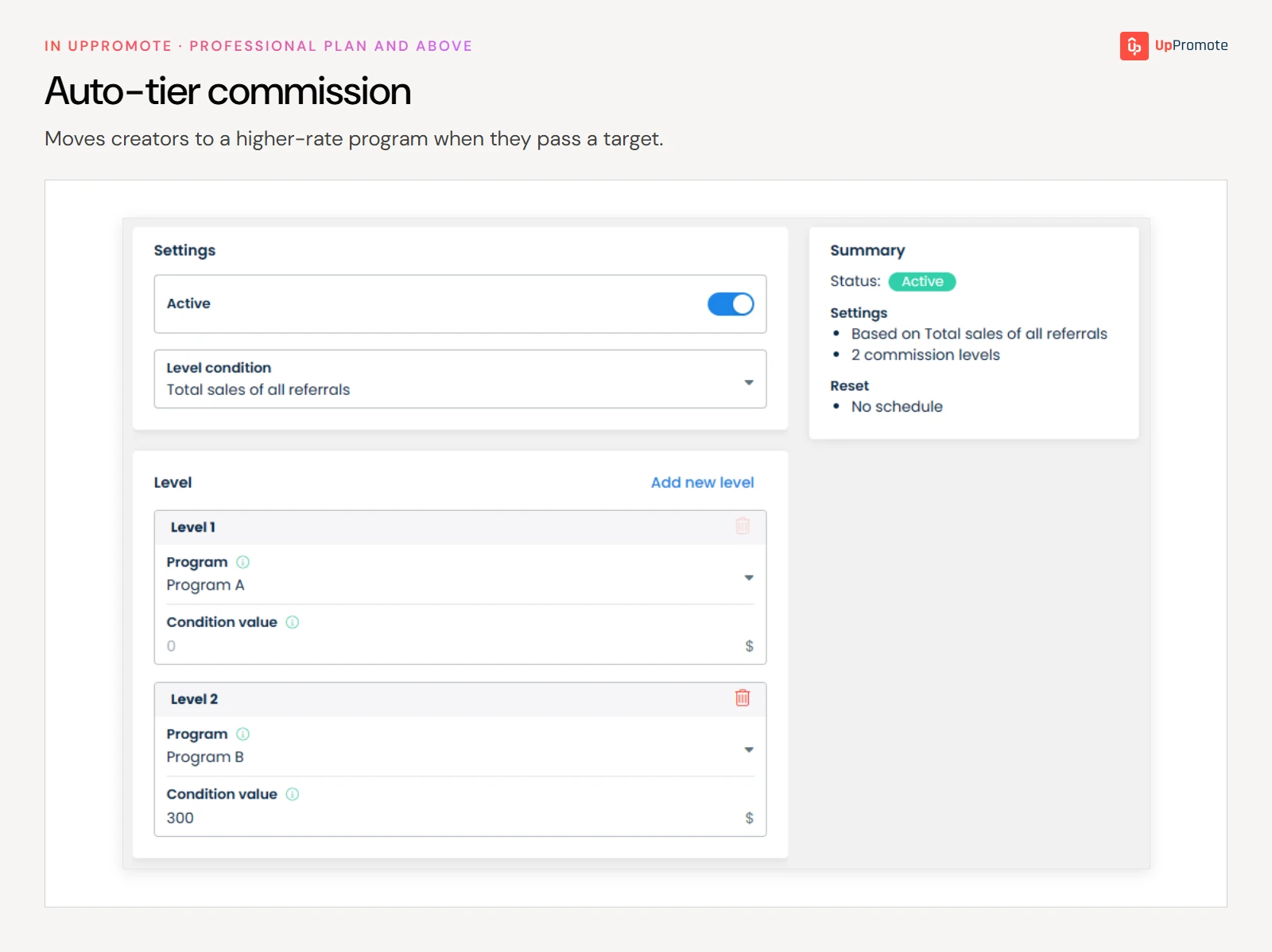
- Automatically: on Professional and above, Auto-tier moves creators up between programs when they pass a target in referral sales, commission earned or number of referrals. It can reset each period, and referrals made before a creator moves up aren’t recalculated at the new rate.

6. Commission on repeat orders
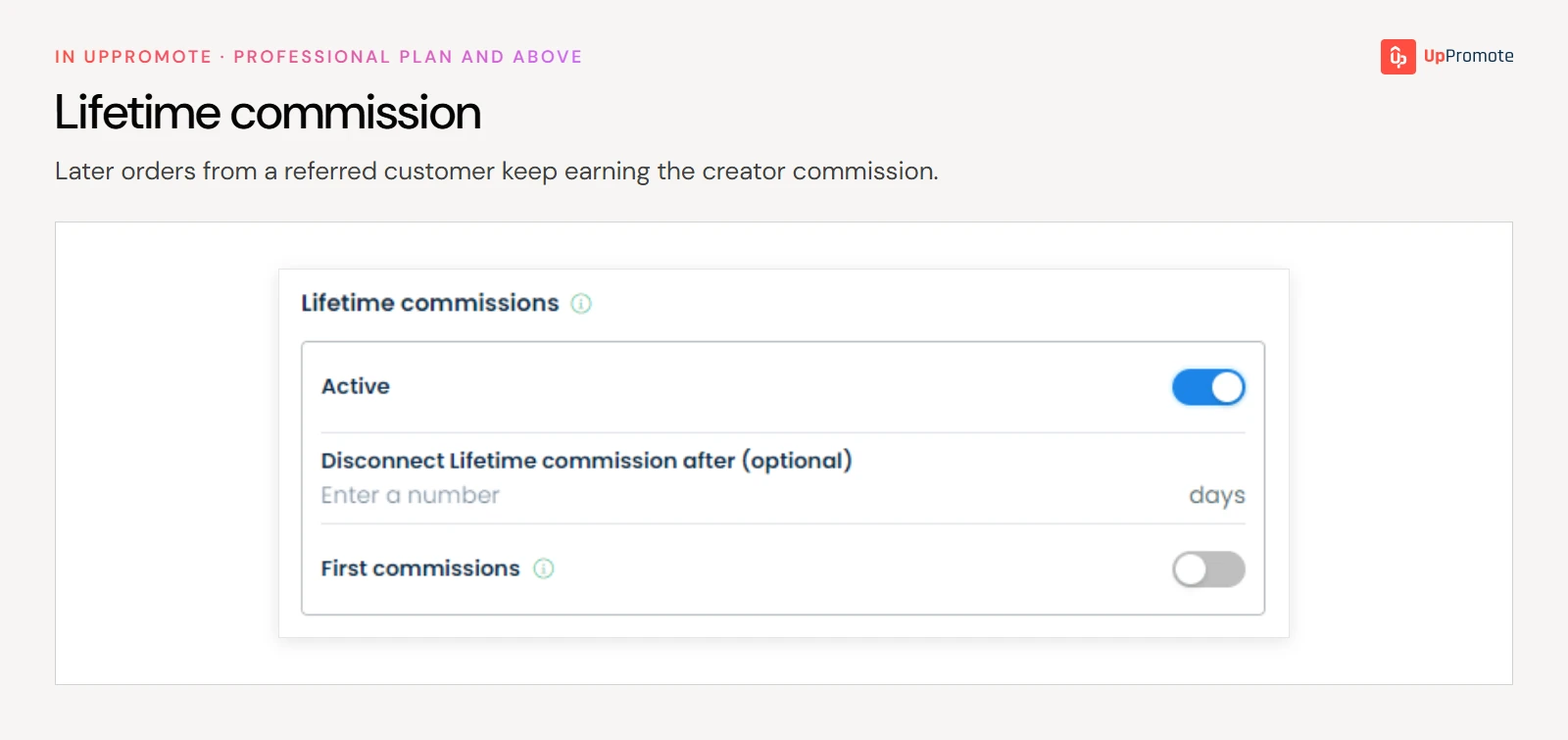
A fee pays once. Lifetime commission keeps paying the creator for as long as the customer they brought keeps buying.
It works by tying the customer to the creator in your store’s data, so later orders from that customer earn the creator commission, even without a new click or code. That makes your deal worth more over time than a one-off fee, and it rewards creators who bring customers who come back, not only first orders.
In UpPromote, lifetime commission is on Professional and above. It isn’t retroactive: a customer who bought before you turned it on is only tied to a creator after their next referred order.
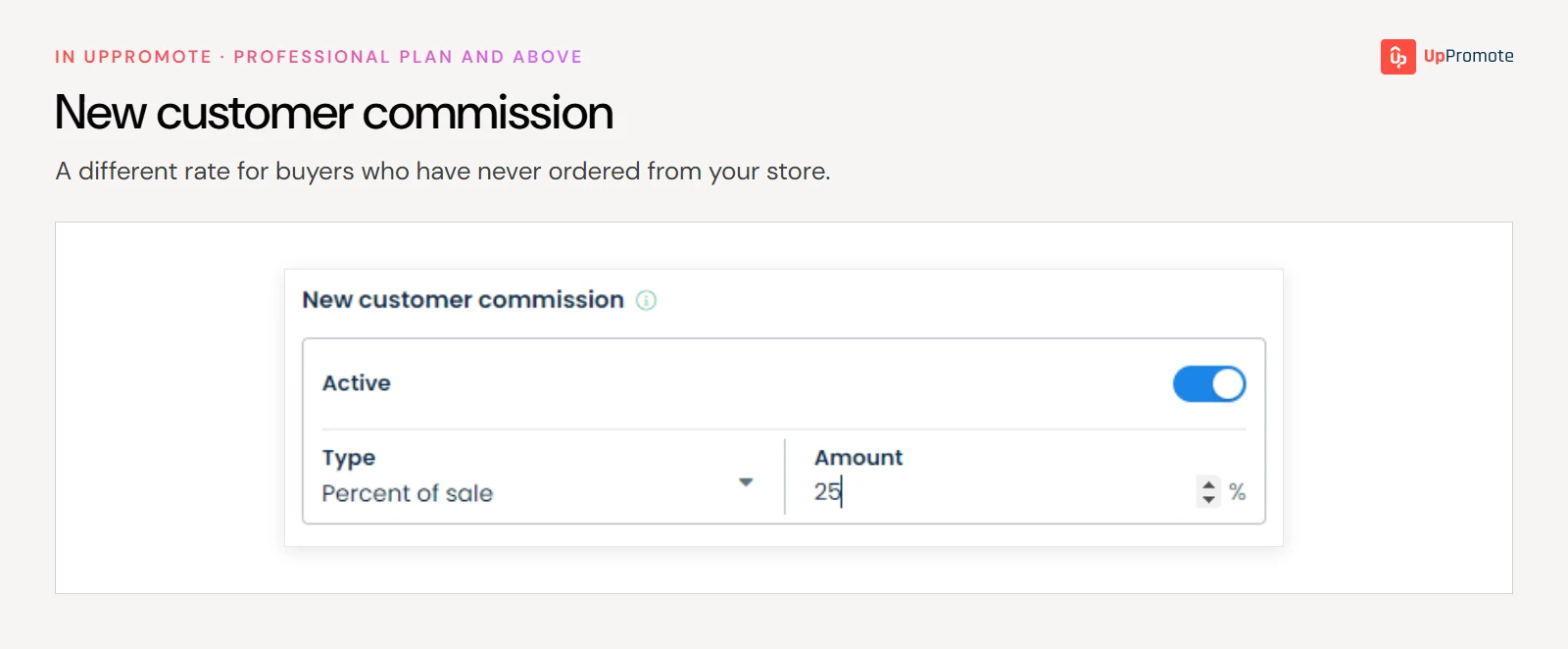
If you’d rather pay creators for bringing new customers than for repeat ones, offer that instead. New customer commission (also Professional and above) sets a different rate for buyers who have no customer account in your store and have never ordered.
7. A three-month commission-first trial
When a creator wants a guarantee, offer a defined trial instead: three months on commission, then a review together.
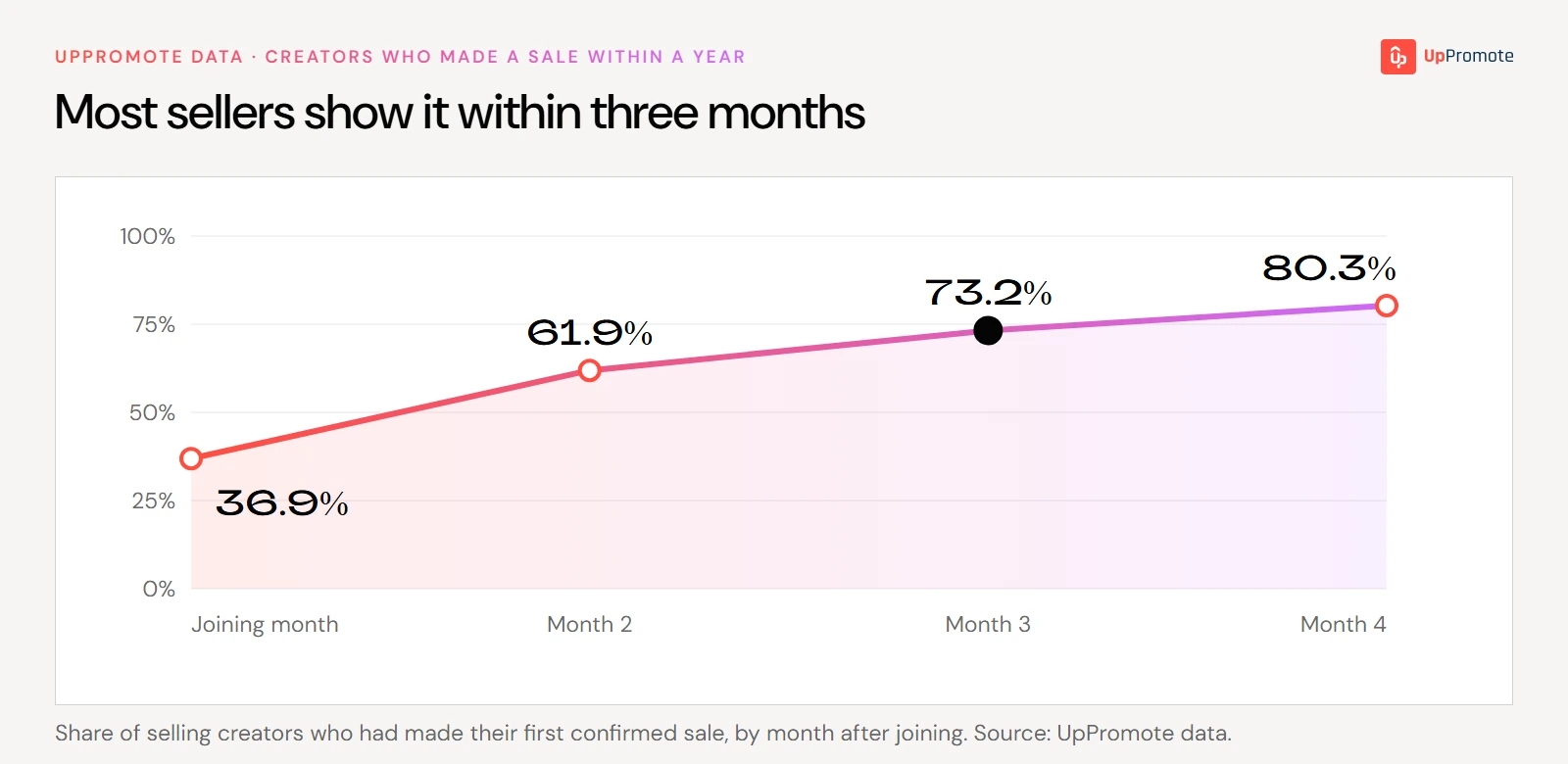
Three months is about how long it takes to see who will sell, because most creators who are going to sell show it early. Among creators who joined programs on UpPromote in one month and went on to make a confirmed sale within about a year, 36.9% made their first one in the month they joined, 61.9% by the end of the next month, 73.2% by the end of the third and 80.3% by the end of the fourth. Treat three months as a guide, not a rule.
Kuvings Deutschland handles fee requests this way. Some influencers ask for upfront payment, and the brand stays on commission for the first three months. As the team put it: “Within the first three months, we don’t know how their community will react.”
Keep the first ask small: one post with the code, a clear call to action, and a short brief (our influencer brief guide covers what goes in it).
Agree on disclosure in the same message: the creator says in the post that they got the product free and earn commission, and you check the post. The FTC’s endorsement guides Q&A treats free product and pay through affiliate links as connections a creator has to disclose, and under 16 CFR § 255.1(d) the brand can be liable when they don’t. These are US rules; check your own market’s. Where the disclosure goes and how to word it is in our guide to the FTC guidelines for influencers.
At the review, look at who sold. Move those creators up to the higher rate or bonus you promised in terms 4 and 5, and keep the rest on the standard deal.
Keeping your sellers engaged after that is a bigger topic, covered in long-term influencer partnerships.
Should you ask for a minimum view guarantee?
Only if you’re paying a fee, and even then it guarantees reach, not sales.
A minimum view guarantee is a creator’s promise that a post will reach a set number of views. If it falls short, they owe you extra content; some deals add a bonus if it beats the number. It’s a way to protect a fee, because a fee is paid whatever happens.
On commission you don’t need one. You pay for each order the post brings in, so a post that underperforms costs you nothing extra. If a creator offers a view guarantee in exchange for a fee, it’s still a fee.
What about deliverables and usage rights?
Under commission, you agree the deliverables rather than price them. “One post and a Story with your code” is a fair ask; bundling posts to cut the price per post only matters when you’re paying per post.
Reusing a creator’s content in your own ads is a separate agreement. Our guide to influencer usage rights covers what to ask for, and the clauses themselves belong in your influencer contract.
How to reply when a creator asks for a fee
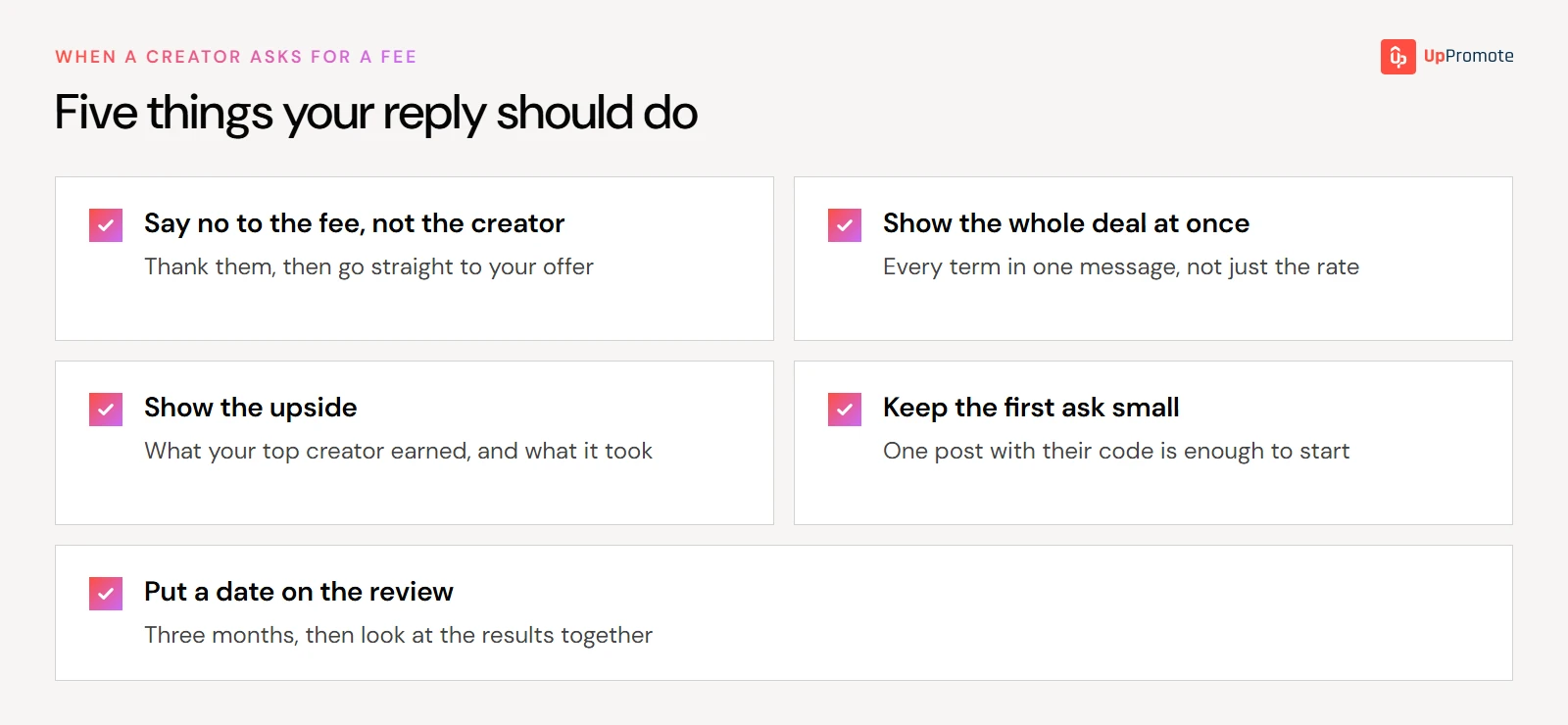
Answer quickly, say no to the fee plainly, and put the whole offer in one message. A few things make that message work:
- Say no to the fee, not to the creator. Thank them for their rates, then move straight to what you can offer.
- Show the whole deal at once. List every term together, so they weigh the full package, not just the rate.
- Show the upside. Tell them what your top creator earned and what it took to get there. It’s the best answer to “commission isn’t guaranteed.”
- Keep the first ask small. One post with their code is enough to start.
- Put a date on the review. Three months, then you look at the results together.
Here’s a reply you can adapt. Fill in the brackets with your own numbers:
Thanks for sending your rates! We don’t pay per-post fees, but here’s what we’d love to offer instead:
- [Product] sent to you free, so you can try it before you post
- Your own code, [NAME10], giving your followers [10%] off
- [X]% commission on every order through your code or link
- [X]% on every order once you pass [$ threshold] in sales a month, plus a [$ bonus] when you hit [target]
- Commission on your customers’ repeat orders, not just their first one
Our top creator earned [$ amount] in commission last [period], and this is the path they took.
Could we try it for three months? One post with your code is plenty to start, with a clear note that you got the product free and earn commission. After three months we’ll look at the results together.
When the review comes, start with help, not an ultimatum. Naughty Nuts looks at its influencers’ sales every 90 days, and its first note to the ones who are falling behind offers support: “We’ve noticed there haven’t been any sales yet. Do you need any help? Let us know if there’s anything we can assist you with.”
If a creator only works for a fee, thank them and leave the door open. Some will come back once they’ve seen what your top sellers earn. For the first message before any of this, see our influencer outreach templates.
Final thoughts
A creator who asks for a fee is telling you that commission alone feels too risky. They’re not wrong: commission isn’t guaranteed, and a good post can still earn them nothing.
The answer isn’t to pay the fee and take on all that risk yourself. It’s to build a commission deal worth taking: product to get the first post, a code of their own, a bonus and a higher rate they can see and reach, commission on repeat orders, and three months to prove it. That way, you only pay more to the creators who bring in orders.