




Flat fee vs commission is the first decision you make when you pay influencers. A flat fee pays a creator a fixed amount for a post. Commission pays the creator a share of every order that comes from their post. So which should you choose?
Short answer: It depends on your goal.
Best answer, proven by brands that earned millions with influencer marketing: Send free products for organic posts. Add in a flat fee for guaranteed posts. And pay commission on top for quality, sales-generating posts.
Keep reading to see why, with the break-even maths and what creators actually sold in the stores that run their programs on UpPromote.
What’s the difference between a flat fee and commission?
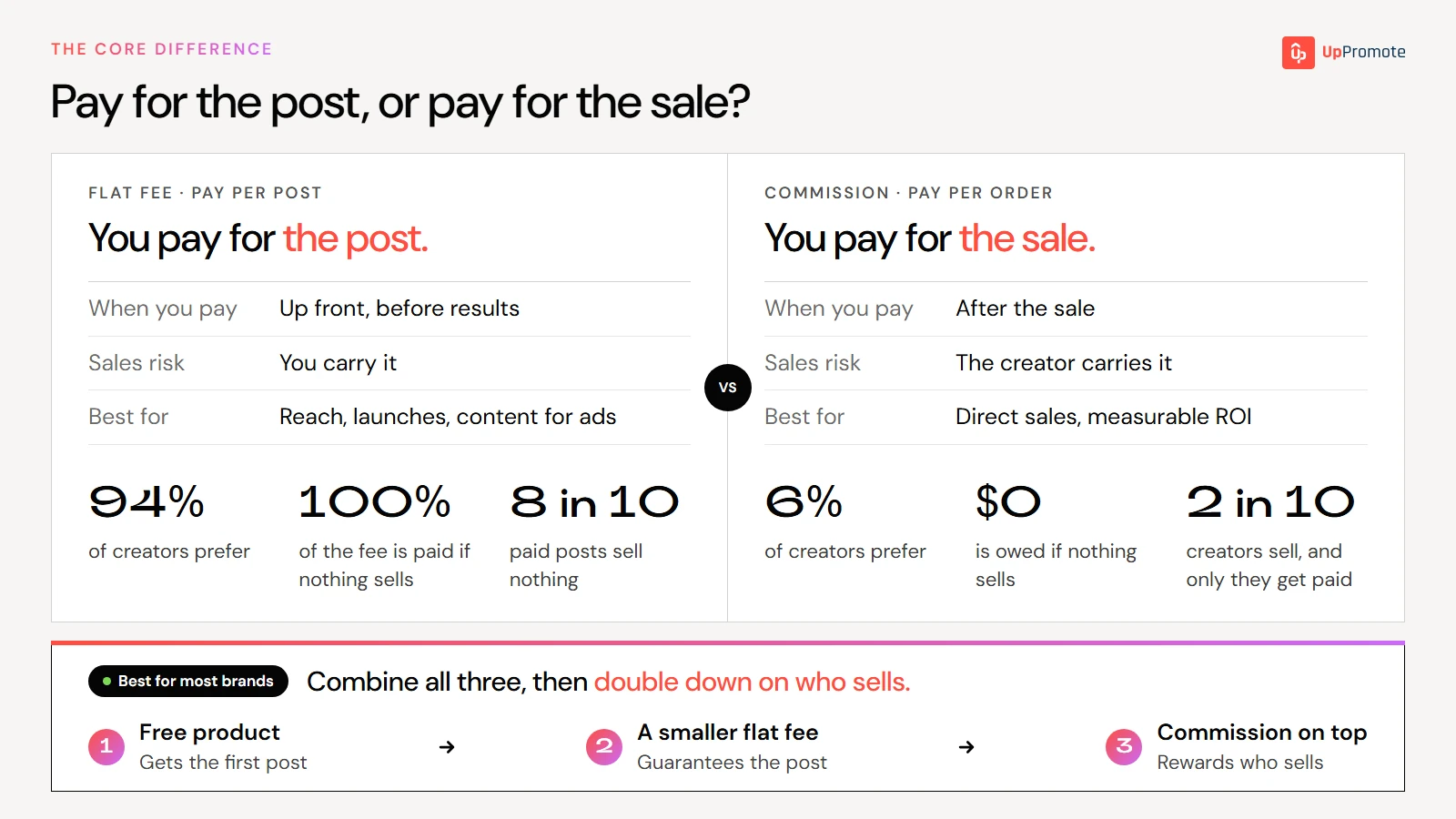
On the surface, the difference is what you pay for. With a flat fee, you pay for the post. With commission, you pay for the orders it drives. Which one is “riskier” depends on what you want the post to do.
With a flat fee, you agree on a price for a deliverable (one Reel, three Stories, a YouTube mention) and pay before or right after it goes live. You know the cost up front, and you get the content, the reach and usually some say over the brief.
If your goal is awareness, a launch moment or content you can reuse in ads, a post that goes live on time and reaches the agreed audience has done its job, even if it sells nothing that week. The risk only shows up when you pay a flat fee and expect sales the creator never agreed to drive.
With commission, the creator gets a tracked link or discount code, and you pay a percentage or a fixed amount for each order it drives.
If the post sells nothing, you owe nothing, so the sales risk sits with the creator. The trade-off is control and reach. Creators decide how much effort to put in. Bigger creators rarely accept commission-only deals. Reach, saves and brand lift that don’t end in a tracked order go unpaid, and often unmeasured.
Many brands end up combining the two: a smaller flat fee to guarantee the post, plus commission on what it sells.
| Flat fee | Commission | |
| What you pay for | The post (content, reach, timing) | The orders it drives |
| When you pay | Before or right after the post goes live | After the sale (ideally after the return window) |
| Cost is known… | Up front | Only after results come in |
| Who carries the sales risk | You | The creator |
| If the post sells nothing | You’ve paid the full fee. That’s fine if the goal was reach or content | $0 |
| Control over content and timing | High: deliverables and deadlines are agreed in advance | Lower: creators post when and how they choose |
| Best for (goal) | Awareness, product launches, content for ads, getting into a new market | Direct sales, steady always-on revenue, measurable ROI |
| Best for (brand) | Brands with a set marketing budget, brands working with mid-size or large creators | Small or early-stage brands with tight cash flow, brands with proven products and good conversion rates |
| Best for (creator type) | Macro and mid-tier creators, and anyone hired mainly to produce content | Nano and micro creators, affiliates, loyal customers, niche creators with high-trust audiences |
| Cost per order | Unknown until the post has run | Your rate, set in advance, plus app fees |
So which should you choose? Start from the goal, not the price. If you need people to see you, pay for the post. If you need people to buy, pay for the sale. If you need both, or you’re testing a creator for the first time, a hybrid deal splits the risk fairly.
What is a “flat fee commission”?
“Flat fee” and “flat fee commission” sound almost the same, but they’re opposite deals.
A flat fee is paid per post. You pay a creator, say, $300 for one Reel, whether it sells or not.
A flat fee commission (also called a flat-rate commission) is paid per sale. You pay the creator a fixed amount, say $5, for every order their post brings in, instead of a percentage. If the post sells nothing, you pay nothing.
In both, “flat” only means the amount is fixed. The difference is what it’s fixed to: the post, or each sale. In UpPromote, for example, “flat rate per order” and “flat rate per item” are commission types that sit next to “percent of sale.” None of them is a fee per post.
How does a flat fee work?
You and the creator agree on deliverables and a price, the creator posts, and you pay. Many creators quote from a rate card based on their followers and platform. (What those rates usually are is its own question; see how much to pay influencers.)
Pros
- Creators like it. In a survey The Motherhood, an influencer agency, ran in November 2023, 94% of more than 200 creators said they prefer a flat fee over pay based on sales.
- You know the cost upfront. One invoice, no tracking to set up.
- You get the post. The deliverable is in the contract, whether or not anyone buys.
Cons
- You pay before you know if it sells. The fee is spent the moment the post goes live.
- Your cost per order is a guess. A $300 post that drives 30 orders and one that drives 2 cost the same.
- Most creators don’t sell. A fee pays a creator who sells nothing the same as one who sells a lot, and in a typical store on UpPromote, most approved creators made no sale at all in their first three months (more on the data below).
When does a flat fee make sense?
When the thing you want from the post isn’t only orders. There are three cases where a fee does a job commission can’t:
- Reach. You want people to see and remember your brand, and you’ll count the post a win whether or not they buy.
- One particular creator. You want a specific, named person talking about your product, not whoever signs up.
- Content you’ll reuse. You want the content itself, to use again after the post has run. That’s really a second deal with its own terms, covered in influencer usage rights.
How does commission work?
You add the creator to your affiliate program, give them a link or code, and pay a rate on each order it brings in. Most stores set a percentage; some pay a fixed amount per order. This is what “performance-based influencer marketing” means: paying for a result (an order, usually) instead of for the post.
Pros
- You pay only for orders. A post that sells nothing costs you nothing in cash.
- Your cost of sale is set in advance. At 10% commission, every creator order costs you 10% of its value, however many or few orders there are.
- It scales. You can have 50 creators on commission for the price of the orders they bring, which you could never do with 50 fees.
Cons
- Fewer creators say yes. Some will only work for a fee.
- Sign-ups come slowly. A typical store gets new creators a few at a time, not a crowd at once.
- Creators who don’t sell earn nothing, so some drift away. That’s the model working as intended, but it means you keep recruiting.
Which costs less per order?
Here’s the maths with two example creators. Your average order value (AOV) is $50.
- Creator A quotes a flat fee of $300 for one post.
- Creator B works on 10% commission, and their audience gets a 10%-off code.
For Creator B, each order costs you two things:
| Cost per order (Creator B) | Amount |
| 10% discount for the customer ($50 × 10%) | $5.00 |
| 10% commission on what the customer pays ($45 × 10%) | $4.50 |
| Total cost per order | $9.50 |
Now fix the spend at $300 and compare:
| You spend $300 | Creator A (flat fee) | Creator B (10% commission + 10% code) |
| When you pay the $300 | Up front, whatever the post sells | Only once B has driven about 32 orders |
| Orders you get for spending $300 | Whatever the post drives | About 32 orders ($300 ÷ $9.50) |
| Cost per order | $300 ÷ orders driven | $9.50, always |
Here’s how Creator A’s cost per order changes with results:
| Orders from Creator A’s post | Revenue | Cost per order | Cost as % of revenue |
| 1 | $50 | $300.00 | 600% (a loss) |
| 5 | $250 | $60.00 | 120% (a loss) |
| 15 | $750 | $20.00 | 40% |
| 32 | $1,600 | $9.38 | 19% (about the same as Creator B) |
| 50 | $2,500 | $6.00 | 12% |
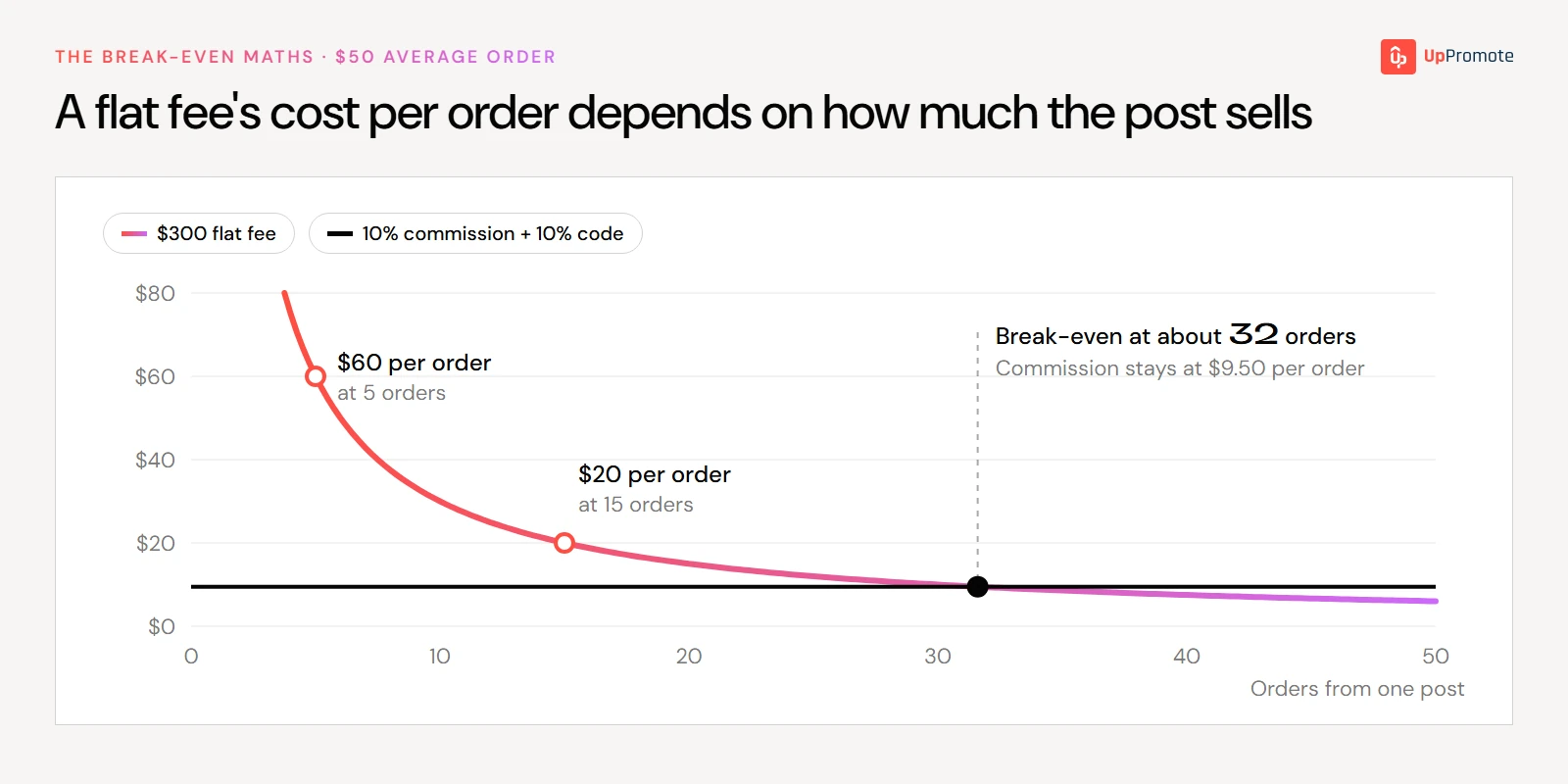
The takeaway: with a flat fee, your cost per order depends entirely on how many orders the post drives, and you only find that out after you’ve paid.
The same $300 can cost you $300 per order or $6 per order, so it’s hard to predict. Commission keeps the cost fixed at $9.50 per order however the post performs. For the flat fee to match it, a single post has to drive about 32 orders, and that’s a high bar for most creators.
Note: these numbers assume you set up commission and tracking yourself. Most affiliate and influencer apps add a monthly subscription and sometimes a performance fee on referral sales.
How many creators reach the break-even line?
Hardly any. Our data says the same.
We tracked tens of thousands of creators across more than 1,700 Shopify stores on UpPromote and counted every order each of them brought in over at least three months.
| About the data | |
| Creators | 45,919 creators who made at least one sale (affiliates who signed up with an Instagram or TikTok handle) |
| Stores | 1,751 Shopify stores where at least five creators made a sale |
| Time period | Creators who joined between November 1, 2025 and August 16, 2026, with orders counted up to November 17, 2026 |
Each creator’s total counts every order from every post they made in that time, so their orders from a single post can only be lower. Here’s what we found:
- Most creators never sold anything. In a typical store, about 8 in 10 approved creators didn’t bring in a single order.
- The ones who did sell usually brought in one or two orders. On average, a selling creator drove about 6 orders, across all their posts.
- Hitting the break-even line is rare. Across all the stores, only about 1 in 13 selling creators ever reached 40 orders (just past the 32-order line), and that took them months, not one post.
Put that next to the maths above. If Creator A drives 6 orders, the $300 fee works out to $50 per order, the same as your average order value. You’d spend every dollar the orders brought in, and get nothing back. Creator B would have cost you about $57 for those same 6 orders.
| Creator A (flat fee) | Creator B (10% commission + 10% code) | |
| Orders (average selling creator) | 6 | 6 |
| What you pay | $300 | $57 |
| Cost per order | $50.00 | $9.50 |
| Cost as % of revenue | 100% | 19% |
Bigger orders don’t change much. The typical creator order in these stores was about $75. At that size, a $300 fee breaks even at around 21 orders. That’s still more than three times what the average selling creator drove.
And remember, for every 10 creators a store works with, only about 2 make a sale. If you paid each of those 10 a flat fee, you’d be paying for 8 posts that sell nothing, before the other 2 even have a chance to break even.
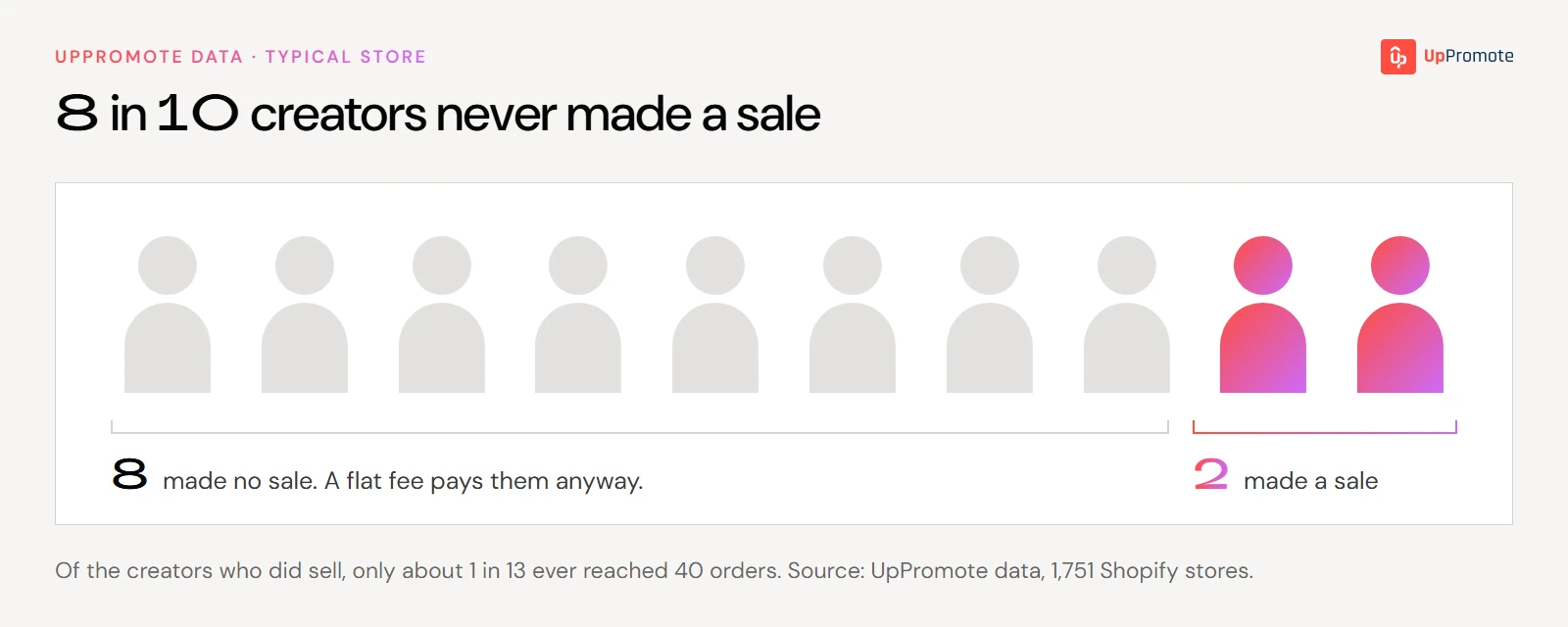
A fair caveat. This doesn’t prove a flat fee always loses money. These creators were paid commission, not a fee, and outliers exist: some creators will drive far more than 32 orders from one post. But unless you can spot those few before they post, paying $300 upfront and hoping for sales is mostly a bet on creators who won’t deliver.
If the goal is orders, there are safer ways to get there: start creators on commission, find the ones who actually sell, then offer those proven sellers a fee or a hybrid deal.
How we counted: “typical store” means the median store for each figure.
Will creators work for commission only?
Some will, but most would rather get a fee. In The Motherhood’s survey, 94% of creators said they prefer a flat fee. Only 6% preferred being paid on sales.
What that looks like in real stores
Commission programs do attract creators, just slowly. Here’s what UpPromote’s data shows over six months:
- In a typical store, 4 creators applied and 2 got approved.
- A quarter of stores got 12 or more applicants.
- One in ten got 41 or more.
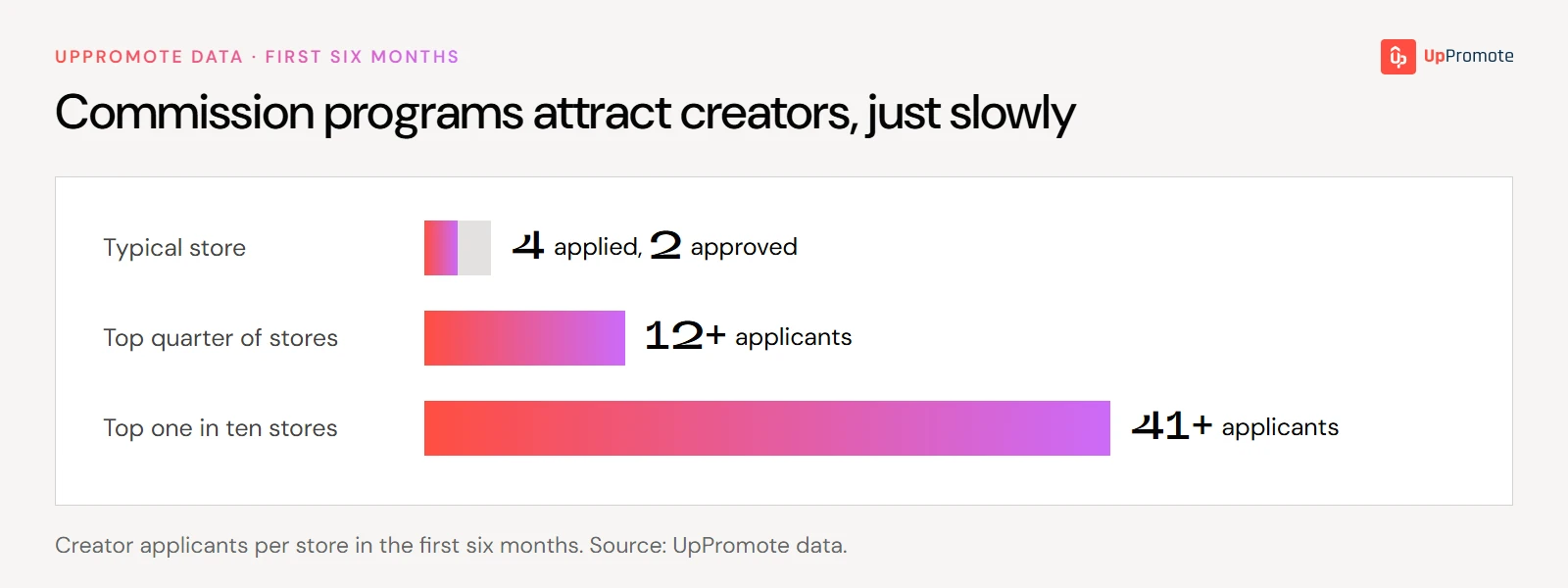
So yes, commission makes recruiting harder. But switching to full fees doesn’t fix that. You’d sign more creators, and pay every one of them before you know who sells.
What works better: make commission worth chasing
Start new creators on commission (or a small fee plus commission). Then give the ones who sell a better deal. Here’s how two UpPromote brands do it.
Kuvings Deutschland (premium juicers)
- The challenge: Some influencers ask for upfront payment.
- What they do: Every new creator starts on commission for three months, because there’s no way to know yet how their audience will react.
- The reward: Creators who sell consistently move from a 10% program to a 15% one.
Naughty Nuts (peanut butter startup, Germany)
- The challenge: Paying influencers upfront for posts that might not sell didn’t fit the budget.
- What they do: Micro-influencers earn 10% commission. Each gets their own 10% discount code, plus a €50 store gift card every month to buy and use the products they post about.
- The result: Over 8,000 referrals tracked.
Takeaway: Creators will take commission when the deal gives them a reason to:
- Free product to get the first post
- A clear path to higher pay for the ones who sell
Already talking to a creator who wants a fee? See how to negotiate with influencers.
Where does gifting product fit?
Gifting gets you the first post; commission pays for the sales after it.
A gift costs you product, not cash, and you only send it once. But on its own, it won’t make a creator sell.
UpPromote’s data shows it clearly: in a typical store, only about 1 in 4 gifted creators brought in an order after receiving their gift. In the best quarter of stores, it was 4 in 10 or higher. (Some of these creators might have sold anyway, so we can’t say the gift itself caused the sale.)
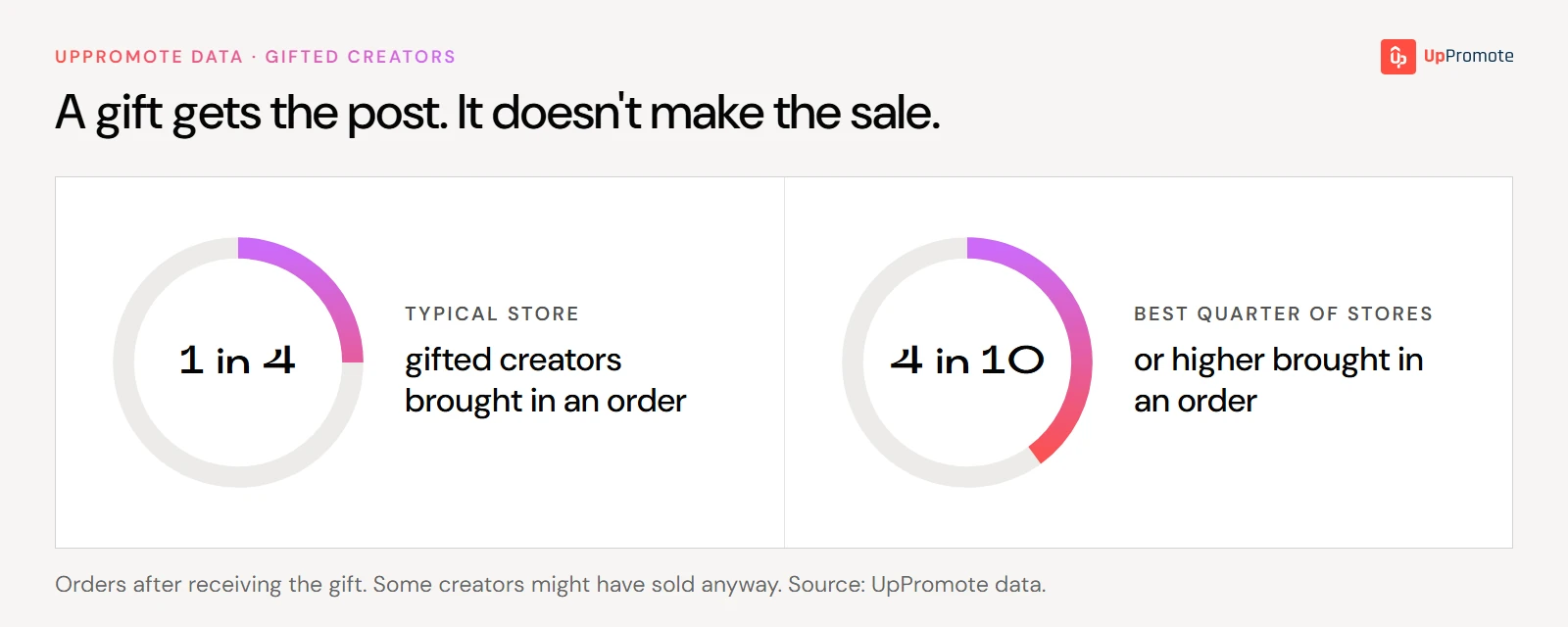
That’s why a gift works best paired with commission rather than standing in for it. The gift opens the door at the cost of a product. The commission then pays the creators who turn that post into orders, and costs nothing for the ones who don’t.
The Carnivore Bar works this way. Instead of open sign-ups, it sends free samples first and invites only the creators who love the product to join its program, and it sometimes trades a box of bars for content. Its affiliates grew from 50 to 500 in just over a year.
A paddle brand that sends product and a 10% code to players in its community told our Customer Success team something that points the same way: the players who expected to be paid for sponsored posts didn’t bring in many sales, compared with the reviewers who looked at the paddles like engineers.
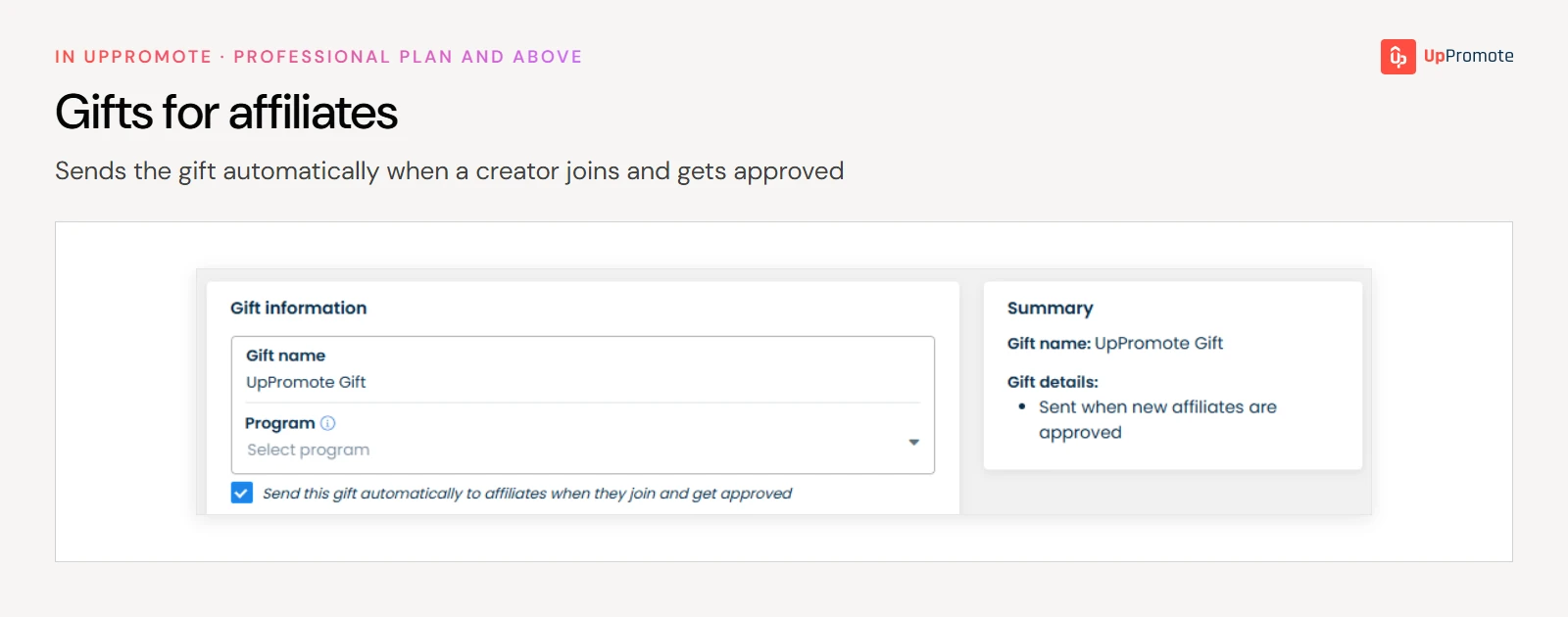
In UpPromote, gifts for affiliates (Professional plan and above) can go out automatically when a creator joins, or by hand to the ones you pick.
For running a gifting program itself, see influencer gifting. For whether product alone is ever enough payment, see how to pay influencers.
What about a flat fee plus commission?
A hybrid deal pays a smaller fee for the post, plus commission on the orders it drives. For most brands, this is the model that works best, and it’s the one brands keep coming back to when they share what actually works.
Why not commission only? Most creators, especially established ones, won’t post for commission alone. A fee guarantees them something for their time, so it gets your offer accepted.
Why not a full flat fee? Because commission does some of the work the fee used to do. When a creator can earn from every order, they’ll often accept a much lower upfront fee. That changes how far your budget goes:
| With a $300 budget | Full flat fee | Hybrid (fee + 10% commission) | Hybrid (fee + 10% commission) |
| Fee per creator | $300 | $100 | $50 |
| Creators you can work with | 1 | 3 | 6 |
| Audiences you reach | 1 | 3 | 6 |
| Pieces of content you get | 1 | 3 | 6 |
| If a creator sells | No extra cost | $9.50 per order on top | $9.50 per order on top |
Remember the data above: for every 10 creators, only about 2 make a sale. With one creator, you’re betting the whole $300 on one post. With three or six, you’re far more likely to land on one who sells. And because you only pay commission on actual orders, the extra cost shows up only when sales do.
You also get more than orders. Even the creators who don’t sell much still give you content. Six creators means six pieces of real customer-style content you can:
- run as ads
- use as testimonials on your product pages
- repost on your own social channels
How to make it work:
- Start low on the fee, strong on the commission. Lead with the earning potential and the discount code for their audience, then agree a fee that covers their time, not their full rate.
- Get usage rights. Agree upfront that you can reuse the content in ads and on your site.
- Double down on the winners. Once you see who actually drives orders, raise their commission, offer a bigger fee, or move them onto a monthly retainer.
Retainers come up most with long-term partners, which our guide to brand ambassador programs covers. For tips on getting a lower fee or a minimum view guarantee, see how to negotiate with influencers.
How do you pay creators who sell more?
Pay them more, and keep paying on commission. Creator sales tend to lean on one person. In a typical store on UpPromote, the top creator brought in about a third of all creator orders, and in a quarter of stores, it was half or more.
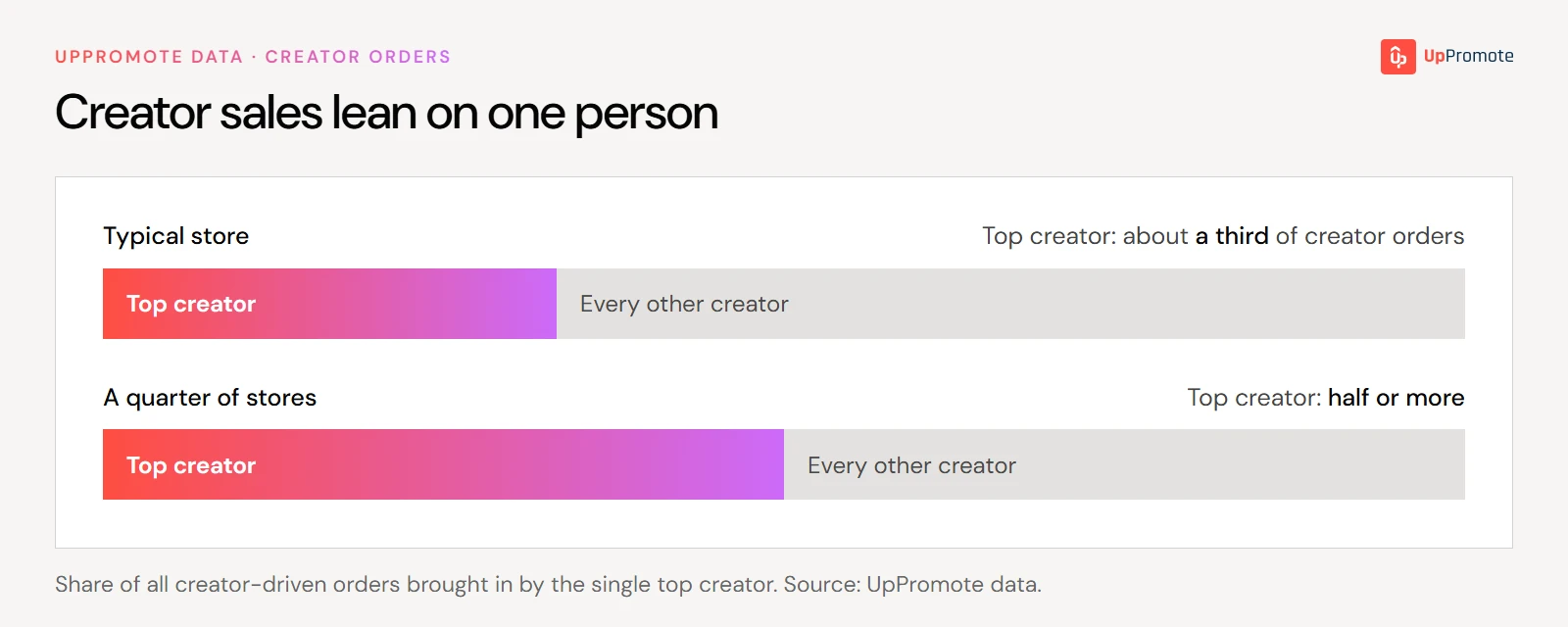
That puts a big share of your creator revenue in one person’s hands, and other brands can see who’s posting about you as easily as you can. A better rate is cheap insurance. On commission, it only costs you more when that creator sells more.
Here are the levers, all paid on sales:
- A higher rate for proven sellers. Put creators who sell consistently into a higher-rate program. Pitstop Nutrition starts its athletes at 3.5% plus a £50 product voucher and moves those who drive £3,000 in monthly referral sales over several months up to 5% plus a £150 voucher. Its affiliates bring in about 60% of its daily orders, around 36 a day. UpPromote’s auto-tier commission moves creators up for you once they hit the target you set.

- Bonuses on targets. Pay a one-time or recurring bonus when a creator hits a number of orders, sales or commission in a period. A bonus in UpPromote needs a target of at least one sale, so it can’t turn into a fee paid for nothing.

- Lifetime commission. Pay the creator on every later order from the customers they brought, not just the first. Switch it on early: a customer who bought before it was on is tied to a creator only once they place a new order through that creator.

- A higher rate for new customers. If new buyers are worth more to you than repeat ones, pay creators more on brand-new customers’ orders.

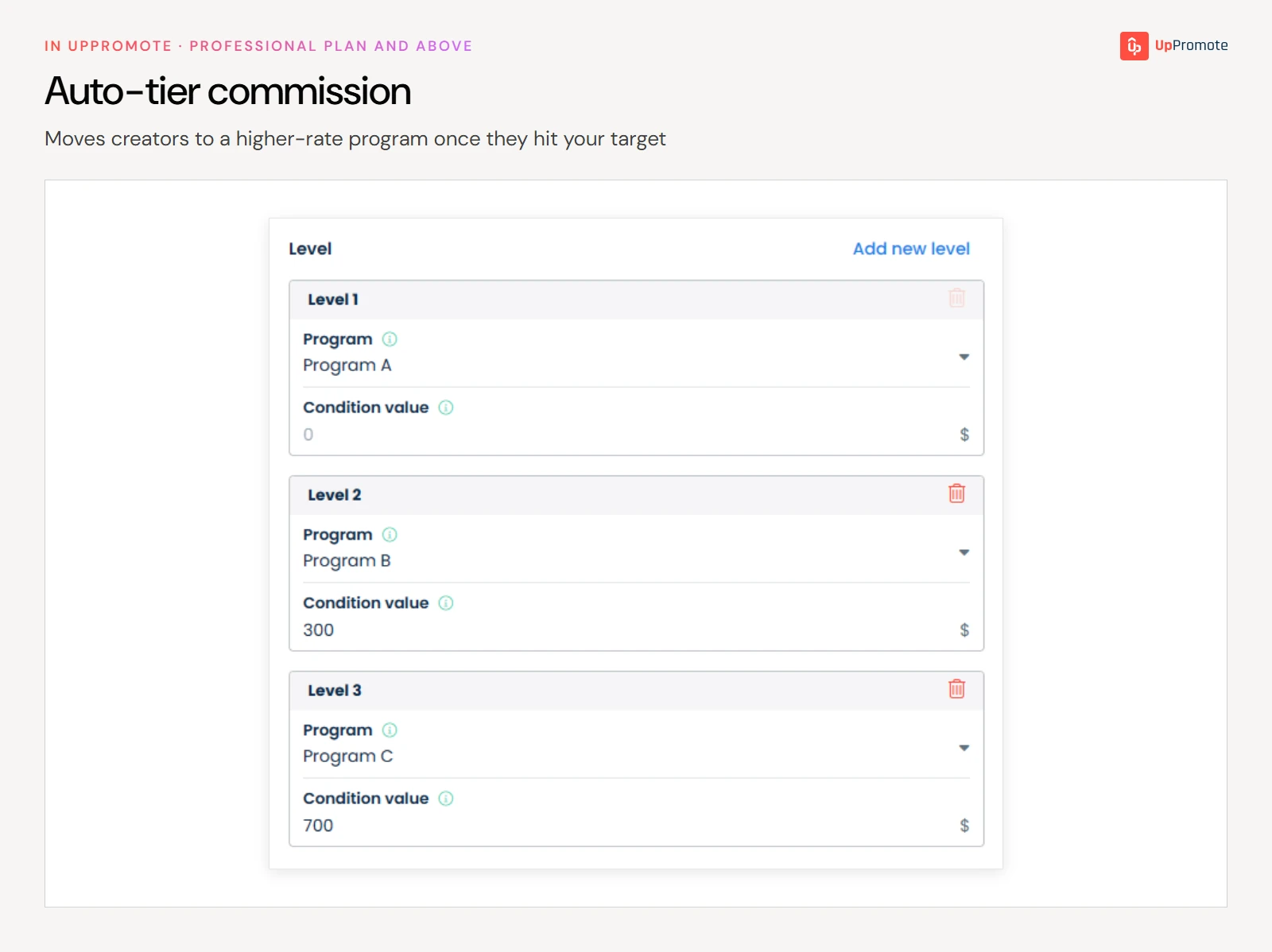
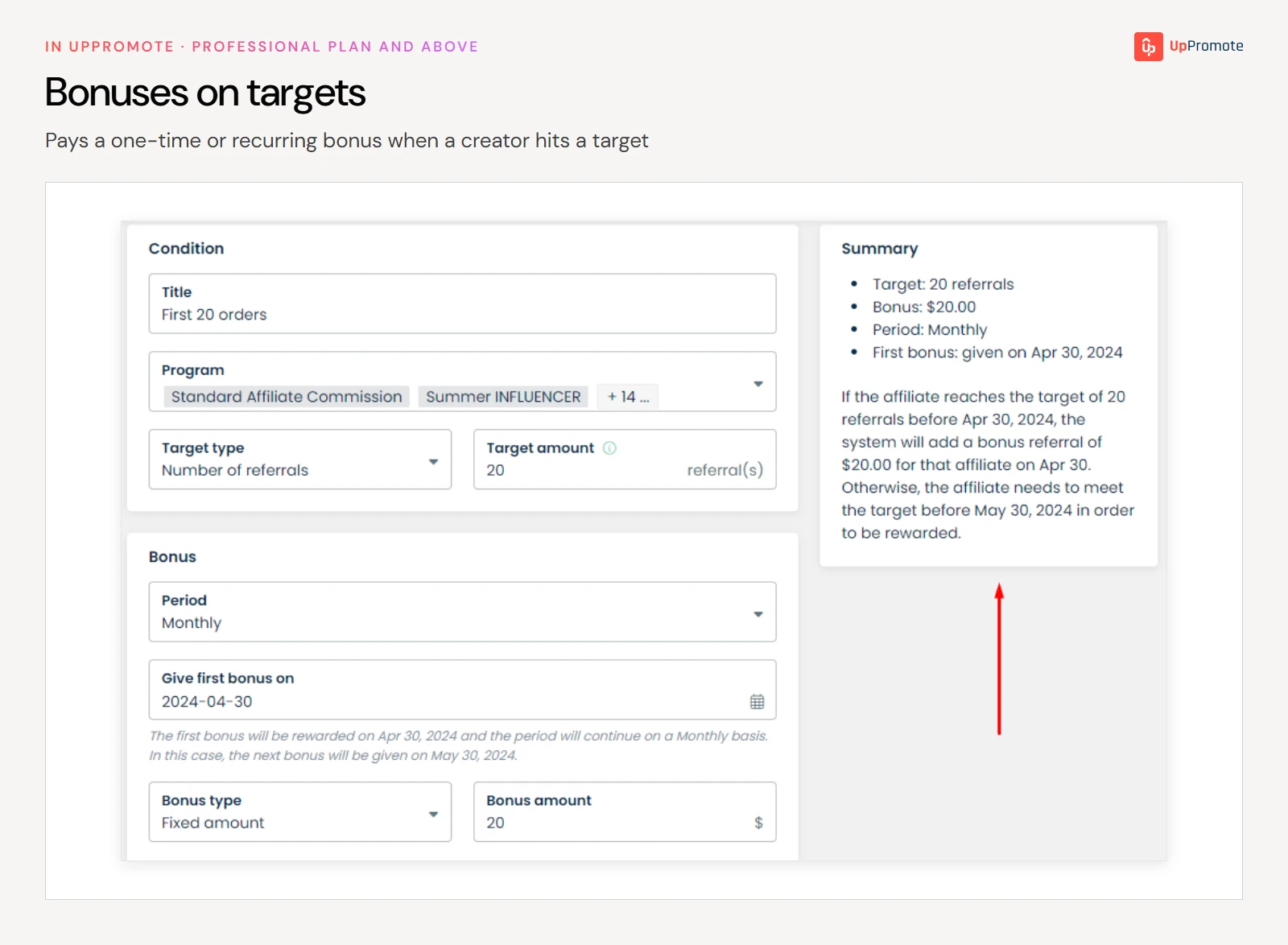
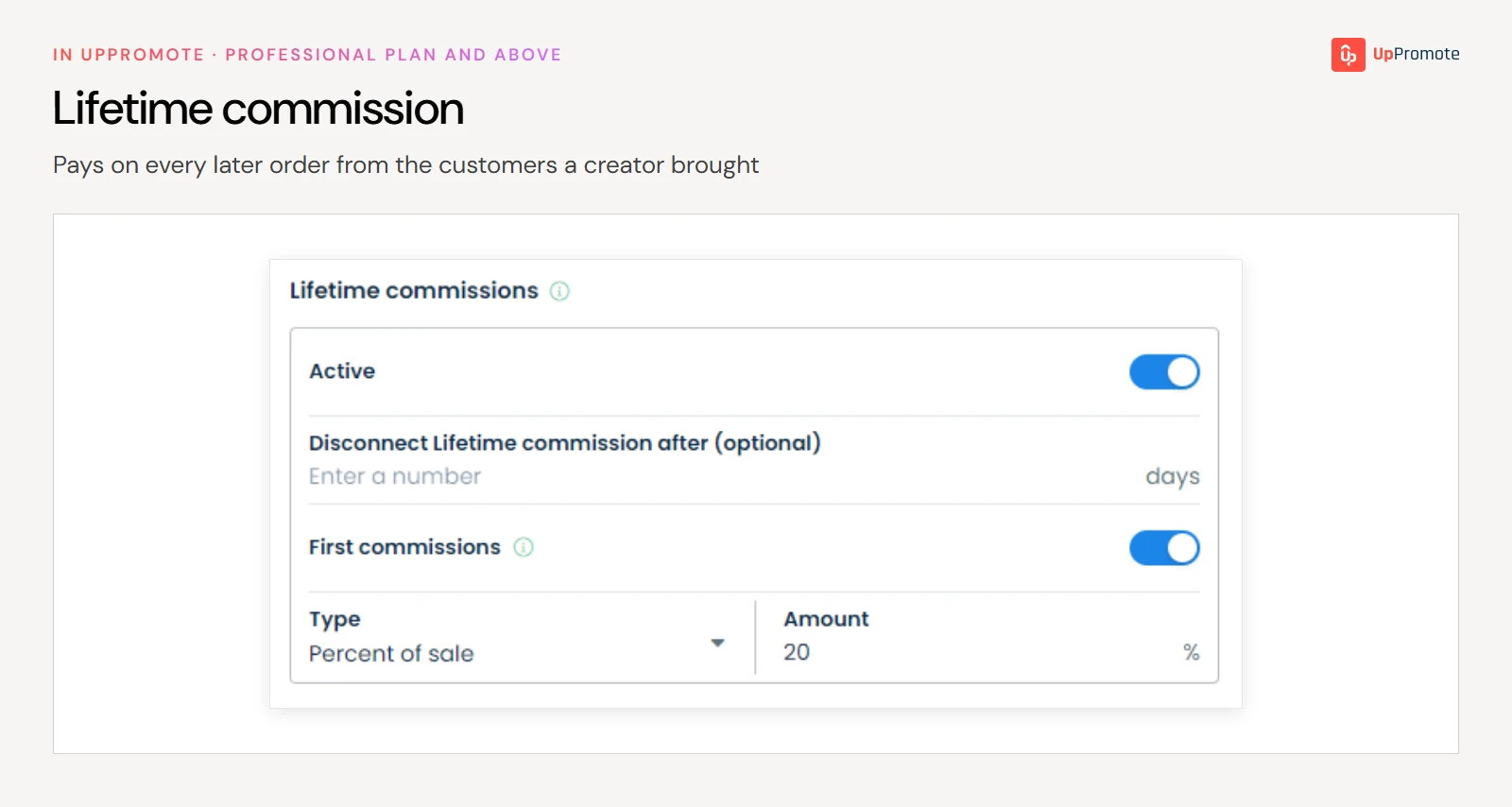
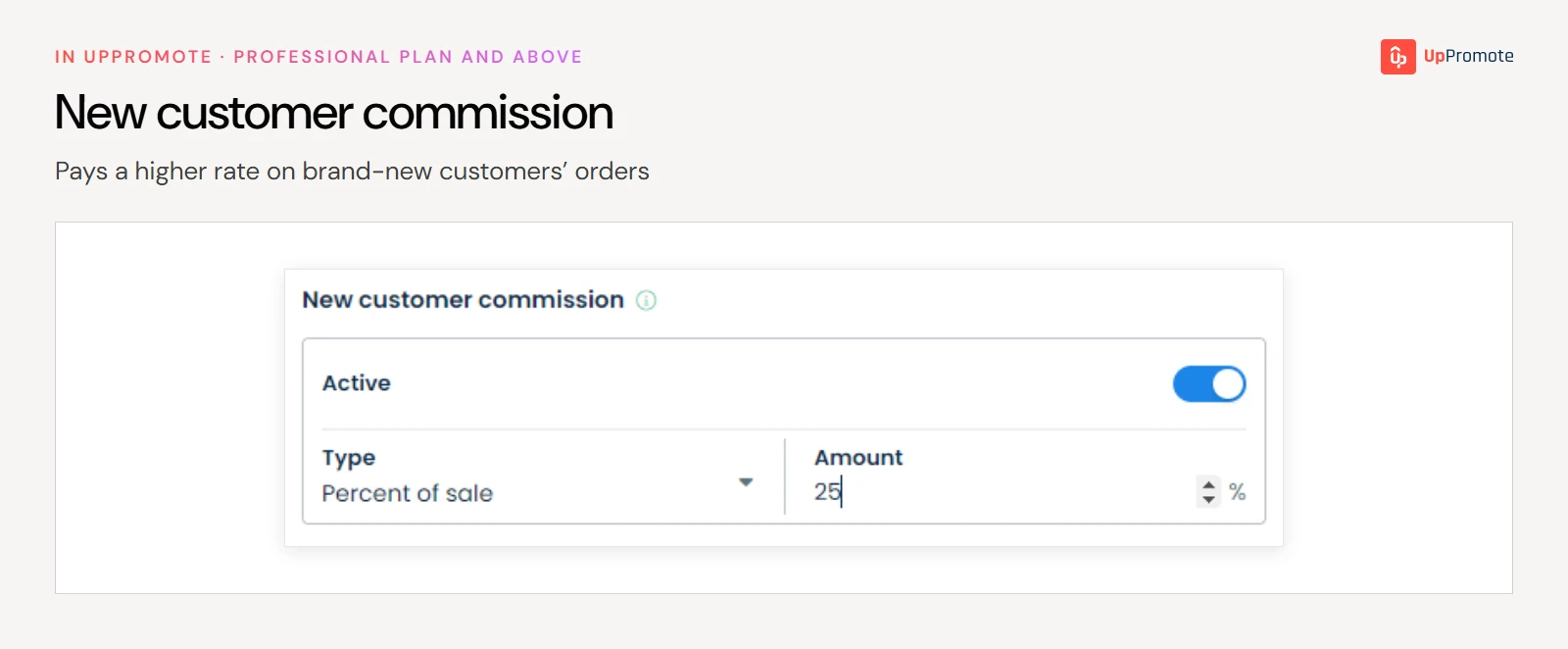
Auto-tier, bonuses, lifetime commission and new customer commission are on UpPromote’s Professional plan and above. What the base rate itself should be comes from your margin; see influencer commission rate.
What should a commission deal spell out?
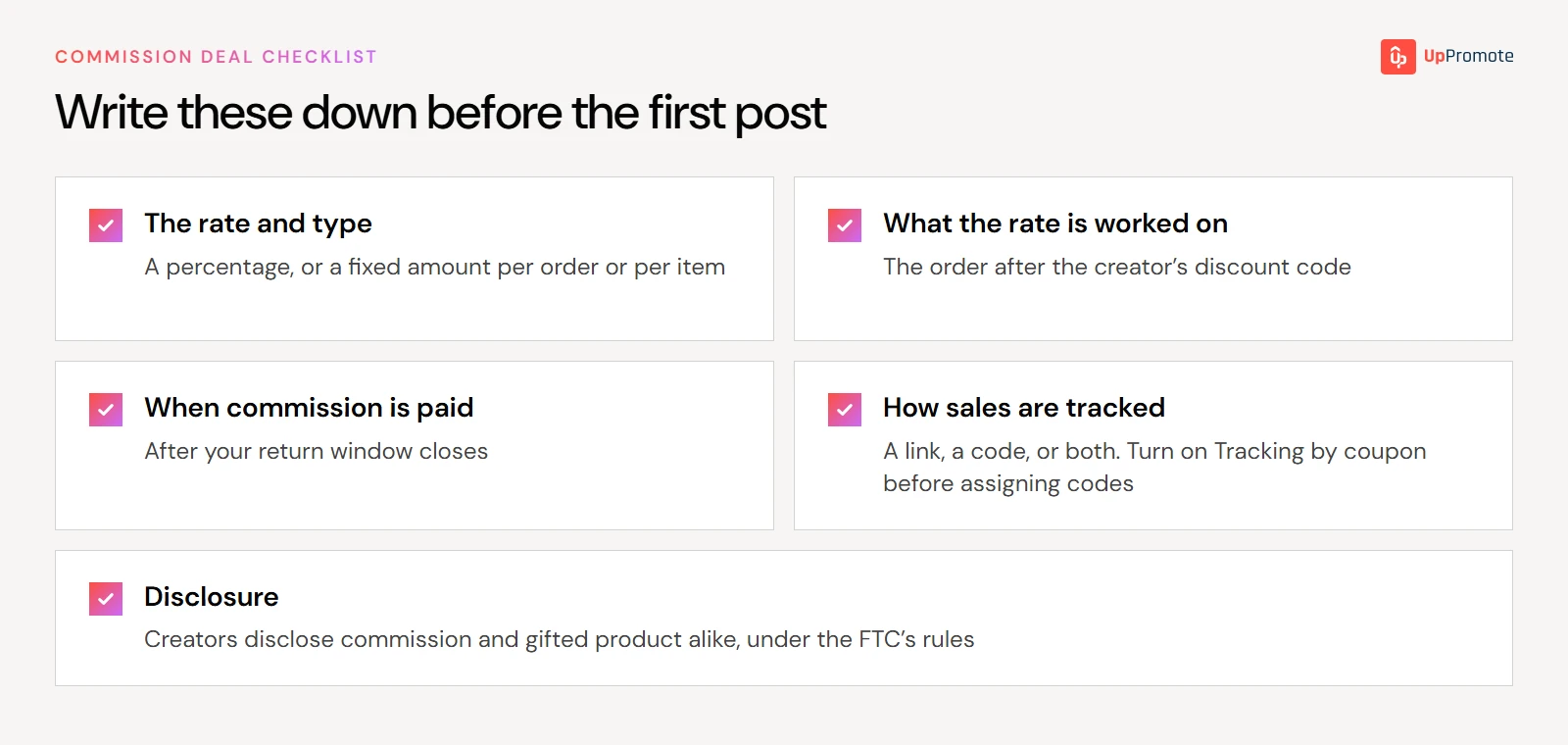
A commission offer is only as good as its terms. Write these down before the first post:
- The rate and type: a percentage, or a fixed amount per order or per item.
- What the rate is worked on: the order after the creator’s discount code. (UpPromote always calculates commission after discounts; whether tax and shipping count is your setting.)
- When commission is paid: after your return window closes, so refunded orders don’t get paid out.
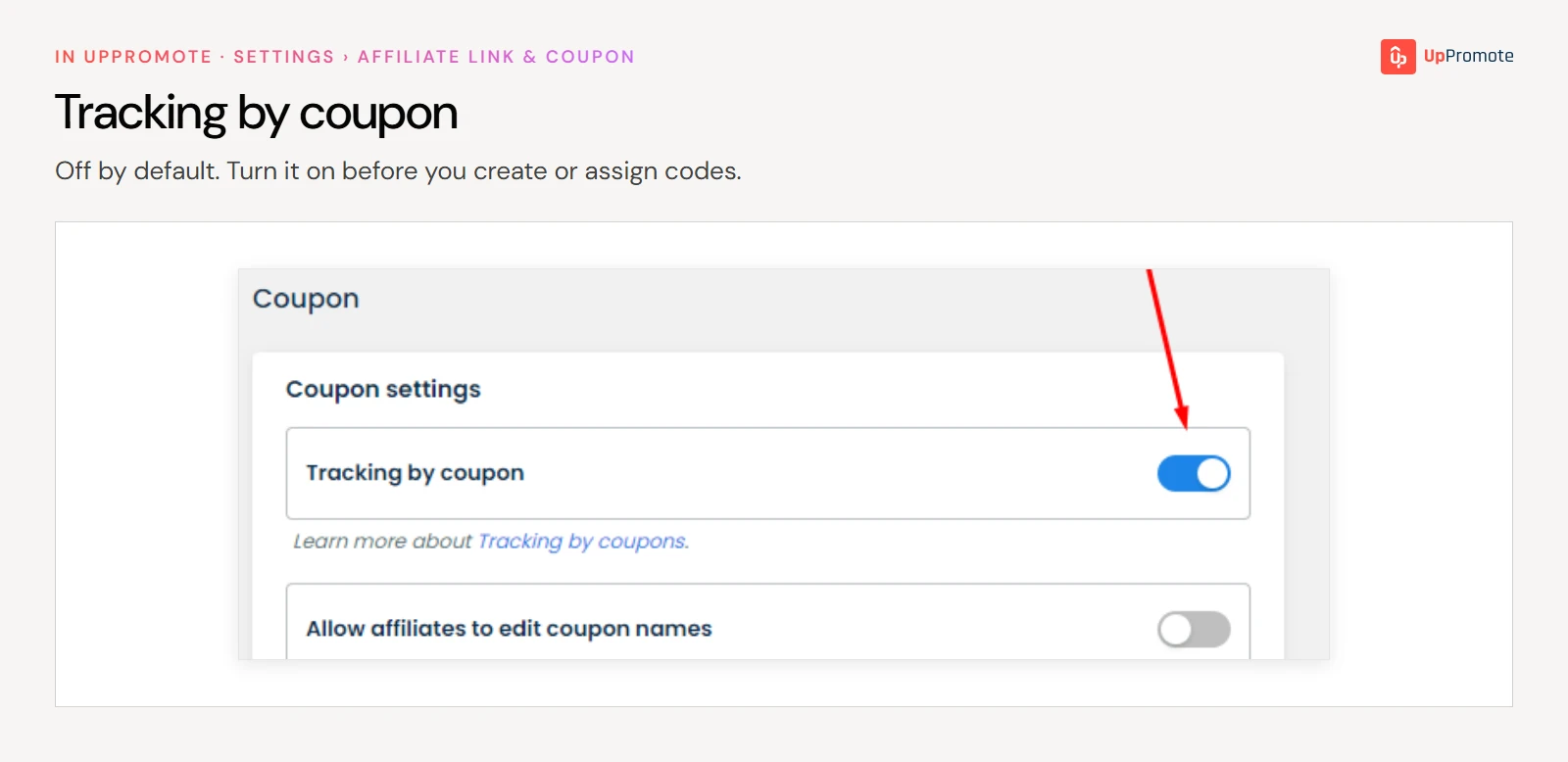
- How sales are tracked: a link, a code, or both. If you give creators codes in UpPromote, turn on Tracking by coupon in Settings > Link & coupon > Coupon settings before you create or assign them. It’s off by default, and code orders aren’t credited until it’s on.

- Disclosure: creators must disclose commission and gifted product alike. Under the FTC’s rules for influencers, free product is a connection to the brand that needs disclosing, just as payment is.
Brands on UpPromote rarely step in to reject a referral. For the median store with steady creator sales, that number is zero, while about 3 in 100 referred orders later turn into refunds.
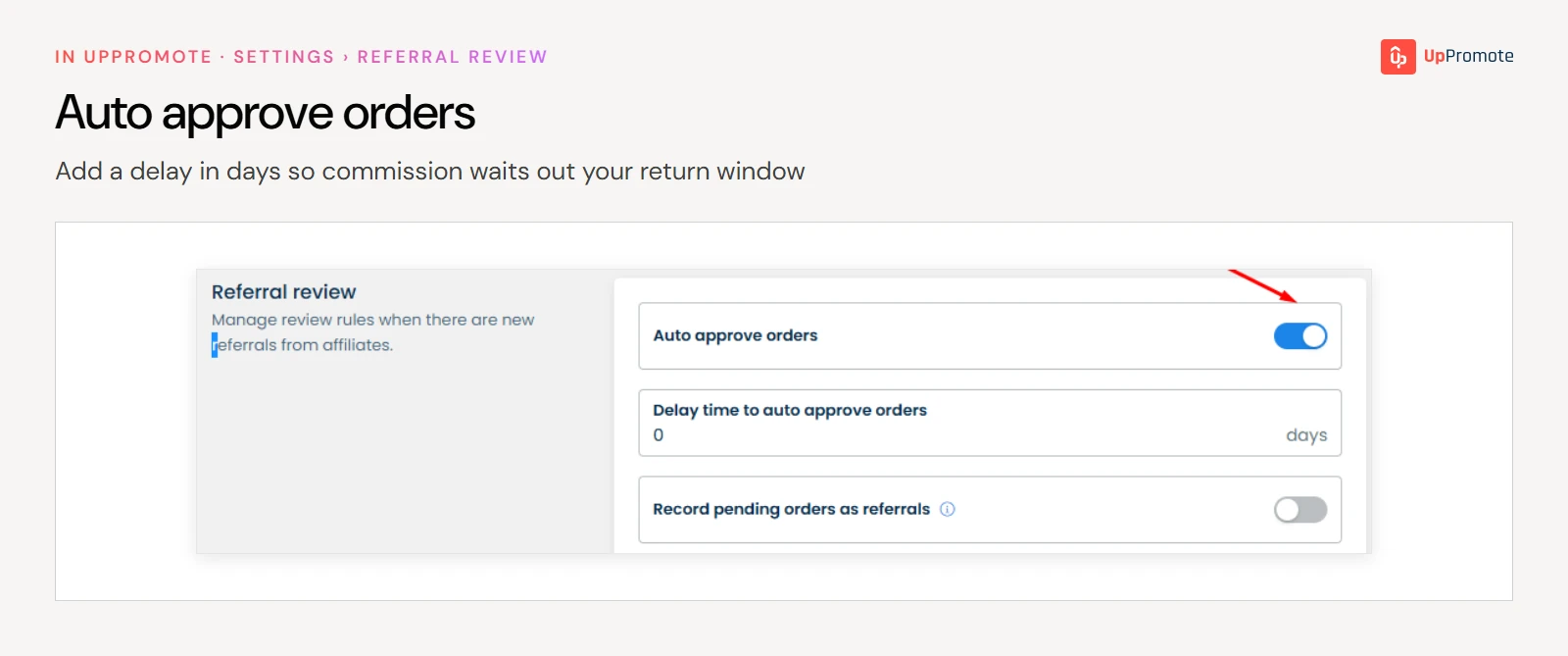
That makes your approval setting your refund policy. Approve referrals the day the order comes in, and you pay commission on refunded orders too. Hold approval until your return window closes, and those orders never get paid.
You don’t have to hold each one by hand. On UpPromote’s Professional plan and above, you can approve referrals automatically after a set number of days, so commission waits out your return period on its own.
How and when the money actually reaches creators (payout methods, timing, tax forms) is in how to pay influencers.
Final thoughts
A flat fee buys a post. Commission buys orders. Which one you need depends on your goal.
If you’re after awareness, a launch moment or content for ads, a flat fee does the job: the post goes live and you’ve got what you paid for.
If you’re after sales, a flat fee alone is a risky bet. In our example, a $300 fee needs about 32 orders to match commission on cost per order. In a typical store on UpPromote, selling creators averaged about 6 orders across all their posts, and only about 2 in every 10 creators made a sale at all.
For most brands, though, the best results come from combining all three:
- Free products to get organic posts and find creators who genuinely like what you sell.
- A smaller flat fee to guarantee the post, and reach more creators with the same budget.
- Commission on top to reward the creators who actually drive sales, and keep them motivated to post again.
Then double down on the few creators who carry your sales, with higher rates, bonuses or a longer-term deal. That way you don’t pay full price to every creator and hope for results. You spread your budget wide, see who performs, and put your money behind the ones who prove it.