




Influencers are sorted two ways. By size, meaning how many followers they have. And by kind, meaning who they are and why their followers listen to them.
By size, there are five tiers: nano, micro, mid-tier, macro and mega. By kind, this guide covers five: everyday niche creators, experts and key opinion leaders (KOLs), athletes, celebrities and virtual influencers.
Learning the labels takes five minutes. The more useful question is which type fits what you want: big names for reach, experts for trust, small niche creators for sales you can track. And whatever the goal, a creator whose audience looks like your customers will do more for you than one who just has a big number.
Below you’ll find every type, what each is good for, and how to choose, with data from UpPromote stores.
The types of influencers at a glance
| Type | Followers | Who they are | Best for |
| Nano | Under 10K | Hobbyists and locals with a small, close audience | Niche products; testing many creators cheaply |
| Micro | 10K–100K | Creators known for one subject | Sales from focused audiences; a good place to start |
| Mid-tier | 100K–500K | Creators who post for a living, still within a niche | Reach plus sales, when their audience matches yours |
| Macro | 500K–1M | Big creators with broad reach | Launches and broad-appeal products |
| Mega | 1M+ | The biggest names on a platform | Awareness at scale |
| Everyday niche creators | Any | People who post about a hobby or interest | Almost every store; the niche does the targeting |
| Experts and KOLs | Any | Coaches, specialists, professionals | Products that need explaining or a trusted opinion |
| Athletes | Any | Competitors and sports people | Sports, fitness and supplements; sometimes fashion |
| Celebrities | Usually 1M+ | People famous for something other than posting | Brand awareness and big launches |
| Virtual influencers | Any | Computer-generated characters run by a studio or brand | Experiments |
The follower bands aren’t a standard. Many guides skip mid-tier and put macro at 100K–1M, and some cap micro at 50K. So treat the edges loosely: a creator with 95K followers and one with 110K are the same kind of partner.
Types of influencers by size
The “four types of influencers” you’ll see in most lists are nano, micro, macro and mega. Lists that count five add mid-tier between micro and macro. Here’s each one, smallest first.
1. Nano influencers (under 10K followers)
A nano influencer has fewer than 10,000 followers. Many are people who post about a hobby, a local scene or their job, and a good share of their followers know them or share the same interest.
That small, close audience is the appeal. A recommendation from a nano creator reads like a tip from a friend, and the people who see it are often exactly the niche you sell to.
For a store, nano creators are the cheapest tier to test. If you send product and a code to one who never posts, you’ve lost one product. That makes them a good fit for finding out which creators sell, as long as you can reach enough of them.
There’s no official minimum follower count for an influencer. At 10,000, most lists move a creator up from nano to micro.
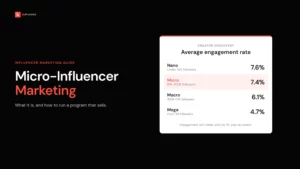
2. Micro influencers (10K–100K followers)
A micro influencer has between 10,000 and 100,000 followers and is usually known for one subject: skincare, home workouts, baking, fishing. They’re big enough that posting is a serious side job or a living, and small enough that they still answer comments.
A creator with 50,000 followers still counts as micro under most bands. A few sources cap micro at 50K, but the more common line is 100K.
Micro creators are a good place to start, because their audiences are focused enough to buy. Romanian supplement retailer Nutriland worked with 27 micro-influencers, many of whom already used its products in their own fitness routines, and paid them 5% commission as store credit on orders placed with their codes. Those 27 creators have brought €400,000 in revenue and more than 10,000 referrals.
Running a micro program has its own guide: micro influencer marketing.
3. Mid-tier influencers (100K–500K followers)
A mid-tier influencer has between 100,000 and 500,000 followers. Not every list includes this tier; many fold it into macro.
It earns a place of its own because two things overlap at this size. Posting is often a business by now, so many mid-tier creators have a rate in mind, the way bigger creators do. Yet their audience is still built around one subject, which keeps it closer to a micro creator’s than a celebrity’s.
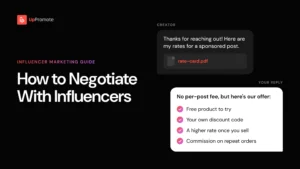
That overlap is why a commission-only offer can go either way here. Some will take it, especially when they already like the product. Others will ask for a fee. A middle path often works: a smaller fee to guarantee the post, plus commission on what it sells.
4. Macro influencers (500K–1M followers)
A macro influencer has between 500,000 and 1 million followers, or 100K–1M in lists that skip mid-tier. They reach a broad audience, often across more than one platform.
A macro creator can put your product in front of far more people than a micro one, but a smaller share of those people are your customers.
Macro creators suit launches and products with broad appeal, where reach is part of the goal. Agree upfront what you’re paying for: if it’s reach, judge them by reach; if it’s sales, add commission and judge them by orders.
5. Mega influencers (1M+ followers)
A mega influencer has more than a million followers. These are the biggest names on a platform, and many are as well known off it.
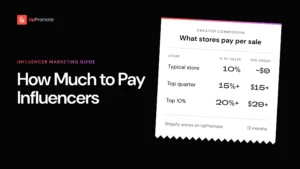
Mega creators usually sell their reach for a fee per post or campaign. That fee buys awareness, a famous face and content you can reuse, which can be worth it for a launch or a new market. Just don’t expect a fee to guarantee orders. If sales matter too, ask for a code and commission on top.
What each tier charges is its own topic: see how much to pay influencers.
Types of influencers by kind
Size tells you how many people a creator reaches. Kind tells you why those people listen. The two cut across each other: an athlete can be nano or mega, and so can an expert.
6. Everyday niche creators
This is the broadest kind: people who post about something they love, from fly fishing to houseplants. Their authority comes from doing the thing, not from credentials or fame.
Lists of influencer niches usually name five to ten of these:
- Fashion and beauty
- Fitness and wellness
- Food
- Travel and lifestyle
- Gaming
- Parenting and family
- Tech
- Finance
- Business
- Home
Which of them is most popular is the less useful question for a store. The useful one is which niche your customers follow. A candle brand will find more buyers among home and lifestyle creators than in the biggest niche on the platform.
Everyday niche creators fit almost every store, because the niche does the targeting for you.
7. Experts and key opinion leaders (KOLs)
Experts are creators whose authority comes from what they know or do for a living: coaches, trainers, dermatologists, mechanics, chefs. In marketing, the people others in a field look to are often called key opinion leaders, or KOLs.
Experts fit products that need explaining, cost a lot, or need a trusted opinion before someone buys.
Pongbot, which sells tennis ball machines and table-tennis robots that can cost more than a thousand dollars, built its program on coaches, clubs and YouTube KOLs. It sent samples only to qualified partners so they could test the robots on camera, paid 10% commission, and added a monthly bonus of $20 to $550 for hitting sales goals. Within about three months, affiliates drove around 20% of its overall sales.
8. Athletes
Athletes are competitors and sports people whose followers watch them train and compete. They come in every size, from Olympians with millions of fans to a local powerlifter with a few thousand followers.
Do athletes count as celebrities? The famous ones do. A pro with millions of fans is a celebrity who happens to play a sport. But a powerlifter with 8,000 followers is an everyday niche creator with a very specific, very loyal audience.
That smaller kind is often the best fit for a store that wants sales. Sports-supplement brand Pitstop Nutrition personally invites a small group of bodybuilders, weightlifters and powerlifters. They start at 3.5% commission plus a £50 product voucher and move up to 5% plus £150 once they reach £3,000 in monthly referral sales over several months. Affiliates now bring in about 60% of its daily orders.
Athletes aren’t only for sports products. A streetwear brand told our team that its early sales came from rappers and athletes wearing its clothes.
9. Celebrities
A celebrity is famous for something other than posting: acting, music, sport, TV. A content creator is famous for their content. That’s the difference between a celebrity and an influencer, even when both have millions of followers.
Celebrities bring reach and instant recognition, and they usually charge a fee for it.
A celebrity deal is really a media buy: you’re paying for attention, like an ad campaign. It can make sense for a big launch with a big budget. For most growing Shopify stores, though, celebrities are rarely the place to start; smaller creators give you more to learn from for the same money.
10. Virtual influencers (AI and CGI influencers)
A virtual influencer is a computer-generated character with its own social accounts, run by a studio or a brand. Some are built with CGI, others with AI.
They’re always available, never go off-message and can be made to fit any brand. The open questions are trust and disclosure. A character can’t use your product the way a person does, and whoever runs it has to decide how plainly to say what it is.
Should your store use one? Only as an experiment, and only if the character’s audience looks like your customers, the same check you’d make with a person. Give it a code, and judge it by the results it brings.
Other ways to sort influencers
Size and kind cover most of what you’ll read. Two other cuts are worth knowing because they change how you work with a creator.
By platform
Instagram, TikTok and YouTube have the same five sizes and five kinds of influencer. Two things change from one platform to the next.
The first is format. A creator’s format matters as much as their size: a product that needs a demo needs a creator who makes demo videos, wherever they post.
The second is how open the biggest creators are to commission. In UpPromote’s data, big Instagram creators were much less likely to work as affiliates than micro creators, while on TikTok big creators were among the most open. More on that below.
By relationship to your brand
Some influencers already have a tie to your store:
- Customers who like the product and share it.
- Employees who post about their work.
- Ambassadors in a long-term program (see brand ambassador program).
- Affiliates who promote many brands for commission.
- UGC creators who make content for you to post, rather than posting it themselves.
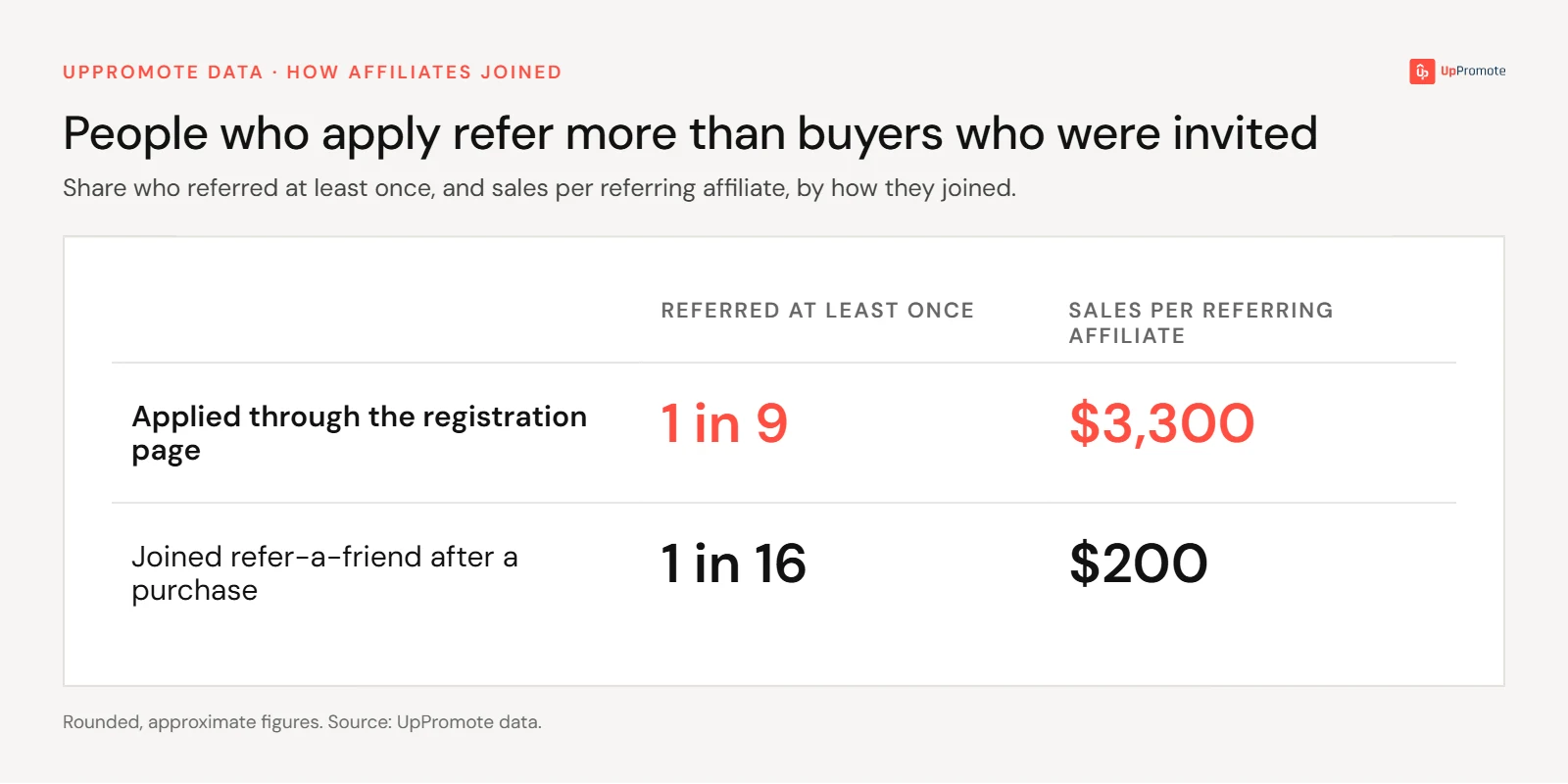
Customers are an obvious tie, but turning buyers into referrers is a different job from recruiting creators. In UpPromote’s data, people who applied through a store’s registration page were about twice as likely to refer as shoppers who joined a refer-a-friend program after buying, and the ones who did refer brought in far more sales.
| How they joined | Referred at least once | Sales per referring affiliate |
| Applied through the registration page | About 1 in 9 | About $3,300 |
| Joined refer-a-friend after a purchase | About 1 in 16 | About $200 |
Kakao Mischa, a cacao brand, runs the two side by side: loyal customers who were already sharing its products, and micro-influencers drawn to the brand’s values. Everyone starts in an entry program paid in store credit, and strong performers move up to a second program paid in cash. Affiliates account for about 20% of its sales.
How to choose the right type of influencer for your store
Start from your goal. If you want awareness, bigger creators and celebrities give you reach. If you want content, look for creators whose style you’d happily reuse in ads. If you want sales you can track, smaller niche creators on commission are usually the best place to start, because a creator who doesn’t sell costs you almost nothing and one who does pays for themselves.
The rest of this section is about that last goal: finding the creators who sell.
Start with fit, not follower count
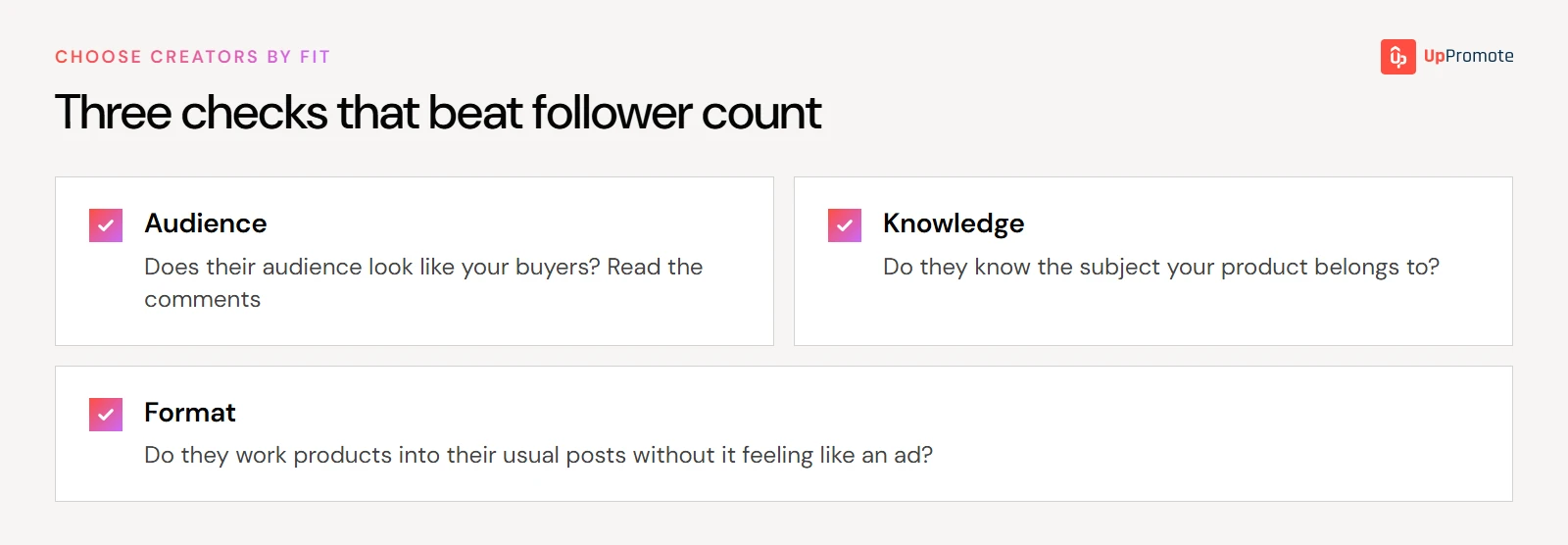
The type that fits your store is the one whose audience looks like your customers. Before you look at follower counts, check three things:
- Their audience is your customer. Read the comments, not just the numbers. Are these people who’d buy what you sell?
- They know the subject. A creator who already uses products like yours explains them better than one reading a brief.
- They can work your product into their own content. If it would look like an ad, their followers will treat it like one.
Size still matters for engagement, just not in the way most people think. A study of Instagram influencers published in the Journal of Marketing found that engagement rises with follower count and then falls, peaking somewhere in the middle. It measured likes and comments, not sales. So a creator’s size tells you little about whether they’ll sell.
If you use UpPromote, Creator Discovery filters Instagram, TikTok and YouTube creators by niche, location, follower size and audience; how to find influencers covers vetting the ones you find.
Don’t rule out a size: every tier turns up on commission
Will big creators work for commission? Some will. We checked which creators found in UpPromote’s Creator Discovery already had an affiliate account at an UpPromote store. Creators of every size did, about 1 in 5 overall, but the pattern depends on the platform:
| Tier | TikTok | |
| Nano (under 10K) | About 10% | About 39% |
| Micro (10K–100K) | About 26% | About 21% |
| Mid-tier (100K–500K) | About 19% | About 29% |
| Macro (500K–1M) | About 24% | About 31% |
| Mega (1M+) | About 12% | About 32% |
On Instagram, micro creators were the most open to commission and mega creators among the least. On TikTok, it ran the other way: the biggest creators were among the most open.
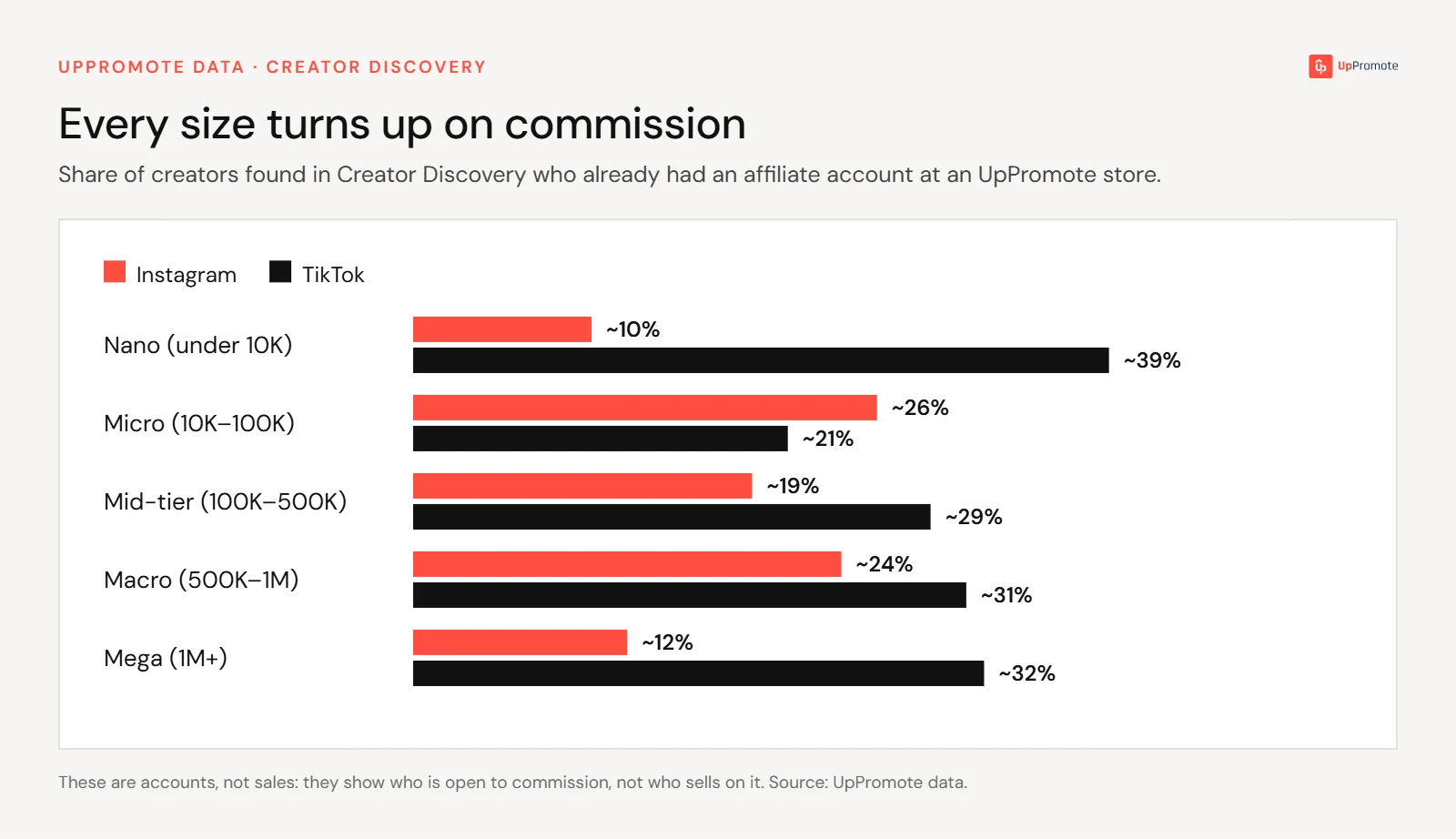
These are accounts, not sales: they show who is open to commission, not who sells on it. That’s why the rest of this section is about finding sellers one creator at a time.
Send product to well-matched small creators first
Because you can’t tell from a profile who will sell, the cheapest way to find out is to send product to well-matched nano and micro creators, give each a code and a link, and pay commission on what they sell.
Whether a creator claims the gift is an early signal. In UpPromote’s data, about 1 in 4 new creators who claimed their gift went on to refer an order, against only about 1 in 20 of those who left it unclaimed.
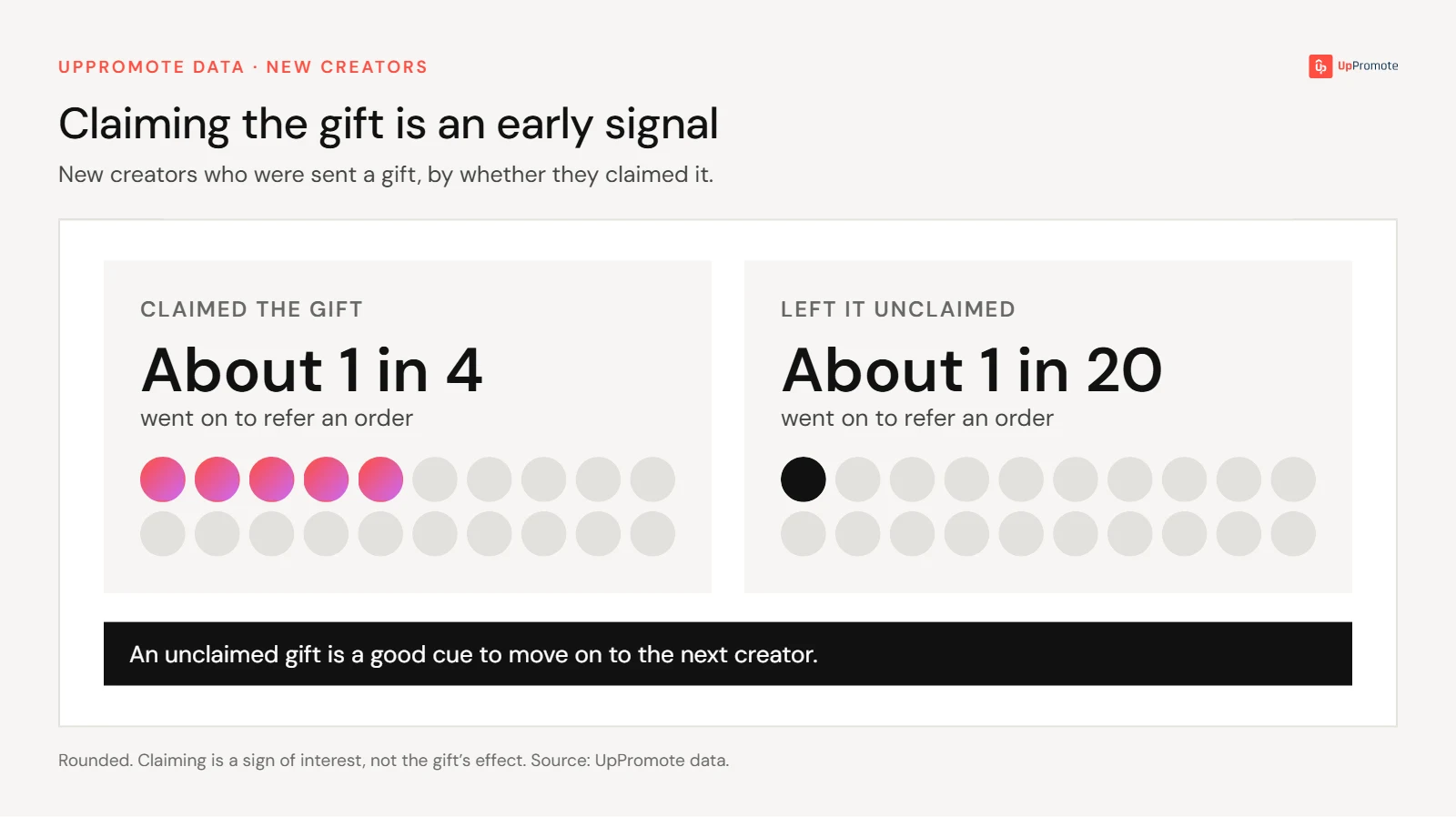
That gap isn’t the gift’s effect: claiming a gift is itself a sign of interest. But it means an unclaimed gift is a good cue to move on to the next creator. UpPromote’s Gifts feature shows you who has claimed.
There are two ways to set up the program:
- A program of their own, when you already want creators on a different rate from customers. Tribal Chimp, a men’s grooming brand, pays influencers 30% and affiliates who join through its form 20%.
- One shared program, then move up, when you’d rather let sales decide. Kakao Mischa starts everyone in one program and moves strong performers into a better-paid one.
Whichever you choose, turn on coupon tracking before you hand out codes. In UpPromote it’s off by default: go to Settings > Link & coupon > Coupon settings and turn on Tracking by coupon, or orders placed with a creator’s code won’t be credited to them.
Pay more to the few who sell
Once affiliates start selling, one of them often carries a big share of the sales. In UpPromote’s data, in stores with a few dozen affiliates making sales, the single best affiliate brought in a quarter or more of all referred sales in about 2 out of 3 stores. As a program grows past 50 sellers, sales spread out more evenly.
So once you know who your sellers are, pay them more. The usual levers:
- A higher commission rate. Move a creator who sells into a better-paid program, by hand or, with auto-tier, automatically when they hit a sales, commission or referral target.
- Bonuses for reaching a target in a period.
- Lifetime commission, which ties each customer a creator brings to that creator for future orders.
In UpPromote, auto-tier, bonuses and lifetime commission are on Professional and above.
Promote by sales, not by follower count. Craft brand Altenew uses follower count only to decide where a creator starts: those with 10,000 followers or fewer begin in its default tier. From there, the team reviews how each creator sells and moves them up by hand when sales improve. Some of its best affiliates sit in tier 3 or 4 rather than its VIP tier.
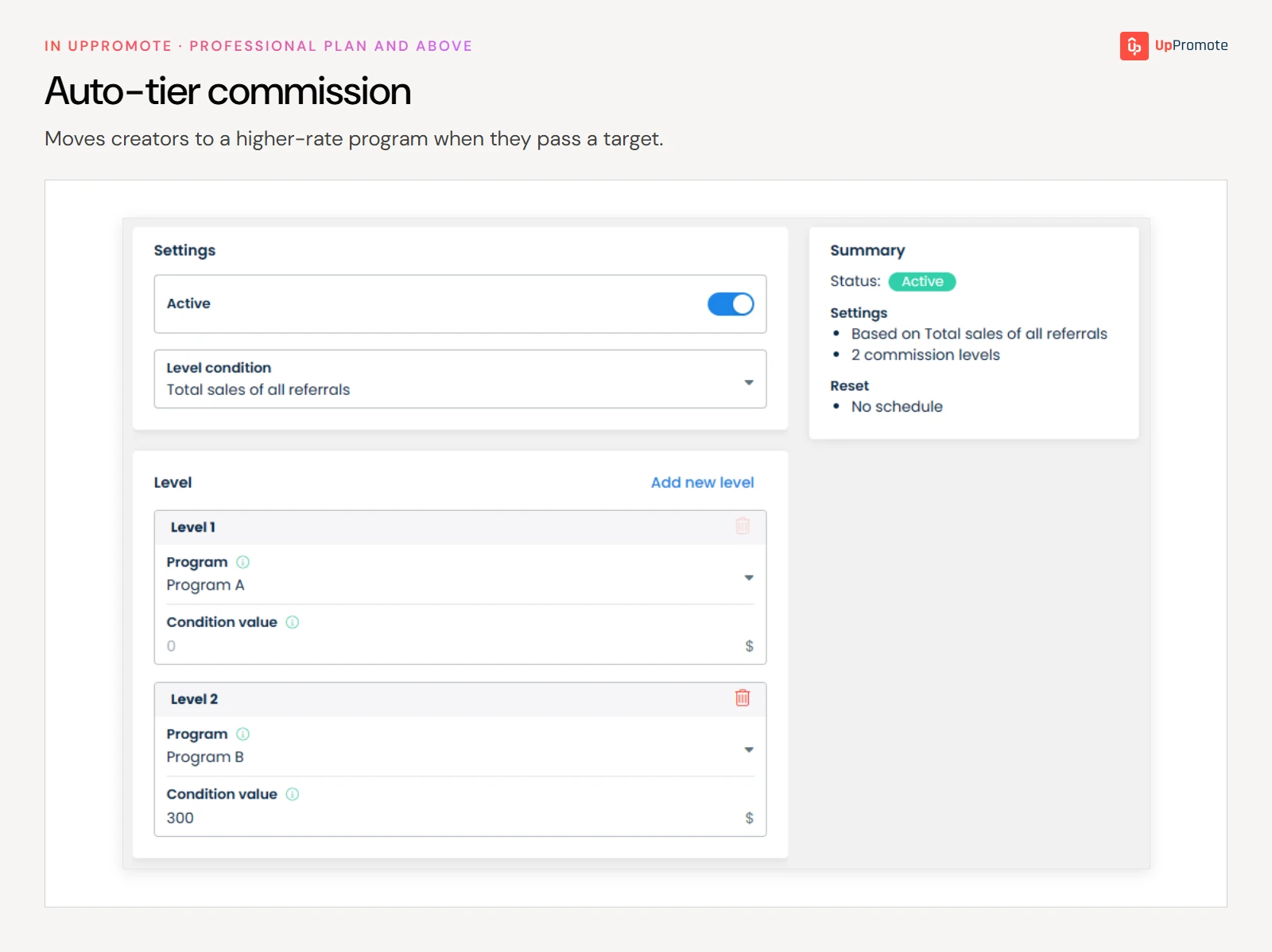
Altenew works with creators from nano to mega, most with 4,000 to 50,000 followers, and its best-performing affiliate has more than 100,000. Affiliate marketing brings it 15–25% of its revenue.
Final thoughts
There are five sizes of influencer and at least five kinds, and the labels are useful for knowing who you’re talking to. Which one to work with depends on your goal: big names for reach, experts for trust, small niche creators for sales.
If sales are the goal, the type that fits is whichever one your customers already follow. Start with well-matched small creators, send them product, and let the orders show you who sells. Then pay those few well, whatever their size.
If you want to scale from there, how to scale influencer marketing covers running many creators at once.